When accountability fails to bite: governance, democracy and the 2026 Tower Hamlets elections

Dr Gulay Icoz, Visiting Research Fellow, Middlesex University London

In theory, the 2026 Tower Hamlets local elections should have been a test of democratic accountability in action. The borough entered election year under active statutory intervention. A Best Value Inspection published in November 2024 had documented serious governance failings under Mayor Lutfur Rahman’s Aspire administration: weak internal controls, a culture of concentrated executive authority, poor transparency, and slow responses to statutory recommendations. A further written ministerial statement in January 2026 confirmed ongoing failures and deteriorating financial governance. In March 2026 — just two months before polling day — the Secretary of State escalated the intervention, granting ministerial envoys enhanced powers to step in directly if the council continued to breach its Best Value Duty.

Then voters went to the polls and Aspire won 33 of 45 council seats. Lutfur Rahman was re-elected as Executive Mayor for a third time. Labour was reduced to five seats — its lowest total in the borough’s history.

I stood as the Labour candidate for Bethnal Green West in those elections. What I observed — during the campaign and in the results — reveals a deeper tension between statutory accountability and community-level democratic legitimacy: one with implications that reach well beyond Tower Hamlets.

The structural picture

The results reveal a distortion that deserves wider attention. Aspire secured 73 per cent of council seats with just over 32 per cent of the vote. Labour and the Green Party each received just under 23 per cent of the vote, yet each won only 11 per cent of seats. In ward after ward, the combined Labour and Green vote exceeded Aspire’s total — yet the block voting system used in multi-member wards — where each voter casts as many votes as there are seats and the top candidates win — converted vote fragmentation into a decisive seat bonus for the incumbent. This is sometimes called plurality block voting, and it rewards coordinated slate-voting, which incumbent parties with strong voter loyalty are structurally better placed to exploit.

The ward-level picture sharpens this further. In Bethnal Green West, Labour entered polling day with an estimated core vote of around 540; Aspire’s coordinated bloc was already three times that size, with split votes running into the thousands. Green candidates who had run no sustained local campaign outpolled every Labour candidate standing — a pattern repeated across wards throughout the borough. The block voting system had no mechanism to reward breadth of engagement or effort: it simply rewarded the most organised and unified voting bloc.

It is worth distinguishing block voting in multi-member wards from single-member first-past-the-post. The coordination premium is structurally higher: a cohesive 32 per cent bloc can sweep three seats simultaneously in a way that would not occur in a series of individual contests. The question this blog is asking is not primarily about proportionality per se, but whether the electoral system can transmit accountability signals when a council is under active statutory intervention for documented governance failure.

This points to a question the electoral systems literature and the local democracy literature have rarely addressed together: when opposition parties are structurally disadvantaged by electoral mechanics, what additional tools does a democratic accountability framework need?

The accountability paradox

A long line of research — from Fiorina’s retrospective voting model through Powell and Whitten’s clarity-of-responsibility framework — establishes that electoral punishment for governance failure is neither automatic nor uniform. Recent scholarship sharpens this further: voters weigh integrity against perceived competence and community delivery (Breitenstein and Hernández, 2024); punishment weakens when opposition is fragmented and alternation unclear (Otjes and Stiers, 2022); and elections are in any case a blunt accountability instrument compared to courts, oversight bodies, and civic challenge (Papadopoulos, 2023). The established literature identifies three conditions that must be met for punishment to occur: voters must have clear information about failure; they must be able to attribute responsibility to the correct actor; and accountability must not be crowded out by competing loyalties or trade-offs. Tower Hamlets 2026 illustrates the failure of all three conditions simultaneously.

Yet the Tower Hamlets case also points to a fourth condition, largely absent from the existing retrospective voting literature: the accountability mechanism itself must be seen as legitimate by the communities it is meant to protect. This is the accountability paradox at the heart of the 2026 result — and it is a contribution that the standard retrospective voting framework is not equipped to capture.

For intervention to function as a democratic corrective, it must be perceived by the electorate — and particularly by the communities most affected by governance failure — as rational, impartial, and operating in their interests. Where that perception fails, intervention becomes politically legible as external imposition, and voting for the incumbent becomes an act of community solidarity rather than an endorsement of governance failure. This dynamic is not accidental: it is actively constructed through political framing, and incumbents with strong identity-based bonds with their electorate are structurally well-placed to construct it.

Recent research on statutory intervention in English local government proposes a five-stage model — crisis revelation, delegitimisation, imposed reforms, capacity building, and restoration — and argues that interventions must be carefully designed to appear rational rather than political if they are to maintain rather than undermine faith in local democracy (Lowther, Joyce and Whiteman, 2025). That model’s second stage — delegitimisation — describes central government’s work to undermine the legitimacy of the council being intervened in. What the Tower Hamlets 2026 election reveals is that delegitimisation can also operate in the opposite direction: the incumbent successfully turned the intervention itself into the object of delegitimisation in the eyes of the electorate, making the accountability mechanism the thing that lacked legitimacy rather than the council it was designed to hold to account.

Conversations on the doorstep revealed the depth of this reframing. Many Aspire supporters had not engaged with the contents of the Best Value report because they had already concluded the report itself was politically motivated — a tool of mainstream parties who disapproved of what Aspire represented rather than a genuine accountability mechanism. More striking still, when specific governance failures were raised — including nepotism and unqualified appointments — some voters had internalised a counter-narrative in which such practices represented community protection rather than misconduct.

It would be reductive to dismiss these perceptions as simply the product of misinformation. Communities with long experience of political marginalisation may have genuine historical grounds for scepticism toward central government intervention, and those experiences shape how accountability claims are received. What the Tower Hamlets case illustrates is the extent to which this pre-existing disposition was mobilised and amplified through deliberate political communication — producing not political apathy but the successful reconstruction of what accountability itself means.

This is not unique to Tower Hamlets. It is a dynamic that researchers of democratic resilience and local governance are increasingly attentive to, and it raises important questions about how accountability mechanisms are designed, communicated, and embedded — questions that are as much about institutional culture and civic trust as they are about statutory frameworks.

Tower Hamlets in context

Tower Hamlets did not stand alone in 2026. The elections produced historic Green gains across inner London — in Hackney, Waltham Forest, Lewisham and Southwark — and a significant realignment of the progressive vote away from Labour. What makes Tower Hamlets distinctive is that this regional realignment intersected with the specific dynamics of the Aspire incumbency, the governance intervention, and the structural incentives of block voting, producing an outcome more disproportionate than anywhere else in the capital.

Understanding whether Tower Hamlets represents an outlier or an advance indicator requires systematic comparison. Several English councils have been subject to statutory intervention in recent years — including Birmingham, Croydon, Slough, Sandwell, and Thurrock — yet the relationship between intervention, governance accountability, and subsequent electoral outcomes has received little comparative attention. Whether the accountability paradox identified here is specific to Tower Hamlets or reflects a broader pattern in how statutory intervention interacts with local political culture is a question that future comparative research must address.

The stakes

What the Tower Hamlets elections confirm, above all, is that democratic resilience is not reducible to electoral outcomes. The borough’s communities — residents navigating overcrowded housing, fractured services, and the cumulative pressures of one of England’s most deprived urban environments — continue to engage, organise, and hold their representatives to account through multiple channels. That engagement, not any single election result, is the foundation on which accountable local governance must ultimately be rebuilt.

What forms of accountability can work when statutory intervention loses legitimacy in the eyes of the very communities it is meant to protect?

Dr Gulay Icoz is a Visiting Research Fellow at Middlesex University London and stood as the Labour candidate for Bethnal Green West in the May 2026 local elections and Former Councillor in Hackney (2006–2014). She researches democratic resilience, local governance, and progressive voter realignment in inner London.

References

Academic sources

Breitenstein, S. and Hernández, E. (2024) ‘Too Crooked to be Good? Trade-offs in the Electoral Punishment of Malfeasance and Corruption’, European Political Science Review. doi:10.1017/S175577392400016X

Fiorina, M.P. (1981) Retrospective Voting in American National Elections. New Haven: Yale University Press.

Lowther, J., Joyce, P. and Whiteman, P. (2025) ‘Intervention 3.0: Designing a Responsive Model for Local Government Support in England’, INLOGOV Blog, 4 November 2025. Available at: https://inlogov.com/2025/11/04/intervention-3-0-designing-a-responsive-model-for-local-government-support-in-england/ [Also published as ‘How not to damage democracy’, Municipal Journal, 16 October 2025.]

Otjes, S. and Stiers, D. (2022) ‘Accountability and alternation: How wholesale and partial alternation condition retrospective voting’, Party Politics, 28(3), pp. 457–467.

Papadopoulos, Y. (2023) Understanding Accountability in Democratic Governance. Cambridge: Cambridge University Press (Elements in Public Policy).

Powell, G.B. and Whitten, G.D. (1993) ‘A Cross-National Analysis of Economic Voting: Taking Account of the Political Context’, American Journal of Political Science, 37(2), pp. 391–414.

Government documents

Ministry of Housing, Communities and Local Government (2024) Best Value Inspection Report: London Borough of Tower Hamlets. London: MHCLG. November 2024.

Ministry of Housing, Communities and Local Government (2026) Written Ministerial Statement: Tower Hamlets Best Value Intervention. London: MHCLG. January 2026.

Secretary of State for Housing, Communities and Local Government (2026) Enhanced Intervention Powers: Tower Hamlets. Ministerial Announcement. March 2026.

Supporting councillors to thrive: the 21st Century Councillor Revisited

Catherine Needham

In our research on the 21st Century Councillor, we’ve found that elected members are facing a barrage of challenges:

  • Perma-austerity has deepened with sustained underfunding of public services  
  • Complexity of place has intensified, through combined authorities and integrated care systems, alongside local government reorganisation.   
  • Communities are in distress, moving from the pandemic straight into the cost-of-living crisis   
  • Incivility in public life has grown with rising issues of abuse and harassment for councillors in particular 
  • The rising profile of equality, diversity and inclusion has drawn attention to how public services systematically fail some workers and citizens  
  • Remote and hybrid working can enhance individual flexibility but can make it more difficult for councillors to build the relationships they need to function effectively. 

From interviews with councillors, we heard about the strategies they use to cope with these challenges and to support their communities to thrive. They are keeping the system human on behalf of communities. They are zooming in and out, from the micro issues facing residents to the big strategic issues of place. They act as a lightning rod, absorbing hostility whilst keeping themselves grounded and safe. You can read more about the research findings here.

If you’re a councillor – or you work in a role supporting councillors – come and join us in Andover on 4 November to hear more about this research and chat to peers about how best to manage these challenges. You’ll also hear from the Local Government Chronicle about their new campaign to support councillors.

Click here to register: 21st Century Councillors Tickets, Tue, Nov 4, 2025 at 10:00 AM | Eventbrite

Disappearing Reform UK Councillors, Lord Mark Pack’s Poll Base, and me, etc.

Chris Game

Literally minutes before I was going to email this already over-lengthy blog, I had my attention drawn to Birmingham’s rather paltry 5.4 score and 4th-from-bottom ranking on the HAYPP vape retailers’ ‘smell score’ scale – pretty well what it sounds like: UK cities ranked on perceived cleanliness. It seemed so obviously distorted by the lengthy bin collection strike and consequently not a lot better than Leeds’ 4.2, rather than up with at least, say, Newcastle (7.4) or even Liverpool (8.2). But, apart from those few lines, I let it pass.

So, on to my initial topic, which, as it happens, kicks off with some equally basic stats. Someone asked me recently – albeit after I’d slightly steered the conversation – if I knew whether (m)any of the several hundred new Reform UK councillors elected in the recent local elections (that I’d written about in a recent INLOGOV blog) had already left the party.  

I had to waffle a bit – after all, the 677 ‘new’ ones had taken Nigel Farage’s party’s national total to just over 850, and some/many undoubtedly shocked themselves. But I did happen to know that the number of recent resignations/suspensions/expulsions was already into double figures. To which I was able gratuitously to add that the party had also ‘lost’, at least for the time being, two of its six MPs.

Which might seem to suggest either that I have a particular academic interest in Farage’s indisputably fascinating party or that I’m some kind of political nerd – to neither of which I’ll readily admit.

No, the explanation for my having acquired this arcane knowledge is that for at least 30 years now I’ve known/known of (nowadays Baron) Mark Pack, his captivation with all things electoral, and his enthusiasm for sharing that captivation – dating back to when he was at the University of Exeter, just up the A38 from the University of Plymouth, original home of ‘(Colin) Rallings & (Michael) Thrasher’ (definitely local government statistical junkies), and now itself home of their internationally renowned Local Government Chronicle Elections Centre, and its/their matchless annual Local Election Handbooks.

Naturally, R&T’s interests and path-breaking publications focus primarily on local government elections. Those of (nowadays) Lord Pack of Crouch Hill (but Mark hereafter) include the Liberal Democrat Party, of which he’s currently an extremely active President; the House of Lords, and, as ever, political opinion polls, about all of which he writes invariably fascinating weekly newsletters; in addition to reporting on almost anything electoral. This and more he shares on his exceedingly lively website, the recommendation of which (to any readers unfamiliar with it) is the main purpose of this blog.

And so, belatedly, back to those disappearing Reform UK councillors. It’s the sort of phenomenon that Mark Pack revels in – the numbers, the reasons/circumstances, it’s all perfect material for a near-daily political diarist.  He naturally keeps a running list of councillors “shed by Reform UK” since the May elections, the most recent updating of which at the time of typing this paragraph being, I think, on July 7th, when the departee figure had reached a quite striking 11.

They comprised five straight resignations as councillors, two expulsions by Reform, three suspensions by the party, one of whom subsequently quit, and one who’d decided they’d prefer to be an Independent.  

As for the (female) Reform UK councillor charged with assault and criminal damage, for instance – well, it was covered, naturally, in Mark Pack’s diary on June 30th, and she’ll shortly be “appearing before magistrates”.  And, as the Crown Prosecution Service publicly emphasised, it’s “extremely important that there be no reporting or sharing of information online which could in any way prejudice ongoing proceedings.”    

Which brings us to the two of the all-time total of just six Reform MPs who already are no longer. First was Great Yarmouth MP Rupert Lowe, who back in March was suspended and reported to the police over alleged threats of physical violence towards the party’s Chairman, Zia Yusuf. And second, more recently, was James McMurdock, who “surrendered the party whip” a few weeks ago over, as The Guardian delicately put it, “questions of loans totaling tens of thousands of pounds.” 

The key, albeit belated, point of this blog, however, is the multifaceted contribution to our political world of Mark Park himself, rather than ‘here-today-gone-tomorrow’ MPs. Yes, he’s a copious diarist, but so much more. In particular, there’s his arguably greatest single contribution to our academic political world: the phenomenon that is what I still think of as his ‘PollBase’, but which comparatively recently has acquired the handle PollBasePro.

If you’re writing anything at all concerning our political world in the 90-plus years since 1938/39 – yes, before the start of World War II – and you need to know or even get a sense of the state of UK public opinion on a virtually month-by-month, and latterly week-by-week, basis, just Google either title, and it’s there, instantly accessible and downloadable. Yes, completely free – all Mark asks is that you point out any mistakes (!) and have the decency to acknowledge the source.

It’s a fabulous resource, easily worth – pretty obviously – a blog on its own, but all it’s going to get on this occasion is this abbreviated reference, kind of explaining why I’ve structured this blog in the way I have. That reference comes from p.2 of the dozens of pages, when the only pollster was Gallup and the only poll publisher the News Chronicle (1930-60, when it was “absorbed into the Daily Mail”).

From the start, in 1938, the sole question asked consistently was “Conservatives Good or Bad”, and, probably not surprisingly, throughout most of World War II, the Conservatives were overwhelmingly (75-90%) ‘Good’. Only from 1943 were questions asked about the other parties, and from the start Labour, polling consistently in the 40s, had a double-figure lead over the Conservatives, suggesting that voters were already clearly differentiating between the conduct of the war and the conduct of peace.

This came to a head in January 1946, when Labour, with 52.5%, outpolled the Conservatives by a massive 20.5%, a lead they’d never previously even approached and would do so just once again in the coming decades. Oh yes, and I was born at the very end of December 1945 – and, if only we’d known, my committed Tory-voting parents would have been deeply unhappy, and I’d have gurgled contentedly. Sorry about the length, but I had to squeeze that last bit in.

Chris Game is an INLOGOV Associate, and Visiting Professor at Kwansei Gakuin University, Osaka, Japan.  He is joint-author (with Professor David Wilson) of the successive editions of Local Government in the United Kingdom, and a regular columnist for The Birmingham Post.

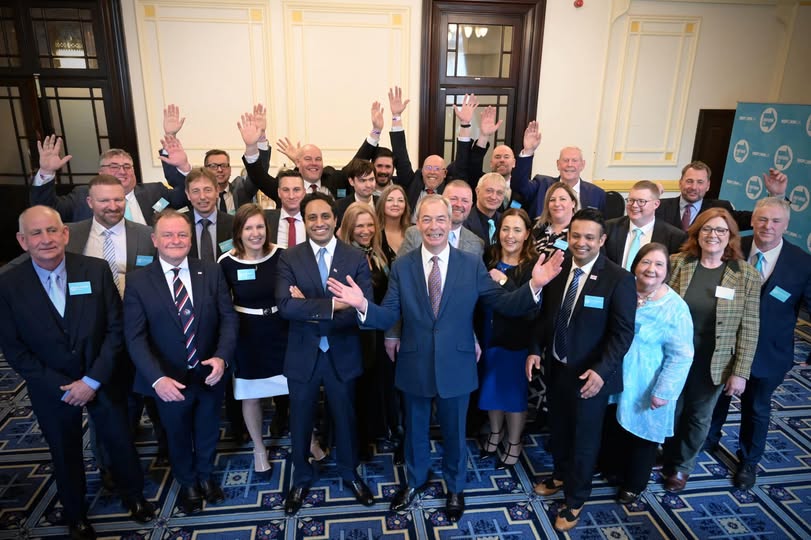
Picture credit: https://www.facebook.com/nigelfarageofficial/posts/today-i-announced-29-local-councillors-have-joined-reform-uk-from-across-the-cou/1184319953049781/

Unsuccessful Political Parties. Exploring and Combining Party Death and Party Failure

Julien van Ostaaijen and Sander Jennissen

‘I am fed up. It was interesting, fascinating, and frustrating. As a small faction it is difficult to be on top of everything and I noticed that I became less focused’. This is how one of many Dutch councillors explains why his party will stop having representatives after the election.

Participating in elections and having representatives elected is one of the main characteristics of political parties. However, political parties can be unsuccessful. They can stop having representatives elected. In the Netherlands, every four years, at least 15% of all Dutch local political parties lose all their representatives. What can happen to parties losing all representatives and what happened to the Dutch parties?

Figure 1: An oversight of unsuccessful parties: party death and party failure

In our article, we separate five possible reasons for political parties losing all representatives (Figure 1). In our framework, the first category is that of party death. In this category, the political party ceases to function as an independent, autonomous organisation. This category encompasses dissolution death (the party organisation no longer exists), merger death (the party has merged with another party), and absorption death (the party has been taken over by another party). The second category is that of party failure. In this category, the political party still functions as an independent, autonomous party organisation and is thus not ‘dead’. However, for other reasons, it no longer has elected representatives. This can be because of a mobilization failure (the party has ‘failed’ to present candidates for (re-)election and thus temporarily withdrawn from the election process) or electoral failure (the party participated in the election but failed to have any representatives elected).

In the Netherlands, we found 129 local political parties that had representative elected in the local elections of 2014, but no longer in 2018 (and most also not in the elections of 2022). Using several data sources, including election results, party websites and media reports, we analysed what had happened to these parties (Figure 2).

Figure 2: Results for local parties with no elected representatives in 2018

Our data show that about three-quarters of all the parties that ceased to have elected representatives after the 2018 local elections had effectively ‘died’, meaning that they ceased to exist as an autonomous organisation. However, most of the parties placed in this category had merged with other parties and therefore continued as part of a new party organisation. This pattern is closely connected to a trend in Dutch local political practice: between 2014 and 2022 the number of Dutch municipalities decreased by about 15% and many local party mergers took place in municipalities that were amalgamating around the same time. The remaining quarter of local parties with no representatives experienced party failure, meaning that they either did not gain sufficient votes to elect a representative, or decided to temporarily not participate in elections. It is noteworthy that the vast majority of these parties can be considered effectively dissolved four years later, in 2022, supporting the view that party failures, consisting of electoral and mobilization failures, are a prelude to party death. Nevertheless, the posited causal relationship should be further investigated.

Regarding our theoretical framework, we would urge to keep separating party death from party failure. In the literature, there are many different definitions and overlaps between concepts. Party death refers to the end of the party organisation. Party failure relates to not participating in the elections or not winning enough votes to elect a representative.

Looking forward, we believe that our framework provides greater clarity for analysing the final stages of political parties at both local and national levels. The five subcategories encompass the different ways in which parties are unsuccessful, i.e. have no elected representatives from one election to the next. The model can identify the circumstances that explain why this is the case. In the Dutch case this was largely due to municipal mergers and therefore party mergers. Applying the model in different countries with different systems will most likely lead to different results. Applying the model to national politics will also be a further test of its relevance.

Find our full article here: https://research.tilburguniversity.edu/en/publications/reasons-political-parties-lose-their-representatives-combining-pa

Julien van Ostaaijen is a professor of Law & Safety at Avans University of Applied Sciences and an assistant professor in Public Administration at Tilburg University. His research interests include local institutions and parties, the relationship between society and politics, local safety, and good governance and countervailing power.

ELECTED MAYORAL GOVERNMENT – SOME INLOGOV ANGLES

Chris Game

This blog was prompted partly by Vivien Lowndes’ and Phil Swann’s recent INLOGOV blog giving “Two cheers for combined authorities and their mayors”. Substantively, anyway, although the decisive stimulus was the realisation that most, if not all, of those present at the relevant ‘Brown Bag’ session would probably have been unaware that seated among them was the co-author of almost certainly the most comprehensive examination of this topic by any INLOGOV colleague over the years.

I refer to the appropriately labelled ‘long-read’, also masquerading as an INLOGOV blog and entitled Briefing Paper: Elected Mayors, published shortly before the 2017 elections of what I think of as the second generation of elected mayors – and produced by Prof Catherine Staite and a Jason Lowther.

Catherine, nowadays an Emeritus Professor of Public Management, had recently stepped down as Director of INLOGOV, in which capacity she had, among numerous other initiatives, both launched and regularly contributed to our/her blog. And, while I certainly recalled reading the Briefing Paper, I confess that, with his name meaning little to me at the time, I’d forgotten her co-author. Apologies, Jason.

He claimed, moreover, that he himself had “forgotten” it (email, 14/5), which I didn’t, of course, believe … until, a few days later and following some ‘research’, I discovered one of my own INLOGOV blogs, on the Magna Carta and 800 years of Elected Mayors, which I really had totally forgotten. Whereupon I realised too that I couldn’t actually recall much of what Catherine, I and other colleagues contributed to that decade of debate on elected mayoral evolution.

So, the remainder, the structure, and – I fear – the length of this blog were prompted, yes, by much of the media coverage of this month’s elections, and the sense that the spread and substance of mayoral government over the past decade aren’t fully recognised even by those who supposedly follow these things; and also by the notion that it would be a pleasing mini-tribute to Catherine to do so by identifying and italicising particularly some of her and colleagues’ INLOGOV blog contributions on these mayoral matters over the years.

We start, however, for the benefit of comparatively late arrivals, at the beginning of not the blog, but the concept. Mayoral government is a postulation you might expect to have found a supportive, even enthusiastic, reception in an Institute of Local Government Studies and it mainly did, albeit with perhaps a certain reservation. Directly elected mayors (DEMs) had played a fluctuating role in the Blair Government’s local government agenda from the outset. London, noted in Labour’s 1997 manifesto as “the only Western capital without an elected city government”, would have a “new deal”. Which took the form in 2000 of the creation of the Mayor-led Greater London Authority – in the manifesto, so no referendum required. Probably no reminder required either, but they’ve been: Ken Livingstone (Ind/Lab; 2000-08), Boris Johnson (Con; 2008-16); Sadiq Khan (Lab; 2016- ).

The Local Government Act 2000 then provided all English and Welsh councils with optional alternatives to the traditional committee system. Chiefly, following a petition of more than 5% of their electorate, they could hold a referendum on whether to introduce a directly elected mayor plus cabinet. There were 30 of these referendums in 2001/02, producing 11 DEMs – plus Stoke-on-Trent’s short-lived mayor-plus-committee system – three in London boroughs, but most famously Hartlepool United’s football mascot, H’Angus the Monkey, aka Stuart Drummond (Indep).

Ten referendums over the ensuing decade produced a further three mayors, prompting the now Cameron-led Conservatives to pledge in their 2010 manifesto to introduce elected ‘Boris-style’ mayors for England’s 12 (eventually 11) largest cities, with significant responsibilities including control of rail and bus services, and money to invest in high-speed broadband.

These DEM referendums eventually took place in May 2012 – three months after the launch of the INLOGOV blog – and provided a natural topic for early blogs by Catherine and colleagues (Ian Briggs). The referendums followed protracted Whitehall battles over mayoral powers (CG) – as revealed by the then Lord Heseltine in a UoB Mayoral Debate (CG) – a combination of ministerial indecision and interference (CG) against a backdrop of opposition from most of the respective councils’ leaderships, with Bristol the only one of the 12 cities voting even narrowly in favour (Thom Oliver).  

Birmingham voted 58% against, despite Labour’s having in Liam Byrne a candidate raring to go, and Coventry 64% against. There was speculation over whether the addition of a well publicised mayoral recall provision (CG) might have swung some of the lost referendums. But it was what it looked: an overdue, and to some welcome (Andrew Coulson), end of an episode (Karin Bottom);arguably the wrong solution to the wrong problem (Catherine Durose).

Since then, the referendums successfully removing elected mayors (Stoke-on-Trent, Hartlepool, Torbay, Bristol) have exceeded those creating new ones (Copeland, Croydon) – though, in fairness, those four removals were more than matched by five retention votes.

A ‘mayoral map’ at the end of that first decade would have looked something like the inset in my illustration of in fact the first 20 years of referendum results – numerous splotches of red for Reject, a few smaller green specks for Accept, and overall a patchy, somewhat arbitrary, experiment that on a national scale never really took off.  

The mayoral concept, though, had also generated interest outside local government – the Institute for Public Policy Research (IPPR), for instance, advocating Mayors for Greater Manchester, the West Midlands, and Liverpool City Region to take the required ‘big’ decisions on housing, transport, and regional development. Prime Minister David Cameron too was a ‘city mayors’ fan, although what scale of ‘city’ wasn’t initially clear, until in 2014 what became known as the first ‘devolution deal’ (Catherine Needham) was announced with the Greater Manchester Combined Authority. Headed by an elected ‘metro-mayor’ (CG), comparable to the Mayor of London, the GMCA would have greater control over local transport, housing, skills and healthcare, with “the levers you need to grow your local economy”.  

New legislation – the Cities and Local Government Devolution Act 2016 – was required, allowing the introduction of directly elected Mayoral Combined Authority or ‘Metro Mayors’ (Vivien Lowndes & Phil Swann) (+ Catherine Staite) in England and Wales, with devolved housing, transport, planning and policing powers.

The Combined Authority elections were held in May 2017 – not coinciding with the General Election (CG) as PM Theresa May had contemplated but, in contrast to Rishi Sunak, chickened out of – with perhaps usefully split results (CG). Elected were Andy Burnham (Lab, Greater Manchester), Steve Rotheram (Lab, Liverpool City Region), Ben Houchen (Cons, Tees Valley), Andy Street (Cons, West Midlands), Tim Bowles (Cons, West of England), and James Palmer (Cons, Cambridgeshire & Peterborough) – followed in 2018 by Dan Jarvis (Lab, Sheffield City Region). The map had started to change – even within the first hundred days (CG) – stutteringly under the less committed Theresa May and/or in several cases where groups of local authorities failed to agree – but eventually dramatically, as evidenced in the larger illustrated map. The Staite/Lowther ‘Briefing Paper’ was well timed.

A few years on, mayoral devolution has trailblazed across the country (CG) to a greater extent than even some commentators on this year’s local elections seemed to have difficulty grasping. As of March 2024, devolution deals had been agreed with 22 areas, covering 60% of the English population – most recently, in late 2022, North of Tyne, Norfolk/Suffolk, East Midlands, York & North Yorkshire; in 2023 Cornwall, Greater Manchester and West Midlands (‘Trailblazers’), Greater Lincolnshire, Lancashire, Hull/East Yorkshire; and so far in 2024 Buckinghamshire, Warwickshire and Surrey.  

From next year, if you draw a straightish line from, say, Ipswich in South Suffolk up through about Alvechurch in South Birmingham, heading for Shrewsbury, at least five-sixths of the bits of England to your north will be under mayoral devolution. Which, to me anyway, seems pretty dramatic news, and considerably more interesting than the endless General Election Date speculation that passed this May for ‘Local Elections’ reporting.

Picture credit: https://en.wikipedia.org/wiki/Mayor_Quimby

Chris Game is an INLOGOV Associate, and Visiting Professor at Kwansei Gakuin University, Osaka, Japan.  He is joint-author (with Professor David Wilson) of the successive editions of Local Government in the United Kingdom, and a regular columnist for The Birmingham Post.

Inflation and Local Authority Budgets

Andrew Coulson

Our two main political parties are locked in a strange debate about the next budget, on 6 March. The elephant in the room is the underfunding of local government.

In the nearly 14 years of Conservative government, the core spending power of local authorities has been cut by 27% in real terms.[1] The County Councils Network has “warned that its members are under extreme pressure, and that the authorities they represent are set to overspend by almost £650m this year due to spiralling costs, particularly in children’s social care and home to school transport, which was contributing to a £4b funding deficit for those authorities over the next three years”. In addition an increase in the National Living Wage is expected to costs these councils £230m next year.[2] This has happened at a time when the ability of councils to raise their council taxes has been held down, for 2024-5 to below 5% for all but a tiny number of councils.[3]  One of its consequences has been the inability of the employers in local government and the NHS to negotiate pay settlements which reflect the rate of inflation, or anything near it.

My reading of the present position is that Gove on the one hand and Rachel Reeves on the other are playing chicken. Each are waiting for the other to move first. They both know that after the general election a new government will have to settle the long-standing pay disputes in the public sector, and that it is not possible, year after year, for the pay of staff employed by local government and the NHS to rise by less the rate of inflation. The consequences are visable: depressed morale, a haemorrhage of experienced staff, and dependence on immigration to employ new staff. Rachel hopes that the Conservatives will be forced to confront this before the election. Gove wants the Labour Party to commit to doing it, because as of now any settlement is unfunded.

My view is that the understanding of inflation both by the two main political parties and the Bank of England is naive, especially as it relates to government policy. The starting point should be that inflation affects the distribution of income. It is an intrinsically political process. Most large companies and the richest people have means through which they can compensate for any inflation. Those who do not have the power or muscle to do so pay the price. Thomas Piketty[4] showed that inflation was the main means by which the middle classes paid for much of the costs of two world wars.[5]  In those inflations, and in the last significant inflation in the UK, which followed the OPEC hikes in oil prices in the 1970s, the trade unions were strong enough to ensure that wages rose at around the rate of inflation. This is no longer the case.

Yet the recent inflation has given the Government unprecedented increases in tax, which means that, if they so choose, they can afford wage increases. Most of this extra income arises from not raising the ceilings on higher rates of tax. Jeremy Hunt would like to use it to lower rates of income tax. The IMF (no less!) has told him that it is not appropriate to do so at this time.[6] The main reason, not always clearly stated, is that there are many unfunded challenges, but of these the public sector pay disputes (and perhaps the need for additional spending on defence, where difficulties in retention and recruitment are also partly a matter of pay settlements not keeping up with inflation) are top of the list. 

Economists in the UK, the USA and other developed countries have had little to say in recent years about inflation. As if it is no longer a problem, which it probably isn’t if inflation stays at around 2%. But the present inflations, driven by wars, the climate crisis and the lockdowns, are another matter. Economic theory is little help. All the traditional theories have been shown to be false. It is not true that inflation and unemployment are opposites: we can have both together, so-called stagflation. Or that it can be controlled by limiting the supply of money, which is not possible when most of it is created by banks which lend far more than they hold in deposits. Or that it is either created by unexpected demands or by unexpected costs.

The British Government urgently needs to resolve the disputes about pay in the public sector, and to do so recognising that most local government employees are substantially worse off than they were before. The Labour spokesperson Angela Rayner has made the practical proposal of negotiating a three year settlement.[7]  It cannot come soon enough.


Andrew Coulson is a nationally-recognised expert on scrutiny in local government and is particularly interested in governance by committee.


[1] Local Government Association, https://www.local.gov.uk/about/campaigns/save-local-services/save-local-services-council-pressures-explained 2024

[2] https://www.countycouncilsnetwork.org.uk/councils-in-significantly-worse-financial-position-after-the-autumn-statement-with-seven-in-ten-now-unsure-if-they-can-balance-their-budget-next-year/

[3] A prescient academic law professor, writing as long ago as 1984, wrote “It seems to me that the provisions for rate-capping … are little removed from a proposal to replace elected councils by administrative units. For a very long time, local inhabitants have enjoyed the right to elect local representatives with the power to tax, and so to determine, within modest political limits, what level of services shall be provided in the locality. … I have no difficulty in saying of an Act to put a limit on the rates leviable by a local authority that it is politically unconstitutional”. John Griffiths, in the Preface to Half a Century of Municipal Decline 1935-1985, George Allen and Unwin, 1985, p.xii

[4] Thomas Piketty, Capital in the Twenty-First Century, Harvard University Press, 2014

[5] The point was also made by one of his critics, Joseph T Salano, “War and the Money Machine: Concealing the costs of War beneath the Veil of Inflation” in John V Denson (ed.) The Costs of War, Routledge, 2nd edn. 1999 

[6] David Milliken and William Schomberg,  https://www.reuters.com/world/uk/imf-cuts-uk-growth-outlook-2025-after-stronger-past-performance-2024-01-30/

[7] “Rayner floats three year pay deal”. Municipal Journal, 14 Feb. 2024