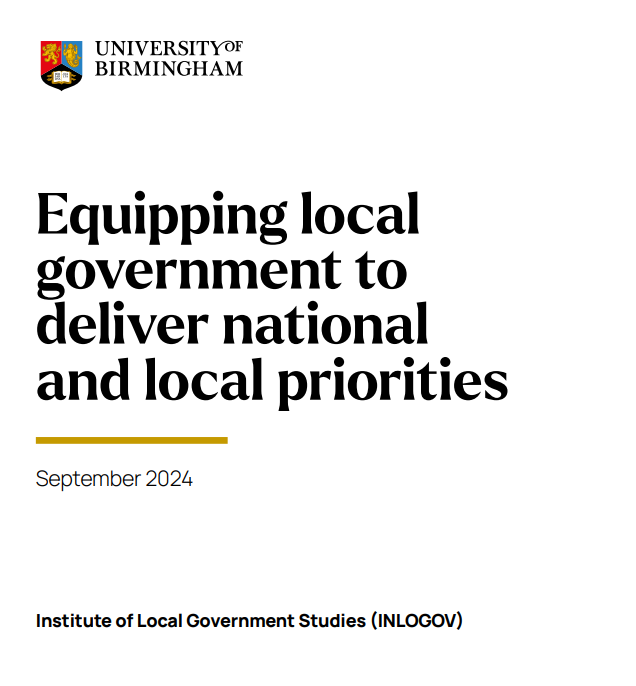
Equipping local governments to deliver national and local priorities

Jason Lowther

Today we launched our latest report, Equipping local government to deliver national and local priorities. Local government is critical to the delivery of the new government’s five key missions, and to improving life across the country. We argue that, once a series of critical reforms are in place, government should have confidence to equip local authorities with more power and (when public finances allow) prioritise additional resources there, enabling local and national priorities to be delivered. But critical reforms are needed in financial management, audit and performance management, and in community power and participation.

The new government inherited many challenges. Council budgets per person in England have been cut by 18% in real terms since 2010. Councils are hitting financial crises: twelve have issued section 114 notices in the last six years, compared with zero in the previous 17 years. Representative institutions at all levels of government are suffering from declining legitimacy and increasing polarisation. Local government plays a vital role in increasing democratic relationships and trust.

But councils’ wide remit, local knowledge, democratic accountability, public service ethos, and key roles in working with partners and shaping local places make them critical to the delivery of all five of the government’s key missions. Local governments are best placed to operationalise solutions to interconnected problems, for example, improving public transport and encouraging more cycling and walking helps meet net zero targets. It can also deliver health benefits, reducing the burden on the NHS, as well as increasing productivity by giving businesses access to a wider and healthier workforce.

Action is required to ensure that councils are fit for purpose to make the type of contribution that central government requires of them. Underlying this is a lack of confidence in local government on the part of ministers and civil servants.  We have identified three areas in which the government must be confident if it is to equip the local level with more power: financial sustainability, performance standards, and community power and participation. 

Policy recommendations

Financial arrangements

  1. Provide multi-year funding.
  2. End competitive bidding and deliver a “single funding pot” for each council/ local area that has been allocated fairly and sensitively to the needs and assets of the community.
  3. Abolish council tax capping.


Audit and performance management

  1. Strengthen the evaluation of councils’ performance management.
  2. Make OFLOG independent and extend its remit and approach.
  3. Reintroduce effective management and support of council external audit by independent bodies.


Community power and participation

  1. Strengthen the role of councillors as facilitators and catalysts of community-driven change.
  2. Embed participatory governance to ensure lived experience and marginalised voices drive policy and service delivery.
  3. Develop public-commons partnerships and community-wealth building to support community-driven sustainable economies.

As the Layfield Commission concluded 50 years ago, local government funding should promote responsible and accountable government. Beyond welcome recognition of acute financial challenges and commitment to multi-year funding settlements, there is a pressing need for additional immediate and longer-term action to improve Councils’ financial position and strengthen local accountability.

Local authorities have different needs for funding, depending for example on levels of population and its composition, deprivation, and spatial factors. Central and local government should develop updated funding formulae and funding models which are as simple as practicable whilst capturing the key elements of local need, and as transparent as practical in operation.  There are many reports researching available options for fairer funding, approaches to fiscal devolution, and local government funding options

Local audit, performance regimes and regulation each have a part to play. Both a parliamentary select committee and the Redmond Review into the Oversight of Local Government have sought to investigate the failings in local government audit.  The latter in 2020 critiqued market driven audits, stating that the new audit arrangements have undermined accountability and financial management. 

The adoption of the Redmond Review’s proposal for an Office for Local Audit Regulation would provide oversight on procurement, management, and regulation of external audits of local authorities. The government could extend the oversight of local government performance management processes while avoiding the creation of an overly powerful national regulator, by adopting key recommendations on the future arrangements of OFLOG (the Office for Local Government).

Proximity means that local government can play a crucial role in improving relationships between government and citizens. By creating conditions to mobilise the diverse expertise and resources of communities, local government can ensure that public policies and funding are informed by the assets, priorities and needs of local people and places.  There are already many examples where local government has made progress with innovations such as citizens’ panels and juries, the delegation of power to the hyper-local level and in building inclusive economies

We have over thirty years’ worth of research on deliberative democracy, social innovation, and co-production evidencing the value of collaboration with diverse communities and stakeholders. Participatory governance is less about finding perfect solutions and more about transforming organisations to engage with communities in processes of co-producing mutual understanding, shared solutions, and a sense of collective ownership.  

Our work on the 21st Century Councillor can help with enabling the role of councillors not just as democratic representatives but also as facilitators and boundary spanners between institutions, communities, civil society and local businesses.

Community-wealth building, pioneered in Preston and several London boroughs, can help strengthen the local economy with insourcing, linking public procurement to local cooperatives and social enterprises. These novel forms of governance can be formalised through Public-Commons Partnerships.

Equipping local government to deliver national and local priorities will leave a long-lasting legacy of a well-resourced, effective, accountable, and engaged local government.

The full report is available here

The report was edited by Jason Lowther and Philip Swann, with particular thanks to the following contributors (alphabetically by last name): Dr Koen Bartels, Dr Sonia Bussu, Prof Nicole Curato, Dr Timea Nochta and Dr Philip Whiteman. With thanks to other colleagues and associates in INLOGOV.

ELECTED MAYORAL GOVERNMENT – SOME INLOGOV ANGLES

Chris Game

This blog was prompted partly by Vivien Lowndes’ and Phil Swann’s recent INLOGOV blog giving “Two cheers for combined authorities and their mayors”. Substantively, anyway, although the decisive stimulus was the realisation that most, if not all, of those present at the relevant ‘Brown Bag’ session would probably have been unaware that seated among them was the co-author of almost certainly the most comprehensive examination of this topic by any INLOGOV colleague over the years.

I refer to the appropriately labelled ‘long-read’, also masquerading as an INLOGOV blog and entitled Briefing Paper: Elected Mayors, published shortly before the 2017 elections of what I think of as the second generation of elected mayors – and produced by Prof Catherine Staite and a Jason Lowther.

Catherine, nowadays an Emeritus Professor of Public Management, had recently stepped down as Director of INLOGOV, in which capacity she had, among numerous other initiatives, both launched and regularly contributed to our/her blog. And, while I certainly recalled reading the Briefing Paper, I confess that, with his name meaning little to me at the time, I’d forgotten her co-author. Apologies, Jason.

He claimed, moreover, that he himself had “forgotten” it (email, 14/5), which I didn’t, of course, believe … until, a few days later and following some ‘research’, I discovered one of my own INLOGOV blogs, on the Magna Carta and 800 years of Elected Mayors, which I really had totally forgotten. Whereupon I realised too that I couldn’t actually recall much of what Catherine, I and other colleagues contributed to that decade of debate on elected mayoral evolution.

So, the remainder, the structure, and – I fear – the length of this blog were prompted, yes, by much of the media coverage of this month’s elections, and the sense that the spread and substance of mayoral government over the past decade aren’t fully recognised even by those who supposedly follow these things; and also by the notion that it would be a pleasing mini-tribute to Catherine to do so by identifying and italicising particularly some of her and colleagues’ INLOGOV blog contributions on these mayoral matters over the years.

We start, however, for the benefit of comparatively late arrivals, at the beginning of not the blog, but the concept. Mayoral government is a postulation you might expect to have found a supportive, even enthusiastic, reception in an Institute of Local Government Studies and it mainly did, albeit with perhaps a certain reservation. Directly elected mayors (DEMs) had played a fluctuating role in the Blair Government’s local government agenda from the outset. London, noted in Labour’s 1997 manifesto as “the only Western capital without an elected city government”, would have a “new deal”. Which took the form in 2000 of the creation of the Mayor-led Greater London Authority – in the manifesto, so no referendum required. Probably no reminder required either, but they’ve been: Ken Livingstone (Ind/Lab; 2000-08), Boris Johnson (Con; 2008-16); Sadiq Khan (Lab; 2016- ).

The Local Government Act 2000 then provided all English and Welsh councils with optional alternatives to the traditional committee system. Chiefly, following a petition of more than 5% of their electorate, they could hold a referendum on whether to introduce a directly elected mayor plus cabinet. There were 30 of these referendums in 2001/02, producing 11 DEMs – plus Stoke-on-Trent’s short-lived mayor-plus-committee system – three in London boroughs, but most famously Hartlepool United’s football mascot, H’Angus the Monkey, aka Stuart Drummond (Indep).

Ten referendums over the ensuing decade produced a further three mayors, prompting the now Cameron-led Conservatives to pledge in their 2010 manifesto to introduce elected ‘Boris-style’ mayors for England’s 12 (eventually 11) largest cities, with significant responsibilities including control of rail and bus services, and money to invest in high-speed broadband.

These DEM referendums eventually took place in May 2012 – three months after the launch of the INLOGOV blog – and provided a natural topic for early blogs by Catherine and colleagues (Ian Briggs). The referendums followed protracted Whitehall battles over mayoral powers (CG) – as revealed by the then Lord Heseltine in a UoB Mayoral Debate (CG) – a combination of ministerial indecision and interference (CG) against a backdrop of opposition from most of the respective councils’ leaderships, with Bristol the only one of the 12 cities voting even narrowly in favour (Thom Oliver).  

Birmingham voted 58% against, despite Labour’s having in Liam Byrne a candidate raring to go, and Coventry 64% against. There was speculation over whether the addition of a well publicised mayoral recall provision (CG) might have swung some of the lost referendums. But it was what it looked: an overdue, and to some welcome (Andrew Coulson), end of an episode (Karin Bottom);arguably the wrong solution to the wrong problem (Catherine Durose).

Since then, the referendums successfully removing elected mayors (Stoke-on-Trent, Hartlepool, Torbay, Bristol) have exceeded those creating new ones (Copeland, Croydon) – though, in fairness, those four removals were more than matched by five retention votes.

A ‘mayoral map’ at the end of that first decade would have looked something like the inset in my illustration of in fact the first 20 years of referendum results – numerous splotches of red for Reject, a few smaller green specks for Accept, and overall a patchy, somewhat arbitrary, experiment that on a national scale never really took off.  

The mayoral concept, though, had also generated interest outside local government – the Institute for Public Policy Research (IPPR), for instance, advocating Mayors for Greater Manchester, the West Midlands, and Liverpool City Region to take the required ‘big’ decisions on housing, transport, and regional development. Prime Minister David Cameron too was a ‘city mayors’ fan, although what scale of ‘city’ wasn’t initially clear, until in 2014 what became known as the first ‘devolution deal’ (Catherine Needham) was announced with the Greater Manchester Combined Authority. Headed by an elected ‘metro-mayor’ (CG), comparable to the Mayor of London, the GMCA would have greater control over local transport, housing, skills and healthcare, with “the levers you need to grow your local economy”.  

New legislation – the Cities and Local Government Devolution Act 2016 – was required, allowing the introduction of directly elected Mayoral Combined Authority or ‘Metro Mayors’ (Vivien Lowndes & Phil Swann) (+ Catherine Staite) in England and Wales, with devolved housing, transport, planning and policing powers.

The Combined Authority elections were held in May 2017 – not coinciding with the General Election (CG) as PM Theresa May had contemplated but, in contrast to Rishi Sunak, chickened out of – with perhaps usefully split results (CG). Elected were Andy Burnham (Lab, Greater Manchester), Steve Rotheram (Lab, Liverpool City Region), Ben Houchen (Cons, Tees Valley), Andy Street (Cons, West Midlands), Tim Bowles (Cons, West of England), and James Palmer (Cons, Cambridgeshire & Peterborough) – followed in 2018 by Dan Jarvis (Lab, Sheffield City Region). The map had started to change – even within the first hundred days (CG) – stutteringly under the less committed Theresa May and/or in several cases where groups of local authorities failed to agree – but eventually dramatically, as evidenced in the larger illustrated map. The Staite/Lowther ‘Briefing Paper’ was well timed.

A few years on, mayoral devolution has trailblazed across the country (CG) to a greater extent than even some commentators on this year’s local elections seemed to have difficulty grasping. As of March 2024, devolution deals had been agreed with 22 areas, covering 60% of the English population – most recently, in late 2022, North of Tyne, Norfolk/Suffolk, East Midlands, York & North Yorkshire; in 2023 Cornwall, Greater Manchester and West Midlands (‘Trailblazers’), Greater Lincolnshire, Lancashire, Hull/East Yorkshire; and so far in 2024 Buckinghamshire, Warwickshire and Surrey.  

From next year, if you draw a straightish line from, say, Ipswich in South Suffolk up through about Alvechurch in South Birmingham, heading for Shrewsbury, at least five-sixths of the bits of England to your north will be under mayoral devolution. Which, to me anyway, seems pretty dramatic news, and considerably more interesting than the endless General Election Date speculation that passed this May for ‘Local Elections’ reporting.

Picture credit: https://en.wikipedia.org/wiki/Mayor_Quimby

Chris Game is an INLOGOV Associate, and Visiting Professor at Kwansei Gakuin University, Osaka, Japan.  He is joint-author (with Professor David Wilson) of the successive editions of Local Government in the United Kingdom, and a regular columnist for The Birmingham Post.

Two cheers for combined authorities and their mayors

Vivien Lowndes and Phil Swann

There are reasons to be cheerful about the fact that the newest component of English local government, the mayoral combined authorities, were in the headlines this spring. There were also reasons for caution, however, most notably the particular focus on two of the mayoral elections, in Teesside and the West Midlands, as a guide to the popularity (or not) nationally of Rishi Sunak and the Conservative Party.

This fact that combined authorities were in the news is a prompt to take stock of their development and impact with some thoughts stimulated by the discussion at a recent INLOGOV Brown Bag[1] session.

The media attention was attributable to the mayoral elections, with many of the incumbent candidates having established a national profile by, for example, challenging the government’s approach to Covid (Andy Burnham in Greater Manchester), defying political gravity and weak governance (Ben Houchen in Teesside) or crafting a new brand of active, compassionate Conservatism and challenging the government’s pruning of HS2 (Andy Street in the West Midlands).

The mayors have also disrupted the escalator assumption of British politics in which ambitious politicians use local government as a stepping stone to parliament and government. Burnham, Liverpool City Region’s Steve Rotherham and the new mayor of the East Midlands Claire Ward have each moved in the opposite direction.

The metro mayors undoubtedly have higher profiles than most council leaders. They have demonstrated impact beyond their statutory remit through soft power, particularly their ability to convene discussions and galvanise action on issues such as public health and homelessness.

Doubts remain about the sense of vesting so much power in a single individual. Only three of the twelve metro-mayors are women, showing the danger of equating ‘strong leader’ with ‘strong man’. More effort is needed on the part of political parties to diversify their mayoral candidate selection.

It is also valid to question whether, for example, an elected mayor in the West Midlands would have added more value as part of the city council’s governance rather than that of the wider city region. Some would argue that the city would benefit from the type of focussed political leadership that Mayor Jules Pipe provided in Hackney. Experience in both Liverpool and Bristol suggests that having a mayor at both city and city region level causes confusion.

There has been very little discussion about the role of council leaders as key players in the governance of combined authorities through their membership of the mayors’ cabinets. As one council leader in Greater Manchester is quoted[2] as saying: “We have to work with a mayor we did not want while he has to work with a cabinet he did not chose”.

The Greater London Authority model is very different, with a separately elected London assembly as well as a mayor. While this may seem more democratic, public awareness of the assembly is far lower than that of the mayor[3]. Perhaps it is time for a comparative review of these two very different sets of governance arrangements. In both cases, there is a strong argument for greater public involvement outside of the electoral cycle, both in setting up new combined authorities and to inform ongoing priorities.

The role of council leaders is inevitably linked with the wider question of the relationship between the combined authorities and their constituent councils. To date this has proved to be remarkably smooth, particularly given the often toxic precedent of county-district relations. The next period may be more testing. To date, councils and metro mayors have been united in coping with austerity, but difficult decisions about priorities will have to be taken should a new government make limited additional resources available. The increased interest of combined authorities and mayors in strategic spatial planning and housing will also raise challenging and potentially divisive issues.

The jury is out on the extent to which the establishment of combined authorities has led to substantive devolution of power from central government, although progress has been made in areas such as adult education, transport, health (in Greater Manchester) and mental health (in the West Midlands). While the new ‘trailblazer deals’ in Greater Manchester and the West Midlands promise a single funding settlement with central government, other combined authorities find themselves still bogged down in competitive bidding for relatively small pots of money.

One important feature of combined authorities is the way they are creating opportunities for innovation and testing new ways of working at a local level. To fully exploit the potential of this development it is important that arrangements are put in place to capture this learning and share it between combined authorities, and especially with newcomers like East Midlands, North East and York and North Yorkshire. There is also potential for metro-mayors to speak with a stronger collective voice in challenging and informing central government on issues affecting local and regional governance.

Finally, it is important to remember that combined authorities did not begin with a blank sheet of paper. The GLA and many of the combined authorities have similar boundaries as the GLC and metropolitan counties which were abolished by Margaret Thatcher in a fit of political pique in the 1980s.

Harold Macmillan pioneered regional arrangements for devolved delivery with regional boards to promote industrial productivity during the second world war and regional housing production boards to help meet his 300,000 a year housing target in the 1950s. Neither were well-received in Whitehall. John Prescott followed with his regional development agencies, abolished by Cameron’s coalition government, and his failed bid to create regional assemblies. What marks out combined authorities is the lack of a ‘one size fits all’ approach, with size, functions and governance arrangements varying around the country.[4] Indeed, only 50% of England’s population live in combined authority areas (so far).

Given this rocky terrain, it may be rash to vest too much hope in combined authorities and their mayors. But they clearly have the potential to disrupt our centralised politics and join-up aspects of regional governance after decades of damaging fragmentation.

Vivien Lowndes is Professor Emerita in the School of Government, University of Birmingham.

Phil Swann is studying for a PhD at INLOGOV in the Department of Public Administration and Policy, University of Birmingham, on the contribution of politicians to central-local government relations.

Picture credit: https://www.birminghammail.co.uk/black-country/sir-keir-starmer-walsall-pledges-29162669


[1] INLOGOV’s Brown Bag sessions are informal monthly discussions on events in and around local government bringing together academics, researchers, students, practitioners and alumni. For further details please Phil Swann ([email protected])

[2] Blakeley, G and Evans, B. 2023 How metro mayors are getting things done – even if they have limited money and power. The Conversation June 28 2023.

[3] According to London Elects (londonelects.org.uk) in January 2020 58% of people were aware that a mayoral election was taking place compared with 32% for the assembly election (down from 40% in 2016).

[4] Durose, C. and Lowndes, V. 2021. Why are designs for urban governance so often incomplete? A conceptual framework for explaining and harnessing institutional incompleteness, Environment & Planning C: Politics & Space, https://doi.org/10.1177/2399654421990;

Durose, C. and Lowndes, V. 2023. The pros and cons of messy devo (themj.co.uk) Municipal Journal 

Keeping an Eye on our Health Providers

Cllr Ketan Sheth

The meetings of the North West London Joint Health Scrutiny Committee, which I Chair, don’t usually set the pulses racing but the recent one was an exception. 

My committee’s job is to keep a friendly but critical eye on how the NHS North West London Integrated Care Board (ICB) delivers its budget of over £4 billion to the 2.4 million population of the eight NW London boroughs.

What made my committee’s recent meeting special was that information had leaked revealing ICB plans for major changes in GP ‘same day’ services, replacing the system of individual practice reception staff passing calls on to GPs with a new system in which far fewer “hubs” would pass 93 percent of calls to other staff, with only 7 percent to be handled by GPs. The ICB had planned to introduce the hubs by April 1 as part of its ‘single offer’ local enhanced service, with practices obliged to sign up to access the funding — effectively mandating the hubs. They were forced to delay by a storm of protest from GPs and our residents.

While my committee meetings are held in public, the members of the public aren’t usually allowed to speak at meetings, but on this occasion, I thought it right to ask Merril Hammer, a Hammersmith resident, Robin Sharp, a Brent resident, and Dr Vishal Vala, a local GP, to set the scene.

Merril spoke eloquently about the risks of triage or assessment in hubs by care co-ordinators or others who were not qualified or experienced GPs. The lack of any analysis of the impact on different groups and of proper risk assessment and of any reports from pilots was also of great concern.

Robin stated that Brent Patient Voice had urged patient involvement in any trials when the pilots were first mentioned, but the ICB had failed to listen. What had emerged to be implemented without any consultation with GPs had caused a great surprise and undermined the role of GPs as established since the NHS began.

When members of my committee gave voice to their questions and concerns, there was heavy criticism of the way in which the scheme had been developed by management consultants behind closed doors and without any prior engagement with the local government. There was concern that only long-term patients with complex needs would be referred to their GPs, when practices were made up of patients of all ages with needs that varied from time to time.

The ICB has now apologised for ‘poor communications’, arguing there had been ‘misunderstandings’ about triaging. They now talk of “co-production” with residents and local government at local level. So we look forward seeing the ICB’s plan for this and for wider engagement with the public as a revised scheme is developed.

Cllr Ketan Sheth chairs the North West London Join Health Scrutiny Committee

Photo credit: https://www.flickr.com/photos/popfossa/

Empowering Local Voices: Unveiling the Role of Councillors in European Governance

Dr Thom Oliver

In the intricate tapestry of European local governance, local councillors stand as pivotal figures, linking citizens to decision-making processes that shape their daily lives. Their interactions within communities, councils, and broader public administration are the bedrock of modern democracy. Last week, alongside colleagues from the University of Bristol, Cardiff University, and Ghent University, we embarked on an ambitious endeavour: an email survey reaching over 19,100 councillors across England, Scotland, Wales, and Northern Ireland.

The survey is part of a broader European effort, with a single shared survey being rolled out with spans twenty-eight European countries driven by a broad collaboration of academics emerges from extensive international research network dedicated to conducting surveys with local political actors to understand local and national political dynamics. Over two decades their comparative work has shed light on the councillor, council leader and mayor roles of local government, administrative intricacies, civic cultures, and political practices across Europe, enriching both academic and practical understanding.

Our latest research now refocuses on local councillors, probing fundamental questions about democracy, their perceptions of their roles, views on local government, challenges within the institutional environment, and policy priorities. The survey also aims to understand councillors’ experiences with aggression and abuse and the influence of such encounters on their council activities and public engagement.

But this survey is more than just academic curiosity; it’s about amplifying the voices of local representatives. Councillors are the conduits between citizens and power, entrusted with articulating community aspirations and championing collective interests. They face mounting external pressures—from austerity to centralisation—and grapple with balancing economic growth, development, and environmental concerns, alongside the existential threat of rising social care costs as more and more councils face financial distress.

Unlike previous paper-based iterations, this survey employs electronic questionnaires sent to individual councillors across England, Wales, Scotland, and Northern Ireland, with the survey lasting around 15 minutes, we are keen that councillors both start and finish the survey, so have enabled them to complete it over multiple sittings if required via simply clicking on the email invitation.

As the survey unfolds across 28 countries, we urge councillors to join the dialogue and lend their voices to the study. Personalised emails have been sent directly to councillors’ inboxes, and follow-ups will continue over the coming month. Any councillors unable to access the survey can reach out to the project team using the contact details provided below.

We are calling on all councillors to check their inbox for our survey! Your voices are crucial to use better understanding the challenges and priorities in your role. This is the first time we have delivered the survey across England, Scotland, Wales, and Northern Ireland so we are really keen to ensure that all voices are represented across political parties, different tiers of local government, and geographies. Let’s ensure all your voices are heard loud and clear.

Dr Thom Oliver is a Senior Lecturer in Politics at the University of the West of England, Bristol. Thom completed his PhD at INLOGOV in 2011. Along with Dr David Sweeting (Bristol), Prof Colin Copus (Gent), and Dr Bettina Petersohn (Cardiff), he is leading the Return of the Councillors study in England, Wales, Scotland, and Northern Ireland. Thom leads the Qualitative Election Study of Britain, and is a co-investigator on the Bristol Civic Leadership Project.