Voter ID – A “Poisoned Cure” and Other Verdicts

Chris Game

It’s easy to claim, but there are times when I miss not having classes of students to endeavour to entertain – partly because, at least from a distance, it can seem rather easier now than back when I had that responsibility.

One gift I’d certainly have used during this year’s exam revision period was the YouTube rap video made by T-Dawg – aka Broadland and South Norfolk Councils’ Managing Director, Trevor Holden – ‘reminding’ intending voters in the May local elections to take photo ID with them to the polling station. Like the whole topic, the video received a mixed reception, but it certainly got my vote (sorry about that!) as an introduction to this split-blog’s attempted overview of the profusion of recently released Voter ID material. I’ve at least flick-read most of it, so you won’t have to worry about not doing so.

First, though, an additional declaration of personal interest, referring back to that  opening paragraph. My students weren’t, of course, learning directly about ‘political literacy’, but high on my short list of ‘research stats I’ve managed to remember for more than a few weeks’ was the depressing finding in the All-Party Parliamentary Group (APPG) on Political Literacy’s 2021 report that, of a 3,300 sample of secondary school teachers in England, only 1% [felt] “fully prepared” to teach courses aimed at developing young people’s political literacy.

The ”fully”, omitted in some reports, was in the question and doubtless partly explains the dispiriting response. But anyway the finding was highlighted by the APPG, led directly to the creation of the social enterprise Shout Out UK (SOUK), and these two bodies’ influence is clearly evident in some of the Electoral Commission’s recommendations for more focused information and awareness raising.

There had, of course, been earlier assessments of May’s elections – principally the Electoral Commission’s Interim Analysis in mid-June, reporting the anonymised returns from the Voter Identification Evaluation Forms (VIDEF) that Returning Officers were required to complete (see table below), plus results of three YouGov pre- and post-election public awareness surveys of between 1,700 and 3,700 adults each.
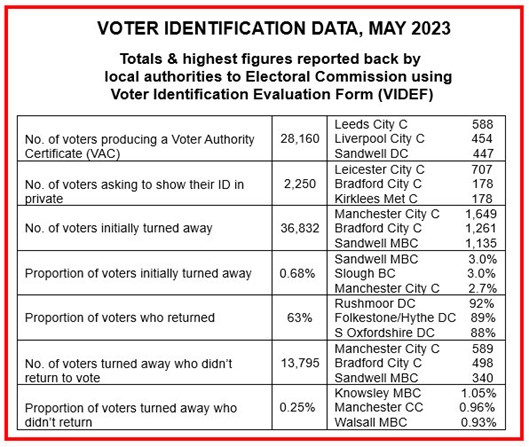
This first, stat-heavy part of the blog will present, in highly summarised form, some of the key data, with the second covering some of the more recent interpretative contributions – including that of the All-Party Parliamentary Group, from which I’ve appropriated the blog’s slightly giveaway title.

First, some scene-setting stats, taken from the final report. The total electorate was 27.3 million, ballot box turnout 32%. For the record, Labour took 33% of the vote and control of 70 councils; Conservatives 28.6% and 33; Lib Dems 37% and 20.  5.2 million postal ballots were initially issued to 19% of the electorate, 3.5 million (67%) of which were returned, of which 89,000 were rejected, mainly for missing or mismatched signatures or dates of birth. OK, it’s only 2.6%, but, after making the effort, it was higher than I might have guessed.

 Key findings from the analysis included that:

  • Immediately post-election, in areas with elections, 92% of people in England were aware they now needed to show photo ID to vote at a polling station. They weren’t asked, however, if that awareness extended to knowing that they couldn’t obtain ID – e.g. the Voter Authority Certificate (VAC) – on polling day itself.
  • Awareness was significantly lower (74%) among those who didn’t already have an accepted form of ID – and, unsurprisingly, among youngest age groups (82% for 18-24 year olds), Black and minority communities (82%), etc.   
  • Approximately 89,500 people applied for a VAC before the 25 April deadline, some 28,000 certificates being subsequently used – i.e. under one-third of the 250,000 to 350,000 estimated likely not to have any other acceptable ID.
  • At least 0.25% of people (c.14,000) who had tried to vote at a polling station were not issued with a ballot paper because of the ID requirement, but this excludes those who reacted to the ID reminder before they could be recorded in the data – thereby inevitably underestimating, as do the post-election analyses generally, the actual impact of the voter ID requirement.

This was essentially the ‘headline’ picture we had to content ourselves with over the summer, until quite suddenly, come September, there was a whole lot more – and it seems logical, if not strictly chronological, to start with the Electoral Commission’s full-scale Voter ID Demographic Analysis Research. The analysis aimed to identify patterns in areas where relatively higher or lower proportions of intending voters were turned away from polling stations due to the new ID requirement.

18 authorities with apparently relatively socioeconomically diverse wards were selected, including the West Midlands’ Coventry and Sandwell – the latter being the sampled borough with the nationally highest “initially turned away” percentage of 3%.  The Census-based ‘proxy’ variables measured were unemployment, ethnicity, household deprivation, and social renters.

Hyper-summarising, the analysis suggested there was “a potential linear relationship” between each selected socio-economic variable and the proportion of voters initially turned away and those who didn’t return to vote. These results are obviously tabulated, but also graphed, as illustrated in what is described as the “moderate relationship” between ethnicity and the proportions initially turned away.
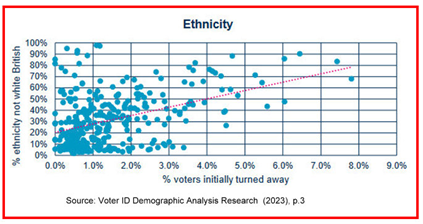
Overall, 13 of the 18 authorities showed at least a moderate relationship between the independent variables and the proportion of voters initially turned away, and 6 exhibited “strong relationships between one or more independent variables”. Strongest correlations were with areas having a high proportion of non-white British individuals, higher deprivation, and higher unemployment.   

Following this specifically Voter ID-focussed report, the Electoral Commission had published in June its overall Report on the May 2023 Local Elections in England, which it updated in early September. It made nine main recommendations, including increasing awareness of the support available for disabled voters, and improving data collection at polling stations.  

Four, however, related specifically to voter ID: review the list of accepted ID; improve access to the Voter Authority Certificate (see above); improve options for voters who don’t have or can’t access any accepted form of accepted ID – e.g. allowing ‘attestation’ by a named and verified elector; and polling station staff to continue to collect voter ID impact data at future elections.

Which brings us to about mid-September, already some way over this blog’s preferred length, and quite the wrong time, therefore, to address the “poisoned cure” and other reactions to these primarily statistical analyses – which will follow, with luck, fairly shortly.

Chris Game is an INLOGOV Associate, and Visiting Professor at Kwansei Gakuin University, Osaka, Japan.  He is joint-author (with Professor David Wilson) of the successive editions of Local Government in the United Kingdom, and a regular columnist for The Birmingham Post.
Splitting up the Second City is a third-rate idea

Andrew Coulson            

Relations between first and second cities are often strained, especially when those who live in the Second City elect leaders from a political party that is not running the national government – as has been the case with Birmingham for much of its life.

After the Second World War, Birmingham was prosperous. It had avoided most of the bombing that destroyed the centre of Coventry, and its factories had produced aircraft, lorries, and other vehicles and equipment for the military and were now available to meet the post-war demand for cars and lorries. Wages for semi-skilled labour were some of the highest in the country.  There were shortages of labour, and to meet them employers welcomed bus drivers, conductors and nurses. These were followed in the 1970s and 1980s by workers mainly from Pakistan and Kashmir.

From the perspective of the London government, Birmingham did not need more employment, so companies who wished to invest in the motor industry were directed to Liverpool and elsewhere. But academic commentators, and the more thoughtful employers, could see that all was not well.  Britain was becoming increasingly dependent on service industries, which were far from strong in the Midlands.  In that context, in the mid-1970s, Birmingham Council proposed to build a National Exhibition Centre, on land near the airport. It would be owned by a company which was a partnership with Birmingham Chamber of Commerce.  The government wanted it in London; the council carried on regardless, and eventually the London government allowed it to do so.

Its structure was innovative – the company had just two shares, one owned by the city council, the other by the chamber. Each could nominate four directors. The chair would always be one of the chamber nominees – for a long time the leading industrialist Sir Adrian Cadbury.  But if voting on the board was tied, the chair did not have a casting vote, and what was proposed would not go ahead. The company, underwritten by the council, borrowed money and built the NEC.

A few years later, in 1987, the NEC company started building the International Convention Centre and Symphony Hall, on land off Broad Street. This was to make Birmingham a centre for conferences and business meetings. The decline in manufacturing and rising unemployment was by then so evident that Birmingham was granted Assisted Area Status by the European Union, so a fraction of the cost was met from Europe. The London government was not involved.

The ICC became a preferred location for large gatherings of professional bodies, such as the British Small Animal Veterinary Association, which grew till it hosted more than 8,000 delegates. It met in Birmingham every year for more than 25 years.  A boom in the construction of hotels met the demand for accommodation for this kind of event. Also of offices, many taken by national or international companies. No longer is Birmingham lagging in its provision of services. On the contrary it is a leader – almost entirely because of these initiatives.  Symphony Hall was built to meet the specification of Simon Rattle, then a very young but highly promising conductor of the City of Birmingham Symphony Orchestra. It was part of a city-council strategy to support the arts, of which another strand was the attraction of what became the Birmingham Royal Ballet to the Hippodrome theatre – with its charismatic directors, Peter Wright, David Bintley and now the Cuban star Carlos Acosta. Another initiative required investors in large buildings to put a small extra amount aside for public art.

The arrival of a national Conservative government in 2010 meant that the council started losing the extra grant it had long enjoyed to meet its high levels of deprivation, and put it under huge financial pressure. Whole levels of staffing in departments of the council were removed. Many senior officers did not stay long. Some posts were not filled. Others are filled by ‘interim’ staff, who are supplied by agencies, do not expect to stay in the city and are very unlikely to live in it.  

The refuse collection service was traditionally headed by an assistant director who had worked in the service for many years. For a period before the 2017 strike, this post was not filled, and the service was for a time run by the director of leisure. The strike was about reducing the number of operatives on each vehicle when wheelie bins were introduced. It was resolved by giving the workers improved pay.

It appears that it was only later that the implications of this for ‘single status’ were recognised, meaning that other categories of workers – in particular in social care – could claim equal pay for work assessed as equivalent. To meet the huge resulting costs, the city sold the NEC company for £300m. It was resold for £800 million three years later – a warning to the current commissioners not to sell this kind of asset on the cheap. Since then, the bin workers have managed to complete their shifts in less time than expected – partly assisted by some residents not putting their bins out every week – and been permitted to sign off early when their round was completed. Again, it has only recently been realised that this opens the city to another round of ‘single status’ claims.  Hence the near bankruptcy, Section 114 Notice, and appointment, by Michael Gove in London, of commissioners.

To resolve challenges such as this, when Birmingham is facing extreme pressures on all its services, will not be easy for the commissioners.

The worst thing they could do would be to split Birmingham into perhaps three smaller councils. This would increase the overhead costs – three directors of each service instead of one, three separate offices – and lose major economies of scale. It would also threaten the leadership and finance which is part of being the Second City – in the arts, in the representative institutions of local government, and in creating and implementing an economic strategy which responds to the local opportunities and needs which are most clear to people living in the city.

Andrew Coulson is a retired lecturer from INLOGOV and a former Birmingham City Councillor.  A longer version of this article was published in The Birmingham Post.  Andrew writes in a personal capacity.

More Collaboration, Less Disruption? Shaping Tomorrow’s (Digital) Cities

Dr Timea Nochta

Promising Artificial Intelligence (AI) tools, most recently the likes of ChatGPT, have created an atmosphere of imminent disruptive change. News outlets bombard us with novel tools and applications that are poised to become the ‘new game in town’, revolutionising various sectors, jobs and ultimately the entire global economy. However, such sensationalist predictions often overlook the complexity of moving from where we are today to working effectively with novel, AI-powered tools in specific, concrete contexts and situations.

AI in the built environment: Digital twins

One such example of a recent hype are digital twins (DTs). Digital twins (virtual replicas) of physical objects or systems have been used for over two decades, most prominently in product engineering and manufacturing. Applications of the technology in the built environment are more recent, and in the UK in particular, the development of digital twins for built environment assets, systems and processes has been triggered by the National Infrastructure Commission’s Data for the Public Good (2017) report. Despite this relatively short history, technology promoters (often suppliers themselves) nowadays pitch the ‘digital twin’ as a ready-made, off-the-shelf data product to city authorities. Further contributing to the hype are various cities who market themselves on the global stage as leaders in digital innovation, and their digital twin projects, including the likes of Helsinki, Singapore, Barcelona, Xiong’an or Herrenberg. In the UK, cities such as Cambridge, Birmingham, Bristol and London have been experimenting with digital twins.

Are urban digital twins better characterised as ‘technology’ or ‘socio-technical innovation’ and why does it matter?

The urban digital twin (UDT) as a technology is often defined as a three-dimensional virtual replica of a city that makes use of a combination of technological innovation in sensors, big data and data science; building and city information modelling (BIM and CIM); and artificial intelligence (AI), machine learning (ML) and automation. At a more fundamental level, it is underpinned by a motivation to create an all-encompassing, single-source-of-truth digital simulation of the city’s built environment which is linked to the physical city via automated bi-dimensional data flows. Whilst the objective may be seen as admirable, there remain a myriad of unanswered questions when trying to unpack the UDT concept from a more practical view, including but not limited to:

  • Is the large-scale investment into the digital infrastructure (sensing, data storage and processing, analytics and modelling) justifiable given the expected benefits?
  • Is there enough good-quality evidence to suggest that the expected benefits can in fact be delivered in a particular context?
  • If so, what conditions might be necessary to enable benefit realisation?
  • How does the UDT project affect and/or incorporate urban citizens, communities and other stakeholders?
  • How does the proposed UDT fit into the existing landscape of data and digital tools in use?

To local authority practitioners these questions may sound common-sense or even routine. However, taking such issues into consideration essentially represents a move away from the purely technological towards a ‘socio-technical’ understanding of UDTs. From this perspective, UDTs are not off-the-shelf data products as they do not exist independently of the contexts in which they are applied. Ultimately, any digital twin will only ever be a partial representation of a city and its built environment, and therefore there are key decisions involved in designing UDTs for different cities (or regions). Such decisions can identify diverse technology design and/or implementation requirements based on specific, pertinent local policy questions or problems, existing data availability and digital twins (e.g., of energy systems) internally or accessed from other stakeholders, citizen and community preferences or needs, currently existing digital expertise, and so on. This process of developing requirements and solutions for digital twins has been termed ‘digital twinning’ in the literature, with scholars arguing that it represents an ‘act of governance’.

This is not to say that each and every UDT will, or need to be, bespoke. However, neither do UDTs need to be uniform, holistic and all-encompassing from the start – even if this were at all possible. Instead, federated systems of digital twins representing different aspects of cities can organically develop and evolve over time and as needs arise and change.

An alternative conceptualisation of UDTs: Transcending silos

Whilst it may not be possible or desirable to develop all-encompassing, ‘single-source-of-truth digital twins, UDTs nevertheless offer the possibility of linking certain currently siloed policy and governance processes which may benefit from some degree of integration to respond to contemporary challenges. One such example could be the intersection of energy, environment, transport and land-use in support of policy goals relating to net zero transition, affordable housing, mobility and employment – a use case we explored in the context of Cambridge.

Siloed working within and between local and regional authorities led to generic policy goals and targets being translated into conflicting sectoral implementation strategies across development planning (for housing, industry and services), electric charging infrastructure and incentives, and upgrades to the electric grid. Developing solution options to this issue necessitates understanding why different people travel, how and where they travel and therefore when and where they might charge their (future) electric cars.

Addressing it did not require extensive sensor deployment for data collection, or the development of ‘single-source-of-truth’ digital twin technology – instead, we could draw on existing available data (e.g., census and employment data) and models (e.g., land-use and transport models). The research team developed a small ‘module’ which served to integrate previously unconnected models and data sources. The exercise concluded that a potentially impactful policy option would be to offer incentives for charging at home and/or disincentives for charging (and/or parking) at workplace for electric car drivers, given travel patterns, the locations of housing, services and employment centres, and electric infrastructure upgrade needs and costs.

Conclusion: Working effectively with digital twins?

So what does such a socio-technical perspective imply in terms of working with UDTs in (local) government? Working effectively with digital twins may, in fact, require more collaborative working both across and between local and regional authorities, as well as with technology and data product designers – as opposed to joining the digital (twin) hype. Collaboration can also contribute to learning and skills development, beyond technology design. Re-establishing some specialist technical competencies through extensive collaboration (which may have been lost in local government in the last few decades) can in turn help developing confidence and competence in commissioning digital (and/or AI-powered) tools, and understanding the impact and implications of their adoption.

If you have any comments or would like to discuss any of the above, please feel free to get in touch via email ([email protected]). If you would like to read more on using a socio-technical perspective to design and implement digital twins for cities, or explore other use cases, you may wish to consult our recent book on Digital Twins for Smart Cities: Conceptualisation, Challenges and Practices.

Timea Nochta is a Lecturer at the Institute of Local Government Studies (INLOGOV) in the Department of Public Administration and Policy, at the University of Birmingham. Her research focuses on networks and governance in urban policy and implementation in the context of technological change, especially decarbonisation and digitalisation.

Is this fair? – a PhD on fairness in local government

Clive Stevens

A year’s gone and I’ve been given the OK to start year two of my PhD, but what have I achieved? Three passes in the taught modules on social science research and piles, nay heaps of reading.

And have I learned anything? That fairness is a complex subject. It is one of a number of moral behaviours that humans (and some other animals) have evolved over deep time to improve cooperation within groups. It’s innate, like language ability, and like language ability conceptions of fairness can differ depending on upbringing and life experiences. You can change your notions of it too although the chances of that recede as you grow older.

Does any of this relate to local government? I plan to look at councillors’ views on fairness; to see how they vary within and across persons in reaction to different case examples, ones they might typically come across in their daily interactions; all treated with confidentiality of course.

Opinions on fairness are usually made very quickly, within a second, and in any group of councillors (past and present) you can be sure that some will react one way and some another.

There are many realms on planet fairness: equality, merit, equity, opportunity, process, power and rights to name a few. Each has different sensitivities and opportunities for disagreement. My working model is that people will respond differently to the same situation due to their diverse backgrounds or assumptions; some will immediately fly off to one realm whereas others will jump to another. Some will be talking merit and just deserts whereas others will be thinking equality. This can lead to profound divergence over perceptions of fairness of a proposed policy or decision.

In local government much emphasis is placed on fairness of process. Areas of responsibility like social care, licensing and planning for example will have policy, and a decision based on policy is deemed fair if due-process has been followed; meaning no bias and a right to hear about and state one’s case. Public acceptance relies on a ‘fairness heuristic’, a natural mental shortcut, where one assumes fair treatment as long as the process followed is fair. Most research studies, but not all, show this heuristic. But is this fair? Firstly, local government policy can be set many years earlier, in different economic or political times, long before it is used to guide decisions. And secondly, was the policy making itself fair or was it dominated by large organisations or outdated assumptions.

The academic study of fairness has extra complexities…the term ‘equity’ is understood differently by those working in psychology (and business) to those in education and health. To the former it means merit; with rewards and punishments proportional to effort and input. To the latter it means giving a helping hand to those that need it. As humans we engage with both meanings.

Fairness is a field rich with research opportunity – too much for me to test them all. So in the coming year, once I have finished the readings, I need to discuss which areas might be of interest to councillors and create some examples for discussion in interviews and focus groups.

This is all with an aim to do what? That’s dictated by the results. For example, if it is discovered that there are some fairness situations which are more likely to trigger discord then, perhaps, adding more context and creating opportunity for discussion and reflection before councillors take a view might lead to better, fairer and more efficient decision making; especially when discussing mitigation of harm to affected residents or businesses.

Clive was a Bristol City Councillor and author of the book of his experiences, After The Revolution. He is entering Year 2 of a PhD at the University of Bristol. He blogs at https://sageandonion.substack.com/ and can be contacted at [email protected]

Birmingham’s contribution to local government numerology

Chris Game

Right – we, meaning I, must start with a dilemma declaration. How to deal with a major national news item – “Birmingham City Council declares itself bankrupt” – the consequences of which, as a long-term Birmingham resident and ratepayer, will affect you personally and about which in the distant past you might well have been invited to opine seriously and professionally. Yes, carry on being retired and/or pretend you’re still on your hols.

Obviously, I’ve chosen an alternative route, emphasising background and context and stuff that might just provide some clarification, or at least updating.  And, if it seems frivolous, tasteless or just indulgent, I apologise. Blame me, not the editor.

I’ll start, as it’s in the intendedly eye-catching title, with numerology – the study of the hidden, divine or mystical meaning of numbers. Even if you’re not into it, you’ll quite likely have come across ‘angel numbers’, aka ‘lucky primes’ – sequences of digits that supposedly bode well and make you feel good. Or, as the ologists put it, messages from the spiritual universe offering insight, wisdom, and directionality – three-digit ‘lucky primes’ usually including 127, 151, 163, 193, etc.

And which bunch of local government personnel, more than most, could benefit from having such character traits built into their job descriptions? Section 151 Officers, of course; aka Chief Finance Officers (CFOs) – those required by Section 151 of the 1972 Local Government Act to arrange and take responsibility for the proper administration of their local authorities’ financial affairs.

Just check out the numerologists. “The energies of number 1 combined with the vibrations of number 5 … a sign from the divine realm that you need to be strong, act as a leader, and be in control of your future life …” etc. etc.

The only problem being that, with a bit of searching, you can get similar hokum for almost any three- or four-digit number. So, somewhat to my disappointment I admit, no fiddling whatever would have been required of the Office of the Parliamentary Counsel – the people who actually draft our laws – to ensure that these matters would be dealt with by Section 151 of the 1972 Act.  Excepting possibly the Satanic 666, which would make the Act impossibly long anyway, almost any three-digit number would have served.  

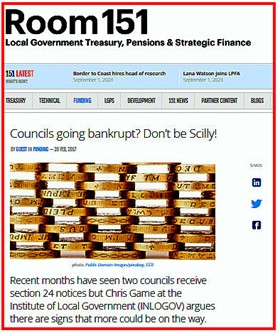
I knew this back in 2017, but I’ve habitually kept a vague look-out for any published follow-up from my INLOGOV blogs and admit that I was quite chuffed when a few years ago one was picked up and passed on by Room 151 – the “online news, opinion and resource service for local authority Section 151 and other senior officers covering treasury, pensions, strategic finance, funding, resources and risk …”.

Chuffed too to that, albeit over a lengthier time period than I was envisaging, the broad thrust of my argument of more being on the way has proved to be accurate – a somewhat nerdy argument, admittedly, that can certainly be made even nerdier, but that, for current blogging purposes, can also be tolerably summarised in a few sentences.

So here goes!  If a council’s Chief Finance/Section 151 Officer (forever male, of course, in the 1988 LG Finance Act, although Birmingham’s current Interim Director of Finance happens to be Fiona Greenway) reckons his council’s expenditure is likely to exceed available resources, he issues a Section 114 Notice prohibiting any new spending apart from that funding statutory services and existing contractual obligations. OK, geeks, they’re technically ‘Reports’, not ‘Notices’, but that really, really isn’t the serious issue.

It’s a situation in which things are pretty obviously and publicly getting out of hand – current spending way over budget, reserves virtually exhausted, no imminent solution. The alternative, however, is worse: Section 24 of the Local Audit and Accountability Act 2014, or washing your dirty linen in public – the council’s EXTERNAL auditors appending a Section 24 ‘Recommendation’ to their Annual Audit letter, “copied to the Secretary of State”.

Which may sound chummy, but, I suggested, was “the bullet-shaped chumminess of a Mafia ‘message job’”: very nasty, and rarer even than 114 Notices – historically. Yet – and this is what prompted that 2017 blog – in the space of two months two Section 24s had been issued, to councils at the very extreme ends of the council scale spectrum: the Scilly Isles and Birmingham, the latter’s then Labour Leader, Cllr Sir Albert Bore, describing it as “the most concerning audit letter” he’d seen in his 36 years as a councillor. For the record, though, and without further explanation, that’s the last you’ll read of them in this particular blog.

The distinctions between the 114/24 courses of action were interesting and debatable, but you didn’t have to be a terribly nerdy follower of local government finances to see the probable beginnings of a trend, so it was pleasing to have been reckoned insightful by the serious pros in Room 151. Especially when the trend didn’t gather pace as quickly and widely as I speculated it might.

However, given the way local government finance ‘works’ in this country, particularly under Conservative administrations, it was only going to be a matter of time, and gradually the signals became unmissable – accelerating in quite a big way with (then Lab) Croydon LBC in late 2020, who issued not one but two s114 Notices in successive months, having again failed to balance its budget in the permitted 21 days of grace. Understandably, it prompted a Commons Inquiry by Clive Betts’ ever-watchful Local Government (sorry – Levelling-up, Housing & Communities) Committee.

Slough BC (Lab then, C/LD now) was next in July 2021, despite having been one of eight councils granted “exceptional support” the previous year, as Ministers became increasingly concerned at the adverse publicity generated by threats of councils ‘going broke’.

Come December and Cumbria’s Copeland BC (Lab then, since abolished and incorporated into Cumberland) was reported to be “in Section 114 territory”, but was soon overshadowed by (Lab) Nottingham City Council’s unlawfully diverting cash from what should have been a ring-fenced Housing Revenue Account to ‘General Funds’ – an ‘accounting error’ which personally I found extraordinary, since it’s one of the few bits of tekkie lg finance that even I know. And it dragged on.

2022 saw serious acceleration. In May Northumberland Council (Con)issued a s114 for unlawful expenditure, including allowances paid to the council’s Chief Executive. It was possibly the case generating least sympathy for the beleaguered council, whose elected members and officers went public with their mutual distrust – not the only such example, but probably the bitterest. 

Towards the end of 2022 it became clear how desperate the situation – or at least the search for commissioners available to ’intervene’ – was becoming, as returning Local Government Secretary Michael Gove sought to launch anticipatory “turnaround programmes” short of sending in commissioners – ‘risk-mitigation directions’, in Govester jargon.

Not in time, however, to prevent Croydon LBC (NOC) issuing its third s114 in three years, and Thurrock Council (Con) having the courage/desperation to report that it would require “exceptional support” from Gove’s Department “over a number of years … to stabilise our financial position and give us time to have balanced budgets.”

At which point – after an obviously uplifting Christmas and New Year – “Whitehall officials”, in the person of Jeremy Pocklington, Permanent Secretary of the Department for Levelling Up, Housing and Communities (DLUHC), had the confidence/nerve/effrontery to announce to a Select Committee that even at the time sounded, well, brave.

As reported in The MJ (Jan 10th), “Whitehall officials are not expecting councils to issue further Section 114 notices in the coming weeks … our assessment, looking at the sector as a whole, is that the financial position is sustainable … strengthened by the additional resources made available in the Autumn Statement.”

Apart, that is, from the nine councils within the Special Interest Group of Municipal Authorities (Sigoma) who warned last week that they could issue a Section 114 notice by 2025; Stoke-on-Trent City Council (Lab) that announced this week that it is on the verge of bankruptcy … oh yes, and Birmingham.

Chris Game is an INLOGOV Associate, and Visiting Professor at Kwansei Gakuin University, Osaka, Japan.  He is joint-author (with Professor David Wilson) of the successive editions of Local Government in the United Kingdom, and a regular columnist for The Birmingham Post.

Local councils must work harder at enabling women to be councillors

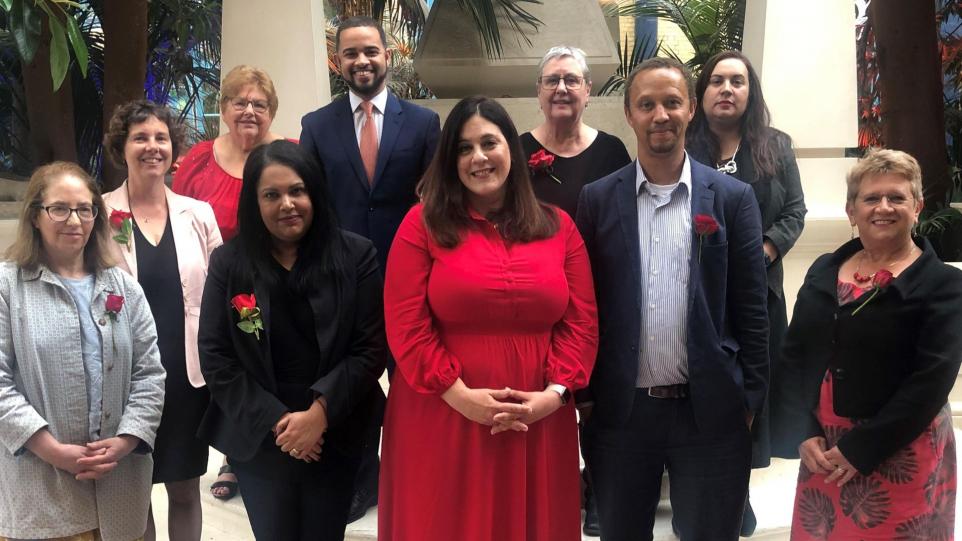
Picture: Haringey Council’s 2022 cabinet

Jason Lowther

Local councils can and must do more to enable women to be councillors. Haringey’s new cabinet shows that this can be done, but fifty years after all government elected officials across the UK were finally elected under universal suffrage, new research shows barely a third of local councillors and MPs are women, whereas earlier research showed less than a quarter of Police and Crime Commissioner (PCC) candidates were women.   This matters not only in terms of democratic fairness, but because politicians’ characteristics impact on public policy.

The research published last week by the Fawcett Society and Democracy Club reflects councillor representation in August 2022 across the UK.  To collect the data, they had to scrape individual council websites since (incredibly) there is no official record of councillors’ gender (or other protected characteristics).  This is because the relevant section of the Equality Act 2010 has still not yet been enacted and in any case as drafted would apply only to candidates in national elections.  This is in contrast to council staff, where the Equality Act applies and has led most councils to capture and publish reasonably detailed assessments of workforce equality issues – as shown by the recent SOLACE / Shared Intelligence report, ‘Understanding and Improving Equality, Diversity and Inclusion in the Local Government Workforce’ which we discussed on the blog last autumn.

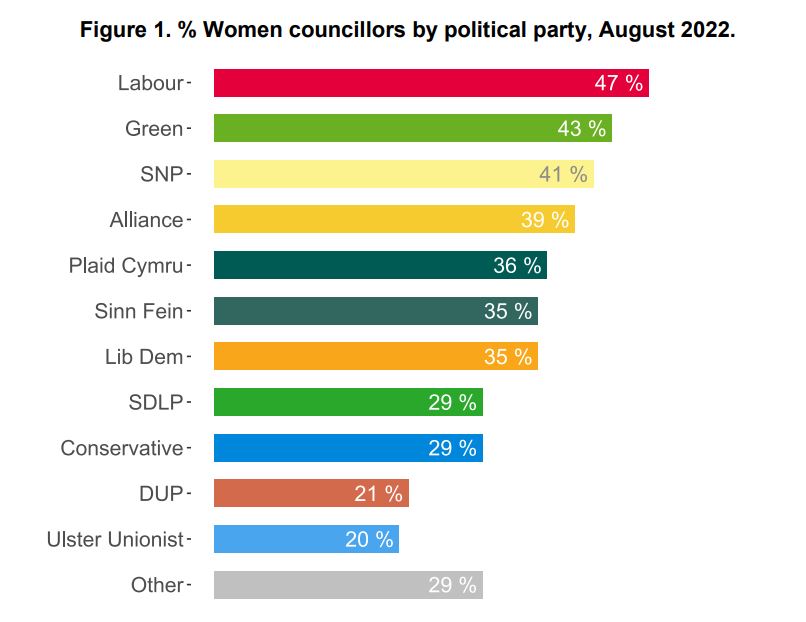
The Fawcett Society / Democracy Club results show no party yet has parity of representation between women and men, but some are doing much better than others.   The highest proportion of women is found in the Labour Party (47%) and the lowest in the Conservative Party (29%), the SDLP, DUP, and Ulster Unionist Parties. 

Source: Gender representation on local councils, Fawcett Society and Democracy Club (2022)

At individual council level, the highest proportions of women councillors were found in Haringey (65%), Rossendale (61%), Brighton and Hove (56%), Lewisham (56%), and Southwark (56%).  In contrast, Perth and Kinross, Pendle, Comhairle nan Eileen Siar and West Berkshire each have 15% or less of the council made up of women councillors.

One effect of having fewer women decision makers may be that issues that disproportionately affect women are given insufficient attention.  Policymakers play key roles in promoting status-based policies.

Recent research by Professor Francesca Gains (University of Manchester) and Professor Vivien Lowndes (Inlogov) published in the journal Politics & Gender in 2021 analysed the effect of Police and Crime Commissioner’s gender on policymaking around violence against women and girls (VAWG).  An earlier quantitative phase of their research found that policy prioritisation was linked to Police and Crime Commissioners’ own gender, with female PCCs twice as likely to prioritize VAWG.  Their later research analysed how this difference occurred, identifying ‘seven sets of rules that have shaped policy prioritization in favour of VAWG: the right to make key appointments; the requirement to set policy priorities; the obligation to utilize equalities duties; the power to commit resources; the expectation of partnership working with other agencies; the commitment to hold operational police officers to account; and the maintenance of diverse channels of contact with victims of crime and the wider public’ (Gains and Lowndes, 2022, p. 396).

To improve the situation, the Fawcett Society / Democracy Club report makes recommendations to government, political parties and local councils.  For councils, the key actions are:

  • implement parental leave policies, to make being a councillor more accessible to those with caring responsibilities;
  • ensure that caring and dependency allowances reflect the real cost of childcare and are accounted for separately from ‘main’ members’ allowance;
  • pilot alternative ways of working including online and hybrid engagement mechanisms to enable councillors with caring responsibilities to carry out their duties more effectively; and
  • adopt codes of conduct, based on the model developed by the LGA in 2020

Local councils can only be truly effective when they represent the communities they serve.  The Fawcett Society report is a timely reminder that we have a long way to go, but the first steps are clear and practical.

Jason Lowther is Director of the Institute for Local Government Studies (INLOGOV), University of Birmingham

Reference

Gains, F. and Lowndes, V. (2022) ‘Identifying the institutional micro-foundations of gender policy change: A case study of police governance and violence against women and girls’, Politics & Gender, 18(2), pp. 394-421.