International Women’s Day and Britain’s gender gap of shame

Sunday sees the 107th celebration of International Women’s Day (IWD), and for the 102nd year on March 8. It’s a longer history than is often supposed and, reflected in its still occasionally used Leninist title – International Working Women’s Day – a more socialist one. There were conspicuous exceptions, but the West as a whole didn’t really latch on to it until, following International Women’s Year in 1975, the UN proclaimed March 8 as the UN Day for Women’s Rights and International Peace and started increasingly to badge and orchestrate it.

That’s fine for those countries where it’s a public holiday, and for those who don’t celebrate Mother’s Day until early May. We, though, link that American creation to Mothering Sunday and the traditional Christian practice of visiting one’s mother church on the fourth Sunday in Lent (March 15 this year). There’s the risk, therefore, particularly when you throw in Valentine’s Day, of IWD morphing into another of those fluffy Spring days when women get a bit of a day off, like domestic servants of yore, and maybe a meal out.

With this in mind, I thought I’d do a quick check on who was doing what in furtherance of the cause. First – partly because they’re doing it literally as I’m typing (Thursday 5th a.m.) – MPs (well, some of them) are debating IWD-related matters in the Commons Chamber, thanks to an initiative from the Backbench Business Committee. Less fleetingly, the Commons Library has produced one of its invariably informative Briefing Notes on IWD itself and women’s equality generally, with some excellent data and references, including some examined later in this blog.

I then googled ‘IWD local government’ and immediately discovered that the first week in March was ‘Women in Local Councils Week’ – which sounded really admirable, until I realised it was in Northern Ireland; oh yes, and in 2012. Not this year apparently, and nothing either on the LGA website. So it was up to individual councils, of which the most prominent (if you live in Birmingham, you’d almost guess this) was Manchester.

You have to admire them: first Combined Authority, by a distance; centre of Chancellor George Osborne’s ‘Northern Powerhouse’; a specially tailored, top-of-the-range Devo Manc devolution package; and only last week a ground-breaking health and social care spending deal.

For IWD, the city council’s website has a classy-looking IWD page, its own IWD theme – ‘Breaking Through’ (snappier, certainly, than the UN’s ‘Empowering Women – Empowering Humanity: Picture It!’), its own annual IWD awards, plus a comprehensive listing of events.

But then, in addition, it has the chutzpah to claim itself as “the birthplace of women’s suffrage in the UK” – yes, of the whole suffrage movement, rather than, presumably, of the Women’s Social and Political Union at the Pankhursts’ Manchester home as late as 1903. Even the Manchester Suffrage Committee (1867) was preceded by Sheffield’s (1851); and what about Jeremy Bentham’s persistent advocacy, the 1832 and 1835 Acts that gave at least some women the actual right to vote, etc.? So, come off it, Manchester, don’t be greedy!

There was another surprise on the IWD website itself – that, of the 1,000+ IWD ‘events’ already registered, the UK will be contributing virtually twice the number of any other single country, the US included. Not all are happening this weekend; indeed, in the date-ordered listings the first actual IWD event doesn’t appear until page 17 – “A Gathering of Goddesses, celebrating ourselves, all women and Mother Earth” at The Hurlers stone circles in Cornwall.

Sadly, one thing the Goddesses won’t be celebrating is this country’s narrowing gender gap – because it isn’t. Over the past decade, according to the best comparative data available, the UK’s overall gender gap hasn’t closed at all in absolute terms. Judged alongside some 120 other countries, the relative gap has widened, as it has on all major sub-indexes, on some of which it has widened absolutely.

The instrument that measures these things is the World Economic Forum’s Global Gender Gap (GGG) Index, the 2014 report of which is its 9th annual edition.

Being an index, its principal interest is less in actual levels than in the gaps between men and women in four main categories (sub-indexes). Economic Participation and Opportunity records labour force participation rates, remuneration, and career advancement. Educational Attainment is about access to primary, secondary and tertiary education. Health and Survival combines sex ratios at birth – to capture internationally the phenomenon of ‘missing women’ – and healthy life expectancy. Political Empowerment compares the ratios of men and women in ministerial and parliamentary positions.

In all indexes, the highest possible score is 1 (equality) and the lowest is 0 (inequality), although in my own adaptations I prefer to lose the decimal points and percentagise the proportion of the possible 100% gender gap that’s been closed.

And the UK’s embarrassment, particularly on International Women’s Day, is that since 2006 our overall gender gap hasn’t closed by a single percentage point. In my graph, 74% of the gap was closed in 2006, and in 2014 it was still 74%, our ranking having dropped from 9th to 26th.

gender graph

Meanwhile, all sorts of countries had overtaken us – not just the US and the volatile French, but from parts of the world one wouldn’t necessarily expect: Nicaragua (6th), Rwanda (7th), the Philippines (9th), Latvia (15th), Burundi (17th), Bulgaria (22nd), Slovenia (23rd) and Moldova (25th).

As already indicated, there’s not much to celebrate in any of the indexes, but naturally some make less embarrassing reading than others. In education, for example, we have a rare sub-index measure of more than 1.00 – a 1.36 female-to-male enrolment ratio in tertiary education – although it’s more than cancelled out by a 0.94 ratio for primary education.

Two sub-indexes are particularly gloomy. On none of the five Economic Participation measures is the UK ranked even as high as 45th, with ratios for career advancement of 0.52, for estimated earned income of 0.62, and wage equality for equal work of 0.69. And a Political Empowerment graph would look very similar to the overall one, the key difference being that the UK’s purple line of shame this time would signify an actual widening of the gender gap, with our ranking plummeting from 12th in 2006 to 33rd.

As we approach the election, our ratios of women in parliament and in ministerial positions are 0.29 and 0.19 respectively – compared, for instance, to Denmark 0.64, 0.83; Finland 0.74, 1.0; South Africa 0.81, 0.59; and Rwanda 1.0, 0.65. Of which the best that can be said is that at least the bar for the next lot to try to jump is set pretty low.

Chris Game - pic

Chris Game is a Visiting Lecturer at INLOGOV interested in the politics of local government; local elections, electoral reform and other electoral behaviour; party politics; political leadership and management; member-officer relations; central-local relations; use of consumer and opinion research in local government; the modernisation agenda and the implementation of executive local government.

What is local government for?

Howard Elcock

Do we know what local government is for? Is it just a device for providing services to people at the behest of the central government, or does it provide local citizens with a means of making policy choices about what they want their councils to do? In the 19th century John Stuart Mill and Charles Toulmin Smith debated this issue, with Mill taking a centralist view that local government is an agent acting for the centre and a training ground for would-be Parliamentarians, while Toulmin Smith argued that local authorities are and must be elected bodies chosen by local people to make local choices on their behalf(Chandler, 2007), a view echoed by Professor John Stewart (1986).

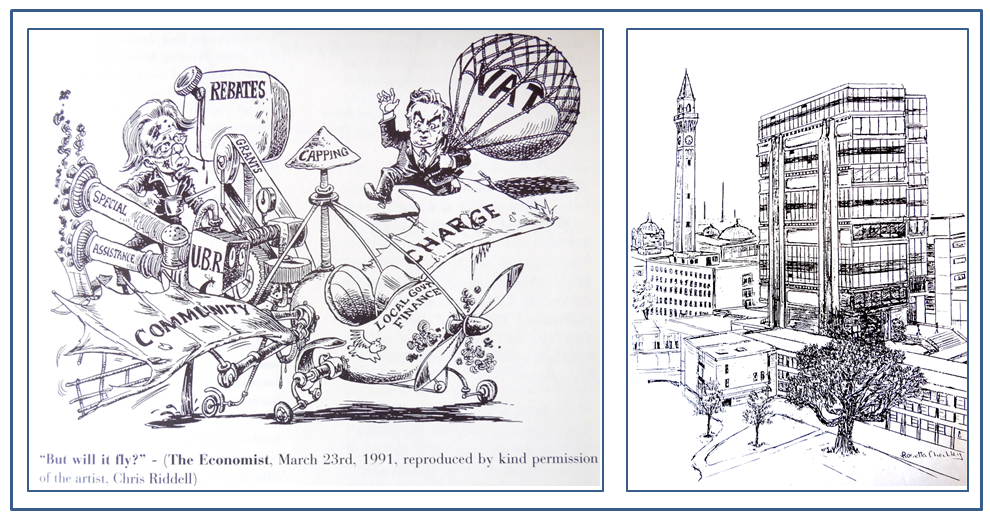
Today local authorities are much too dependent on central government to be able to make major local choices. In 1976 the Layfield Committee said that if central government provided more than 40 per cent of local authority funding, this would make local councils excessively dependent on the centre. Today that proportion is between 70 and 80 per cent as a result of rate capping, the bitter legacy of the Poll Tax and incremental funding decisions to support local services with central grants. Beyond all this, local authorities are dependent on Westminster and Whitehall for their very existence, as has been demonstrated by repeated and largely enforced reorganisations imposed on local government by Parliament since 1972.

The role of local government can be discussed in terms of its five purposes. The first is to represent the different political balances in different parts of the country. In England this has become an acute issue as a result of the recent Scottish independence referendum because devolution for England is being discussed partly in terms of proposals such as “English votes for English laws” and the creation of an English Parliament that treat the country as a unit and ignore the major differences in the economic interests and political balance between the North and the South-East, which ought to be reflected in any proposals for constitutionals change. Enhancing the autonomy of local authorities would be one way of achieving this.

Secondly, councillors are the only elected representatives apart from Members of Parliament who can hold public servants to account on behalf of their electors. Thirdly, local authorities can adopt varied methods of providing local services which may provide models for other public authorities to copy. Fourthly, local authorities provide responsive and accessible services that can be sensitive to local needs and wishes – something the central government with its responsibility for 60 million citizens cannot hope to achieve. Lastly, local control of certain activities has long been regarded as a defence against tyranny. For example, the local control of police forces ensures that the central government cannot enforce its policies on the control of public order without persuading local police forces to comply with its demands. Again, the dispersed ownership of computer systems may provide a protection against an all-knowing and all controlling central state.

However, all these purposes are in danger of being diluted or even lost as a result of excessive central control. The diminished powers of local authorities mean that they are not able fully to represent the views and interests of their local citizens. Secondly, their ability to hold public servants to account has been weakened by the creation of increasing numbers of non-departmental public bodies (“Quangos”) with no local and tenuous national accountability to elected representatives, as well as by the enforced privatisation of local services including care homes. Thirdly, local initiatives are stifled both by financial restrictions and excessive regulation, especially through target setting by Whitehall departments. Fourthly local government has been made less local by the creation of smaller numbers of increasingly large units of local government, especially unitary authorities that cannot easily identify and respond to the concerns of local communities within their wide areas. Lastly, central control over public services has been increased by financial constraint, reorganisation and over-regulation, thus increasing central control even over services such as policing where local control is an important bulwark of democracy and accountability, which has not been significantly reversed by the 2011 Localism Act (Jones and Stewart, 2012).

It will take bold Ministers and a collective commitment by the central government to reverse these trends, particularly because the Treasury will be staunchly resistant to an effective programme of renewed devolution of powers and functions to local authorities. Such a programme would have to include an end to council tax capping, the introduction of new sources of local revenue such as a local income tax together with the reduction of central government grants towards the 40 per cent limit recommended by the Layfield Committee. This must be accompanied by renewed creation of truly local democracy by strengthening the powers of parish and town councils and securing their creation where they do not now exist. The dead hand of central regulation and target setting must also be relaxed. Lastly, the rights, duties and powers of local government must be guaranteed under a written Constitutional settlement. I fear that this is too big an agenda for any of our political parties to cope with.

References

Chandler, JA, (2007) Understanding local government, Manchester, Manchester University Press

Jones, G and JD Stewart (2012): “Local government: the past, the present and the future”. Public Policy m& Administration, volume 27, no. 4, pp. 346-367

Layfield Committee (1976): Local Government Finance, Cmnd 6453, London, HMSO

Stewart, JD,(1986): The New Management of Local Government, London, G Allen & Unwin

DSCF5376_Elcock_small

Howard Elcock is Professor (emeritus) at Northumbria University. He is author of Administrative Justice (1969), Portrait of a Decision: the Council of Four and the Treaty of Versailles (1972), Local Government (three editions 1984–1994) and Political Leadership (2001). His current research includes political leadership and elected mayors; local democracy; and the ethics of government.

The future is analogue – confirms local government’s Honey Man

Chris Game

Of all the reactions to Northamptonshire County Council’s controversial ‘Next Generation Model’ – abandoning service provision in favour of outsourcing everything to ‘specialist social enterprises’ – few can have been as measured and dispassionate as my colleague Ian Briggs’ reflections on the merits or otherwise of Public Interest Companies (PICs).

Personally, it came as a bit of a blast from the past. Typing that opening paragraph, I really couldn’t recall when I last consciously thought about that particular three-letter initialism that once seemed to feature in a good proportion of my lectures. Especially following the 2004 Companies Act, PICs were ubiquitous, and taxonomising them – and/or CICs (Community Interest Companies) – quite a fad: national and local, companies limited by guarantee, industrial and provident societies, limited companies owned by service users, unincorporated associations, social firms, share trusts, mutuals, co-operatives.

So, rusty as I am, I admit to being curious about how Northamptonshire’s down-sizing vision works out once it leaves the drawing board. This blog’s concern, though, is not Northamptonshire’s or any other single council’s future, but that of English local government as a whole – which, in a neat triad of happenstances, was also addressed last week, in the final report of the Independent Commission on Local Government Finance (ICLGF), Financing English Devolution.

The third part of the triad, unfortunately, is directly relevant only to those of us residing within reach of Birmingham’s fine Repertory Theatre, which also last week staged a highly successful production of Tyrone Huggins’ play, The Honey Man. So, three disparate events from which, if you’ll bear with me, I’ll attempt to draw a coherent theme.

The ICLGF was established by the LGA and CIPFA, and is chaired by Darra Singh. The former chief executive of Ealing and Luton Councils bears little physical resemblance to the St Kitts-born author/actor Huggins, but, if his report has the transformative impact he obviously hopes, he could reasonably claim in, say, a decade’s time, to have been English local government’s Honey Man.

Digitals see the world in terms of ones and zeros, black and white, right and wrong answers, clearly defined systems. Analogues understand and deal in approximations, probabilities and muddle, 50-plus shades of grey.

Successive governments – ministers and civil servants both – have tried for years to run local government as a single, centrally controlled, one-size-fits-all digital system. ‘Honey Man’ Darra Singh’s message is that, while local services will be delivered increasingly digitally, the delivering ‘system’, insofar as there is one, will be increasingly analogue.

Huggins’ Digital Projects have not been that extensively performed. Even so, it would be hard for their collective impact to have been any less than that of the first three efforts in the Local Finance Reform Quartet: the Layfield Committee (1976), the Balance of Funding Review (2004), and the Lyons Review (2007). All three started from the premiss that the status quo is unsatisfactory – lacking transparency, fairness, balance, and accountability – and major reform vital. Yet all were either ignored or, in Lyons’ case, attacked and effectively rejected by ministers within hours of publication.

This time, the reflex rubbishing was administered by Local Government Minister Kris Hopkins, who immediately dismissed the Commission’s proposals for local areas to determine the number and value of council tax bands, and for tax increase referendums to be abolished.

No change there, then – and clearly there won’t be from the present Conservative-led coalition. The question is whether the new lot after May accept that this time the Commission really isn’t crying wolf: that the future now facing many, if not most, councils – severely less money, increasing and more complex service demands, and cripplingly limited scope to raise additional revenue – really has regressed from unsatisfactory to unsustainable.  And recognise too that, following core grant cuts of 40%, radical reform is no longer urgent but imperative – if, that is, anything resembling a viable, democratically accountable, service-providing local government sector is to have a future.

There is of course, and always has been, an alternative: the wholly Contracting Council, famously envisioned in the 1980s by Conservative Environment Secretary Nicholas Ridley as meeting once a year to award all the council service contracts to private firms. A number of councils in recent years have gone some way down that road – most notably perhaps Suffolk and Barnet – and now Northamptonshire is preparing to go a good deal further.

Northamptonshire County Council, employer ten years ago of nearly 20,000 full- and part-time staff, plans in future a workforce of 150 max, with services formerly provided by the council or by council-run companies and partnerships being commissioned from external organisations: a Children’s Services Mutual, an Accountable Care Organisation for vulnerable adults, a Wellbeing Community Organisation, and a Place Shaping Company “to deliver services to improve Northamptonshire as a place”.

It’s analogue service provision alright, and pioneering, but not in the quite the form the Commission’s final report sets out. Nor last October’s interim report, although, reflecting the quite startling speed with which events have moved since the Scottish independence referendum, the two documents do have differing emphases.

The interim report, Public Money, Local Choice, underlined the need for council tax reform and for a desperately overdue property revaluation and banding revision.  But the headlines it earned were all about how, through full – rather than the present partial – retention of business rates and appropriate ‘equalisations’ between richer and poorer councils, English local government could by 2018-19 become financially self-sufficient and independent of central government grant funding.

There was an interim vagueness about how these equalisations would be managed, and a somewhat cavalier assertion (p.18) that “there is less disparity in wealth between the different parts of the country than in often assumed.”  The brief equalisation discussion, though, like the report generally, focused on individual local authorities, even down to numbers of toppers and toppees: “On 2018-19 projections, self-sufficiency would require 247 councils to ‘top up’ 106 councils. Most of this could be managed through transfers between councils in the same area.”

There was a passing reference to Combined Authorities perhaps playing a part in this redistributive process, but otherwise no mention of these institutions that since then have so dominated local government discourse – while the Pioneer Authorities that take centre-stage in last week’s final report weren’t even embryonic.

The Commission’s blueprint isn’t as immediately arresting as Northamptonshire’s and its timescale is inevitably longer. But, if even substantially implemented, the shift of the central-local balance from Whitehall and Westminster to English cities and regions would be profound. Following a 10-year devolution programme, more than £200 billion of annual public spending would be controlled at ‘sub-national’ level – or twice the current total of English local authorities’ net revenue service expenditure.

The key analogue feature of the Commission’s programme is what tekkies would call its two- or variable-speed gearbox. All councils would have multi-year funding settlements, freedom to set council tax and tax discounts, and would retain 100% of business rates and business rate growth.

But there would also be ‘Pioneer’ authorities: combined authorities wishing and judged able to reform at a faster pace. These could vary council tax bands and undertake their own revaluations, have access to new or devolved taxes like stamp duty, tourism and airport taxes, and, most significantly, would control single place-based budgets covering a full range of public services, including transport, community safety, and – starting already with Greater Manchester – health.

As the Honey Man’s Commission notes, the analogue principle of variability has already been established, with city deals and devolution packages to Combined Authorities. These latter are clearly the key – which is why the honey coming the way of Birmingham and the West Midlands so far has been mostly the unblended stuff, while Greater Manchester is already onto the organic.

Chris Game - pic

Chris Game is a Visiting Lecturer at INLOGOV interested in the politics of local government; local elections, electoral reform and other electoral behaviour; party politics; political leadership and management; member-officer relations; central-local relations; use of consumer and opinion research in local government; the modernisation agenda and the implementation of executive local government.

An earlier, more Birmingham-focused version of this blog appeared in The Chamberlain Files.

All eyes on Manchester

Catherine Needham

If you live in Birmingham, like I do, you could be forgiven for feeling slightly green-eyed at what is going on in Manchester at the moment. After the unprecedented devolution package that the city secured at the end of 2014, it has today been announced that Greater Manchester will be given complete control of its £6 billion NHS budget.

This means that Greater Manchester, led by a directly elected mayor, will have control of the budgets for social care; GP services; mental health; and acute and community care, as well as public health. There is clearly enormous potential here for the Manchester region to make integrated health and social care a reality. Whilst the dust settles on the details of the new arrangements, there are a few issues to consider:

  • There are increasing calls for integration to be at the level of the individual rather than the system, to avoid some of the problems of previous attempts at structural integration such as Care Trusts. Further structural reorganisation will also be resisted by local NHS bodies, still recovering from the Lansley reforms. Can the region be imaginative in its approach to integration, and learn lessons from what has worked and not worked in the past?
  • A new Greater Manchester Health and Wellbeing Board is being created to oversee the budget. Health and Wellbeing Boards are increasingly seen as the host for tackling all sorts of complex health and social care issues, and researchers at the University of Manchester have warned of placing ‘unrealistic expectations’ on the ability of boards to deliver on these agendas.
  • Will the notoriously centralised Department of Health really be willing to let go control on such a grand scale? Who will bear the reputational risk when problems occur?
  • The success of directly elected mayors has been distinctly mixed where they have been tried elsewhere in the UK. In the Greater Manchester context, where a mayor has been forced on the region by Whitehall, how likely it is that there will be sufficient public interest and support for the role to make the holder of the office a dynamic political force?
  • Does the announcement signal the end of the National Health Service, and if so should we mourn its passing? Local political control is very attractive in what has previously been such a centralised state, and is clearly in line with what is happening in Scotland and Wales already. However fragmentation brings the inevitability of postcode lotteries and the need for a robust political response to such differences, but it may also create new entry points for other political agendas, such as an increase in privatisation.

It must be a very exciting time to live in Manchester, although the role of pioneer can also be a rather exposed and risky place. Let’s hope that Birmingham and the other core cities can watch, learn from what’s worked and what hasn’t, and be ready soon to work with their own near neighbours to secure more local control.

needham-catherine2

Catherine Needham is Reader in Public Policy and Public Management at the Health Services Management Centre, University of Birmingham, and is developing research around public service reform and policy innovation. Her recent work has focused on co-production and personalization, examining how those approaches are interpreted and applied in frontline practice.  Follow Catherine on Twitter: @DrCNeedham.

This blog can also be found here on the Health Services Management Centre’s website

Getting to Grips with Public Interest Companies

Ian Briggs

The recent announcement by Northamptonshire County Council heralding a move towards a ‘next generation model’ where four public interest companies are to be established to deliver front line services and leaving a core client organisation of around 150 employees adds to the growing number of councils (and other parts of the public sector) who are seeking to adopt this model. What is interesting here is that is goes far beyond the tired rhetoric of what is best, direct public provision or privatisation? The establishment of what are increasingly referred to as ‘public interest companies’ (PIC’s) has been slowing gathering pace in recent years, often quietly and tentatively by local authorities who may seek cost and value advantages in working with arm’s length bodies but wish to retain certain controls whilst at the same time offering freedoms to compete in open markets.

There may be a longer history to this model of provision than many may believe; however this approach does beg some interesting questions and exposes the relative lack of research and meaningful data as to the overall efficacy of the approach. Near the top of the list has to be what might this do to the market for services? Putting a potentially highly efficient, skilled and savvy organisation into the market place might be seen as a threat to any commercial provider who currently occupies part of this market space.  The example of an East Anglian council who established a comparatively small arm’s length company to manage property services some years ago has grown into a successful organisation that operates in many parts of the UK, trading services within a growing number of public and commercial clients. The efficiency returns for the growing number of public sector clients will be welcomed but it can potentially have the effect of diminishing the returns of existing commercial organisations – there may be no inference at all that the trading position is in any way illegal but where staff are transferred to public interest companies they do so with a great deal of knowledge and intelligence as to what both the client and community requirements are that can be both difficult and expensive for a commercial provider to obtain.

The second interesting question is one that can be summed as ‘mind-set’. The strategic leadership of public interest companies face unusual challenges; given that the shareholding is exclusively within the public sector that shareholder will have more than just an economic interest in success, it can and does demand more than economic viability. It must ensure that the needs of the public are met and that the social value of delivery matches the economic value, something that it can be argued is not always present in wholly commercial shareholdings. Reconciling this is a new challenge for those within PIC’s. In most recently established PIC’s most of not all staff are being transferred over from the public sector and work has to be undertaken to develop a mind-set that meets the challenge of delivering to a commercial agenda as well as a public one. Failing to do this successfully can be handicap hard to overcome and may be ultimately a cause of commercial failure. This leads to the third and crucial question. Even with a small and proficient client organisation are there the right skills there to create the conditions to enable the next generation model to prosper and provide successfully for the communities served? If the right depth of commercial analysis has been undertaken and the politicians driving the new model are confident that the model and market is correct are they able to act as an intelligent shareholder on behalf of the community? It may be no good having a fresh, hybrid mind set within the PIC if it is not matched with understanding and the correct support from the client organisation. Getting beyond a vanity decision and having a realistic expectation that anything as new as a next generation model provider will need a bedding in period to operate within the tensions between a commercial market and public expectation requires tolerance and understanding of councillors and senior managers.

With a growing number of councils actively exploring this approach there may be a lesson for those who are dithering – being late to the game could leave no space to enable PIC’s to be established as your neighbour has done it for you! Whatever direction this takes it is perhaps one of the most fundamental shifts we have seen since the days of CCT, no longer public bad – private good but a half-way house creating demands for new skills both within PIC’s and in slimmed down intelligent clients. Get in wrong on either side of this equation and retrieval could be more problematic than getting off the ground in the first place. That a growing number of PIC’s are already out there quietly getting on with it may suggest that the decision Northamptonshire has taken is not merely brave but one that is based upon sound good sense.

briggs

Ian Briggs is a Senior Fellow at the Institute of Local Government Studies. He has research interests in the development and assessment of leadership, performance coaching, organisational development and change, and the establishment of shared service provision.

Pickles’ Shock-horror News: Biggest Councils Have Biggest Tax Arrears

Chris Game

Communities and Local Government Secretary Eric Pickles is famed for his sensitive news antennae. I wonder therefore just what – in a week dominated by revelations of his party’s and government’s moral flakiness on the whole tax collection business – persuaded those antennae that it would be a good time to attack local authorities’ tax collecting record.

Actually, I don’t wonder.  I assume that, as with the many other Pickles’ Passions – from council newspapers and biscuits at meetings (bad) to street parties and weekly bin collections (good) – he just can’t stop himself.

Councils’ uncollected taxes and hoarded revenue reserves have become Pickles’ winter perennials – a reassuring sign of approaching spring – and three league tables of the supposedly guiltiest councils were duly posted by the DCLG last Tuesday.

As a Birmingham City Council taxpayer, I was naturally interested to note that Birmingham featured prominently on two of these naughty lists – first of the 10 councils with highest council tax arrears, and fourth of those with highest non-ringfenced reserves – and, to be honest, slightly surprised that it didn’t register at all on the third. Doubtless to the minister’s disappointment, DCLG hadn’t found a single “surplus fixed asset, not directly occupied, used or consumed in the delivery of services”.

There’s no attempt to percentagise these lists, or acknowledge that there might just possibly be some relationship with, say, the size or relative deprivation of councils’ populations.  So Pickles’ shock-horror story amounts to large councils having bigger tax arrears, reserves, etc. than small councils.

It’s hardly headline stuff, but Local Government minister, Kris Hopkins, was determined we should share his boss’s outrage. During that same day’s Commons debate on the recent local government finance settlement, my and the University’s Birmingham, Edgbaston MP, Gisela Stuart, had questioned the fairness and sustainability of Birmingham’s share of that settlement. In customary Commons style, the minister, rather than answer that tricky question, preferred to tell the House about the council’s tax arrears:

“I am afraid that poor leadership in Birmingham and the fact it has not collected some £100 million in council tax arrears may explain some of the issues it is facing. Stronger leadership and the ability to carry out the simple function of placing a charge on an individual and collecting it will assist it” (col.671).

In the heat of the moment, Hopkins omitted to explain that this arrears figure was a cumulative one covering the whole 21-year life of the council tax, or that it includes costs incurred in collecting unpaid taxes. Nor, even more unfortunately, was there time for Gisela Stuart or anyone else to observe that the biggest councils have not only the largest cumulative tax arrears, but also, equally unsurprisingly, the largest tax receipts.

For, by Hopkins’ reasoning, Birmingham’s having collected £63 million more last year in council tax and non-domestic rates than any other English authority outside London presumably reflects rather positively on the quality of its political leadership (Table 5).

Returning from Planet Hopkins to the real world, the key statistics – and they are key – are those for tax collection rates: not pounds collected but percentages collected of the total sum due.

The 2013-14 council tax collection rate for all English authorities was 97%, ranging from shire districts’ 97.9% to 95.4% for Inner London boroughs and Birmingham’s most obvious comparators, the 36 metropolitan districts. Birmingham’s 95.3%, therefore, was fractionally below the met district average, but, as it happens, second highest among the 10 large authorities in the DCLG’s naughty list – behind only Croydon (96.2%) and way ahead of the coalition’s current favourite Labour council, Manchester (91.7%).

Certainly not the disgrace, then, that its heading of the naughty list suggested, but yes: both improvable and costly. If ever decimal places matter, it’s here. Though respectable nationally, Birmingham’s 95.4% collection rate was lowest of the seven West Midlands metropolitan districts – behind Solihull (98.6%) and, in a perhaps less expected second place, Sandwell (98%), ranked 9th most multiply deprived of England’s 326 local authorities against Birmingham’s 13th.  With each percentage point worth nearly £3 million, if Birmingham had achieved even Sandwell’s rate, it would have collected an additional £8 million – and a similar sum each year.

The DCLG’s non-ringfenced reserves naughty list is even more contestable. There is no set or professionally agreed formula for an ‘appropriate’ level of reserves, or for the balance between earmarked/ringfenced and unallocated reserves. But when CIPFA (Chartered Institute of Public Finance and Accountancy) asserts that councils increasing their cash reserves “is essential for protecting frontline services” and finance officers advise that, with council funding over the next few years being exceptionally uncertain, it’s only prudent to set aside reserves in anticipation, it’s hard for councillors – and should be for Pickles – to argue otherwise.

Birmingham’s prominence on this particular list – again, a consequence of its sheer size – is just perverse, given repeated warnings by the council’s external auditors about the councils’ reserves being, if anything, too low. In fact, last month’s Annual Audit letter noted specifically a concern regarding the “relatively low levels of general fund reserves (£85.8 million compared to a revenue budget of £3.5 billion)” (p.7).

Returning to tax collection, if there are numbers of individual councils that find it difficult to, as the minister put it, “carry out the simple function of placing a charge on an individual and collecting it”, what should we make of Her Majesty’s less than exhaustively tenacious Revenue and Customs (HMRC)?

One of HMRC’s helpful ancillary services – or hostages to fortune – is its annual report detailing all the taxes it doesn’t collect: in 2012-13 just the £34 billion – or 6.8% of the total it should have managed.  In other words, all but the very worst council tax collection rates exceed the average managed by the people whose sole job is tax collection.

If we take that most “simple function” of individual taxation, English local authorities failed to collect £734 million (3%) in council tax, while HMRC failed to collect £14.2 billion (5.3%) in income tax, NI contributions and capital gains tax. From businesses, councils failed to collect £478 million (2.1%) in non-domestic rates, while HMRC failed to collect £12.4 billion (10.9%) in VAT, and £3.9 billion (8.7%) in corporation tax.

As Matthew, the Galilean tax collector-turned-gospeller, might have put it: You hypocrite, Pickles; first take the plank out of your own eye, and then you will see clearly to remove the speck from your brother’s eye.

game

Chris Game is a Visiting Lecturer at INLOGOV interested in the politics of local government; local elections, electoral reform and other electoral behaviour; party politics; political leadership and management; member-officer relations; central-local relations; use of consumer and opinion research in local government; the modernisation agenda and the implementation of executive local government.