Inter-municipal Cooperation is the key to better environments in our cities.

Victor Osei Kwadwo

The 2021 United Nations Climate Change Conference (COP26) aims at “Uniting the World to Tackle Climate Change”. While the technical aspects to addressing climate change is more evident in the goals of COP 26, it is time attention is equally paid to the governance of climate change at the metropolitan scale made up of our major cities.

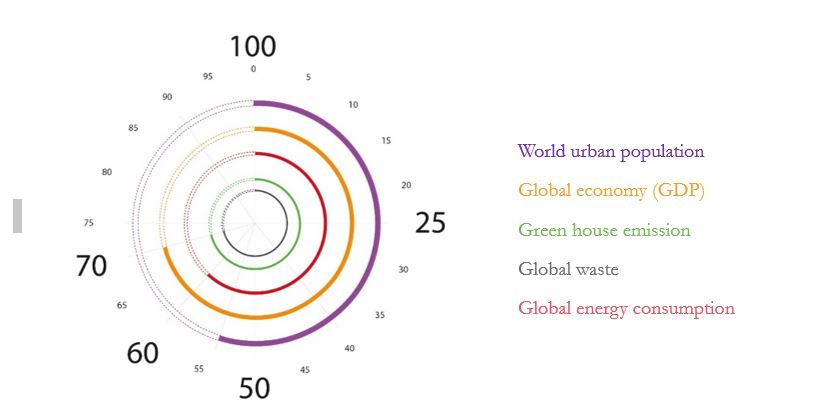
Due to rapid urbanization, the world is increasingly becoming metropolitan. Cities have expanded outwards and have become more interdependent with their immediate peripheries. Cities occupy only approximately 2% of the world’s total land yet host 54.5% of the world’s population. Cities are responsible for 70% of the world’s GDP, over 60% of global energy consumption, 70% of global greenhouse gas emissions, and 70% of global waste.
As cities agglomerate, the footprint and interdependence within and between cities blur existing administrative boundaries to the extent that development issues in one local government jurisdiction have spillover effects on neighbouring jurisdictions. These spillover effects have led to a call for cooperation on functional grounds, making metropolitan areas a salient scale for public policy interventions. Metropolitan areas such as Cape Town, London, Mexico City, São Paulo and Tokyo are mainly characterised by densely inhabited functional urban areas and their surrounding interconnected lower-density areas.

In the management of metropolitan areas, for instance, many cities in the USA, Greater London, Brussels, Dar es Salaam and Greater Accra, the joint provision of metropolitan-wide services or jointly addressing a cross-boundary problem is an explicit choice of local governments that make up the metropolitan area. This voluntary nature of cooperation poses a collective action dilemma when local governments have to address problems jointly.

The dilemma arises from the externalities of environmental outcomes that drive low incentives for cooperation and a high risk of free-riding. To find joint solutions to cross-boundary problems in metropolitan areas, inter-municipal cooperation (IMC) is identified as critical for better economic and environmental outcomes in service delivery. There is empirical evidence that inter-municipal cooperation saves costs but does it also improve environmental outcomes?

Governments tend to be reluctant to cooperate when environmental outcomes are at stake, and this is partly due to the limited evidence on the impact of cooperation on environmental outcomes. It is therefore important to provide an evidential basis on which local governments can justify and initiate cooperation arrangements to address environmental concerns jointly.

In a study I co-authored with Tatiana Skripka, we provide this evidence using data covering 229 metropolitan areas in 16 OECD countries. The study tests the impact of cooperation in transportation on CO2 transport emissions. We did this by estimating a three-level mixed-effects model that takes into account both national and metropolitan-specific characteristics.

The results demonstrate that if local governments cooperate, better environmental outcomes can be achieved. Metropolitan areas that worked together on transportation issues were able to reduce CO2 transport emissions.

The findings give an indication of what needs to be done to effectively fight the environmental challenge. More significantly, beyond normative predictions, the findings provide a basis for local governments to justify and pursue local to local partnerships to address environmental issues.

What we measured

We used “working together on transportation” as a measure of cooperation and “CO2 transport emissions” for environmental outcomes to estimate the impact of cooperation on CO2 transport emissions reported in 2000, 2005 and 2008 for 229 metropolitan areas in 16 OECD countries.

We accounted for factors such as the year of observation, economic status, socio-cultural, geographical, technological and governance measures such as mitigation policies, enforcement, and metropolitan structure. The factors covered both the national and metropolitan area-specific characteristics: socio-cultural conditions, level of technology, geography, and metropolitan governance structure. We used data from the OECD metropolitan governance database, the OECD Metropolitan Governance Survey, the World Bank, among others.

Key findings

We found that metropolitan governance structures, whether fragmented or consolidated, are equally inefficient in delivering reduction in CO2 transport emissions. The finding contrasts with an increasing trend of scholars advocating for fragmented metropolitan structures that favour voluntary cooperation, compared to consolidated structures that address collective action problem through coercion.

We also found that countries with a higher GDP were more efficient in reducing CO2 transport emissions. In contrast, metropolitan areas with higher GDP recorded increases in CO2 transport emissions. While national funding can dictate climate-related interventions and standards, metropolitan wealth is more flexible in taking on such obligations. As metropolitan areas are mainly production centres, investments in environmentally-friendly interventions may be more easily sacrificed at the metropolitan level for economic gains.

We further found that CO2 transport emissions increase despite the mere presence of environmental mitigation policies. This is consistent with empirical observations. For example, while the Paris Agreement has 196 Parties adopting to limit global warming to less than 2 degrees Celsius, emissions have continued to rise globally by 1.4 per cent per year on average since 2010. Environmental policy effectiveness lies in the ability of the cooperating parties to ensure widespread policy implementation and enforcement.

The crucial factor explaining the reduction of CO2 transport emissions in metropolitan areas is inter-municipal cooperation that facilitates coherence and widespread enforcement of mitigation policies. The impact of cooperation on CO2 transport emissions is magnified in metropolitan areas within countries that have stringent environmental mitigation policies.

Next steps

Inter-municipal cooperation (IMC) is critical in the governance of metropolitan areas if better environmental outcomes are to be achieved in our cities. Cooperation ensure policy uniformity, facilitates the possibility of widespread enforcement and reduces incentives for free-riding irrespective of governance structure. It is recommended that scholars and policymakers emphasise how to incentivise effective cooperation regardless of the metropolitan governance structure. Also, efforts must be geared toward uniform mitigation policies and their subsequent enforcement across local jurisdictions in metropolitan areas.

Read the full paper here

https://www.tandfonline.com/doi/full/10.1080/03003930.2021.1958785

Victor Osei Kwadwo is a PhD fellow in Economics and Governance at UNU-MERIT and Maastricht University. He has broad expertise in political science, economics, and public policy with a special emphasis on urban governance and development. For his PhD, he explores how and why independent local governments cooperation arrangements emerge to address transboundary issues in metropolitan areas.
NOC NOC! Is anybody there – or are you all botching each other?

Chris Game

NOC – that’s what this blog’s about.  It’s prompted, like many I assume, by the topic being one the author has a ‘thing’ about – only here it’s two things. There, authorial duty done: you’ve now been warned.

The first ‘thing’, I’m guessing, originated with an enthusiastic primary school English teacher, keen for as many of us as possible to pass the 11+ or ‘grading test’ that would get us into grammar school. Anyway, it was when I probably learnt the crucial distinction between common abbreviations and what most of us interpreted even then as posher/middle class acronyms and initialisms.

Abbreviations – for the benefit, obviously, of non-native English speakers/readers – are simply shortened forms of words: approx, dept, tbs (tablespoon), etc.  Acronyms are the posh, clever ones – comprising the first letters of several words but pronounced as if they are words themselves.

Most famous in these parts is obviously INLOGOV – but not, sadly, the most structurally perfect, which must be CREES.  Outside academia my favourite, because I’d bet even some police users don’t know it, is TASER – Thomas A. Swift’s Electric Rifle.

So, to initialisms, which comprise the first letters of several words, but can’t be (or are bewildering if) pronounced as words themselves – and which are regularly and incorrectly called acronyms.

Like NOC, which – whether referring to a National Olympics Committee, a prescription treatment for scurvy, or, as here, an elected body under ‘No Overall Control’ – is always pronounced, and in the case of the scurvy tablets spelt, ENOCEE.   

The elected bodies are usually councils, but strictly speaking Scotland was under NOC until recently, when the Scottish Greens’ co-leaders became ministers in the Holyrood Government, creating a power-sharing SNP-Green coalition.

It’s true that NOC sounds less alarming than OOC (Out Of Control) would be, but it’s entirely unclear what it does signify.  It’s certainly unhelpful – but worse, I’d suggest, in being a positive deterrent to trying to learn more – in metamorphosing indeed into No One Cares.

As a recent description of Kabul, as Taliban militants seized rapid control from Afghanistan’s civilian government, NOC would for maybe two days max have been fair and accurate. But not thereafter.

Nor when used for months on end apparently to describe the political management and day-to-day running of constitutionally elected UK local government councils. That, I suggest, is both disappointingly unhelpful and misleading.

Immediately following an inconclusive local election, with no single party securing an overall majority of councillors, some uncertainty – even within the council – may be unavoidable. There may well follow perhaps a fortnight’s discussions within and between the various party groups and maybe Independents before the Annual Meeting, at which ‘Who Runs the Council?’ has to be officially determined.

Whereupon there should be public clarity. If previously there hadn’t been, through no single party having an overall majority of councillors, the Council should, surely, officially announce and publicly explain the new situation – the leadership, any agreement/working arrangement between parties, Cabinet composition, and so on – ideally in the local media and certainly prominently (within a couple of clicks) on its own website.

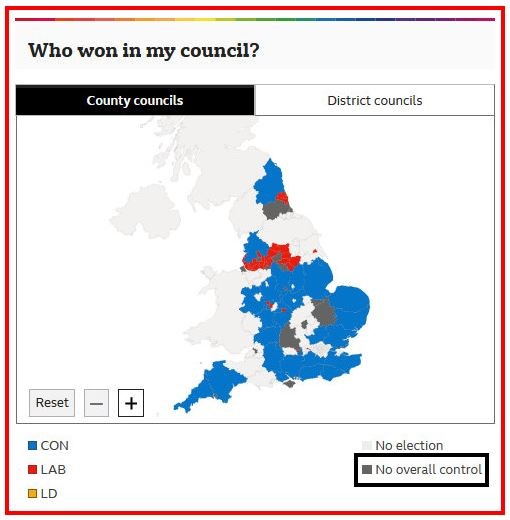
That way it would matter less that the BBC, for instance, can’t be troubled to update its ‘Elections 2021’ statistics or even to footnote news of the actual resolutions of the 29 blackish ‘No Overall Control’ splotches and dots on its English councils map

NOC map

Still, however – and despite my having mentioned it on numerous occasions, not least in these columns – some councils don’t.  And what really p****s – sorry, incenses me is that the process and outcome of these post-NOC negotiations are not just factually informative, but frequently rather more fascinating than the elections that brought them about.

Bear with me, please, while I try to illustrate with the ‘aid’ of said map – or at least reference to it. You will observe three large blackish splotches, which you might imagine would be the three – all geographically large – county councils that have been NOC since at least the May elections: Cambridgeshire, Oxfordshire and Cumbria.

Until you note that the top splotch is on the wrong side: not Cumbria, but Durham, which you may also know ceased being a county when in 2009 it became a unitary.  It did, however, produce surely the most historic result of this year’s ‘large’ authority elections, with Labour losing overall control of the council for the first time in over a century, and being replaced by a barely hyperbolic ‘rainbow’ coalition of the Lib Dems, Conservatives, Independents, and the North East Party – led moreover by the Council’s first-ever female leader, Lib Dem Amanda Hopgood.

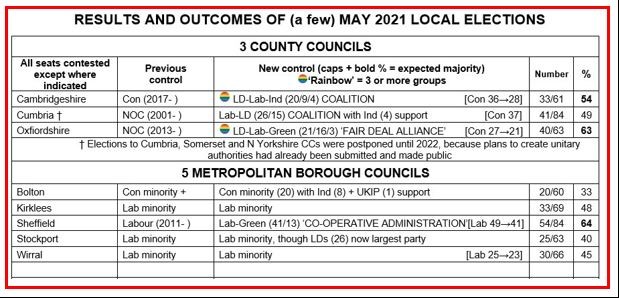
So, to the two central England splotches – Cambridgeshire and Oxfordshire County Councils – plus what would have been a third, had Cumbria’s election, like those of Somerset and North Yorkshire CCs not been postponed pending the outcome of already submitted unitary proposals.

In both cases the Conservatives had most councillors following the May elections, but no overall council majority. And in both cases the outcome of post-election negotiations was that the other party leaders and groups felt they had more in common with, or simply preferred working with, each other than with the historically dominant Conservatives.

And something essentially similar would doubtless have happened in Cumbria too, with the council having had a single party in majority control for just four of the past 36 years. So, when someone comes NOC NOCing on the Cumbria House door in Carlisle’s delightfully named Botchergate, they will be met not by rioting, out-of-control councillors, botching each other, but a seemly Labour/Liberal Democrat coalition. 

Likewise in Oxbridge, where they will encounter what tend to qualify nowadays as ‘rainbow coalitions’: comprising in Oxfordshire the Lib Dems (yellow), Labour (red) and Greens, and in Cambridgeshire Lib Dems, Labour and Independents. Doing indeed what voters reportedly tell pollsters they want party politicians to do: work together rather than just shout across the council chamber at one another.

Personally, in case you were wondering, I have ambivalent views about ‘rainbow coalitions’ – the terminology, I should stress, not their existence, which is almost invariably fascinating to observe. I used to reckon that, with rainbows having seven colours, a ‘rainbow coalition’ ought to comprise at least a majority – i.e. four parties or political groups.

The obvious problem, though, is that it restricts the field and would deprive many local newspaper editors of potentially appealing headlines.  By my reckoning – and with possibly excessive reliance on Open Council Data UK – England currently has just seven of these ‘proper’ rainbow coalitions: Durham, Folkestone & Hythe, Lewes, North Somerset, Swale, Waverley, and our own local Wyre Forest. 

Add in three-group coalitions, though, and you almost triple the number, while still lagging well behind the 32 single-party minority administrations and the 28 two-party arrangements. 

It also enables me to fulfil a tiny part of a kind of promise to INLOGOV Head of Department and blog editor, Jason Lowther – to whom I mentioned a round-up of May’s local election results, in the tabulated form I’ve sometimes managed previously, including my patented symbols for ‘rainbow coalitions’. 

For several reasons, including the sheer number of NOCs nowadays, I stalled after the ‘biggies’, but, thanks to the previously described Oxbridge tendency, there are at least a couple of rainbows.

NOC table

______________________

A more West Midlands-focussed version of this blog was published in the Birmingham Post on 9th September.

Photo

Chris Game is an INLOGOV Associate, and Visiting Professor at Kwansei Gakuin University, Osaka, Japan.  He is joint-author (with Professor David Wilson) of the successive editions of Local Government in the United Kingdom, and author of the Local Government chapter in the just published 10th edition of Politics UK (Routledge), about the only surviving sizeable (just the 780pp.) textbook of its kind.

The Lambeth tragedy and electoral reform

Chris Game

The recent Independent Inquiry report, chaired by Professor Alexis Jay, into the serial sexual abuse of children in the residential care (or neglect) of Lambeth Council from the 1960s to 1990s makes dire, sickening reading. It is lessened not one jot by being semi-historic, particularly for someone like myself who had at least intermittent dealings with the councillors and officers of Lambeth and other London councils during the 1980s, the most politically malevolent of those decades.

Pause for some indulgent, but explanatory, personal history – only three paras, promise!  I remember that key mid-80s period vividly. My early INLOGOV years, in the early 80s, felt like a kind of extended apprenticeship. I’d been appointed to launch the Department’s undergraduate PMA (Public Policymaking & Administration) degree, of which several senior colleagues were undisguisedly suspicious. I had no personal local government background, and was barely allowed near INLOGOV’s ‘shop window’: its prestigious, 6-week Wast Hills residential AMDP (Advanced Management Development Programme) for senior lg officers – because, well, what could I possibly tell them that they didn’t already know and weren’t already doing?

But then came ‘Widdy’ – the Committee of Inquiry into the Conduct of Local Authority Business, chaired by David Widdicombe QC – the Thatcher Government’s thinly disguised vehicle that would reveal the scurrilous goings-on (and, yes, ‘abuses’ – though even she didn’t mean sexual ones) in particularly left-wing Labour councils, enabling legislation that would restrain and generally weaken them. For several reasons it didn’t work out like that. Future Professor Steve Leach and myself from INLOGOV and two other colleagues spent the summer of 1985 visiting over 100 GB councils, interrogating senior members and officers, and eventually producing a 340-page report – far longer and more detailed, nuanced and qualified than the ‘hatchet job’ it was widely assumed the PM and Environment Secretary Nicholas Ridley had been hoping for.

For me, though it cost me a cricket season, it was fantastic.  At last I knew stuff about the inner political workings of local government that both councillors and officers were actually asking to hear about.  I could jointly run seminars and training programmes for officers and members – including week-long residential programmes for officers from groups of London boroughs – AND even get invited to address AMDP, without senior colleagues sitting in at the back checking me out.

We would discuss the internal, organisational politics of our local government system: the workings of and relations between party groups; one-party committees and sub-committees; the differences between Independent-dominated and ‘politicised’ councils; and, of course, member-officer relations and respective spheres of responsibility, including to electors and service users.

However … it was also during the 1980s that the Jay Inquiry found a root cause of the “widespread” sexual and other abuse of children in ‘care’ to have been the “politicised behaviour and turmoil” (p.vii) that dominated and warped Lambeth’s Labour-controlled council, for which “a succession of elected members and senior professionals ought to have been held accountable” (p.v), and weren’t.

Children were functionally weaponised in a “toxic power game” (p.vii) between Labour councillors and the Thatcher Conservative Government – a project that took precedence over providing quality, or simply adequate and undamaging, services and in 1985/6 over even setting a council tax rate (for which, for the record, 26 Labour councillors were surcharged and disqualified from office).

It’s rather late now to return my training programme fees, and I can’t meaningfully comment on the fundamental changes and redress measures since implemented.  I raise the Lambeth case solely because it loosely links to recent election-related news items I do know something about.

The first is that on 6th May, while I was previewing the various ‘First-Past-The-Post’ or ‘winner-takes-all’ council elections across the West Midlands, voters elsewhere in GB were voting in their sixth sets of Proportional Representation (PR) elections for their respective devolved institutions: the Scottish and Welsh Parliaments and London Assembly. There at least, what was once considered radical and even ‘Un-British’ is now the widely supported norm, with versions of PR also used in Scottish local elections and soon, if councils choose, in Wales too.

They are preferred to ‘Winner-takes-all’ because of results like those, for example, in this May’s Warwickshire and Worcestershire County Council elections. The respective Conservative parties took 74% and 79% of their councils’ seats – and four years of statistically comfortable overall policy control – on well under half the respective votes cast.

Just as that 1983 Thatcher Conservative Government won its 144-seat Commons majority with 42% of votes. These unearned bonuses are not just decisive, but gross, distorting, and potentially dangerous. Under even a loosely PR system, that 42% would have given the Conservatives under 300 seats instead of 397, Labour perhaps 180, and the Social Democratic-Liberal Alliance’s 25% vote share a potentially Government-determining 160-plus, instead of just 23.  And that whole fractious decade would have been very different.

Fantasy, of course. But – and finally, the key prompt for this blog – I do distinctly recall discussing, with Lambeth’s 40 Labour and 23 non-Labour councillors, how, had their 1982 local elections been run under any PR system, the chances were that, just as Thatcher probably wouldn’t have been in Downing Street, Labour almost certainly wouldn’t have won control of their 64-seat council.

For the Conservatives had won comfortably most votes, their 39% giving them perhaps 25 seats. Labour’s 33% could have meant not 40, but 22, leaving – as nationally – the Social Democratic-Liberal Alliance councillors holding the balance of power with maybe 17.  And the tragic events recorded in the Jay report would never have happened. The message is obvious: yes, election results shape history, but those results and outcomes are shaped by electoral systems.

There are many variants of PR electoral systems, but all aim to produce parliamentary or council memberships proportionately reflecting actual votes cast. And, conveniently, all three bodies mentioned – the Scottish and Welsh Parliaments and London Assembly – use versions of the Additional Member System (AMS).

Voters have two ballot papers. One lists candidates standing for single-member constituencies, the candidate with most Xs winning the seat. The second, usually regional, ballot paper lists the contesting parties and their respective candidates, and the voter’s X goes to their preferred party list. Now the key bit: these list seats are allocated specifically to ensure the overall seat shares in the Parliament/Assembly/Council match as closely as possible the shares of party votes received.

And back in May?  Space here, I’m afraid, only for Scotland, where the nowadays dominant Scottish National Party (SNP) won 62 of the Parliament’s 73 constituency seats – but with under 48% of the constituency vote. The nearly 22% vote shares of the Conservatives and Labour won them just 5 and 2 constituency seats respectively.

These disparities, however, were ironed out in the second, regional votes. The SNP’s 40% vote gained it only two additional seats, giving a total of 64 – just short of an overall majority in the 129-member Parliament, and reflecting its failure to win majorities in either vote.

By contrast, the Conservatives’ 24% regional vote earned them 26 additional seats to total 31.  Labour’s 18% brought them up to 22, and the Greens, without any constituency seats, won 8% of the regional vote, gaining them 8 seats. Which is why, once they understand it, voters tend on balance to like it – because it includes, rather than excludes.

Which, sadly, is the precisely opposite aim of Home Secretary Priti Patel’s planned electoral reforms – from compulsory photo ID to abolishing preferential electoral systems for Mayors, Police Commissioners and the London Assembly. But then inclusivity really isn’t her bag, is it – and, though a Londoner herself, she’s too young to remember 1980s Lambeth.

_____________________

A shorter version of this blog – minus the personal INLOGOV bits – was published in the Birmingham Post on 19th August under the title ‘Electoral reform could have prevented tragedy’ (https://www.pressreader.com/uk/birmingham-post/20210819/281956020861052)

Photo

Chris Game is an INLOGOV Associate, and Visiting Professor at Kwansei Gakuin University, Osaka, Japan.  He is joint-author (with Professor David Wilson) of the successive editions of Local Government in the United Kingdom, and a regular columnist for The Birmingham Post.

As the children return to school in September, the change in Pupil Premium funding will see many schools lose out

Cllr Ketan Sheth

Cllr Sheth on a recent visit to a school

Pupil Premium funding for our most disadvantaged children, based on the number of children eligible for free school meals (FSM) data collated every January, provides critical funding to schools for essential resources, which in turn benefits all children. Each FSM successfully registered increases the funding to schools, a substantial amount of which does not reach schools because not all parents who are eligible apply for FSM for their child.

New Government conditions have seen a change in how it is calculated. By shifting from a January date, for calculation, to the previous October date, a stretched borough, such as Brent, now, will have 900 fewer secondary school pupils eligible, amounting to a loss of £860K in their budget. 

Pupils at primary schools fare a little better in Brent; but the picture elsewhere in the country is less kind – 62,000 fewer eligible pupils in primary schools in England, according to FFT Education Datalab analysis of the Department of Education recent figures.

The need for FSM and eligibility is rising, as are casual admissions all year round, due to changes in family incomes. This change results in £90M missing from budgets when schools have already been under intense pressure with lockdown and are attempting to build-up again as we recover following Covid-19.

The result means that the Government has introduced a detrimental lag in funding, which will introduce a current year saving; but will impact on the much needed essential support for children who have had the greatest challenges of home-learning throughout the pandemic and now beyond.

We are often reminded of the mantra: “every child matters”; if we are serious about levelling-up everywhere then we must rethink this decision and how we best support our children, so no child is disadvantage. The time between September, the start of the school year, and January allows for an accurate reflection of school children in need of FSM; and therefore, schools requirement for Pupil Premium. The timing is essential to promote and ensure effective communication with parents/carers, enabling them to register for FSM.

There is some speculation amongst head teachers that the Government may overhaul or perhaps completely remove the funding – this will be catastrophic and a retrograde step for the levelling-up agenda.

Cllr Ketan Sheth is Chair of the Community and Wellbeing Scrutiny Committee of Brent Council

Petticoat Council – cheesy name, historic achievement

Chris Game

Nottingham Castle reopened to visitors recently, after a Covid-protracted three-year closure for what was anyway going to be a pretty extensive renovation. Even unrenovated, the castle has always been a good visit, not least for its exhibitions, which now include an enticingly named Rebellion Gallery, whose current Nottingham-focused displays, curated by University of Nottingham historian Dr Richard Gaunt, comprise the Civil War, the Luddite movement, and parliamentary reform with particular emphasis on women’s suffrage.

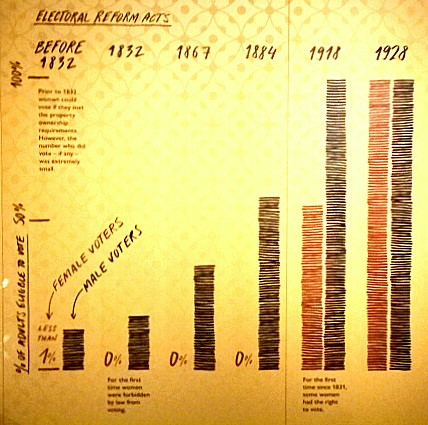
For reasons that will become clear, it was the last of these that particularly resonated with me – and one (poorly phone-photographed) bar chart in particular.

While its primary aim is presumably to emphasise the length of the continually frustrated campaign for women’s suffrage, it also showed how, near the start of that campaign, some women – those that “met the property ownership requirements” – actually lost their right to vote during the 1830s.

The otherwise franchise-extending 1832 Reform Act specified ‘male persons’ only, depriving at least small numbers of property-owning women of their parliamentary vote until 1918. And the 1835 Municipal Corporations Act excluded them from local elections – until 1869/70, when unmarried women ratepayers were granted the right to vote in first municipal council and then the new school board elections.

Between those dates, though, and with no confounding documentary evidence, it was widely believed, and taught, even in Patricia Hollis’ ‘bible’ – Ladies Elect: Women in English Local Government, 1865-1914 (Appendix B) – that women lost their voting rights completely, just like the 0%, 0%, 0% on the Nottingham bar chart.

Taught by me too, until a few years ago when I caught by chance a BBC Sounds broadcast describing the discovery of documentary evidence of at least some West Midlands women casting votes in local elections decades before those history books told us the 1869 Municipal Franchise Act legalised it.

The BBC programme described the recent discovery in Lichfield Record Office of an 1843 Poll Book. Compiled apparently for local Conservative Party campaigning purposes, it detailed all voters in that year’s St Chad’s Parish election of an Assistant Overseer of the Poor – the bloke (naturally) with responsibility for outdoor (cash) or indoor (workhouse) poor relief.

And of the 371 voters in that 1843 election …. 30 were women, including one, an evidently very well-heeled Grace Brown, with no fewer than four votes. It was a genuine, history-rewriting discovery – though not in fact the main point of this blog.

For that we must turn to the programme’s presenter: Sarah Richardson, nowadays Professor of History at Warwick University, and author of the then recently published The Political Worlds of Women: Gender and Politics in Nineteenth Century Britain.

Totally relevant, obviously, but Richardson’s even more pertinent role here must surely be one unmentioned in her University profile: longstanding Governor and currently Chair of Governors at Bishop’s Itchington Primary School.

Bishop’s Itchington is a South Warwickshire village/parish south-east of Royal Leamington Spa and about 18 miles from Coventry, which, as we’ll see, is more immediately relevant. It has a lengthy history too, its name combining references to the passing River Itchen and the Bishop of the afore-mentioned Lichfield Cathedral.

In many European countries, and unquestionably in France with its 35,000 communes, even its reduced present-day population of around 2,000 would make Bishop’s Itchington what we would call a principal local authority in its own right, with an elected mayor, a full range of local powers and responsibilities, and significant control of its own funding.

But in a middle England parish council, without even these basics, where, you might reasonably ask, is there the potential even for much passing interest, never mind drama?  To which the answer is: in its elected councillors, and, more precisely, those elected in 1949 to form what became the first female majority council in the UK.

It’s a hefty claim, but, in respect of a village/parish whose primary school Chair of Governors just happens to be a national authority on such matters, pretty authoritative.

Profesor Richardson herself summarises – this time on YouTube.  Edith Chapple-Hyam, Chair of the village Women’s Institute, was fed up with the all-male parish council’s lack of action on issues such as accessible electricity and running water, social housing, policing and speed restrictions, the sewage works, and public spaces, particularly for children.

In short, she and her WI members saw areas like Coventry being built up after the War and wanted a piece of the action.  So, when an election was announced, she and five WI committee members submitted their nominations.

Most of the sitting councillors assumed that, as no doubt regularly happened, the election would go uncontested and they would be re-elected by default.  Only one, therefore, bothered to submit his papers before nominations closed.

He was duly elected, but alongside all six women, who effectively – in both senses – took over.  And now, just the 72 years on, the Bishop’s Itchington story has been both informatively and highly entertainingly dramatised as a ‘folk musical’ and one of Coventry’s UK City of Culture 2021 events.

Entitled ‘Petticoat Council’, I saw it myself recently, and the mix of storytelling, song, dance and puppetry melded together by playwright Frankie Meredith – herself the great-niece of Ivy Payne, one of the six victorious councillors – is a delight, unquestionably worth catching if you ever get the chance.

My sole initial reservation had been the slightly cheesy title, for which I was prepared to blame the Americans, who had instantly labelled a very similar women’s power grab in Umatilla, Oregon back in 1916 a ‘Petticoat Revolution’.

But I was wrong. It apparently came from a local newspaper, reporting in 1952 how the men on the council were plotting to “overthrow petticoat rule”, as “the women have been getting too bossy”. Material for a sequel perhaps?

______________________

A version of this blog, with an accompanying photograph – of the councillors, not me – was published in the Birmingham Post on 15th July under the title The ‘Petticoat Council’ and a slice of Midland History

Photo

Chris Game is an INLOGOV Associate, and Visiting Professor at Kwansei Gakuin University, Osaka, Japan.  He is joint-author (with Professor David Wilson) of the successive editions of Local Government in the United Kingdom, and a regular columnist for The Birmingham Post.

The surge of migration-related city networks around world: between militancy or co-optation

Thomas Lacroix


In December 2018, a delegation of mayors from various parts of the world attended in Marrakech the signature of the Global Compact for Safe, Orderly and Regular Migrations. Their presence was not random: the compact acknowledges local governments as a key level of implementation of its objectives. Cities were largely absent from the international discussions on migration only a decade ago. They are now regarded as a central player of global migration governance, along with states and civil society organisations. This influence is directly related to the surge in the number of migration-related city networks around the world. These networks are lesser-known than their leading mayoral figures such as Marvin Rees in Bristol, Eric Garcetti in Los Angeles, Luca Orlando in Palermo or Valérie Plante in Montreal. But, together, they form a web of interconnected cities advancing a progressive agenda for the welcoming and integration of immigrant populations. In a recently published article of Local Government Studies, I provide a picture of their extend, types and activities. This work draws on a database mustered through internet search between Spring 2019 and July 2020, compiling information on their members, date of creation, activities and funding. Three key findings emerge from this analysis.

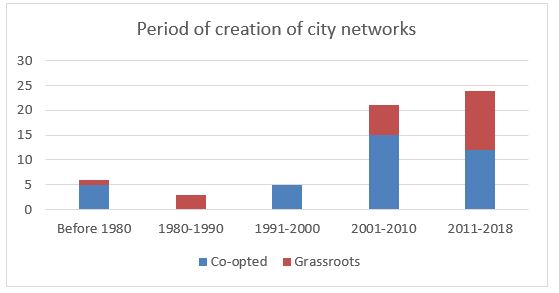
First, the surge of such groupings is a relatively recent phenomenon. If city networks are far from being a novelty, their concern for migration issues has been spreading since the early 2000s. Out of the 64 included in this database, 45 have been founded since 2000, and 24 since 2011. Three drivers account for this. In the first place, local authorities occupy a growing place in the agenda of international organisations. A larger share of development aid is geared towards cities (deemed as trustful and less prone to corruption than state administrations). In parallel, local authorities fill a void on issues such as climate change and migration where intergovernmental cooperation is in a deadlock. In consequence, inter- and supranational organisations support the creation of city networks on these strategic issues. In the second place, the wave of decentralisation reforms undergone by Southern and Northern cities since the early nineties have left local authorities with a broader range of responsibilities (including on integration issues), but no more financial resources. Municipalities turn towards alternative sources of financing: project-based funding bids, city to city partnerships, engagement with the private and third sectors. In the third place, the security approach to immigration in receiving countries has affected cities: the growing pressure and precariousness undergone by immigrants hinder their integration prospects. In reaction, many cities develop narratives challenging this security approach. They hail immigrants as economic actors of a vibrant cosmopolitan city or as human beings in need for welfare, education and health support. This engagement has propelled the multiplication of grassroots networks of like-minded cities in want of promoting an alternative management to immigrant populations.

From this follows a second finding, i.e. the distinction between co-opted and grassroots networks. The former, sponsored by external funding bodies, adhere to their agenda. This is true for the URBACT network which stems from the Urban Agenda of the European Union. The latter are spontaneous organisations formed by local authorities in want of sharing a space for common concerns. In the field of migration, this is illustrated by politicised networks opposing state policies: the sanctuary policies movement in the US, the ANVITA association in France, etc. Of course, these categories are porous. Eurocities is a grassroots European network created in the late eighties which is now largely funded by EU institutions. However, the initial conditions of their creation explain the divergent orientations of their activities. Both types foster exchange of experience and best practices, but co-opted organisations have more financial means to support projects while grassroot ones are more likely to engage in lobbying and awareness-raising activities.

 GlobalRégionalNationalTotal
Europe12151239
Amérique du Sud4117
Amérique du Nord 921
Océanie 213
Afrique5219
Asie1115

Third, this surge of migration-related city networks is a global but unevenly distributed phenomenon. 36 are them are located in Europe and North America. If we add to those the 12 world networks connected to these spaces, one counts three quarters of city networks including major immigration country localities among their members. The types and scales of these networks vary in different parts of the world. In Southern countries, they are almost exclusively organisations sponsored by international organisations: Sello migrante network, a group of cities developing welcoming policies for refugees in Latin America and supported by the High Commission for Refugees, is a case in point. In contrast, in North America, they are mostly grassroots networks gathering cities in reaction to policies targeting undocumented migrants: beyond the sanctuary cities movement, Welcoming America and City for Actions are but a few examples. Europe displays a mixed landscape, with co-opted networks supported by the EU or the Council of Europe for the promotion of local integration policies and more recent grassroots organisations reacting to restrictive migration policies.

Image Source: Alpha Stock Images – http://alphastockimages.com/
Original Author: Nick Youngson – link to – http://www.nyphotographic.com/

Thomas Lacroix is CNRS research director in geography affiliated to the Maison Française of Oxford. He works on local migration governance, city networks and the formation of the transnational state. He recently published with Amandine Desille “International Migrations and local Governance” (Palgrave, 2018)