Jason Lowther
It’s been an exciting month in government, nationally and locally, since the General Election on 4th July. As the new Labour administration finds its feet, somewhere on Ministers’ “to do” list will be local government performance and (the department formerly known as) DLUHC’s attempts to improve this through the establishment of OFLOG, the Office for Local Government.
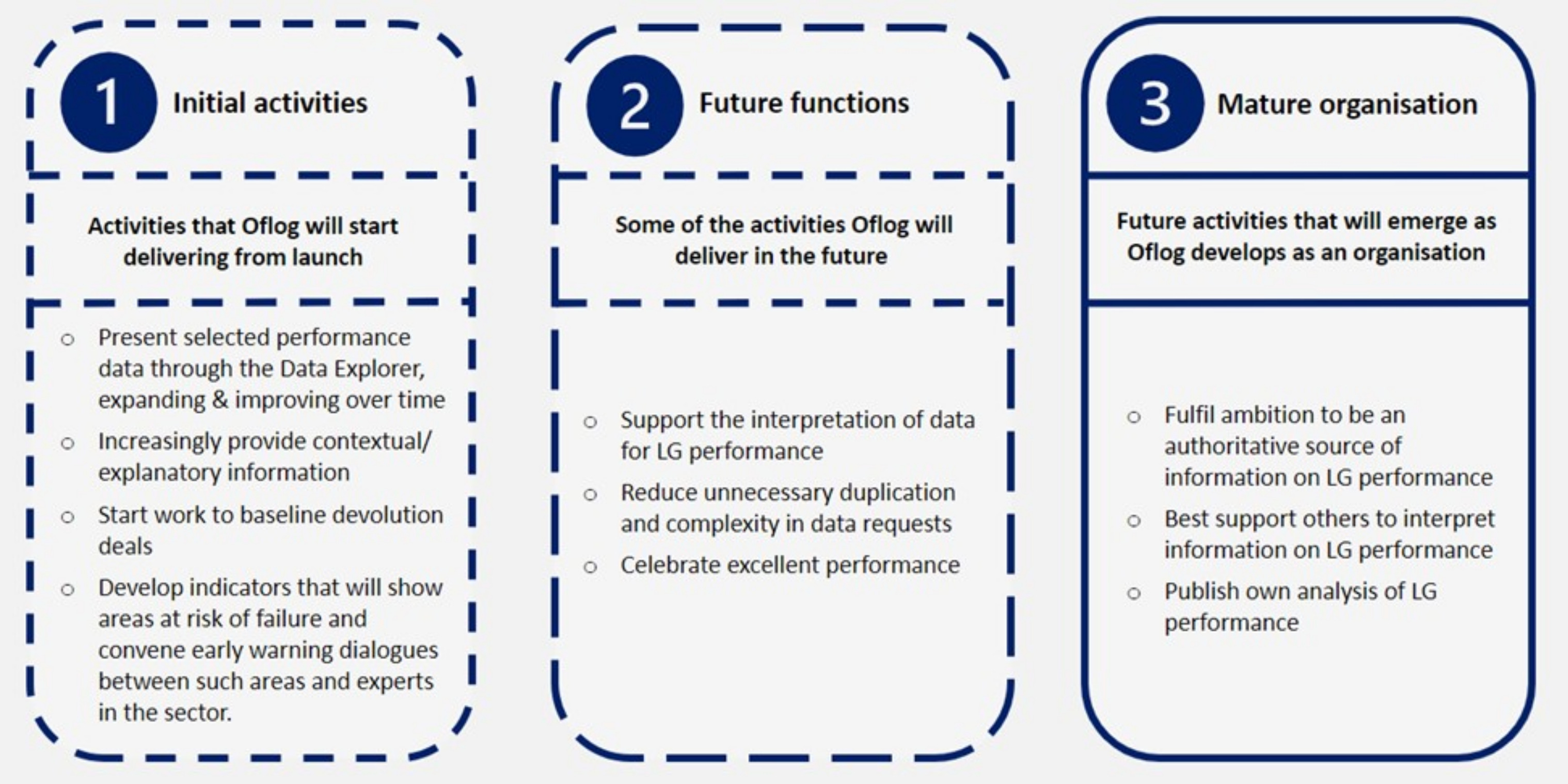
The election marked the exact anniversary of Michael Gove’s statement setting up OFLOG through the policy document, Understanding and supporting local government performance. Its remit was “to provide authoritative and accessible data and analysis about the performance of local government and support its improvement”.
Gove was at pains to stress “this is not about recreating the Audit Commission”. With that point at least, I agree. Whereas the Audit Commission was fiercely independent, often willing to criticise government policy where it was a factor in poor performance, OFLOG was established as an office of the department within the DLUHC department itself. Whereas the Audit Commission developed comprehensive performance measures which were rigorously audited to assure consistency, OFLOG picked 27 PIs and published these. Whereas the Audit Commission provided detailed national studies to inform best practice in local services, sometimes leading to wholesale systems change such as around youth justice services, with the local implementation of recommendations then supported by local specialist value for money auditors, the nascent OFLOG offered to “continue a programme of webinars to share best practice”.
An early product of OFLOG, in July 2023, was its “Local Authority Data Explorer”, which now brings together PIs on waste management, planning, adult social care, roads, and corporate and financial issues. For each service, users can select three comparison councils to produce scatter charts like Figure 1, which compares my local council’s waste management with that of three other big cities. This led to some rather uninformed press commentary and a response from the LGA. One may also say this is perhaps not the most compelling presentation of data in the world, arguably significantly less clear or flexible than the LGA’s excellent Inform tool which has been freely available for several years and includes thousands of published metrics.
Caution should be applied to OFLOG’s position within a ministerial setting and the potential for politicians to be selective in how they use data for judging local authorities that are not of their political persuasion. Whilst some may argue that the former Audit Commission may have been too powerful, it did provide a greater degree of transparency and objectivity at interpreting performance data.
Figure 1: Waste management
As my colleague in Inlogov, Dr Philip Whiteman, has recently argued, the new government should ensure that OFLOG is independent of government with a remit to focus on:
- Working with the sector to identify councils at risk of failure to ensure that support can be provided from within the sector, minimising the need for government intervention.
- Collecting, analysing, and reporting data to enable individual councils, groups of councils and the sector nationally to make progress with shared priorities agreed with government.
- Developing intelligence from on-going engagement with councils.
- Supporting improvement in local services and councils’ contribution to national outcomes through researching, synthesising, and disseminating good practice.
- Working with academic institutions such as Inlogov to incorporate key lessons from existing and future research.
We can be confident that local government performance overall is strong, and sector-led improvement has demonstrated our collective commitment to continuous improvement. But with so much of the new government’s ambitious “Missions” depending on highly effective local government, we need to take a fresh look at how OFLOG can be further developed to identify and propagate good practice across the sector.
Jason is Director of the Institute of Local Government Studies (INLOGOV) at the University of Birmingham and was employed by the Audit Commission from 1994 to 2004. This article was first published in the August 2024 LARIA Newsletter. Email [email protected]
INLOGOV’s new report, Equipping Local Government to Deliver National and Local Priorities, is available here.
 INLOGOV Blog