The Participatory Party

Phil Swann

The urgency of Sonia Busso’s call for councils to develop participatory governance arrangements is evident in her recent INLOGOV policy paper[1], The Participatory Council. Bussu recognises that politicians can enable or block this development and argues that progress can be impeded if the council as an institution is not prepared for meaningful participation. I argue in this blog that an equally important precondition of action is that political parties are engaged in participatory processes, reflecting their roles in both councils and wider civic society.

The Participatory Party should sit alongside the Participatory Council.

Bussu sets out a convincing set of recommendations to advance inclusive participation including developing the role of boundary spanners, building on existing community assets and resources, and adopting an intersectional approach to engage marginalised voices.

She recognises the part that political parties played in two of the five case she refers to: the introduction of participatory budgeting in Porto Alegre in Brazil; and the radical widening of the participatory infrastructure and processes in Barcelona. A third case, the deployment of citizens’ assemblies in the London Borough of Camden, was initiated by the then council leader Georgia Gould[2] following her recognition of the councils’ failure to listen to the residents of tower blocks in the borough before the tragic Grenfell Fire.

Bussu distinguishes between “disjointed events vulnerable to the political cycle” and “coherent processes embedded in day-to-day policymaking”, an ambition which is reflected in Gould’s final leader’s annual report in which she claimed the council was “getting on with a radical shift in power that is seeing democratic renewal led from the bottom up”.

In my view, however.  more attention needs to be paid to how political parties can play bigger roles both in enriching civic society and in embedding participatory process in the way that Bussu seeks. This is particularly important at a time when populist parties are opting for simplistic solutions rather than engaging with the hard graft of participatory policymaking.

Gould, for example, in a lecture in 2022 called for a move beyond a transactional model of public services. Demanding the abandonment of traditional structures and hierarchies and a recognition of the power of communities and the ability of residents to change their lives, she warned that “services that don’t have a connection to communities or an understanding of their needs can be de-humanising, paternalistic and create a transactional model of public services that cannot make lives better in the longer term.”

In terms of the contribution of politicians and political parties to this, there are three key lessons from the experience of three of Gould’s predecessors: Herbert Morrison, leader of the London County Council and dynamo of Atlee’s post-war government; Richard Crossman, Minister for Housing and Local Government in Harold Wilson’s first cabinet; and David Blunkett, leader of Sheffield and holder of three cabinet posts in Tony Blair’s government.

First, the potential for exploiting the contribution of political parties as an important feature of the wider civic society. Morrison, for example, was clear that it was impossible to understand local government without understanding how political parties worked. It was “out of the clash of opinion and principle between the parties” that progress was made. For Crossman vibrant local government hinged on overcoming public apathy and that political parties had the potential to do that so long as party membership provided substantive opportunities to influence party policy. Writing when he was leader of the Labour Group on Oxford City Council in 1939 he said: democracy inside our parties is as valuable a part of our liberties as the right of voting at elections.”

Blunkett believed that the value of local politics was not confined to its legal powers, but to its ability to extend and develop democracy enabling the emergence of new social movements. During the period when he was leader of Sheffield, Blunkett argued that “if we can stimulate the community action that brings people into the [Labour] party and gets them to relate their community problems to a sense of political purpose, then we have begun to change society.”

Second, the value of engagement beyond the council and the party. Towards the end of his period as a leading local politician Blunkett warned that town halls could feel “impossibly remote and anonymous”. Reflecting on the state of local government in 2023, he said council leaders should do more than run their authority: they should see the council as a mechanism for fully engaging local people. Morrison, in his reflections on his period as leader of the LCC in the 1930s, came to a similar conclusion: “It was important that councillors and aldermen, once elected and appointed, should still move among the people they represented. They should be with and for the people, not above them.”

Finally, the key link between local government and wider civic society. Crossman was clear that “the real basis of successful political democracy is not to be found in politics at all, but below the surface in the organisation of a whole network of popular interests”. He argued that the future of the Labour party depended on not on the competence of its leaders and its electoral success, but also on the creation of “new organisations for the conquest of liberties yet unwon.” Blunkett was equally honest about the need for local politicians to avoid paternalism. Writing in 2002, when he was Home Secretary, Blunkett described how every since his first experience of canvassing in his council ward he had been “keen to inform and involve as many residents of Sheffield and its environs as possible in the aims and decision-making of the council.”

Bussu is right to stress that participatory governance requires sustained political commitment and is vulnerable to political change. The work of Gould and politicians such as Morrison, Crossman and Blunkett has created the foundations on which to build a participatory party. And Andy Burnham’s statements about how he intends to lead the Labour Party and listen to communities suggests that now is a good time to do so.

Phil Swann is studying for a PhD on the contribution of politicians to central-local government relations at the University of Birmingham.


[1] The Participatory Council
http://epapers.bham.ac.uk//id/eprint/4443/

[2] Now an MP and minister

Now is the time to refresh local politics

Photo by Michael D Beckwith on Pexels.com

Phil Swann

The sad state of many neighbourhoods and communities, with their desolated high streets, has been identified as a significant driver of the rejection of politicians and political parties which lay behind the May 2026 local election results

As the shallowness of programmes such as Pride in Place demonstrates, this is not an issue that central government can tackle alone. It requires local action reflecting local circumstances. Yet local councils lack the resources and levers to secure lasting improvements. Meeting this challenge requires deep collaboration between central and local government at a time when changes in political control locally will make that more difficult to achieve than ever.

Is it too naïve to hope that engagement between local political actors, local people and local organisations and groups could inform new approaches to revitalise struggling local communities? Could the involvement of national politicians in the process secure the reform of local government finance and the provision of new powers necessary to enable localities to act?

Writing in 1939, when he was leader of the Labour Group on Oxford City Council, Richard Crossman, argued that one of the strongest arguments for local party politics “is that they do provide a method of creating interest and focussing attention upon the enormously important issues as stake.” Crossman, who went to serve as Harold Wilson’s Minister for Housing and Local Government, added that “the real basis of successful political democracy is not to be found in politics at all, but below the surface in the organisation of a whole network of popular interests into pressure groups.”

Writing just over 40 years later, when he was leader of Sheffield Council, David Blunkett also called for collective local action. He argued that politicians and communities should “do things together rather than having them done for us, to remove the conditions of poverty and dependence rather than trap people in them, and thus to develop a sense of supporting and being supported.” He made a similar point in 2004, when he was Home Secretary, recognising the importance of a partnership between local politicians and citizens “to revitalise democracy and strengthen citizenship and civil society, so that people are part of the process of reform and modernisation.”

Now more than ever it is important to follow the advice of Crossman and Blunkett and refresh local politics through collaboration with local groups and communities to deliver improvements locally and secure reforms nationally to enable that local action. Succeeding in doing this could also begin to restore trust in politics and politicians.

Phil Swann is studying for a PhD at INLOGOV in the Department of Public Administration and Policy, University of Birmingham, on the contribution of politicians to central-local government relations.

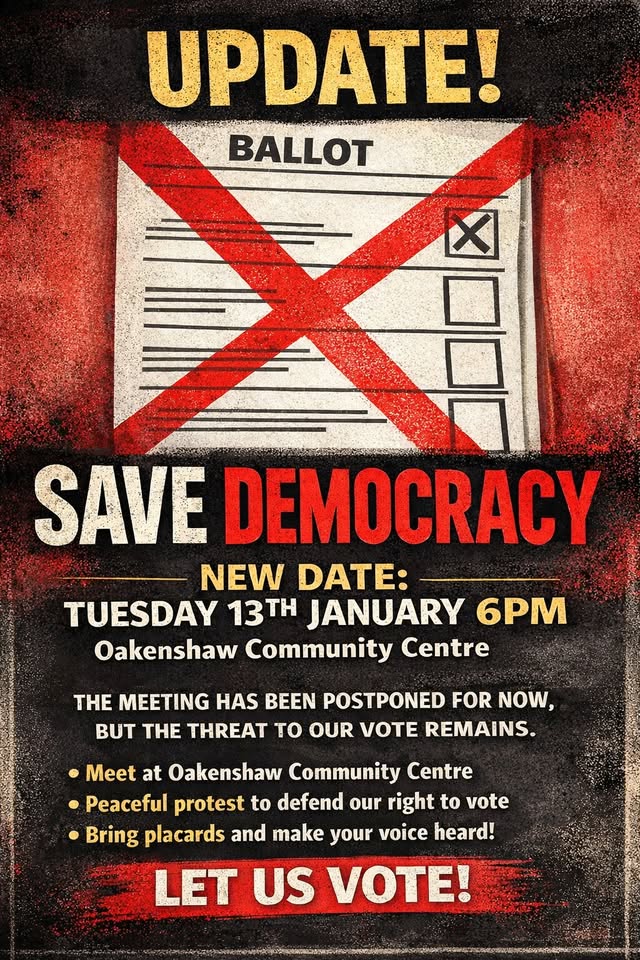
Are deferred local elections the real threat to UK democracy?

Jason Lowther

With dozens of English councils and hundreds of councillors facing delays to this year’s May elections, opponents claim the move could undermine public trust in democracy.  History shows deferral of elections in similar circumstances is rare but not exceptional.  There are however far bigger threats to the UK’s democracy.

Media reports today are suggesting that more than a third of eligible English councils have requested to delay their planned May 2026 local elections, potentially requiring around 600 councillors to serve an additional year.  These councils state that the Government’s ongoing local government restructure makes it difficult to run the polls effectively at the planned dates, and central government claims holding elections for councils that are soon to be abolished would waste time and money.  

But the delays have sparked criticism, and even led to unrest at this week’s Redditch council meeting. Opponents argue the move weakens democratic accountability.  Reform UK leader Nigel Farage denounced the proposal as “monstrous”, claiming that “denying elections is the behaviour of a banana republic” and threatening a judicial review.  Conservative and Liberal Democrat MPs have also criticised the move.  The Electoral Commission’s chief executive said: “As a matter of principle, we do not think that capacity constraints are a legitimate reason for delaying long planned elections. Extending existing mandates risks affecting the legitimacy of local decision making and damaging public confidence.”

Delays to local elections in England have occurred previously.  During the Second World War, all local elections were suspended between 1939 and 1944, making this the most extensive postponement in modern history.  In peacetime, delays have largely been tied to local government reorganisation, most notably in the 1990s, when Parliament approved major structural reforms that abolished counties such as Avon, Cleveland, and Humberside and created 46 new unitary authorities.  These reforms led to altered or cancelled election dates to align with the establishment of new councils and avoid electing councillors to authorities that were about to be dissolved.  In 2025, nine councils had their elections delayed by one year to support transitions to new unitary structures.

But even though there are clear precedents for the current electoral postponements, there are other longer-term, more significant and worrying trends which risk seriously undermining our democracy.  Academic commentary shows growing concern among constitutional scholars that the UK’s democratic safeguards have weakened in recent years.  

Scholars at the UCL Constitution Unit  warned in 2022 that the UK faced a real risk of “democratic backsliding,” defined as a gradual erosion of checks and balances, growing executive dominance, attacks on civil liberties and the weakening of political norms that traditionally safeguarded constitutional stability.  Their analysis emphasised that democratic decline can occur incrementally through the actions of elected leaders, especially in systems like the UK’s where constitutional rules are flexible and can be rapidly altered.  

Further alarm was raised by Professor Alison Young at the University of Cambridge, who described the UK as standing on a “constitutional cliff‑edge.”  In her 2023 book, she argued that a series of constitutional changes and executive‑centric reforms have strengthened government power while weakening the political and legal checks that previously constrained it.  Young warned that without reforms to reinforce accountability, transparency, and oversight, the UK risks drifting towards “unchecked power,” eroding the democratic norms that underpin good governance.  

Last year, Dr Sean Kippin of the University of Stirling argued that recent Conservative governments engaged in “democratic backsliding” by deploying what he calls an “illiberal playbook,” using both lawful and legally dubious tools to weaken institutional checks, restrict protest rights, and compromise the independence of the Electoral Commission. His research concludes that “between 2016 and 2024, the Conservatives used power to diminish, weaken, and compromise Britain’s already imperfect democracy”.

There have been some positive moves by the ‘new’ Labour government to improve the functioning of our democratic system, such as the widening of voter ID criteria and promises to lower the voting age to16. However, overall there hasn’t yet been commitment to fundamental reforms to address the issues identified in the above reports, such as the impact of donations on political impartiality, and there have been some worrying developments, for example around civil liberties and the right to protest

A year’s deferral of elections to a disappearing council doesn’t fundamentally undermine our democracy, but failing to address the longer term and serious issues of democratic backsliding could prepare the way for those who will.

Dr Jason Lowther is director of INLOGOV (the Institute of Local Government Studies) at the University of Birmingham.  

References

Kippin, S., 2025. Democratic backsliding and public administration: the experience of the UK. Policy Studies, pp.1-20.

Russell, M., Renwick, A. and James, L., 2022. What is democratic backsliding, and is the UK at risk. The Constitutional Unit Briefing.

Young, A.L., 2023. Unchecked power?: How recent constitutional reforms are threatening UK democracy. Policy Press.

Picture credit: https://www.facebook.com/events/898249983102646/

Renewing Democratic Leadership

Jason Lowther and Sonia Bussu

Legislative Theatre with West Midlands Combined Authority

As local government in England undergoes significant restructuring, with fewer councils serving larger and more diverse populations, the role of councillors is under pressure. At the same time, democratic innovations, such as citizens’ assemblies, or creative methods of participation, such as legislative theatre and digital engagement, are gaining traction. These innovations offer new ways to engage communities and strengthen democratic legitimacy.  But how do they fit with the role of elected councillors?

Recent research and practice suggest that councillors can play a crucial role in facilitating inclusive and impactful citizen participation.

Politicians’ Views on Participation

Across the UK and Europe, many elected representatives have expressed support for citizen participation in policymaking. They see it as a way to build trust, improve decision quality, acknowledge a wider range of perspectives and knowledge, engage citizens more deeply in political life, and potentially identify novel solutions to politically difficult issues. However, research by Kersting shows that this support is often conditional. Councillors tend to favour participatory instruments that reinforce their representative role, such as advisory boards or structured consultations. They are more sceptical of online platforms and randomly selected citizen assemblies (so-called minipublics), which they worry may not be genuinely representative of their electorate and may lack the capacity to understand complex issues.

Werner and Marien’s comparative experiments in Sweden and the Netherlands provide further insight. Their work shows that participatory processes consistently increase perceptions of fairness. This matters because fairness perceptions are closely linked to trust, policy compliance, and perceived legitimacy. Importantly, these effects are not limited to winners (who support the outcome of the exercise); even those who lose in participatory decisions tend to view the process more positively than in purely representative settings.

These findings highlight a tension. While democratic innovations can enhance legitimacy, councillors often feel uncertain about their role within them. Without open discussion, clear support, and integration, these processes risk bypassing councillors altogether.

Reimagining the Role of Councillors

Inlogov’s 21st Century Councillor research offers a compelling framework for renewing councillors’ roles. It describes councillors as hybrid connectors who build relationships both online and offline, multi-level diplomats who navigate partnerships across governance layers, and system stewards who shape democratic innovation and institutional change.

To fulfil these roles, councillors need support. This includes help to understand democratic innovations and any potential concerns.  They need understanding of key areas such as facilitation skills and digital engagement, confidence in narrative-building around democratic innovation, access to mentoring from peers with experience of these approaches, opportunity to explore difficult scenarios, and chance to reflect on their practice. Councils must also empower community members to scrutinise participatory outputs, and help councillors to navigate tensions between citizen input, officer advice, and party lines.

The Camden Model: Embedding Participation

Camden Council offers a practical example of how participatory processes can be embedded within representative governance. The council has institutionalised citizens’ assemblies as regular tools for major policy development, including planning, climate change, and health and social care. Assemblies are commissioned by council boards, which commit to formally responding to recommendations. In the case of the 2019 Climate Assembly, all 17 proposals were endorsed and integrated into Camden’s Climate Action Plan, with the citizen’s assembly referenced throughout the document.

This approach demonstrates how local government can lead participatory processes, ensuring they are not just consultative exercises but integral to policy development. However, several recommendations from the Camden climate assembly extended beyond the council’s jurisdiction, highlighting the structural limitations of local deliberative processes in addressing systemic issues like the climate. Councillors could have played a stronger bridging role, helping to clarify expectations and ensure that recommendations were grounded in the council’s remit. Stronger involvement from elected representatives might have thus enhanced democratic accountability.

Inclusive youth engagement in policymaking in the West Midlands

There is much more to learn and do to make democratic innovations more inclusive and effective, supporting participation from historically marginalised groups, which tend to ignore invitations to participate in citizen assemblies or formal consultation exercises.

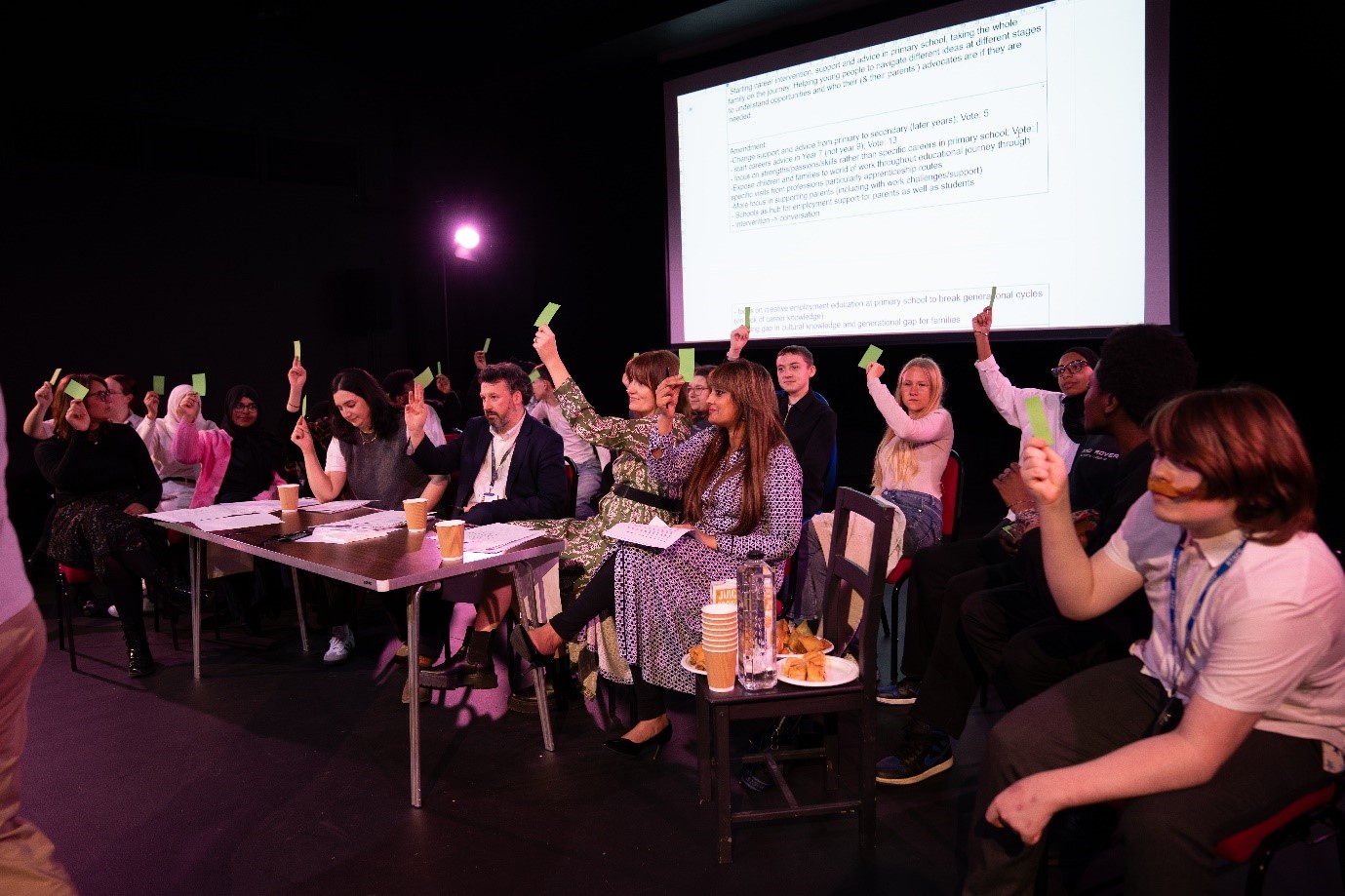
A recent example of inclusive approaches comes from the West Midlands, where the INSPIRE project, led by the University of Birmingham, used legislative theatre to engage young people in shaping youth employment policy. Legislative theatre is a method developed by Augusto Boal that uses performance to explore lived experience, test policy interventions, and co-create solutions. It involves watching a play co-created by the participants on real issues and based on their lived experience. During the event, an audience of community members and policymakers become spect-actors, acting out alternative scenarios, proposing policy changes, and voting on them in a public forum.

The University of Birmingham partnered with the Young Combined Authority and Youth Focus West Midlands to recruit a diverse group of 15 young people (14-17 years old) who, under the guidance of legislative theatre practitioners, developed a play about barriers to work experience and youth employment. Through performances and structured dialogue with policymakers, they co-created six policy proposals. These include reforms to careers advice, work experience, and employer accountability.

Crucially, policymakers were invited to participate not just as observers but as co-creators and champions. Their involvement can help bridge the gap between lived experience and institutional action, demonstrating how local government can play a central role in democratic innovation for social change.

Councillors as Democratic Innovators

Democratic innovations in Camden and the West Midlands are two examples of how local government can promote democratic renewal. Councillors can and should play more central roles in these processes, beyond party politics, to facilitate and nurture dialogue between citizens and institutions, ensuring follow-through on recommendations, and using committee structures to embed participatory outputs.

Rather than seeing participation as a threat, councillors can embrace it as a tool to strengthen their representative role and reconnect with communities. They are uniquely positioned to bridge the gap between citizen voice and institutional action. This requires a shift in mindset and practice.

Dr Jason Lowther is Director of Inlogov (the Institute of Local Government Studies) at the University of Birmingham, and was Assistant Director (Strategy) at Birmingham City Council from 2004 to 2018.  His research focuses on the use of evidence in public policy and central intervention in local government.

Dr Sonia Bussu is an Associate Professor at the University of Birmingham Department of Public Administration and Policy where she studies and teaches public policy. Her main research interests are participatory governance and democratic innovations, and creative and arts-based methods for research and public engagement. 

This article was first published in the Municipal Journal, 25th September 2025, available online here: https://www.themj.co.uk/renewing-democratic-leadership

Picture credit: Inspire Legislative Theatre, March 2025 – photo by Bucuria Maria Polodeanu – Insta: @reelmasterproduction

Governance and accountability: from dull subject to hot topic

Catherine Staite
Accountability is the lifeblood of good governance.  Good leaders understand that they are responsible for the well-being of others, that they need to explain their actions, really listen to those on whom those actions have an impact and act swiftly to put things right if they go wrong.  They know that the higher the level of vulnerability of the people they serve, the higher the duty of care – to serve the powerless and not to demean or demonize them. Good leaders would say that none of that needs to be said because governance and accountability are written through their everyday working lives like lettering through rock. That may be true of good leaders but it isn’t true of everyone.

There are so many flaws in our fragmented systems of governance that it can be very hard to understand who really is accountable when things go wrong.  There has been much focus recently on the negative impacts of privatising regulatory services but that is just the tip of the iceberg. Just think about the outsourcing of benefits assessment to a demonstrably incompetent company, the divestment of social housing from councils, the purchaser/provider split in health and the structural, professional, financial and organisational chasms between health and social care.  All of those exercises in fragmentation result in the people all these different services serve falling through those cracks without ever understanding who is responsible for their suffering. Homelessness is a classic example of this phenomenon. Failure compounds failure and more energy is expended  on shunting the blame than on solving the problems.

That might lead us to believe that all we need to do to put things right is tidy up a bit and then create a couple more regulatory bodies, et voila, job done.  That has always appealed to me; I do love a tidy structure. But even as I crave order, I know that we’ll never achieve it. The reality is that systems, structures and processes in both the public and private sectors are complex and messy and doubly so where sectors intersect, as in public transport or primary care. If we tidy up in one place, we’ll create knock-on messiness somewhere else.  We’d do better to focus on the people in the system – on developing their skills and strengthening their values so they understand the real importance of good governance and the critical role of accountability.

The key to future good governance and accountability lies in the way in which we recruit, train, develop, manage and lead our 21st century public servants.  That is also true of our democratic representatives. A democratic mandate alone does not confer wisdom or effectiveness.  Yet, most councils have cut their staff and member development budgets to the bone, as development is a luxury and not a vital necessity.

We all the see the necessity of the maintenance and repair of our cars, our computers and our washing machines. The maintenance and good governance of our organisations is even more important.  Mechanical failures can cause many problems but the failure of organisations destroys lives.

Catherine Staite 02

Catherine Staite is Professor of Public Management and Director of Public Service Reform at the University of Birmingham. As Director of Public Service Reform, Professor Catherine Staite leads the University’s work supporting the transformation and reform of public services, with a particular focus on the West Midlands.  As a member of INLOGOV, Catherine leads our on-line and blended programmes, Catherine also helps to support INLOGOV’s collaboration with a wide range of organisations, including the Local Government Association  and the Society of Local Authority Chief Executives as well as universities in the USA, Europe, Australia and China. She was named by the Local Government Chronicle, in 2015 and 2016 as one of the top 100 most influential people in local government.

Being able to say ‘I’m sorry’ is a sign of strength – not of weakness

Catherine Staite, Director of INLOGOV

Yesterday was a remarkable day in many ways. We heard a passionate but thoughtful debate in the House of Commons.  There wasn’t much of the usual ‘yah boo’ and name calling. Some very good speeches, including by Margaret Becket and Hilary Benn reminded us of the power of argument.  They also reminded me that, while there is so much to criticize in the way this country is led, I am lucky to live in a democracy where a Prime Minister cannot rely on positional power but who needs to persuade MPs both of the moral and strategic arguments for the things he wants to do. In spite of the common perception of MPs as powerless lobby fodder, it was clear yesterday that many were demonstrably acting according to their consciences, led by their reason. In many ways it was a good day for democracy, respect for differing opinions and the exercise of collective leadership.

In other ways yesterday demonstrated some of the ways in which passion, conscience and reason can be subverted to justify the worst possible behaviour.  The problem of bullying, of all sorts of people, in all walks of life, has become part of our understanding of how the world works. Perhaps the word ‘bully’ has lost some of its power because we have applied it so often to such a wide range of behaviours.  Maybe we should move away from the generic to the specific and talk about the terrible psychological damage done by ‘insults’, ‘assaults’ and ‘attacks’.  The old saying ‘sticks and stones may break my bones but words can never hurt me’ is the opposite of the truth. Sometimes words hurt because they exclude – ‘you aren’t one of us’, they vilify – ‘you are one of them’ or they threaten – damage to reputations and careers.

We often look to leaders to set standards, to model good behaviour and hold bullies to account. It’s hard for them to do that when they indulge in that sort of behaviour themselves or fail to deal with it in others.  Jeremy Corbyn seems to me to be a gentle, principled man but some of his more extremely left wing colleagues are using his popular support to justify criminal behaviour.  To what extent is this his responsibility?  He is the leader of his party so it’s absolutely his responsibility. Modelling good behaviour is a necessary but not sufficient element of effective  leadership. Action is also required.  If Jeremy Corbyn’s sins are of omission, David Cameron’s are definitely of commission. His words about ‘terrorist sympathisers’ makes him a bully because he was seeking both to exclude and to vilify.  We’d find that behaviour reprehensible in a child in the the playground and it is utterly unacceptable in the holder of the highest political office.

However, leaders are only human. Everyone makes mistakes under pressure, even leaders.  Its what they do then that indicates the extent to which they are really good leaders.  Willingness to admit mistakes and to apologise for them demonstrates self-knowledge and humility and those are very attractive attributes in a leader. If someone says they were wrong, we’ll trust them next time they tell us they really are right. If someone tells us they are sorry when they are in the wrong we’ll trust them next time they say they really are in the right.

Refusal to admit mistakes or to apologise for them undermines our trust in leaders. It also give followers a clear message ‘Look at me…I bullied and I got away with it. You can bully and get away with it too’. Nice work Mr Cameron. You won the vote but you diminished your moral authority. Moral authority is the currency of leadership and you’ve squandered yours in support of a vote you would have won anyway. Will that be remembered long after we’ve finished bombing in Syria?

Catherine Staite

Catherine Staite is the Director of INLOGOV. She provides consultancy and facilitation to local authorities and their partners, on a wide range of issues including on improving outcomes, efficiency, partnership working, strategic planning and organisational development, including integration of services and functions.