The role of the third sector in delivering public services: what we know and what we’d like to know

James Rees

Inlogov and TSRC recently held a stimulating and well attended seminar involving guests from University of Illinois at Chicago. It was a great opportunity to share knowledge on the role of third sector organisations in public services, and to compare the ways in which there are similarities facing TSOs in both the US and UK.

But as so often it begged many questions as well and I want to reflect a bit on both the state of what we know and what we ought to know about the third sector’s role in delivering public services (in the UK!).

When I talk to people about the research that I do, the usual response is “what on earth is the third sector?” followed by “do they really deliver public services?” I’ll come back to the first question but the second is certainly very interesting.

There is a very long history to the involvement of what we now call the third sector in meeting welfare needs and providing services. Many are aware of early charitable and philanthropic action in the 19th century (Barnardo’s, RNIB and RSPCA for example); there was an explosion of mutual, co-operative and associations in the early industrial period; and before the dawn of the welfare state many health services were provided in voluntary hospitals that worked in partnership with local government.

Pete Alcock pointed out how these forms of the third sector had waxed and waned in response to political and economic change, leading right up to the 1980s Conservative interest in the third sector as alternative providers, the influence of New Public Management, and New Labour’s commitment to ‘partnership’ with the sector, written into a Compact.

In my discussion I suggested that it was useful to look at different levels or ‘strata’ of the third sector in relation to service delivery.

There are the big national charities (for example Barnardo’s, NSPCC, RNIB and the Salvation Army). It’s probably fair to say that the public perceive that these organisations rely on donations and fundraising, but they also hold very significant contracts to deliver services. For example Barnardo’s and Family Action run ‘Sure Start’ Childrens Centres. Action for Blind People, part of the RNIB Group, deliver a number of publically funded services to people with sight loss including schools, supported housing, and tailored health services within the NHS. This of course is only a tiny snapshot of what is by far the most visible part of the sector.

All of the mentioned organisations, and many more of varying sizes, large, medium and tiny, are involved in the Government’s controversial Work Programme, which aims to help benefit recipients into sustained employment. Our recent research drew attention to the difficulties charities were facing in terms of the strictures of the payments system, the lack of resources, and the prevalence of perverse ‘creaming and parking’ behaviour.

The work programme experience shows how public service delivery can be controversial and risky for charities, both financially and reputationally. But the costs are balanced by the opportunities contracts provide for charities to lobby government (where involvement can equal ‘insider status’ and credibility); and many charities argue it is consistent with their mission to bring their expertise to bear to improve services for their own client groups.

In my view there is a ‘missing middle’ as far the third sector and its role in public services is concerned. Missing only in the sense that we know less about it and there is a huge variety of experience so it is difficult to make generalisations about what is happening at this level.

Many organisations are much smaller than the ones mentioned above and tend to operate at the level of a region like the north-west, across a small number of local authorities, or even within a neighbourhood. They might have contracts with a local authority or a PCT (soon to be a CCG), and this part of the sector delivers a bewildering range of services.

We have been studying just these sorts of organisations as part of current research into public sector commissioning of the third sector. I have been struck firstly by the immense variety exhibited by organisations at this level, in terms of the types of services that they provide, their size and scope of operation, and seeming difference in their ethos, culture and degree of professionalism.

Secondly I have been struck by how vulnerable some seem to apparent threats in the current environment, most obviously loss of existing contracts and grants as a result of (mainly local authority) cuts, but also the possibility of competition from other TSOs and private sector organisations, and a wider sense of uncertainty, verging on fear.

Perhaps in some sense this is par for the course for the sector, and no organisation has a special right to exist. But I do wonder if we fully understand and value what might be lost if we start to lose these organisations in any great number, as they undoubtedly play an important role for many communities and individuals.

Finally, TSRC has done a great deal of research on organisations ‘below the radar’. Arguably again little is really known about how grassroots groups might interact with public services, enhance them, or what impact austerity might have on this vast ‘ecosystem’ of organisations. Much the same can be said about the important role of volunteers in public services. At the same time there is growing interest in how small community groups can be part of the co-production of public services.

Back to that first question: what on earth is the third sector? As soon as we start talking about different levels of the third sector, the huge diversity it contains, and the porous boundaries between in this case the grassroots and community sector, it begs the question of why we use the label ‘the third sector’. Are we dealing with a sector at all?

In an esoteric but influential paper in 1997, Perri 6 and Diana Leat argued forcefully that the sector had been ‘invented by committee’, in other words it was a social construction that suited the interests of some key political interests and society might have been better off without this invented sector and an obsession with the ‘politics of organizational form’. Pete Alcock takes a softer line, suggesting that the sector is held together in a ‘strategic unity’ in which tensions and disparities are sometimes played down in order strengthen the sector’s hand in negotiations with the state. These might seem like questions designed to keep academics in jobs, but it is interesting that people in the sector seem to keep asking similar ones as well: what makes our sector distinctive? What are our unique values and ways of working?

The seminar was interesting because even in the short amount of time we had available participants began to pose some really hard questions for academic research. I hope we can return to many of these:

  • What is the ‘right’ role for the state in providing public services?
  • Is the third sector just a foil for ongoing privatisation of the public sector and wider public realm?
  • Is the third sector doomed to be under-resourced, vulnerable and ‘under-professionalised’? Or can innovations like social finance and social impact bonds make a revolutionary difference?

rees-james

James Rees is a Research Fellow at the Third Sector Research Centre at the University of Birmingham. His recent research concentrates on transformations in UK public services including the role of the third sector, but his longer term interests have been in the governance of urban and regional governance, with a particular focus on the politics of city-regionalism; critical perspectives on urban housing market restructuring and housing policy; and more broadly on issues in urban regeneration, neighbourhoods and community. Follow him on Twitter: @jamesrees_tsrc.

A relational revolution in local public services

Chris Lawrence-Pietroni

On June 13 2013 BBC News broadcast CCTV footage of 83 year old Muriel Price suffering in her own home. Like so many elderly people receiving local authority care, Muriel relied on a private provider to send care staff to look after her basic needs. Taken over the course of one month, the footage revealed a pattern of neglect: carers turning up late or not at all; Muriel suffering the indignity of having her incontinence pads changed in full view of her neighbours; her food being prodded by a carer to test its temperature.

Yet despite her treatment Muriel still found a reason to be grateful: ‘It’s terrible the way they treat old people. I’m lucky I’ve got a family to look after me. Those that haven’t got a family – God help them, poor Devils’.

Public concern over the treatment of vulnerable people supposedly being cared for by public services has increased as a number of scandals have hit the headlines with Winterbourne View and the Mids-Staff Inquiries being only the most high-profile. Shocking as these cases are, anyone working in health and social care knows that it’s casual neglect like Muriel’s that is far more common. And with the ageing population and financial constraint that is the backdrop to any contemporary discussion of local public services, the likelihood of others facing similar experiences is growing.

When confronted with these tragedies the question that lingers is: how could anyone treat another human being in this way? How is it possible to knowingly leave an elderly person alone for 13 hours? How could you expose an adult to the shame of having their incontinence pads changed in public when all that is required is that you draw the curtains? Why stick your fingers into someone else’s food? Would you treat a member of your own family like that?

The answer to this last question is (one hopes) “no” – and that of course is the point. As Muriel so rightly points out, she is lucky to have family that care for her and look out for her welfare. It is these relationships that not only give her life meaning (the regular visits of her grandson and trips out in her wheelchair) they also keep her safe (it was her grandson who installed the CCTV). These relationships, built up over years of mutual exchanges of love and practical support, mean that Muriel and her grandson see each other not as ‘clients’ or ‘tasks’ but as human beings to be valued.

The challenge of enabling genuinely relational services is not new, but it is growing and becoming more urgent. It is a simple fact of demography that personal social care is going to become an even greater part of public service and (for the foreseeable future at least) a political reality that the financial resources available to support it are going to be even fewer. Working out how to meet the needs of vulnerable older people with humanity is one of the most pressing issues facing local public services. The relational challenge, however, goes much further.

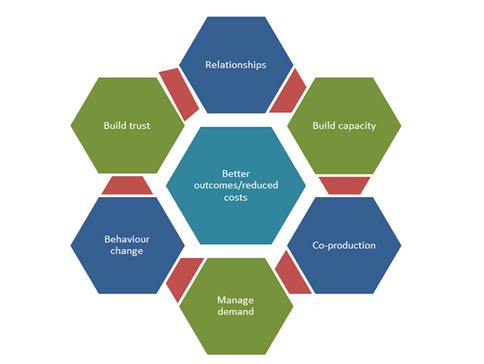
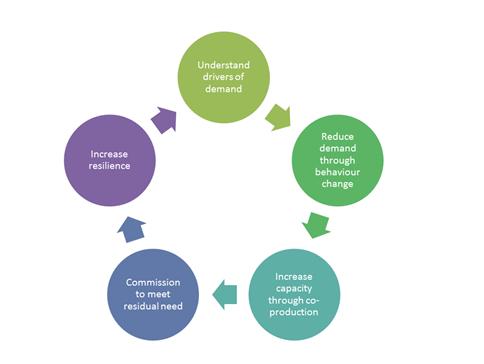
Firstly, enabling relationships to flourish between public service providers and those they serve – individually and collectively – is an absolute necessity if our aspirations for co-production and behaviour change are to be realised. It is increasingly understood that achieving significant change in so many of the challenges facing society – obesity, living well into old age, educational attainment, training and employment in an uncertain job market (to which you can add the pressing issue of your choice) – requires the active engagement of all of us as citizens. It is therefore at this point of interaction between citizens and the public services they use that we should focus our attention. As the new model of public services presented in Chapter 1 suggests, effective relationships, building trust and behaviour change are intimately connected.

Secondly, we know that the quality of the relationship between citizen and service provider can be a key determinant in the quality of the outcome of the service: evidence from fields as diverse as education, employment services and healthcare all suggest this.

Finally, we are slowly coming to understand that the complexity of organisations like those delivering local public services and the rapidity of change that they face mean that only those that are flexible and adaptive will excel. The process of constant learning needed to enable success itself requires a fundamental shift of attitude towards the nature of work – a shift of attitude that takes seriously the need to create meaning for staff within our organisations such that they carry with them the motivation, courage and adaptability needed to face the challenges of their daily tasks.

In this context enabling genuine relationships – relationships that carry with them more than a transactional or instrumental benefit – are not a soft option ‘nice to have’ but a hardnosed prerequisite for effectiveness. What we need is a relational revolution in our local public services.

This blog draws on ideas in Chapter 2 of a new book ‘Making Sense of the Future’

lawrence-pietroni

Chris Lawrence Pietroni joined INLOGOV as an Associate in September 2012. His work focuses on achieving sustainable systems change cross public services in the UK and the US. Building on over 15 years’ experience in local government working with senior leaders on the design of innovative service improvement and community engagement strategies, his work now focuses on the intersection between service design, leadership development and community empowerment. Much of Chris’ current work provides accessible ways for leaders to draw on systems thinking to enhance their collective effectiveness. Together with Mari Davis, Chris is pioneering the application of insights drawn from social movements and community organizing to achieve sustainable systemic change.

Damaged reputations (and how to repair them)

Ian Briggs

During a recent conversation with a senior product development engineer who works for a high end vehicle manufacturer, the importance of ‘halo products’ opened up an interesting conversation. Investment in such ‘halo’ products is a given in a highly competitive marketplace and the known impact they have on consumer behaviour is a strong justification for the high levels of investment needed in them.

The conversation turned to the near universally low esteem that this talented, hard working professional engineer held local public services in. To him, they were poorly managed, overly costly and rarely related to the wants and needs of the local people. Perhaps I should not have been surprised that he held this view but I did ask him if there was anything he really valued about local public services.

There was very little, but one service emerged as something that he did value – the local Fire and Rescue Service. He could find little to criticise about them. He cited a number of times that he was called upon to work professionally with them, and he saw them as having a very high level of professionalism when exploring vehicle safety issues. Any cut backs in this service he felt was poor political judgement. He was continually impressed by them and appreciated that in many cases the conditions within which they worked were challenging, dangerous and above all professionally demanding.

So why, if within the case he was putting forward that in the commercial sector investment in halo products and services is seen as a key way of leading and managing the overall brand, did the public sector not think and behave in the same way?

This contrasts with two papers that have crossed my desk recently. In both cases a strong argument is put forward for increasing the importation of private sector talent into the public service. However, in both cases the argument centres around the skills that commercial managers and leaders have in controlling inputs whilst at the same time improving the outcome quality of products and services. No mention is made of strategic investment in halo products and understanding of how careful promotion of those products and services that are known to be valued, even by those who consume products lower down the range, have a positive impact on overall consumer behaviour.

We did go on to discuss how the reverse could be true; could poor product perception have a negative impact upon products and services across the brand? The answer was a clear yes but the means by which this was countered was revealing. He cited cases of increasing management and leadership attention on those products and services that are valued. Clearly this has to be done simultaneously with rectifying where possible poor product and service across the portfolio, but it makes me reflect upon the tactics we apply in public service management. Are we missing a trick? The media is full of challenging stories of very serious public sector failure and the reputational damage that the NHS is suffering is potentially immense, as are sections of local government and other governmental agencies. But within this there seem to be few issues that lead to reputational harm to the Fire and Rescue Services – although I do not wish to tempt fate here!

So, should we explore this transferability of positive product and service a little more closely? My product engineer friend said that lessons could be learned in how these high value products are developed – in certain cases the positive impact of the product was achieved through a ‘less is more’ approach. Consumer behaviour can be positively impacted on by taking out unnecessary or unappreciated elements of a product or service; this is perhaps counterintuitive but is now an established mechanism for commercial organisations. The giving of more or adding more leads to a rapid acceleration of wants and needs but positively promoting the efficiency of a product that closely matches the expectation of the consumer adds value.

It would appear that within the highly tuned commercial mindset the notion of meeting the needs of the consumer is not always about the surprise and delight extras that are offered, but rather exists within the precise tailoring of need to product – even if somewhat perversely it may cost the provider more to take things out than to put additional things in.

What seems to be key here is the amount of attention that is paid to understanding what you do well whilst at the same time seeking address what you may not do so well. This is a principle that is commonly adopted in commerce – it is drawn from the theoretical perspective of ‘appreciative enquiry’ – seeking to understand what is positive and then taking active steps to deploy the factors that lead to success. There is an extensive literature on the subject that rarely seems to have an airing in public management circles, but perhaps this is something that we could learn from other sectors.

The key point here seems to be the accepted dimension of the transferability of reputations, both positive and negative, and the need for commercially savvy organisations to pay close attention to the ‘halo’ product and service. If that positive transferability is a reality then we should perhaps pay more attention to where we are succeeding and achieving high reputational advantage, even if the media still wants to pay rightful attention only to those areas where we may deserve a poor reputation. Maybe it could be a case of not seeking to import private and commercial sector savvy to wider public services, but to recruit more fire-fighters into wider public sector jobs.

briggs

Ian Briggs is a Senior Fellow at the Institute of Local Government Studies. He has research interests in the development and assessment of leadership, performance coaching, organisational development and change, and the establishment of shared service provision.

What do MMR and personal budgets have in common?

Catherine Needham

The recent spike in measles cases in Swansea and elsewhere has a particular salience for local government, occurring just as authorities took on new responsibilities for public health. Events in Swansea brought back into public attention the decline in uptake of the MMR (Measles, Mumps, Rubella) vaccine that followed a spate of media stories several years ago reporting an apparent link to autism. Despite the thorough discrediting of the link, MMR take-up rates have not recovered.

Declining rates of vaccination are not a UK-phenomenon and cannot wholly be laid at the door of a single rogue study. Research that I have been doing with Anat Gofen from Hebrew University in Jerusalem has highlighted that vaccination rates are dropping across western democracies. Often, in each country, the decline will be associated with a particular vaccine and a set of commonly circulating myths surrounding it. In the US, for example, it has been a rise in cases of whooping cough that has provoked most concern.

Whilst vaccine take-up rates have always been low within some disadvantaged communities, what has grown is the prevalence of parents practicing a form of so-called ‘scientific citizenship’, in which they research issues for themselves, make use of official and oppositional websites, and weigh the perceived risks. They may opt to delay the jabs until a child is older or to split combined vaccines into separate shots rather than not vaccinate at all. If they decide not to proceed with vaccination, they will find an online community of fellow resistors with whom to share stories and provide support.

What has this got to do with personal budgets in social care services? In both cases, citizens are challenging conventional notions of professional expertise and authority, and making a claim to know what is best for them and their families.

The two cases have many dissimilarities: accepting that older people and people with disabilities know best about their immediate care needs and should have choice and control about how they spend their time is clearly very different from accepting that parents know best about a medical intervention like vaccination. Personal budgets have been the culmination of many years of campaigning by disability organisations for recognition that the person using services is an “expert on their own life” and has widespread support in government and civil society. Vaccine refusal is a widely criticised activity with dangerous consequences for public health.

However for health and social care professionals on the frontlines, navigating the boundaries of citizen expertise is a growing challenge. With personal budgets expanding into the NHS as personal health budgets, it is no longer assumed that health interventions should always be determined on the basis of a traditional clinical evidence base. Like ‘expert patient’ programs, health budgets have been principally targeted at people with chronic conditions which require self-management and enable them to develop knowledge over the long-term. Other areas of health, such as vaccination, remain off limits.

However, citizens themselves may not accept this demarcation. Declining vaccination rates highlight the difficulties that officials face in attempting to ‘hold the line’, encouraging citizen expertise in some sectors of health and care whilst denying it in others. There are challenges for practitioners in explaining why you can be an expert patient but not an expert parent.

needham

Catherine Needham is a Senior Lecturer at the Health Services Management Centre, University of Birmingham, and is developing research around public service reform and policy innovation. Her recent work has focused on co-production and personalization, examining how those approaches are interpreted and applied in frontline practice. Her most recent book, public by the Policy Press in 2011, is entitled, Personalising Public Services: Understanding the Personalisation Narrative.