Tackling social problems: why don’t we do ‘what works’?

Jon Bright

One of the most significant problems in public policy has been the persistent failure to draw on evidence of “what works”—and, perhaps more crucially, what doesn’t.

Despite a growing interest in evidence-based policy, we still have a long way to go in identifying and scaling up successful practice. Take, for example, the findings from Nesta’s 2013 report, which revealed that only three out of seventy programmes implemented by the Department of Education were well evaluated (1). Sadly, this gap in evidence was not confined to education and still applies today (2).

Public sector managers need to know what works, what doesn’t and where they should experiment intelligently. However, until the late 1990s, there was little emphasis on evidence as a basis for policy and we haven’t moved as fast as we should have since then. As a result, we have been slow to innovate, evaluate, and scale up new ideas that add value.

What have been the consequences?

That’s not to say there haven’t been some stellar examples of innovation. But these have usually been down to exceptional people or circumstances. In most public organisations, knowledge of best practice is either lacking or hard to access. Public sector managers, particularly outside of professional disciplines, often lack the skills to assess evidence or adapt successful policies to different contexts. In some cases, even when they are aware of evidence, politicians may override advice in favour of projects shaped by political pressure, ideology, or personal interest.

As a result, we keep reinventing policies rather than refining and improving them over the longer term. This makes it much harder to tackle persistent social problems. What’s worse, some policies have been introduced despite evidence that they probably wouldn’t work (3). And even when successful programs are found, we struggle to replicate or scale them up in different contexts.

The Challenges of Policy Transfer and Scaling

This is the core of the problem. A good example is the attempt by English police forces in the early 2000s to replicate a successful gang violence reduction program from the US. Unfortunately, they ignored the detail underpinning the most important components of the US model and the results were largely unsuccessful (4).

In contrast, Strathclyde Police in Scotland carefully adapted the model and successfully reduced gang-related violence. Between 2004 and 2017, the murder rate in Strathclyde halved, and the rate of knife crime dropped by 65%. This example underscores the importance of understanding not only what works, but why it works and how it can be adapted to local contexts (5).

Scaling up successful interventions presents additional difficulties. Long-term success depends on increased funding which is rarely guaranteed. Family Nurse Partnerships (FNPs), for example, have been shown to be effective but have only benefited a small fraction of eligible children in the U.K., despite their positive impact on school readiness and early education outcomes (6). There must be a better way.

Why Is This Still a Problem?

There are several reasons why doing ‘what works’ is a difficult nut to crack. not least of which is the political environment in which decisions are made. Politicians may also reject evidence-based proposals for understandable reasons: cost, public opposition or concern about how they will land with colleagues and the media. Sometimes the timing’s just not right.

Moreover, public sector organisations are often risk-averse. Innovation requires a supportive culture, special funding, expertise, and incentives—elements that are frequently absent. On the plus side, the requirement to produce a business case for new policies does encourage the search for evidence.
The most common objection to evidence-based policy is that we often don’t have the evidence. I deal with this below.

Finally, until recently, there have been too few organisations charged with bringing evidence to decision-makers.

The What Works Centres

The good news is there has been some progress. Ten independent ‘what works’ centres have been set up in recent years to provide evidence-based guidance to policymakers. These centres, covering areas such as health, education, crime, homelessness, ageing and children’s social care, help to bridge the gap between research and practice (7). Their role is to provide unbiased, rigorous, and practical advice to help public services become more effective (8).

However, the work is far from complete. While the centres have made significant strides, there is no agreed, systematic way of incorporating ‘what works’ into the development of policy and delivery of services. Additionally, there has been no independent review of the centres’ overall impact on public policy in the 10 +years since they were founded.

What next for What Works?

The Centre for Public Impact (CPI) argues that a lot of evidence simply isn’t robust enough as the sole basis for social policy (9). It suggests we should use the term ‘evidence-informed’ alongside ‘evidence-based’ and proposes a combination of evidence, expertise, and experience as the best bet for designing policies that will work in most places.
Evidence-informed practice – Centre for Public Impact

To progress the evidence-based policy agenda, five points need to be addressed:

  1. Government Commitment: Government should invest more in research and development. While private companies like Volkswagen allocate a substantial portion of their budget to R&D, most government departments spend less than 1%. Senior civil servants must also be better equipped to understand and apply evidence-based policies (10).
  2. Local Government Involvement: Much of the ‘what works’ conversation takes place at the national level. Local government and civil society must be more involved to ensure better policy and bigger impact. The Welsh Centre for Public Policy is thought effective because of its close working with the devolved government.
  3. The Limits of Evidence: Often, evidence is incomplete or not easily applied to specific contexts. Furthermore, while the Centres are good at synthesising evidence, they don’t take account of the politics of policy making. Local policy makers often query the relevance of evidence when it doesn’t address their main policy questions (11). Evidence often needs to be combined with professional expertise and local experience to tailor policies to local needs.
  4. Scaling Up Good Practice: Public sector organisations need better systems for integrating successful new approaches into their mainstream services. This reduces the need for special funding. Similarly, successful programmes should be repackaged in a form that makes them easier to replicate at scale (12).
  5. Support for Local Managers and Practitioners: User-friendly, evidence-based information is crucial. For example, the Education Endowment Foundation assesses interventions based on evidence strength, cost and impact. This helps schools make good decisions. Other centres also provide ‘what works’ toolkits (13)

During 2024/25, there have been developments in the Network. For example, the Centre for Local Economic Growth has advised local authorities and emphasised tailored interventions that consider local contexts and needs. The Centre for Children’s Social Care has been recommending practices to improve outcomes for children in care. There has been greater collaboration among the Centres including a unified digital platform to disseminate findings. Looking ahead, new centres on climate resilience and digital inclusion are anticipated. The UK government has renewed its funding to the Network.

The ‘what works’ movement is a major step forward in improving public policy. To maximize its impact, its leadership needs to be refreshed, local government and civil society better engaged, and systems created to incorporate successful practice into mainstream services.

Jon Bright is a former civil servant who worked in the Cabinet Office and Department of Communities and Local Government between 1998 and 2014.

References

  1. Cited in The What Works Network (2018) The What Works Movement Five Years On. P15.
  2. Mulgan. G and Puddick. R, (2013) Making evidence useful- the case for new institutions, National Endowment for Science, Technology and the Arts (NESTA).
    See also Institute for Government event in October 2022 ‘What works’ in Government: 10 years of using evidence to make better policy. At this event, David Halpern commented that only 8% of sample of Government programmes had evaluation plans in place.
  3. Wolchover. N, (2012) Was DARE effective? Live Science 27.3.2012; and College of Policing (2015) Scared Straight Programmes, Crime Prevention Toolkit.

4. Knight. G, (2009) How to really hug a hoodie. Prospect. November 2009. See also, Tita. G, Riley. J,
Ridgeway. G, and Greenwood. P, (2005) Reducing Gun Violence Operation Ceasefire. National Institute of Justice (USA); and Braga. A. Kennedy. D, Waring. E, Morrison Piehl. A, (2001) Problem-oriented policing, deterrence, and youth violence: an evaluation of Boston’s Operation Ceasefire. National Institute of Justice.

5.Big Issue (2020) How Scotland’s’ Violence Reduction Unit breaks the cycle of crime, Big Issue 11.9.2020;
Craston. M, et al, (2020) Process evaluation of the Violence Reduction Units Home Office Research Report 116, August 2020; O’Hare. P, (2019) How Scotland stemmed the tide of knife crime, BBC Scotland news website, 4 March 2019; and Batchelor. S, Armstrong. S, and MacLellan. D, (2019) Taking Stock of Violence in Scotland, Scottish Centre for Crime and Justice Research August 2019.

  1. National Institute of Health Research (2021) Family Nurse Partnerships Building Blocks 5-6 study.
  2. Gov.UK (2013, updated 2022) What Works Network, Evaluation Task Force. https://www.whatworksnetwork. org.uk/
  3. The What Works Network (2018) The What Works Movement Five Years On.
    See also Breckon. J, and Mulgan. G, (2018) Celebrating Five Years of the UK What Works Centres, NESTA.
  4. Snow. T, and Brown. A, (2021) Why evidence should be the servant, not the master of good policy Centre for Public Impact.10.8.2021
  5. Halpern, D presentation at an Institute for Government (2022) event op cit.
  6. Private correspondence with Jason Lowther, Head of INLOGOV.
  7. Little. M, (2010) Improving children’s outcomes depends on systemising evidence-based practice… Demos
  8. Education and Endowment Foundation – Teaching and learning toolkit. An accessible summary of education evidence https://educationendowmentfoundation.org.uk/

REASONS TO BE HOPEFUL – HOW THE GAP IN LIFE EXPECTANCY BETWEEN ENGLISH REGIONS WAS NARROWED

Nicholas Hicks and Jon Bright

In this blog, we discuss a major success in health policy that’s been largely forgotten.

What happened?
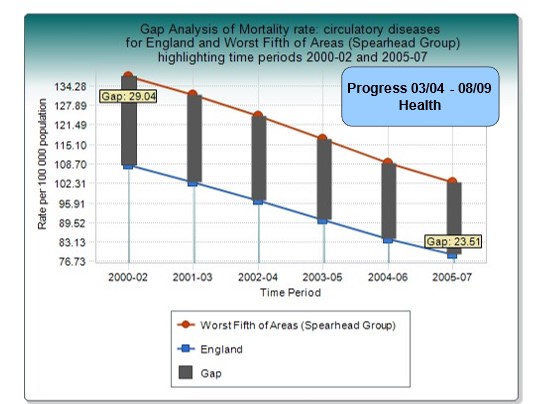
During the 2000s, a government strategy to tackle health inequalities in England led to a reduction in geographical differences in life expectancy. Furthermore, this success reversed a trend that had been increasing. It was achieved by reducing death rates caused by coronary heart disease.


The chart below shows an overall reduction in coronary heart disease mortality and a reduction of nearly 20% (19.07%) in the gap between the national average and the poorest areas. [Barr et al 2017]


This is the only period in the last 50 years when inequalities in death rates between rich and poor have narrowed. It was a considerable achievement and an historic result.

What was the impact in terms of lives extended?
This policy meant that many millions of people lived longer and healthier lives. Much of the benefit was probably due to reductions in smoking and managing risks such as high blood pressure and cholesterol. In 2000, 38% of the adult population smoked and smoking was twice as common amongst those on low incomes. Today, only about 13% of the adult population smoke, the lowest since records began.

But this achievement was not down to health policy alone. Importantly, it was also due to coordinated action across Government to tackle inequalities more generally. This is because many of the factors that affect health lie outside the health sector.

What were the policy drivers?
This work started in 2000 with the NHS Plan (that committed Government to publishing inequality targets), and the Department of Health’s National Service Framework for Coronary Heart Disease, and continued over several years.

These policies led to a national commitment to reduce inequalities. In the wake of the NHS Plan, the Government set Inequalities targets and incorporated them into national Public Service Agreements (PSAs). These Agreements required central government Departments to do better in those parts of the country where outcomes were poorest. This applied not only to health but also to low income, family functioning, education, employment, and crime. These wider issues are major influences on people’s health and targeted action on these made it more likely that health-specific interventions would succeed.

PSAs defined the goals of the 2002 and 2004 Comprehensive Spending Review. Departmental budgets were only agreed once each Department produced credible plans showing how they would contribute to the inequality targets.

What did all this mean in practice for people living in poorer regions?
Health-specific interventions included smoking cessation clinics; improving the distribution of GPs – many disadvantaged areas had no GP service; more resources for disadvantaged areas; national guidance on best practice; and improved access to mental health services. Action to tackle the wider causes of poor health included improving housing (the Decent Homes Standard); increasing household income (the Minimum Wage, Tax Credits); investment in education and skills; reducing the number of young people not in education, employment and training; teenage pregnancy prevention; and investment in early years (Sure Start and family support).

This approach is consistent with Prof Michael Marmot’s conclusions in his 2010 report, ‘Fair Society, Healthy Lives‘ .


What did evaluators find?
Evaluators found that regional inequalities decreased for all-cause mortality and that the strategy was broadly successful in meeting its ambitious targets. Writing in 2017, Barr et al they concluded that ‘future approaches should learn from this experience”. They noted that current policies were probably reversing this achievement of the previous decade. See also Holroyd et al’s systematic review.

In our main paper REASONS TO BE HOPEFUL we discuss the evaluations in more detail.


What lessons should we draw?
There are five main lessons to draw from this evidence:

  1. When Government takes a coordinated approach to a problem – and sticks with it over time – the results can be impressive, even with problems thought to be intractable.
  2. Health is a good proxy for Levelling Up. Narrowing the health gap between regions is a good proxy for ‘levelling up’ more widely. Health inequalities are in large part due to poverty, poor education, and poor housing. Regional inequalities in educational attainment and crime also narrowed.
  3. Leadership and persistence are essential. A ‘whole of government’ approach requires good cross departmental working, full engagement with local government, and leadership from the Prime Minister.
  4. Tackling the nation’s problems needs longer term policy making so successful approaches don’t fizzle out whenever there’s a change of Government. As we’ve seen, benefits achieved up to 2010 may have been lost by 2017. Maintaining progress requires cross-party, long-term collaboration.
  5. This approach worked by influencing mainstream budgets via better targeting and evidence-based interventions, rather than relying only special ring-fenced funding

Today, the big health challenges today are obesity, diabetes and related conditions. Again, poorer populations are much more affected. Will today’s politicians rise to the occasion?

Dr Nicholas Hicks BM BCh FRCP FRCGP FFPH is an Honorary Senior Research Fellow, Nuffield Department of Primary Health Care Sciences at the University of Oxford and a Senior Strategy Advisor, Department of Health and Social Care. He is also an Associate Fellow, Green Templeton College, University of Oxford. He was seconded to the Department of Health Strategy Unit and helped draft the inequalities chapter of the NHS Plan in July 2000 ([email protected]).

Jon Bright is a former civil servant who worked in the Cabinet Office and Department of Communities and Local Government between 1998 and 2014.

References

  1. Meadows D. Leverage points: places to intervene in a system.
  2. NHS Plan. A plan for investment; a plan for reform. Department of Health (2000): 106-7
  3. Health inequalities – national targets on infant mortality and life expectancy – technical briefing . Department of Health March 2002
  4. Spending Review 2002: Public Service Agreements, HM Treasury 2002 para 1.12
  5. Holdroyd I, Vodden A, Srinivasan A, Kuhn I, Bambra C, Ford JA. Systematic review of the effectiveness of the health inequalities strategy in England between 1999 and 2010. BMJ Open. 2022 Sep 9;12(9):e063137. doi: 10.1136/bmjopen-2022-063137. PMID: 36134765; PMCID: PMC9472114.

Dusting down the cautious welcome: Initial reflections on the devolution white paper

Phil Swann

When I was director of strategy and communications at the LGA I was frequently criticised, by the late professor John Stewart among others, for issuing press releases “cautiously welcoming” one Blairite initiative or another.

The criticism was probably justified, but I would definitely have deployed that phrase in response to the government’s recently published devolution white paper.

There is undoubtedly a lot to welcome, not least the stated commitment to devolution, the additional powers for metro mayors, the revival of strategic planning, its reference to struggling small unitary councils and the focus on audit and standards.

There are, however, at least four reasons to be cautious.

First, every serious reformer of local government since George Goschen in the 1860s has argued that local government finance and structures should be reformed together. No government has ever had the political will or energy to do so. This government has also ducked the opportunity. As a result, this white paper will not fulfil its potential.

Second, the current mess and confusion in the structure of English local government is the result of incremental change. Just think of Peter Shore’s “organic change” and Michael Heseltine’s ill-fated Banham Commission. There is a real danger that this government will run out of restructuring energy or time. The contrast with Scotland and Wales, where local government was reorganised in one go, could not be starker.

Third, the effectiveness of the structures being proposed will depend on the quality of the relationships between mayors and councils, between councils and parishes and between ministers and mayors, councils and parishes. In England we are not good at relationships like these and there is precious little in the white paper to signal the trust, effort and imagination that will be needed to make these relationships work better than the previous ones did.

Finally, key to the revival of local government and effective devolution is a revival of citizen engagement in local politics and local governance. Word has it this will be addressed in a forthcoming white paper, but it should be central to this one.

So, a very cautious welcome it is.

Phil Swann is studying for a PhD on central-local government relations at INLOGOV.

ELECTED MAYORAL GOVERNMENT – SOME INLOGOV ANGLES

Chris Game

This blog was prompted partly by Vivien Lowndes’ and Phil Swann’s recent INLOGOV blog giving “Two cheers for combined authorities and their mayors”. Substantively, anyway, although the decisive stimulus was the realisation that most, if not all, of those present at the relevant ‘Brown Bag’ session would probably have been unaware that seated among them was the co-author of almost certainly the most comprehensive examination of this topic by any INLOGOV colleague over the years.

I refer to the appropriately labelled ‘long-read’, also masquerading as an INLOGOV blog and entitled Briefing Paper: Elected Mayors, published shortly before the 2017 elections of what I think of as the second generation of elected mayors – and produced by Prof Catherine Staite and a Jason Lowther.

Catherine, nowadays an Emeritus Professor of Public Management, had recently stepped down as Director of INLOGOV, in which capacity she had, among numerous other initiatives, both launched and regularly contributed to our/her blog. And, while I certainly recalled reading the Briefing Paper, I confess that, with his name meaning little to me at the time, I’d forgotten her co-author. Apologies, Jason.

He claimed, moreover, that he himself had “forgotten” it (email, 14/5), which I didn’t, of course, believe … until, a few days later and following some ‘research’, I discovered one of my own INLOGOV blogs, on the Magna Carta and 800 years of Elected Mayors, which I really had totally forgotten. Whereupon I realised too that I couldn’t actually recall much of what Catherine, I and other colleagues contributed to that decade of debate on elected mayoral evolution.

So, the remainder, the structure, and – I fear – the length of this blog were prompted, yes, by much of the media coverage of this month’s elections, and the sense that the spread and substance of mayoral government over the past decade aren’t fully recognised even by those who supposedly follow these things; and also by the notion that it would be a pleasing mini-tribute to Catherine to do so by identifying and italicising particularly some of her and colleagues’ INLOGOV blog contributions on these mayoral matters over the years.

We start, however, for the benefit of comparatively late arrivals, at the beginning of not the blog, but the concept. Mayoral government is a postulation you might expect to have found a supportive, even enthusiastic, reception in an Institute of Local Government Studies and it mainly did, albeit with perhaps a certain reservation. Directly elected mayors (DEMs) had played a fluctuating role in the Blair Government’s local government agenda from the outset. London, noted in Labour’s 1997 manifesto as “the only Western capital without an elected city government”, would have a “new deal”. Which took the form in 2000 of the creation of the Mayor-led Greater London Authority – in the manifesto, so no referendum required. Probably no reminder required either, but they’ve been: Ken Livingstone (Ind/Lab; 2000-08), Boris Johnson (Con; 2008-16); Sadiq Khan (Lab; 2016- ).

The Local Government Act 2000 then provided all English and Welsh councils with optional alternatives to the traditional committee system. Chiefly, following a petition of more than 5% of their electorate, they could hold a referendum on whether to introduce a directly elected mayor plus cabinet. There were 30 of these referendums in 2001/02, producing 11 DEMs – plus Stoke-on-Trent’s short-lived mayor-plus-committee system – three in London boroughs, but most famously Hartlepool United’s football mascot, H’Angus the Monkey, aka Stuart Drummond (Indep).

Ten referendums over the ensuing decade produced a further three mayors, prompting the now Cameron-led Conservatives to pledge in their 2010 manifesto to introduce elected ‘Boris-style’ mayors for England’s 12 (eventually 11) largest cities, with significant responsibilities including control of rail and bus services, and money to invest in high-speed broadband.

These DEM referendums eventually took place in May 2012 – three months after the launch of the INLOGOV blog – and provided a natural topic for early blogs by Catherine and colleagues (Ian Briggs). The referendums followed protracted Whitehall battles over mayoral powers (CG) – as revealed by the then Lord Heseltine in a UoB Mayoral Debate (CG) – a combination of ministerial indecision and interference (CG) against a backdrop of opposition from most of the respective councils’ leaderships, with Bristol the only one of the 12 cities voting even narrowly in favour (Thom Oliver).  

Birmingham voted 58% against, despite Labour’s having in Liam Byrne a candidate raring to go, and Coventry 64% against. There was speculation over whether the addition of a well publicised mayoral recall provision (CG) might have swung some of the lost referendums. But it was what it looked: an overdue, and to some welcome (Andrew Coulson), end of an episode (Karin Bottom);arguably the wrong solution to the wrong problem (Catherine Durose).

Since then, the referendums successfully removing elected mayors (Stoke-on-Trent, Hartlepool, Torbay, Bristol) have exceeded those creating new ones (Copeland, Croydon) – though, in fairness, those four removals were more than matched by five retention votes.

A ‘mayoral map’ at the end of that first decade would have looked something like the inset in my illustration of in fact the first 20 years of referendum results – numerous splotches of red for Reject, a few smaller green specks for Accept, and overall a patchy, somewhat arbitrary, experiment that on a national scale never really took off.  

The mayoral concept, though, had also generated interest outside local government – the Institute for Public Policy Research (IPPR), for instance, advocating Mayors for Greater Manchester, the West Midlands, and Liverpool City Region to take the required ‘big’ decisions on housing, transport, and regional development. Prime Minister David Cameron too was a ‘city mayors’ fan, although what scale of ‘city’ wasn’t initially clear, until in 2014 what became known as the first ‘devolution deal’ (Catherine Needham) was announced with the Greater Manchester Combined Authority. Headed by an elected ‘metro-mayor’ (CG), comparable to the Mayor of London, the GMCA would have greater control over local transport, housing, skills and healthcare, with “the levers you need to grow your local economy”.  

New legislation – the Cities and Local Government Devolution Act 2016 – was required, allowing the introduction of directly elected Mayoral Combined Authority or ‘Metro Mayors’ (Vivien Lowndes & Phil Swann) (+ Catherine Staite) in England and Wales, with devolved housing, transport, planning and policing powers.

The Combined Authority elections were held in May 2017 – not coinciding with the General Election (CG) as PM Theresa May had contemplated but, in contrast to Rishi Sunak, chickened out of – with perhaps usefully split results (CG). Elected were Andy Burnham (Lab, Greater Manchester), Steve Rotheram (Lab, Liverpool City Region), Ben Houchen (Cons, Tees Valley), Andy Street (Cons, West Midlands), Tim Bowles (Cons, West of England), and James Palmer (Cons, Cambridgeshire & Peterborough) – followed in 2018 by Dan Jarvis (Lab, Sheffield City Region). The map had started to change – even within the first hundred days (CG) – stutteringly under the less committed Theresa May and/or in several cases where groups of local authorities failed to agree – but eventually dramatically, as evidenced in the larger illustrated map. The Staite/Lowther ‘Briefing Paper’ was well timed.

A few years on, mayoral devolution has trailblazed across the country (CG) to a greater extent than even some commentators on this year’s local elections seemed to have difficulty grasping. As of March 2024, devolution deals had been agreed with 22 areas, covering 60% of the English population – most recently, in late 2022, North of Tyne, Norfolk/Suffolk, East Midlands, York & North Yorkshire; in 2023 Cornwall, Greater Manchester and West Midlands (‘Trailblazers’), Greater Lincolnshire, Lancashire, Hull/East Yorkshire; and so far in 2024 Buckinghamshire, Warwickshire and Surrey.  

From next year, if you draw a straightish line from, say, Ipswich in South Suffolk up through about Alvechurch in South Birmingham, heading for Shrewsbury, at least five-sixths of the bits of England to your north will be under mayoral devolution. Which, to me anyway, seems pretty dramatic news, and considerably more interesting than the endless General Election Date speculation that passed this May for ‘Local Elections’ reporting.

Picture credit: https://en.wikipedia.org/wiki/Mayor_Quimby

Chris Game is an INLOGOV Associate, and Visiting Professor at Kwansei Gakuin University, Osaka, Japan.  He is joint-author (with Professor David Wilson) of the successive editions of Local Government in the United Kingdom, and a regular columnist for The Birmingham Post.

Inflation and Local Authority Budgets

Andrew Coulson

Our two main political parties are locked in a strange debate about the next budget, on 6 March. The elephant in the room is the underfunding of local government.

In the nearly 14 years of Conservative government, the core spending power of local authorities has been cut by 27% in real terms.[1] The County Councils Network has “warned that its members are under extreme pressure, and that the authorities they represent are set to overspend by almost £650m this year due to spiralling costs, particularly in children’s social care and home to school transport, which was contributing to a £4b funding deficit for those authorities over the next three years”. In addition an increase in the National Living Wage is expected to costs these councils £230m next year.[2] This has happened at a time when the ability of councils to raise their council taxes has been held down, for 2024-5 to below 5% for all but a tiny number of councils.[3]  One of its consequences has been the inability of the employers in local government and the NHS to negotiate pay settlements which reflect the rate of inflation, or anything near it.

My reading of the present position is that Gove on the one hand and Rachel Reeves on the other are playing chicken. Each are waiting for the other to move first. They both know that after the general election a new government will have to settle the long-standing pay disputes in the public sector, and that it is not possible, year after year, for the pay of staff employed by local government and the NHS to rise by less the rate of inflation. The consequences are visable: depressed morale, a haemorrhage of experienced staff, and dependence on immigration to employ new staff. Rachel hopes that the Conservatives will be forced to confront this before the election. Gove wants the Labour Party to commit to doing it, because as of now any settlement is unfunded.

My view is that the understanding of inflation both by the two main political parties and the Bank of England is naive, especially as it relates to government policy. The starting point should be that inflation affects the distribution of income. It is an intrinsically political process. Most large companies and the richest people have means through which they can compensate for any inflation. Those who do not have the power or muscle to do so pay the price. Thomas Piketty[4] showed that inflation was the main means by which the middle classes paid for much of the costs of two world wars.[5]  In those inflations, and in the last significant inflation in the UK, which followed the OPEC hikes in oil prices in the 1970s, the trade unions were strong enough to ensure that wages rose at around the rate of inflation. This is no longer the case.

Yet the recent inflation has given the Government unprecedented increases in tax, which means that, if they so choose, they can afford wage increases. Most of this extra income arises from not raising the ceilings on higher rates of tax. Jeremy Hunt would like to use it to lower rates of income tax. The IMF (no less!) has told him that it is not appropriate to do so at this time.[6] The main reason, not always clearly stated, is that there are many unfunded challenges, but of these the public sector pay disputes (and perhaps the need for additional spending on defence, where difficulties in retention and recruitment are also partly a matter of pay settlements not keeping up with inflation) are top of the list. 

Economists in the UK, the USA and other developed countries have had little to say in recent years about inflation. As if it is no longer a problem, which it probably isn’t if inflation stays at around 2%. But the present inflations, driven by wars, the climate crisis and the lockdowns, are another matter. Economic theory is little help. All the traditional theories have been shown to be false. It is not true that inflation and unemployment are opposites: we can have both together, so-called stagflation. Or that it can be controlled by limiting the supply of money, which is not possible when most of it is created by banks which lend far more than they hold in deposits. Or that it is either created by unexpected demands or by unexpected costs.

The British Government urgently needs to resolve the disputes about pay in the public sector, and to do so recognising that most local government employees are substantially worse off than they were before. The Labour spokesperson Angela Rayner has made the practical proposal of negotiating a three year settlement.[7]  It cannot come soon enough.


Andrew Coulson is a nationally-recognised expert on scrutiny in local government and is particularly interested in governance by committee.


[1] Local Government Association, https://www.local.gov.uk/about/campaigns/save-local-services/save-local-services-council-pressures-explained 2024

[2] https://www.countycouncilsnetwork.org.uk/councils-in-significantly-worse-financial-position-after-the-autumn-statement-with-seven-in-ten-now-unsure-if-they-can-balance-their-budget-next-year/

[3] A prescient academic law professor, writing as long ago as 1984, wrote “It seems to me that the provisions for rate-capping … are little removed from a proposal to replace elected councils by administrative units. For a very long time, local inhabitants have enjoyed the right to elect local representatives with the power to tax, and so to determine, within modest political limits, what level of services shall be provided in the locality. … I have no difficulty in saying of an Act to put a limit on the rates leviable by a local authority that it is politically unconstitutional”. John Griffiths, in the Preface to Half a Century of Municipal Decline 1935-1985, George Allen and Unwin, 1985, p.xii

[4] Thomas Piketty, Capital in the Twenty-First Century, Harvard University Press, 2014

[5] The point was also made by one of his critics, Joseph T Salano, “War and the Money Machine: Concealing the costs of War beneath the Veil of Inflation” in John V Denson (ed.) The Costs of War, Routledge, 2nd edn. 1999 

[6] David Milliken and William Schomberg,  https://www.reuters.com/world/uk/imf-cuts-uk-growth-outlook-2025-after-stronger-past-performance-2024-01-30/

[7] “Rayner floats three year pay deal”. Municipal Journal, 14 Feb. 2024

Could do better – supporting young carers at school

Elaine Campbell

Young carers provide unpaid, and often unacknowledged care, usually for parents or other family members. While caring may be viewed as a health and social care issue, most young carers who are under 18 will spend much of their time in full-time education. So it is critical that education professionals are ready and able to support young carers to achieve at school.

This study explored how a multi-agency approach could improve the educational experiences of young carers in Northern Ireland through a survey of teachers and interviews with professionals in education and health and social care.  Young carers are often unseen by medical and educational professionals, who may be unaware they are providing care or unaware of what support may be needed.

Key findings

  • Young carers and their experiences are routinely overlooked and unseen in educational and health care settings. 
  • The lack of legislative recognition for young carers has created a policy void, despite input which has explicitly identified the need to support and care for this group of young people. 
  • Existing guidance which outlines ways to support young carers in school has not been routinely implemented in schools or shared with school staff
  • A combination of a strengths-based model, combined with existing protective factors for young people has the potential to provide appropriate care and support, promote positive self-worth and improve educational outcomes for young carers.
  • A systematic failure of planning contributes to patchy and inconsistent partnership approaches which are overly reliant on individual commitment to change, rather than systems change

Background 

While my study focused on Northern Ireland, many of the issues faced by young carers are universal in nature. The literature review highlights the unseen nature of young carers as a key barrier identified by researchers and young peoples’ experience across cross-national researchers

Teachers’ understanding of impact and role of young carers is variable, and at times, dismissive. The age at which young carers may begin their caring role is often at primary school, which is unexpected by teaching and medical professionals. The study highlighted a willingness to help but also a reliance on parents or young carers disclosing their status. 

Reaching out to young carers is essential

Teachers acknowledged the difficulties of identifying young carers; other research has established that young carers may be reluctant to self-identify or to ask for support if they feel they have not been listened to. Teachers felt that parents only disclosed when they felt forced, often during a crisis. 

Transition points provide an excellent opportunity to encourage disclosure. Updating contact information each year, conversations about the transfer to post-secondary school and when young people enrol in a new school are ideal opportunities to ask if a child is undertaking caring responsibilities. This can help start the conversation about how to support them in school. Schools can include information on their websites, on posters, and use Assemblies to recognise the contribution young carers make.

The policy deficit contributes to suffering 

Resources and initiatives have been identified, but never implemented, which is both disappointing, but also provides an opportunity for change. Guidance without legislative protection is unlikely to be prioritised. Young carers are less likely to take up further education and more likely to live in poverty, and more likely to experience poor mental health.  

The sustained lack of policy attention is an issue which requires urgent redress. Existing guidance includes specific, practical examples of ways to support young carers emotionally and practically to achieve at school, and many of the suggestions require time and planning, not financial costs. A renewed effort to share and monitor this guidance, using a policy lever, could make a powerful impact on young carers. 

Shifting the focus from harm reduction to promoting wellbeing 

Professionals described a system which considers young carers primarily in terms of harm reduction. Despite the challenges, many young people are proud of their caring role and display outstanding qualities and strengths.

There is insufficient focus on working collaboratively to provide proactive support to young carers to achieve in school, take up opportunities to socialise, and enjoy breaks from caring, or to share information about this support to young carers.

Education Authority guidance, with input from young carers, highlights that what they often want most is practical support to help them get through the school day and for their teachers to show understanding of their reality.

Conclusion 

This study highlighted that there are pockets of good practice and existing multi-agency working which have contributed to collaboration, but these are exceptional rather than routine. 

The study concludes that there is a need for greater legislative recognition, including a statutory responsibility on key agencies in health and social care and education to provide support for young carers.

Agencies should be more proactive in seeking out young carers, by including information on school enrolment and admissions forms, asking during clinical admissions and review medical appointments, and signposting to young carers’ projects and other partners.

Young carers are being failed; they deserve better, and the answers are already there. What’s needed now is the impetus to follow through and deliver.

Elaine Campbell was awarded an MPA in 2023. Previously an Assistant Director at children’s charity Barnardo’s, Elaine is currently Head of Service Enablement and Improvement at Alzheimer’s Society. She is also a Chair of Board of Governors at a primary school. She can be contacted at [email protected]