Monday Jan 17th 2022 – The Great Parliamentary Resistance (Part 1)

Chris Game

About the first sizable 2022-dated research-based publication I at least scanned was the alliteratively subtitled The Great Reset: Public Opinion, Populism, and the Pandemic by Cambridge University’s Centre for the Future of Democracy.  Based on massive international data sets, it finds that (summarising outrageously), while the pandemic has generally reversed the rise of populist leaders, parties and attitudes, the cost has been “a disturbing erosion of support for core democratic beliefs and principles, including less liberal attitudes with respect to basic civil rights and liberties, and weaker preference for democratic government.”

The UK Government can obviously provide numerous illustrations – from its treatment of refugees and asylum seekers to a Justice Secretary who wants to rewrite the Human Rights Act minus its “wokery”.

But then, literally following the weekend of my coming across The Great Reset, we had the extraordinary, in parts even historic, Monday evening of the Great Parliamentary Resistance.

Both Houses were involved, and two separate Government Bills, both as controversial as they are important, both the subject of consequential, even history-making action simultaneously throughout the evening – and virtually all of at least interest, where not of direct relevance, to an Institute of Local Government Studies.

This Government, even in its legislative behaviour, is greedy, disorganised and unscrupulous, and on that Monday 17th it was all on display – the problem being that, with the more complicated (House of Lords) action being summarily and potentially misleadingly reported, doing justice to the historic legislative events seemed a bit too much for a single blog.  What’s more, I didn’t come across a single stealable visual aid.

So, I took a decision: two separate but linked blogs. The second – because it makes better chronological sense – will cover the hugely controversial Elections Bill, that seeks to ‘Reset’ some of those core democratic beliefs and principles referred to above: among other things, introducing mandatory voter ID at polling stations, undermining the independence of the Electoral Commission, and changing the electoral system for Mayors and Police & Crime Commissioners.

Its intentions to restrict voting are blatantly partisan; it has been rammed through Parliament, added to and amended, minimising legislative scrutiny; and on that Monday evening it received its Third Commons Reading on more or less straightforward partisan lines (https://www.bbc.co.uk/news/uk-politics-60037651), and thereby progresses to the Lords.

Both Jason Lowther and I have blogged previously about aspects of the Bill, and Part 2 of ‘The Great Parliamentary Resistance’ will shortly update them.

For the remainder of this Part 1, though, it’s across to the Lords and their truly historic Monday evening, when they savaged the Government’s ‘flagship’ Police, Crime, Sentencing and Courts Bill – and not once or twice but an apparently Parliamentary record 14 times! 

Even the Bill’s title suggests a huge legislative gallimaufry, and it is – a classic Priti Patel production, taking the whole of the second part of last year to progress through the Lords to last Monday’s Report stage. That time lapse proving, pleasingly piquantly, the key to some of the Government’s difficulties.

For Patel evidently thought it would be a clever wheeze to use the Lords’ extended deliberations as an opportunity to add all sorts of additional clauses to the Bill, covering some of the myriad things that had enraged her since March – like Insulate Britain’s M25 traffic obstructions last September and Extinction Rebellion protests around November’s UN Cop26 climate summit.

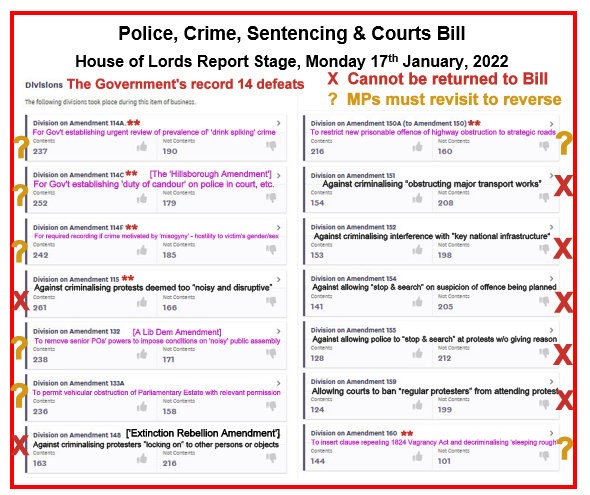
All of which meant that there were three distinct types of Government defeats – sorry, votes – taking place at this Lords Report Stage.  First, the ‘normal procedural’ ones, on parts of the Bill as received from the Commons last July, that the opposition parties in the Lords would like to see reconsidered by MPs and ideally amended or removed. This will kick off the process so whimsically known as ‘parliamentary ping pong’ between the two Houses.

Patel’s ‘late additions’, though, are another matter entirely: criminalising protests deemed too noisy and disruptive … and protesters ‘locking on’, either to each other or immovable objects … and interference with key national infrastructure … and obstructing major transport works … and allowing police to stop and search without giving reasons … and allowing courts to ban regular protesters from even attending protests …   The Lords defeated all of these and MPs can’t reinstate them, as they never voted them into the Bill in the first place, so they’re removed altogether – or at least until Patel repackages them into another Bill for the new parliamentary year starting in April.

Then there are the Lords’ own ‘late additions’ – reviewing the prevalence of ‘drink-spiking’ crime … and crime motivated by ‘misogyny’ … and removing police powers to determine what constitutes a ‘noisy’ assembly … and belatedly repealing the 1824 Vagrancy Act, thereby establishing that begging or sleeping rough should no longer, in this post-Napoleonic/Waterloo era, constitute criminal offences.

None of these were in the Bill when it left the Commons, but they are now – and if MPs don’t like them, they’ll have to vote them down.

What concerned me about the initial reports I read of the Great Lords Monday Night Rebellion was that most seemed, albeit understandably, excited by the record 14 Government defeats, to the point of failing to note the really rather significant differences in the categories and potential significance of the defeats – even some of those with a stake in some of that detail, like Police Professional or Green World.  

So, having recently received my copy of the Inlogov Associates Handbook and being slightly apprehensive that the Director might try to inveigle me into some actual lecturing, I thought I’d prepare the first new overhead I’ve attempted for, well, a few years now – summarising at least my understanding of the current state of play. Hope it helps!


Photo

Chris Game is an INLOGOV Associate, and Visiting Professor at Kwansei Gakuin University, Osaka, Japan.  He is joint-author (with Professor David Wilson) of the successive editions of Local Government in the United Kingdom, and a regular columnist for The Birmingham Post.
Decarbonising Transport: How Can we Work Together to Make an Impact?

Dr Louise Reardon

With the COP26 climate change conference only days away, the media is awash with pieces on the challenge we face and the policy options available (or not) for us to meet our net-zero commitments. One of the areas needing significant attention is transport.

Transport contributed 28% of total domestic Green House Gas emissions in 2018, making it the UK’s largest emitting sector. To date the sector is proving a tough nut to crack, with transport emissions 4% higher now than they were in 2013 and only 3% lower than in 1990. To be on track we need an annual rate of emissions reduction of at least 6%. We therefore need bold and significant action.

While electric vehicles have been the primary focus of central government attention and are an important part of the policy mix, many experts have highlighted how they alone will not be enough to achieve the sustainable transition we need. We also require significant behaviour change (shifting from car use to walking and cycling for example) and less travel full stop.

Easier said than done. Our current CREDS research is identifying the multitude of different ways organisations are (and can) work together to decarbonise transport at the city level and their views on the barriers and opportunities for affecting change. Some of the issues arising are cultural (the car as a status symbol for example), some are institutional (lack of capacity to focus on decarbonisation, for instance), and others political (will the electorate support this?).

Whatever the issues, no two towns and cities will have the same mixture of challenges, solutions and therefore pathways to a more sustainable transport system. Moreover, the reasons why we travel in the first place (and the means of doing so) are a result of complex intersections of social, economic and political factors. To change this system therefore requires a multitude of coordinated interventions, including action from individuals and a diverse range of institutions all pushing in the same direction.

With that said, it can be hard to know where to start. While the climate change challenge is global, there is real opportunity and need to act locally on transport to make significant progress. While many rightly turn to their local authority for action, it is unrealistic to think they can act alone, especially when many of the changes we need to make may be potentially controversial (at least for some).

To help identify ways forward we will be hosting a webinar (on 11 November) as part of the ESRC’s Festival of Social Science. Two inspirational panellists – Karen Creavin (CEO, The Active Wellbeing Society) and Chris Todd (Director, Transport Action Network) – will join us. Both of whom, in their different ways, have sought to transform our transport system to a more sustainable and fair one and have plenty of insights to share.

The session will be interactive, aiming to get a real conversation going about the strategies we can employ to make sustainable transport a reality. It’s free to attend and we’d love to hear your views and insights. You can register here. Do join us!

Louise Reardon is Associate Professor of Governance and Public Policy at INLOGOV and currently leading the CREDS funded project Facilitating Policy Change towards Low-Carbon Mobility, in collaboration with INLOGOV Lecturer Timea Nochta and Li Wan, University of Cambridge. You can also follow Louise on Twitter @LouiseReardon1

How can we nurture urban transformation?

Dr. Catherine Durose

The complex, rapidly changing, increasingly precarious nature of cities has highlighted the limits of a traditional ‘top down’ master governance plan. How then can we shape and transform cities in order to address the challenges we face as a society, from sustainability to social cohesion?

Rather than attempting to discipline the urban governance environment, academics are increasingly trying to use different ways of thinking about the urban environment in order to work with its messiness, focusing on contingency, emergence and interaction. In our recent research, we have embraced this approach, but sought to develop it by also acknowledging the role of human agency in shaping and nurturing urban transformation.  Our work has given a sustained focus on how different people – those working on the front-line of public services, or in voluntary, community or social enterprise organisations, activists, and residents – can create change in urban neighbourhoods. Our new research places those working for change at the centre of debates on how cities transform.

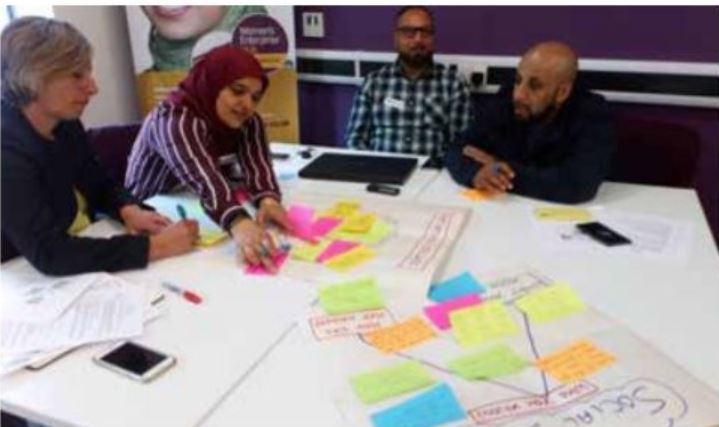
We conducted a 30 month study in neighbourhoods in Amsterdam, Birmingham, Copenhagen and Glasgow. With local partners, we identified individuals who had a reputation for making a difference. We interviewed and observed them, and created spaces for them to come together to reflect on what they do, how they do it and why it matters. Our research discovered examples of how people made use of and nurtured four common resources:

  • Vision: a set of ideas to bring people together and offers a collective narrative for the future.
  • Relationships: ongoing engagement with a range of different people, often across cultural, economic or organisational boundaries.
  • Different ways of knowing: from professional knowledge to local.
  • Materials: from buildings to human bodies.

Living Lab in Birmingham

Examples included: how a mobile bakery in Amsterdam brought people together to take action, how historic buildings were re-purposed in Glasgow to offer a different future for the neighbourhood, how healthy lifestyle opportunities in Birmingham helped women from under-served communities realise their potential, and how resources were re-used and shared in Copenhagen to build a sustainable neighbourhood food economy. 

Seen together these examples begin to demonstrate a different way of thinking and showing how cities may be transformed:

First, how transformation may come from giving meaning to action and a pathway to a more liveable neighbourhood. 

Second, nurturing rather than extracting resources.

Third, engaging with people as community members to foster a sense of belonging and solidarity.

Finally, recognising and valuing different kinds of knowledge and harnessing them to respond creatively to social problems.

These practices did not begin with, focus upon, or end with those formal institutions that govern a city. Indeed, they often reflected institutional limits. Instead, they were guided by a belief in fostering power in communities towards a shared vision of a different future. 

The understanding of change expressed here, brings together a recognition of the role of people in catalysing urban transformation by bringing together different resources in a way that is purposeful, but also allows for a process of becoming that emerges over time. The work and resources we draw attention to here were often precarious, hidden, unvalued and yet hard to replace. Opportunities to experiment, to nurture, to fail, to reflect were all crucial, but we should acknowledge are also under severe pressure.

Our research brings together the history of different urban neighbourhoods, and their potential, and recognised the actual whilst considering the possible. We hope these insights contribute to ongoing learning and critical imagination in how we can approach the future of cities differently. Our article, ‘Working the urban assemblage: a transnational study of transforming practices’ by Catherine Durose, Mark van Ostaijen, Merlijn van Hulst, Oliver Escobar and Annika Agger has now been published in Urban Studies, and is available open access.

Catherine is Reader in Policy Sciences at INLOGOV, with a specific interest in urban governance and public policy.

Inter-municipal Cooperation is the key to better environments in our cities.

Victor Osei Kwadwo

The 2021 United Nations Climate Change Conference (COP26) aims at “Uniting the World to Tackle Climate Change”. While the technical aspects to addressing climate change is more evident in the goals of COP 26, it is time attention is equally paid to the governance of climate change at the metropolitan scale made up of our major cities.

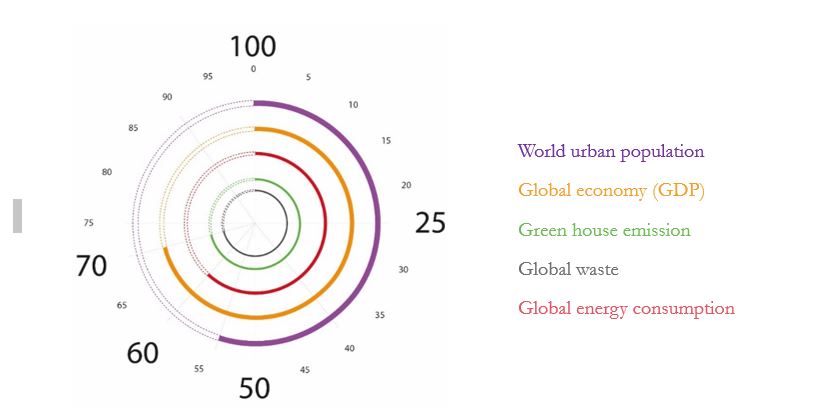
Due to rapid urbanization, the world is increasingly becoming metropolitan. Cities have expanded outwards and have become more interdependent with their immediate peripheries. Cities occupy only approximately 2% of the world’s total land yet host 54.5% of the world’s population. Cities are responsible for 70% of the world’s GDP, over 60% of global energy consumption, 70% of global greenhouse gas emissions, and 70% of global waste.

As cities agglomerate, the footprint and interdependence within and between cities blur existing administrative boundaries to the extent that development issues in one local government jurisdiction have spillover effects on neighbouring jurisdictions. These spillover effects have led to a call for cooperation on functional grounds, making metropolitan areas a salient scale for public policy interventions. Metropolitan areas such as Cape Town, London, Mexico City, São Paulo and Tokyo are mainly characterised by densely inhabited functional urban areas and their surrounding interconnected lower-density areas.

In the management of metropolitan areas, for instance, many cities in the USA, Greater London, Brussels, Dar es Salaam and Greater Accra, the joint provision of metropolitan-wide services or jointly addressing a cross-boundary problem is an explicit choice of local governments that make up the metropolitan area. This voluntary nature of cooperation poses a collective action dilemma when local governments have to address problems jointly.

The dilemma arises from the externalities of environmental outcomes that drive low incentives for cooperation and a high risk of free-riding. To find joint solutions to cross-boundary problems in metropolitan areas, inter-municipal cooperation (IMC) is identified as critical for better economic and environmental outcomes in service delivery. There is empirical evidence that inter-municipal cooperation saves costs but does it also improve environmental outcomes?

Governments tend to be reluctant to cooperate when environmental outcomes are at stake, and this is partly due to the limited evidence on the impact of cooperation on environmental outcomes. It is therefore important to provide an evidential basis on which local governments can justify and initiate cooperation arrangements to address environmental concerns jointly.

In a study I co-authored with Tatiana Skripka, we provide this evidence using data covering 229 metropolitan areas in 16 OECD countries. The study tests the impact of cooperation in transportation on CO2 transport emissions. We did this by estimating a three-level mixed-effects model that takes into account both national and metropolitan-specific characteristics.

The results demonstrate that if local governments cooperate, better environmental outcomes can be achieved. Metropolitan areas that worked together on transportation issues were able to reduce CO2 transport emissions.

The findings give an indication of what needs to be done to effectively fight the environmental challenge. More significantly, beyond normative predictions, the findings provide a basis for local governments to justify and pursue local to local partnerships to address environmental issues.

What we measured

We used “working together on transportation” as a measure of cooperation and “CO2 transport emissions” for environmental outcomes to estimate the impact of cooperation on CO2 transport emissions reported in 2000, 2005 and 2008 for 229 metropolitan areas in 16 OECD countries.

We accounted for factors such as the year of observation, economic status, socio-cultural, geographical, technological and governance measures such as mitigation policies, enforcement, and metropolitan structure. The factors covered both the national and metropolitan area-specific characteristics: socio-cultural conditions, level of technology, geography, and metropolitan governance structure. We used data from the OECD metropolitan governance database, the OECD Metropolitan Governance Survey, the World Bank, among others.

Key findings

We found that metropolitan governance structures, whether fragmented or consolidated, are equally inefficient in delivering reduction in CO2 transport emissions. The finding contrasts with an increasing trend of scholars advocating for fragmented metropolitan structures that favour voluntary cooperation, compared to consolidated structures that address collective action problem through coercion.

We also found that countries with a higher GDP were more efficient in reducing CO2 transport emissions. In contrast, metropolitan areas with higher GDP recorded increases in CO2 transport emissions. While national funding can dictate climate-related interventions and standards, metropolitan wealth is more flexible in taking on such obligations. As metropolitan areas are mainly production centres, investments in environmentally-friendly interventions may be more easily sacrificed at the metropolitan level for economic gains.

We further found that CO2 transport emissions increase despite the mere presence of environmental mitigation policies. This is consistent with empirical observations. For example, while the Paris Agreement has 196 Parties adopting to limit global warming to less than 2 degrees Celsius, emissions have continued to rise globally by 1.4 per cent per year on average since 2010. Environmental policy effectiveness lies in the ability of the cooperating parties to ensure widespread policy implementation and enforcement.

The crucial factor explaining the reduction of CO2 transport emissions in metropolitan areas is inter-municipal cooperation that facilitates coherence and widespread enforcement of mitigation policies. The impact of cooperation on CO2 transport emissions is magnified in metropolitan areas within countries that have stringent environmental mitigation policies.

Next steps

Inter-municipal cooperation (IMC) is critical in the governance of metropolitan areas if better environmental outcomes are to be achieved in our cities. Cooperation ensure policy uniformity, facilitates the possibility of widespread enforcement and reduces incentives for free-riding irrespective of governance structure. It is recommended that scholars and policymakers emphasise how to incentivise effective cooperation regardless of the metropolitan governance structure. Also, efforts must be geared toward uniform mitigation policies and their subsequent enforcement across local jurisdictions in metropolitan areas.

Read the full paper here

https://www.tandfonline.com/doi/full/10.1080/03003930.2021.1958785

Victor Osei Kwadwo is a PhD fellow in Economics and Governance at UNU-MERIT and Maastricht University. He has broad expertise in political science, economics, and public policy with a special emphasis on urban governance and development. For his PhD, he explores how and why independent local governments cooperation arrangements emerge to address transboundary issues in metropolitan areas.

NOC NOC! Is anybody there – or are you all botching each other?

Chris Game

NOC – that’s what this blog’s about.  It’s prompted, like many I assume, by the topic being one the author has a ‘thing’ about – only here it’s two things. There, authorial duty done: you’ve now been warned.

The first ‘thing’, I’m guessing, originated with an enthusiastic primary school English teacher, keen for as many of us as possible to pass the 11+ or ‘grading test’ that would get us into grammar school. Anyway, it was when I probably learnt the crucial distinction between common abbreviations and what most of us interpreted even then as posher/middle class acronyms and initialisms.

Abbreviations – for the benefit, obviously, of non-native English speakers/readers – are simply shortened forms of words: approx, dept, tbs (tablespoon), etc.  Acronyms are the posh, clever ones – comprising the first letters of several words but pronounced as if they are words themselves.

Most famous in these parts is obviously INLOGOV – but not, sadly, the most structurally perfect, which must be CREES.  Outside academia my favourite, because I’d bet even some police users don’t know it, is TASER – Thomas A. Swift’s Electric Rifle.

So, to initialisms, which comprise the first letters of several words, but can’t be (or are bewildering if) pronounced as words themselves – and which are regularly and incorrectly called acronyms.

Like NOC, which – whether referring to a National Olympics Committee, a prescription treatment for scurvy, or, as here, an elected body under ‘No Overall Control’ – is always pronounced, and in the case of the scurvy tablets spelt, ENOCEE.   

The elected bodies are usually councils, but strictly speaking Scotland was under NOC until recently, when the Scottish Greens’ co-leaders became ministers in the Holyrood Government, creating a power-sharing SNP-Green coalition.

It’s true that NOC sounds less alarming than OOC (Out Of Control) would be, but it’s entirely unclear what it does signify.  It’s certainly unhelpful – but worse, I’d suggest, in being a positive deterrent to trying to learn more – in metamorphosing indeed into No One Cares.

As a recent description of Kabul, as Taliban militants seized rapid control from Afghanistan’s civilian government, NOC would for maybe two days max have been fair and accurate. But not thereafter.

Nor when used for months on end apparently to describe the political management and day-to-day running of constitutionally elected UK local government councils. That, I suggest, is both disappointingly unhelpful and misleading.

Immediately following an inconclusive local election, with no single party securing an overall majority of councillors, some uncertainty – even within the council – may be unavoidable. There may well follow perhaps a fortnight’s discussions within and between the various party groups and maybe Independents before the Annual Meeting, at which ‘Who Runs the Council?’ has to be officially determined.

Whereupon there should be public clarity. If previously there hadn’t been, through no single party having an overall majority of councillors, the Council should, surely, officially announce and publicly explain the new situation – the leadership, any agreement/working arrangement between parties, Cabinet composition, and so on – ideally in the local media and certainly prominently (within a couple of clicks) on its own website.

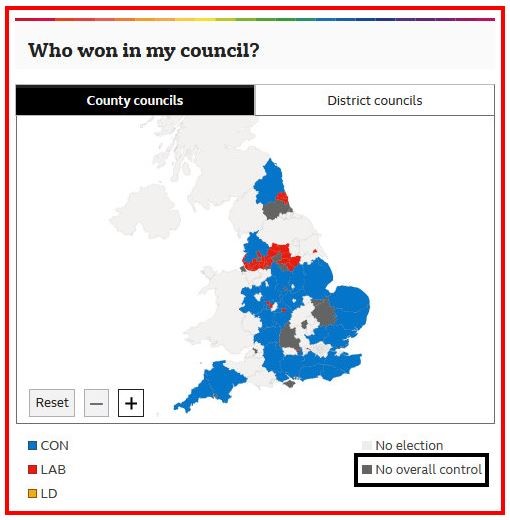
That way it would matter less that the BBC, for instance, can’t be troubled to update its ‘Elections 2021’ statistics or even to footnote news of the actual resolutions of the 29 blackish ‘No Overall Control’ splotches and dots on its English councils map

NOC map

Still, however – and despite my having mentioned it on numerous occasions, not least in these columns – some councils don’t.  And what really p****s – sorry, incenses me is that the process and outcome of these post-NOC negotiations are not just factually informative, but frequently rather more fascinating than the elections that brought them about.

Bear with me, please, while I try to illustrate with the ‘aid’ of said map – or at least reference to it. You will observe three large blackish splotches, which you might imagine would be the three – all geographically large – county councils that have been NOC since at least the May elections: Cambridgeshire, Oxfordshire and Cumbria.

Until you note that the top splotch is on the wrong side: not Cumbria, but Durham, which you may also know ceased being a county when in 2009 it became a unitary.  It did, however, produce surely the most historic result of this year’s ‘large’ authority elections, with Labour losing overall control of the council for the first time in over a century, and being replaced by a barely hyperbolic ‘rainbow’ coalition of the Lib Dems, Conservatives, Independents, and the North East Party – led moreover by the Council’s first-ever female leader, Lib Dem Amanda Hopgood.

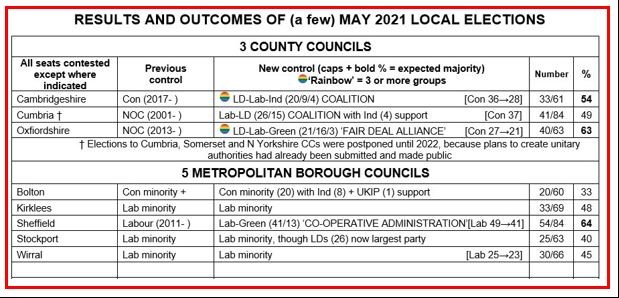
So, to the two central England splotches – Cambridgeshire and Oxfordshire County Councils – plus what would have been a third, had Cumbria’s election, like those of Somerset and North Yorkshire CCs not been postponed pending the outcome of already submitted unitary proposals.

In both cases the Conservatives had most councillors following the May elections, but no overall council majority. And in both cases the outcome of post-election negotiations was that the other party leaders and groups felt they had more in common with, or simply preferred working with, each other than with the historically dominant Conservatives.

And something essentially similar would doubtless have happened in Cumbria too, with the council having had a single party in majority control for just four of the past 36 years. So, when someone comes NOC NOCing on the Cumbria House door in Carlisle’s delightfully named Botchergate, they will be met not by rioting, out-of-control councillors, botching each other, but a seemly Labour/Liberal Democrat coalition. 

Likewise in Oxbridge, where they will encounter what tend to qualify nowadays as ‘rainbow coalitions’: comprising in Oxfordshire the Lib Dems (yellow), Labour (red) and Greens, and in Cambridgeshire Lib Dems, Labour and Independents. Doing indeed what voters reportedly tell pollsters they want party politicians to do: work together rather than just shout across the council chamber at one another.

Personally, in case you were wondering, I have ambivalent views about ‘rainbow coalitions’ – the terminology, I should stress, not their existence, which is almost invariably fascinating to observe. I used to reckon that, with rainbows having seven colours, a ‘rainbow coalition’ ought to comprise at least a majority – i.e. four parties or political groups.

The obvious problem, though, is that it restricts the field and would deprive many local newspaper editors of potentially appealing headlines.  By my reckoning – and with possibly excessive reliance on Open Council Data UK – England currently has just seven of these ‘proper’ rainbow coalitions: Durham, Folkestone & Hythe, Lewes, North Somerset, Swale, Waverley, and our own local Wyre Forest. 

Add in three-group coalitions, though, and you almost triple the number, while still lagging well behind the 32 single-party minority administrations and the 28 two-party arrangements. 

It also enables me to fulfil a tiny part of a kind of promise to INLOGOV Head of Department and blog editor, Jason Lowther – to whom I mentioned a round-up of May’s local election results, in the tabulated form I’ve sometimes managed previously, including my patented symbols for ‘rainbow coalitions’. 

For several reasons, including the sheer number of NOCs nowadays, I stalled after the ‘biggies’, but, thanks to the previously described Oxbridge tendency, there are at least a couple of rainbows.

NOC table

______________________

A more West Midlands-focussed version of this blog was published in the Birmingham Post on 9th September.

Photo

Chris Game is an INLOGOV Associate, and Visiting Professor at Kwansei Gakuin University, Osaka, Japan.  He is joint-author (with Professor David Wilson) of the successive editions of Local Government in the United Kingdom, and author of the Local Government chapter in the just published 10th edition of Politics UK (Routledge), about the only surviving sizeable (just the 780pp.) textbook of its kind.

The Lambeth tragedy and electoral reform

Chris Game

The recent Independent Inquiry report, chaired by Professor Alexis Jay, into the serial sexual abuse of children in the residential care (or neglect) of Lambeth Council from the 1960s to 1990s makes dire, sickening reading. It is lessened not one jot by being semi-historic, particularly for someone like myself who had at least intermittent dealings with the councillors and officers of Lambeth and other London councils during the 1980s, the most politically malevolent of those decades.

Pause for some indulgent, but explanatory, personal history – only three paras, promise!  I remember that key mid-80s period vividly. My early INLOGOV years, in the early 80s, felt like a kind of extended apprenticeship. I’d been appointed to launch the Department’s undergraduate PMA (Public Policymaking & Administration) degree, of which several senior colleagues were undisguisedly suspicious. I had no personal local government background, and was barely allowed near INLOGOV’s ‘shop window’: its prestigious, 6-week Wast Hills residential AMDP (Advanced Management Development Programme) for senior lg officers – because, well, what could I possibly tell them that they didn’t already know and weren’t already doing?

But then came ‘Widdy’ – the Committee of Inquiry into the Conduct of Local Authority Business, chaired by David Widdicombe QC – the Thatcher Government’s thinly disguised vehicle that would reveal the scurrilous goings-on (and, yes, ‘abuses’ – though even she didn’t mean sexual ones) in particularly left-wing Labour councils, enabling legislation that would restrain and generally weaken them. For several reasons it didn’t work out like that. Future Professor Steve Leach and myself from INLOGOV and two other colleagues spent the summer of 1985 visiting over 100 GB councils, interrogating senior members and officers, and eventually producing a 340-page report – far longer and more detailed, nuanced and qualified than the ‘hatchet job’ it was widely assumed the PM and Environment Secretary Nicholas Ridley had been hoping for.

For me, though it cost me a cricket season, it was fantastic.  At last I knew stuff about the inner political workings of local government that both councillors and officers were actually asking to hear about.  I could jointly run seminars and training programmes for officers and members – including week-long residential programmes for officers from groups of London boroughs – AND even get invited to address AMDP, without senior colleagues sitting in at the back checking me out.

We would discuss the internal, organisational politics of our local government system: the workings of and relations between party groups; one-party committees and sub-committees; the differences between Independent-dominated and ‘politicised’ councils; and, of course, member-officer relations and respective spheres of responsibility, including to electors and service users.

However … it was also during the 1980s that the Jay Inquiry found a root cause of the “widespread” sexual and other abuse of children in ‘care’ to have been the “politicised behaviour and turmoil” (p.vii) that dominated and warped Lambeth’s Labour-controlled council, for which “a succession of elected members and senior professionals ought to have been held accountable” (p.v), and weren’t.

Children were functionally weaponised in a “toxic power game” (p.vii) between Labour councillors and the Thatcher Conservative Government – a project that took precedence over providing quality, or simply adequate and undamaging, services and in 1985/6 over even setting a council tax rate (for which, for the record, 26 Labour councillors were surcharged and disqualified from office).

It’s rather late now to return my training programme fees, and I can’t meaningfully comment on the fundamental changes and redress measures since implemented.  I raise the Lambeth case solely because it loosely links to recent election-related news items I do know something about.

The first is that on 6th May, while I was previewing the various ‘First-Past-The-Post’ or ‘winner-takes-all’ council elections across the West Midlands, voters elsewhere in GB were voting in their sixth sets of Proportional Representation (PR) elections for their respective devolved institutions: the Scottish and Welsh Parliaments and London Assembly. There at least, what was once considered radical and even ‘Un-British’ is now the widely supported norm, with versions of PR also used in Scottish local elections and soon, if councils choose, in Wales too.

They are preferred to ‘Winner-takes-all’ because of results like those, for example, in this May’s Warwickshire and Worcestershire County Council elections. The respective Conservative parties took 74% and 79% of their councils’ seats – and four years of statistically comfortable overall policy control – on well under half the respective votes cast.

Just as that 1983 Thatcher Conservative Government won its 144-seat Commons majority with 42% of votes. These unearned bonuses are not just decisive, but gross, distorting, and potentially dangerous. Under even a loosely PR system, that 42% would have given the Conservatives under 300 seats instead of 397, Labour perhaps 180, and the Social Democratic-Liberal Alliance’s 25% vote share a potentially Government-determining 160-plus, instead of just 23.  And that whole fractious decade would have been very different.

Fantasy, of course. But – and finally, the key prompt for this blog – I do distinctly recall discussing, with Lambeth’s 40 Labour and 23 non-Labour councillors, how, had their 1982 local elections been run under any PR system, the chances were that, just as Thatcher probably wouldn’t have been in Downing Street, Labour almost certainly wouldn’t have won control of their 64-seat council.

For the Conservatives had won comfortably most votes, their 39% giving them perhaps 25 seats. Labour’s 33% could have meant not 40, but 22, leaving – as nationally – the Social Democratic-Liberal Alliance councillors holding the balance of power with maybe 17.  And the tragic events recorded in the Jay report would never have happened. The message is obvious: yes, election results shape history, but those results and outcomes are shaped by electoral systems.

There are many variants of PR electoral systems, but all aim to produce parliamentary or council memberships proportionately reflecting actual votes cast. And, conveniently, all three bodies mentioned – the Scottish and Welsh Parliaments and London Assembly – use versions of the Additional Member System (AMS).

Voters have two ballot papers. One lists candidates standing for single-member constituencies, the candidate with most Xs winning the seat. The second, usually regional, ballot paper lists the contesting parties and their respective candidates, and the voter’s X goes to their preferred party list. Now the key bit: these list seats are allocated specifically to ensure the overall seat shares in the Parliament/Assembly/Council match as closely as possible the shares of party votes received.

And back in May?  Space here, I’m afraid, only for Scotland, where the nowadays dominant Scottish National Party (SNP) won 62 of the Parliament’s 73 constituency seats – but with under 48% of the constituency vote. The nearly 22% vote shares of the Conservatives and Labour won them just 5 and 2 constituency seats respectively.

These disparities, however, were ironed out in the second, regional votes. The SNP’s 40% vote gained it only two additional seats, giving a total of 64 – just short of an overall majority in the 129-member Parliament, and reflecting its failure to win majorities in either vote.

By contrast, the Conservatives’ 24% regional vote earned them 26 additional seats to total 31.  Labour’s 18% brought them up to 22, and the Greens, without any constituency seats, won 8% of the regional vote, gaining them 8 seats. Which is why, once they understand it, voters tend on balance to like it – because it includes, rather than excludes.

Which, sadly, is the precisely opposite aim of Home Secretary Priti Patel’s planned electoral reforms – from compulsory photo ID to abolishing preferential electoral systems for Mayors, Police Commissioners and the London Assembly. But then inclusivity really isn’t her bag, is it – and, though a Londoner herself, she’s too young to remember 1980s Lambeth.

_____________________

A shorter version of this blog – minus the personal INLOGOV bits – was published in the Birmingham Post on 19th August under the title ‘Electoral reform could have prevented tragedy’ (https://www.pressreader.com/uk/birmingham-post/20210819/281956020861052)

Photo

Chris Game is an INLOGOV Associate, and Visiting Professor at Kwansei Gakuin University, Osaka, Japan.  He is joint-author (with Professor David Wilson) of the successive editions of Local Government in the United Kingdom, and a regular columnist for The Birmingham Post.