Why Short CPD Training and Long – Term Mentoring Communities of Practice Should Work Together

Shailen Popat

In today’s rapidly changing public sector, professional development is no longer a luxury — it’s a necessity. But what’s the best way to equip public managers with the skills and mindsets they need to lead effectively? Is it through short, intensive training sessions, or through long – term mentoring and peer learning? My recent article, Reflections on Short CPD Training and Long – Term Mentoring Communities of Practice for Public Managers, explores this question through two linked initiatives in Ghana and the UK. You can read the full piece here, but here’s a summary of the key insights.

Two Initiatives, One Goal: Building Public Sector Capacity

In March 2024, I co – led a three – day Continuing Professional Development (CPD) workshop at the Ghana Institute of Management and Public Administration (GIMPA). Over forty senior local government officers came together to explore cultural intelligence, organisational culture, and change management. The workshop was highly participatory, encouraging reflection on power dynamics and leadership behaviours. It wasn’t just about technical skills — it was about shifting mindsets. A year later, in March 2025, we launched a transnational Community of Practice (CoP) in Birmingham. Fourteen Ghanaian city managers and academics joined UK counterparts for a week of collaborative learning, site visits, and strategic dialogue. Unlike the CPD workshop, this wasn’t a one – off event. It was the start of an ongoing network designed to foster mutual learning, co – produce training materials, and build institutional partnerships.

What CPD Brings to the Table

CPD is familiar to most professionals: structured, time – bound, and focused on specific competencies. It’s efficient and accessible, making it ideal for introducing new frameworks or addressing urgent skills gaps. Our GIMPA workshop, for example, gave participants analytical tools to examine organisational culture and power dynamics — critical for reforming local governance. But CPD has limitations. Without follow – up, its impact often fades. Participants in Accra voiced this concern: how could they sustain the momentum after the workshop ended? This reflects a broader critique in the literature — CPD can feel like a “tick – box” exercise if not embedded in a longer learning journey.

The Power of Communities of Practice

Communities of Practice, a concept popularised by Etienne Wenger, take a different approach. They’re about relational, situated learning — professionals learning with and from each other over time. Our Ghana – UK CoP exemplified this. Participants didn’t just absorb knowledge; they co – created it. They shared case studies, identified research priorities, and even laid the groundwork for joint projects and staff exchanges. This collaborative model builds trust, fosters innovation, and creates a sense of ownership. It also delivers tangible outcomes: institutional partnerships, co – produced training materials, and a platform for policy experimentation. In short, CoPs turn learning into a living, evolving process.

Why We Need a Hybrid Model

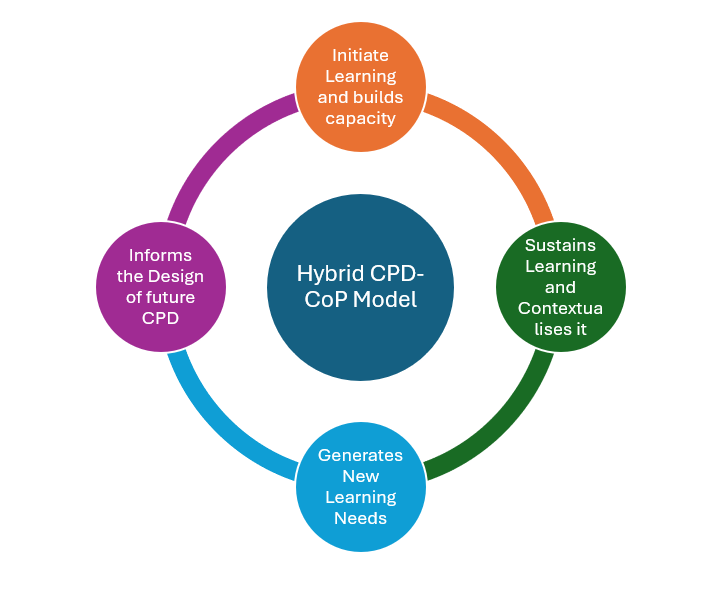
So, which is better — CPD or CoPs? The answer is both. CPD offers structure and accessibility; CoPs provide depth and sustainability. When combined, they create a dynamic learning ecosystem:

  • CPD as the entry point: Introduce core concepts and skills in a structured, time – efficient way.
  • CoPs as the follow – through: Sustain learning, contextualise it, and generate new insights for future CPD.

This cyclical relationship ensures that professional development is continuous and adaptive. It aligns with the idea of a “learning organisation” and supports the kind of hybrid professionalism today’s public managers need — technical expertise plus collaborative, contextual competencies.
The Role of Universities

Universities are uniquely positioned to make this happen. They have the research capacity, convening power, and infrastructure to sustain long – term engagement. But this requires a shift: from delivering knowledge at a distance to embedding themselves in professional ecosystems. That means co – designing curricula with practitioners, facilitating peer learning across borders, and evaluating impact not just in terms of knowledge acquisition but institutional transformation. Our Ghana initiatives show what’s possible when universities embrace this role. The CPD workshop sparked mindset shifts; the CoP built enduring partnerships and practical tools for governance reform. Together, they created a professional learning ecosystem grounded in local realities and enriched by global perspectives.

Why This Matters Now Public managers face unprecedented challenges — climate change, urbanisation, digital transformation. These are “wicked problems” that demand adaptive, collaborative leadership. Short – term training alone won’t cut it. Neither will informal networks without structure. We need integrated models that combine the best of both worlds. If you’re a public sector leader, educator, or policymaker, I invite you to read the full article here. Let’s reimagine professional development as a shared, iterative, and relational endeavour. The future of public service depends on it.
Dr. Shailen Popat works as an Assistant Professor in Public Policy and is the Director of the MSc in Public Management at the University’s Institute of Local Government Studies. He completed his PhD at the University of Oxford and his thesis explored the sensemaking processes of School Principals when enacting a significant new policy. He specialises in supporting public managers to enact policies in a manner that can be effective in their context and is a founding partner of a partnership between the University, GIMPA, and Ghana Local Government. Known for his student-centred approach and ability to explain complex concepts in a comprehensible manner, Shailen is considered to be an outstanding lecturer and tutor and was awarded the accolade of ‘Teacher of the Year’ at the 2022 University of Birmingham Teaching Awards, and in 2023 he was awarded a Senior Fellowship of the UK Higher Education Academy for his Educational Leadership.


Supporting councillors to thrive: the 21st Century Councillor Revisited

Catherine Needham

In our research on the 21st Century Councillor, we’ve found that elected members are facing a barrage of challenges:

  • Perma-austerity has deepened with sustained underfunding of public services  
  • Complexity of place has intensified, through combined authorities and integrated care systems, alongside local government reorganisation.   
  • Communities are in distress, moving from the pandemic straight into the cost-of-living crisis   
  • Incivility in public life has grown with rising issues of abuse and harassment for councillors in particular 
  • The rising profile of equality, diversity and inclusion has drawn attention to how public services systematically fail some workers and citizens  
  • Remote and hybrid working can enhance individual flexibility but can make it more difficult for councillors to build the relationships they need to function effectively. 

From interviews with councillors, we heard about the strategies they use to cope with these challenges and to support their communities to thrive. They are keeping the system human on behalf of communities. They are zooming in and out, from the micro issues facing residents to the big strategic issues of place. They act as a lightning rod, absorbing hostility whilst keeping themselves grounded and safe. You can read more about the research findings here.

If you’re a councillor – or you work in a role supporting councillors – come and join us in Andover on 4 November to hear more about this research and chat to peers about how best to manage these challenges. You’ll also hear from the Local Government Chronicle about their new campaign to support councillors.

Click here to register: 21st Century Councillors Tickets, Tue, Nov 4, 2025 at 10:00 AM | Eventbrite

From Consultation to Co-Creation: How Birmingham Can Lead the Way in Participatory Governance

Susana Higueras and Sonia Bussu

In a time of growing inequality, political disillusionment, and institutional strain, Birmingham is at a crossroads. The city’s bold initiative, Shaping Birmingham’s Future Together (SBFT), offers a timely and transformative opportunity: to reimagine how local government works with its communities.

A new report by Susana Higueras and Sonia Bussu lays out a compelling roadmap for how Birmingham City Council (BCC) can become a participatory council. Drawing on UK and international examples, as well as interviews with local stakeholders, the report argues that participatory governance must be more than a buzzword. It must be embedded into the everyday workings of the council, grounded in inclusive practices, and driven by a genuine commitment to share power.

Why Participation, Why Now?

Birmingham is one of the UK’s most diverse and youngest cities. This diversity is a strength, but also a challenge when it comes to ensuring that all voices are heard in policymaking. At the same time, the city faces deep structural inequalities, including the highest child poverty rates in the UK. Traditional top-down governance models are no longer fit for purpose. What’s needed is a shift from consultation to co-creation.

The SBFT partnership, launched in 2024, aims to tackle these challenges by fostering collaboration across public, private, and community sectors. But as the report makes clear, this vision will only succeed if participation is embedded, not treated as an add-on or a one-off event.

What Does Embedded Participation Look Like?

Embedded participation means making citizen engagement a routine part of how decisions are made, from setting priorities to evaluating outcomes. It requires:

  • Facilitative leadership that enables collaboration and power-sharing;
  • Boundary spanners, or individuals who bridge the gap between institutions and communities;
  • Strong partnerships with civil society, grassroots, and voluntary organisations;
  • Intersectional inclusion that centres the voices of those facing multiple, overlapping barriers to participation.

The report highlights that successful participatory governance is not about flashy new tools or one-off events. It’s about culture change, within the council, across sectors, and in how communities are engaged.

Lessons from Elsewhere

The report draws on global examples to show what’s possible, and what pitfalls to avoid.

  • Porto Alegre, in Brazil, was a trailblazer in participatory budgeting, enabling residents to directly allocate public funds, at one point transferring over $300 per person annually to community control. However, as political leadership shifted, the commitment to the process waned, and budget allocations steadily declined, leading to a loss of momentum.
  • Barcelona, Spain, embedded citizen participation through digital platforms like Decidim and cultivated strong ties with social movements. At its peak, over 40,000 citizens engaged in budgetary decisions. Yet, the experience underscores the vulnerability of transformative initiatives when overly reliant on charismatic leadership, making them susceptible to political cycles.
  • Camden, London, institutionalised citizens’ assemblies, integrating them into formal decision-making structures. Notably, all 17 citizen recommendations on climate policy were adopted. Still, challenges persist around ensuring inclusivity and maintaining consistent follow-through.
  • Reykjavik, Iceland, leveraged digital platforms to crowdsource citizen ideas and implement participatory budgeting. Initially successful in mobilising thousands of residents, the initiative faltered as political support diminished and the platforms remained peripheral to formal governance, highlighting the limitations of digital participation without institutional anchoring.
  • Ostbelgien, Belgium, established the world’s first permanent deliberative system linked to a legislative body. Its legally enshrined Citizens’ Council and Assemblies offer a promising model of democratic stability and accountability. However, the top-down design and limited community ownership reveal the critical need for co-creation and inclusive recruitment to prevent the reinforcement of existing inequalities.

These examples show that embedding participation requires sustained commitment, institutional support, and mechanisms for accountability.

Opportunities in Birmingham

Despite the challenges, Birmingham has a strong foundation to build on:

But There Are Challenges Too

The report doesn’t shy away from the barriers:

  • Broken trust: Communities are tired of being consulted without seeing change.
  • Hierarchical leadership: A top-down culture limits innovation and responsiveness.
  • Structural silos: Departments often work in isolation, duplicating efforts and missing opportunities for collaboration and nurturing citizen participation.
  • Unfair funding mechanisms: Smaller community organisations feel sidelined and overburdened by bureaucracy.

These challenges are not unique to Birmingham, but they must be addressed head-on if SBFT is to succeed.

What Needs to Happen Next?

The report offers a clear set of policy recommendations.

Rebuild trust through transparent communication and visible follow-through.

Trust has been eroded by repeated consultations without tangible outcomes. BCC must commit to clear feedback loops, visibly acting on community input and explaining decisions transparently to rebuild credibility and legitimacy.

Embed participation in budgeting, service design, and scrutiny processes.

Participation should not be limited to one-off events; it must be embedded across governance functions. This can include participatory budgeting, citizen panels, and co-designed scrutiny mechanisms that give residents real influence over public decisions.

Foster facilitative leadership and cross-sector collaboration.

Leadership must shift from command-and-control to facilitation, enabling shared power and collaborative problem-solving. Cross-departmental working groups and partnerships with civil society can help break down silos and foster innovation.

Work better with communities, recognising them as co-creators, not just consultees.

Community organisations should be treated as equal partners, with fair funding, early involvement in policy development, and recognition of their expertise. This means moving from consultation to co-creation, where communities help shape solutions from the outset.

Design for intersectional inclusion, addressing overlapping barriers to participation.

Inclusive participation requires acknowledging and addressing systemic inequalities. Councils must create safe, accessible spaces and use diverse engagement methods, including arts-based approaches and multilingual formats, to ensure marginalised voices are centred and valued.

The SBFT partnership can be a catalyst of this change and become the space for shared governance and accountability.

A Call to Action

The SBFT initiative is more than a policy programme, it’s a democratic innovation. It’s a chance to reshape how power is shared in the city, how decisions are made, and how communities are valued. As one community leader put it: “We’re not asking to be asked. We’re asking to lead.”

If Birmingham can rise to this challenge, it won’t just be shaping its own future. It will be setting a national, and even global, example of what inclusive, embedded participatory governance can look like in the 21st century.


DOI: https://doi.org/10.48352/inlogov.bhamx.0001

Dr Sonia Bussu is an Associate Professor at the University of Birmingham Department of Public Administration and Policy where she studies and teaches public policy. Her main research interests are participatory governance and democratic innovations, and creative and arts-based methods for research and public engagement. 

Susana Higueras Carrillo is a Peruvian anthropologist. She is PhD candidate at Goldsmiths, University of London and holds a master’s degree in Environmental Governance from the University of Oxford. She has worked at the University of Birmingham in the INSPIRE (Intersectional Space of Participation: Inclusive, Resilient, Embedded) project researching how to strengthen intersectional inclusion through arts-based methods such as legislative theatre. Her research interests lie in environmental and social justice and communicating research in creative and impactful ways.

Politicians’ conceptions of fairness

Clive Stevens

“You won’t find many of them”, people quip when I tell them the title of my PhD; and my riposte, “that’s why I asked councillors”. And I was right; interviews with 17 councillors across four parties have revealed over 2,000 examples. Conceptions include: equality, proportionality, equity, fair opportunity, market fairness, fair administrative process and more. These conceptions were collected during the semi-structured interviews based on four carefully crafted vignettes (case studies). Thematic coding assisted their allocation into eight broad types (Realms) along with sub-categories like reciprocity, merit and efficiency. Sometimes the councillor denied they were talking about fairness, but they were; a simple reframing, usually changing a point of view, clarified the analysis, for example, council efficiency can be reframed as value for money and thus fairness to the taxpayer.

My PhD can be likened to an exploration. With me, the explorer, finding snippets of theory from various academic sources each describing a type of fairness and sometimes disagreeing with another. Thus equipped, I ventured into the jungle, Bristol City Council, and witnessed, watched and registered actual conceptions coming from actual politicians. I returned relatively unscathed and after analysis discovered much that agreed with theory but also much else. I now have a clear report to deliver about the eight, strange, fairness-beasts that rule their Realms and what happens when they mix.

Combinations

The findings map out the Realms more accurately and show that in certain circumstances a combination of Realms can elicit quite strong responses. For example, in one vignette, six councillors wanted to request a breach of council-house regulations to allow a tenant to sublet her flat. Reasons varied, but many were drawn to the description of her disadvantage, escaping an abusive relationship, and were impressed that despite all her problems she had not only sought work but actually landed a job. “Respect” and “this is the type of person we should be helping” were two of many responses. However, an equal number of councillors were totally unimpressed and thought she should be served notice as per the tenancy. 

Another vignette, about a large donation to the Children in Care Service, offered councillors three policy options. Eight wanted to make policy changes; and every one of those changes was based on making the choices fairer.

Fair Process or Outcome?

With this more reliable set of fairness definitions, the data can be analysed in many ways. For example, there is debate about whether fairness in Local Government should be about fair process or fair outcome, some arguing one way and some the other. I recall a council officer telling me that if a decision follows fair process from a fairly formulated policy, then it must be right whatever the outcome. But is that fair?

This data lets me measure the number of conceptions of fair process and the number of conceptions of fair outcome; there was little difference whether the councillors were male or female, new or experienced, and from different parties. But it did change and dramatically, if the councillor was or recently had been in a cabinet or committee chair position compared with backbench councillors. The latter group were much more interested in fairness of outcome. This is a finding from a qualitative study, so not definitive, but I’ve already had a number of conversations saying “that’s not surprising” each with suggested reasons. Perhaps a more rigorous study could be done.

Party Dogma?

Another question I’m asked is about the influence of parties. The interviews were conducted singly and confidentially; I hope I reached the councillors’ true views. One vignette asked them to come to a conclusion and vote based on their values, and then asked whether their vote might change if it were whipped. Many said they might change out of loyalty. Loyalty, like fairness, is a moral value and clearly quite powerful.

Wicked Problems

One of many potential uses is in understanding intractable “wicked” problems. These are made more wicked if there are value differences between the stakeholders. Fairness is a human value, so perhaps an understanding of fairness could assist in some small way to make headway with such problems that seem nowadays to be popping up everywhere.

What next?

I have just entered the final year; out of the jungle but not quite out of the woods, yet; there’s a lot of writing up to do, and then I’d like to use the findings and meet up with people interested in better understanding other councillors’ or parties’ values.

An ex-councillor in Bristol and author of the book on Local Government, After the Revolution, Clive followed up on politicians’ conceptions of fairness. He is now his final year of a PhD at the University of Bristol, interviews complete and writing it up. His personal blog site is: https://sageandonion.substack.com/

LGOF: CPA-lite or Daily Mail target practice?  

Jason Lowther

In July, then Local Government Minister Jim McMahon announced a new Local Government Outcomes Framework (LGOF), which (he said) “forms an integral part of this Government’s reforms to ensure we have a sector which is fit, legal and decent”.  These reforms are already pretty extensive, including LG reorganisation, devolution, community engagement, member standards and funding arrangements.

The LGOF framework, the Minister hoped, “will help to put the right checks and balances in place to ensure value for the taxpayer and results for citizens to whom councils are ultimately responsible”.  Given the removal of most systematic monitoring of local performance and outcomes in England with the demise of the Audit Commission a decade ago, is this a new dawn for helpful local insights and intelligent central steering, or the raw material for a crude league table that obscures more than it illuminates?

History shows the difficulty of designing and using performance measures effectively.  Whilst the logic of measuring what matters to inform management (and political) decision making is clear, and there are many examples of successful applications, there are enough examples of failures and unintended negative consequences to encourage caution. 

The immediate precursor to LGOF was a set of measures developed by the ill-fated Office of Local Government (OFLOG).  These were immediately manipulated by the Times newspaper into a league table, labelling Nottingham as the worst council.  The fact that this took place during the pre-election period only made the impact more negative, leading to a stinging letter from the LGA to the then Secretary of State, Michael Gove.  OFLOG was in some ways set up to fail.  Sited inside the Ministry, its political independence was immediately open to challenge.  And reconciling providing local authorities with better data at the same time as acting as an accountability mechanism to central government was always going to be tricky. 

The health service experience of performance measures and targets presents mixed evidence.  It appears that four-hour A&E waiting times targets were associated with reduced mortality, but at the same time there were examples of departments admitting patients near to the time limit at the expense of others more in need of urgent care, a few examples of blatant misrepresentation of figures, and some bizarre holding of patients in ambulances and redefinition of corridors as wards.

Key lessons from these examples include the importance of having a clear focus for the LGOF and the adoption of a broad ‘exploratory’ approach to presenting the performance measures.   As the Institute for Government argued for OFLOG, a key contribution could be making data more consistently available, comparable and usable – and hence supporting evidence-based policy making through the deliberative use of robust evidence.

The LGOF data needs to be presented in ways that enable and encourage exploration and questioning, rather than simplistic league tables which ignore the inherent differences between different councils in terms of population, geography, deprivation, funding, etc.  It therefore needs exhibit what I call the three Cs: to be comparable across councils, contextualised to reflect local circumstances, and citizen-focussed (accessible to lay people).

There are many positive features of the new framework, including its attempt to look at missions and outcomes (rather than just council outputs).  Interested parties had until 12 September 2025 to respond to the Government’s consultation, so we now await the government’s response to that.  Councils can easily see how the proposed LGOF measures look for them using the excellent new LG Inform LGOF report. 

Dr Jason Lowther is Director of the Institute of Local Government Studies (INLOGOV) at the University of Birmingham.  This article was initially published in the Local Area Research and Intelligence Association (LARIA) newsletter. Email [email protected]

Openness of council finances is key for a functioning democracy

Matty Edwards, Research For Action

Local authorities are under immense pressure to find savings whenever they can. After more than a decade of austerity, the collective deficit in the sector is expected to reach £9.3bn by next financial year. Local authority finances have also become increasingly speculative, as budgets are prepared on the basis of unpredictable grant allocations and single-year financial settlements, sometimes without audited accounts. Pressures to find new sources of income through commercial investments and private sector partnerships have also increased the complexity of council funding.

This creates a challenge: scrutiny of local government finance is more important than ever. Yet even with the best intentions, local authorities struggle to produce open and accessible financial information. 

In a research collaboration between Research for Action and the University of Sussex, we set out to explore how financial information — such as council budgets and accounts — could be made more accessible to the public. Our research found that even experienced researchers, accountants and councillors struggle to find and understand local authority financial information.

We spoke to 26 people from the local government sector over three months this spring to examine barriers to making local authority financial information accessible to councillors and the wider public. Interviewees included councillors from a range of authorities, council officers, academics, accountants, journalists and key sector bodies like CIPFA. 

Our key findings were a lack of standard reporting requirements, strained council capacity after years of austerity and a fragmented data landscape with no standard formats for publishing financial information. These barriers make it difficult to understand a single council’s finances and make comparisons across the sector, hindering effective scrutiny by councillors and journalists, and democratic participation by the public. 

Some interviewees argued that accessibility was less of a priority in the face of a mounting crisis in local authority finances, but in our view, openness is not a luxury. It is key to effective local democracy. 

How to improve open up council finances

Based on our findings, we set out a series of recommendations for greater transparency and openness. 

The government should introduce new data standards for local government to improve accessibility, potentially via a Local Government Finance Act. This should include making financial information machine readable where possible and using accessible file formats. An easy win in this area would be to create a single repository for all local government financial information.

Local audit reforms are also an important piece of the puzzle. The new Local Audit Office (LAO) should be made responsible for local government financial data, including making it publicly available with tools to enable comparison and oversight. A more ambitious idea for the new LAO could be to create a traffic light warning system for the financial health of local authorities based on indicators that are timely and easy to understand, taking inspiration from Japan. 

Council accounts were highlighted as a particularly technical and opaque part of local government finance. That’s why councils should be mandated to attach a narrative report to their annual accounts, as previously recommended by the Redmond Review.

We think that the Local Government Data Explorer, recently scrapped, should be replaced with a data visualisation that is genuinely accessible and interactive, perhaps taking inspiration from a dashboard created by academics in Ireland. There should also be funding for local open data platforms, because there have been isolated examples of successes, such as the Data Mill North. 

The other part of the problem is that councillors often don’t have the knowledge and skills to properly scrutinise the complicated world of local government finance. That’s why we’re calling for greater support and training for councillors to enable better financial scrutiny, as well as public resources to improve literacy around local government.

While the sector faces great upheaval in the next few years through local government reorganisation and English Devolution, these reforms also present an opportunity to improve transparency – whether that’s at unitary or combined authority level. 

We believe that greater openness will ultimately facilitate better public participation and healthier local democracies.

Matty Edwards is a freelance journalist based in Bristol who also works for Research For Action, a cooperative team of researchers that in recent years has investigated PFI, LOBO loans, the local audit crisis and scrutiny in local government.