Local democracy at the sharp end: diary from a Parish Council

Ian Briggs

It starts in the autumn of 2013. The Secretary of State knocks back the latest submission of the Core Strategy from the District Council – more homes needed please. Suddenly, the Parish Council becomes inundated with requests for meetings from developers – the story here being that this rural village has the postcode where houses change hands on the market the fastest for miles around, and for the highest possible price.

By November 2013, eight potential housing developments are highlighted and the community becomes ‘punch drunk’ with consultations for housing developments. Plans are submitted to the District Council but mysteriously they do not appear on the website.

Early January 2014, the Parish Council calls a community meeting to discuss development, the fact that HS2 Ltd are now proposing permanent road closures, and the Environmenet Agency is looking at proposals for an advanced form of ‘fracking’ – underground coal gasification for the area.

It is hardly surprising that those local residents present at the meeting are up in arms and demanding answers. Council Council member is present at meeting but rather quiet and makes sharp exit at the close. No District Ward councillor present and no apologies sent.

The following morning, the members of the Parish Council are given sight of resignation letter from District Councillor.

Week two, January 2014. District Council meets to agree new proposed core strategy. Shock – areas within the Parish Council highlighted to absorb thousands of houses – sets out case that it is at the periphery of the District so should be little trouble – wonder why ward councillor resigns?

Still no sign on the District Council website of plans submitted by developers in December 2013. Then, find they have put them on the website but believe they relate to a totally different parish – oops!

Letter sent to the Leader of the District Council requesting urgent meeting – no acknowledgment, no reply after ten working days. Leader of Council is in London for extended period according to Council staff. Wonder what on earth he is up to and who he is talking to?

All of the above is a trust story. But the important issue here is that this is set against a backdrop of ‘localism’ – if the intention is to give greater powers to local communities then we need to look closely at the decision-making mechanisms that we have to work with. There are questions arising as to how we are failing to integrate decision-making across different levels of local democracy.

A fundamental  tenant of any democracy is being clear and open as to where decisions are made. If all this sounds as though it is an attack on the District Council in question, it is not meant to be so – the Council is in the same position as most others. It has made deep and significant cuts to its operations and is now faced with making decisions that are expensive in terms of time and associated managerial costs.

In amongst all of this are the public. They are open to persuasion from a local media that is keen to jump upon any news story that could sound as though the Council is failing, and given that event well educated and sensible members of the public are poorly informed of the mechanisms of local democratic decision-making, it is no wonder that they turn to the most available and accessible form of local representation – the Parish Council.

Next diary entries to start soon…..

briggs

Ian Briggs is a Senior Fellow at INLOGOV, and sits on a rural Parish Council in Warwickshire. He has research interests in the development and assessment of leadership, performance coaching, organisational development and change, and the establishment of shared service provision.

Reason, myth and migration

Phillip Cole

One of the dominant features of public debate about immigration in the United Kingdom is the absence of reason. Many political commentators have begun to notice the reluctance of people to abandon basic myths about immigration, despite the prevalence of evidence that shows those myths to be false. For example, net immigration has fallen over the past three years, but only one fifth of people believe that. The rest are convinced that net immigration is on the rise.

I think there is something deep seated at play here in the public sphere. I don’t mean to draw attention away from the importance of racism in anti-immigration stances, or the important role of the media in creating a great deal of hostility. But I do want to suggest the idea of ‘Heimat’ can supplement these explanations and help shed light on the persistence of myth within the immigration debate.

‘Heimat’ is an extraordinarily complex idea that plays an important role in German thought and culture, and I can’t hope to do it justice here. It captures the feeling of being at home, or, more accurately, is a reaction to the experience of not feeling at home.

In other words, ‘Heimat’ is a reactive idea, a reaction against the fluidity and change experienced under conditions of modernity, which result in alienation and a feeling of lost-ness. Heimat is an idea of a place where one really belongs, and so is an imaginary home set up against our experience of alienation. It is essentially backward looking and nostalgic, and so it does not exist in the present.

But equally it does not exist in the past. Although it is a place, and exists in the past in one sense, it is not a place that has ever existed. It is an imaginary place when things were, we are told, more innocent and simple and stable: it is motion-less and change-less.

This place is not open to rational criticism. When people say things were better in the past, pointing out to them that this past has never actually existed – it is an imaginary reaction to the present — brings about no change in their nostalgia. And although as an idea ‘Heimat’ has played a role in both right and left politics in Germany, one key element of it is mistrust of the outsider, whose presence is at least one cause of the loss of ‘Heimat’.

So the immigrant brings change, but change of something that lies in an imaginary past. The reality is that the world was never like that and has already changed. In fact the immigrant may symbolize change, but they don’t bring it. The world just has changed and is changing – it always has. And the immigrant is one who lives in the borderlands of change.

Although the idea of Heimat is explicit in the German-speaking world and has no simple equivalent in the English-speaking world, I have no doubt that it is present in the way we think. Patrick Wright’s description of ‘Englishness’ in his article, “Last orders for the English aborigine”, certainly fits the model, and perfectly captures the stance of UKIP and its supporters.

This Englishness “…finds its essence in that sense of being opposed to the prevailing trends of the present. It’s a perspective that allows even the most well-placed man of the world to imagine himself a member of an endangered aboriginal minority: a freedom fighter striking out against ‘alien’ values and the infernal workings of a usurping state”. At its heart is an idea of England “…in which the very thought of difference or change is instantly identified with degeneration, corruption and death” (pp.68-69).

And so ‘Heimat’ is a reactive idea, a reaction against the fluidity and change experienced under conditions of modernity, which result in alienation and a feeling of lost-ness. And it is the migrant – part of the process of motion and change – who is identified as the culprit for this lost-ness. But the key point here is that it is not open to rational criticism. It is an idea that lies beyond reason.

My suggestion is that if we study the public debate about immigration, and the anti-immigration stance that many take, we will find the theme of Heimat running through them – phrases keep re-occurring in those debates, most strikingly, I have found, the theme of not people to being at home in their own country. And the most important aspect of this theme is, of course, that it is not open to reason – the resistance to argument and evidence is an essential dimension of Heimat.

Myths, of course, can be combated through persisting with reason and evidence, and it may be that we can see this in the fact that Nigel Farage, UKIP leader, recently stated that he would rather be poorer with fewer migrants, an acceptance that immigration brings economic growth to the UK, and that it was the social/cultural impact of immigration that was important rather than economic impact.

This seems to show that the barrage of evidence and argument about the economic benefits of immigration have had some effect even within the minds of UKIP, where in the past the economic myths have been pretty much hard-wired. So the fact that we find our attempts to reason rebuffed by myth again and again should not discourage us from continuing with our efforts. The one thing we must never do is abandon hope in the power of reason.

SONY DSC

Phillip Cole is a Visiting Professor in Applied Philosophy with the Social Ethics Research Group at the University of South Wales, and Senior Lecturer in Politics and International Relations at the University of West of England. He is co-author of Debating the Ethics of Immigration: Is There a Right to Exclude? with Christopher Heath Wellman (Oxford University Press 2011), and Philosophies of Exclusion: Liberal Political Theory and Immigration (Edinburgh University Press 2000).

Phillip presented these ideas as a paper for the Migration and Citizenship Seminar Series at the University of Birmingham. See the programme for details of forthcoming events.

Where have all the politics gone? On wildebeest, lions and other political animals

Catherine Staite

One benefit of spending many days mass catering and washing up over Christmas has been the companionship of Radio 4 news programmes.  Sadly, I now feel a bit like those women who decide on divorce just after Christmas.  Prolonged exposure to political reporting has left me feeling betrayed and irritated in equal measure.

Perhaps it isn’t Radio 4’s fault. Perhaps they can only do the best they can with the dross they have to work with.  Perhaps the lack of substantial topics and forensic interrogation are products of the absence of principle and passion in political debate.

There is the obsession with retail.  I like a bit of shopping myself but retail trends and their reflection of wider society and their impact on the economy are reported with mind-numbing and repetitive banality.  If I hear more bland stories about ‘cash strapped families shopping around’ I’ll cry.

Why aren’t the world’s best journalists digging underneath these seasonal superficialities? What about the differences in spending power and standards of living between rich and poor?  The poor are rarely mentioned, unless negatively and simplistically as  ‘working age benefits claimants’.  What about the places our goods come from and the people who make them? Whether we get our bargains from John Lewis or Amazon – they all come across the sea in big containers  from the same places but the people who make them don’t get a fair return on their labour and are often brutally exploited. This only gets reported on when thousands die at one time, which makes the issue newsworthy  – until it is promptly forgotten again.

Immigration is perhaps the topic where a lack of intelligent, questioning journalism is most evident.  National politicians resemble small boys playing football – all dashing after the ball together with a woeful lack of strategy or even tactics.  The ball they are all chasing is a nasty construction of xenophobia, fear and ignorance, held together by nostalgia for a misremembered past. At other times they resemble wildebeest (other herding animals with a tendency to mass panic are available).  Is UKIP now a lion?  Only if the wildebeest think so.

Where are the facts?  How much do immigrants contribute to the Exchequer, our culture and our quality of life?  Lincolnshire farmers could not harvest their crops without immigrant labour. Our hospitals could not function without  immigrant health professional. So the answer has to be ‘lots’. How many of us – that’s us to distinguish us from them who come in ‘hordes’, determined only on scrounging and/or destroying our way of life – are immigrants or the descendants of immigrants ourselves?  Lots and lots. Instead, we get a diet of unchallenging reporting of the prevailing narrative which is creating bias merely through repetition.

Reporting of the floods has not been accompanied by many facts.  Bald statements about the money allocated to capital works and cuts to revenue  leading to job losses leaves us no wiser about the costs and benefits of flood defences and  the public policy choices to be made about the best way of allocating scarce resources remain uncharted waters.  Cameron was reportedly issuing stern instructions to local government about fulfilling their duties – without challenge.  No reporter questioned the authority of someone who couldn’t navigate his way out of damp carpet to instruct sovereign  bodies to perform their expert functions.

Going back to work has been a welcome relief from shouting at the radio but I’m still suffering from a deep sense of dissatisfaction.  There are questions to be asked and answers that really matter – but who is asking them?

Catherine Staite

Catherine Staite is the Director of INLOGOV. She provides consultancy and facilitation to local authorities and their partners, on a wide range of issues including on improving outcomes, efficiency, partnership working, strategic planning and organisational development, including integration of services and functions.

Electoral reform: STV for local elections and first-time compulsory voting

Chris Game

Two research-based reports on electoral reform appeared almost simultaneously last week. Great for anoraks, but for a local government blog a dilemma.  Only one report directly concerns local government, and here, therefore, it properly leads off. But the second is – how to put this – at least methodologically the more interesting and will receive the greater attention.

Northern Blues: the Conservative case for local government reform is an Electoral Reform Society (ERS) report. The case starts from the Conservatives’ proportional under-representation – indeed, frequently complete non-representation – on northern metropolitan and unitary councils, due to the workings of the plurality or First-Past-The-Post (FPTP) electoral system. This weakens the party’s base for fighting parliamentary elections and undermines its claim to be a genuinely national party. The most obvious remedy, the report suggests, would be to follow the Scottish switch to the Single Transferable Vote (STV) form of proportional representation for local elections, which since 2007 has given Conservatives seats on councils and even in cabinets, where previously their presence was minimal.

None of this, of course – apart from the supporting statistics – is remotely new, even to Conservatives. Conservative Action for Electoral Reform (CAER), for example, is 40 next year, and jointly sponsored the oddly unmentioned 2005 forerunner of this report: Lewis Baston’s The Conservatives and the Electoral System.

The statistics do demonstrate the party’s under-representation on nine northern metropolitan councils in the three most recent sets of elections, but they are less “compelling” than the report’s foreword suggests, due to elections by thirds not being treated as individual events (p.8), and the omission throughout of total membership sizes of the councils on which the Conservatives are under-represented.

Simpler statistics and, I’d suggest, more compelling are that: (1) in the 2011 elections, in which the Conservatives overall did tolerably well, in the eight metropolitan boroughs of Gateshead, Knowsley, Liverpool, Manchester, Newcastle upon Tyne, Sheffield, South Tyneside and Wigan, the party’s candidates won an average of over 11% of the vote, but not one seat; and (2) today, of the total of 606 members on those same councils, just two are Conservatives (South Tyneside and Wigan, if you were wondering).

We know all about the Tories being the rich and nasty party, but sometimes overlooked is their stupidity quotient – as noted by John Stuart Mill to a Conservative MP in one of history’s great “I was misquoted” apologies: “I never meant to say the Conservatives are generally stupid. I meant to say that stupid people are generally Conservative”.  Sadly, even Peter Osborne, Telegraph and Spectator journalist and author of the ERS report’s above-mentioned foreword, is no exception to the rule. As blind as most of the party to the self-harm of its obsessional commitment to FPTP, Oborne claims “reading this report has persuaded me that proportional representation in local elections may be part of the answer” to the question of how to stem the wipe-out of Conservatism in northern England. It’s only one convert, but who knows?

Back in the world in which the rest of us live, we have Divided Democracy: Political inequality and why it matters – published by the ‘progressive’ thinktank, the Institute for Public Policy Research (IPPR). It’s a fascinating study of non-voting and its consequences that might almost have been devised to rebut the more objectionable views that the comedian, Russell Brand, has been inflicting on us recently.

Among Brand’s addictions are four-syllable words: he’s “utterly disenchanted”; politicians are all frauds and liars; the political system is merely “a bureaucratic means for furthering the augmentation and advantages of economic elites”. Until a “total revolution of consciousness” appears on a ballot paper, he will never vote – non-voting being “a far more potent political act to completely renounce the current paradigm”.

Pretty obviously, it’s not potent at all, but it’s his next pearl that really gets me: “I will never vote, and I don’t think you should, either … it seems like a tacit act of compliance”.  He wants us to join his misguided personal tantrum, and that is objectionable.

If self-interested economic elites are your enemies, it’s NOT VOTING that is the tacit act of compliance, consenting to their authority and perpetuating their rule. Not voting is a delusion: you either vote by voting, or you vote by abstaining and doubling the value of an opponent’s vote. Inaction has its own consequences. Multi-millionaire Brand can afford to be careless of the consequences of his inaction.  Potential non-voting disciples may not all be as fortunate.

The IPPR counter-thesis is simply summarised. Turnout in UK elections is not just falling, but is becoming more unequal. Governments aren’t stupid: they note these trends and act on them. They privilege voters, discriminate against non-voters, thereby ratcheting up societal inequality – at present, massively. One obvious way of making such behaviour at least more politically risky is through full or selective compulsory voting.

First, the figures. Recent General Election turnouts have fallen dramatically: from nearly four-fifths of the electorate in the 1960s to below 60% in 2001 and 65% in 2010. The fall has been anything but equal: much higher among the youngest and poorest. In 1970 the turnout gap between 18-24 year olds and over-65s was 18%; in 2010 it was nearly double: 76% of over-65s voting, but only 44% of 18-24 year olds. As for income, if you divide electors into five income groups, in the 1980s turnout among all five groups was over 80%. In 2010, while over three-quarters of the highest income quintile voted, turnout among the lowest quintile was barely half.

Any rational government, knowing these unequal turnout statistics, would in its own self-interest pay more attention to the likely voters than to the non-voters. The IPPR authors’ major contribution is to have developed measures of the extent to which the Coalition has acted in this way during its three years of cuts-driven austerity. In short, have low turnout groups suffered disproportionately from the funding reductions announced in the 2010 Spending Review and the national and local public service cuts to which they led?

game 2

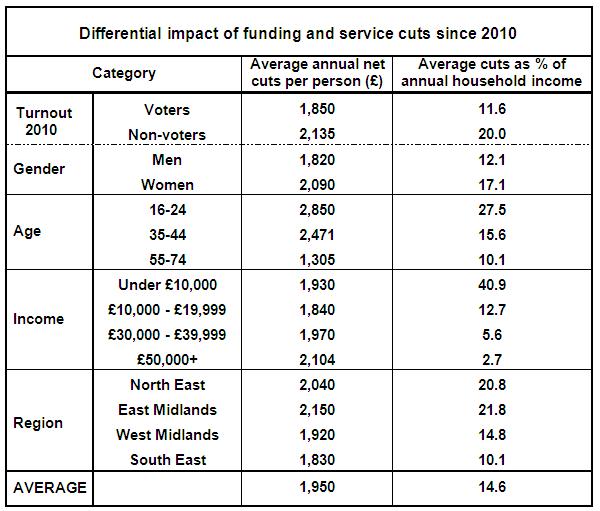
As the summary table shows, the answer is unmistakably Yes. The methodology, fully described in the IPPR paper, is complex, but uses the Treasury’s own accounting framework to collapse all public service expenditure into hundreds of small, everyday items, and then allocate them to households on the basis of known household consumption and spending patterns. Essentially the same is done for individuals, using information about voters and non-voters collected by the 2010 British Election Study.

The table confirms that all groups have been adversely affected to some degree, but that there are clear political inequality effects: women suffering a greater annual loss in services and benefits than men; the young more – much more – than the middle-aged and elderly; some regions more than others. Considered as a proportion of the average household income, the differences are even starker, especially in the case of income level itself. To quote the researchers: “Those with annual household incomes under £10,000 have lost an average of £1,926 annually from the spending measures, comprising a staggering 40.9 per cent of their average income”.

These are clearly important statistics in themselves, but the IPPR study’s primary concern is with the political inequality effect in respect of voters and non-voters: the cuts representing at household level 11.6 per cent of voters’ annual income and 20 per cent of that of non-voters.

Governments may not systematically aim to discriminate against non-voters, but that is the irrefutable effect of their policies – the inevitable consequence being “a vicious cycle of disaffection”. The less responsive politicians seem to be to their interests, the more disaffected people become, the less inclined they are to vote, and the less incentive politicians have to pay them attention.

The IPPR is already on record as a supporter of compulsory voting, as already practised in around a quarter of the world’s democracies. Even where not very robustly enforced, it produces significantly enhanced turnout rates – particularly among likely non-voters, thereby drastically reducing turnout inequality. Recognising, though, that a proportion of UK citizens tend to be fiercely protective of their right not to vote, the present authors settle for the more limited measure of making electoral participation compulsory for first-time voters only.

They would be obliged to go to the polls once, on the first occasion they were eligible – at their place of study for students living away from home.  A ‘None of the above’ option would be available, as in many compulsory systems, and it is suggested that a small fine be set as a gentle persuader.

There are several ancillary arguments for first-time compulsory voting. It should encourage voting in subsequent elections, boost citizenship awareness and political education, but above all it would force politicians to pay more attention to young people and their interests than they are inclined to do at present. Oh yes, and it’s infinitely more constructive than anything Russell Brand has to offer.

Chris Game - pic

Chris is a Visiting Lecturer at INLOGOV interested in the politics of local government; local elections, electoral reform and other electoral behaviour; party politics; political leadership and management; member-officer relations; central-local relations; use of consumer and opinion research in local government; the modernisation agenda and the implementation of executive local government.


Building public trust in policing? The contribution of Police and Crime Commissioners, one year on

John Raine

The ‘Plebgate’ saga, which has now drawn apologies to Andrew Mitchell from three chief constables, has once again raised questions about police integrity and dented public trust and confidence in policing more generally. Building such trust was, of course, one of the Coalition Government’s arguments for introducing Police and Crime Commissioners (PCCs) – and, as the first anniversary of those elections is now close upon us; it seems timely to consider what difference PCCs have so far made.

It was, we all remember, an inauspicious start; with an embarrassingly low electoral turn-out (averaging less than 12 per cent) because of poor advance publicity on the new PCC role; failure to provide most voters with candidate election leaflets, and choice of a November polling date when no other local or national elections were taking place. Moreover, matters seemed to get worse in subsequent months with critical media headlines concerning the appointment of deputy commissioners and youth commissioners; reports of disagreements and discord with chief constables, and discontent over policy priorities and budget decisions.

But one year on, with PCCs becoming established in their roles, the picture has begun to look rather more settled. It is, for sure, too soon to assess the impacts – beneficial and otherwise – of the new police governance framework. But a recent round of ‘stock-take’ interviews with a small sample of PCCs (including Conservative, Labour and Independent office holders), has highlighted at least two key respects in which the directly-elected model of governance already seems distinctly different from the previous regime of Police Authorities.

First: the new PCCs are giving much more priority to public engagement – they are out and about on a near daily basis, presenting themselves and taking feedback at council meetings, in open public meetings, and indeed, in shopping precincts and market squares around their (very large) patches. They are also all actively exploiting the potential of Facebook, Twitter and other social media in reaching-out and communicating and handling considerably more direct correspondence (email and post) and telephone calls from citizens. Their public profile is already much higher than that of Police Authorities.

Second: there is a stronger sense of ‘local leadership’ to their work. The Home Office has admirably resisted the temptation to try to drive the new system and impose its own perspectives and priorities on PCCs. Although cuts in all police budgets have been driven by reductions in Home Office grants, Westminster and Whitehall have generally allowed PCCs to get on with the job locally as each considers best. As a result, there is more diversity between the PCCs with regard to their approach and priorities in the role than was previously apparent with Police Authorities.

Relationships and accountabilities with chief constables and with other criminal justice and local governance agencies are intriguingly variable, as each PCC brings their own personality and preferred style to the role. Indeed, it is clear that the different career backgrounds and experiences of each PCC are colouring and shaping their approach to the role and their priorities.

By the time of the next PCC elections – scheduled for May 2016 – it will be interesting to gauge the significance and durability of these early signs of change towards stronger democratic engagement and local accountability, and to see what, if any, are the implications for public trust and confidence in policing. At least a more lively public debate and much higher turn-out are surely to be expected next time.

raine

John Raine is Professor of Management in Criminal Justice at INLOGOV. He has been involved in criminal justice research, consultancy and teaching at Birmingham for some twenty-five years and has a strong track record of commissions for the Home Office, Lord Chancellor’s Department/Department for Constitutional Affairs/Ministry of Justice on aspects of policy and practice within the criminal (and civil) justice sectors.

Leading a Council: insights from Warwickshire

Izzi Seccombe

May 2nd 2013 was a greatly significant day. Not only was I appointed leader of Warwickshire County Council, but, as the first female leader, I felt incredibly proud and honoured to be steering our county borough into the future.

Being leader of such a wide-ranging organisation as Warwickshire County Council is both a privilege and a challenge. On assuming position in May 2013 I quickly learned the importance of co-operation and conversation with both opposition leaders and the district councils, not least because we are an administration that lacks overall control.

Underpinning this administration’s vision are two key pillars; a desire to ensure integrity of services within a constrained budget and an aspiration to drive forward Warwickshire as a centre of economic excellence.

The first pillar is perhaps the trickiest. As leader of an administration which holds no absolute control, careful consideration has to be made into the effects and impacts of key decisions that have ‘domino effects’ for external organisations and the populations we serve as elected members. It is with this in mind that the ‘shaping the future’ programme was born. Engaging with communities is vital and I hope that as many people as possible will participate in this conversation. These are our services and it is vital our values are in line with those of the communities we represent.

As already mentioned, the task of delivering our services for the most vulnerable within a constrained budget is a great one. The transformation of services should involve the integration of the ‘3rd sector’ into traditional approaches, simultaneously maintaining our services and bringing communities closer together. In doing so, we provide an answer to the great demands placed on health and social care (for example) by demographic changes in society.

The second pillar of our administration focuses on economic development and growth. Creating and maintaining valuable jobs is vital in enhancing our economic capabilities. Jaguar Land Rover is but one example where innovation and investment enhance our economy and our outlook for the future. Linked to this, the procurement of skills of our young people within a changing labour market is also an important asset in ensuring economic development. Apprenticeships are increasing; engaging members of society with their local economies, equipping them with valuable skills needed to succeed.

One of the key elements of developing a strong, stable economy is the confidence it gives to our population that they will have jobs that will be sustainable. The role the county needs to play here is in matching the skills of our young people to the job needs within Warwickshire. The Warwickshire economy, has, by and large faired reasonably well through this difficult period. We are now poised to develop a thriving economy for the future.

It is essential for the wellbeing of generations ahead that Warwickshire plays the pivotal part now in shaping our future in this area.

izzi

Councillor Izzi Seccombe became the first female leader of Warwickshire County Council in May 2013. She was elected as Councillor for Stour and the Vale in 2001, and prior to becoming leader was Cabinet Member for Children, Young People and Families from 2005 to 2010.