The Participatory Party

Phil Swann

The urgency of Sonia Busso’s call for councils to develop participatory governance arrangements is evident in her recent INLOGOV policy paper[1], The Participatory Council. Bussu recognises that politicians can enable or block this development and argues that progress can be impeded if the council as an institution is not prepared for meaningful participation. I argue in this blog that an equally important precondition of action is that political parties are engaged in participatory processes, reflecting their roles in both councils and wider civic society.

The Participatory Party should sit alongside the Participatory Council.

Bussu sets out a convincing set of recommendations to advance inclusive participation including developing the role of boundary spanners, building on existing community assets and resources, and adopting an intersectional approach to engage marginalised voices.

She recognises the part that political parties played in two of the five case she refers to: the introduction of participatory budgeting in Porto Alegre in Brazil; and the radical widening of the participatory infrastructure and processes in Barcelona. A third case, the deployment of citizens’ assemblies in the London Borough of Camden, was initiated by the then council leader Georgia Gould[2] following her recognition of the councils’ failure to listen to the residents of tower blocks in the borough before the tragic Grenfell Fire.

Bussu distinguishes between “disjointed events vulnerable to the political cycle” and “coherent processes embedded in day-to-day policymaking”, an ambition which is reflected in Gould’s final leader’s annual report in which she claimed the council was “getting on with a radical shift in power that is seeing democratic renewal led from the bottom up”.

In my view, however.  more attention needs to be paid to how political parties can play bigger roles both in enriching civic society and in embedding participatory process in the way that Bussu seeks. This is particularly important at a time when populist parties are opting for simplistic solutions rather than engaging with the hard graft of participatory policymaking.

Gould, for example, in a lecture in 2022 called for a move beyond a transactional model of public services. Demanding the abandonment of traditional structures and hierarchies and a recognition of the power of communities and the ability of residents to change their lives, she warned that “services that don’t have a connection to communities or an understanding of their needs can be de-humanising, paternalistic and create a transactional model of public services that cannot make lives better in the longer term.”

In terms of the contribution of politicians and political parties to this, there are three key lessons from the experience of three of Gould’s predecessors: Herbert Morrison, leader of the London County Council and dynamo of Atlee’s post-war government; Richard Crossman, Minister for Housing and Local Government in Harold Wilson’s first cabinet; and David Blunkett, leader of Sheffield and holder of three cabinet posts in Tony Blair’s government.

First, the potential for exploiting the contribution of political parties as an important feature of the wider civic society. Morrison, for example, was clear that it was impossible to understand local government without understanding how political parties worked. It was “out of the clash of opinion and principle between the parties” that progress was made. For Crossman vibrant local government hinged on overcoming public apathy and that political parties had the potential to do that so long as party membership provided substantive opportunities to influence party policy. Writing when he was leader of the Labour Group on Oxford City Council in 1939 he said: democracy inside our parties is as valuable a part of our liberties as the right of voting at elections.”

Blunkett believed that the value of local politics was not confined to its legal powers, but to its ability to extend and develop democracy enabling the emergence of new social movements. During the period when he was leader of Sheffield, Blunkett argued that “if we can stimulate the community action that brings people into the [Labour] party and gets them to relate their community problems to a sense of political purpose, then we have begun to change society.”

Second, the value of engagement beyond the council and the party. Towards the end of his period as a leading local politician Blunkett warned that town halls could feel “impossibly remote and anonymous”. Reflecting on the state of local government in 2023, he said council leaders should do more than run their authority: they should see the council as a mechanism for fully engaging local people. Morrison, in his reflections on his period as leader of the LCC in the 1930s, came to a similar conclusion: “It was important that councillors and aldermen, once elected and appointed, should still move among the people they represented. They should be with and for the people, not above them.”

Finally, the key link between local government and wider civic society. Crossman was clear that “the real basis of successful political democracy is not to be found in politics at all, but below the surface in the organisation of a whole network of popular interests”. He argued that the future of the Labour party depended on not on the competence of its leaders and its electoral success, but also on the creation of “new organisations for the conquest of liberties yet unwon.” Blunkett was equally honest about the need for local politicians to avoid paternalism. Writing in 2002, when he was Home Secretary, Blunkett described how every since his first experience of canvassing in his council ward he had been “keen to inform and involve as many residents of Sheffield and its environs as possible in the aims and decision-making of the council.”

Bussu is right to stress that participatory governance requires sustained political commitment and is vulnerable to political change. The work of Gould and politicians such as Morrison, Crossman and Blunkett has created the foundations on which to build a participatory party. And Andy Burnham’s statements about how he intends to lead the Labour Party and listen to communities suggests that now is a good time to do so.

Phil Swann is studying for a PhD on the contribution of politicians to central-local government relations at the University of Birmingham.


[1] The Participatory Council
http://epapers.bham.ac.uk//id/eprint/4443/

[2] Now an MP and minister

Crisis management in cities: how politicians and public servants worked together during the Ukrainian refugee reception

Dr. Nicolai De Wulf, Prof. Dr. Joris Voets

When Russia invaded Ukraine in February 2022, millions of people fled their homes seeking safety across Europe. In Belgium, cities such as Antwerp, Ghent, and Mechelen were suddenly faced with the urgent task of housing and supporting thousands of Ukrainian refugees. Local leaders had to act fast, building emergency villages almost overnight. But how do politics and administration work together when everything is urgent?

In my recent article in Local Government Studies (co-authored with Joris Voets), we examined how local governments managed this unprecedented crisis and how politicians and civil servants collaborated under pressure. Our study provides new insights into how city administrations function when crises disrupt “business as usual”.

The local dimension of crisis management

Local governments are the first to respond when crises hit. They are close to citizens, know their communities, and must act fast. But crises like the arrival of Ukrainian refugees test even the most prepared administrations. They demand not only logistical problem-solving, like building emergency housing, but also leadership, trust, and coordination across political and administrative levels.

The study draws on 25 interviews with mayors, aldermen, and senior civil servants in Antwerp, Ghent, and Mechelen. These cities hosted the highest numbers of Ukrainian refugees in Flanders and each built an “emergency village” to provide collective housing.

Politics and administration: not separate worlds

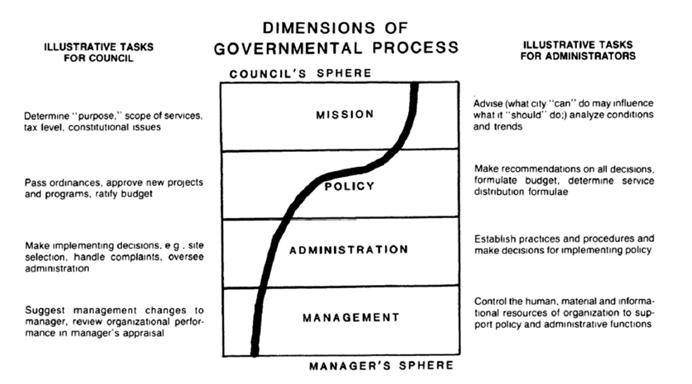
Traditionally, politics and administration are seen as separate spheres: politicians make decisions, and civil servants carry them out. However, decades of research, including the complementarity model developed by Svara, show that successful governance depends on cooperation between the two. The shared responsibility is aptly visualised:

The study addresses the following research question: ‘How complementary are the interactions between politics and administration in cities during the management of the Ukrainian refugee crisis?’

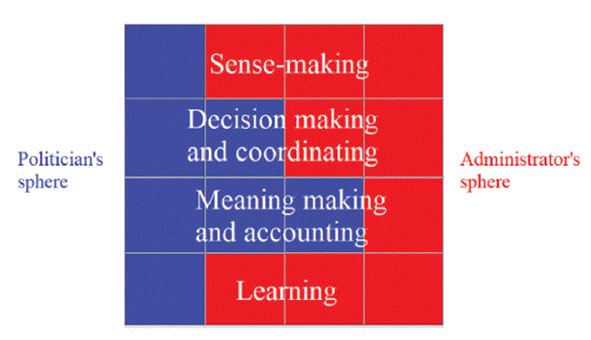
Our study shows that this politico-administrative complementarity is clearly observed during the Ukrainian refugee crisis. Crises blur boundaries: decisions must be made quickly, communication is intense, and trust becomes vital. We replaced the 4 building blocks of ‘regular’ policy making (missions, policy, administration, and management) by 4 crisis management tasks (sense-making, decisions making and coordinating, meaning making and accounting, and learning). We visualised the politico-administrative role division, as for example for the case in Antwerp:

Overall, the tasks of sense-making and learning are predominantly performed by the administration. It has to be noted that the ‘lessons learned’ primarily relate to adaptations along the way, rather than formal evaluations. The decision and coordination task shows a very mixed image: in each of the 3 cases under study, the responsibility of the decision lies, of course, with the politicians. However, the deliberation preceding the decision always showed a shared effort. The meaning-making and account-giving task is predominantly taken on by the politicians involved, most notably the mayors.

Three cities, three approaches

Antwerp had a clearly structured crisis response, with distinct political and administrative levels. The Emergency Planning Coordinator (EPC) played a key role as liaison between the mayor’s team and the city administration.

Ghent adopted a more collaborative approach, with large crisis meetings that included both the College of Mayor and Aldermen and the Management Team. This inclusivity built broad consensus but also slowed decision-making.

In Mechelen, the acting mayor and Emergency Planning Coordinator shared leadership, while the city’s political “DNA” of human rights and diversity shaped its narrative and public communication.

In all cases, civil servants were observed operating in a political world. Primarily the Emergency Planning Coordinators, but also civil servants such as project managers, can play a very determining role in the structuring of the crisis management approach, decision-making, and coordination.

Lessons for local crisis management

Complementarity works: Trust and mutual respect between political and administrative leaders were crucial. In all three cities, politicians and administrators worked as a team, but with notable differences in style. City identity shapes response, each city’s political culture influenced how it managed the crisis.

The study highlights that crises are not only technical challenges but governance challenges. They reveal the real dynamics of how cities work.

For practitioners, the message is clear: invest in relationships between political and administrative leaders before the next crisis hits. For scholars, this case offers evidence that Svara’s complementarity model holds up even under crisis conditions, but needs adaptation to capture the intensity and speed of crisis decision-making.

As crises become more frequent, cities need to build governance systems based on trust, expertise, and teamwork. Complementarity between politics and administration is not a luxury, it is what keeps local government resilient when it matters most.

Dr. Nicolai De Wulf (ORCID 0000-0002-1748-6604) finalised his PhD focusing on politico-administrative relations within local government. In the PhD three topics are studied through a politico-administrative lens: policy integration and coordination, partisan political staff, and crisis management. The PhD was supervised by prof. dr. Joris Voets.

Prof. Dr. Joris Voets (ORCID 0000-0002-8266-8607) is an associate professor in the Department of Public Governance and Management at Ghent University, Belgium. His main research interests are inter-organisational networks and local government.

Rewiring Local Government for Citizen Engagement

Jason Lowther

The Institute of Local Government Studies (INLOGOV) has published a new report, Rewiring Local Government for Citizen Engagement, which sets out a compelling case for reimagining the relationship between local authorities and the communities they serve. At a time of structural reform, fiscal constraint and lower public trust, the report argues that citizen engagement must become fully embedded local governance, rather than a peripheral activity.

The report identifies three interrelated conditions that are essential for effective engagement. First, local authorities must convene inclusive democratic spaces that enable deliberation, dialogue and collective decision-making. These spaces, whether in the form of citizens’ assemblies, participatory budgeting or neighbourhood forums, can help to rebuild trust and foster more responsive policymaking.

Second, councils must invest in building community capacity. This involves supporting citizens, particularly those from groups whose views are often neglected, to participate meaningfully in public life. It also requires sustained investment in community infrastructure, such as local venues, networks and organisations, which provide the foundations for civic engagement.  The report recognises that 15 years of austerity since 2010 has significantly reduced the availability of community meeting places such as libraries, neighbourhood offices, youth and community centres, and cultural and leisure services.

Third, the report highlights the importance of co-producing public services. By involving service users in the design and delivery of services, councils can ensure that provision is more closely aligned with the lived experiences and priorities of local people. Co-production also fosters innovation and strengthens the legitimacy of public institutions.

The report draws on a wide body of academic research and practical experience, both in the UK and internationally. It shows that democratic innovations are already taking root in many councils, despite the challenges posed by austerity and institutional inertia. Examples include digital engagement platforms, youth-led initiatives, and the devolution of powers to neighbourhood and parish levels.

However, the report also acknowledges the barriers that councils need to address. Organisational cultures, limited resources, the need to develop new skills in officers and members, and legitimate concerns among elected members about the implications of participatory approaches can all inhibit progress. The report calls for leadership, reform and investment to embed engagement in the everyday practices of governance.

We pay particular attention on the vital role of councillors, who are well placed to act as facilitators and mediators between communities and institutions. Supporting councillors to develop these roles is essential if engagement is to be sustained and meaningful. The report also emphasises the need to engage young people and to make appropriate use of digital tools.

In conclusion, Rewiring Local Government for Citizen Engagement offers a clear and evidence-based framework for strengthening local democracy. It argues that by embedding citizen engagement in governance structures and practices, councils can foster trust, improve outcomes and build more inclusive and resilient communities.

We will be discussing our findings with councils, central government and related think tanks and sector organisations over coming months.

The full report is available here:

Placemaking: how do we design better homes and neighbourhoods?

Jon Bright and Vincent Goodstadt

The Government wants to build 1.5m new homes. Here, we discuss one aspect of this ambition: how to ensure that they are designed well. Many in the past have not been.

Good design results in attractive homes, streetscapes and neighbourhoods. It contributes to placemaking, creating popular places, with community facilities, green spaces and essential services.

Well-designed neighbourhoods are sustainable: they don’t rely on high levels of car ownership and energy consumption. As a result, homes are more affordable with low energy bills and access to public transport.

There’s lots of guidance on design, for example, the ‘National Model Design Code’, Oxfordshire County Council’s ‘Street Design Guide’, and the Building Beautiful Commission’s report ‘Living with Beauty’. The problem is not primarily with the guidance.

The problem is that developers and housebuilders don’t use the guidance that exists and planning authorities don’t enforce it.

What’s the evidence?
A 2020 report, ‘A housing design audit for England ‘, concluded that the design of new housing developments in England is overwhelmingly ‘mediocre’ or ‘poor’.

The audit reveals that 75% of new housing developments studied should not have gone ahead due to ‘mediocre’ or ‘poor’ design. It inspected 142 housing developments and found that one in five should have been refused planning permission outright as their poor design was contrary to the National Planning Policy Framework (NPPF). A further 54% should not have been granted permission without improvements to their design.

The importance of design has been reaffirmed in the new NPPF (December 2024).

In addition:
• Housing for less affluent communities is much more likely to be poorly designed.
• Low-scoring developments scored badly in terms of character and sense of place.
• The worst places were dominated by access roads, storage, bins and car parking.
• More positively, schemes scored highly for security and included homes of varying sizes.

The author, Professor Matthew Carmona said: “Planning authorities are under pressure to deliver new homes and are prioritising numbers over the long-term impacts of bad design. At the same time, house builders have little incentive to improve when their designs continue to pass through the planning system. Some highways departments do not even recognise their role in creating a sense of place.

“House builders, planning authorities and highways departments need to significantly raise their game. This can’t come soon enough”.

A second study – ‘Delivering Design Value’ – assessed the problem of design quality by looking at what happens on the ground when large housing schemes are built. It confirmed that although planners want to create attractive places, design is frequently overlooked because of the pressure to meet housing targets. This is because we don’t have enough planners, especially with design skills.

Of course, developers are also responsible for design quality. But it’s widely known that volume house builders use tried and tested site layouts and house types that lack design value. Too often, local authorities approve them when they shouldn’t.

The study recommends that design should be at the heart of development and design value standards prepared that are simple, concise and translatable into clear guidance.
Without change, the housebuilding industry will continue to receive a ‘free pass’ on design and local authorities’ powers to shape places will be eroded further.

What is to be done?
Central government has revised the NPPF and the chapter on design is strong. But much will depend on how its implemented. Drawing on the two studies, we recommend that:

National design standards should place design at the heart of planning and housebuilding. Local design codes should be prepared for each major site and highways design should be a part of the planning process.

Applications for new housing should reflect national design standards and local policies covering placemaking, sustainability, streetscape, landscaping and access for pedestrians, cyclists and motor vehicles.

Local Design Panels should include specialists and review the design of major housing schemes. This should not cause delays if guidance has been followed. Design guidance should be a part of the Local Development Plan.

Local Authorities need more planners with design expertise. The main players – house builders, planners, design experts and community leaders – should collaborate on the design and master planning of large housing developments.

Conclusion
Too many housing developments are poorly designed. This must change. Local Authorities should give more attention to design, review large developments and set and enforce planning conditions.

As the new NPPF notes, ‘Development that is not well designed should be refused, especially where it fails to reflect local design policies and government guidance on design.’ (Para 139).

Developers and housebuilders need to raise their game by drawing on their best achievements and stop relying on a small number of site layouts and building types.

(Our full paper which amplifies the views in this blog can be accessed through the link here.

Jon Bright is a former Director at the Department of Communities and Local Government. He was involved in designing and implementing the Government’s national strategy for neighbourhood renewal (1998-2007) and is currently a Trustee of a charity that advises communities on Neighbourhood Planning. His book ‘Modern Management and Leadership: People, Places and Organisations’ was published in 2023.

Vincent Goodstadt is a member of the Design Council’s Network of Experts and advises organisations in the public, private, and voluntary sectors. Previously, he held senior planning posts in local government. He is a Past President of the Royal Town Planning Institute (RTPI), holds an Honorary Professor at the University of Manchester, and is a Vice-President of the Town & Country Planning Association.

Equipping local governments to deliver national and local priorities

Jason Lowther

Today we launched our latest report, Equipping local government to deliver national and local priorities. Local government is critical to the delivery of the new government’s five key missions, and to improving life across the country. We argue that, once a series of critical reforms are in place, government should have confidence to equip local authorities with more power and (when public finances allow) prioritise additional resources there, enabling local and national priorities to be delivered. But critical reforms are needed in financial management, audit and performance management, and in community power and participation.

The new government inherited many challenges. Council budgets per person in England have been cut by 18% in real terms since 2010. Councils are hitting financial crises: twelve have issued section 114 notices in the last six years, compared with zero in the previous 17 years. Representative institutions at all levels of government are suffering from declining legitimacy and increasing polarisation. Local government plays a vital role in increasing democratic relationships and trust.

But councils’ wide remit, local knowledge, democratic accountability, public service ethos, and key roles in working with partners and shaping local places make them critical to the delivery of all five of the government’s key missions. Local governments are best placed to operationalise solutions to interconnected problems, for example, improving public transport and encouraging more cycling and walking helps meet net zero targets. It can also deliver health benefits, reducing the burden on the NHS, as well as increasing productivity by giving businesses access to a wider and healthier workforce.

Action is required to ensure that councils are fit for purpose to make the type of contribution that central government requires of them. Underlying this is a lack of confidence in local government on the part of ministers and civil servants.  We have identified three areas in which the government must be confident if it is to equip the local level with more power: financial sustainability, performance standards, and community power and participation. 

Policy recommendations

Financial arrangements

  1. Provide multi-year funding.
  2. End competitive bidding and deliver a “single funding pot” for each council/ local area that has been allocated fairly and sensitively to the needs and assets of the community.
  3. Abolish council tax capping.


Audit and performance management

  1. Strengthen the evaluation of councils’ performance management.
  2. Make OFLOG independent and extend its remit and approach.
  3. Reintroduce effective management and support of council external audit by independent bodies.


Community power and participation

  1. Strengthen the role of councillors as facilitators and catalysts of community-driven change.
  2. Embed participatory governance to ensure lived experience and marginalised voices drive policy and service delivery.
  3. Develop public-commons partnerships and community-wealth building to support community-driven sustainable economies.

As the Layfield Commission concluded 50 years ago, local government funding should promote responsible and accountable government. Beyond welcome recognition of acute financial challenges and commitment to multi-year funding settlements, there is a pressing need for additional immediate and longer-term action to improve Councils’ financial position and strengthen local accountability.

Local authorities have different needs for funding, depending for example on levels of population and its composition, deprivation, and spatial factors. Central and local government should develop updated funding formulae and funding models which are as simple as practicable whilst capturing the key elements of local need, and as transparent as practical in operation.  There are many reports researching available options for fairer funding, approaches to fiscal devolution, and local government funding options

Local audit, performance regimes and regulation each have a part to play. Both a parliamentary select committee and the Redmond Review into the Oversight of Local Government have sought to investigate the failings in local government audit.  The latter in 2020 critiqued market driven audits, stating that the new audit arrangements have undermined accountability and financial management. 

The adoption of the Redmond Review’s proposal for an Office for Local Audit Regulation would provide oversight on procurement, management, and regulation of external audits of local authorities. The government could extend the oversight of local government performance management processes while avoiding the creation of an overly powerful national regulator, by adopting key recommendations on the future arrangements of OFLOG (the Office for Local Government).

Proximity means that local government can play a crucial role in improving relationships between government and citizens. By creating conditions to mobilise the diverse expertise and resources of communities, local government can ensure that public policies and funding are informed by the assets, priorities and needs of local people and places.  There are already many examples where local government has made progress with innovations such as citizens’ panels and juries, the delegation of power to the hyper-local level and in building inclusive economies

We have over thirty years’ worth of research on deliberative democracy, social innovation, and co-production evidencing the value of collaboration with diverse communities and stakeholders. Participatory governance is less about finding perfect solutions and more about transforming organisations to engage with communities in processes of co-producing mutual understanding, shared solutions, and a sense of collective ownership.  

Our work on the 21st Century Councillor can help with enabling the role of councillors not just as democratic representatives but also as facilitators and boundary spanners between institutions, communities, civil society and local businesses.

Community-wealth building, pioneered in Preston and several London boroughs, can help strengthen the local economy with insourcing, linking public procurement to local cooperatives and social enterprises. These novel forms of governance can be formalised through Public-Commons Partnerships.

Equipping local government to deliver national and local priorities will leave a long-lasting legacy of a well-resourced, effective, accountable, and engaged local government.

The full report is available here

The report was edited by Jason Lowther and Philip Swann, with particular thanks to the following contributors (alphabetically by last name): Dr Koen Bartels, Dr Sonia Bussu, Prof Nicole Curato, Dr Timea Nochta and Dr Philip Whiteman. With thanks to other colleagues and associates in INLOGOV.

Why do philanthropic foundations engage with city governments?

Dr Ruth Puttick

The fact that governments face an array of challenges is a well-rehearsed argument. City governments across the globe are tackling a myriad of social, economic and environmental issues, from trying to reduce homelessness, improving health and wellbeing, or increasing educational attainment.  In parallel, philanthropic foundations’ accumulated wealth and knowledge means they are increasingly welcomed as a government partner in addressing social needs. So why do philanthropic foundations engage with city governments?

The UK Association of Charitable Foundations defines philanthropic foundations as “charities with private, independent, sustainable income that supports individuals and/or organisations” (Pharoah and Walker, 2019, p. 1). In 2015, there were over 10,000 charitable foundations based in the UK and some of these are engaging with city governments.

In the U.S. context, philanthropic foundations have a long history of interacting with the government (Zunz, 2012) They have traditionally funded physical structures like libraries and opera houses, and in recent years, foundations have increasingly working directly with governments to tackle issues as diverse as climate change (Madénian and Van Nest, 2023), gun control, and poverty reduction (Barber, 2014; Nijman, 2009; Moir et al., 2014). Yet, there has been little exploration of this phenomenon in the English context.

Based upon the case study analysis of three contrasting English cities, Bristol, Manchester, and Newcastle, I drew upon qualitative interviews and policy reports to understand the interconnections between foundations and city governments.

Why do city governments and foundations collaborate

Philanthropic foundations can be a capacity-building partner of city government, providing direct funding and non-financial resources to help city governments solve problems.  Philanthropic foundations provide city governments with direct funding and non-financial resources, including data, research, events, and other outputs, such as toolkits.

Foundations are motivated to improve public services, develop new approaches to problem-solving, advocate on policy issues, and fill funding gaps left by austerity. Foundations select city governments based on personal rapport and perceived ease of working.

City governments are motivated to engage with foundations to access resources, for foundations to help amplify the voice of city governments, and because foundations are perceived as less bureaucratic and more trustworthy funders.

Barriers to city government and foundation collaborations

Foundation engagement with city governments is inconsistent. This study found that certain city governments (in this case, Manchester and Bristol) had more partnerships with foundations. The reason is that foundations often will not work with city governments when the city government’s priorities are unclear, if they are hard to engage, or when there is a perceived slow pace of change in city hall.

On the part of city governments, a scarcity of resources can prevent them from seeking foundation resources. With the impacts of austerity still lingering, it may have been surmised that austerity could prompt cities to seek foundation support, instead, this study has found that a lack of internal capacity can prevent the city government from seeking foundation involvement.

Implications for policy and practice

City governments interacting with foundations in England is a relatively nascent and under-explored phenomenon. As well as few academic studies, there is often an opaqueness in the nature of these collaborations. A lack of transparency can hinder scrutiny, which is problematic if city governments and their partners are to be held to account. Going forward, a key facet of city government engagement with foundations should be a commitment to transparency in the nature of the collaboration and an openness to sharing evidence of the impacts of the interactions on the outcomes that the foundation and city governments are trying to achieve.

Areas for future research

As a relatively underexplored topic, more research could usefully explore foundation engagement with city governments across England on a larger scale, particularly to understand the implications for accountability. Futuremore, future research could usefully explore whether philanthropic foundations prioritise collaborating with city governments over different types of organisations, such as charities, and if so, whether this is because city governments enable potentially larger degrees of policy influence than more “marginal” political institutions, such as NGOs or community groups.

To find out more about the research, please contact Dr Ruth Puttick, [email protected]

The full article is available here.

Picture credit: https://www.jolietymca.org/blog/the-significance-and-joy-of-giving/


Dr Ruth Puttick runs a research consultancy and is a Senior Research Fellow at the Institute for Innovation and Public Purpose (IIPP) at University College London. She has over 15 years of practical research experience in the public and private sectors advising on public sector reform, innovation and impact. She served as a Senior Policy Advisor in the UK Government’s Open Innovation Team, and before that, she worked at Tony Blair Associates, a global management consultancy, helping establish the policy and research team in the government advisory practice. Prior to that, she spent six years at Nesta, the UK’s innovation agency. Ruth is on X.com @rputtick and can be contacted at www.ruthputtick.com