Jason Lowther and Sonia Bussu
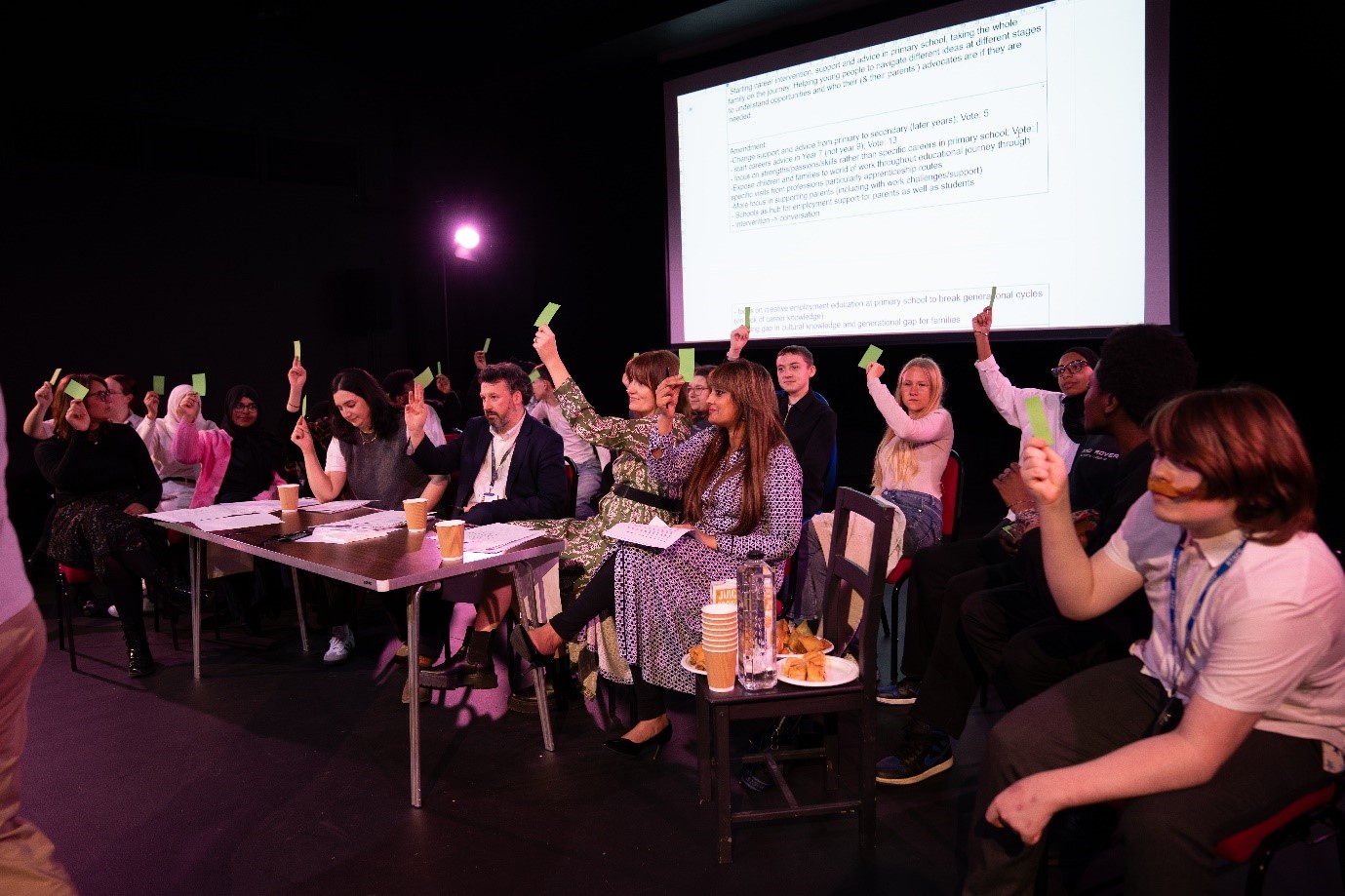
Legislative Theatre with West Midlands Combined Authority
As local government in England undergoes significant restructuring, with fewer councils serving larger and more diverse populations, the role of councillors is under pressure. At the same time, democratic innovations, such as citizens’ assemblies, or creative methods of participation, such as legislative theatre and digital engagement, are gaining traction. These innovations offer new ways to engage communities and strengthen democratic legitimacy. But how do they fit with the role of elected councillors?
Recent research and practice suggest that councillors can play a crucial role in facilitating inclusive and impactful citizen participation.
Politicians’ Views on Participation
Across the UK and Europe, many elected representatives have expressed support for citizen participation in policymaking. They see it as a way to build trust, improve decision quality, acknowledge a wider range of perspectives and knowledge, engage citizens more deeply in political life, and potentially identify novel solutions to politically difficult issues. However, research by Kersting shows that this support is often conditional. Councillors tend to favour participatory instruments that reinforce their representative role, such as advisory boards or structured consultations. They are more sceptical of online platforms and randomly selected citizen assemblies (so-called minipublics), which they worry may not be genuinely representative of their electorate and may lack the capacity to understand complex issues.
Werner and Marien’s comparative experiments in Sweden and the Netherlands provide further insight. Their work shows that participatory processes consistently increase perceptions of fairness. This matters because fairness perceptions are closely linked to trust, policy compliance, and perceived legitimacy. Importantly, these effects are not limited to winners (who support the outcome of the exercise); even those who lose in participatory decisions tend to view the process more positively than in purely representative settings.
These findings highlight a tension. While democratic innovations can enhance legitimacy, councillors often feel uncertain about their role within them. Without open discussion, clear support, and integration, these processes risk bypassing councillors altogether.
Reimagining the Role of Councillors
Inlogov’s 21st Century Councillor research offers a compelling framework for renewing councillors’ roles. It describes councillors as hybrid connectors who build relationships both online and offline, multi-level diplomats who navigate partnerships across governance layers, and system stewards who shape democratic innovation and institutional change.
To fulfil these roles, councillors need support. This includes help to understand democratic innovations and any potential concerns. They need understanding of key areas such as facilitation skills and digital engagement, confidence in narrative-building around democratic innovation, access to mentoring from peers with experience of these approaches, opportunity to explore difficult scenarios, and chance to reflect on their practice. Councils must also empower community members to scrutinise participatory outputs, and help councillors to navigate tensions between citizen input, officer advice, and party lines.
The Camden Model: Embedding Participation
Camden Council offers a practical example of how participatory processes can be embedded within representative governance. The council has institutionalised citizens’ assemblies as regular tools for major policy development, including planning, climate change, and health and social care. Assemblies are commissioned by council boards, which commit to formally responding to recommendations. In the case of the 2019 Climate Assembly, all 17 proposals were endorsed and integrated into Camden’s Climate Action Plan, with the citizen’s assembly referenced throughout the document.
This approach demonstrates how local government can lead participatory processes, ensuring they are not just consultative exercises but integral to policy development. However, several recommendations from the Camden climate assembly extended beyond the council’s jurisdiction, highlighting the structural limitations of local deliberative processes in addressing systemic issues like the climate. Councillors could have played a stronger bridging role, helping to clarify expectations and ensure that recommendations were grounded in the council’s remit. Stronger involvement from elected representatives might have thus enhanced democratic accountability.
Inclusive youth engagement in policymaking in the West Midlands
There is much more to learn and do to make democratic innovations more inclusive and effective, supporting participation from historically marginalised groups, which tend to ignore invitations to participate in citizen assemblies or formal consultation exercises.
A recent example of inclusive approaches comes from the West Midlands, where the INSPIRE project, led by the University of Birmingham, used legislative theatre to engage young people in shaping youth employment policy. Legislative theatre is a method developed by Augusto Boal that uses performance to explore lived experience, test policy interventions, and co-create solutions. It involves watching a play co-created by the participants on real issues and based on their lived experience. During the event, an audience of community members and policymakers become spect-actors, acting out alternative scenarios, proposing policy changes, and voting on them in a public forum.
The University of Birmingham partnered with the Young Combined Authority and Youth Focus West Midlands to recruit a diverse group of 15 young people (14-17 years old) who, under the guidance of legislative theatre practitioners, developed a play about barriers to work experience and youth employment. Through performances and structured dialogue with policymakers, they co-created six policy proposals. These include reforms to careers advice, work experience, and employer accountability.
Crucially, policymakers were invited to participate not just as observers but as co-creators and champions. Their involvement can help bridge the gap between lived experience and institutional action, demonstrating how local government can play a central role in democratic innovation for social change.
Councillors as Democratic Innovators
Democratic innovations in Camden and the West Midlands are two examples of how local government can promote democratic renewal. Councillors can and should play more central roles in these processes, beyond party politics, to facilitate and nurture dialogue between citizens and institutions, ensuring follow-through on recommendations, and using committee structures to embed participatory outputs.
Rather than seeing participation as a threat, councillors can embrace it as a tool to strengthen their representative role and reconnect with communities. They are uniquely positioned to bridge the gap between citizen voice and institutional action. This requires a shift in mindset and practice.

Dr Jason Lowther is Director of Inlogov (the Institute of Local Government Studies) at the University of Birmingham, and was Assistant Director (Strategy) at Birmingham City Council from 2004 to 2018. His research focuses on the use of evidence in public policy and central intervention in local government.

Dr Sonia Bussu is an Associate Professor at the University of Birmingham Department of Public Administration and Policy where she studies and teaches public policy. Her main research interests are participatory governance and democratic innovations, and creative and arts-based methods for research and public engagement.
This article was first published in the Municipal Journal, 25th September 2025, available online here: https://www.themj.co.uk/renewing-democratic-leadership
Picture credit: Inspire Legislative Theatre, March 2025 – photo by Bucuria Maria Polodeanu – Insta: @reelmasterproduction
 INLOGOV Blog