The sad state of many neighbourhoods and communities, with their desolated high streets, has been identified as a significant driver of the rejection of politicians and political parties which lay behind the May 2026 local election results
As the shallowness of programmes such as Pride in Place demonstrates, this is not an issue that central government can tackle alone. It requires local action reflecting local circumstances. Yet local councils lack the resources and levers to secure lasting improvements. Meeting this challenge requires deep collaboration between central and local government at a time when changes in political control locally will make that more difficult to achieve than ever.
Is it too naïve to hope that engagement between local political actors, local people and local organisations and groups could inform new approaches to revitalise struggling local communities? Could the involvement of national politicians in the process secure the reform of local government finance and the provision of new powers necessary to enable localities to act?
Writing in 1939, when he was leader of the Labour Group on Oxford City Council, Richard Crossman, argued that one of the strongest arguments for local party politics “is that they do provide a method of creating interest and focussing attention upon the enormously important issues as stake.” Crossman, who went to serve as Harold Wilson’s Minister for Housing and Local Government, added that “the real basis of successful political democracy is not to be found in politics at all, but below the surface in the organisation of a whole network of popular interests into pressure groups.”
Writing just over 40 years later, when he was leader of Sheffield Council, David Blunkett also called for collective local action. He argued that politicians and communities should “do things together rather than having them done for us, to remove the conditions of poverty and dependence rather than trap people in them, and thus to develop a sense of supporting and being supported.” He made a similar point in 2004, when he was Home Secretary, recognising the importance of a partnership between local politicians and citizens “to revitalise democracy and strengthen citizenship and civil society, so that people are part of the process of reform and modernisation.”
Now more than ever it is important to follow the advice of Crossman and Blunkett and refresh local politics through collaboration with local groups and communities to deliver improvements locally and secure reforms nationally to enable that local action. Succeeding in doing this could also begin to restore trust in politics and politicians.
Phil Swann is studying for a PhD at INLOGOV in the Department of Public Administration and Policy, University of Birmingham, on the contribution of politicians to central-local government relations.
With dozens of English councils and hundreds of councillors facing delays to this year’s May elections, opponents claim the move could undermine public trust in democracy. History shows deferral of elections in similar circumstances is rare but not exceptional. There are however far bigger threats to the UK’s democracy.
Media reports today are suggesting that more than a third of eligible English councils have requested to delay their planned May 2026 local elections, potentially requiring around 600 councillors to serve an additional year. These councils state that the Government’s ongoing local government restructure makes it difficult to run the polls effectively at the planned dates, and central government claims holding elections for councils that are soon to be abolished would waste time and money.
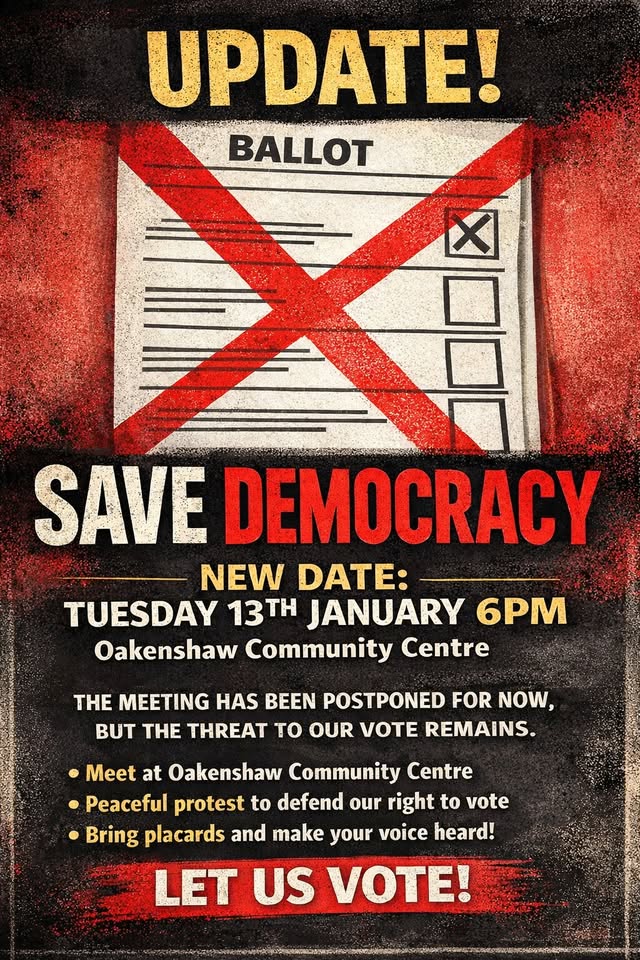
But the delays have sparked criticism, and even led to unrest at this week’s Redditch council meeting. Opponents argue the move weakens democratic accountability. Reform UK leader Nigel Farage denounced the proposal as “monstrous”, claiming that “denying elections is the behaviour of a banana republic” and threatening a judicial review. Conservative and Liberal Democrat MPs have also criticised the move. The Electoral Commission’s chief executive said: “As a matter of principle, we do not think that capacity constraints are a legitimate reason for delaying long planned elections. Extending existing mandates risks affecting the legitimacy of local decision making and damaging public confidence.”
Delays to local elections in England have occurred previously. During the Second World War, all local elections were suspended between 1939 and 1944, making this the most extensive postponement in modern history. In peacetime, delays have largely been tied to local government reorganisation, most notably in the 1990s, when Parliament approved major structural reforms that abolished counties such as Avon, Cleveland, and Humberside and created 46 new unitary authorities. These reforms led to altered or cancelled election dates to align with the establishment of new councils and avoid electing councillors to authorities that were about to be dissolved. In 2025, nine councils had their elections delayed by one year to support transitions to new unitary structures.
But even though there are clear precedents for the current electoral postponements, there are other longer-term, more significant and worrying trends which risk seriously undermining our democracy. Academic commentary shows growing concern among constitutional scholars that the UK’s democratic safeguards have weakened in recent years.
Scholars at the UCL Constitution Unit warned in 2022 that the UK faced a real risk of “democratic backsliding,” defined as a gradual erosion of checks and balances, growing executive dominance, attacks on civil liberties and the weakening of political norms that traditionally safeguarded constitutional stability. Their analysis emphasised that democratic decline can occur incrementally through the actions of elected leaders, especially in systems like the UK’s where constitutional rules are flexible and can be rapidly altered.
Further alarm was raised by Professor Alison Young at the University of Cambridge, who described the UK as standing on a “constitutional cliff‑edge.” In her 2023 book, she argued that a series of constitutional changes and executive‑centric reforms have strengthened government power while weakening the political and legal checks that previously constrained it. Young warned that without reforms to reinforce accountability, transparency, and oversight, the UK risks drifting towards “unchecked power,” eroding the democratic norms that underpin good governance.
Last year, Dr Sean Kippin of the University of Stirling argued that recent Conservative governments engaged in “democratic backsliding” by deploying what he calls an “illiberal playbook,” using both lawful and legally dubious tools to weaken institutional checks, restrict protest rights, and compromise the independence of the Electoral Commission. His research concludes that “between 2016 and 2024, the Conservatives used power to diminish, weaken, and compromise Britain’s already imperfect democracy”.
There have been some positive moves by the ‘new’ Labour government to improve the functioning of our democratic system, such as the widening of voter ID criteria and promises to lower the voting age to16. However, overall there hasn’t yet been commitment to fundamental reforms to address the issues identified in the above reports, such as the impact of donations on political impartiality, and there have been some worrying developments, for example around civil liberties and the right to protest.
A year’s deferral of elections to a disappearing council doesn’t fundamentally undermine our democracy, but failing to address the longer term and serious issues of democratic backsliding could prepare the way for those who will.
Dr Jason Lowther is director of INLOGOV (the Institute of Local Government Studies) at the University of Birmingham.
References
Kippin, S., 2025. Democratic backsliding and public administration: the experience of the UK. Policy Studies, pp.1-20.
Russell, M., Renwick, A. and James, L., 2022. What is democratic backsliding, and is the UK at risk. The Constitutional Unit Briefing.
Young, A.L., 2023. Unchecked power?: How recent constitutional reforms are threatening UK democracy. Policy Press.
Legislative Theatre with West Midlands Combined Authority
As local government in England undergoes significant restructuring, with fewer councils serving larger and more diverse populations, the role of councillors is under pressure. At the same time, democratic innovations, such as citizens’ assemblies, or creative methods of participation, such as legislative theatre and digital engagement, are gaining traction. These innovations offer new ways to engage communities and strengthen democratic legitimacy. But how do they fit with the role of elected councillors?
Recent research and practice suggest that councillors can play a crucial role in facilitating inclusive and impactful citizen participation.
Politicians’ Views on Participation
Across the UK and Europe, many elected representatives have expressed support for citizen participation in policymaking. They see it as a way to build trust, improve decision quality, acknowledge a wider range of perspectives and knowledge, engage citizens more deeply in political life, and potentially identify novel solutions to politically difficult issues. However, research by Kersting shows that this support is often conditional. Councillors tend to favour participatory instruments that reinforce their representative role, such as advisory boards or structured consultations. They are more sceptical of online platforms and randomly selected citizen assemblies (so-called minipublics), which they worry may not be genuinely representative of their electorate and may lack the capacity to understand complex issues.
Werner and Marien’s comparative experiments in Sweden and the Netherlands provide further insight. Their work shows that participatory processes consistently increase perceptions of fairness. This matters because fairness perceptions are closely linked to trust, policy compliance, and perceived legitimacy. Importantly, these effects are not limited to winners (who support the outcome of the exercise); even those who lose in participatory decisions tend to view the process more positively than in purely representative settings.
These findings highlight a tension. While democratic innovations can enhance legitimacy, councillors often feel uncertain about their role within them. Without open discussion, clear support, and integration, these processes risk bypassing councillors altogether.
Reimagining the Role of Councillors
Inlogov’s 21st Century Councillor research offers a compelling framework for renewing councillors’ roles. It describes councillors as hybrid connectors who build relationships both online and offline, multi-level diplomats who navigate partnerships across governance layers, and system stewards who shape democratic innovation and institutional change.
To fulfil these roles, councillors need support. This includes help to understand democratic innovations and any potential concerns. They need understanding of key areas such as facilitation skills and digital engagement, confidence in narrative-building around democratic innovation, access to mentoring from peers with experience of these approaches, opportunity to explore difficult scenarios, and chance to reflect on their practice. Councils must also empower community members to scrutinise participatory outputs, and help councillors to navigate tensions between citizen input, officer advice, and party lines.
The Camden Model: Embedding Participation
Camden Council offers a practical example of how participatory processes can be embedded within representative governance. The council has institutionalised citizens’ assemblies as regular tools for major policy development, including planning, climate change, and health and social care. Assemblies are commissioned by council boards, which commit to formally responding to recommendations. In the case of the 2019 Climate Assembly, all 17 proposals were endorsed and integrated into Camden’s Climate Action Plan, with the citizen’s assembly referenced throughout the document.
This approach demonstrates how local government can lead participatory processes, ensuring they are not just consultative exercises but integral to policy development. However, several recommendations from the Camden climate assembly extended beyond the council’s jurisdiction, highlighting the structural limitations of local deliberative processes in addressing systemic issues like the climate. Councillors could have played a stronger bridging role, helping to clarify expectations and ensure that recommendations were grounded in the council’s remit. Stronger involvement from elected representatives might have thus enhanced democratic accountability.
Inclusive youth engagement in policymaking in the West Midlands
There is much more to learn and do to make democratic innovations more inclusive and effective, supporting participation from historically marginalised groups, which tend to ignore invitations to participate in citizen assemblies or formal consultation exercises.
A recent example of inclusive approaches comes from the West Midlands, where the INSPIRE project, led by the University of Birmingham, used legislative theatre to engage young people in shaping youth employment policy. Legislative theatre is a method developed by Augusto Boal that uses performance to explore lived experience, test policy interventions, and co-create solutions. It involves watching a play co-created by the participants on real issues and based on their lived experience. During the event, an audience of community members and policymakers become spect-actors, acting out alternative scenarios, proposing policy changes, and voting on them in a public forum.
The University of Birmingham partnered with the Young Combined Authority and Youth Focus West Midlands to recruit a diverse group of 15 young people (14-17 years old) who, under the guidance of legislative theatre practitioners, developed a play about barriers to work experience and youth employment. Through performances and structured dialogue with policymakers, they co-created six policy proposals. These include reforms to careers advice, work experience, and employer accountability.
Crucially, policymakers were invited to participate not just as observers but as co-creators and champions. Their involvement can help bridge the gap between lived experience and institutional action, demonstrating how local government can play a central role in democratic innovation for social change.
Councillors as Democratic Innovators
Democratic innovations in Camden and the West Midlands are two examples of how local government can promote democratic renewal. Councillors can and should play more central roles in these processes, beyond party politics, to facilitate and nurture dialogue between citizens and institutions, ensuring follow-through on recommendations, and using committee structures to embed participatory outputs.
Rather than seeing participation as a threat, councillors can embrace it as a tool to strengthen their representative role and reconnect with communities. They are uniquely positioned to bridge the gap between citizen voice and institutional action. This requires a shift in mindset and practice.
Dr Jason Lowther is Director of Inlogov (the Institute of Local Government Studies) at the University of Birmingham, and was Assistant Director (Strategy) at Birmingham City Council from 2004 to 2018. His research focuses on the use of evidence in public policy and central intervention in local government.
Dr Sonia Bussu is an Associate Professor at the University of Birmingham Department of Public Administration and Policy where she studies and teaches public policy. Her main research interests are participatory governance and democratic innovations, and creative and arts-based methods for research and public engagement.
“You won’t find many of them”, people quip when I tell them the title of my PhD; and my riposte, “that’s why I asked councillors”. And I was right; interviews with 17 councillors across four parties have revealed over 2,000 examples. Conceptions include: equality, proportionality, equity, fair opportunity, market fairness, fair administrative process and more. These conceptions were collected during the semi-structured interviews based on four carefully crafted vignettes (case studies). Thematic coding assisted their allocation into eight broad types (Realms) along with sub-categories like reciprocity, merit and efficiency. Sometimes the councillor denied they were talking about fairness, but they were; a simple reframing, usually changing a point of view, clarified the analysis, for example, council efficiency can be reframed as value for money and thus fairness to the taxpayer.
My PhD can be likened to an exploration. With me, the explorer, finding snippets of theory from various academic sources each describing a type of fairness and sometimes disagreeing with another. Thus equipped, I ventured into the jungle, Bristol City Council, and witnessed, watched and registered actual conceptions coming from actual politicians. I returned relatively unscathed and after analysis discovered much that agreed with theory but also much else. I now have a clear report to deliver about the eight, strange, fairness-beasts that rule their Realms and what happens when they mix.
Combinations
The findings map out the Realms more accurately and show that in certain circumstances a combination of Realms can elicit quite strong responses. For example, in one vignette, six councillors wanted to request a breach of council-house regulations to allow a tenant to sublet her flat. Reasons varied, but many were drawn to the description of her disadvantage, escaping an abusive relationship, and were impressed that despite all her problems she had not only sought work but actually landed a job. “Respect” and “this is the type of person we should be helping” were two of many responses. However, an equal number of councillors were totally unimpressed and thought she should be served notice as per the tenancy.
Another vignette, about a large donation to the Children in Care Service, offered councillors three policy options. Eight wanted to make policy changes; and every one of those changes was based on making the choices fairer.
Fair Process or Outcome?
With this more reliable set of fairness definitions, the data can be analysed in many ways. For example, there is debate about whether fairness in Local Government should be about fair process or fair outcome, some arguing one way and some the other. I recall a council officer telling me that if a decision follows fair process from a fairly formulated policy, then it must be right whatever the outcome. But is that fair?
This data lets me measure the number of conceptions of fair process and the number of conceptions of fair outcome; there was little difference whether the councillors were male or female, new or experienced, and from different parties. But it did change and dramatically, if the councillor was or recently had been in a cabinet or committee chair position compared with backbench councillors. The latter group were much more interested in fairness of outcome. This is a finding from a qualitative study, so not definitive, but I’ve already had a number of conversations saying “that’s not surprising” each with suggested reasons. Perhaps a more rigorous study could be done.
Party Dogma?
Another question I’m asked is about the influence of parties. The interviews were conducted singly and confidentially; I hope I reached the councillors’ true views. One vignette asked them to come to a conclusion and vote based on their values, and then asked whether their vote might change if it were whipped. Many said they might change out of loyalty. Loyalty, like fairness, is a moral value and clearly quite powerful.
Wicked Problems
One of many potential uses is in understanding intractable “wicked” problems. These are made more wicked if there are value differences between the stakeholders. Fairness is a human value, so perhaps an understanding of fairness could assist in some small way to make headway with such problems that seem nowadays to be popping up everywhere.
What next?
I have just entered the final year; out of the jungle but not quite out of the woods, yet; there’s a lot of writing up to do, and then I’d like to use the findings and meet up with people interested in better understanding other councillors’ or parties’ values.
An ex-councillor in Bristol and author of the book on Local Government, After the Revolution, Clive followed up on politicians’ conceptions of fairness. He is now his final year of a PhD at the University of Bristol, interviews complete and writing it up. His personal blog site is: https://sageandonion.substack.com/
Local authorities are under immense pressure to find savings whenever they can. After more than a decade of austerity, the collective deficit in the sector is expected to reach £9.3bn by next financial year. Local authority finances have also become increasingly speculative, as budgets are prepared on the basis of unpredictable grant allocations and single-year financial settlements, sometimes without audited accounts. Pressures to find new sources of income through commercial investments and private sector partnerships have also increased the complexity of council funding.
This creates a challenge: scrutiny of local government finance is more important than ever. Yet even with the best intentions, local authorities struggle to produce open and accessible financial information.
In a research collaboration between Research for Action and the University of Sussex, we set out to explore how financial information — such as council budgets and accounts — could be made more accessible to the public. Our research found that even experienced researchers, accountants and councillors struggle to find and understand local authority financial information.
We spoke to 26 people from the local government sector over three months this spring to examine barriers to making local authority financial information accessible to councillors and the wider public. Interviewees included councillors from a range of authorities, council officers, academics, accountants, journalists and key sector bodies like CIPFA.
Our key findings were a lack of standard reporting requirements, strained council capacity after years of austerity and a fragmented data landscape with no standard formats for publishing financial information. These barriers make it difficult to understand a single council’s finances and make comparisons across the sector, hindering effective scrutiny by councillors and journalists, and democratic participation by the public.
Some interviewees argued that accessibility was less of a priority in the face of a mounting crisis in local authority finances, but in our view, openness is not a luxury. It is key to effective local democracy.
How to improve open up council finances
Based on our findings, we set out a series of recommendations for greater transparency and openness.
The government should introduce new data standards for local government to improve accessibility, potentially via a Local Government Finance Act. This should include making financial information machine readable where possible and using accessible file formats. An easy win in this area would be to create a single repository for all local government financial information.
Local audit reforms are also an important piece of the puzzle. The new Local Audit Office (LAO) should be made responsible for local government financial data, including making it publicly available with tools to enable comparison and oversight. A more ambitious idea for the new LAO could be to create a traffic light warning system for the financial health of local authorities based on indicators that are timely and easy to understand, taking inspiration from Japan.
Council accounts were highlighted as a particularly technical and opaque part of local government finance. That’s why councils should be mandated to attach a narrative report to their annual accounts, as previously recommended by the Redmond Review.
We think that the Local Government Data Explorer, recently scrapped, should be replaced with a data visualisation that is genuinely accessible and interactive, perhaps taking inspiration from a dashboard created by academics in Ireland. There should also be funding for local open data platforms, because there have been isolated examples of successes, such as the Data Mill North.
The other part of the problem is that councillors often don’t have the knowledge and skills to properly scrutinise the complicated world of local government finance. That’s why we’re calling for greater support and training for councillors to enable better financial scrutiny, as well as public resources to improve literacy around local government.
While the sector faces great upheaval in the next few years through local government reorganisation and English Devolution, these reforms also present an opportunity to improve transparency – whether that’s at unitary or combined authority level.
We believe that greater openness will ultimately facilitate better public participation and healthier local democracies.
Matty Edwards is a freelance journalist based in Bristol who also works for Research For Action, a cooperative team of researchers that in recent years has investigated PFI, LOBO loans, the local audit crisis and scrutiny in local government.
Literally minutes before I was going to email this already over-lengthy blog, I had my attention drawn to Birmingham’s rather paltry 5.4 score and 4th-from-bottom ranking on the HAYPP vape retailers’ ‘smell score’ scale – pretty well what it sounds like: UK cities ranked on perceived cleanliness. It seemed so obviously distorted by the lengthy bin collection strike and consequently not a lot better than Leeds’ 4.2, rather than up with at least, say, Newcastle (7.4) or even Liverpool (8.2). But, apart from those few lines, I let it pass.
So, on to my initial topic, which, as it happens, kicks off with some equally basic stats. Someone asked me recently – albeit after I’d slightly steered the conversation – if I knew whether (m)any of the several hundred new Reform UK councillors elected in the recent local elections (that I’d written about in a recent INLOGOV blog) had already left the party.
I had to waffle a bit – after all, the 677 ‘new’ ones had taken Nigel Farage’s party’s national total to just over 850, and some/many undoubtedly shocked themselves. But I did happen to know that the number of recent resignations/suspensions/expulsions was already into double figures. To which I was able gratuitously to add that the party had also ‘lost’, at least for the time being, two of its six MPs.
Which might seem to suggest either that I have a particular academic interest in Farage’s indisputably fascinating party or that I’m some kind of political nerd – to neither of which I’ll readily admit.
No, the explanation for my having acquired this arcane knowledge is that for at least 30 years now I’ve known/known of (nowadays Baron) Mark Pack, his captivation with all things electoral, and his enthusiasm for sharing that captivation – dating back to when he was at the University of Exeter, just up the A38 from the University of Plymouth, original home of ‘(Colin) Rallings & (Michael) Thrasher’ (definitely local government statistical junkies), and now itself home of their internationally renowned Local Government Chronicle Elections Centre, and its/their matchless annual Local Election Handbooks.
Naturally, R&T’s interests and path-breaking publications focus primarily on local government elections. Those of (nowadays) Lord Pack of Crouch Hill (but Mark hereafter) include the Liberal Democrat Party, of which he’s currently an extremely active President; the House of Lords, and, as ever, political opinion polls, about all of which he writes invariably fascinating weekly newsletters; in addition to reporting on almost anything electoral. This and more he shares on his exceedingly lively website, the recommendation of which (to any readers unfamiliar with it) is the main purpose of this blog.
And so, belatedly, back to those disappearing Reform UK councillors. It’s the sort of phenomenon that Mark Pack revels in – the numbers, the reasons/circumstances, it’s all perfect material for a near-daily political diarist. He naturally keeps a running list of councillors “shed by Reform UK” since the May elections, the most recent updating of which at the time of typing this paragraph being, I think, on July 7th, when the departee figure had reached a quite striking 11.
They comprised five straight resignations as councillors, two expulsions by Reform, three suspensions by the party, one of whom subsequently quit, and one who’d decided they’d prefer to be an Independent.
As for the (female) Reform UK councillor charged with assault and criminal damage, for instance – well, it was covered, naturally, in Mark Pack’s diary on June 30th, and she’ll shortly be “appearing before magistrates”. And, as the Crown Prosecution Service publicly emphasised, it’s “extremely important that there be no reporting or sharing of information online which could in any way prejudice ongoing proceedings.”
Which brings us to the two of the all-time total of just six Reform MPs who already are no longer. First was Great Yarmouth MP Rupert Lowe, who back in March was suspended and reported to the police over alleged threats of physical violence towards the party’s Chairman, Zia Yusuf. And second, more recently, was James McMurdock, who “surrendered the party whip” a few weeks ago over, as The Guardian delicately put it, “questions of loans totaling tens of thousands of pounds.”
The key, albeit belated, point of this blog, however, is the multifaceted contribution to our political world of Mark Park himself, rather than ‘here-today-gone-tomorrow’ MPs. Yes, he’s a copious diarist, but so much more. In particular, there’s his arguably greatest single contribution to our academic political world: the phenomenon that is what I still think of as his ‘PollBase’, but which comparatively recently has acquired the handle PollBasePro.
If you’re writing anything at all concerning our political world in the 90-plus years since 1938/39 – yes, before the start of World War II – and you need to know or even get a sense of the state of UK public opinion on a virtually month-by-month, and latterly week-by-week, basis, just Google either title, and it’s there, instantly accessible and downloadable. Yes, completely free – all Mark asks is that you point out any mistakes (!) and have the decency to acknowledge the source.
It’s a fabulous resource, easily worth – pretty obviously – a blog on its own, but all it’s going to get on this occasion is this abbreviated reference, kind of explaining why I’ve structured this blog in the way I have. That reference comes from p.2 of the dozens of pages, when the only pollster was Gallup and the only poll publisher the News Chronicle (1930-60, when it was “absorbed into the Daily Mail”).
From the start, in 1938, the sole question asked consistently was “Conservatives Good or Bad”, and, probably not surprisingly, throughout most of World War II, the Conservatives were overwhelmingly (75-90%) ‘Good’. Only from 1943 were questions asked about the other parties, and from the start Labour, polling consistently in the 40s, had a double-figure lead over the Conservatives, suggesting that voters were already clearly differentiating between the conduct of the war and the conduct of peace.
This came to a head in January 1946, when Labour, with 52.5%, outpolled the Conservatives by a massive 20.5%, a lead they’d never previously even approached and would do so just once again in the coming decades. Oh yes, and I was born at the very end of December 1945 – and, if only we’d known, my committed Tory-voting parents would have been deeply unhappy, and I’d have gurgled contentedly. Sorry about the length, but I had to squeeze that last bit in.
Chris Game is an INLOGOV Associate, and Visiting Professor at Kwansei Gakuin University, Osaka, Japan. He is joint-author (with Professor David Wilson) of the successive editions of Local Government in the United Kingdom, and a regular columnist for The Birmingham Post.