Professor Shunsuke Kimura
The ombudsman is an institution that serves as a voice for Parliament and the public, conducting administrative reviews through hearings and investigations of complaints and inquiries. Rooted in human rights protection, the ombudsman system monitors administrative agencies by directly addressing citizens’ claims.
This paper analyses the functions of the Japanese ombudsman system within the public policy framework, particularly considering Japan’s cultural characteristics. Despite its adoption by some local governments since 1990, the ombudsman institution has not gained widespread prominence across Japan. This raises questions regarding its effectiveness within the administrative dispute system and the reasons for its limited adoption. Research indicates that there are structural issues within Japan’s local administrative system that may hinder the mediation process.
The study employs original statistics sourced from interviews with ombudsmen from Kawasaki City, which was the first municipality to establish an ombudsman in 1990. The paper also highlights the presence of approximately 5,000 administrative advisors across Japan, which contrasts with the relatively small number of municipalities that have adopted the ombudsman system.
Municipal ombudsmen have contributed to addressing administrative grievances and improving local governance through reforms. The Japanese administrative dispute system comprises three subsystems: the administrative case litigation system, the administrative appeal system, and the grievance system, with the ombudsman system falling under the latter. (See Table1)

The ombudsman primarily addresses inadequate administrative actions, aiming to enhance administrative justice. Japan’s local government system consists of ordinary and special local governments, with prefectures and municipalities being the primary units.
The paper emphasizes that, unlike many countries, Japan does not have a national ombudsman system, only local government systems, which contributes to the unique characteristics of its public ombudsman framework. This framework includes legislative and executive types of ombudsmen, with the latter being more prominent in local governance.
This paper discusses the varying implementation of ombudsmen across municipalities, pointing out that their presence is particularly notable in designated cities. However, the diffusion of ombudsmen remains limited, with only 71 municipalities adopting the system.(See Table2)
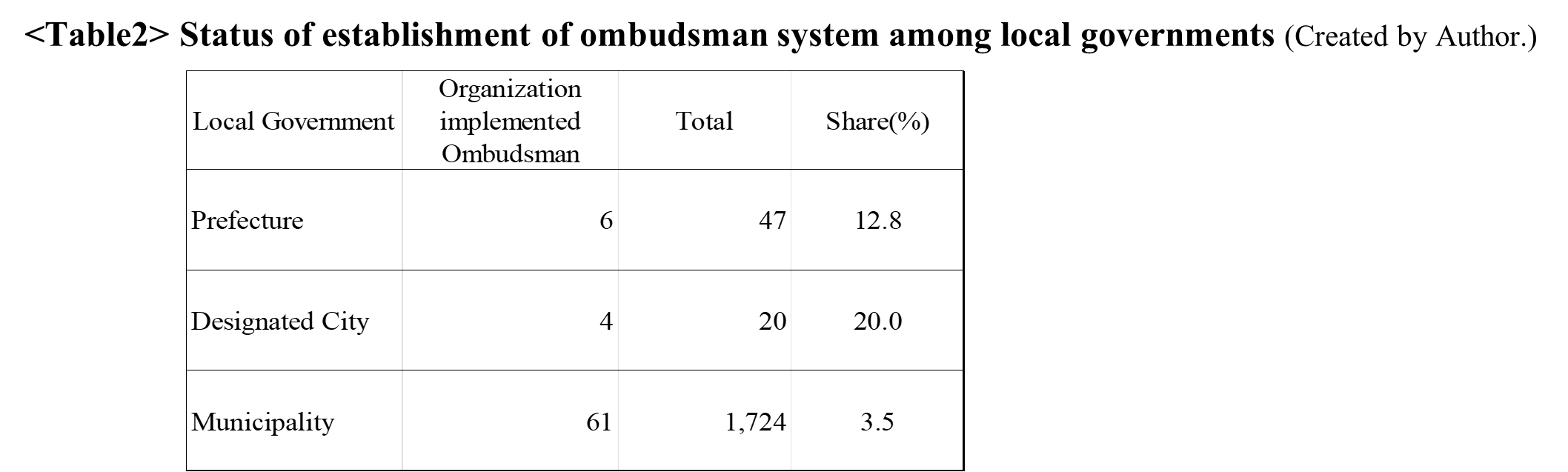
This limitation can be attributed to cultural factors that prioritize group cohesion over individual expression, as well as historical beliefs regarding government infallibility.
The role of the ombudsman in Japan is further complicated by the lack of national oversight and the challenges in securing competent personnel. Additionally, existing administrative bodies with similar functions pose competition for the establishment of ombudsmen.
The study concludes that while the ombudsman system has not spread significantly, it plays a crucial role in addressing administrative issues and enhancing citizen participation. The future of the ombudsman system in Japan hinges on recognizing its value in promoting administrative justice and ensuring the protection of citizens’ rights. In summary, the Japanese ombudsman system, despite its limitations, has the potential to evolve as a vital mechanism for administrative accountability and citizen engagement, particularly in an era marked by increasing complexity in governance and citizen demands.
Professor Shunsuke Kimura, PhD, is Professor and Dean of Graduate School of Global Governance, Meiji University, Tokyo, Japan. PhD(law) at Hitotsubashi Univ. After retiring from Ministry of Internal-Affairs, he has been working as a professor. He has been a Visiting Scholar at Lille Univ. in 2023 and at the University of Birmingham (INLOGOV) in 2025.
 INLOGOV Blog