How can the 21st century public servant survive an era of perma-austerity?

Catherine Mangan

We are launching the first theme from our 21st Century Public Servant project – the need to survive a seemingly unending period of austerity – to coincide with the Local Government Association conference, where austerity is a central theme.

Our research with local government and other public service delivery organisations found that ‘perma-austerity’ is both inhibiting and catalysing change, as organisations struggle to balance short-term cost-cutting and redundancies with a strategic vision for change.

In our interviews with people working in public service delivery and in national stakeholder organisations (more details on research design are here) some talked about the current ‘narrative of doom’ is preventing progress – some talked about a sense of loss and grief for the past; with organisations paralysed by the impact of the cuts, and unable to provide a new vision to work towards. As one put it, ‘No message of hope – leadership is putting council into survival mode by the language they’re using. Nobody is planning for post austerity.’ One interviewee spoke about the effect of losing large numbers of staff: ‘You hear the language of loss everywhere. I get affected by it.’

Although interviewees accepted that the financial context offered opportunities for doing things differently, some commented on the challenge of moving forward whilst dealing with the reality of the impact of large scale redundancies: ‘The cuts are forcing us to confront change. In public service, change doesn’t necessarily happen unless there is a crisis or a disaster, or it happens very slowly. But think tanks and consultancies can find it exciting, for them it’s a massive playground. We have to remind them that people are losing their jobs, services are being cut. There has to be a balance.’ Others commented that the enormity of the challenge needs to be recognized and responded to: ‘It’s not salami slicing because you wouldn’t have salami that big, it’s hacking things off. It’s about rethinking the role of the state in light of the changing economy, technology, the changing ways that people live their lives. The cuts are so big that we have to confront the questions we have been putting off: what is a library service, what is a leisure service?’

The biggest shift being driven by austerity is developing a different relationship with citizens: ‘We won’t have the money so we will have to focus on the enabling and facilitating, enabling the rest of community to do it.’ As one interviewee put it: ‘You can only get so far by being a supply side mechanic, cutting and slicing. You need a better sense of what your people are like, who they are, what their networks are, how they can do more not for themselves but how they can be more a part of the value that you create about what you do as a council.’

However another interviewee described the difficulties she encountered in reconciling the austerity agenda with more relational ways of working: ‘There is a complicated tension between the desire on the one hand for efficiency and rational processes versus the expectations and needs of customers which is more relational and focused on the personal and local. We are expected to do both, to move to the more relational in the government’s commitment to localisation and neighbourhoods. But elsewhere we are moving to customer relationship management and call centres. You phone or visit a call centre, pick up a ticket, it’s not a holistic relationship with the person on the other end of the phone.’

The 21st century public servant will have to ‘find a way through that knot’.

Portrait of OPM staff member

Catherine Mangan is a Senior Fellow at INLOGOV.  Her interests include public sector re-design, outcomes based commissioning and behaviour change.  Prior to joining INLOGOV she managed the organisational development and change work for a not-for-profit consultancy, specialising in supporting local government; and has also worked for the Local Government Association, and as Deputy Director of the County Councils Network.  She specialises in adult social care, children’s services and partnerships.

21st century public servant: the discussion phase

Catherine Needham

After nine months of researching the 21st Century Public Servant, we are today formally starting the discussion phase of the project. We have undertaken a literature review, we have spoken to over 40 people working in public services in public, private and voluntary sector bodies, and to national stakeholder organisations. From that we have identified key themes of what it means to be a 21st Century public servant which we will be blogging about over the next few months.

We begin this week with a focus on ‘perma-austerity’ which is the key contextual factor for public services, and a major theme at this week’s Local Government Association conference. As well as sharing the findings of our research we will have guest blogs from people working in and close to public services about ways to address the challenges of austerity.

A clear finding from the interviews we’ve done is that there is no unified vision of the future of public services and the people who work to deliver them. The future will be messy and tentative, with paradoxes being managed and lived with rather than solved. In the same spirit we don’t feel we have come up with the answers in this project, but rather with a series of themes that we want to test out with you. If you feel inspired to blog or comment that’s great.

We will be discussing the themes at the IPPR today, beginning a series of project events. You can also come along to the Inlogov stall at the LGA conference to find out more.

needham-catherine2

Catherine Needham is Reader in Public Policy and Public Management at the Health Services Management Centre, University of Birmingham, and is developing research around public service reform and policy innovation. Her recent work has focused on co-production and personalization, examining how those approaches are interpreted and applied in frontline practice. Her most recent book, published by the Policy Press in 2011, is entitled, Personalising Public Services: Understanding the Personalisation Narrative. Follow Catherine on Twitter: @DrCNeedham.

The Great NHS Robbery – and the great fraud headline con

Chris Game

Some social phenomena are exceptionally tricky to measure: the black economy, white-collar crime, illegal immigration.  So when someone claims to have done so, no matter how flaky their findings, they attract huge, and largely uncritical, media attention. Like last week’s excitement about the scale of NHS fraud.

The catalyst was a Panorama programmeThe Great NHS Robbery – that needed some pre-transmission headlines. The programme consisted mainly of specific cases of GPs, dentists, pharmacists, private contractors and suppliers who’d been found guilty of defrauding the NHS. It alleged that the Government’s official NHS fraud figure of £229 million p.a. is a huge under-count or under-estimate, and suggested that, having cut the staffing and budgets of NHS Protect and other fraud investigators, the Government was turning a proverbial blind eye to the scale of the problem, especially by comparison with the increased resources it allocated to the detection of the much smaller quantum of benefit fraud.

Old cases and political sniping, however, don’t make major headlines. What Panorama needed were some seriously big and scary figures, and fortunately there were some to hand – just down the M3 at the University of Portsmouth’s Centre for Counter Fraud Studies (CCFS). By happy coincidence, the CCFS was about to co-publish, on the very same day as the first showing of The Great NHS Robbery, a report analysing, as the programme put it, “the most rigorous data on health care fraud in the world”, and containing some “staggering” findings for the NHS.

The BBC had its headlines“NHS fraud and error costing the UK £7 billion a year” – and Panorama had its audience. Other contemporaneous media headlines were all apparently taken either from the BBC’s plug story or the programme itself. Some were fractionally more cautious, like The Guardian’s “NHS fraud could be as high as £5 billion a year, says former health service official”; others less, like the Nursing Times“Fraud costs NHS £7 billion – enough to pay for 250,000 nurses”.

None of the authors, it seemed, went to the CCFS report to check how the loss figures were arrived at and what they represented – possibly imagining that a global report on such a complex and technical topic, representing the product of several years’ research, would be vast, probably undownloadable, and incomprehensible to the average reader.

Interestingly, though, it’s none of these things. The Financial Cost of Healthcare Fraud 2014: What data from around the world shows runs to just 16 pages, including the two covers. The rest comprises: Contents, Foreword, three prefaces, three pages about the authors and publishers, a full-page picture, a blank page … and a 4½-page ‘report’. There are no “data from around the world”, so, even with the glossy pictures, you could, if you wished, download it in about a second.

However, to save you having to plough through all 4½ pages yourselves, let me take you through the methodology step by step.

1.  Do a literature review of the 92 studies of healthcare fraud and error losses that you’re  able to find that have been undertaken since 1997 – not ‘globally’, but in languages you can understand: the UK, US, France, Belgium, the Netherlands and New Zealand;

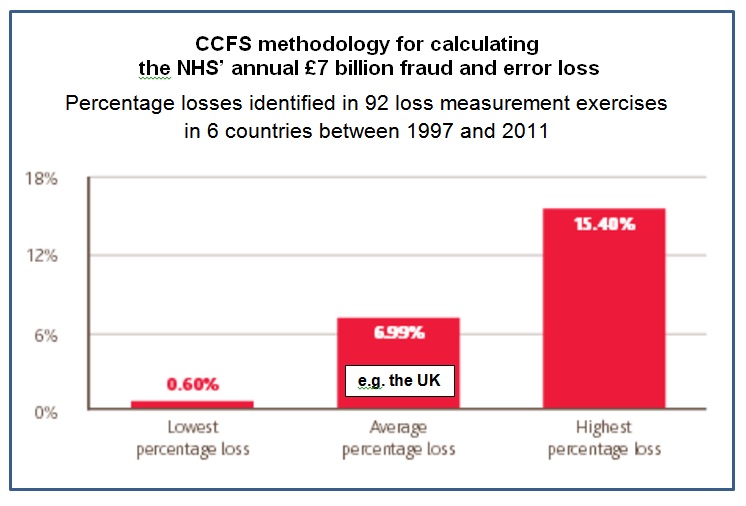
2.  Don’t worry about the studies being in numerous completely different areas of health care, but average out the quoted financial loss figures in all 92 studies and cite that average with real authoritative precision – i.e. not 7%, but 6.99% – because, remember, these have to look like “the most rigorous data on health care fraud in the world”;

3.  Globalise your ‘research’ by finding a figure for global healthcare expenditure for some recent year (no, not ‘global’ as in your six countries, but really global) – say, $6.97 trillion for 2011 (or £4.48 trillion) – and again don’t worry about whether they’re US or International $$ or what the figure actually represents, for this is one of those footnote- and reference-free reports;

4.  Divide (3) by (2), and again state the sum with great precision: that this shows that £313 billion is being lost by the world’s healthcare services each year – or 25% more than when you last did the sum in 2008;

5.  Guess – because you’ve apparently no evidence one way or the other – that the financial integrity of the NHS is probably about average for the six countries you’ve studied, and assert that it is therefore losing 7% of expenditure each year – or £7 billion out of its roughly £100 billion total – in ‘fraud and error’, making sure, of course, that you emphasise the fraud bit.

6.  Add a little diagram, as shown below with the addition of my clarification of where the UK figure comes from.

game graph

I must confess at this point to having misled you a little. I mentioned that the report contains no “data from around the world”, and indeed there are no figures for the UK or any other individual country.  The £7 billion came in the Panorama programme, from one of the report’s two principal authors, Jim Gee. Gee is the former health service official referred to The Guardian’s headline: former CEO of the NHS Counter Fraud Service and now Director of Counter Fraud Services at BDO LLP – not, sadly, the British Darts Organisation, but Binder, Dijker, Otte and Co., an accountancy firm specialising in anti-fraud services – and Chair of the CCFS at the University of Portsmouth. Gee left it to the programme’s presenter to add that “he puts more than £5 billion of that £7 billion down to fraud, rather than financial error” – which explains the other part of The Guardian’s headline.

Though certainly not on the same scale as its undercover filming of LSE students in North Korea, Panorama’s decision to rest the central argument of this programme on such flaky statistics, produced at least in part to further the interests of a self-promoting business services company, seems to me another clear editorial misjudgement. Certainly it irritated me when I pieced together the above account and realised that in effect I’d been conned.

Much more importantly, though, it must in anything other than the short term undermine, rather than substantiate, the key points the programme was seeking to make: that the way the Department of Health currently measures and estimates NHS fraud is grossly inadequate and damagingly misleading; that governments, and this Government in particular, see it in their interests to under-record the scale of fraud (and financial error, for that matter); and that more, rather than less, funding should be being invested in fraud detection and inspection services.

The sad truth is that Panorama seized on CCFS/BDO’s £5 to £7 billion because there was nothing better or more accurate available. Jim Gee’s ‘methodology’ suggests to me that he’s probably underestimating global healthcare financial losses and overestimating those of the NHS, but neither I nor the Government have any way of officially demonstrating it. Nor is there any likelihood of the Government, since it is substantially in denial, embarking on a programme to reduce the losses by up to the 40% within 12 months that Gee, wearing his BDO hat, considers feasible. I doubt if many others agree, but, to adapt the proverb: in the land of the dataless, the one-figure man is king.

game

Chris Game is a Visiting Lecturer at INLOGOV interested in the politics of local government; local elections, electoral reform and other electoral behaviour; party politics; political leadership and management; member-officer relations; central-local relations; use of consumer and opinion research in local government; the modernisation agenda and the implementation of executive local government.

When will they ever learn?

Catherine Staite

The news of the death of Pete Seeger has reminded me again of his old song ‘Where have all the flowers gone?’ The line ‘oh when will they ever learn?’ has been running through my head since I saw an item on the local news about police officers and mental health professionals working together to prevent people with mental health problems ending up in police cells for want of the right support. ‘Good stuff!’ you might think.  Indeed it is  – but it is also profoundly depressing to hear such a venture being reported as ‘new’.

In 1993 I led a multi-agency, multi-disciplinary team, which diverted people with mental health problems and learning disabilities from custody.  The team included all the right skills and necessary statutory powers – a specialist social worker, two community psychiatric nurses, a senior probation officer and a police inspector.  We had the backing of all the chief officers and the team went wherever they were needed, the police station, the bridewell below the magistrates court and the remand and hospital wings of the local prison.

The approach was simple but effective. By bringing the right skills into the system at the right time, we were often able to help get the right decisions and find the right services. Within a year, the prison hospital wing was no longer full of prisoners with mental illness and learning disabilities. This was a time when the local mental hospital was being run down for closure, so it was no small feat. Of course, some of our clients were very disturbed and a small number were dangerous, or had committed very serious offences so they had to stay in prison or be moved to a secure hospital but at least we knew who they were and where they were.  We advocated for them. They were not dumped and forgotten.

We shared our learning and even wrote a book about our approach which was replicated and adapted all over the country. It was cheap and effective because it made better collective use of existing individual professional skills, capacity and powers and partner agencies’ budgets.  It was about reducing demand, reducing costs and reducing re-offending – but most of all it was about reducing risk and suffering.

‘What’s not to like?’ you might ask and you’d be right but, somehow or other, twenty years later, police officers and mental health nurses are re-embarking on the same journey. Is it because mental health services are still the “Cinderella’ – and their budgets have been cut even when the rest of the NHS has had increases in funding? Is it because we are still so ignorant and fearful about mental illness? Or is it because innovation is generated by enthusiasts on short-term funding so it doesn’t get mainstreamed or embedded? Perhaps it is all of the above.

Whatever the reason, our collective inability to use the available evidence to guide our thinking and to take shared professional and organizational responsibility for public policy challenges means we are doomed to keep making the same mistakes.

When will we ever learn?

Catherine Staite

Catherine Staite is the Director of INLOGOV. She provides consultancy and facilitation to local authorities and their partners, on a wide range of issues including on improving outcomes, efficiency, partnership working, strategic planning and organisational development, including integration of services and functions.

Crime on the high street goes missing

John Raine

For almost two decades now the statistics for recorded crime in England and Wales have been falling.  And even though there has always been a difference, of some magnitude, between the numbers gathered through the British Crime Survey – a large-scale sample of the public’s experiences of crime victimisation – and the (persistently smaller) statistics compiled by the police, there has been broad agreement at least in the downward trend.

No doubt this has given much cause for encouragement within government, particularly in these recent years of economic recession when most criminologists had been predicting a reversal in the trend – at least for acquisitive crime.   The official statistics suggest this has simply not happened.  But have we been seeing the whole picture, it must be asked?

Probably not, would be one conclusion to be drawn from a recent report from the British Retail Consortium (BRC) – a report that draws attention to the considerable scale and growth of crime on our High Streets.  The statistics (annually collected by BRC) and were based on surveys of just thirty retailing organisations.  But they were among the largest such enterprises, together accounting for just over half of national retail turnover.  They show 2012/13 to have experienced among the highest levels of shop-theft for nine years, with a total of more than 631,000 such incidents recorded, and at a cost to the retail industry of around £511 million last year.

But then come the most surprising revelations – that just 9 per cent of these crime incidents were ever reported to the police, and that the reporting rate here was 12 per cent lower than in the preceding year, 2011-12.  Here then, appears to be a very different perspective on crime in Britain in a recessionary period.  Certainly the low reporting rate to the police indicates that the official crime statistics miss a significant proportion of acquisitive crime, and the suggestion in the report is that the main reason lies in diminishing confidence in the police to respond.

This latter point, of course, is hardly new – the British Crime Survey has consistently found high levels of non-reporting of petty crime to be due to lack of public confidence in the police to respond, still less to be able to apprehend the offender and recover any lost property.  For most people, we are told, the main value in reporting property crime to the police is to obtain a crime number to assist with an insurance claim.

But what of the situation on the High Street?  As well as arguing for improvements in the reporting and recording of shop-thefts and other retail crime, and for better law enforcement (from reporting through to prosecution), the BRC report presses the case for a more concerted focus on business crime by local police forces.  In this respect it is interesting to note from our own research here at the University of Birmingham that an analysis of the Police and Crime Plans – the statutory strategy documents produced last year by each Police and Crime Commissioner, and which establish the priorities for policing locally over a five year period – revealed that, while almost all included generalised commitments towards the reduction and prevention of crime, specific reference to High Street crime, or to initiatives to address the problems identified in the BRC report, were few and far between. Similarly, it was notable that, while around one in three of the Plans established the improvement of public confidence in policing as a priority to be addressed, very few references were to be found to the extremely low level of confidence in police responsiveness among retailers.

In light of this report, perhaps some further reflection is called for, both on our perspectives about crime trends and on the priorities for policing.

john raine

John Raine is Professor of Management in Criminal Justice at INLOGOV. He has been involved in criminal justice research, consultancy and teaching at Birmingham for some twenty-five years and has a strong track record of commissions for the Home Office, Lord Chancellor’s Department/Department for Constitutional Affairs/Ministry of Justice on aspects of policy and practice within the criminal (and civil) justice sectors.