A new response to the ‘jaws of doom’

Catherine Staite responds to Local Government Chronicle’s anonymous ‘Insider’ columnist about the ‘jaws of doom’ and INLOGOV’s New Model of Public Services.

Dear Secret Chief Executive

I’m so sorry to hear you are having such a miserable time.  Leading in difficult times really does take it out of you. However, this isn’t like you – so buck up.  If you give way to despair, how will your staff cope?

You describe an impossible conundrum.  You have rising demands and falling resources – otherwise known as the ‘jaws of doom’.  You know that the solutions of the past aren’t going to solve the problems of the present or the future.  You need some new thinking.  The good news is that there is a lot of it available and much of it is pretty much free.

At INLOGOV, we’ve developed a model that you can use to re-think the way you meet your challenges. We’ve tested the model with many of your chief executive colleagues who’ve shared their time, insights and inspiration with us so we can offer something useful to you.  Our book ‘Making sense of the future: do we need a new model of public services?’ is available to download on our website. There are chapters on building better relationships, behaviour change and demand management, co-production and risk and resilience.  Chapters on collaboration and integration and on income generation will be added shortly.  The book is a gift from us to you.

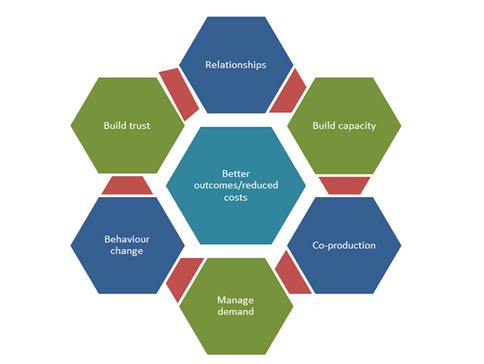
In brief – here’s some of our thinking. You operate in a whole system. Changing the way you think and operate in one part of the system will have impacts elsewhere.  The old thinking – a focus on the deficits of individuals and communities, which placed councils and their partners in relationships of power over communities – doesn’t work anymore.  There isn’t enough money to be all things to all people  and perhaps it isn’t good to try to be.

staite 1

Here are some questions you might ask yourself:

  • Are we clear what the Council is for?  Do we know what we must do, what only we can do and what could be done as well or better by others?
  • Is political and officer leadership aligned and focused on shared ambitions? Can anyone I meet in the corridor tell me what those ambitions are? Now ask a few people in the street what matters to them and see if there is a strong match.
  • Do we have strong relationships with our communities? If not – what can be done to foster better relationships?
  • Are our services building confidence, capacity and resilience – or perpetuating  dependency?
  • Do we encourage and support co-production? Could our residents do more for themselves and others? Do we make the best use of volunteering to enhance lives and maintain services e.g. libraries, in our communities?
  • How do we recognise and build capacity in individuals and communities?
  • Do we understand the pattern of demand? Have we managed out waste and the demand  which is driven by service and communication failure, not need?
  • Do we invest in early intervention and prevention?
  • Do we understand how we need to change perceptions and influence behaviour to improve lives and deliver better outcomes?
  • Are we maximising income and using prudential borrowing as leverage for income generation and growth?

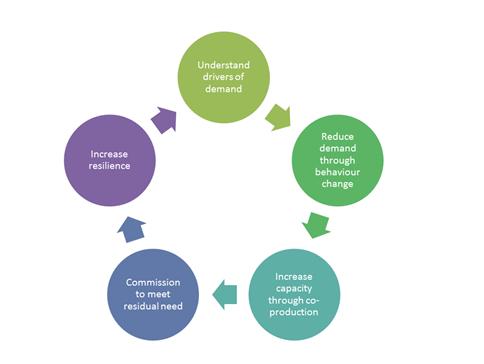
You might  think about creating a virtuous circle like this:

staite 2

If you can sew braid onto your daughter’s skirt, then the people you serve can also make a contribution to their own welfare and that of others.  Give them access to braid and sewing lessons and then let them adapt their own metaphorical skirts. If you can do it – so can they.

Catherine Staite

Catherine Staite is the Director of INLOGOV. She provides consultancy and facilitation to local authorities and their partners, on a wide range of issues including on improving outcomes, efficiency, partnership working, strategic planning and organisational development, including integration of services and functions.

This post was originally featured in Local Government Chronicle, September 2013.

The role of social value outcomes in commissioning services

William Jabang

A contract culture has become widespread in public services, but the question often asked is: is ‘price’ alone a satisfactory mechanism for deciding what is done and by whom? The very meaning of ‘value’ has been dominated by the notion of price. In many organisational settings, price is seen as the most obvious way of gauging contract performance, as well as the means by which to judge efficiency.

However, many have questioned this approach and successive governments have sought to widen the debate by bringing forward policies that go beyond price as a mechanism for deciding what has to be done and how. This could be best illustrated by the ‘Best Value’ regime that emerged in the latter part of the twentieth century and still places a duty upon public services to seek best value – where price alone is seen as restrictive in ensuring that services match with what the public actually wants and needs.

This has brought with it certain difficulties and challenges that many public sector managers and elected members have experienced. However, the search goes on for policies and legislative instruments that help bring the public’s needs and requirements closer to an institutional decision-making mechanism that looks beyond price to ensure that what the public value is in line with what they get. Few citizens take the time to investigate the actual cost (in price terms alone) of contracts that are led by public bodies. Eric Pickles took the lead in expressing his desire to have an ‘army of armchair auditors’ scrutinising the books of public bodies after the 2010 General Election, though little evidence beyond the activity of the Tax Payers’ Alliance exists to support this desire.

Many public service managers will have been exposed to the debate introduced by Mark Moore some years ago on the concept of ‘Public Value’ – an interesting line of thinking that has occupied academics for some years now. The next step in this journey has now been taken. On 31st January 2013, the Public Services (Social Value) Act came into force in Engaldn and Wales (although its application to Wales is limited). The Act provides a new statutory requirement for public authorities to consider the economic, social and environmental wellbeing of the local area when commissioning or procuring services.

Consideration of social value is generally not promoted in the existing design, process and delivery of procurement. A recent survey carried out by Guardian Professional indicates that many procurement and commissioning staff feel they don’t even have the skills and training needed to carry out social value commissioning and procurement effectively.

Given the relatively short time for which the Act has been in place, it could be argued that it is too early to assess its full impact on procurement design, process and delivery. However, an appraisal of the level of awareness and degree of implementation of the Act by the public and voluntary/community sector could be important, providing a useful pointer to the potential effectiveness of the Act and the outcomes it could deliver.

In view of this, INLOGOV is working together with the Society of Procurement Officers (SOPO), the National Association for Voluntary and Community Action (NAVCA) and the Association of Chief Executives of Voluntary Organisations (ACEVO) to carry out a survey. The survey aims to:

  1. Examine the awareness and perception of the Public Services (Social Value) Act 2012
  2. Identify changes (if any) which organisations are making as a result of the Act
  3. Establish whether or not the Act has opened up (or is likely to open up) more contract opportunities for voluntary, community and social enterprise organisations (VCSEs)
  4. Establish whether cost is a deterrent to pursuing social value outcomes.

We would appreciate it if you could provide us with your views by completing one of our survey questionnaires. The survey findings will be published jointly by the four organisations named above. It is the aim of the researching organisations that the information from this survey will help to improve existing practice and will enhance the sharing of knowledge between organisations.

The survey is likely to take approximately 15-20 minutes and all information provided will be held in strict confidence – and will be recorded and stored in accordance with the Data Protection Act 1998.

Please click to complete either the Voluntary, Community and Social Enterprise organisations questionnaire; or the Public Sector/NHS organisations questionnaire.

Thank you for taking part.

William Jabang is a Doctoral Researcher at INLOGOV. His PhD research is focused on commissioning and procuring social value.

Fracking: the latest challenge in the Tory heartlands

Martin  Stott

The hot days of July finally saw the debates around the implications of ‘fracking’ of unconventional hydro-carbons in the UK reach out and grab the attention of the national media. As Tory grandee Lord Howell called for the process to be focussed on the ‘desolate North’ (he corrected the initial impression that he was referring to the North East by saying that he really meant the North West) and  Energy Minister Michael Fallon was reported in the Mail on Sunday as warning that fracking was likely to face fierce resistance from the middle classes in Conservative heartlands, as if to prove his point dozens of protesters were arrested at an exploratory drilling site near the village of Balcombe in West Sussex.

Hydraulic fracturing or fracking – the process of drilling and then injecting fluid into the ground at high pressure to  fracture shale rocks to release natural gas, has caused a revolution in energy policy in the USA where gas prices have dropped dramatically as gas from fracking particularly in North Dakota, and more controversially Pennsylvania, has come on stream. Coal has suddenly seemed a dirty and expensive option and as a consequence carbon emissions from the world’s biggest economy have dropped significantly.

Can the trick be repeated in the UK? The Coalition Government is betting the farm –  quite a  few farms actually – that it can. Chancellor George Osborne announced in this year’s Budget that fracking companies would receive tax allowances for developing gas fields and would be able to offset expenditure on exploration against tax for ten years.The next tax avoidance scandal perhaps. Best known and a pioneer in the field is Cuadrilla (referred to by some opponents as ‘Godzilla’) whose explorations in Lancashire have amongst other things led to a couple of minor earthquakes near Blackpool in April and May 2011. But there are quite a few other companies across the country as the official estimate for UK reserves is 37 trillion cubic metres of shale gas in the north of England and geologists have yet to quantify reserves in the south.

But it is Balcombe in rural West Sussex which is becoming the test bed for what this means for energy experts, planners, campaigners and politicians. Campaign group Don’t Frack with the Fylde certainly raised the issues and those earthquakes, 1.5 and 2.3 in magnitude respectively, shook confidence in the safety of the technology (let’s face it: who notices in North Dakota where the  nearest house is 60 miles away?) but the opposition in southern England is having a greater impact on politicians and opinion formers. The Mail on Sunday’s  report of Sevenoaks MP Michael Fallon’s private briefing on fracking reported him as saying of potential well-heeled protesters ‘We are going to see how thick their rectory walls are, whether they like the flaring at the end of the drive.’ He admitted that exploratory drilling was likely to spread the length and breadth of southern England saying ‘The second area [after the North West] being studied is the Weald. It’s from Dorset all the way along through Hampshire, Sussex… all the way a bit into Surrey and even into my own county of Kent.’

This focus on the lusher parts of the South East which has started at Balcombe is going to be a real concern for Conservative strategists. The ‘Noting Hill set’ has repeatedly been accused of ignoring its rural base as proposals ranging from the sell-off of forests, to wind farm policies, changes in planning laws, opposition to which has been championed by the Daily Telegraph, and the HS2 rail route through the Chilterns have all been seen as a slap in the face for this rural base, many of whom have gravitated towards UKIP. But the Greens too have a presence in the South East, with their charismatic MP Caroline Lucas representing a Sussex seat, an MEP for the region and their only council, Brighton and Hove, only a few miles away.

Meanwhile up in Whitehall, the Department for Communities and Local Government has been ruminating on what to do about the planning and land use implications of promoting the fracking revolution and on 19 July it spoke,  issuing guidance  to local planning authorities. The guidance stresses that fracking could be a vital source of energy, saying ‘Mineral extraction is essential to local and national economies… minerals planning authorities should give great weight to the benefits of minerals extraction including to the economy when determining planning applications.’ It goes on to explicitly exclude any attempts by planning authorities to trade off fracking with renewable developments saying, ‘Mineral planning authorities should not consider  demand for or consider alternatives to oil and gas resources when  determining planning applications.’ Because of the scale and strategic nature of minerals planning applications these have remained a planning function of county councils, still Tory controlled in southern England.

It  remains to be seen if DCLG will allow a level of discretion in determining these applications by county planning authorities which could well limit or even stop fracking in its tracks in the south, or whether  as would be possible using potential secondary legislation  under the Growth and Infrastructure Act, it could take applications for  fracking for shale gas  out of the hands of county councils and instead have them decided by the Secretary of State as  part of the regime for nationally significant infrastructure projects. On the one hand it could bow to Tory pressure in the shires and allow all the developments to happen ‘up north’ by default as counties refuse most if not all applications. On the other, it may decide to take the risk, strip counties of their power and pull shale gas development permissions back into Whitehall. Only time, and a bit of local politics in the home counties, will tell.

stott

Martin Stott joined INLOGOV as an Associate in 2012 after a 25 year career in local government. He is National Policy Adviser on minerals planning for the Royal Town Planning Institute.

Dr Foster’s day out in the sun: the use and abuse of hospital mortality rates

Chris Game

It was an odd happenstance that Dr Foster – a gentleman best known for his rain-ruined, nursery rhyme expedition to Gloucester – should have his proverbial 15 minutes of contemporary news fame in the middle of last week’s heat wave.

The unfortunate doctor, you may recall, went to Gloucester in a shower of rain. Ignoring the truly excruciating rhyme ahead, he stepped in a puddle, right up to his middle, and never went there again.

The news to which this doggerel relates is, of course, allegedly failing hospital trusts, and specifically Hospital Standardised Mortality Ratios (HSMRs) – the widely used measures of hospital death rates developed, publicised, defended and refined by today’s equally fictional Dr Foster.

The doctor and his HSMRs took rather a beating in last week’s report by Prof Sir Bruce Keogh, National Medical Director for the NHS in England: “However tempting it may be, it is clinically meaningless and academically reckless to use such statistical measures to quantify actual numbers of avoidable deaths” (p.5).

Strong words, and justified – because this is precisely what had happened the previous weekend, with numerous media claims that the report would be about 13,000 ‘needless deaths’ at the 14 NHS hospitals selected, because of their high mortality rates, for special investigation. It wasn’t.  The report contained no such numbers, and instead provided detailed, focused recommendations to assist the improvement of the hospitals’ serious but not irremediable problems.

Sir Bruce’s report had been calculatedly hijacked, but who he held chiefly responsible – Ministers and their advisers, the media, even some collusive involvement of Dr F himself – was unclear. The outcome, sadly, was unmistakeably clear. Health Secretary Jeremy Hunt’s parliamentary presentation of the report became a shameful partisan blame-fest – so depressing for so important a topic that, as a completely non-expert observer but low-key Dr Foster fan, I was moved to attack my keyboard.

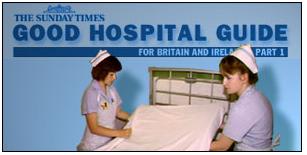
I remember well my own first encounter with Dr Foster in January 2001.  I was teaching a course here at Birmingham University on policy research methods, and in, of all places, a two-part Sunday Times supplement, there appeared some near-perfect raw material for a student assignment: the first ever listing of standardised ‘death rates’ (HSMRs) for England’s or any other nation’s hospitals.

game

So what, my students discussed, were these ‘metrics’, and what did they really measure?  What did they include, and exclude?  Who’d collected and analysed the data? How did they relate to other possible measures of a hospital’s care and performance? What was the range, and where were the highest and lowest ratios – that ‘Where?’ question providing an additional reason for my recalling that first Dr Foster’s Good Hospital Guide.

A hospital’s Standardised Mortality Ratio is usually presented as a percentage: the recorded deaths in hospital from most (but not all) diseases, as a percentage of the number that would normally be expected, after taking account of, or standardising for, a wide range of factors concerning the patients and the nature and severity of their illnesses.

HSMRs’ other key feature, consistently misunderstood, is that they measure hospitals not against some objective clinical standard, but against each other. An HSMR of 100 is the national average; below 100 means fewer deaths than statistically expected; over 100 means more. Not needless, preventable or avoidable deaths, not deaths from incompetent care, simply more than statistically expected. Even if all hospitals were good, half would still have ratios of 100+ and look ‘bad’ – and vice versa.

The Dr Foster Guides and website emphasise these points scrupulously. A high HSMR should be treated as a warning: a risk, but not proof, of failings in care, and reason for further investigation, with attention focusing mainly on ‘outliers’ – those outside, especially if repeatedly outside, the normal range. University Hospitals Birmingham NHS Foundation Trust’s HSMRs, though consistently over 100, are thus less immediately concerning than the 130+ ratios of Basildon & Thurrock (2005-09) and Mid Staffordshire (2005-07).

However, as Sir Brian Keogh noted, in the dash for political advantage or media headlines, the temptation to elbow aside these literally health warnings is powerful indeed. So, although those first hospital ratios weren’t listed in league table format, they were quickly sorted into one and the range calculated.

It was wide and, although all mortality rates have fallen significantly in the past decade – and, of course, the HSMR baseline adjusted accordingly – it remains so today. Then, University College London Hospitals had the lowest ratio of 68, and most of the low ratios were in London and the South-East. But two of the three highest were on our proverbial doorstep in the West Midlands: Walsall Hospitals Trust with 119 and Sandwell with 117.

My recollection is that these hospitals and trusts, not to mention their patients, had little advance notification of their figures. Certainly, there were widespread protests – by those assuming that, if this was a ‘Good Hospital Guide’, high-ratio hospitals must be ‘bad’. However, despite their susceptibility to such misinterpretation, HSMRs were here to stay. Which begged the obvious question: who was this pioneering but troublesome Dr Foster?

As already indicated, there is no actual Dr Foster. The name was the whimsical invention of two journalists involved in producing the 2001 Sunday Times supplements. But, if there were a real doctor, the only possible candidate is someone you may well have seen recently on your TV screens, Professor Sir Brian Jarman.

A one-time GP who by the 1990s had become a distinguished Imperial College academic, he developed the ‘Jarman Index’ – a formula for distributing government funding to the nation’s hospitals – which gradually evolved into the HSMR, a formula for identifying a hospital’s share of responsibility for its death rates. It was a major statistical advance, but the then Health Secretary was nervous and refused Jarman permission to publish individual hospitals’ HSMRs.

He took his stats, therefore, to two journalists rather more committed to the idea that transparent, debatable research findings and more informed patients had key roles to play in improving health care: the Sunday Times’ Tim Kelsey and the Financial Times’ Roger Taylor. The outcomes were swift and far-reaching: the first of the now annual Dr Foster Good Hospital Guides, and Dr Foster Intelligence – an initially private company that since 2006 has been half-owned by the Department of Health (another controversial development) and is today an internationally renowned provider of healthcare information.

And the drivers of almost all this growth, and indeed of the career progression of the key actors, have been HSMRs – which might surprise some of my 2001 students, who had no difficulty identifying what they saw as potential weaknesses.

Yes, HSMRs are a purely statistical exercise – no visits, inspections, interviews or case notes. Yes, if the indicators in the formula change, so too could the ratios. Yes, they record only in-hospital deaths, and not even all of them. Yes, they surely could be manipulated – by discharging terminally ill patients into hospices or ‘the community’, or (as three West Midlands trusts were later accused of doing) by stretching the ‘admitted for palliative care’ code and thereby raising the expected death rate. And yes, it does seem a rather blunt way of measuring quality of care – or indeed the overall performance of a large hospital.

To their credit, many hospitals’ response to a high HSMR has been to work with the Dr Foster team, to try to understand better the causes and thereby bring the ratio down. Walsall, for example, reduced its HSMR in five successive years, down to 103 by 2005/06.

There have also, though, been continuous criticisms of both HSMR methodology and interpretation – from health care professionals, the media and academia – particularly after 2007, when some of Dr Foster’s statistical ratios contradicted the inspection-based assessments of the Care Quality Commission.

There followed the first Francis Inquiry into the Mid Staffordshire NHS Foundation Trust, and with it the development and official approval of a new, more comprehensive mortality measure – the Summary Hospital-level Mortality Indicator (SHMI) – covering all, instead of most, in-hospital patient deaths, plus those occurring up to 30 days after discharge from hospital.

The two measures sound similar, and frequently they produce broadly similar results, as shown in the 2012 Dr Foster Guide. Birmingham’s HSMR is 112, its SHMI 105; Sandwell & West Birmingham 99 and 97; Coventry & Warwickshire 103 and 107; Walsall 117 and 113; Royal Wolverhampton 100 and 103.

But they can differ significantly – and did for several of the 14 trusts investigated in the Keogh Report. You might think that the Government, having finally found in SHMIs a more comprehensive mortality measure than HSMRs, which most statisticians and clinicians seem to accept as more reliable, would use it to select the hospital trusts it wished to have investigated.

Wrong!  The supposedly failing trusts were picked because of being high ‘outliers’ for two consecutive years (2010/11 and 2011/12) on either of the two measures. So Tameside and Basildon/Thurrock, for example, were included apparently because of their higher than expected SHMIs, but Burton and Sherwood because of higher than expected HSMRs.

We’re into circumstantial evidence here. But, suppose you were a Government keen to rubbish Labour’s NHS record and frighten patients and electors into viewing further privatisation more favourably. It surely wouldn’t seem a bad tactic to maximise the number of allegedly  failing ‘killer’ hospitals – 14 is nearly one in 10 of England’s acute hospital trusts – and feed the media scare stories about thousands of ‘avoidable’ deaths. Or has my imagination run away with me?

game

Chris Game is a Visiting Lecturer at INLOGOV interested in the politics of local government; local elections, electoral reform and other electoral behaviour; party politics; political leadership and management; member-officer relations; central-local relations; use of consumer and opinion research in local government; the modernisation agenda and the implementation of executive local government.
The role of the third sector in delivering public services: what we know and what we’d like to know

James Rees

Inlogov and TSRC recently held a stimulating and well attended seminar involving guests from University of Illinois at Chicago. It was a great opportunity to share knowledge on the role of third sector organisations in public services, and to compare the ways in which there are similarities facing TSOs in both the US and UK.

But as so often it begged many questions as well and I want to reflect a bit on both the state of what we know and what we ought to know about the third sector’s role in delivering public services (in the UK!).

When I talk to people about the research that I do, the usual response is “what on earth is the third sector?” followed by “do they really deliver public services?” I’ll come back to the first question but the second is certainly very interesting.

There is a very long history to the involvement of what we now call the third sector in meeting welfare needs and providing services. Many are aware of early charitable and philanthropic action in the 19th century (Barnardo’s, RNIB and RSPCA for example); there was an explosion of mutual, co-operative and associations in the early industrial period; and before the dawn of the welfare state many health services were provided in voluntary hospitals that worked in partnership with local government.

Pete Alcock pointed out how these forms of the third sector had waxed and waned in response to political and economic change, leading right up to the 1980s Conservative interest in the third sector as alternative providers, the influence of New Public Management, and New Labour’s commitment to ‘partnership’ with the sector, written into a Compact.

In my discussion I suggested that it was useful to look at different levels or ‘strata’ of the third sector in relation to service delivery.

There are the big national charities (for example Barnardo’s, NSPCC, RNIB and the Salvation Army). It’s probably fair to say that the public perceive that these organisations rely on donations and fundraising, but they also hold very significant contracts to deliver services. For example Barnardo’s and Family Action run ‘Sure Start’ Childrens Centres. Action for Blind People, part of the RNIB Group, deliver a number of publically funded services to people with sight loss including schools, supported housing, and tailored health services within the NHS. This of course is only a tiny snapshot of what is by far the most visible part of the sector.

All of the mentioned organisations, and many more of varying sizes, large, medium and tiny, are involved in the Government’s controversial Work Programme, which aims to help benefit recipients into sustained employment. Our recent research drew attention to the difficulties charities were facing in terms of the strictures of the payments system, the lack of resources, and the prevalence of perverse ‘creaming and parking’ behaviour.

The work programme experience shows how public service delivery can be controversial and risky for charities, both financially and reputationally. But the costs are balanced by the opportunities contracts provide for charities to lobby government (where involvement can equal ‘insider status’ and credibility); and many charities argue it is consistent with their mission to bring their expertise to bear to improve services for their own client groups.

In my view there is a ‘missing middle’ as far the third sector and its role in public services is concerned. Missing only in the sense that we know less about it and there is a huge variety of experience so it is difficult to make generalisations about what is happening at this level.

Many organisations are much smaller than the ones mentioned above and tend to operate at the level of a region like the north-west, across a small number of local authorities, or even within a neighbourhood. They might have contracts with a local authority or a PCT (soon to be a CCG), and this part of the sector delivers a bewildering range of services.

We have been studying just these sorts of organisations as part of current research into public sector commissioning of the third sector. I have been struck firstly by the immense variety exhibited by organisations at this level, in terms of the types of services that they provide, their size and scope of operation, and seeming difference in their ethos, culture and degree of professionalism.

Secondly I have been struck by how vulnerable some seem to apparent threats in the current environment, most obviously loss of existing contracts and grants as a result of (mainly local authority) cuts, but also the possibility of competition from other TSOs and private sector organisations, and a wider sense of uncertainty, verging on fear.

Perhaps in some sense this is par for the course for the sector, and no organisation has a special right to exist. But I do wonder if we fully understand and value what might be lost if we start to lose these organisations in any great number, as they undoubtedly play an important role for many communities and individuals.

Finally, TSRC has done a great deal of research on organisations ‘below the radar’. Arguably again little is really known about how grassroots groups might interact with public services, enhance them, or what impact austerity might have on this vast ‘ecosystem’ of organisations. Much the same can be said about the important role of volunteers in public services. At the same time there is growing interest in how small community groups can be part of the co-production of public services.

Back to that first question: what on earth is the third sector? As soon as we start talking about different levels of the third sector, the huge diversity it contains, and the porous boundaries between in this case the grassroots and community sector, it begs the question of why we use the label ‘the third sector’. Are we dealing with a sector at all?

In an esoteric but influential paper in 1997, Perri 6 and Diana Leat argued forcefully that the sector had been ‘invented by committee’, in other words it was a social construction that suited the interests of some key political interests and society might have been better off without this invented sector and an obsession with the ‘politics of organizational form’. Pete Alcock takes a softer line, suggesting that the sector is held together in a ‘strategic unity’ in which tensions and disparities are sometimes played down in order strengthen the sector’s hand in negotiations with the state. These might seem like questions designed to keep academics in jobs, but it is interesting that people in the sector seem to keep asking similar ones as well: what makes our sector distinctive? What are our unique values and ways of working?

The seminar was interesting because even in the short amount of time we had available participants began to pose some really hard questions for academic research. I hope we can return to many of these:

  • What is the ‘right’ role for the state in providing public services?
  • Is the third sector just a foil for ongoing privatisation of the public sector and wider public realm?
  • Is the third sector doomed to be under-resourced, vulnerable and ‘under-professionalised’? Or can innovations like social finance and social impact bonds make a revolutionary difference?

rees-james

James Rees is a Research Fellow at the Third Sector Research Centre at the University of Birmingham. His recent research concentrates on transformations in UK public services including the role of the third sector, but his longer term interests have been in the governance of urban and regional governance, with a particular focus on the politics of city-regionalism; critical perspectives on urban housing market restructuring and housing policy; and more broadly on issues in urban regeneration, neighbourhoods and community. Follow him on Twitter: @jamesrees_tsrc.

A relational revolution in local public services

Chris Lawrence-Pietroni

On June 13 2013 BBC News broadcast CCTV footage of 83 year old Muriel Price suffering in her own home. Like so many elderly people receiving local authority care, Muriel relied on a private provider to send care staff to look after her basic needs. Taken over the course of one month, the footage revealed a pattern of neglect: carers turning up late or not at all; Muriel suffering the indignity of having her incontinence pads changed in full view of her neighbours; her food being prodded by a carer to test its temperature.

Yet despite her treatment Muriel still found a reason to be grateful: ‘It’s terrible the way they treat old people. I’m lucky I’ve got a family to look after me. Those that haven’t got a family – God help them, poor Devils’.

Public concern over the treatment of vulnerable people supposedly being cared for by public services has increased as a number of scandals have hit the headlines with Winterbourne View and the Mids-Staff Inquiries being only the most high-profile. Shocking as these cases are, anyone working in health and social care knows that it’s casual neglect like Muriel’s that is far more common. And with the ageing population and financial constraint that is the backdrop to any contemporary discussion of local public services, the likelihood of others facing similar experiences is growing.

When confronted with these tragedies the question that lingers is: how could anyone treat another human being in this way? How is it possible to knowingly leave an elderly person alone for 13 hours? How could you expose an adult to the shame of having their incontinence pads changed in public when all that is required is that you draw the curtains? Why stick your fingers into someone else’s food? Would you treat a member of your own family like that?

The answer to this last question is (one hopes) “no” – and that of course is the point. As Muriel so rightly points out, she is lucky to have family that care for her and look out for her welfare. It is these relationships that not only give her life meaning (the regular visits of her grandson and trips out in her wheelchair) they also keep her safe (it was her grandson who installed the CCTV). These relationships, built up over years of mutual exchanges of love and practical support, mean that Muriel and her grandson see each other not as ‘clients’ or ‘tasks’ but as human beings to be valued.

The challenge of enabling genuinely relational services is not new, but it is growing and becoming more urgent. It is a simple fact of demography that personal social care is going to become an even greater part of public service and (for the foreseeable future at least) a political reality that the financial resources available to support it are going to be even fewer. Working out how to meet the needs of vulnerable older people with humanity is one of the most pressing issues facing local public services. The relational challenge, however, goes much further.

Firstly, enabling relationships to flourish between public service providers and those they serve – individually and collectively – is an absolute necessity if our aspirations for co-production and behaviour change are to be realised. It is increasingly understood that achieving significant change in so many of the challenges facing society – obesity, living well into old age, educational attainment, training and employment in an uncertain job market (to which you can add the pressing issue of your choice) – requires the active engagement of all of us as citizens. It is therefore at this point of interaction between citizens and the public services they use that we should focus our attention. As the new model of public services presented in Chapter 1 suggests, effective relationships, building trust and behaviour change are intimately connected.

Secondly, we know that the quality of the relationship between citizen and service provider can be a key determinant in the quality of the outcome of the service: evidence from fields as diverse as education, employment services and healthcare all suggest this.

Finally, we are slowly coming to understand that the complexity of organisations like those delivering local public services and the rapidity of change that they face mean that only those that are flexible and adaptive will excel. The process of constant learning needed to enable success itself requires a fundamental shift of attitude towards the nature of work – a shift of attitude that takes seriously the need to create meaning for staff within our organisations such that they carry with them the motivation, courage and adaptability needed to face the challenges of their daily tasks.

In this context enabling genuine relationships – relationships that carry with them more than a transactional or instrumental benefit – are not a soft option ‘nice to have’ but a hardnosed prerequisite for effectiveness. What we need is a relational revolution in our local public services.

This blog draws on ideas in Chapter 2 of a new book ‘Making Sense of the Future’

lawrence-pietroni

Chris Lawrence Pietroni joined INLOGOV as an Associate in September 2012. His work focuses on achieving sustainable systems change cross public services in the UK and the US. Building on over 15 years’ experience in local government working with senior leaders on the design of innovative service improvement and community engagement strategies, his work now focuses on the intersection between service design, leadership development and community empowerment. Much of Chris’ current work provides accessible ways for leaders to draw on systems thinking to enhance their collective effectiveness. Together with Mari Davis, Chris is pioneering the application of insights drawn from social movements and community organizing to achieve sustainable systemic change.