Is this fair? – a PhD on fairness in local government

Clive Stevens

A year’s gone and I’ve been given the OK to start year two of my PhD, but what have I achieved? Three passes in the taught modules on social science research and piles, nay heaps of reading.

And have I learned anything? That fairness is a complex subject. It is one of a number of moral behaviours that humans (and some other animals) have evolved over deep time to improve cooperation within groups. It’s innate, like language ability, and like language ability conceptions of fairness can differ depending on upbringing and life experiences. You can change your notions of it too although the chances of that recede as you grow older.

Does any of this relate to local government? I plan to look at councillors’ views on fairness; to see how they vary within and across persons in reaction to different case examples, ones they might typically come across in their daily interactions; all treated with confidentiality of course.

Opinions on fairness are usually made very quickly, within a second, and in any group of councillors (past and present) you can be sure that some will react one way and some another.

There are many realms on planet fairness: equality, merit, equity, opportunity, process, power and rights to name a few. Each has different sensitivities and opportunities for disagreement. My working model is that people will respond differently to the same situation due to their diverse backgrounds or assumptions; some will immediately fly off to one realm whereas others will jump to another. Some will be talking merit and just deserts whereas others will be thinking equality. This can lead to profound divergence over perceptions of fairness of a proposed policy or decision.

In local government much emphasis is placed on fairness of process. Areas of responsibility like social care, licensing and planning for example will have policy, and a decision based on policy is deemed fair if due-process has been followed; meaning no bias and a right to hear about and state one’s case. Public acceptance relies on a ‘fairness heuristic’, a natural mental shortcut, where one assumes fair treatment as long as the process followed is fair. Most research studies, but not all, show this heuristic. But is this fair? Firstly, local government policy can be set many years earlier, in different economic or political times, long before it is used to guide decisions. And secondly, was the policy making itself fair or was it dominated by large organisations or outdated assumptions.

The academic study of fairness has extra complexities…the term ‘equity’ is understood differently by those working in psychology (and business) to those in education and health. To the former it means merit; with rewards and punishments proportional to effort and input. To the latter it means giving a helping hand to those that need it. As humans we engage with both meanings.

Fairness is a field rich with research opportunity – too much for me to test them all. So in the coming year, once I have finished the readings, I need to discuss which areas might be of interest to councillors and create some examples for discussion in interviews and focus groups.

This is all with an aim to do what? That’s dictated by the results. For example, if it is discovered that there are some fairness situations which are more likely to trigger discord then, perhaps, adding more context and creating opportunity for discussion and reflection before councillors take a view might lead to better, fairer and more efficient decision making; especially when discussing mitigation of harm to affected residents or businesses.

Clive was a Bristol City Councillor and author of the book of his experiences, After The Revolution. He is entering Year 2 of a PhD at the University of Bristol. He blogs at https://sageandonion.substack.com/ and can be contacted at [email protected]

Birmingham’s contribution to local government numerology

Chris Game

Right – we, meaning I, must start with a dilemma declaration. How to deal with a major national news item – “Birmingham City Council declares itself bankrupt” – the consequences of which, as a long-term Birmingham resident and ratepayer, will affect you personally and about which in the distant past you might well have been invited to opine seriously and professionally. Yes, carry on being retired and/or pretend you’re still on your hols.

Obviously, I’ve chosen an alternative route, emphasising background and context and stuff that might just provide some clarification, or at least updating.  And, if it seems frivolous, tasteless or just indulgent, I apologise. Blame me, not the editor.

I’ll start, as it’s in the intendedly eye-catching title, with numerology – the study of the hidden, divine or mystical meaning of numbers. Even if you’re not into it, you’ll quite likely have come across ‘angel numbers’, aka ‘lucky primes’ – sequences of digits that supposedly bode well and make you feel good. Or, as the ologists put it, messages from the spiritual universe offering insight, wisdom, and directionality – three-digit ‘lucky primes’ usually including 127, 151, 163, 193, etc.

And which bunch of local government personnel, more than most, could benefit from having such character traits built into their job descriptions? Section 151 Officers, of course; aka Chief Finance Officers (CFOs) – those required by Section 151 of the 1972 Local Government Act to arrange and take responsibility for the proper administration of their local authorities’ financial affairs.

Just check out the numerologists. “The energies of number 1 combined with the vibrations of number 5 … a sign from the divine realm that you need to be strong, act as a leader, and be in control of your future life …” etc. etc.

The only problem being that, with a bit of searching, you can get similar hokum for almost any three- or four-digit number. So, somewhat to my disappointment I admit, no fiddling whatever would have been required of the Office of the Parliamentary Counsel – the people who actually draft our laws – to ensure that these matters would be dealt with by Section 151 of the 1972 Act.  Excepting possibly the Satanic 666, which would make the Act impossibly long anyway, almost any three-digit number would have served.  

I knew this back in 2017, but I’ve habitually kept a vague look-out for any published follow-up from my INLOGOV blogs and admit that I was quite chuffed when a few years ago one was picked up and passed on by Room 151 – the “online news, opinion and resource service for local authority Section 151 and other senior officers covering treasury, pensions, strategic finance, funding, resources and risk …”.

Chuffed too to that, albeit over a lengthier time period than I was envisaging, the broad thrust of my argument of more being on the way has proved to be accurate – a somewhat nerdy argument, admittedly, that can certainly be made even nerdier, but that, for current blogging purposes, can also be tolerably summarised in a few sentences.

So here goes!  If a council’s Chief Finance/Section 151 Officer (forever male, of course, in the 1988 LG Finance Act, although Birmingham’s current Interim Director of Finance happens to be Fiona Greenway) reckons his council’s expenditure is likely to exceed available resources, he issues a Section 114 Notice prohibiting any new spending apart from that funding statutory services and existing contractual obligations. OK, geeks, they’re technically ‘Reports’, not ‘Notices’, but that really, really isn’t the serious issue.

It’s a situation in which things are pretty obviously and publicly getting out of hand – current spending way over budget, reserves virtually exhausted, no imminent solution. The alternative, however, is worse: Section 24 of the Local Audit and Accountability Act 2014, or washing your dirty linen in public – the council’s EXTERNAL auditors appending a Section 24 ‘Recommendation’ to their Annual Audit letter, “copied to the Secretary of State”.

Which may sound chummy, but, I suggested, was “the bullet-shaped chumminess of a Mafia ‘message job’”: very nasty, and rarer even than 114 Notices – historically. Yet – and this is what prompted that 2017 blog – in the space of two months two Section 24s had been issued, to councils at the very extreme ends of the council scale spectrum: the Scilly Isles and Birmingham, the latter’s then Labour Leader, Cllr Sir Albert Bore, describing it as “the most concerning audit letter” he’d seen in his 36 years as a councillor. For the record, though, and without further explanation, that’s the last you’ll read of them in this particular blog.

The distinctions between the 114/24 courses of action were interesting and debatable, but you didn’t have to be a terribly nerdy follower of local government finances to see the probable beginnings of a trend, so it was pleasing to have been reckoned insightful by the serious pros in Room 151. Especially when the trend didn’t gather pace as quickly and widely as I speculated it might.

However, given the way local government finance ‘works’ in this country, particularly under Conservative administrations, it was only going to be a matter of time, and gradually the signals became unmissable – accelerating in quite a big way with (then Lab) Croydon LBC in late 2020, who issued not one but two s114 Notices in successive months, having again failed to balance its budget in the permitted 21 days of grace. Understandably, it prompted a Commons Inquiry by Clive Betts’ ever-watchful Local Government (sorry – Levelling-up, Housing & Communities) Committee.

Slough BC (Lab then, C/LD now) was next in July 2021, despite having been one of eight councils granted “exceptional support” the previous year, as Ministers became increasingly concerned at the adverse publicity generated by threats of councils ‘going broke’.

Come December and Cumbria’s Copeland BC (Lab then, since abolished and incorporated into Cumberland) was reported to be “in Section 114 territory”, but was soon overshadowed by (Lab) Nottingham City Council’s unlawfully diverting cash from what should have been a ring-fenced Housing Revenue Account to ‘General Funds’ – an ‘accounting error’ which personally I found extraordinary, since it’s one of the few bits of tekkie lg finance that even I know. And it dragged on.

2022 saw serious acceleration. In May Northumberland Council (Con)issued a s114 for unlawful expenditure, including allowances paid to the council’s Chief Executive. It was possibly the case generating least sympathy for the beleaguered council, whose elected members and officers went public with their mutual distrust – not the only such example, but probably the bitterest. 

Towards the end of 2022 it became clear how desperate the situation – or at least the search for commissioners available to ’intervene’ – was becoming, as returning Local Government Secretary Michael Gove sought to launch anticipatory “turnaround programmes” short of sending in commissioners – ‘risk-mitigation directions’, in Govester jargon.

Not in time, however, to prevent Croydon LBC (NOC) issuing its third s114 in three years, and Thurrock Council (Con) having the courage/desperation to report that it would require “exceptional support” from Gove’s Department “over a number of years … to stabilise our financial position and give us time to have balanced budgets.”

At which point – after an obviously uplifting Christmas and New Year – “Whitehall officials”, in the person of Jeremy Pocklington, Permanent Secretary of the Department for Levelling Up, Housing and Communities (DLUHC), had the confidence/nerve/effrontery to announce to a Select Committee that even at the time sounded, well, brave.

As reported in The MJ (Jan 10th), “Whitehall officials are not expecting councils to issue further Section 114 notices in the coming weeks … our assessment, looking at the sector as a whole, is that the financial position is sustainable … strengthened by the additional resources made available in the Autumn Statement.”

Apart, that is, from the nine councils within the Special Interest Group of Municipal Authorities (Sigoma) who warned last week that they could issue a Section 114 notice by 2025; Stoke-on-Trent City Council (Lab) that announced this week that it is on the verge of bankruptcy … oh yes, and Birmingham.

Chris Game is an INLOGOV Associate, and Visiting Professor at Kwansei Gakuin University, Osaka, Japan.  He is joint-author (with Professor David Wilson) of the successive editions of Local Government in the United Kingdom, and a regular columnist for The Birmingham Post.

Local councils must work harder at enabling women to be councillors

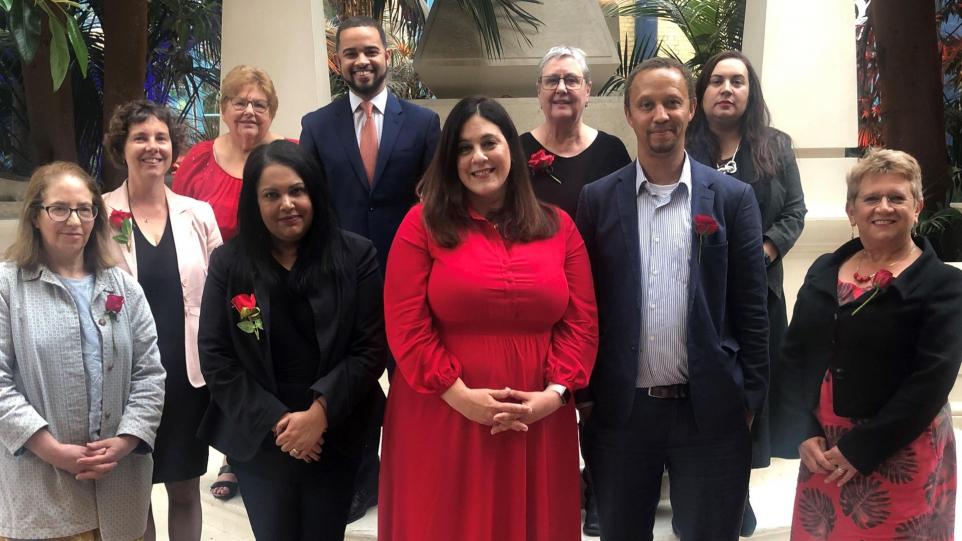
Picture: Haringey Council’s 2022 cabinet

Jason Lowther

Local councils can and must do more to enable women to be councillors. Haringey’s new cabinet shows that this can be done, but fifty years after all government elected officials across the UK were finally elected under universal suffrage, new research shows barely a third of local councillors and MPs are women, whereas earlier research showed less than a quarter of Police and Crime Commissioner (PCC) candidates were women.   This matters not only in terms of democratic fairness, but because politicians’ characteristics impact on public policy.

The research published last week by the Fawcett Society and Democracy Club reflects councillor representation in August 2022 across the UK.  To collect the data, they had to scrape individual council websites since (incredibly) there is no official record of councillors’ gender (or other protected characteristics).  This is because the relevant section of the Equality Act 2010 has still not yet been enacted and in any case as drafted would apply only to candidates in national elections.  This is in contrast to council staff, where the Equality Act applies and has led most councils to capture and publish reasonably detailed assessments of workforce equality issues – as shown by the recent SOLACE / Shared Intelligence report, ‘Understanding and Improving Equality, Diversity and Inclusion in the Local Government Workforce’ which we discussed on the blog last autumn.

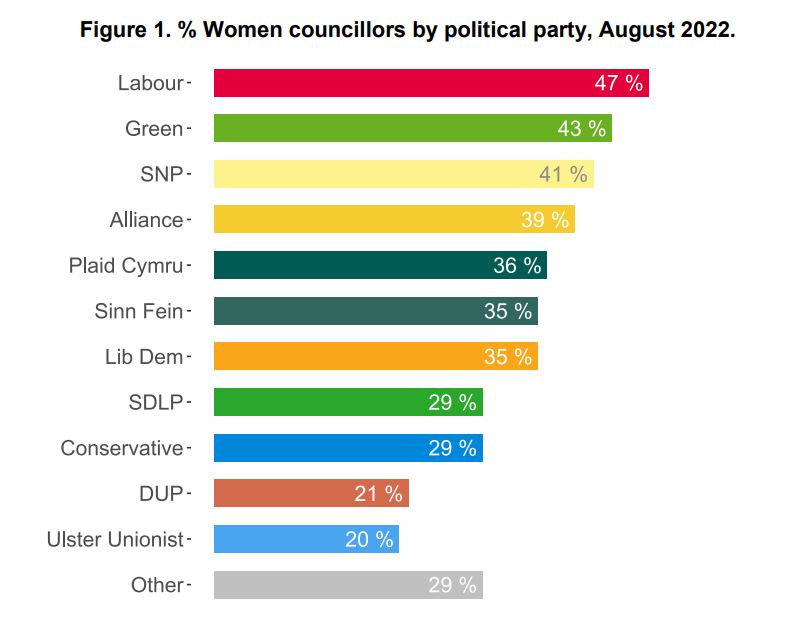
The Fawcett Society / Democracy Club results show no party yet has parity of representation between women and men, but some are doing much better than others.   The highest proportion of women is found in the Labour Party (47%) and the lowest in the Conservative Party (29%), the SDLP, DUP, and Ulster Unionist Parties. 

Source: Gender representation on local councils, Fawcett Society and Democracy Club (2022)

At individual council level, the highest proportions of women councillors were found in Haringey (65%), Rossendale (61%), Brighton and Hove (56%), Lewisham (56%), and Southwark (56%).  In contrast, Perth and Kinross, Pendle, Comhairle nan Eileen Siar and West Berkshire each have 15% or less of the council made up of women councillors.

One effect of having fewer women decision makers may be that issues that disproportionately affect women are given insufficient attention.  Policymakers play key roles in promoting status-based policies.

Recent research by Professor Francesca Gains (University of Manchester) and Professor Vivien Lowndes (Inlogov) published in the journal Politics & Gender in 2021 analysed the effect of Police and Crime Commissioner’s gender on policymaking around violence against women and girls (VAWG).  An earlier quantitative phase of their research found that policy prioritisation was linked to Police and Crime Commissioners’ own gender, with female PCCs twice as likely to prioritize VAWG.  Their later research analysed how this difference occurred, identifying ‘seven sets of rules that have shaped policy prioritization in favour of VAWG: the right to make key appointments; the requirement to set policy priorities; the obligation to utilize equalities duties; the power to commit resources; the expectation of partnership working with other agencies; the commitment to hold operational police officers to account; and the maintenance of diverse channels of contact with victims of crime and the wider public’ (Gains and Lowndes, 2022, p. 396).

To improve the situation, the Fawcett Society / Democracy Club report makes recommendations to government, political parties and local councils.  For councils, the key actions are:

  • implement parental leave policies, to make being a councillor more accessible to those with caring responsibilities;
  • ensure that caring and dependency allowances reflect the real cost of childcare and are accounted for separately from ‘main’ members’ allowance;
  • pilot alternative ways of working including online and hybrid engagement mechanisms to enable councillors with caring responsibilities to carry out their duties more effectively; and
  • adopt codes of conduct, based on the model developed by the LGA in 2020

Local councils can only be truly effective when they represent the communities they serve.  The Fawcett Society report is a timely reminder that we have a long way to go, but the first steps are clear and practical.

Jason Lowther is Director of the Institute for Local Government Studies (INLOGOV), University of Birmingham

Reference

Gains, F. and Lowndes, V. (2022) ‘Identifying the institutional micro-foundations of gender policy change: A case study of police governance and violence against women and girls’, Politics & Gender, 18(2), pp. 394-421.

A Japanese view of Jeremy’s budget

Chris Game

I had an interesting Budget week. I was part-hosting a Japanese academic colleague – Prof Toshihiko Ishihara (Kwansei Gakuin University) and his wife, Midori – making their first overseas trip since Covid. They briefly visited Birmingham, where Toshi was an erstwhile INLOGOV Associate, but were based in London, where I’d agreed to organise a theatre visit.

I’d booked tickets for a well-reviewed modern-day play, Romeo and Julie, loosely based on one of Shakespeare’s. Single-sentence synopsis: Julie – a bright, Cambridge University-bound, aspiring astrophysicist – is emotionally torn between uni and her affection for young single dad, Romeo, effectively sole carer for his baby daughter afflicted with Poonami.  

No, the Poonami doesn’t feature in Shakespeare’s version, but, researcher that I am, I’d discovered it’s a real medical thing, meaning affected babies’ sudden, massive, uncontrollable bowel movements. Better still, that etymologically Poonami derives directly from the Japanese tsunami – a sudden, volcanic, unstoppable wave. My guests were delighted – and the play too was excellent.   

The following Wednesday, however, was Budget Day – followed by the Birmingham Post’s impassioned coverage of our region’s “Power grab”, the “seismic shift in devolution as West Midland leaders take more control from Whitehall”, etc. (pp.1,7) – guaranteeing some amused but tricky questions from someone who both lives with and studies serious mayoral governance.

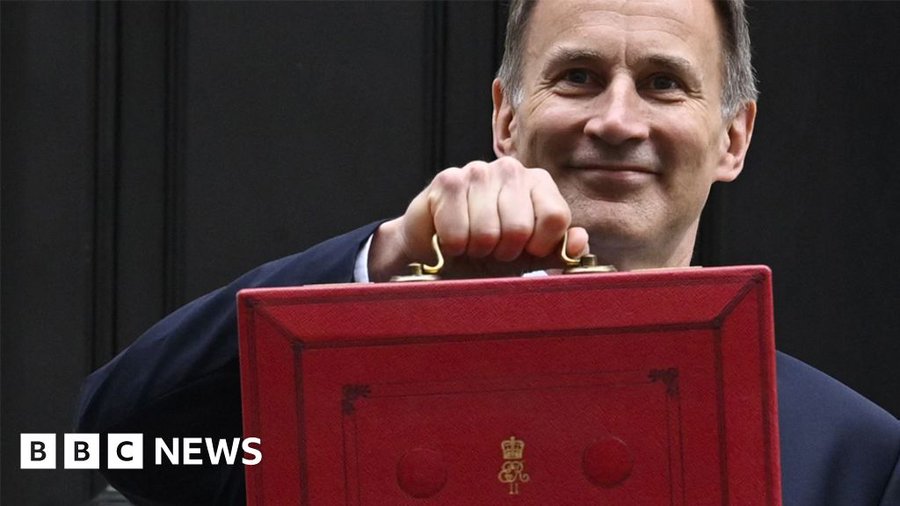
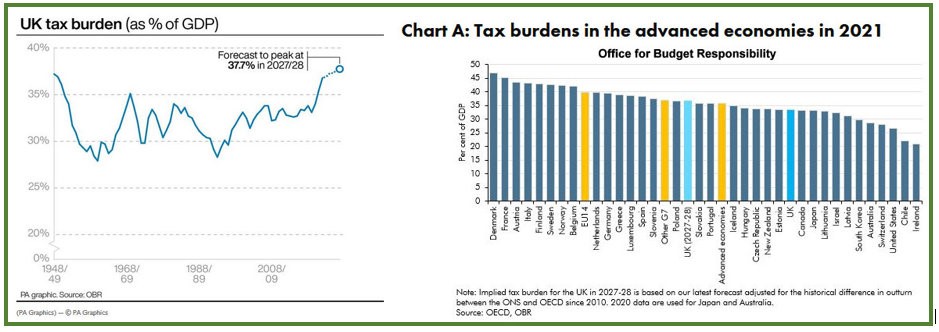
It was the national news headlines, though, that I was obliged to address first, and the UK’s “unsustainable … biggest since the war … tax burden” – characterised by Chancellor Jeremy Hunt as something horrendous and to be avoided, certainly by a Conservative Government, at almost any costs.

We’re not Basil Fawltys, but my Japanese friends and I tend not to mention ‘the war’ that much. Anyway, the timescale wasn’t really the issue. It was that highest-level tax forecast of 37.7% of Gross Domestic Product (GDP) – and yes, we do make life harder by colluding in almost invariably labelling it a “tax burden”, rather than, say, the “quality-of-life price” that the tax helps pay for.

What Toshi and other Japanese students of these things invariably query is: why the excitement/horror over a tax-to-GDP ratio currently almost identical to theirs? Yes, ours is indeed a higher ‘burden’ than those of, say, the US or Switzerland. But, as shown in the Office for Budget Responsibility’s Chart A, both we – at roughly 34% of GDP – and Japan are currently in the bottom third of “advanced economies”, and even at a forecast 37.7% we’d still be mid-table and some way BELOW both most sizeable West European countries, plus bits of Eastern Europe too.

It’s interesting. Pollsters never ask us if we prefer NOT being an ‘advanced economy’ – you know, one with fully staffed and functioning health and social services, decently funded schools, reliable public transport, etc.?  And I’m not sure how collectively we’d answer. Clearly, these things do cost money, yet we obviously like visiting these higher-taxed places for our holidays.  Not Denmark perhaps – top, with its 47% tax ‘burden’ – but France, Austria, Italy, Scandinavia, Greece, Spain, Portugal, etc.

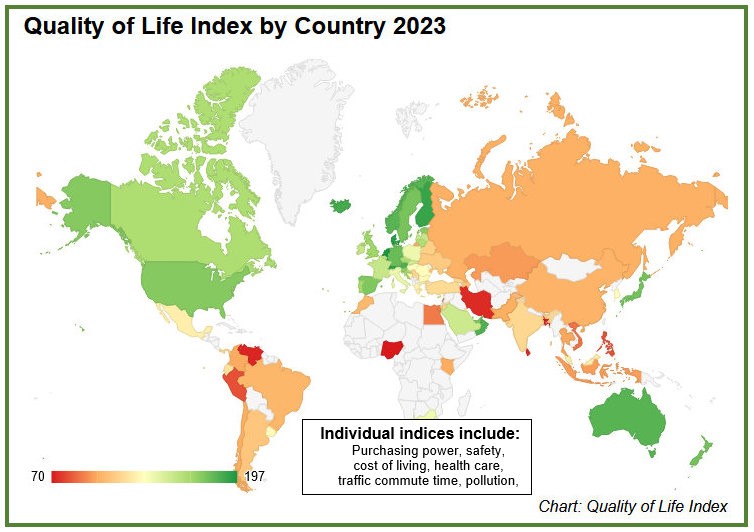
It’s presumably at least partly these countries’ ‘quality of life’ (QoL) that attracts us – which, unsurprisingly, correlates broadly with ‘tax burden’. There are several QoL indexes, one being Numbeo’s. It’s not the most methodologically sophisticated, but it does produce nice maps, collectively summarising its measures, which include purchasing power, safety, health care, cost of living, and pollution.

Netherlands, Denmark and Switzerland are currently top, scoring nearly 200 QoL points. Then the usual suspects – Finland, Iceland, Austria, Australia, New Zealand, Japan (13th) etc. – down to No.21 – UK 166.4, just ahead of Croatia. Disappointing, but could be worse – bottom at 84th is red Nigeria, not with ‘nul points’ exactly, but only 40.

The underlying, systemic problem, obviously not mentioned by Chancellor Hunt, is precisely his Department: His Majesty’s Treasury – first time I’ve typed that! – and its overbearing central funding control, currently exercised politically and communicated by him. And formerly by, among others, one George Osborne – which is where the irony starts. When Chancellor of the Exchequer, Osborne launched, and currently chairs, the Northern Powerhouse Partnership (NPP) – self-described as “the leading voice of business and civic leaders across the North”.

And currently a very shouty voice. For, within days of Hunt’s Budget pronouncements, along came Osborne with his NPP ‘wrecking ball’ – a clumsily titled but potentially headline-making report: Fiscal DevoNation – The Blueprint for How to Devolve Tax to the Regions of England. The Treasury, he and his Powerhouse chums now reckon – and as local government has complained for years – far from being the provider of solutions, is itself the problem. Its voice is the overwhelmingly dominant one in what Osborne nowadays sees as a damagingly over-centralised fiscal system. Just like when he was boss.

The NPP’s solutions involve, at least eventually, full-scale fiscal devolution. The “most unfair” council tax – with its outdated property values – stamp duty (paid on purchasing residential property), and business rates should all go, eliminating the Treasury’s all-powerful role altogether. The at least eventual replacement, following a comprehensive revaluation of all homes, would be a locally set land value tax, plus three new council tax ‘super bands’ for the most valuable properties, with revenue to be shared across the country.

Yep – that’s radical, but there’s more – like the localised hotel tax that numerous other countries already have, which NPP reckons could raise an annual £5.5 millions for the Lake District alone.

But I digress – from what my Japanese visitors really wanted to talk about: that Budget highlight of a “seismic shift” in devolution, to the West Midlands and Greater Manchester regions, and their elected Mayors, Andys Street and Burnham, who will get new multi-year devolution funding deals, and be allowed to retain business rates – to be followed by further such agreements across England.

At the time of writing, there hadn’t been a direct response from Northern Powerhouse as to how far down the ‘full-scale fiscal devolution’ road this might take us. As for a Japanese reaction, well, this blog is already overlong; but their response would probably start with the country’s written constitution, and the local government chapter guaranteeing its role and “the principle of local autonomy”. It’s an ultra-crude summary, but basically the national state does currency, diplomacy and defence, and pretty much everything else is left to the 47 prefectures and 1,700 or so municipalities. And heading those municipalities … directly elected mayors!

As the American phrase puts it: ‘Way to go’ – in both senses.  

_____________________

This is an adapted version of an article that appeared in the March 23rd edition of the Birmingham Post.

Chris Game is an INLOGOV Associate, and Visiting Professor at Kwansei Gakuin University, Osaka, Japan.  He is joint-author (with Professor David Wilson) of the successive editions of Local Government in the United Kingdom, and a regular columnist for The Birmingham Post.

Mission Possible? 

Jason Lowther

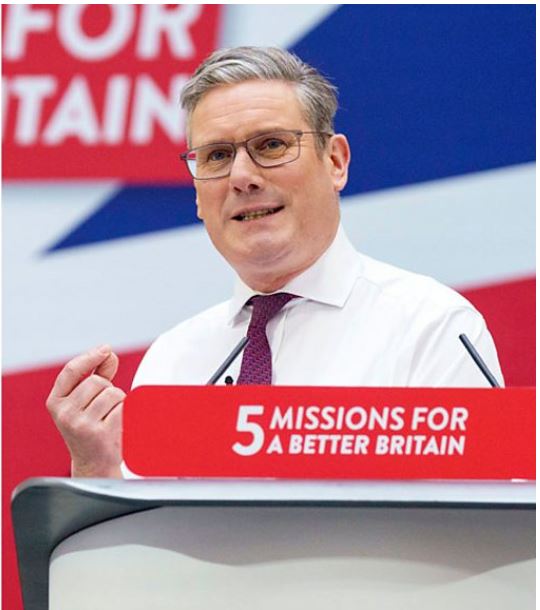
With under 700 days to the next UK general election, political parties are busy developing their manifesto documents.  In February, Labour leader Keir Starmer made a major speech laying out his “five missions for a better Britain”.   How do these five missions relate to local government?  And is the turn to “mission driven” government likely to work?

The five missions vary in their level of specificity and challenge.  Securing “the highest sustained growth in the G7, with good jobs and productivity growth in every part of the country…” is a little vague but likely to be difficult, especially given we are currently ranked 6 out of 7 in terms of output per worker.  Mission #2, “make Britain a clean energy superpower”, accelerating the move to zero-carbon electricity from 2035 to 2030, is specific but very challenging.  Mission #3, reform of health and social care and reducing health inequalities, will require a re-focus from secondary (hospital) care to social care and addressing the social determinants of health.  Mission #4 is about community safety, and likely to involve more community policing.  Finally, mission #5 is to “break down the barriers to opportunity at every stage” through reform to the childcare and education systems.

Local government potentially has important roles in each of the five missions.  Local education, skills and economic development functions will be critical to improving productivity.  On energy, Net Zero requires at least a doubling of electricity generation by 2050, from decarbonised sources.  Decarbonisation strategies need to be place-based, taking account of the geography, building types, energy infrastructure, energy demand, resources and urban growth plans.   We’ve recently argued here for the key roles of councils in this area. 

Turning to health and care services, local government clearly has leading roles – including ensuring place-based planning to address the social and behavioural causes of health inequalities.  Analysis by the Liverpool and Lancaster Universities Collaboration for Public Health Research in 2021 concluded: “investment across the whole of local government is needed to level up health including investment in housing, children’s, leisure, cultural, environmental, and planning services”.  Similarly community safety, child care and education are areas where local government could be enabled to have much greater positive impact.

Perhaps as important as the specific “missions” is the approach to governing which the party is proposing.   Labour’s document characterises this as a move from top-down, target-led, short-term, siloed approaches, to government which is more “agile, empowering and catalytic”, working across the public and private sectors, and civil society.  This, it argues, requires organising government around a shared vision, focusing on real world outcomes, concentrating on ends with flexibility and innovation concerning means, devolving decision making from Westminster, increasing accountability including central and local data transparency, and adopting long-term preventative approaches including greater financial certainty for local areas. 

In some ways the idea of mission-driven government echoes the 1990s thinking of Ted Gaebler and David Osborne’s book “reinventing government”, which argued for a more entrepreneurial approach to the delivery of government.  Their work pointed to entrepreneurial companies setting overall missions and goals, and then leaving managers to figure out how best to deliver these – for example, by providing an overall budget for a service rather than detailed line-by-line budgets which disappear if not spent by year end.  The focus on managers rather than considering the perspective of politicians is one of the problems identified in subsequent evaluations of the reinventing government model, together with difficulties in sustaining the approach.

Mission-driven policies addressing ‘grand challenges’ of society are increasingly common, for example in the UN Sustainable Development Goals and various EU policies.  Mazzucato et al recently argued that addressing such challenges requires strategic thinking about: the desired direction of travel, the structure and capacity of public sector organisations, the way in which policy is assessed, and the incentive structure for the private, public (and I would add community) sectors. Labour’s paper makes a start (albeit at a very high level) on thinking through these areas. The litmus test, though, will be in developing the detail and how far this engages with local areas.   

Over the next few months, we will be contributing to the debate on the upcoming party manifestos with some research-informed thoughts on a variety of local government related policy areas.  If you would like to be involved in developing these, please get in touch

Jason Lowther is the Director of INLOGOV. His research focuses on public service reform and the use of “evidence” by public agencies.  Previously he worked with West Midlands Combined Authority, led Birmingham City Council’s corporate strategy function, worked for the Audit Commission as national value for money lead, for HSBC in credit and risk management, and for the Metropolitan Police as an internal management consultant. He tweets as @jasonlowther

Picture credit: BBC

Responding to National Populism

Picture credits: https://www.spiked-online.com/ and https://unherd.com/

Jon Bloomfield

The playwright David Edgar and I have written a two-part essay for Byline Times which was published before Xmas. It focuses on the role of two distinct web-sites – ‘Unherd’ and ‘Spiked’- in shaping the debate on culture wars and promoting national populist ideas across British politics. Here is a brief summary of the essay, full links below.

So, now the dust is settling, what is the ideological future of the Conservative Party? With kamikaze supply-side Trussonomics so thoroughly discredited, will Rishi Sunak and his – relatively – big-tent Cabinet return to a 2020s version of Cameronian fiscal austerity? If so, what happens to the Johnsonian cocktail of high public spending and social conservatism which proved so palatable to the voters of the Red Wall? And what is the role of online ideologues – notably writers for the websites Spiked and Unherd – in the battle for the party’s soul?

British national populism has proved much more than just a short-term political tactic, unexpectedly successful in the Brexit referendum and re-conceived as an election-winner three years later. Like the free market ideologues of Tufton Street, national populists are organised into influential groups of intellectuals and political campaigners who have gained considerable reach into mainstream media. The role of The Spectator is well-known but this article focuses on the profound influence of two websites: Unherd and Spiked

What makes these sites so significant and successful is that many of their lead writers originate not on the right but on the mainstream and indeed the far left, and now promote ideologies that seem contradictory but – in practice – are increasingly allied.

The emergence of national populism has seen strange, paradoxical political alliances emerging within the two main political parties exemplified by the Red Tory and Blue Labour tendencies. Even stranger has been the ideological overlap between the website of a formerly Marxist, now right-libertarian think tank and the main online home of anti-liberal communitarianism. So why – on the issues that are tearing Britain apart – do Spiked and Unherd appear to be bedfellows?   

Both are prolific sites supplying a daily flow of political and cultural commentary. Spiked is an outgrowth of the  Revolutionary Communist Party (RCP), which developed an increasingly eccentric version of Trotskyism with its magazine Living Marxism. Launching the website Spiked in 2000, its cadres – including former RCP guru Frank Furedi, polemicist and now Brexit-supporting peer Claire Fox, and Munira Mirza, later to become Boris Johnson’s policy chief  – continued the RCP’s trajectory towards anti-statist, economic libertarianism while retaining its original Leninist discipline and capacity for harsh polemic. 

Unherd has more conventional origins within the Conservative party.  Its founder Tim Montgomerie set out its stall in Prospect arguing for a “social Thatcherism,” which would re-balance “from a conservatism of freedom to a conservatism of locality and security.” Montgomerie argued that within the Conservative Party “the magnetism of national sovereignty has finally overtaken the magnetism of free markets.” However, Unherd has also attracted former left polemicists, including ex-Labour-supporting, Prospect-editing journalist David Goodhart – now ‘Head of Demography, Immigration and Integration’ at the right-wing think-tank Policy Exchange; academic turned national-populist advocate Matthew Goodwin; trade union activist and anti-woke campaigner Paul Embery; and the ex SWP-flirting, Tory-convert vicar Giles Fraser. 

The reason for this unexpected cross-fertilisation of ex-Trotskyites, traditionalist Tories and communitarian, socially-conservative Labourites is their ideological alignment on many of the key cultural controversies of the day. A fervent commitment to Brexit and belief in the unreformed UK nation-state are central, but what gives the two platforms their raison d’etre is the consistent vitriol directed at the mainstream left and the new social movements that have emerged around it over the last few decades. A bitter animosity against social liberalism and a caricatured ‘woke’ left is their most distinctive, current and common thrust. Their ideas – particularly on multiculturalism and the ‘woke agenda’ – have been eagerly lapped up by the mainstream right-wing media. 

Within the Sunak government, in their various ways Kemi Badenoch, Michael Gove and Suella Braverman are all signalling their wish to return to the national-populist ‘culture wars’ agenda. Like their counterparts in Europe and the US, the national-populists want to roll-back the advances that have been made in the past 50 years. The likes of Spiked and Unherd are crucial propagandists in this battle. In particular, these two sites have mounted a consistent assault on progressivism on the major social and cultural issues of the day: climate justice, feminism and anti-racism. On three of the great social issues of our era – climate change, women’s inequalities and structural racism and discrimination – the editorial lines of Spiked and Unherd are marching in lockstep, deploying similar arguments and even phraseology, to minimise the issues or to deny that there’s any problem.

National-populism has its own logic. Mobilising ethnic nationalism; arousing fears about race and religion; attacking social liberalism; overtly or covertly promoting the ‘Great Replacement’ conspiracy theory. All lead in just one direction.

This is a moment for liberals, progressives and the Left to wake up. 

It’s time for them to draw on their own history and re-build the alliances that have led to so much social and economic progress in the past.  In the more variegated, less homogenous world of 21st Century capitalism, finding the ways to navigate common ground between movements and build cross-class alliances is more important than ever.

The provocations of Spiked and Unherd stand in the way. At a moment when the hard-Right is showing a readiness to indulge in racist and nationalist politics reminiscent of dangerous eras of the not-too-distant past, it is time for progressives to prioritise unity, rebuild alliances which have done so much good in the past, and direct their firepower at their main opponents.

Red Tory to Blue Labour – How Spiked and Unherd are Keeping National Populism Alive – Byline Times

Fighting Back Against National-Populism – Byline Times

Jon Bloomfield has been involved with the EU’s Climate KIC programme for over a decade, helping to develop educational and training programmes and experimental projects which help companies, cities and communities to make effective transitions to a low carbon economy.