So far in 2024 (as at 19th March), there have been 26 debates in Parliament to discuss Local Government issues. By way of comparison, there have been 12 debates on illegal immigration, and 16 on energy prices.
So, it seems reasonable to conclude that Parliament does discuss Local Government issues, but what issues have been discussed and who’s been doing the talking?
There are various sources of data on this topic, including Hansard and Parliament TV. For this blog, I used the ScrutinyCounts app, which analyses MP’s contributions in Parliament (as recorded by Commons Hansard) and presents the data in an easy-to-use format on a mobile app so users can see who is saying what about which topics quickly and easily on their smartphone.
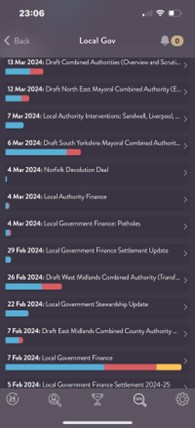
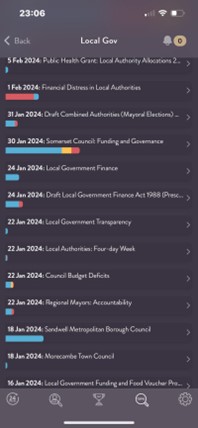
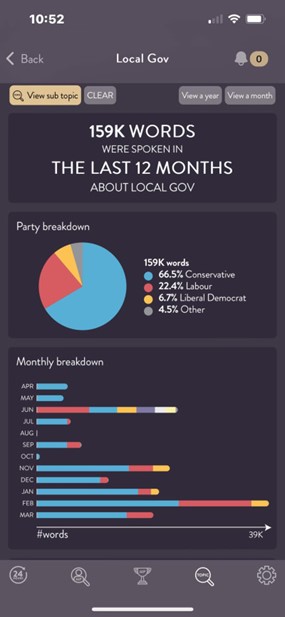
The charts below, taken from the Scrutiny Counts mobile app, show the Local Government debates that have taken place so far this year and the date they took place.
As can be seen from the screenshot charts, there’s a breadth of discussion on Local Government matters ranging from Financial Distress and Funding, Combined Authorities, Mayors, through to Four-day week working. Within the app, there is click-thru functionality which lets you see the full debate content, the MP’s who have participated, and the contributions they have made. There’s also “share” functionality to enable useful and interesting content to be quickly and easily shared with friends and colleagues.
Looking across the past twelve months, there have been over 159,000 words spoken in Local Government debates (measured by words spoken as recorded in Commons Hansard).
Across the debates, Conservative MPs contributed into the debates 66.5%, Labour 22.4% and other parties 11.2% (this compares with the party split by number of sitting MPs of 53%, 30% and 17% respectively).
As can be seen in the “monthly breakdown” area of the chart below, after a relatively quiet few months over summer of 2023, the level of debate activity significantly increased during Autumn 23 and early 2024 with February 2024 being a particularly busy month.
Perhaps not unsurprisingly the top contributing MPs in Local Government debates were government and shadow government ministers such as Simon Hoare (Parliamentary Under Secretary of State (Department for Levelling Up, Housing and Communities) and Jim McMahon (Shadow Minister (Levelling Up, Housing, Communities and Local Government) with contributions being made in their respective roles.
But aside from Frontbench MP’s, who have been the top contributing Backbench MPs in Local Government related debates during the last 12 months? (measured by words spoken as recorded by Commons Hansard).
The charts below show the top contributing Frontbench MPs, and the top contributing Backbench Conservative and Labour MP’s;
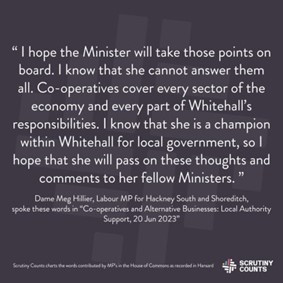
There are often detailed and constructive contributions into the debates from all the parties. The quotes shown below are taken from speeches given by the two top contributors in the above charts. They both give an insight into the work that MPs do in representing their communities and constituents in parliamentary debates.
So, in summary, yes Local Government issues are discussed in Parliament. The news in the mainstream media may focus on the weekly exchanges in PMQ’s, the political gossip of the day, or the topical late night divisions and votes, but in so doing many don’t see the work MP’s of all parties do in important debates across a range of subjects such as Local Government, Housing, Social Care, etc.
The contributions in debates are often constructive and well thought through, providing valuable insight for politicians, councillors, and council officers and all those with an interest in Local Government. The debates form an important function in bringing local issues to the national stage and play an important role in our democratic system.
The charts and images in the article are taken from the ScrutinyCounts mobile app which is available via subscription on Apple AppStore and Google Playstore. The app uses data as reported in Commons Hansard and presents it in an easy to digest format which enables users to quickly and easily read what MPs are discussing in Parliament.
Steve Watson is a Director of Hinc Ltd, the provider of the ScrutinyCounts mobile app. Steve started his career as an electronics engineer but quickly came to realise he was more suited to working with computers rather than designing them! After being a joint owner of a Local Authority data insight company which was successfully grew and subsequently sold, Steve started a new venture to develop a mobile app called ScrutinyCounts which enables users to quickly and easily see what is being said, and by who, in Parliament. More information about ScrutinyCounts can be found here or at Twitter/X @ScrutinyCounts
My sister lives in the Netherlands. I saw her at the weekend. She’s planning her return to the UK, and so our conversation inevitably turned to “the state of the UK”. To my surprise, the first thing she raised was the parlous state of Local Government. It’s not a topic that usually cuts through to the general public. Has it got that bad?
The slant that I take on this topic (and all others to be fair) is different from most people’s. I’m Alice Watson, part of the team that created the ScrutinyCounts app, which provides easy access to parliamentary debates. So every day I use the app to check what’s been said in the House, and I dip into any debates that look of particular interest.
And as luck would have it, recently (1st Feb 2024) there was a debate about Local Authorities in Financial Distress. And a few days before that there was one about Somerset Council’s difficulties, and the week before that there was one about Transparency in Local Government, and the week before that there was one about the potential merits of the Four Day Working Week….and the list goes on. There isn’t a shortage of topical content.
People groan when I say I read Parliamentary Debates. They assume they are like PMQ’s (a pet hate of mine), which they aren’t.
Here’s a quote from the recent debate about Local Authorities in Financial Distress. It’s a reply from a Labour MP (Clive Betts) to a Conservative MP (Bob Blackman):
It’s a cheering thought. Cross party select committees working collaboratively to explore problems and find solutions.
And what else did I learn from the debate? That the woes of some councils are self-inflicted, but not all. That the various mixed pots of funding available to councils makes for a patchy funding pattern geographically. That the three main spending challenges are Social Care, Special Educational Needs, and Homelessness.
There are two big benefits to reading a parliamentary debate on this (and any other) topic. Firstly, you get to read all sides of the political argument, which is good for the soul regardless of where you sit politically. And secondly, you get a sense of how different regions are affected. By way of example, Bradford’s problems stem from the high cost of Children’s Services in the Borough. The Trustees running Children’s Services have demanded a sum equivalent to about 50% of the council’s budget. Very different from the much-reported Equal Pay claims at Birmingham.
There are hundreds of other topics that are equally interesting and relevant to people who spin in the world of Local Government. On 11th January 2024 there was a debate about SEND Provision and Funding. As is often the case, MP’s volunteered personal stories which adds conviction and context to their contributions. Read this quote from David Davis (Conservative) about his granddaughter, Chloe:
I won’t try and precis this, or any other debates here. Because with every precis, comes editorial judgement, and the whole point of ScrutinyCounts is that we don’t edit, summarise, filter or distort. We have created summary charts that enable you to navigate quickly to items that are of interest. Then you click through to the original debate and text. Our screen designs are optimised for speed reading so you can jump to contributions that interest you, and scroll up and down fast.
So what did I say to my sister about the parlous state of Local Government? I told her not to believe everything she reads in the news, but to look on ScrutinyCounts, read about it for herself, and make her own judgement!
Alice Watson is a Director of Hinc Ltd, the provider of the ScrutinyCounts mobile app. Having trained as an Engineer (Bath Uni), she established Porge (a data insight company), which she successfully grew and subsequently sold. ScrutinyCounts is her latest chapter. It sprung from her belief that people need an easy way of following politics, undistorted by echo chambers or soundbites. More information about ScrutinyCounts can be found here – https://www.scrutinycounts.co.uk/ or follow us on Twitter/X @ScrutinyCounts
Young carers provide unpaid, and often unacknowledged care, usually for parents or other family members. While caring may be viewed as a health and social care issue, most young carers who are under 18 will spend much of their time in full-time education. So it is critical that education professionals are ready and able to support young carers to achieve at school.
This study explored how a multi-agency approach could improve the educational experiences of young carers in Northern Ireland through a survey of teachers and interviews with professionals in education and health and social care. Young carers are often unseen by medical and educational professionals, who may be unaware they are providing care or unaware of what support may be needed.
Key findings
Young carers and their experiences are routinely overlooked and unseen in educational and health care settings.
The lack of legislative recognition for young carers has created a policy void, despite input which has explicitly identified the need to support and care for this group of young people.
Existing guidance which outlines ways to support young carers in school has not been routinely implemented in schools or shared with school staff
A combination of a strengths-based model, combined with existing protective factors for young people has the potential to provide appropriate care and support, promote positive self-worth and improve educational outcomes for young carers.
A systematic failure of planning contributes to patchy and inconsistent partnership approaches which are overly reliant on individual commitment to change, rather than systems change
Background
While my study focused on Northern Ireland, many of the issues faced by young carers are universal in nature. The literature review highlights the unseen nature of young carers as a key barrier identified by researchers and young peoples’ experience across cross-national researchers
Teachers’ understanding of impact and role of young carers is variable, and at times, dismissive. The age at which young carers may begin their caring role is often at primary school, which is unexpected by teaching and medical professionals. The study highlighted a willingness to help but also a reliance on parents or young carers disclosing their status.
Reaching out to young carers is essential
Teachers acknowledged the difficulties of identifying young carers; other research has established that young carers may be reluctant to self-identify or to ask for support if they feel they have not been listened to. Teachers felt that parents only disclosed when they felt forced, often during a crisis.
Transition points provide an excellent opportunity to encourage disclosure. Updating contact information each year, conversations about the transfer to post-secondary school and when young people enrol in a new school are ideal opportunities to ask if a child is undertaking caring responsibilities. This can help start the conversation about how to support them in school. Schools can include information on their websites, on posters, and use Assemblies to recognise the contribution young carers make.
The policy deficit contributes to suffering
Resources and initiatives have been identified, but never implemented, which is both disappointing, but also provides an opportunity for change. Guidance without legislative protection is unlikely to be prioritised. Young carers are less likely to take up further education and more likely to live in poverty, and more likely to experience poor mental health.
The sustained lack of policy attention is an issue which requires urgent redress. Existing guidance includes specific, practical examples of ways to support young carers emotionally and practically to achieve at school, and many of the suggestions require time and planning, not financial costs. A renewed effort to share and monitor this guidance, using a policy lever, could make a powerful impact on young carers.
Shifting the focus from harm reduction to promoting wellbeing
Professionals described a system which considers young carers primarily in terms of harm reduction. Despite the challenges, many young people are proud of their caring role and display outstanding qualities and strengths.
There is insufficient focus on working collaboratively to provide proactive support to young carers to achieve in school, take up opportunities to socialise, and enjoy breaks from caring, or to share information about this support to young carers.
Education Authority guidance, with input from young carers, highlights that what they often want most is practical support to help them get through the school day and for their teachers to show understanding of their reality.
Conclusion
This study highlighted that there are pockets of good practice and existing multi-agency working which have contributed to collaboration, but these are exceptional rather than routine.
The study concludes that there is a need for greater legislative recognition, including a statutory responsibility on key agencies in health and social care and education to provide support for young carers.
Agencies should be more proactive in seeking out young carers, by including information on school enrolment and admissions forms, asking during clinical admissions and review medical appointments, and signposting to young carers’ projects and other partners.
Young carers are being failed; they deserve better, and the answers are already there. What’s needed now is the impetus to follow through and deliver.
Elaine Campbell was awarded an MPA in 2023. Previously an Assistant Director at children’s charity Barnardo’s, Elaine is currently Head of Service Enablement and Improvement at Alzheimer’s Society. She is also a Chair of Board of Governors at a primary school. She can be contacted at [email protected]
In the intricate tapestry of European local governance, local councillors stand as pivotal figures, linking citizens to decision-making processes that shape their daily lives. Their interactions within communities, councils, and broader public administration are the bedrock of modern democracy. Last week, alongside colleagues from the University of Bristol, Cardiff University, and Ghent University, we embarked on an ambitious endeavour: an email survey reaching over 19,100 councillors across England, Scotland, Wales, and Northern Ireland.
The survey is part of a broader European effort, with a single shared survey being rolled out with spans twenty-eight European countries driven by a broad collaboration of academics emerges from extensive international research network dedicated to conducting surveys with local political actors to understand local and national political dynamics. Over two decades their comparative work has shed light on the councillor, council leader and mayor roles of local government, administrative intricacies, civic cultures, and political practices across Europe, enriching both academic and practical understanding.
Our latest research now refocuses on local councillors, probing fundamental questions about democracy, their perceptions of their roles, views on local government, challenges within the institutional environment, and policy priorities. The survey also aims to understand councillors’ experiences with aggression and abuse and the influence of such encounters on their council activities and public engagement.
But this survey is more than just academic curiosity; it’s about amplifying the voices of local representatives. Councillors are the conduits between citizens and power, entrusted with articulating community aspirations and championing collective interests. They face mounting external pressures—from austerity to centralisation—and grapple with balancing economic growth, development, and environmental concerns, alongside the existential threat of rising social care costs as more and more councils face financial distress.
Unlike previous paper-based iterations, this survey employs electronic questionnaires sent to individual councillors across England, Wales, Scotland, and Northern Ireland, with the survey lasting around 15 minutes, we are keen that councillors both start and finish the survey, so have enabled them to complete it over multiple sittings if required via simply clicking on the email invitation.
As the survey unfolds across 28 countries, we urge councillors to join the dialogue and lend their voices to the study. Personalised emails have been sent directly to councillors’ inboxes, and follow-ups will continue over the coming month. Any councillors unable to access the survey can reach out to the project team using the contact details provided below.
We are calling on all councillors to check their inbox for our survey! Your voices are crucial to use better understanding the challenges and priorities in your role. This is the first time we have delivered the survey across England, Scotland, Wales, and Northern Ireland so we are really keen to ensure that all voices are represented across political parties, different tiers of local government, and geographies. Let’s ensure all your voices are heard loud and clear.
Dr Thom Oliver is a Senior Lecturer in Politics at the University of the West of England, Bristol. Thom completed his PhD at INLOGOV in 2011. Along with Dr David Sweeting (Bristol), Prof Colin Copus (Gent), and Dr Bettina Petersohn (Cardiff), he is leading the Return of the Councillors study in England, Wales, Scotland, and Northern Ireland. Thom leads the Qualitative Election Study of Britain, and is a co-investigator on the Bristol Civic Leadership Project.
Continuing our celebration of the dissertations of our Degree Apprentices. The use of data and data analytics is becoming increasingly important for all organisations – an essential asset to help effectively manage and transform local places. For a truly holistic data view of a city or place, multi-agency approaches to partnerships and data sharing are essential. What are the key governance considerations regarding a place-wide approach to data analytics?
This study found support for the concept of multi-agency partnerships and data sharing. Several barriers to data sharing were identified, including technical, organisational, political, economic and legal constraints.
The key governance factors to consider include the need to truly understand the problem which data is being asked to solve, to acknowledge and address the barriers as they are understood, to align overall governance with existing multi-agency governance structures and to create the relevant capacity for strategy and leadership regarding data and data analytics for the area.
Key findings:
There needs to be senior level drive and ownership for data that will champion its use within an organisation and wider city, but in most cities there is not a ‘go to’ person or function that has lead responsibility and can provide guidance on data sharing across organisations.
Local partnerships need to consider the purpose, vision and strategy for data use, the objectives that data sharing will achieve, how the public can engage and understand data, and how far organisational cultures support effective data use. Data sharing governance should be explicitly identified within existing multi-agency governance structures.
Existing data sharing agreements are generally not designed to deal with the frequency, level and types of data that now need to be shared.
Councils could lead the ‘democratisation’ of data as a public asset
The study identifies two key elements of successful place-wide data sharing: a senior role identified as taking ownership and leadership responsibility for data, and a data strategy which defines the city’s ambition and vision for the use of data.
Background
Public authorities collect, hold and process a significant amount of data which could be used to make services more targeted and effective through design, delivery and transformation to improve outcomes whilst delivering efficiencies. The 2020 National Data Strategy seeks to make better use of data across businesses, government, civil society and individuals.
Data sharing has been in the spotlight as a result of the need for analysis to support interventions in response to the COVID-19 pandemic, the increasing public awareness of data and data privacy, and work to encourage greater public uptake of digital services. For example, at the start of the lockdown period data was used to identify families in the case study city likely to become more vulnerable because of lockdown. The data had never been combined in this way before.
There is a growing need for a sustainable model and framework for data sharing across multiple agencies when considering the management and development of towns, cities and regions.
What we knew already
Organisations learn and develop when part of the organisation acquires knowledge that they recognise as important to the rest of the organisation, distribute and interpret this information efficiently and has effective organisational ‘memory’.
Data sharing can encourage innovation and help solve sector-wide challenges. However, trust in the use of public data is very low with many believing that they have no control over their personal data. A more trustworthy approach to public data is recommended by giving citizens more control over the use of their data.
Multi-agency approaches can deliver value and outcomes that would not be possible to deliver working individually. However, there are significant challenges such as a lack of willingness to collaborate, protecting individual interests, local rivalries, governance, funding, communication, and conflicting priorities.
Multi- agency information sharing is difficult to achieve because of multiple barriers which may be technical (such as technically incompatible IT system, data standards or security requirements), organisational (such as risk aversion or lack of trust), political (such as avoidance of scrutiny, economic (lack of resources), and legal (concerns about the law around data sharing).
Frameworks for data sharing Despite a number of these barriers being identified over twenty years ago they still resonant today. Existing data sharing agreements are, by design, very technical and detailed documents these do not address the use of data to understand policy problems. They are generally not designed to deal with the frequency, level and types of data that now need to be shared. In addition, in most cities there is not a ‘go to’ person or function that has lead responsibility and can provide guidance on data sharing across organisations.
Multi-agency working and governance
Every council area has important multi-agency partnerships in place, such as Health and Wellbeing Boards and Local Enterprise Partnerships. Most of these are established in a fairly traditional bureaucratic style with clear lines of authority, very detailed reporting arrangements and formalised decision making. The study found no desire for specific governance structures to be established purely for data sharing, instead this should be explicitly identified within existing multi-agency governance structures. The governance of these structures may need to evolve beyond the current bureaucratic model.
Local partnerships need to consider the purpose, vision and strategy for data use, the objectives that data sharing will achieve, how the public can engage and understand data, and how far organisational cultures support effective data use. There needs to be senior level drive and ownership for data that will champion its use within an organisation and wider city.
Councils could lead the ‘democratisation’ of data as a public asset – moving beyond allowing access to the data and making it easy for people to understand the data use under principles of transparency, integrity, accountability, and stakeholder participation.
Examples of local data sharing partners
Conclusions
The study identifies two key elements of successful place-wide data sharing: a senior role identified as taking ownership and leadership responsibility for data, and a data strategy which defines the city’s ambition and vision for the use of data.
The findings suggest that the key governance factors to consider include the need to truly understand the problem which data is being asked to solve, to acknowledge and address the barriers as they are understood, to align overall governance with existing multi-agency governance structures and to create the relevant capacity for strategy and leadership regarding data and data analytics for the city.
This research was a Master’s dissertation as part of the MSc in Public Management and Leadership, completed by Paul Ward and supervised by Dr Louise Reardon. The project included detailed interviews with ten members and officers related to data sharing in an urban area.
Further information on Inlogov’s research, teaching and consultancy is available from the institute’s director, Jason Lowther, at [email protected]
Continuing our National Apprenticeship Week celebrations, this dissertation explores what “good” leadership looks like in public service. The study of leadership within public services has evolved over the last twenty years. Leadership continues to be understood as imperative within public services, particularly around driving reform. There has been a shift from understanding leadership as ‘heroic’, towards an understanding of leadership as transformative.
This study provides insight into the way in which leadership is understood and constructed within public services today. Good leadership is now understood to be transformative and strategic – with an overwhelming rejection of traditional ‘heroic’ and ‘trait’ models of leadership within public services.
Key points
There is a collective rejection of the role of ‘heroic’ styles of leadership within this literature.
Leadership is not borne of a character trait, but rather can be developed in individuals.
A key aspect of ‘good’ leadership is a positive relationship between a leader and followers.
Leadership is necessary for the creation and implementation of vision within an organisation.
The role of leadership has become more important in a de-centralised, strategic state.
Leadership is essential to driving public service reform.
Background
Over the last century, questions such as ‘what is leadership?’, ‘what makes a good leader?’ and ‘what are the benefits of leadership?’ have been explored. Over the last three decades, there has been an increased interest in leadership specific to public services. This project uses ‘integrative review’ to analyse four core texts within the area of public service leadership and academic thinking, highlighting persistent themes within the literature and demonstrating how it contributes to understandings around leadership within public services.
What we knew already
Historically, leadership had been theorised as a collection of character ‘traits’ (such as heroism and bravery) possessed by a select few, primarily men. These traits would be ‘God given’ or naturally acquired and would emerge at such points that leadership was required, for example during political turmoil.
The mid-20th century saw the emergence of behavioural theories of leadership which demonstrated a shift from understanding leadership as something one ‘is’ to something one ‘does’. Research here focused upon behaviours associated with leadership in different contexts and the desirability of such behaviours. This work led to the emergence of further theories of leadership, such as situational and transformational. Situational theories of leadership were concerned with the way in which leaders would adapt leadership style according to varying contexts and transformational theories focused on the way in which leaders influence followers. Transformational theories of leadership explored leaders’ interactions with others within an organisation and how leadership was co-constructed by various agents. Most recently, social constructive perspectives consider leadership as a product of collective meaning making, developed on an ongoing basis between leaders, managers and/or followers. These perspectives create space for consideration of the wider cultural and social implications of leadership, for example around gender or ethnicity.
Research focussing on public service leadership aims to take into account the many differences between the public and private sector, for example in terms of accountability and ownership.
Good leadership is not ‘heroic’
The research explicitly rejects the role of ‘heroic’ and ‘trait’ leadership within the public sector, which is seen as ineffective compared to more collaborative styles of leadership in the context of complex, adaptive problems facing society in a decentralised, knowledge intensive context this form of leadership.
Leadership is therefore seen as something that can be developed and that public service organisations have a duty to develop: leaders are ‘made’ rather than ‘born’. That said, some personal characteristics can contribute to ‘good’ leadership, such as integrity, diplomacy and the ability to handle conflict. This reflects the wider (private sector focussed) literature on leadership.
Good leadership is transformative
Transformative leadership can be understood as a way by which leaders can change or influence the goals of others. Here, there is a rejection of command and control forms of leadership, aiming for commitment (rather than simply compliance) from ‘followers’. Good leadership is seen as inspiring people through driving values and vision, persuading others, listening to others and learning from them.
The promotion of transformational leadership styles however may be problematic as for one individual to hold responsibility over ‘influencing’ and ‘changing’ the behaviour and attitudes of others is, in a way, heroic. A move away from ‘heroic’ leadership could be said to democratise the process of leadership, making it an aspect of organisational life that is accessible to those who are willing to develop, but how far transformative leadership symbolises this democratisation is questionable. The fundamental principal of changing followers’ attitudes and beliefs may still suggest an element of control on the part of a leader and the importance of character traits associated with having the ability to influence individuals, such as confidence.
Good leadership is strategic
There is a marked emphasis on leadership as strategic – the ability to plan ahead and enrol others in transforming the organisation. Leadership is understood as essential to developing, implementing and managing strategic plans. Leaders are important in setting the cultural ‘tone’ of an organisation and acting strategically to achieve a shared future vision. Looking to the future is particularly challenging in circumstances whereby resources are scarce, and demand continues to rise. Critically, this understanding of good leadership demonstrates the need for public services to have a greater function than just to ‘survive’.
This project notes the lack of research on ways of promoting the role of non-leaders within an organisation in developing strategy. For example, this could developing strategy in a way that involves stakeholders, such as trade unions or staff groups, to make use of the knowledge and wisdom of ‘non-leaders’.
Leadership is important for driving reform
Leadership is imperative to public sector reform and as a key driver in enhancing organisational performance, establishing and promoting values and building relationships in order to drive change. Leadership is important to managing strategic issues (developments or events that risk the achievement of key goals) in order to realise the organisation’s strategic goals.
The challenges, expectations and demands of public services are changing, thus leaders have a responsibility to ensure that public services can rise to each of these. Leadership can be understood as a means by which stability is provided in a period of change. The findings here echo arguments that flow through the wider literature, for example that leadership is imperative to driving organisations change and reform.
Challenging leadership theories
The textual analysis carried out within this research has demonstrated that the role of leadership within the public sector remains unchallenged. There is no coverage of the limitations of leadership in the core texts reviewed. This is reflective of the wider literature, whereby leadership is accepted as a phenomenon and, though attempts are made to define and understand it, challenges to it remain scarce. The most powerful challenges to leadership include that leadership serves to reinforce existing social beliefs and structures about the necessity of hierarchy, and that leadership enables the maintenance of the status quo.
A core criticism of leadership theory is that it is underpinned by the assumption that leadership is a while, male construct. Black and minority ethnic people remain underrepresented in the top 5,000 leadership roles across the public and voluntary sectors. In addition, women’s leadership is often viewed less favourably because traditional ‘leadership behaviour’ is not desirable in women. The exclusion of any discussion around gender or ethnicity in any one of the texts dismisses the reality of leadership for those who are often excluded from leadership roles, and the wider conversation around promoting inclusion.
Conclusions
This research has argued that understanding ‘good’ leadership within public services is increasingly important in an age of public service reform. It has outlined a distinct effort within the literature to distance ideas of ‘good’ leadership within public services from ‘heroic’ ideas of leadership and to align ‘good’ leadership with transformative ideologies of leadership. It has also demonstrated that leadership is a key driver of good public service organisation.
Furthermore, this research has highlighted that this role of leadership within public services has not been challenged, nor has there been consideration into the potential problems associated with leadership. This research has argued that the way in which leadership is constructed within the literature has real life implications for the reality of leadership within public service organisations, arguing that further research into leadership would benefit from being both follower-centric and providing more critique of the ‘leader’ role.
This research was a Master’s dissertation as part of the MSc in Public Management and Leadership, completed by Gemma Carmichael and supervised by Professor Vivien Lowndes.
For further information
Please contact the Director of the Institute of Local Government Studies (INLOGOV) Jason Lowther, at [email protected]