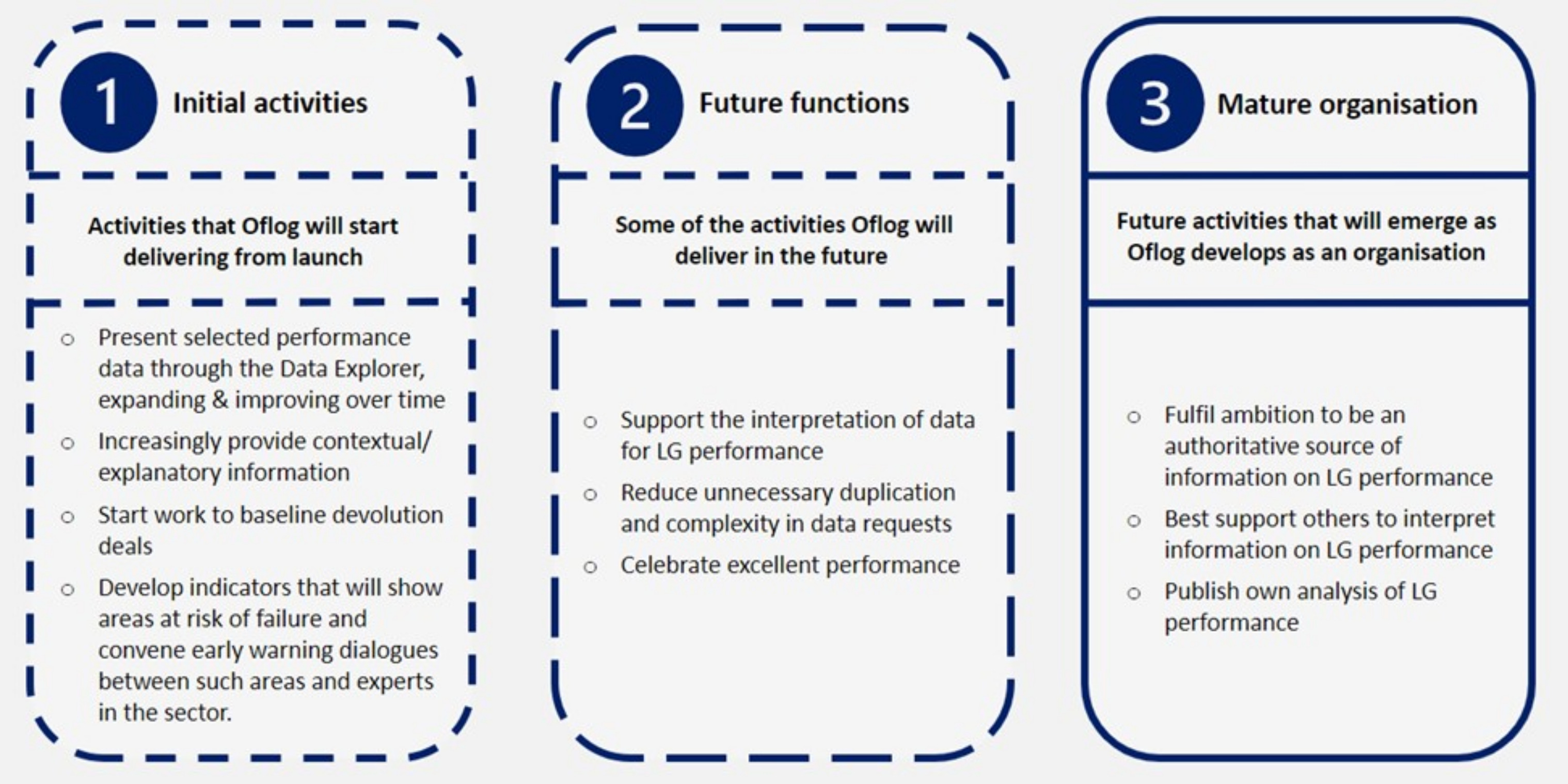
It’s been an exciting month in government, nationally and locally, since the General Election on 4th July. As the new Labour administration finds its feet, somewhere on Ministers’ “to do” list will be local government performance and (the department formerly known as) DLUHC’s attempts to improve this through the establishment of OFLOG, the Office for Local Government.
The election marked the exact anniversary of Michael Gove’s statement setting up OFLOG through the policy document, Understanding and supporting local government performance. Its remit was “to provide authoritative and accessible data and analysis about the performance of local government and support its improvement”.
Gove was at pains to stress “this is not about recreating the Audit Commission”. With that point at least, I agree. Whereas the Audit Commission was fiercely independent, often willing to criticise government policy where it was a factor in poor performance, OFLOG was established as an office of the department within the DLUHC department itself. Whereas the Audit Commission developed comprehensive performance measures which were rigorously audited to assure consistency, OFLOG picked 27 PIs and published these. Whereas the Audit Commission provided detailed national studies to inform best practice in local services, sometimes leading to wholesale systems change such as around youth justice services, with the local implementation of recommendations then supported by local specialist value for money auditors, the nascent OFLOG offered to “continue a programme of webinars to share best practice”.
An early product of OFLOG, in July 2023, was its “Local Authority Data Explorer”, which now brings together PIs on waste management, planning, adult social care, roads, and corporate and financial issues. For each service, users can select three comparison councils to produce scatter charts like Figure 1, which compares my local council’s waste management with that of three other big cities. This led to some rather uninformed press commentary and a response from the LGA. One may also say this is perhaps not the most compelling presentation of data in the world, arguably significantly less clear or flexible than the LGA’s excellent Inform tool which has been freely available for several years and includes thousands of published metrics.
Caution should be applied to OFLOG’s position within a ministerial setting and the potential for politicians to be selective in how they use data for judging local authorities that are not of their political persuasion. Whilst some may argue that the former Audit Commission may have been too powerful, it did provide a greater degree of transparency and objectivity at interpreting performance data.
Figure 1: Waste management
As my colleague in Inlogov, Dr Philip Whiteman, has recently argued, the new government should ensure that OFLOG is independent of government with a remit to focus on:
Working with the sector to identify councils at risk of failure to ensure that support can be provided from within the sector, minimising the need for government intervention.
Collecting, analysing, and reporting data to enable individual councils, groups of councils and the sector nationally to make progress with shared priorities agreed with government.
Developing intelligence from on-going engagement with councils.
Supporting improvement in local services and councils’ contribution to national outcomes through researching, synthesising, and disseminating good practice.
Working with academic institutions such as Inlogov to incorporate key lessons from existing and future research.
We can be confident that local government performance overall is strong, and sector-led improvement has demonstrated our collective commitment to continuous improvement. But with so much of the new government’s ambitious “Missions” depending on highly effective local government, we need to take a fresh look at how OFLOG can be further developed to identify and propagate good practice across the sector.
Jason is Director of the Institute of Local Government Studies (INLOGOV) at the University of Birmingham and was employed by the Audit Commission from 1994 to 2004. This article was first published in the August 2024 LARIA Newsletter. Email [email protected]
INLOGOV’s new report, Equipping Local Government to Deliver National and Local Priorities, is available here.
This blog was prompted partly by Vivien Lowndes’ and Phil Swann’s recent INLOGOV blog giving “Two cheers for combined authorities and their mayors”. Substantively, anyway, although the decisive stimulus was the realisation that most, if not all, of those present at the relevant ‘Brown Bag’ session would probably have been unaware that seated among them was the co-author of almost certainly the most comprehensive examination of this topic by any INLOGOV colleague over the years.
I refer to the appropriately labelled ‘long-read’, also masquerading as an INLOGOV blog and entitled Briefing Paper: Elected Mayors, published shortly before the 2017 elections of what I think of as the second generation of elected mayors – and produced by Prof Catherine Staite and a Jason Lowther.
Catherine, nowadays an Emeritus Professor of Public Management, had recently stepped down as Director of INLOGOV, in which capacity she had, among numerous other initiatives, both launched and regularly contributed to our/her blog. And, while I certainly recalled reading the Briefing Paper, I confess that, with his name meaning little to me at the time, I’d forgotten her co-author. Apologies, Jason.
He claimed, moreover, that he himself had “forgotten” it (email, 14/5), which I didn’t, of course, believe … until, a few days later and following some ‘research’, I discovered one of my own INLOGOV blogs, on the Magna Carta and 800 years of Elected Mayors, which I really had totally forgotten. Whereupon I realised too that I couldn’t actually recall much of what Catherine, I and other colleagues contributed to that decade of debate on elected mayoral evolution.
So, the remainder, the structure, and – I fear – the length of this blog were prompted, yes, by much of the media coverage of this month’s elections, and the sense that the spread and substance of mayoral government over the past decade aren’t fully recognised even by those who supposedly follow these things; and also by the notion that it would be a pleasing mini-tribute to Catherine to do so by identifying and italicising particularly some of her and colleagues’ INLOGOV blog contributions on these mayoral matters over the years.
We start, however, for the benefit of comparatively late arrivals, at the beginning of not the blog, but the concept. Mayoral government is a postulation you might expect to have found a supportive, even enthusiastic, reception in an Institute of Local Government Studies and it mainly did, albeit with perhaps a certain reservation. Directly elected mayors (DEMs) had played a fluctuating role in the Blair Government’s local government agenda from the outset. London, noted in Labour’s 1997 manifesto as “the only Western capital without an elected city government”, would have a “new deal”. Which took the form in 2000 of the creation of the Mayor-led Greater London Authority – in the manifesto, so no referendum required. Probably no reminder required either, but they’ve been: Ken Livingstone (Ind/Lab; 2000-08), Boris Johnson (Con; 2008-16); Sadiq Khan (Lab; 2016- ).
The Local Government Act 2000 then provided all English and Welsh councils with optional alternatives to the traditional committee system. Chiefly, following a petition of more than 5% of their electorate, they could hold a referendum on whether to introduce a directly elected mayor plus cabinet. There were 30 of these referendums in 2001/02, producing 11 DEMs – plus Stoke-on-Trent’s short-lived mayor-plus-committee system – three in London boroughs, but most famously Hartlepool United’s football mascot, H’Angus the Monkey, aka Stuart Drummond (Indep).
Ten referendums over the ensuing decade produced a further three mayors, prompting the now Cameron-led Conservatives to pledge in their 2010 manifesto to introduce elected ‘Boris-style’ mayors for England’s 12 (eventually 11) largest cities, with significant responsibilities including control of rail and bus services, and money to invest in high-speed broadband.
Birmingham voted 58% against, despite Labour’s having in Liam Byrne a candidate raring to go, and Coventry 64% against. There was speculation over whether the addition of a well publicised mayoral recall provision(CG) might have swung some of the lost referendums. But it was what it looked: an overdue, and to some welcome(Andrew Coulson), end of an episode(Karin Bottom);arguably “the wrong solution to the wrong problem”(Catherine Durose).
Since then, the referendums successfully removing elected mayors (Stoke-on-Trent, Hartlepool, Torbay, Bristol) have exceeded those creating new ones (Copeland, Croydon) – though, in fairness, those four removals were more than matched by five retention votes.
A ‘mayoral map’ at the end of that first decade would have looked something like the inset in my illustration of in fact the first 20 years of referendum results – numerous splotches of red for Reject, a few smaller green specks for Accept, and overall a patchy, somewhat arbitrary, experiment that on a national scale never really took off.
The mayoral concept, though, had also generated interest outside local government – the Institute for Public Policy Research (IPPR), for instance, advocating Mayors for Greater Manchester, the West Midlands, and Liverpool City Region to take the required ‘big’ decisions on housing, transport, and regional development. Prime Minister David Cameron too was a ‘city mayors’ fan, although what scale of ‘city’ wasn’t initially clear, until in 2014 what became known as the first ‘devolution deal’ (Catherine Needham) was announced with the Greater Manchester Combined Authority. Headed by an elected ‘metro-mayor’ (CG), comparable to the Mayor of London, the GMCA would have greater control over local transport, housing, skills and healthcare, with “the levers you need to grow your local economy”.
New legislation – the Cities and Local Government Devolution Act 2016 – was required, allowing the introduction of directly elected Mayoral Combined Authority or ‘Metro Mayors’(Vivien Lowndes & Phil Swann) (+ Catherine Staite) in England and Wales, with devolved housing, transport, planning and policing powers.
The Combined Authority elections were held in May 2017 – not coinciding with the General Election(CG) as PM Theresa May had contemplated but, in contrast to Rishi Sunak, chickened out of – with perhaps usefully split results(CG). Elected were Andy Burnham (Lab, Greater Manchester), Steve Rotheram (Lab, Liverpool City Region), Ben Houchen (Cons, Tees Valley), Andy Street (Cons, West Midlands), Tim Bowles (Cons, West of England), and James Palmer (Cons, Cambridgeshire & Peterborough) – followed in 2018 by Dan Jarvis (Lab, Sheffield City Region). The map had started to change – even within the first hundred days (CG) – stutteringly under the less committed Theresa May and/or in several cases where groups of local authorities failed to agree – but eventually dramatically, as evidenced in the larger illustrated map. The Staite/Lowther ‘Briefing Paper’ was well timed.
A few years on, mayoral devolution has trailblazed across the country (CG) to a greater extent than even some commentators on this year’s local elections seemed to have difficulty grasping. As of March 2024, devolution deals had been agreed with 22 areas, covering 60% of the English population – most recently, in late 2022, North of Tyne, Norfolk/Suffolk, East Midlands, York & North Yorkshire; in 2023 Cornwall, Greater Manchester and West Midlands (‘Trailblazers’), Greater Lincolnshire, Lancashire, Hull/East Yorkshire; and so far in 2024 Buckinghamshire, Warwickshire and Surrey.
From next year, if you draw a straightish line from, say, Ipswich in South Suffolk up through about Alvechurch in South Birmingham, heading for Shrewsbury, at least five-sixths of the bits of England to your north will be under mayoral devolution. Which, to me anyway, seems pretty dramatic news, and considerably more interesting than the endless General Election Date speculation that passed this May for ‘Local Elections’ reporting.
Chris Game is an INLOGOV Associate, and Visiting Professor at Kwansei Gakuin University, Osaka, Japan. He is joint-author (with Professor David Wilson) of the successive editions of Local Government in the United Kingdom, and a regular columnist for The Birmingham Post.
There are reasons to be cheerful about the fact that the newest component of English local government, the mayoral combined authorities, were in the headlines this spring. There were also reasons for caution, however, most notably the particular focus on two of the mayoral elections, in Teesside and the West Midlands, as a guide to the popularity (or not) nationally of Rishi Sunak and the Conservative Party.
This fact that combined authorities were in the news is a prompt to take stock of their development and impact with some thoughts stimulated by the discussion at a recent INLOGOV Brown Bag[1]session.
The media attention was attributable to the mayoral elections, with many of the incumbent candidates having established a national profile by, for example, challenging the government’s approach to Covid (Andy Burnham in Greater Manchester), defying political gravity and weak governance (Ben Houchen in Teesside) or crafting a new brand of active, compassionate Conservatism and challenging the government’s pruning of HS2 (Andy Street in the West Midlands).
The mayors have also disrupted the escalator assumption of British politics in which ambitious politicians use local government as a stepping stone to parliament and government. Burnham, Liverpool City Region’s Steve Rotherham and the new mayor of the East Midlands Claire Ward have each moved in the opposite direction.
The metro mayors undoubtedly have higher profiles than most council leaders. They have demonstrated impact beyond their statutory remit through soft power, particularly their ability to convene discussions and galvanise action on issues such as public health and homelessness.
Doubts remain about the sense of vesting so much power in a single individual. Only three of the twelve metro-mayors are women, showing the danger of equating ‘strong leader’ with ‘strong man’. More effort is needed on the part of political parties to diversify their mayoral candidate selection.
It is also valid to question whether, for example, an elected mayor in the West Midlands would have added more value as part of the city council’s governance rather than that of the wider city region. Some would argue that the city would benefit from the type of focussed political leadership that Mayor Jules Pipe provided in Hackney. Experience in both Liverpool and Bristol suggests that having a mayor at both city and city region level causes confusion.
There has been very little discussion about the role of council leaders as key players in the governance of combined authorities through their membership of the mayors’ cabinets. As one council leader in Greater Manchester is quoted[2] as saying: “We have to work with a mayor we did not want while he has to work with a cabinet he did not chose”.
The Greater London Authority model is very different, with a separately elected London assembly as well as a mayor. While this may seem more democratic, public awareness of the assembly is far lower than that of the mayor[3]. Perhaps it is time for a comparative review of these two very different sets of governance arrangements. In both cases, there is a strong argument for greater public involvement outside of the electoral cycle, both in setting up new combined authorities and to inform ongoing priorities.
The role of council leaders is inevitably linked with the wider question of the relationship between the combined authorities and their constituent councils. To date this has proved to be remarkably smooth, particularly given the often toxic precedent of county-district relations. The next period may be more testing. To date, councils and metro mayors have been united in coping with austerity, but difficult decisions about priorities will have to be taken should a new government make limited additional resources available. The increased interest of combined authorities and mayors in strategic spatial planning and housing will also raise challenging and potentially divisive issues.
The jury is out on the extent to which the establishment of combined authorities has led to substantive devolution of power from central government, although progress has been made in areas such as adult education, transport, health (in Greater Manchester) and mental health (in the West Midlands). While the new ‘trailblazer deals’ in Greater Manchester and the West Midlands promise a single funding settlement with central government, other combined authorities find themselves still bogged down in competitive bidding for relatively small pots of money.
One important feature of combined authorities is the way they are creating opportunities for innovation and testing new ways of working at a local level. To fully exploit the potential of this development it is important that arrangements are put in place to capture this learning and share it between combined authorities, and especially with newcomers like East Midlands, North East and York and North Yorkshire. There is also potential for metro-mayors to speak with a stronger collective voice in challenging and informing central government on issues affecting local and regional governance.
Finally, it is important to remember that combined authorities did not begin with a blank sheet of paper. The GLA and many of the combined authorities have similar boundaries as the GLC and metropolitan counties which were abolished by Margaret Thatcher in a fit of political pique in the 1980s.
Harold Macmillan pioneered regional arrangements for devolved delivery with regional boards to promote industrial productivity during the second world war and regional housing production boards to help meet his 300,000 a year housing target in the 1950s. Neither were well-received in Whitehall. John Prescott followed with his regional development agencies, abolished by Cameron’s coalition government, and his failed bid to create regional assemblies. What marks out combined authorities is the lack of a ‘one size fits all’ approach, with size, functions and governance arrangements varying around the country.[4] Indeed, only 50% of England’s population live in combined authority areas (so far).
Given this rocky terrain, it may be rash to vest too much hope in combined authorities and their mayors. But they clearly have the potential to disrupt our centralised politics and join-up aspects of regional governance after decades of damaging fragmentation.
Vivien Lowndes is Professor Emerita in the School of Government, University of Birmingham.
Phil Swann is studying for a PhD at INLOGOV in the Department of Public Administration and Policy, University of Birmingham, on the contribution of politicians to central-local government relations.
[1] INLOGOV’s Brown Bag sessions are informal monthly discussions on events in and around local government bringing together academics, researchers, students, practitioners and alumni. For further details please Phil Swann ([email protected])
[2] Blakeley, G and Evans, B. 2023 How metro mayors are getting things done – even if they have limited money and power. The Conversation June 28 2023.
[3] According to London Elects (londonelects.org.uk) in January 2020 58% of people were aware that a mayoral election was taking place compared with 32% for the assembly election (down from 40% in 2016).
[4] Durose, C. and Lowndes, V. 2021. Why are designs for urban governance so often incomplete? A conceptual framework for explaining and harnessing institutional incompleteness, Environment & Planning C: Politics & Space, https://doi.org/10.1177/2399654421990;
The commons refer to those cultural and material resources collectively managed by the community and represent an alternative to both the state and the market. Recent literature emphasises the capacity of the commons’ prefigurative politics to develop alternative institutions to neoliberal regimes and/or deliberative and collective forms of resource management. The grassroots movements managing the commons often take an oppositional stance to the state, but they might also depend on its resources. By the same token, the state has an interest in supporting assets and services managed as commons, which offer flexibility and efficiency, while encouraging citizen participation in local politics.
Within political contexts sympathetic to progressive socio-economic projects, such as new municipalism in Barcelona, formalised alliances between the local state and the commons started to emerge, facilitating the development of novel policy instruments that respond better to the demands of the commons and open opportunities for more participatory policymaking. So-called public-common partnerships are long-term agreements based on cooperation between state actors and the commons members. In our paper, we wanted to understand better the relational work behind these partnerships and the role of boundary spanners that build bridges between two worlds, such as the state and the commons, which are often quite distant in terms of visions of local democracy and the language to articulate such visions. We take the case of the Citizen Asset Programme (CAP) in Barcelona to explore the relationships between public officials and commons members, highlighting how these collaborations shape governance practices and can help foster a collaborative culture within public administration.
CAP was approved in 2016 and aims to create the institutional framework to recognise and support commons-managed municipal assets in the city. Based on qualitative analysis of interviews with public officials and commons members involved in the partnership, as well as official documents, we drew out insights on the relational dynamics that facilitated the creation of two policy instruments under CAP: The Community Balance Metrics and the Social Return on Investment of Can Batlló. The first one is a set of indicators to evaluate the performance of community-managed assets considering their transformative potential and including dimensions of internal democracy, care, inclusion, and environmental sustainability. The second helps to measure the value of activities and volunteer work carried out in the community centre of Can Batlló.
Through a series of vignettes depicting the different state and commons actors involved, we examined how they forged alliances and employed creative thinking to manage conflicts, resistance, and scepticism from both the local administration and the grassroots movements. Public officials from the Active Democracy Department were able to build trust among commons representatives by recognising their needs and potential. They explained the workings of public administration in a clear language. They created spaces of open-ended dialogue between grassroots movements and different departments to facilitate the development of policy instruments, measures and indicators that valued the commons’ innovative work, while still coherent with existing legal requirements. For instance, a working commission was set up involving members of Can Batlló, the Legal and the Heritage Department, as well as representatives of the District administration. This public-commons partnership developed a comprehensive agreement to regulate asset transfers, which fully recognises the social and economic value of the commons.
By the same token, the commons members played a crucial role in communicating to grassroots movements the work of the Active Democracy officials and build mutual trust. On the one hand, they helped the commons understand feasibility issues of their demands; on the other they pressed the public administration for greater transparency and creative interpretation of existing regulatory framework to strengthen democratic values underpinning asset transfer agreements.
Two cooperatives supported these partnerships as consultants. They contributed knowledge of innovative public policies from across the world. They also facilitated knowledge sharing to encourage cooperation between commons members and state institutions, for instance by inviting grassroots groups from other parts of the world to share their experience of working with the state.
The work of these public-commons partnerships is gradually reshaping the administrative culture and fostering more transparent and democratic working practices within the public administration. An example is the joint work to develop the Community Balance Metrics, which helps evaluate the performance of the commons using indicators agreed upon by both local public administration and the commons. However, these processes face a number of challenges, as they clash with established working routines and performance evaluations of public administrators that hardly ever value participatory work. Existing literature suggests that despite the introduction and encouragement of new practices, there is a tendency to revert to traditional policymaking methods when faced with unexpected problems. When boundary spanners that had supported the partnership exit the process, they can leave a vacuum that is hard to fill and that can jeopardise the partnership. In Barcelona, ongoing discussion between Can Batlló members and the City Council on who is responsible for funding the refurbishment of one of Can Batlló’s building is causing friction within the partnership and some of the work has stalled.
Inevitably this collaborative work is hard to sustain, but in the face of multiple and overlapping crises facing local government, these public-commons partnerships are also beginning to open safe space to experiment and do things differently.
Picture credit: Victoria Sánchez.
Sonia is an Associate Professor in INLOGOV. Her main research interests are participatory governance and democratic innovations, and creative and arts-based methods for research and public engagement. She led on projects on youth participation to influence mental health policy and services, coproduction of research on health and social care integration, models of local governance, and leadership styles within collaborative governance.
Marina is a researcher at Autonomous University of Barcelona (UAB). She holds a PhD in Public Policy from UAB and a M.A. in Sociology from Columbia University (New York). She has been a visiting scholar at CUNY Graduate Center (New York) and at INLOGOV, University of Birmingham. Her research interests include community assets transfer, democratisation of public administration, community development and public-common partnerships.
It’s little consolation to the ‘powers that were’ in Birmingham Council House, but the past several months’ headlines about “Europe’s Largest Local Authority” going bankrupt have done wonders for my personal online social networking. From the BBC and Financial Times to the World Socialist International Trotskyists, that headline has made us Brummies suddenly globally famous as citizens of ELLA.
I’ve been emailed by erstwhile colleagues and ex-students I’ve not seen or heard from for years, now back home in Australia and South Africa, Japan and Kazakhstan, wanting to know whether Birmingham really is Europe’s Largest Local Authority – like it boasts on its Website Awards page – and, if so, why didn’t I make more of it while they were students here.
Yes, they’re curious about the bankruptcy bit, which I also have to try to explain, but it’s the ELLA boast that really fascinates them – because they recall their travels around Britain and Europe, and clearly blame me for their not having been able to boast about temporarily residing in the continent’s LLA. The clever-dick ones even add, “What about Kent?” Or “Didn’t you say it was East Lindsey in Lincolnshire?”.
And they’re not wrong, of course. Take the real ‘biggies’. In population, Kent is nowadays just one of the ‘Big 3’ of the 36 non-metropolitan or shire counties – its 1,858,000 fractionally behind Essex and Hampshire, and all roughly half as large again as Birmingham City Council’s 1.15 million. However, those counties’ local governments are, of course, two-tiered – counties and districts, each responsible for different functions and services. And – spoiler alert – it’s single-tier or unitary authorities, responsible for providing all principal local government services in an area, that count here.
County councils provide services covering the whole county – education, adult social care, waste disposal, etc. More local services, like refuse collection, environmental health, and leisure facilities, are provided – as I’d certainly have pointed out – by, in Kent’s case, 12 smaller district councils.
Sounds straightforward, doesn’t it? In fact, it’s anything but, and, if you were a class of students, I’d have had to at least mention the bizarre distinctions between ceremonial and historic counties, Lord-lieutenants (Lords-Lieutenant?) and High Sheriffs. Suffice it here to stress that it’s the two-tier structure and the ‘county’ bit that bar these bodies from challenging Birmingham’s status as ‘Largest’.
We do, of course, have a West Midlands Combined Authority, headed currently by Mayor Andy Street, but that’s entirely different and its 18 local authorities cover a far larger regional area than the old West Midlands County Council that Margaret Thatcher abolished in 1986. It’s an increasingly important, and influential, regional and national voice, but definitely not a local authority.
And East Lindsey? I honestly can’t remember ever mentioning this. If I did, I’d guess it was to encourage some overseas students to visit Skegness, as somewhere ‘different’ but inherently English and off the proverbial tourist track. It’s a pleasant seaside resort with a rather splendid clock tower – which tells the time, unlike, for apparently a further several weeks, the UoB’s Old Joe – that probably happened then to be the largest town in England’s geographically largest local government district – East Lindsey – and five or six times the area of Birmingham.
We’ve fully established, then, that Birmingham’s ‘Europe’s Largest Local Authority’ claim has nothing to do with either population or geographical size, but everything to do with the UK’s uniquely large-scale, or ‘non-local’, local government structure and the gradual disappearance of devolution to more local units of government.
Put another way, it’s a question of NUTS. Yes, there’s plenty about our local government system that doesn’t make much sense – not least its sheer non-localness – but here we’re actually talking about the Nomenclature of Territorial Units for Statistics, which both sounds better in the original French and produces an easily memorable acronym.
It’s statistical shorthand for the EU’s hierarchical way of standardising the different ways in which the hugely varying EU states administratively structure their sub-central governments – regardless, if necessary, of the institutional reality. A statistical harmonisation exercise, therefore, rather than an aid to serious cross-national local government comparison.
The NUTS classification subdivides every member country into three principal levels, NUTS 1 to 3, to which large countries can add further levels by subdividing NUTS 3 into LAU (Local Administrative Units). Very roughly, then, the currently 92 NUTS 1s are major socio-economic regions or groups of regions of relatively larger states – Germany’s 16 Länder, France’s 14 Régions, Poland’s 7 Makroregiony. And the UK, were we still EU members, would have 12: West Midlands and the eight other English regions, plus Scotland, Wales and Northern Ireland.
The 240 NUTS 2s are basic regions or regional groupings for the application of regional policies – Austrian Bundesländer, Belgian, Dutch and France’s former Provinces – and in the UK 40 conveniently grouped counties, London ‘districts’, and in the West Midlands its seven boroughs.
The 1,164 NUTS 3s tend to be sub-divisions of regions, provinces, counties, or groupings of municipalities for specific purposes, rather than individual local authorities. But such is the UK’s exceptional non-local scale that it takes nearly one-sixth of that total (174), with many councils qualifying for their own, including all seven West Midlands boroughs.
Even forgetting the UK’s large slice, that 1,164 doesn’t sound that many for a whole continent, does it? Hence those Local Administrative Units – over 92,000 of them which constitute the overwhelmingly biggest columns in the main NUTS table. In our case LAU 4s would be the upper tiers of our traditionally two-tier system of county and district councils, and LAU 5s the lower tiers – or, rather, would have been, the two levels having since been merged.
I hate that LAU term. It’s misleading bureaucratese: a seriously disparaging label for what most European countries’ residents would first think of when asked to identify their elected local governments. To pick some examples: France’s LAU 4s were/are its nearly 35,000 Communes, Germany’s its 10,775 Gemeinden, Italy and Spain their 8,000 Comuni and Municipios – with, obviously, what we would consider mostly modest-sized populations to match.
At which point I admit my age and recall Mr Spock’s immortal response to Star Trek’s Captain Kirk: “It’s life, Jim, but not as we know it”. And yes, I know it was from a later song, rather than the TV series, but it fits. Because for a Brit those sizeable NUTS/LAU numbers could easily be described as representing “Real Local Government, Jim, but not as we know it.”
Chris Game is an INLOGOV Associate, and Visiting Professor at Kwansei Gakuin University, Osaka, Japan. He is joint-author (with Professor David Wilson) of the successive editions of Local Government in the United Kingdom, and a regular columnist for The Birmingham Post.
So far in 2024 (as at 19th March), there have been 26 debates in Parliament to discuss Local Government issues. By way of comparison, there have been 12 debates on illegal immigration, and 16 on energy prices.
So, it seems reasonable to conclude that Parliament does discuss Local Government issues, but what issues have been discussed and who’s been doing the talking?
There are various sources of data on this topic, including Hansard and Parliament TV. For this blog, I used the ScrutinyCounts app, which analyses MP’s contributions in Parliament (as recorded by Commons Hansard) and presents the data in an easy-to-use format on a mobile app so users can see who is saying what about which topics quickly and easily on their smartphone.
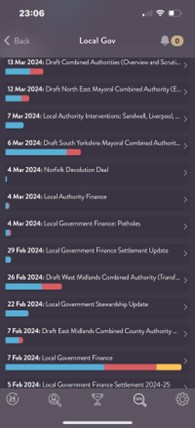
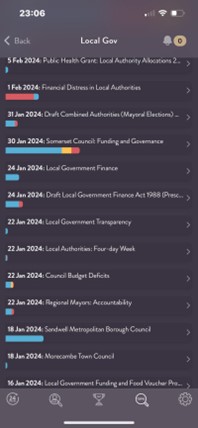
The charts below, taken from the Scrutiny Counts mobile app, show the Local Government debates that have taken place so far this year and the date they took place.
As can be seen from the screenshot charts, there’s a breadth of discussion on Local Government matters ranging from Financial Distress and Funding, Combined Authorities, Mayors, through to Four-day week working. Within the app, there is click-thru functionality which lets you see the full debate content, the MP’s who have participated, and the contributions they have made. There’s also “share” functionality to enable useful and interesting content to be quickly and easily shared with friends and colleagues.
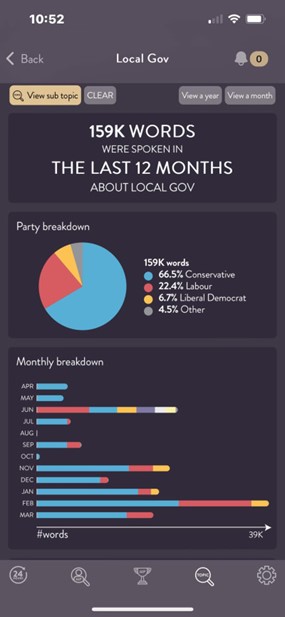
Looking across the past twelve months, there have been over 159,000 words spoken in Local Government debates (measured by words spoken as recorded in Commons Hansard).
Across the debates, Conservative MPs contributed into the debates 66.5%, Labour 22.4% and other parties 11.2% (this compares with the party split by number of sitting MPs of 53%, 30% and 17% respectively).
As can be seen in the “monthly breakdown” area of the chart below, after a relatively quiet few months over summer of 2023, the level of debate activity significantly increased during Autumn 23 and early 2024 with February 2024 being a particularly busy month.
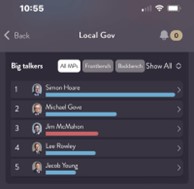
Perhaps not unsurprisingly the top contributing MPs in Local Government debates were government and shadow government ministers such as Simon Hoare (Parliamentary Under Secretary of State (Department for Levelling Up, Housing and Communities) and Jim McMahon (Shadow Minister (Levelling Up, Housing, Communities and Local Government) with contributions being made in their respective roles.
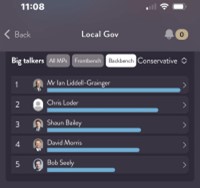
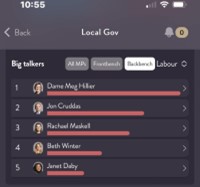
But aside from Frontbench MP’s, who have been the top contributing Backbench MPs in Local Government related debates during the last 12 months? (measured by words spoken as recorded by Commons Hansard).
The charts below show the top contributing Frontbench MPs, and the top contributing Backbench Conservative and Labour MP’s;
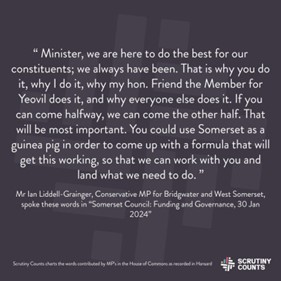
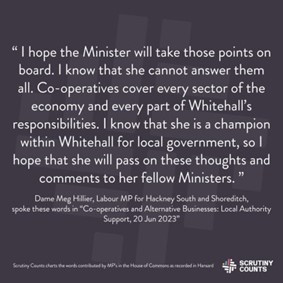
There are often detailed and constructive contributions into the debates from all the parties. The quotes shown below are taken from speeches given by the two top contributors in the above charts. They both give an insight into the work that MPs do in representing their communities and constituents in parliamentary debates.
So, in summary, yes Local Government issues are discussed in Parliament. The news in the mainstream media may focus on the weekly exchanges in PMQ’s, the political gossip of the day, or the topical late night divisions and votes, but in so doing many don’t see the work MP’s of all parties do in important debates across a range of subjects such as Local Government, Housing, Social Care, etc.
The contributions in debates are often constructive and well thought through, providing valuable insight for politicians, councillors, and council officers and all those with an interest in Local Government. The debates form an important function in bringing local issues to the national stage and play an important role in our democratic system.
The charts and images in the article are taken from the ScrutinyCounts mobile app which is available via subscription on Apple AppStore and Google Playstore. The app uses data as reported in Commons Hansard and presents it in an easy to digest format which enables users to quickly and easily read what MPs are discussing in Parliament.
Steve Watson is a Director of Hinc Ltd, the provider of the ScrutinyCounts mobile app. Steve started his career as an electronics engineer but quickly came to realise he was more suited to working with computers rather than designing them! After being a joint owner of a Local Authority data insight company which was successfully grew and subsequently sold, Steve started a new venture to develop a mobile app called ScrutinyCounts which enables users to quickly and easily see what is being said, and by who, in Parliament. More information about ScrutinyCounts can be found here or at Twitter/X @ScrutinyCounts






 INLOGOV Blog