The Jaws of Doom – still relevant a decade on

Chris Game

“Things from the past you’ll never see again”.  I came across a listing of these recently, and they were – well, moderately interesting. More so, anyway, than the accompanying “trends that have unfortunately returned” – pleated skirts, corsets, and structured vests, whatever they were.

The never-see-agains included smoking adverts, bubblegum cigarettes, and rotary push lawnmowers – to which I might easily have added “The Barnet Graph of Doom” as at least a never-expected-to-see-again.

It was a visual aid devised a dozen or so years ago primarily for the councillors of the London Borough of Barnet. It would come, however, to be associated with/appropriated by Birmingham City Council, and something with which some INLOGOV colleagues were so taken that it was discussed and illustrated in these pages not once but repeatedly – by, inter alia, me in May 2012 and January 2013 and the Institute’s then Director and this blog’s progenitor, Catherine Staite, in December 2012 and October 2013. Indeed, as Catherine notes in that second blog, it at least part-prompted an INLOGOV ‘book’ or, more accurately, Discussion Paper.

Impactful at the time, then, but at least not prominently, I presumed, over the ensuing decade. Certainly I, though at best semi-detached from these matters nowadays, was genuinely surprised to be confronted by its reappearance in a recent Financial Times (indeed, its double reappearance). Somewhat less so that it was credited entirely to Birmingham City Council, with Barnet getting, as my mother would have said, nary a mention. Which justifies at least a brief résumé, and for more senior readers a bit of reminiscence.

Some 15 years or so ago the very Conservative Barnet LBC acquired the not entirely flattering moniker of ‘easyCouncil’ – that precise orthography/spelling, though frequently ignored in the media, being arguably the policy’s most appealing attribute. With its stray upper-case C intendedly referencing the easyJet business model that inspired the council’s almost boundless outsourcing drive for no-frills efficiency, it embraced pretty well all services, from reduced-size waste bins and privatised street cleaning to limited ‘personalised’ adult social care budgets.    

Improved and cheaper services were obviously the aim, but senior officers foresaw that the sheer scale of demographic change – more children, more elderly – would in any foreseeable future take up an unmanageable proportion of the Council’s increasingly constricted budget. “No libraries, no parks, no leisure centres – not even bin collections”.  Hence the original Barnet Graph of Doom. The one on the left of the illustration, that is – the other, pleasing if more alarmist one, being a public ‘reminder’ tweeted a few years later, just as the social services budget was seriously taking off as forecast.

The Barnet graph, described at some length in my first blog and more summarily by the Guardian’s Public Services editor, David Brindle, started life as part of first a PowerPoint, later video, presentation used by the Council’s Chief Executive, Nick Walkley, to:

“focus the thoughts of colleagues and councillors …  In five to seven years we get to the point where it starts to restrict our ability to do anything very much else. Over a 20-year period, unless there was really radical corrective action, adult social care and children’s services would need to take up the totality of our existing budget.”

The tone, as Brindle noted, was deliberately alarmist, with the policy making no provision, inter alia, for Barnet’s anticipated rise in income through regeneration schemes. As an illustrative device, though, it was hugely effective. It featured regularly in local government media, and also in presentations by the late Sir Bob Kerslake – then Permanent Secretary at the DCLG, and whose outstanding career in both central and local government was fulsomely recounted following his recent death.

Alarming, yes, but “Where are the jaws?”, I hear you ask – and, of course, there weren’t any, yet. They were Birmingham Council’s contribution when it took the idea over and “simplified/dramatised” it by, as Patrick Butler put it, again in The Guardian, projecting “a ‘budget pressures’ line rising steeply to the top right of the grid, and a ‘grant reductions’ line crashing to the bottom right.”  It featured prominently as a ‘Jaws of Doom Graph’ in the council’s 2013 Budget Consultation document, and could indeed resemble, as Butler suggested, “a child’s depiction of a shark, or crocodile, about to bite its prey. Lunch, in this case, appears to be local government itself.”

In my January 2013 blog I sought to address the question of whether the ‘doom-mongering’ was entirely fair: Were “Birmingham and urban councils generally, or Labour councils, or the country’s most deprived areas, being particularly harshly treated by the government’s grant funding cuts?”

Which, you’ll be relieved to learn, I’ll not be bothering you with here – not least because, as already noted, for the vast bulk of the past decade I’ve personally given these particular ‘Jaws of Doom’ and their graph scarcely a passing thought. Now, though, I wonder whether that’s simply another consequence of a retiree’s detachment from the daily concerns and parlance of local government personnel. Could it be that this is what today’s finance officers jaw about, as it were, down the pub of an evening?

For suddenly there it was, weeks before the journalistic ‘silly season’, and in ‘The Pink Un’ – no, not Norwich City FC’s newsletter, but the albeit self-styled “worldʼs leading global business publication”: “The Jaws of Doom” graph in its original glory, and not once but twice. First, in a kind of editorial intro by Associate Editor, Stephen Bush, commending to readers William Wallis’ “excellent piece … featuring this alarming chart [shown on the right below] about the … ‘jaws of doom’ facing local authorities”.  And then Wallis’ article itself.

As you’d expect, it’s a good summary presentation – that I’d certainly be recommending to students, if I still had any – the thrust of which is that:

 “for more than a decade, local authorities in England have been sacrificing services and staff to what they call “the jaws of doom” – a reference to a graphic produced by Birmingham city council to show worsening budgetary pressures, that resembled a crocodile’s mouth.

Between rising demand for social care and other essential services, and the dwindling funds councils have received to provide these, discretionary spending on everything from libraries to youth clubs has already been eaten up.

Although local authorities won a better than usual financial settlement for 2023-24, 9.4% up on the year before, inflation running at 8.7% is eroding any benefits.”

And, having already well exceeded a thousand words, that’s where I’ll stop … though not before sharing the interesting and, more importantly, interactive graph of Sigoma’s English Indices of Multiple Deprivation also included in Wallis’ article – not new, so doubtless familiar to some readers, but to me unfamiliar, informative (see added results), surprising in places, and, I felt, worth sharing.  It made me (almost) sad not still to be lecturing and so able to play with it in public, as they say!

Chris Game is an INLOGOV Associate, and Visiting Professor at Kwansei Gakuin University, Osaka, Japan.  He is joint-author (with Professor David Wilson) of the successive editions of Local Government in the United Kingdom, and a regular columnist for The Birmingham Post.

Voter ID – the warning lights are flashing

Picture credit: https://www.electoral-reform.org.uk/why-the-governments-mandatory-voter-id-plans-are-a-terrible-idea/

Jason Lowther

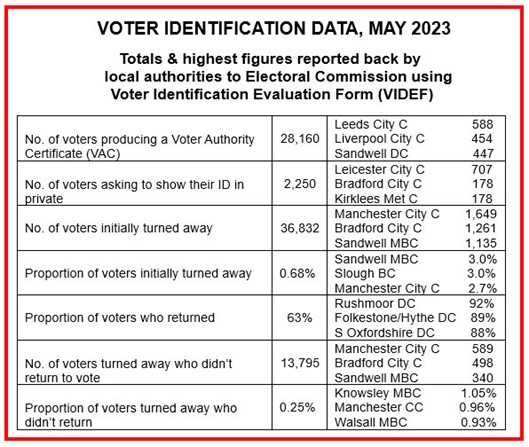
Previous columns have urged a cautious approach to the introduction of photographic voter ID in England.  The May 2023 elections provided the first nationwide test of the system, and early analyses are highlighting some significant issues. 

Elections took place in 230 areas in England and around 27 million people were eligible to vote.  This week, the Association of Electoral Administrators (the people in councils who actually deliver elections) issued their post-match analysis, highlighting ‘the fragility of the system’ and recommending a fundamental review of the country’s electoral arrangements.   

With less than four months between the enactment of the new legislation and polling day, which included new statutory duties on accessibility as well as voter ID, councils faced a huge and risky task to administer the new system effectively.  They also faced significantly more paperwork, with new forms to track electors unable to vote and new data capture requirements.  The AEA report significant impact on polling officials: ‘many of our members reported POs feeling overwhelmed by paperwork and the time it takes to complete throughout polling day and at the close of poll’.

The AEA report reveals that the government’s website to provide free photo ID to those needing Voter Authority Certificates (VACs) failed to work properly from its launch in January and many functions were still not available by the deadline to apply for a VAC for 4 May poll.  Updates were still being issued two weeks before polling day.  Almost 90,000 people applied for VACs by the deadline, well short of the Electoral Commission’s earlier estimate of 250,000 – 350,000 applications based on the proportion of local election voters who did not have suitable ID.  Many didn’t know they would need one – just over half (57%) of the overall population and those who said they did not already have photo ID were aware of VACs in May, according to the Electoral Commission.

The types of photo ID acceptable under the legislation proved rather esoteric.  Passports are accepted, but what about a passport from Zimbabwe or a British format immigration document?  London Oyster 60+ cards are accepted, but not the Merseytravel Over 60s pass which has similar application checks.  Photo IDs issued by councils themselves, such as taxi licences and gun licences, were presented but could not be accepted. Similarly police warrant cards, NHS and other emergency services photo ID were presented but unable to be accepted.

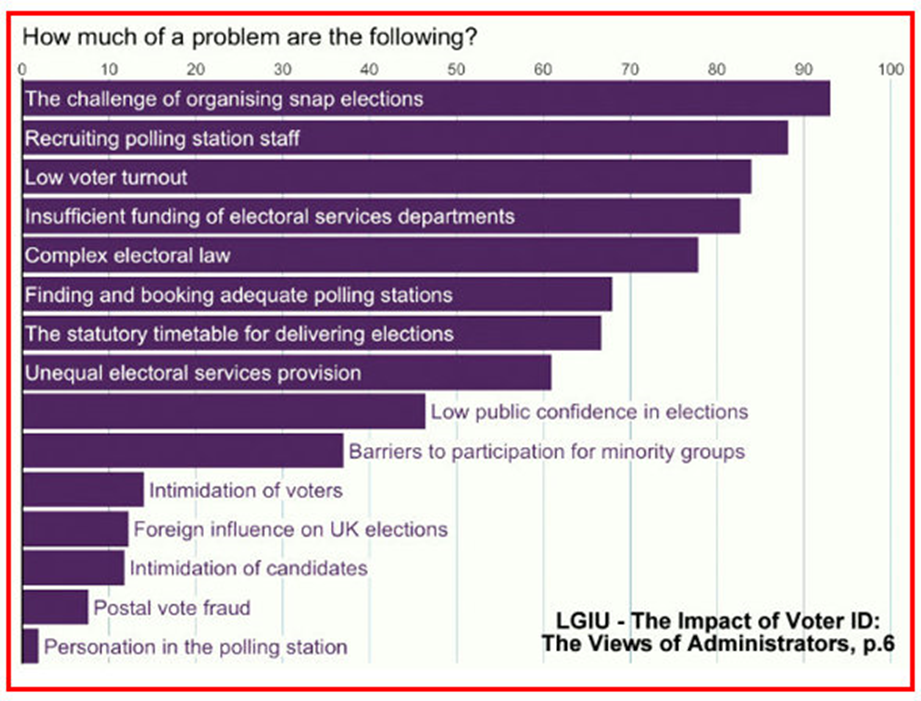
The Electoral Commission’s interim report on the election was issued on 23rd June.  They found that immediately before polling day, 87% of people in England (excluding London, where there were no elections) were aware that they needed to show photo ID to vote at a polling station – implying that around 3.5 m potential voters were not aware as the poll approached.  Awareness was lowest amongst young people, BME communities, those who haven’t previously voted in local elections, and people who didn’t have the necessary forms of photo ID.

To avoid voters queuing for a ballot paper and being turned away, in some areas ‘greeters’ were appointed to meet electors as they arrived and check whether they had an accepted form of photo ID with them.  Others provided posters and banners to explain the requirements outside polling stations.  Polling stations with greeters recorded a smaller proportion of people ‘turned away’ inside the polling station compared to those without greeters.  As a result of voters receiving advice outside the polling stations, and because of some other data issues, we should treat statistics on numbers of electors unable to vote with caution. Data collected inside polling stations shows that at least at least 0.7% of people (39,000 voters) who tried to vote at a polling station were initially turned away but around two-thirds of those people (63%) returned later in the day and were able to vote.  In some councils more than 1 in 100 electors were turned away.

More worryingly, the Electoral Commission found that 4% of people who said they did not vote in these elections gave an unprompted reason related to the ID rules, and the proportion of non-voters giving an ID-related reason rose from 4% to 7% when survey respondents were selecting from a list of reasons.

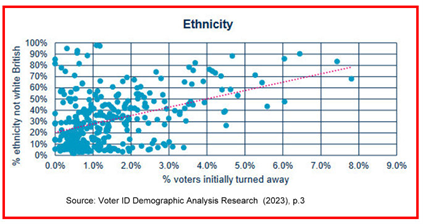
It was not possible to capture reliable demographic data on people who were not able to vote because of the ID requirement because electoral law did not allow polling station staff to collect demographic information about individuals who were turned away.  In the EC survey, disabled people and those who are unemployed were more likely than other groups to give a reason related to ID for not voting.

Voter confidence doesn’t seem to have been massively improved.  In fact, the EC found 68% of people were confident that the May elections were well run, compared to 73% in 2022.  For those who said they were not confident, the most common reason selected (by 46%) was that “some people were unable to vote due to the ID requirement”.

We await the Electoral Commission’s full report in the autumn.

Meanwhile, I close with an interesting comment made at the National Conservatism conference on the 15th May 2023 by former Secretary of State for Business, Energy and Industrial Strategy, Sir Jacob William Rees-Mogg:

Parties that try and gerrymander end up finding their clever scheme comes back to bite them – as dare I say we found by insisting on voter ID for elections.  We found the people who didn’t have ID were elderly and they by and large voted Conservative, so we made it hard for our own voters and we upset a system that worked perfectly well.

Jason Lowther is the Director of INLOGOV. His research focuses on public service reform and the use of “evidence” by public agencies.  Previously he worked with West Midlands Combined Authority, led Birmingham City Council’s corporate strategy function, worked for the Audit Commission as national value for money lead, for HSBC in credit and risk management, and for the Metropolitan Police as an internal management consultant. He tweets as @jasonlowther

Navigating between narratives of ‘vulnerability’ and ‘active citizenship’: how urban professionals facilitate citizen participation in marginalised neighbourhoods.

Simone van de Wetering

Residents of marginalised neighbourhoods have long been governed as a vulnerable group in need of help. Today, they are increasingly expected to be active citizens and (co-)creators in improving their neighbourhood. In the Netherlands, like in other European countries, local and participatory approaches are now central in urban policy for marginalised neighbourhoods. But what does this shift in governance approach look like in the work practice of urban professionals who give shape to citizen participation?

Urban professionals are known to play a key role in realising citizen participation: municipal and non-municipal professionals, ranging from civil servants to professionals working for welfare organisations and other social partners linked to the neighbourhood. What their role exactly entails is, however, not really clear. Especially in terms of the (dis)empowerment of urban residents and in marginalised neighbourhoods. 

On the one hand, urban professionals are seen to empower citizens. They can navigate between different roles and mediate between ‘the state’ and ‘the people’ due to their unique position in between. On the other hand, they can undermine residents’ power. This can happen when, despite emancipatory aims, decision-making authority remains in the hands of public officials or is shared only with a small group of already privileged residents.

I explored how urban professionals gave shape to citizen participation in my ethnographic study of a participatory governance approach in a Dutch marginalised neighbourhood. Here, I found that the work of these urban professionals cannot be classified simply as either empowerment or disempowerment.

While the participatory approach was discursively positioned as embodying active citizenship, in the work practice of urban professionals the idea of vulnerable places and people in need of help was not so easily replaced. Residents were viewed as having problems and simultaneously as having talents and capabilities; they were assumed to be in need of help from the government and from professionals, while also being able to come up with and execute initiatives to improve the neighbourhood.

As urban professionals translated the broader shift in the governance of urban marginality to their work practice, they navigated between narratives of ‘vulnerability’ and ‘active citizenship’ and employed, what I call ‘selective empowerment’. This is a differentiated approach towards citizen participation in which professionals ascribe a significant role to themselves as a continuous support system for citizens. In the words of one urban professional: “Participation needs to be supported. . . . We [professionals] need to create a canvas on which participation can go nuts. But you can’t expect a painting to arise without bringing the brushes.” Moreover, they facilitate participation within a normative framework of ‘appropriate’ or more traditional expressions of active citizenship. For instance, youths who violently protested in response to the COVID-19 evening-curfew were redirected to a youth council.

By employing selective empowerment, urban professionals reproduced existing categories of vulnerability while reworking the meaning of ‘active citizenship’ or ‘citizen participation’ with marginalised groups. Acknowledging vulnerability is then not (only) a reproduction of existing inequalities. It is also an embedded approach employed by urban professionals to facilitate context-specific citizen participation against the background of urban marginalisation. A discursive shift in governance approach is not automatically synchronised with the work practice of urban professionals. Based on my research, I propose a more nuanced understanding of the work of urban professionals beyond mere empowerment or disempowerment. These insights may provide a starting point for urban professionals’, and, more generally, local governments’, reflexivity: to challenge not only their perceptions of residents as ‘vulnerable’, but also the storyline of residents as ‘active citizens’. Such reflexivity could imply a move beyond discursive ideals of ‘active citizenship’ towards context-specific practices of participation in local neighbourhood policy.

Simone van de Wetering is a PhD candidate at the Department of Public Law and Governance of Tilburg University. Her research focuses on identity and inequality in the city. In her PhD project, she studies citizen participation in marginalised urban neighborhoods in the Netherlands and France. Taking an ethnographic approach, she zooms in on the strategies of citizens and the state to make urban change.

twitter.com/simvdw

linkedin.com/simonevdwetering

Photo credit: opensource.com

Oops!  We lost two Mayors – let’s overthrow a sensible system

Chris Game

I assume it was the 2021 mayoral election results that finally clinched it. With the Conservatives winning just two of that year’s 13 mayoralties to Labour’s 11, it was time to enact the party’s 2019 manifesto pledge – “to continue to support the First-Past-The-Post (FPTP) system of voting, as it allows voters to kick out politicians who don’t deliver, both locally and nationally”.  Specifically, the Supplementary Vote (SV) system – despite also, like electoral systems generally, featuring the kicking-out of politicians – had to be replaced for mayoral and Police and Crime Commissioner (PCC) elections asap.

True, the counting of electors’ supplementary – second preference – votes had just enabled West Midlands Conservative Mayor, Andy Street, to be re-elected with the useful perk of a narrow overall majority of votes cast, along with the party’s rising star, Tees Valley’s Ben Houchen, who’d swept in with nearly 73% of first preference votes.

No supplementary second round necessary there, but nor should there have been, reformers reckoned, in Cambridgeshire & Peterborough, where the established Conservative Mayor, James Palmer, had been a victim of the dastardly SV ‘system’. He’d comfortably led Labour’s Nik Johnson after the count of first preference votes – by nearly 18,000 votes or 8%. Yet, by some foul trickery, or possibly because he simply wasn’t as broadly appealing his opponent, after the counting of relevant second preference votes, he’d fallen behind: 48.7% to new Mayor Johnson’s 51.3%.  Despite Government Ministers repeatedly claiming that “the candidate with the most votes” lost, he hadn’t. He’d won – he just wasn’t Conservative.

Anyway, Palmer threw what looked like a wobbly, promptly retired from politics, and SV elections for Mayors and PCCs would be retired with him, though not in time for last May’s Mayorals, which very nearly produced a Croydon re-run of that Cambs & Peterborough result. First count: Jason Perry (Con) 34.8%, Val Shawcross (Lab) 32.7%. Second count: Perry 50.4%, Shawcross 49.6% – the candidate with the leadership-resonant first name just edged it.

By then, though, the FPTP legislation was well under way. The next Mayoral elections – this May – would use FPTP, as will next May’s PCC elections. It seemed a good time for a review of the whole SV lifespan, facilitated by the invaluable statistical records of my polling specialist friend, David Cowling.

Quickish review: the Supplementary Vote is obviously not a proportional system, which would be tricky when electing single Mayors, Police & Crime Commissioners, etc.  Rather, it’s a simplified majoritarian system, enabling voters to rank their two most favoured candidates on the ballot paper in order of preference.

If no candidate gets over 50% of first preference votes on the first count, just the top two candidates continue to a run-off, thereby encouraging candidates from the outset to seek support beyond their core supporter base. The winner may still get less than half the total vote, but will need significantly wider support than under FPTP, and especially under FPTP with a lowish turnout.

Both, however – ultra-topical insert – are more democratic than this past weekend’s Spanish ‘mayoral’ elections, in which Barcelona Mayor Ada Colau, almost certainly the nation’s best-known mayor both at home and abroad, is seeking a third term of office … but as Leader of a two-party socialist coalition – for Spanish mayors aren’t even elected by ‘the people’, but indirectly by fellow councillors.

The name – Supplementary Vote – may have been new when it was ‘invented’ by an early 1990s Labour Working Party, but essentially similar ‘preferential’ systems had been quite widely used internationally for ages. France’s Presidential ‘double-ballot run-off’ was one example, but most obviously there was the Alternative Vote – the actual subject of Winston Churchill’s senseless but oft-recycled quote, about it rewarding “the most worthless votes given for the most worthless candidates” – although today’s Conservative critics have no difficulty unearthing and redirecting it to SV.

I’m old enough to recall lecturing about the SV’s UK ‘invention’ by a Labour Party working party in the early 1990s and the even then revered ‘psephologist’, the late Sir David Butler, getting uncharacteristically incensed about it – calling it “silly”!  But his sphere of matchless expertise was parliamentary elections, with turnouts at the time of consistently over 70%. Even they, though, have slipped a bit since, and well over a third of today’s MPs won less than 50% of their constituency vote, and that’s an awful lot of voters left feeling unrepresented.

Local (including mayoral) election turnouts, however, are proverbially in another ballpark – and this is probably the blog’s key point. Except when they coincide with parliamentary elections, they average around 40%, and that’s on good days. PCC turnouts, unsurprisingly, are significantly lower still – not one of the 39 areas in England and Wales managing even 51% in May 2021, and Durham and Wiltshire not quite achieving 17%.  All of which, under FPTP, will mean large percentages of the votes of the most civically conscientious and politically committed citizens being ‘wasted’ and, arguably even more importantly, the mandates of the elected mayors and PCCs correspondingly diminished.

And then there’s the loss of the visual aids – for SV also produces what I only recently discovered are called ‘Sankey charts’, illustrating how the second-round count both produces a winner able to claim a statistical majority of positive votes and a dramatic reduction in the proportion of ‘wasted votes’ – on the part of voters choosing not to make use of their possible second choice. Good, isn’t it!

The Supplementary Vote, then, still favours the two main parties, but, returning to recent history and as shown in the following table, one in three of the 67 SV Mayoral elections going to second counts were won by Lib Dems, Independents and other parties. Labour won by far the most mayoral contests, but they also lost most in second counts. All of which contributes to SV hovering around mid-table in global democratic rankings of electoral systems – nothing to shout home about, except when compared with FPTP’s ranking as ‘least democratic’, apart from maybe Djibouti’s ‘Party Block Voting’.

SV’s statistical merits apply in principle to any elections, but particularly to a set in which two-thirds of turnouts were under 50% and nearly a third under 40% (see table). First, it hugely reduces the number and proportion of so-called ‘wasted votes’ – those cast for neither of the leading two candidates – and secondly it ensures that the winning candidate can claim the majority backing not necessarily of all voters, but at least of those the system counted.

My presumptuous guess would be that West Midlands PCC Simon Foster likes knowing, and possibly even mentioning now and then, that he was elected with 53.7% of the vote, rather than 45.5%. And, while I don’t know any of these people, that Surrey PCC Lisa Townsend (one of 12 women PCCs, if you were wondering) definitely prefers her 58% to 33.5%.

Time to start closing, by checking out the arguments Ministers sought to make to justify their replacement of SV with FPTP – or, rather, plundering the critique the Constitution Unit’s Alan Renwick and Alejandro Castillo-Powell made at the time.

  1. That SV increases the number of spoilt ballots – possibly, very fractionally; but, if so, why not work on improving ballot paper design?
  2. It allows ‘loser candidates’ to win – stupid argument (see above); they won the election they were required to contest.
  3. It reduces the accountability voters have in expressing a clear choice – but increases it by saving them from calculating how best to cast their single vote ‘tactically’ to elect or defeat a particular candidate.
  4. “FPTP is the world’s most widely used electoral system.”  Tricky – needs its own separate blog; also a bit silly. Depends a bit on whether you mean number of countries or number of voters. India, Pakistan, Bangladesh and the US give FPTP a head start. More to the point, a 650-Member legislature isn’t the same as a single elected mayor or PCC.
  5. SV is an “anomaly … out of step’ with other elections in England.” True, it was decisively rejected in the 2011 referendum for the election of MPs, but these are the country’s only public elections to executive offices. In short, they’re completely different.  

None of which, of course, stands the remotest chance of influencing, never mind changing, anything … but it was quite enjoyable to ‘research’ and write!

Chris Game is an INLOGOV Associate, and Visiting Professor at Kwansei Gakuin University, Osaka, Japan.  He is joint-author (with Professor David Wilson) of the successive editions of Local Government in the United Kingdom, and a regular columnist for The Birmingham Post.

Picture credit: Theresa Thompson at www.flickr.com/photos/theresasthompson/

Lessons from literature for local government

Professor Catherine Staite LLB, MBA, FRSA

No man is an island entire of itself: every man is a piece of the continent, a part of the main;

If a clod be washed away by the sea, Europe is the less, as well as if a promontory were,

As well as any manner of thy friends or of thine own were.

Any man’s death diminishes me because I am involved in mankind,

And therefore, never send to know for whom the bell tolls;

It tolls for thee.

John Donne

When every week seems to bring news of yet another major failure of governance in a local authority, some members and officers in other councils will be fearful that the same fate will befall their own council before too long, while others will be confident that all will be well for them.

When we look at the notable governance failures that have occurred in recent years, we see a very complex picture. Causes of failure are many and varied, ranging from the absence of the most basic controls to ambitious but risky money-making schemes. Some patterns are visible in all the complexity, including, failure to listen to officer advice, engaging in commercial activities without the requisite skills and knowledge, weak financial controls and opaque decision-making processes.

Councils need both strong rules, about finance and behaviour and strong public service values. Constant vigilance and honest collective self-reflection are vital to ensure that decision makers are independent, transparent, accountable, behave with integrity, have a sense of shared purpose and focus on outcomes. Ask yourself – are our informal and formal governance arrangements fit-for-purpose? If not, where might the weaknesses lie? Look at your structures. Are your Constitution, Codes of Conduct and Standing Orders up-to-date? Is your organizational structure robust? Are your s151 officer and Monitoring Officer on the senior management team and do they report directly to the Chief Executive? Then look at your systems. Are decision making processes clear? Can projects be started without the right sign-off? Can officers exceed their authority without consequences? Last, but by no means least, take a long hard look at organizational behaviour. How do leading politicians and officers respond to being challenged? Is bad behaviour rife but undiscussable?

It’s important to avoid complacency. Most of the members and officers leading and managing councils that have failed to uphold the best standards of good governance either thought what they were doing was fine, or that they could get away with it. Sometimes those who are part of an organization are the last to notice how the patterns of weak governance and bad behaviour, which have become so familiar that they cease to be noticed, will eventually lead to their downfall. Even when officers can see that their council is not going to able to balance its books or manage its risks, it can be difficult to speak up if members do not want to listen and it can be career limiting when a bullying culture prevails. Although statutory officers have statutory powers and duties, they are will not be protected from retaliation if they are perceived to be raining on the parade of colleagues and members who, because of ambition or political expediency, have lost sight of what good governance looks like. The statutory protections that attach to senior roles are not proof against bullying or actions amounting to constructive dismissal. The power imbalance between members and officers remains significant because while members may lose positions of power, or even their seats, officers risk losing their livelihoods and even their careers.

Those members and officers who consider themselves safe from failure may take some guilty pleasure from the failure of another council, especially if its run by another party. Councils have been encouraged to compete with each other for funding and kudos, so perhaps it’s natural to feel that the standing of better run councils goes up when the reputations of failing councils go right down. That’s a big mistake, for two very strong reasons; failure of one local authority reduces public confidence in local government as whole and it gives central government convincing reasons for not delegating resources and power to a local level. For all that we refer to ‘sovereign’ councils, no council is ‘an island, entire of itself’ and the failure of one diminishes all. When we open the LGC or MJ, to see for ‘whom the bell tolls’ we should hear the message that ‘it tolls for thee’.

Picture credit: Maggie Meng https://www.flickr.com/photos/snowfish2014/

Catherine is a researcher, consultant and coach who specialises in strengthening leadership, improving governance and supporting senior politicians and managers.  She is an independent consultant with Darlingburn, a small consultancy practice and is working with Grant Thornton on local government audit, specializing in governance. She was the Director of the Institute of Local Government Studies (INLOGOV) at the University of Birmingham from 2011 to 2017.

Local councils must work harder at enabling women to be councillors

Picture: Haringey Council’s 2022 cabinet

Jason Lowther

Local councils can and must do more to enable women to be councillors. Haringey’s new cabinet shows that this can be done, but fifty years after all government elected officials across the UK were finally elected under universal suffrage, new research shows barely a third of local councillors and MPs are women, whereas earlier research showed less than a quarter of Police and Crime Commissioner (PCC) candidates were women.   This matters not only in terms of democratic fairness, but because politicians’ characteristics impact on public policy.

The research published last week by the Fawcett Society and Democracy Club reflects councillor representation in August 2022 across the UK.  To collect the data, they had to scrape individual council websites since (incredibly) there is no official record of councillors’ gender (or other protected characteristics).  This is because the relevant section of the Equality Act 2010 has still not yet been enacted and in any case as drafted would apply only to candidates in national elections.  This is in contrast to council staff, where the Equality Act applies and has led most councils to capture and publish reasonably detailed assessments of workforce equality issues – as shown by the recent SOLACE / Shared Intelligence report, ‘Understanding and Improving Equality, Diversity and Inclusion in the Local Government Workforce’ which we discussed on the blog last autumn.

The Fawcett Society / Democracy Club results show no party yet has parity of representation between women and men, but some are doing much better than others.   The highest proportion of women is found in the Labour Party (47%) and the lowest in the Conservative Party (29%), the SDLP, DUP, and Ulster Unionist Parties. 

Source: Gender representation on local councils, Fawcett Society and Democracy Club (2022)

At individual council level, the highest proportions of women councillors were found in Haringey (65%), Rossendale (61%), Brighton and Hove (56%), Lewisham (56%), and Southwark (56%).  In contrast, Perth and Kinross, Pendle, Comhairle nan Eileen Siar and West Berkshire each have 15% or less of the council made up of women councillors.

One effect of having fewer women decision makers may be that issues that disproportionately affect women are given insufficient attention.  Policymakers play key roles in promoting status-based policies.

Recent research by Professor Francesca Gains (University of Manchester) and Professor Vivien Lowndes (Inlogov) published in the journal Politics & Gender in 2021 analysed the effect of Police and Crime Commissioner’s gender on policymaking around violence against women and girls (VAWG).  An earlier quantitative phase of their research found that policy prioritisation was linked to Police and Crime Commissioners’ own gender, with female PCCs twice as likely to prioritize VAWG.  Their later research analysed how this difference occurred, identifying ‘seven sets of rules that have shaped policy prioritization in favour of VAWG: the right to make key appointments; the requirement to set policy priorities; the obligation to utilize equalities duties; the power to commit resources; the expectation of partnership working with other agencies; the commitment to hold operational police officers to account; and the maintenance of diverse channels of contact with victims of crime and the wider public’ (Gains and Lowndes, 2022, p. 396).

To improve the situation, the Fawcett Society / Democracy Club report makes recommendations to government, political parties and local councils.  For councils, the key actions are:

  • implement parental leave policies, to make being a councillor more accessible to those with caring responsibilities;
  • ensure that caring and dependency allowances reflect the real cost of childcare and are accounted for separately from ‘main’ members’ allowance;
  • pilot alternative ways of working including online and hybrid engagement mechanisms to enable councillors with caring responsibilities to carry out their duties more effectively; and
  • adopt codes of conduct, based on the model developed by the LGA in 2020

Local councils can only be truly effective when they represent the communities they serve.  The Fawcett Society report is a timely reminder that we have a long way to go, but the first steps are clear and practical.

Jason Lowther is Director of the Institute for Local Government Studies (INLOGOV), University of Birmingham

Reference

Gains, F. and Lowndes, V. (2022) ‘Identifying the institutional micro-foundations of gender policy change: A case study of police governance and violence against women and girls’, Politics & Gender, 18(2), pp. 394-421.