Unsuccessful Political Parties. Exploring and Combining Party Death and Party Failure

Julien van Ostaaijen and Sander Jennissen

‘I am fed up. It was interesting, fascinating, and frustrating. As a small faction it is difficult to be on top of everything and I noticed that I became less focused’. This is how one of many Dutch councillors explains why his party will stop having representatives after the election.

Participating in elections and having representatives elected is one of the main characteristics of political parties. However, political parties can be unsuccessful. They can stop having representatives elected. In the Netherlands, every four years, at least 15% of all Dutch local political parties lose all their representatives. What can happen to parties losing all representatives and what happened to the Dutch parties?

Figure 1: An oversight of unsuccessful parties: party death and party failure
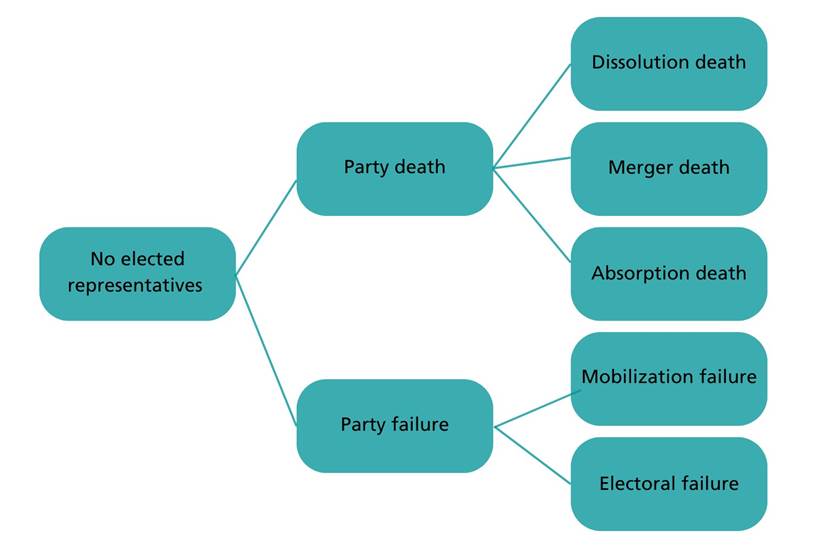
In our article, we separate five possible reasons for political parties losing all representatives (Figure 1). In our framework, the first category is that of party death. In this category, the political party ceases to function as an independent, autonomous organisation. This category encompasses dissolution death (the party organisation no longer exists), merger death (the party has merged with another party), and absorption death (the party has been taken over by another party). The second category is that of party failure. In this category, the political party still functions as an independent, autonomous party organisation and is thus not ‘dead’. However, for other reasons, it no longer has elected representatives. This can be because of a mobilization failure (the party has ‘failed’ to present candidates for (re-)election and thus temporarily withdrawn from the election process) or electoral failure (the party participated in the election but failed to have any representatives elected).

In the Netherlands, we found 129 local political parties that had representative elected in the local elections of 2014, but no longer in 2018 (and most also not in the elections of 2022). Using several data sources, including election results, party websites and media reports, we analysed what had happened to these parties (Figure 2).

Figure 2: Results for local parties with no elected representatives in 2018
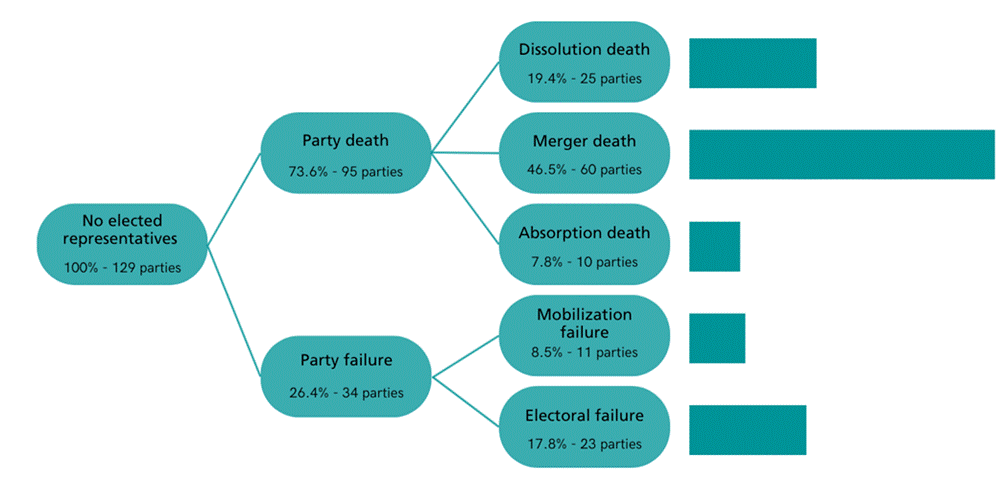
Our data show that about three-quarters of all the parties that ceased to have elected representatives after the 2018 local elections had effectively ‘died’, meaning that they ceased to exist as an autonomous organisation. However, most of the parties placed in this category had merged with other parties and therefore continued as part of a new party organisation. This pattern is closely connected to a trend in Dutch local political practice: between 2014 and 2022 the number of Dutch municipalities decreased by about 15% and many local party mergers took place in municipalities that were amalgamating around the same time. The remaining quarter of local parties with no representatives experienced party failure, meaning that they either did not gain sufficient votes to elect a representative, or decided to temporarily not participate in elections. It is noteworthy that the vast majority of these parties can be considered effectively dissolved four years later, in 2022, supporting the view that party failures, consisting of electoral and mobilization failures, are a prelude to party death. Nevertheless, the posited causal relationship should be further investigated.

Regarding our theoretical framework, we would urge to keep separating party death from party failure. In the literature, there are many different definitions and overlaps between concepts. Party death refers to the end of the party organisation. Party failure relates to not participating in the elections or not winning enough votes to elect a representative.

Looking forward, we believe that our framework provides greater clarity for analysing the final stages of political parties at both local and national levels. The five subcategories encompass the different ways in which parties are unsuccessful, i.e. have no elected representatives from one election to the next. The model can identify the circumstances that explain why this is the case. In the Dutch case this was largely due to municipal mergers and therefore party mergers. Applying the model in different countries with different systems will most likely lead to different results. Applying the model to national politics will also be a further test of its relevance.

Find our full article here: https://research.tilburguniversity.edu/en/publications/reasons-political-parties-lose-their-representatives-combining-pa

Julien van Ostaaijen is a professor of Law & Safety at Avans University of Applied Sciences and an assistant professor in Public Administration at Tilburg University. His research interests include local institutions and parties, the relationship between society and politics, local safety, and good governance and countervailing power.

The Little Black Book of the Populist Right

Jon Bloomfield

The spectre of the Populist Right haunts our politics: Farage and Trump, Orban and Le Pen. Why and how has this reactionary movement managed to redraw the political map from Warsaw via Workington to Wisconsin? Co-written with playwright David Edgar, our Little Black Book of the Populist Right is a crucial analysis of one of the greatest challenges of our time. Who votes for the 21st century demagogues eroding our politics – and why? What structural forces have aligned to enable their rise to power around the world?

In one short book, we provide a concise, accessible history and analysis of the Populist Right.

  • How the failures of globalisation – wealth inequality, outsourcing, the instability of global financial markets – and the retreat of social democratic parties from their traditional defence of ‘the labour interest’ and public services has left the space for cynical right-wing demagogues to exploit and come to power under the guise of “taking back control”.
  • How its ideology of national populism rewrote the right’s playbook, throwing up charismatic, often racist leaders, who appealed to new coalitions of abandoned voters.
  • How descendants of the interwar far right sanitised their parties, new anti-immigration movements emerged in Europe and the populist right invaded existing mainstream parties in Britain and America.

The book exposes the fallacies, flaws and fantasies of national populism. It tackles head-on the ideas of its main ideologues – the 4 Gs: Matthew Goodwin, David Goodhart, John Gray and Maurice Galsman. It then shows how progressives can fight back.

To halt the forward march of the populist right, we argue for a new paradigm, a progressive, bold vision of an alternative globalisation; a politics built on empathy and solidarity; new industrial and urban development strategies; and much, much more.

“Combines clear and concise analysis with a compelling case for action” Professor Jonathan Portes.

“A brilliant book” Neal Lawson, Director of Compass.

“Vital reading” Helena Kennedy KC

Available in all good bookshops £9.99 or on-line. Populist Right — Byline Books

Dr. Jon Bloomfield. Honorary Research Fellow, Institute of Local Government Studies, University of Birmingham.

Two cheers for combined authorities and their mayors

Vivien Lowndes and Phil Swann

There are reasons to be cheerful about the fact that the newest component of English local government, the mayoral combined authorities, were in the headlines this spring. There were also reasons for caution, however, most notably the particular focus on two of the mayoral elections, in Teesside and the West Midlands, as a guide to the popularity (or not) nationally of Rishi Sunak and the Conservative Party.

This fact that combined authorities were in the news is a prompt to take stock of their development and impact with some thoughts stimulated by the discussion at a recent INLOGOV Brown Bag[1] session.

The media attention was attributable to the mayoral elections, with many of the incumbent candidates having established a national profile by, for example, challenging the government’s approach to Covid (Andy Burnham in Greater Manchester), defying political gravity and weak governance (Ben Houchen in Teesside) or crafting a new brand of active, compassionate Conservatism and challenging the government’s pruning of HS2 (Andy Street in the West Midlands).

The mayors have also disrupted the escalator assumption of British politics in which ambitious politicians use local government as a stepping stone to parliament and government. Burnham, Liverpool City Region’s Steve Rotherham and the new mayor of the East Midlands Claire Ward have each moved in the opposite direction.

The metro mayors undoubtedly have higher profiles than most council leaders. They have demonstrated impact beyond their statutory remit through soft power, particularly their ability to convene discussions and galvanise action on issues such as public health and homelessness.

Doubts remain about the sense of vesting so much power in a single individual. Only three of the twelve metro-mayors are women, showing the danger of equating ‘strong leader’ with ‘strong man’. More effort is needed on the part of political parties to diversify their mayoral candidate selection.

It is also valid to question whether, for example, an elected mayor in the West Midlands would have added more value as part of the city council’s governance rather than that of the wider city region. Some would argue that the city would benefit from the type of focussed political leadership that Mayor Jules Pipe provided in Hackney. Experience in both Liverpool and Bristol suggests that having a mayor at both city and city region level causes confusion.

There has been very little discussion about the role of council leaders as key players in the governance of combined authorities through their membership of the mayors’ cabinets. As one council leader in Greater Manchester is quoted[2] as saying: “We have to work with a mayor we did not want while he has to work with a cabinet he did not chose”.

The Greater London Authority model is very different, with a separately elected London assembly as well as a mayor. While this may seem more democratic, public awareness of the assembly is far lower than that of the mayor[3]. Perhaps it is time for a comparative review of these two very different sets of governance arrangements. In both cases, there is a strong argument for greater public involvement outside of the electoral cycle, both in setting up new combined authorities and to inform ongoing priorities.

The role of council leaders is inevitably linked with the wider question of the relationship between the combined authorities and their constituent councils. To date this has proved to be remarkably smooth, particularly given the often toxic precedent of county-district relations. The next period may be more testing. To date, councils and metro mayors have been united in coping with austerity, but difficult decisions about priorities will have to be taken should a new government make limited additional resources available. The increased interest of combined authorities and mayors in strategic spatial planning and housing will also raise challenging and potentially divisive issues.

The jury is out on the extent to which the establishment of combined authorities has led to substantive devolution of power from central government, although progress has been made in areas such as adult education, transport, health (in Greater Manchester) and mental health (in the West Midlands). While the new ‘trailblazer deals’ in Greater Manchester and the West Midlands promise a single funding settlement with central government, other combined authorities find themselves still bogged down in competitive bidding for relatively small pots of money.

One important feature of combined authorities is the way they are creating opportunities for innovation and testing new ways of working at a local level. To fully exploit the potential of this development it is important that arrangements are put in place to capture this learning and share it between combined authorities, and especially with newcomers like East Midlands, North East and York and North Yorkshire. There is also potential for metro-mayors to speak with a stronger collective voice in challenging and informing central government on issues affecting local and regional governance.

Finally, it is important to remember that combined authorities did not begin with a blank sheet of paper. The GLA and many of the combined authorities have similar boundaries as the GLC and metropolitan counties which were abolished by Margaret Thatcher in a fit of political pique in the 1980s.

Harold Macmillan pioneered regional arrangements for devolved delivery with regional boards to promote industrial productivity during the second world war and regional housing production boards to help meet his 300,000 a year housing target in the 1950s. Neither were well-received in Whitehall. John Prescott followed with his regional development agencies, abolished by Cameron’s coalition government, and his failed bid to create regional assemblies. What marks out combined authorities is the lack of a ‘one size fits all’ approach, with size, functions and governance arrangements varying around the country.[4] Indeed, only 50% of England’s population live in combined authority areas (so far).

Given this rocky terrain, it may be rash to vest too much hope in combined authorities and their mayors. But they clearly have the potential to disrupt our centralised politics and join-up aspects of regional governance after decades of damaging fragmentation.

Vivien Lowndes is Professor Emerita in the School of Government, University of Birmingham.

Phil Swann is studying for a PhD at INLOGOV in the Department of Public Administration and Policy, University of Birmingham, on the contribution of politicians to central-local government relations.

Picture credit: https://www.birminghammail.co.uk/black-country/sir-keir-starmer-walsall-pledges-29162669


[1] INLOGOV’s Brown Bag sessions are informal monthly discussions on events in and around local government bringing together academics, researchers, students, practitioners and alumni. For further details please Phil Swann ([email protected])

[2] Blakeley, G and Evans, B. 2023 How metro mayors are getting things done – even if they have limited money and power. The Conversation June 28 2023.

[3] According to London Elects (londonelects.org.uk) in January 2020 58% of people were aware that a mayoral election was taking place compared with 32% for the assembly election (down from 40% in 2016).

[4] Durose, C. and Lowndes, V. 2021. Why are designs for urban governance so often incomplete? A conceptual framework for explaining and harnessing institutional incompleteness, Environment & Planning C: Politics & Space, https://doi.org/10.1177/2399654421990;

Durose, C. and Lowndes, V. 2023. The pros and cons of messy devo (themj.co.uk) Municipal Journal 

Inflation and Local Authority Budgets

Andrew Coulson

Our two main political parties are locked in a strange debate about the next budget, on 6 March. The elephant in the room is the underfunding of local government.

In the nearly 14 years of Conservative government, the core spending power of local authorities has been cut by 27% in real terms.[1] The County Councils Network has “warned that its members are under extreme pressure, and that the authorities they represent are set to overspend by almost £650m this year due to spiralling costs, particularly in children’s social care and home to school transport, which was contributing to a £4b funding deficit for those authorities over the next three years”. In addition an increase in the National Living Wage is expected to costs these councils £230m next year.[2] This has happened at a time when the ability of councils to raise their council taxes has been held down, for 2024-5 to below 5% for all but a tiny number of councils.[3]  One of its consequences has been the inability of the employers in local government and the NHS to negotiate pay settlements which reflect the rate of inflation, or anything near it.

My reading of the present position is that Gove on the one hand and Rachel Reeves on the other are playing chicken. Each are waiting for the other to move first. They both know that after the general election a new government will have to settle the long-standing pay disputes in the public sector, and that it is not possible, year after year, for the pay of staff employed by local government and the NHS to rise by less the rate of inflation. The consequences are visable: depressed morale, a haemorrhage of experienced staff, and dependence on immigration to employ new staff. Rachel hopes that the Conservatives will be forced to confront this before the election. Gove wants the Labour Party to commit to doing it, because as of now any settlement is unfunded.

My view is that the understanding of inflation both by the two main political parties and the Bank of England is naive, especially as it relates to government policy. The starting point should be that inflation affects the distribution of income. It is an intrinsically political process. Most large companies and the richest people have means through which they can compensate for any inflation. Those who do not have the power or muscle to do so pay the price. Thomas Piketty[4] showed that inflation was the main means by which the middle classes paid for much of the costs of two world wars.[5]  In those inflations, and in the last significant inflation in the UK, which followed the OPEC hikes in oil prices in the 1970s, the trade unions were strong enough to ensure that wages rose at around the rate of inflation. This is no longer the case.

Yet the recent inflation has given the Government unprecedented increases in tax, which means that, if they so choose, they can afford wage increases. Most of this extra income arises from not raising the ceilings on higher rates of tax. Jeremy Hunt would like to use it to lower rates of income tax. The IMF (no less!) has told him that it is not appropriate to do so at this time.[6] The main reason, not always clearly stated, is that there are many unfunded challenges, but of these the public sector pay disputes (and perhaps the need for additional spending on defence, where difficulties in retention and recruitment are also partly a matter of pay settlements not keeping up with inflation) are top of the list. 

Economists in the UK, the USA and other developed countries have had little to say in recent years about inflation. As if it is no longer a problem, which it probably isn’t if inflation stays at around 2%. But the present inflations, driven by wars, the climate crisis and the lockdowns, are another matter. Economic theory is little help. All the traditional theories have been shown to be false. It is not true that inflation and unemployment are opposites: we can have both together, so-called stagflation. Or that it can be controlled by limiting the supply of money, which is not possible when most of it is created by banks which lend far more than they hold in deposits. Or that it is either created by unexpected demands or by unexpected costs.

The British Government urgently needs to resolve the disputes about pay in the public sector, and to do so recognising that most local government employees are substantially worse off than they were before. The Labour spokesperson Angela Rayner has made the practical proposal of negotiating a three year settlement.[7]  It cannot come soon enough.


Andrew Coulson is a nationally-recognised expert on scrutiny in local government and is particularly interested in governance by committee.


[1] Local Government Association, https://www.local.gov.uk/about/campaigns/save-local-services/save-local-services-council-pressures-explained 2024

[2] https://www.countycouncilsnetwork.org.uk/councils-in-significantly-worse-financial-position-after-the-autumn-statement-with-seven-in-ten-now-unsure-if-they-can-balance-their-budget-next-year/

[3] A prescient academic law professor, writing as long ago as 1984, wrote “It seems to me that the provisions for rate-capping … are little removed from a proposal to replace elected councils by administrative units. For a very long time, local inhabitants have enjoyed the right to elect local representatives with the power to tax, and so to determine, within modest political limits, what level of services shall be provided in the locality. … I have no difficulty in saying of an Act to put a limit on the rates leviable by a local authority that it is politically unconstitutional”. John Griffiths, in the Preface to Half a Century of Municipal Decline 1935-1985, George Allen and Unwin, 1985, p.xii

[4] Thomas Piketty, Capital in the Twenty-First Century, Harvard University Press, 2014

[5] The point was also made by one of his critics, Joseph T Salano, “War and the Money Machine: Concealing the costs of War beneath the Veil of Inflation” in John V Denson (ed.) The Costs of War, Routledge, 2nd edn. 1999 

[6] David Milliken and William Schomberg,  https://www.reuters.com/world/uk/imf-cuts-uk-growth-outlook-2025-after-stronger-past-performance-2024-01-30/

[7] “Rayner floats three year pay deal”. Municipal Journal, 14 Feb. 2024

Lessons from former ministers could help a new government prepare properly

Leighton Andrews

Keir Starmer’s shadow ministerial team has now started the access talks with the civil service which Prime Ministers traditionally permit in the run-up to a general election. These talks are designed to help the civil service familiarise itself with both shadow ministers and the potential policies of a new government, and to help shadow ministers understand the mindset of senior civil servants.

Not all shadow ministers transition to the same policy role in government, of course. Tony Blair’s former chief of staff, Jonathan Powell, revealed in his 2010 book The New Machiavelli how in their access talks, they had to arrange for one Permanent Secretary to meet two different shadow ministers – the one who currently had the portfolio, and the one they intended to do the job if New Labour won the election.

There is no manual on how to be a minister, and new ministers have often found themselves taking time to adapt to their new roles, aided by their private offices whom they meet on their first day after their appointment. Interviews contained in the Ministers Reflect archive of the Institute for Government, now almost 150-strong, confirm the centrality of the private office to a new minister’s life. They help them settle in, introduce them to the routines and artefacts of ministerial life, and prepare them for their first performances in the role. But private offices are double agents, warns former Conservative Cabinet Minister Ken Clarke, feeding information to ministers on the running of the department and feeding information back to the Permanent Secretary on the new minister.

The civil service is not, most former ministers believe, a conspiracy designed to stop ministers carrying out their objectives. Most praise the support they had from civil servants. But there is a genuine tension between the activist desire of ministers to ‘make a difference’ and the long-established processes of the civil service machine. My research in the Ministers Reflect archive suggests that over the last quarter-century, ministers have taken a stronger interest in issues of delivery and implementation, and ministers from all parties have come to express frustration with the delivery capacity of the civil service.

The interest in delivery and implementation has been driven from the centre of government: the Prime Minister’s Office, the Cabinet Office and also the Treasury. New Labour established a Prime Minister’s Delivery Unit. The Coalition abolished it – a mistake, admitted David Cameron and his fixer Oliver Letwin later – and then created an Implementation Unit to take things forward. Ministers developed their own techniques for checking their department’s delivery performance. Of course, an interest in delivery does not itself mean delivery has got better!

Traditionally ministers were appointed to leadership roles without any formal training. Learning was something you did on the job., Ministerial training is now on the agenda, and there have been training sessions organised both informally outside the government machine and more recently within it. But former ministers tend to believe it is their prior political activity which gets them appointed as ministers, while it is their prior work experience which helps them navigate their roles.

Ministers are appointed to positions of leadership by prime ministers and first ministers. Of course, it is what they do with that position that matters, and not simply their possession of authority deriving from appointment. Former Conservative Cabinet Minister Eric Pickles tells new ministers ‘don’t occupy the post, do something with it’. Former Labour Home and Foreign Secretary Jack Straw reminds them ‘you’re not just a place-holder’ .

Ministers perform a range of forms of leadership work. Their leadership identity – their ministerial mindset – necessarily develops over time as they work to understand their role. Their leadership takes a number of forms – collective, as members of a ministerial or Cabinet team; departmental, in a dual leadership role with their Permanent Secretary, Director General of divisional director; or as system leaders (for example in Education or Health). They perform as leaders publicly and privately; they take leadership decisions; they carefully manage their time as leaders. At some point, for whatever reason, they exit the leadership stage.

Will we see a new set of UK ministers soon? Are some now set for the exit? Time will tell. But time spent learning from the experience of former ministers is never wasted. After the minister is appointed, there’s little time left for learning….or life outside the job, come to that.

Leighton Andrews’ book Ministerial Leadership is published by Palgrave Macmillan on 17 February. More information here: https://link.springer.com/book/10.1007/978-3-031-50008-4

Leighton Andrews is Professor of Practice in Public Service Leadership at Cardiff Business School and teaches and researches government and leadership. Formerly Minister for Education and Skills and Minister for Public Services in the Welsh Government from 2009-16, he was Assembly Member for the Rhondda from 2003-16. www.leightonandrews.live

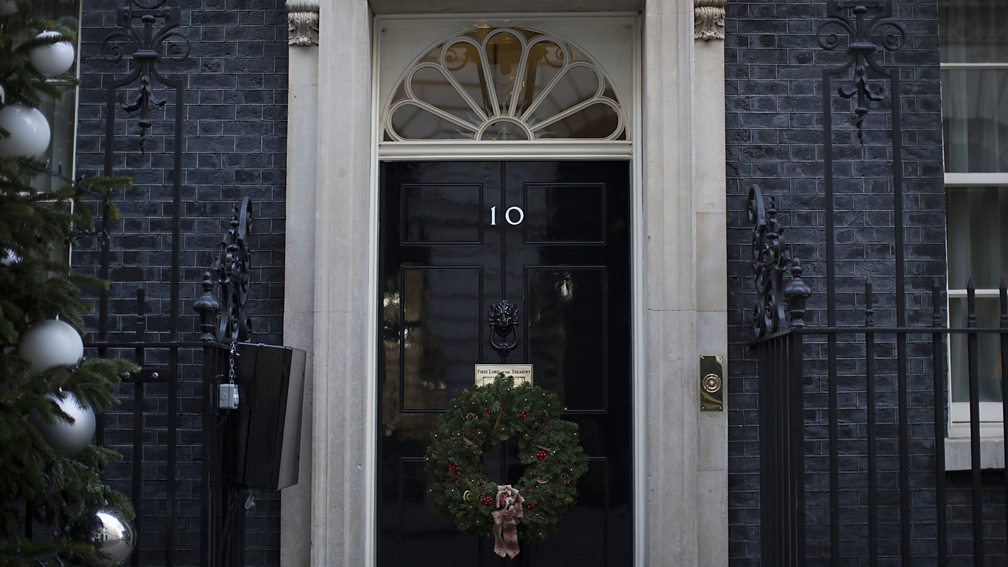
Picture credit: https://www.bbc.co.uk/programmes/articles/1tvcrzdvsbtj4pQQ1g7N2Tn/rare-photos-from-inside-number-10-downing-street

Voter ID – A “Poisoned Cure” and Other Verdicts

Chris Game

It’s easy to claim, but there are times when I miss not having classes of students to endeavour to entertain – partly because, at least from a distance, it can seem rather easier now than back when I had that responsibility.

One gift I’d certainly have used during this year’s exam revision period was the YouTube rap video made by T-Dawg – aka Broadland and South Norfolk Councils’ Managing Director, Trevor Holden – ‘reminding’ intending voters in the May local elections to take photo ID with them to the polling station. Like the whole topic, the video received a mixed reception, but it certainly got my vote (sorry about that!) as an introduction to this split-blog’s attempted overview of the profusion of recently released Voter ID material. I’ve at least flick-read most of it, so you won’t have to worry about not doing so.

First, though, an additional declaration of personal interest, referring back to that  opening paragraph. My students weren’t, of course, learning directly about ‘political literacy’, but high on my short list of ‘research stats I’ve managed to remember for more than a few weeks’ was the depressing finding in the All-Party Parliamentary Group (APPG) on Political Literacy’s 2021 report that, of a 3,300 sample of secondary school teachers in England, only 1% [felt] “fully prepared” to teach courses aimed at developing young people’s political literacy.

The ”fully”, omitted in some reports, was in the question and doubtless partly explains the dispiriting response. But anyway the finding was highlighted by the APPG, led directly to the creation of the social enterprise Shout Out UK (SOUK), and these two bodies’ influence is clearly evident in some of the Electoral Commission’s recommendations for more focused information and awareness raising.

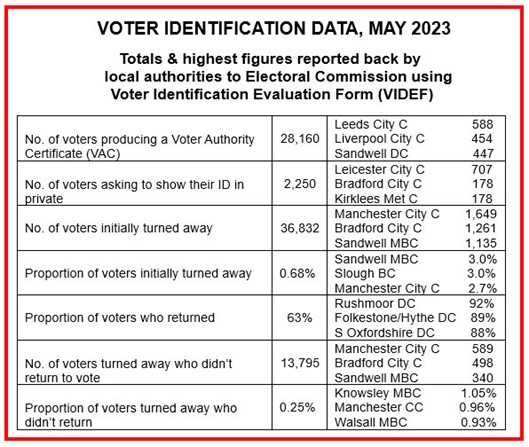
There had, of course, been earlier assessments of May’s elections – principally the Electoral Commission’s Interim Analysis in mid-June, reporting the anonymised returns from the Voter Identification Evaluation Forms (VIDEF) that Returning Officers were required to complete (see table below), plus results of three YouGov pre- and post-election public awareness surveys of between 1,700 and 3,700 adults each.

This first, stat-heavy part of the blog will present, in highly summarised form, some of the key data, with the second covering some of the more recent interpretative contributions – including that of the All-Party Parliamentary Group, from which I’ve appropriated the blog’s slightly giveaway title.

First, some scene-setting stats, taken from the final report. The total electorate was 27.3 million, ballot box turnout 32%. For the record, Labour took 33% of the vote and control of 70 councils; Conservatives 28.6% and 33; Lib Dems 37% and 20.  5.2 million postal ballots were initially issued to 19% of the electorate, 3.5 million (67%) of which were returned, of which 89,000 were rejected, mainly for missing or mismatched signatures or dates of birth. OK, it’s only 2.6%, but, after making the effort, it was higher than I might have guessed.

 Key findings from the analysis included that:

  • Immediately post-election, in areas with elections, 92% of people in England were aware they now needed to show photo ID to vote at a polling station. They weren’t asked, however, if that awareness extended to knowing that they couldn’t obtain ID – e.g. the Voter Authority Certificate (VAC) – on polling day itself.
  • Awareness was significantly lower (74%) among those who didn’t already have an accepted form of ID – and, unsurprisingly, among youngest age groups (82% for 18-24 year olds), Black and minority communities (82%), etc.   
  • Approximately 89,500 people applied for a VAC before the 25 April deadline, some 28,000 certificates being subsequently used – i.e. under one-third of the 250,000 to 350,000 estimated likely not to have any other acceptable ID.
  • At least 0.25% of people (c.14,000) who had tried to vote at a polling station were not issued with a ballot paper because of the ID requirement, but this excludes those who reacted to the ID reminder before they could be recorded in the data – thereby inevitably underestimating, as do the post-election analyses generally, the actual impact of the voter ID requirement.

This was essentially the ‘headline’ picture we had to content ourselves with over the summer, until quite suddenly, come September, there was a whole lot more – and it seems logical, if not strictly chronological, to start with the Electoral Commission’s full-scale Voter ID Demographic Analysis Research. The analysis aimed to identify patterns in areas where relatively higher or lower proportions of intending voters were turned away from polling stations due to the new ID requirement.

18 authorities with apparently relatively socioeconomically diverse wards were selected, including the West Midlands’ Coventry and Sandwell – the latter being the sampled borough with the nationally highest “initially turned away” percentage of 3%.  The Census-based ‘proxy’ variables measured were unemployment, ethnicity, household deprivation, and social renters.

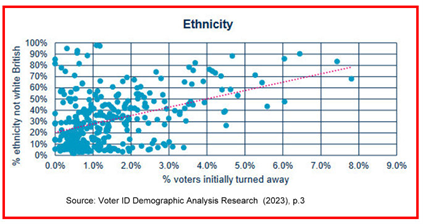
Hyper-summarising, the analysis suggested there was “a potential linear relationship” between each selected socio-economic variable and the proportion of voters initially turned away and those who didn’t return to vote. These results are obviously tabulated, but also graphed, as illustrated in what is described as the “moderate relationship” between ethnicity and the proportions initially turned away.

Overall, 13 of the 18 authorities showed at least a moderate relationship between the independent variables and the proportion of voters initially turned away, and 6 exhibited “strong relationships between one or more independent variables”. Strongest correlations were with areas having a high proportion of non-white British individuals, higher deprivation, and higher unemployment.   

Following this specifically Voter ID-focussed report, the Electoral Commission had published in June its overall Report on the May 2023 Local Elections in England, which it updated in early September. It made nine main recommendations, including increasing awareness of the support available for disabled voters, and improving data collection at polling stations.  

Four, however, related specifically to voter ID: review the list of accepted ID; improve access to the Voter Authority Certificate (see above); improve options for voters who don’t have or can’t access any accepted form of accepted ID – e.g. allowing ‘attestation’ by a named and verified elector; and polling station staff to continue to collect voter ID impact data at future elections.

Which brings us to about mid-September, already some way over this blog’s preferred length, and quite the wrong time, therefore, to address the “poisoned cure” and other reactions to these primarily statistical analyses – which will follow, with luck, fairly shortly.

Chris Game is an INLOGOV Associate, and Visiting Professor at Kwansei Gakuin University, Osaka, Japan.  He is joint-author (with Professor David Wilson) of the successive editions of Local Government in the United Kingdom, and a regular columnist for The Birmingham Post.