Shailen Popat
In today’s rapidly changing public sector, professional development is no longer a luxury — it’s a necessity. But what’s the best way to equip public managers with the skills and mindsets they need to lead effectively? Is it through short, intensive training sessions, or through long – term mentoring and peer learning? My recent article, Reflections on Short CPD Training and Long – Term Mentoring Communities of Practice for Public Managers, explores this question through two linked initiatives in Ghana and the UK. You can read the full piece here, but here’s a summary of the key insights.
Two Initiatives, One Goal: Building Public Sector Capacity
In March 2024, I co – led a three – day Continuing Professional Development (CPD) workshop at the Ghana Institute of Management and Public Administration (GIMPA). Over forty senior local government officers came together to explore cultural intelligence, organisational culture, and change management. The workshop was highly participatory, encouraging reflection on power dynamics and leadership behaviours. It wasn’t just about technical skills — it was about shifting mindsets. A year later, in March 2025, we launched a transnational Community of Practice (CoP) in Birmingham. Fourteen Ghanaian city managers and academics joined UK counterparts for a week of collaborative learning, site visits, and strategic dialogue. Unlike the CPD workshop, this wasn’t a one – off event. It was the start of an ongoing network designed to foster mutual learning, co – produce training materials, and build institutional partnerships.
What CPD Brings to the Table
CPD is familiar to most professionals: structured, time – bound, and focused on specific competencies. It’s efficient and accessible, making it ideal for introducing new frameworks or addressing urgent skills gaps. Our GIMPA workshop, for example, gave participants analytical tools to examine organisational culture and power dynamics — critical for reforming local governance. But CPD has limitations. Without follow – up, its impact often fades. Participants in Accra voiced this concern: how could they sustain the momentum after the workshop ended? This reflects a broader critique in the literature — CPD can feel like a “tick – box” exercise if not embedded in a longer learning journey.
The Power of Communities of Practice
Communities of Practice, a concept popularised by Etienne Wenger, take a different approach. They’re about relational, situated learning — professionals learning with and from each other over time. Our Ghana – UK CoP exemplified this. Participants didn’t just absorb knowledge; they co – created it. They shared case studies, identified research priorities, and even laid the groundwork for joint projects and staff exchanges. This collaborative model builds trust, fosters innovation, and creates a sense of ownership. It also delivers tangible outcomes: institutional partnerships, co – produced training materials, and a platform for policy experimentation. In short, CoPs turn learning into a living, evolving process.
Why We Need a Hybrid Model
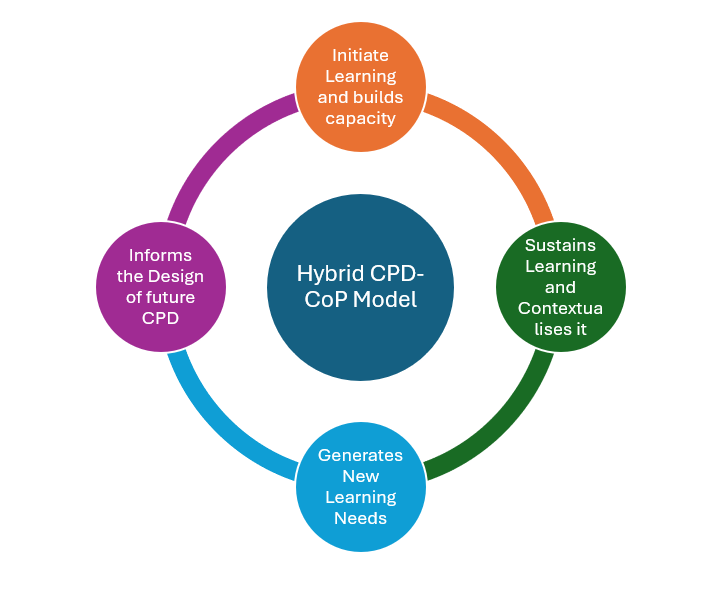
So, which is better — CPD or CoPs? The answer is both. CPD offers structure and accessibility; CoPs provide depth and sustainability. When combined, they create a dynamic learning ecosystem:
- CPD as the entry point: Introduce core concepts and skills in a structured, time – efficient way.
- CoPs as the follow – through: Sustain learning, contextualise it, and generate new insights for future CPD.
This cyclical relationship ensures that professional development is continuous and adaptive. It aligns with the idea of a “learning organisation” and supports the kind of hybrid professionalism today’s public managers need — technical expertise plus collaborative, contextual competencies.
The Role of Universities
Universities are uniquely positioned to make this happen. They have the research capacity, convening power, and infrastructure to sustain long – term engagement. But this requires a shift: from delivering knowledge at a distance to embedding themselves in professional ecosystems. That means co – designing curricula with practitioners, facilitating peer learning across borders, and evaluating impact not just in terms of knowledge acquisition but institutional transformation. Our Ghana initiatives show what’s possible when universities embrace this role. The CPD workshop sparked mindset shifts; the CoP built enduring partnerships and practical tools for governance reform. Together, they created a professional learning ecosystem grounded in local realities and enriched by global perspectives.
Why This Matters Now Public managers face unprecedented challenges — climate change, urbanisation, digital transformation. These are “wicked problems” that demand adaptive, collaborative leadership. Short – term training alone won’t cut it. Neither will informal networks without structure. We need integrated models that combine the best of both worlds. If you’re a public sector leader, educator, or policymaker, I invite you to read the full article here. Let’s reimagine professional development as a shared, iterative, and relational endeavour. The future of public service depends on it.

Dr. Shailen Popat works as an Assistant Professor in Public Policy and is the Director of the MSc in Public Management at the University’s Institute of Local Government Studies. He completed his PhD at the University of Oxford and his thesis explored the sensemaking processes of School Principals when enacting a significant new policy. He specialises in supporting public managers to enact policies in a manner that can be effective in their context and is a founding partner of a partnership between the University, GIMPA, and Ghana Local Government. Known for his student-centred approach and ability to explain complex concepts in a comprehensible manner, Shailen is considered to be an outstanding lecturer and tutor and was awarded the accolade of ‘Teacher of the Year’ at the 2022 University of Birmingham Teaching Awards, and in 2023 he was awarded a Senior Fellowship of the UK Higher Education Academy for his Educational Leadership.
 INLOGOV Blog