The recent publication of Grant Thornton’s report on “Lessons from recent Public Interest Reports” highlighting the lack of sound scrutiny in certain Councils reminded me of the question that was circulating at the time of the 2007-2008 financial crisis.
“What’s the difference between a non-executive director and a supermarket trolley?”
Answer: “It’s the supermarket trolley that has a mind of its own.”
The Grant Thornton report makes the point that arguments can be made for and against different governance models, but their effectiveness, as demonstrated by recent Public Interest Report cases, is less about the system of governance and more about how it operates, who operates it and how willing it is to accept scrutiny and challenge.
Unfortunately, this is not a new revelation and the report does not make any specific recommendations about scrutiny.
Having worked for some of my career in Edinburgh and conscious of how the forthcoming Scottish Parliament elections might affect the UK, I have been taking an interest in the recent cross-party Scottish Parliamentary Committee investigation into the issues raised by the previous SNP Leader, Alex Salmond. As I write, it has just been leaked that the committee has voted by 5 to 4 that Nicola Sturgeon misled the committee on one particular matter.
What struck me in looking at the Committee sessions was the contrast between the often imposing evidence given by both Alex Salmond and Nicola Sturgeon (the latter having a marathon 8-hour session) and the invariably partisan questioning by the Committee. The SNP members frequently feeding friendly points to Nicola Sturgeon to build her response and the Opposition Members invariably revealing their own pre-conceived opinions.
“Isn’t this inevitable?”, I hear you say.
Perhaps, but there are also many examples, cited by the Centre for Governance and Scrutiny, of where scrutiny has and does effectively challenge the Executive, but this is less newsworthy. In writing this short blog, I just hope that Council Leaders will recognise the correlation between good scrutiny and good governance and at their Annual General Meetings, following the May elections, appoint/enable not a lapdog to chair the function, but an Airedale terrier (“an alert and energetic breed, not aggressive but fearless” – according to Wikipedia)
John Cade is an INLOGOV associate and former senior local government officer. His interests relate to governance arrangements with a particular focus on relationships and developing trust between Executives, Chairs and Scrutiny Members.
In a recent blog entitled ‘Elections in a pandemic’ Jason Lowther concluded, along with the great bulk of surveyed council Returning Officers and Chief Executives, that ‘Super Thursday’ on May 6th may not be a great idea. Over 5,000 representatives in 4,300-plus separate ballots, including councillors in 150 English councils and the London Assembly, 13 mayors, 40 Police and Crime Commissioners, plus the Scottish Parliament and Welsh Senedd, town and parish councils, and the odd local referendum – to complete what might well be our “most complex elections ever”.
On balance, and notwithstanding that well over 100 countries have managed to hold significant public votes over the past 13 months, Jason’s conclusion was that, while:
“as always, local government will rise to the challenge if the decision is to go ahead in May, … the Westminster government … might be wise to start contemplating a Plan B.”
I happen to agree, although I can’t pretend to share the “incredulity” of those council chief executives Jason had consulted “that the Government seems unwilling to seriously consider delaying until October”. Indeed, it serves as the starting point for this blog.
Postponement of ‘Super Thursday’ – including now probably the Hartlepool parliamentary by-election – would still be perfectly feasible. It would reassure at least some potential voters, and almost certainly increase turnout – as evidenced in a recent online survey by Hope Not Hate, the anti-racism charity, and the National Education Union, as part of their #MAKEVOTINGEASIER drive. Over a quarter of respondents felt the Covid-19 situation would make them less likely to go to the polling station to vote, rising to around 40% of ethnic minorities and the largely unvaccinated under-25s.
Ah, but, Government Ministers and the Electoral Commission probably responded, you didn’t describe polling stations’ additional safety measures, and how easily – if you remember and have a working printer handy – you can apply for a postal or proxy vote by April 20th or 27th respectively.
But detailed dates aren’t the real issue. Last year’s postponement came on March 13th, this year’s current deadline is March 29th, and even could be stretched. But it won’t be, because those Ministers have nil incentive to jeopardise any political ‘vaccine bounce’, or #MAKEVOTINGEASIER for more young and ethnic minority voters to turn out and support mainly other parties.
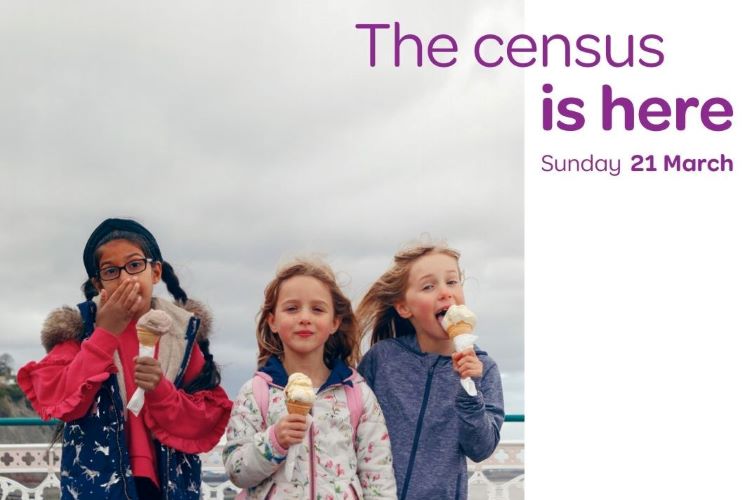
Even that vanishingly small chance, though, is a big difference from Sunday’s Census, which passed its optimal postponement date sometime last summer – when Covid’s potential impacts were already apparent, leading the canny Scots and Irish to postpone their scheduled Censuses until March and April 2022 respectively.
The Chief Executive of the Scottish Public Record Office, National Records of Scotland, described it as “the right decision”, as it has surely proved. Scottish academics, or at least some, disagreed – one labelling it “an act of scientific vandalism”, while “the country’s leading historian” (name in URL), almost incredibly, could “not understand how the incidence of coronavirus in a year’s time would affect the collection of census data in Scotland” – which even then made you wonder what he thought the purpose of the Census actually is.
Speaking as a definitely non-leading academic, and nowadays merely tax-paying UK citizen, I can honestly claim to have applauded the Scots’ July decision at the time, and, as circumstantial witnesses, would call on the undergrad students to whom I once taught ‘Research and Measurement in Public Policy’. I offered to bet the class of 2000/01 that that April’s Census would be the last traditional count-everybody-on-a-random-Sunday Census of its type, and that by 2011 we would have followed the increasing number of at least European countries who even then were switching to alternative, more efficient, flexible, and significantly cheaper methodologies.
I would have lost hands-down, of course, but I’m not completely stoopid, and knew that by then they would have long left Birmingham, forgotten the bet, or both. Rather more importantly, though, the Scots’ decision and the questionable value of significant chunks of Sunday’s data should finally end the mythology of our 200-year old decennial event being uniquely capable of providing policymakers with the comprehensive statistical data they will require over the next decade.
Yes, mythology, in several ways. First, there is no ‘UK Census’ and never has been. Nothing to do with devolution. Right back to the first official census in 1801 – of England and Wales – it has always been censusES, with Scotland then Ireland in 1821 doing their own thing. Usually that has meant the four countries using the same arbitrary Sunday, asking similar but not identical questions, and separately processing and publishing their results.
Genuine UK-wide statistical comparability – “harmonisation of outputs” is the favoured euphemism – is a real struggle. Even the Office for National Statistics rated only half the last Census’s roughly 50 questions as ‘highly comparable’ across the whole UK. A quarter were ‘broadly comparable’, the rest ‘country specific’.
Sunday’s exercise, therefore, will be a sophisticated snapshot of Scotland-less pandemic Britain at the most exceptional, unrepresentative point in most of our lives. And costing close to £1 billion – much of it going to the Zurich-based Adecco company, for expensively recruiting and training 30,000 inexperienced ‘field staff’ for door-to-door ‘completion-checking’ – a further Covid-model scandal in itself.
The Scots’ foresightful postponement obviously scuppers any genuine UK-wide comparability. It should, however, enable them to reconsider and potentially rephrase key questions and reduce obvious pitfalls: over-counting those working from home; under-counting street homelessness, the unemployed – by excluding the ‘furloughed’ – and the vulnerably housed; miscounting travel-to-work patterns, migrant workers, early availability for work, and our own university students.
Then there are potentially hugely important new questions – on vaccination perhaps, place of work, mode of travel-to-work, travel days per week. Plus the opportunity to get some existing ones aired and re-clarified – why Britain’s Jews and Sikhs aren’t treated as separate ethnic groups, for example, and the really rather basic difference between a person’s sex and their gender identity.
We know this Government doesn’t like gender self-identification, but that hardly justifies muddying its Census guidance. It was only finally sorted last week, thanks to the crowd-funded campaign group, Fair Play for Women, and a High Court judge – after an estimated 3 million of us had, albeit prematurely, completed our forms.
To clarify: ‘sex’ is one’s legal sex, as registered on birth or gender recognition certificate – but not necessarily one’s passport, which, like a driving licence, is alterable without a formal legal process, and so, contrary to the original Census guidance, NOT technically a legal document. Gender identity is an entirely separate, voluntary question for over-16 respondents. You’d think someone official over the preparatory decade might have clocked that – wouldn’t you?
All of which shambles surely means we may finally join – possibly as early as 2026 with an emergency, catch-up census – at least most other European countries in using census methodologies more appropriate to the 21st Century than the early 19th – more frequent perhaps, thus more continuously reflective of change, and significantly cheaper.
It is 50 years now since Denmark held its last ‘traditional’ census and started modelling the switch towards register-based – and in some countries five-yearly – censuses, with information on population, households and dwellings being continuously compiled in various registers, files and databases.
The UN Economic Commission for Europe, in announcing that some 15 countries have so far postponed planned censuses to some degree – just contemplate all that “scientific vandalism”! – suggests that approaching 60% of the 2020-22 round of European censuses will be at least partly register-based, leaving the UK, Ireland and mainly small and/or Eastern European countries with their ‘traditional, direct collection’ methods – plus France, forever proud in its exceptionalism, with its ‘rolling census’.
However, some Stop Press news from the Office for National Statistics: “We are investigating the feasibility of moving to a census based on administrative data after 2021.” Fingers crossed that they don’t rush things.
Chris Game is an INLOGOV Associate, and Visiting Professor at Kwansei Gakuin University, Osaka, Japan. He is joint-author (with Professor David Wilson) of the successive editions of Local Government in the United Kingdom, and a regular columnist for The Birmingham Post.
When you’re Leader of the Opposition, you welcome almost any headlines. But “Make ‘fire-and-rehire’ tactics illegal”, following Sir Keir Starmer’s keynote address to last September’s TUC Conference, seemed risky even at the time. Fire-and-rehire is the practice openly adopted by several companies – including British Airways and British Gas – of handing employees redundancy notices, then re-employing them on worse contracts. “Against British values”, pronounced Sir Keir, and should be outlawed.
As with most Starmer pronouncements, there was no orchestrated follow-up, which here was perhaps fortunate. For the local council most prominently pilloried for exactly the same practice was the overwhelmingly Labour controlled East London Borough of Tower Hamlets. The Council termed it a “workforce investment” exercise; to the workers themselves it was #TowerRobbery.
Embarrassing, you might think, for almost any self-respecting council, but uniquely so for Tower Hamlets. For this month the borough will embark, howsoever Covid permits, on a summer-long centennial commemoration of the famous Poplar Rates Rebellion mounted by the obviously rather different class of Labour councillors of one of its predecessor authorities, Poplar Metropolitan Borough. We’ll focus here, therefore, on the history.
The 1918 Representation of the People Act transformed British politics at a stroke probably more than any other single law since the Great Reform Act of 1832. Extending the vote to all men and most over-30 women tripled the electorate, revamped elections, and potentially recast the elected memberships of local councils – though here in Birmingham and the West Midlands, as it happens, the stroke took rather longer than in most of the rest of the country. With the important exceptions of the Black Country and the Potteries, the well-organised and well-funded Unionist organisations controlled by the Chamberlains and Stanley Baldwin at least diluted and delayed the advance of Labour, if not the decline of the Liberals.
Poplar was the complete reverse, the Labour Party there being led by the radical socialist, Labour pioneer, and the party’s future national Leader, George Lansbury. By 1919 he had been a longstanding elected Poor Law Guardian and Poplar councillor, a Labour MP before resigning to fight, and lose, a by-election on the specific issue of women’s suffrage – and, particularly useful for attracting publicity during the Rates Rebellion, editor throughout the First World War of the anti-war Daily Herald.
In the 1919 local elections, Labour’s assortment of railway, dock and postal workers, labourers and housewives ousted almost entirely Poplar’s pre-war class of Conservative and Independent local businessmen-councillors.
The party took 39 of the 42 Council seats, including six women, and 19 of the 24-member Board of Poor Law Guardians, the body elected by local owners and occupiers of land liable to pay the ‘poor rate’ that funded the harsh ‘workhouse’ regime providing minimal accommodation and employment for those financially unable to support themselves. Much less surprisingly, Lansbury was elected a very non-ceremonial Mayor.
The reforms – particularly vividly recounted by Janine Booth and local historian Mick Lemmerman – began almost immediately, aimed at alleviating unemployment, hunger and grinding poverty. The big hurdle, though, was always going to be that outdated, almost intendedly inhumane, 1834 Poor Law, requiring that borough councils fund their own local poor relief – those councils with greatest need having almost by definition the least funding to do so and residents least able to afford any rate increase.
Lansbury himself, both as a Guardian and as a member of the 1905-09 Royal Commission on the Poor Laws, had long argued for complete replacement of the workhouse system by a combination of old age pensions, a minimum wage, and national and local public works projects. 112 years on, I doubt he’d be hugely impressed by our minimum wage, but certainly the workhouses have gone.
Back then, though, there was worse. In addition to collecting their own local rates, borough councils had to collect and hand over ‘precepts’ for the funding of four cross-London authorities: London County Council plus the Metropolitan Police, Asylums Board, and Water Board. And when it came to the crunch – at the Council meeting on March 22nd 1921 – it was these precepts the Poplar Councillors collectively voted to refuse to pay, but to apply the revenues instead to the costs of local poor relief while campaigning for a fairer rate system.
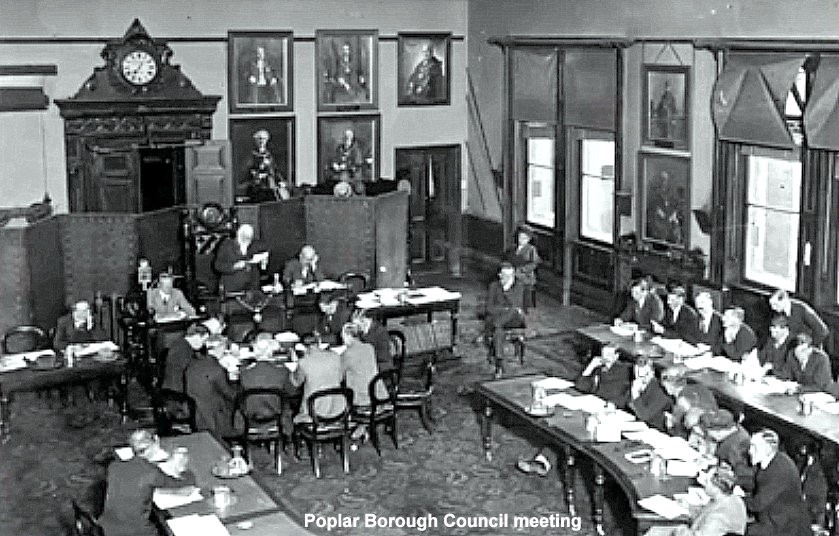
Which is an excuse to include one of my favourite local government photos – of a (admittedly, not the) 1921 Poplar Council meeting, showing the Mayoral chain of office draped around not the neck of the anti-ceremonial Mayor Lansbury, but a chair.
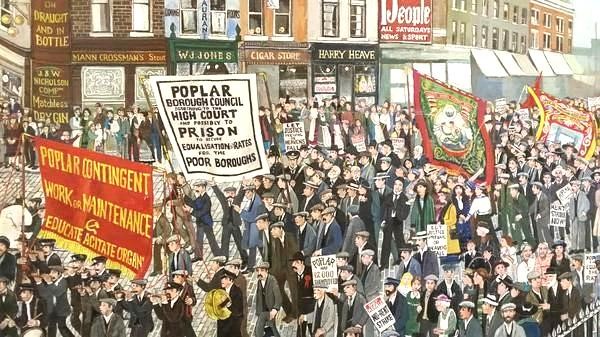
Hugely supported locally, this illegal action inevitably led to proceedings against the Council. So on July 29th, 30 councillors, including the six women, processed from Bow – accompanied by brass band and a banner proclaiming “Poplar Borough Council marching to the High Court and possibly to prison”.
The banner was prescient. Persisting in their refusal to hand over the precepts, the 30 were found guilty of contempt of court and in September sentenced to imprisonment. The men went to Brixton, the women, armed with flowers and surrounded by thousands of supporters, to Holloway – including the remarkable Nellie Cressall, pregnant then with her sixth child, and who was still serving on the Council in the 1960s.
The revolt received wide public and trade union support, neighbouring councils threatened similar action, and ‘Poplarism’ entered the political lexicon as a short-hand for both large-scale municipal poverty relief and local defiance of national government. Eventually, after six weeks’ imprisonment, the Court responded to public opinion and had the councillors released, while Parliament rushed through legislation roughly equalising tax burdens between rich and poor boroughs.
True, it took until 1929 for Poor Law Unions to be wholly abolished and the poor relief burden lifted from local councils. But try finding anyone, particularly this summer, who sees the ‘Poplar Rates Rebellion’ as anything but a stonkingly historic local government victory.
Chris Game is an INLOGOV Associate, and Visiting Professor at Kwansei Gakuin University, Osaka, Japan. He is joint-author (with Professor David Wilson) of the successive editions of Local Government in the United Kingdom, and a regular columnist for The Birmingham Post.
“Underlying the democratic ideal of government by consent of the governed is… the consent of the governed to behave themselves” (Jacobs, 2004, p. 211)
What might Jane Jacobs have had to say about recent challenges to democracy – like the prorogation of the UK parliament, the assault on the US capitol, Myanmar, and the fraught tragi-comedy of Handforth Parish Council’s infamous committee meeting? The expectation that the governed should behave themselves surely extends to those elected to govern. But our representatives sometimes disregard this, dismissing codes of conduct and protocols, as the Committee on Standards in Public Life has found. In my limited experience as a community council clerk I witnessed some of the consequences, having had to ensure on one occasion that police were on hand for a full council meeting, following a reported threat of disruption. It’s not so fanciful to see a connection between the villages of Washington DC and Handforth, Cheshire. Nonetheless, there may be a positive indirect consequence for local democracy, which I shall come to.
I do not propose to re-measure the hole that Handforth councillors dug themselves into. The episode was referred to by the Society of Local Council Clerks as “superficially amusing” while it exemplifies syndromic bullying behaviours. At the same time, if the celebrated Jackie Weaver has entertained many, there seems little doubt that she was out of order. The puzzle that remains unsolved (for me, at least) was posed parenthetically by David Allen Green in a heavily-commented post: “who can exclude a disruptive chair if the chair is disruptive?” I refer my right honourable friend to the quotation I gave earlier.
For those of us who have been keen to see a higher profile for parish and community councils, the Handforth incident is Fate’s Reminder to be careful what you wish for. And for all the comment generated – much of it showcasing a forensic fascination with regulatory niceties – what has struck me is how little of it acknowledges how local people have been forsaken by the institution designed to represent them.
There are two elephants in the zoom. One is the alpha male whose sense of power tramples his sense of responsibility (‘trump’ might be a better verb to use, but for the entangling of metaphors). The SLCC calls for “a dramatic strengthening of the standards regime”. Hmm, how dramatic would you like?
The other is democracy’s reliance on an impenetrable bureaucratic skin. It’s hard to see how the regulatory framework can be reduced, and Handforth may have given cause to extend it. But its effects can be countered, and there are all sorts of devices for that. As a clerk I wanted councillors to host, in turn, one each month, an informal reception (refreshments of course) immediately before each council meeting, inviting all residents from their zone (ward). And keep doing it. A few people we didn’t know, would have come. In time, the democratic return on investment would surely be visible in terms of the numbers who stayed on for at least part of the meeting, those who raised issues, and those who voted at the next election.
I failed to persuade my management group of any virtues in this idea, but had I stayed longer in post I think I could have got this and similar notions established. Democracy needs diligent ongoing maintenance, not frantic last-minute repairs.
To me, a key point about town and parish councils – now sometimes called ‘ultra-local councils’ – is that among their powers is a rather special informal convening power. They are able quickly, and usually a-politically, to bring together agencies (including principal authorities, police, health, schools etc), local businesses, community groups and residents to focus on specific local issues and get them sorted. This is oddly under-appreciated, not least by principal authorities. And it points to the need, when talking about democratic revitalisation, to ensure reference to the community sector, which can function as a democracy sandpit, default care provider, lightning-conductor for issues, and social responsibility conscience for councils.
Well, we now have a parish council in England that has become a huge embarrassment to its residents. The technology made a difference: Jackie Weaver’s performance would have been impossible in a face-to-face meeting. Meanwhile, councils in all tiers apparently have reported increased participation through online meetings. Bryony Rudkin offered insightful councillor’s reflections on the comparison with face-to-face meetings, on this channel recently. Now the government is under pressure to remove, permanently, the legal requirement for councils to meet in person.
I observe that public debate over the past year, in and out of lockdown, has acknowledged the reality that many families do not have anything like adequate technology to participate in a virtual society: so at least that argument doesn’t have to be made, does it? How then are hybrid meetings going to function against the risk of exclusion (the affluent signing in from home, with their intimidating bookshelf-backdrops; the rest huddling round a phone on threadbare broadband)? Do we expect those who would not have been likely to attend a formal council meeting before, and who cannot participate online, suddenly to be so excited at the prospect of a Weaveresque fracas that they’ll be queuing at the door?
There will have to be guidance for hybrid meetings, for all tiers. I’d like to see strong recommendation that councils fund community centres to host large-screen streaming. Community development workers will want to set these up anyway – refreshments, creche, homework corner, publicity; and someone on hand to give a little introduction and explain procedural necessities, to ‘sub-chair’ participation from the ‘annexe’, and provide feedback to officers. Councillors and officers should be encouraged to participate from these locations.
Forget the Handforth cacophony, maybe this is a chance to improve the acoustics of local democracy.
Kevin Harris is a PhD student at INLOGOV, researching into democratic voice and community action in local councils. He was previously a community development consultant and Chief Officer at Queen’s Park Community Council in London (2017-2019).



 INLOGOV Blog