Win an election and implement your manifesto – that’s novel!

Image: Emily Sinclair/BBC https://www.bbc.co.uk/news/articles/c367lry5ypxo

Chris Game

First, a reader alert. What follows is in essence an only marginally revised column written for and hopefully published in this week’s Birmingham Post, to which for many years now I’ve been a regular contributor. Thanks, at least in part, to the “many years”, I’m permitted a wide scope of subject matter, but for obvious reasons local government in some form or other is what I tend to resort to most frequently – not least around local election season.

With the Post’s Thursday publication date, this is a mixed blessing, knowing that most readers interested in these matters would very likely have learned the results of the elections before they read one’s prognostications and predictions. What follows here, then, is my third column focused on this year’s local (County/Unitary Council) elections, which were, of course, limited to just 24 of England’s 317 local authorities (plus the Isles of Scilly) and precisely none in, never mind Birmingham, the whole metropolitan West Midlands.

Faced with the alternative option of ignoring the topic altogether, I decided to focus on the four West Midlands County Councils: three with biggish, if declining, Conservative majorities – Shropshire, Worcestershire and Warwickshire – plus STAFFORDSHIRE: Labour for decades, but Conservative since 2009, and, until the May council elections, with 55 Conservative councillors out of 62, almost as Tory as they come.

However … since last July, when the county’s parliamentary constituencies all went Labour, Nigel Farage’s Reform UK Party had been energetically hoping to build in Staffordshire on what statistically had been among its most promising performances. And indeed it did: Reform UK: 49 of the 62 County Council seats, leaving the previously controlling Conservatives with 10, and Labour, Greens and Independents 1 each. The Lib Dems, along with UKIP, the Workers Party of Britain and others, failed to score.

It typified results across the country. On what nationally was an exceptionally quiet election day, Reform UK increased its nation-wide base of just two councillors (both on Hampshire’s Havant Borough Council), to a relatively massive 677 (39% of the total seats contested) and gained majority control of no fewer than 10 of the 23 councils.

One can only speculate at some of the results that a fuller involvement of, say, the 130 unitary authorities, metropolitan districts and London boroughs might have produced. I concluded that Election Day column, though, not with any numerical predictions, but with Farage’s most publicised campaign observation/pledge: “We probably need a DOGE for every single county council in England”.

Which could have sounded a touch presumptuous from the Leader of a party who had approached that Election Day holding just two of the 1,700+ seats ‘up for grabs’ – but not from Farage.

I did wonder, though, what onlookers would make of that DOGE acronym (or, in some versions, D.O.G.E. – that’s how novel it is). Indeed, even Reform candidates, who probably knew at least that it stood for the love child of President Trump and the recently very departed Elon Musk’s Department Of Government Efficiency, trod carefully.

Created, they could possibly parrot, to “modernise information technology, maximise productivity and efficiency, and cut wasteful spending”, but did they have any real idea of how the function and office might work in a UK political context? Or did they possibly assume that, like so many campaign pledges, even if, rather incredibly, a DOGE majority did emerge, it would find itself, at least for the present, on the ‘too hard just now …. we’ve only just elected our Leader’ pile?

Certainly I, while having at least some idea of what county councils having an English DOGE might entail, would definitely NOT have predicted that, within just one month of those county elections, one of England’s biggest and traditionally most Conservative counties, KENT, would be preparing to face an ‘Elon Musk-style’ DOGE audit by a team of technical experts assembled specifically to analyse its £2.5 billion-plus budget spending and assess its financial efficiency.

Since the past weekend, the ‘Elon Musk-style’ bit will possibly have been played down, but not, seemingly, the ongoing implementation. With LANCASHIRE – £1.2 billion budget – already announced as next on the list, this just could prove insightful and potentially serious stuff.

Until May 1st, Kent County Council comprised 62 Conservatives, 12 Lib Dems, 4 Greens, 0 Reform UK.  Since then, it’s been 10 Conservatives, 6 Lib Dems, 5 Greens, and 49 Reform UK. If dramatic change is to be the agenda, Kent seemed an apt and attention-guaranteeing choice. 

By any measure, and almost whatever happens next, that – in my book, anyway – is an impressive achievement. There’s been, predictably enough, ‘Establishment’ outrage – “a superficial response to the deep problems of local government” … “initiating a review of local authority spending misunderstands the circumstances facing local authorities … All councils have been caught in an iron triangle of falling funding, rising demand, and legal obligations to deliver services. In that context every local authority has had to make difficult choices to cut services …” (Institute for Government).

On the other hand, win an election and implement your party manifesto! – a demonstration that turning out and voting in local elections, even in our exceedingly non-proportional electoral system – can produce policy action.

Or, rather, especially in our exceedingly non-proportional electoral system. Two of the new Combined Authority mayors (outside the West Midlands) were elected on under 30% of the votes cast, and obviously a much smaller percentage still of the registered electorate.

This follows the recent ditching of the Supplementary Vote in favour of ‘First-Past-The-Post’, where voters pick just one candidate, and the one with the most votes wins – even if, as this time in the West of England, that percentage was under a quarter of an already very modest turnout.

To me, anyway, it’s arguably even more important in these local/Mayoral elections than in parliamentary ones – for us, the elected Mayors, and democracy generally – that voters can indicate their first AND SECOND Mayoral preferences, thereby ensuring that, however low the turnout, the finally elected winner can claim the support of at least a genuine majority of voters.  Which means electoral reform – but that’s another column/blog.

Chris Game is an INLOGOV Associate, and Visiting Professor at Kwansei Gakuin University, Osaka, Japan.  He is joint-author (with Professor David Wilson) of the successive editions of Local Government in the United Kingdom, and a regular columnist for The Birmingham Post.

Placemaking: how do we design better homes and neighbourhoods?

Jon Bright and Vincent Goodstadt

The Government wants to build 1.5m new homes. Here, we discuss one aspect of this ambition: how to ensure that they are designed well. Many in the past have not been.

Good design results in attractive homes, streetscapes and neighbourhoods. It contributes to placemaking, creating popular places, with community facilities, green spaces and essential services.

Well-designed neighbourhoods are sustainable: they don’t rely on high levels of car ownership and energy consumption. As a result, homes are more affordable with low energy bills and access to public transport.

There’s lots of guidance on design, for example, the ‘National Model Design Code’, Oxfordshire County Council’s ‘Street Design Guide’, and the Building Beautiful Commission’s report ‘Living with Beauty’. The problem is not primarily with the guidance.

The problem is that developers and housebuilders don’t use the guidance that exists and planning authorities don’t enforce it.

What’s the evidence?
A 2020 report, ‘A housing design audit for England ‘, concluded that the design of new housing developments in England is overwhelmingly ‘mediocre’ or ‘poor’.

The audit reveals that 75% of new housing developments studied should not have gone ahead due to ‘mediocre’ or ‘poor’ design. It inspected 142 housing developments and found that one in five should have been refused planning permission outright as their poor design was contrary to the National Planning Policy Framework (NPPF). A further 54% should not have been granted permission without improvements to their design.

The importance of design has been reaffirmed in the new NPPF (December 2024).

In addition:
• Housing for less affluent communities is much more likely to be poorly designed.
• Low-scoring developments scored badly in terms of character and sense of place.
• The worst places were dominated by access roads, storage, bins and car parking.
• More positively, schemes scored highly for security and included homes of varying sizes.

The author, Professor Matthew Carmona said: “Planning authorities are under pressure to deliver new homes and are prioritising numbers over the long-term impacts of bad design. At the same time, house builders have little incentive to improve when their designs continue to pass through the planning system. Some highways departments do not even recognise their role in creating a sense of place.

“House builders, planning authorities and highways departments need to significantly raise their game. This can’t come soon enough”.

A second study – ‘Delivering Design Value’ – assessed the problem of design quality by looking at what happens on the ground when large housing schemes are built. It confirmed that although planners want to create attractive places, design is frequently overlooked because of the pressure to meet housing targets. This is because we don’t have enough planners, especially with design skills.

Of course, developers are also responsible for design quality. But it’s widely known that volume house builders use tried and tested site layouts and house types that lack design value. Too often, local authorities approve them when they shouldn’t.

The study recommends that design should be at the heart of development and design value standards prepared that are simple, concise and translatable into clear guidance.
Without change, the housebuilding industry will continue to receive a ‘free pass’ on design and local authorities’ powers to shape places will be eroded further.

What is to be done?
Central government has revised the NPPF and the chapter on design is strong. But much will depend on how its implemented. Drawing on the two studies, we recommend that:

National design standards should place design at the heart of planning and housebuilding. Local design codes should be prepared for each major site and highways design should be a part of the planning process.

Applications for new housing should reflect national design standards and local policies covering placemaking, sustainability, streetscape, landscaping and access for pedestrians, cyclists and motor vehicles.

Local Design Panels should include specialists and review the design of major housing schemes. This should not cause delays if guidance has been followed. Design guidance should be a part of the Local Development Plan.

Local Authorities need more planners with design expertise. The main players – house builders, planners, design experts and community leaders – should collaborate on the design and master planning of large housing developments.

Conclusion
Too many housing developments are poorly designed. This must change. Local Authorities should give more attention to design, review large developments and set and enforce planning conditions.

As the new NPPF notes, ‘Development that is not well designed should be refused, especially where it fails to reflect local design policies and government guidance on design.’ (Para 139).

Developers and housebuilders need to raise their game by drawing on their best achievements and stop relying on a small number of site layouts and building types.

(Our full paper which amplifies the views in this blog can be accessed through the link here.

Jon Bright is a former Director at the Department of Communities and Local Government. He was involved in designing and implementing the Government’s national strategy for neighbourhood renewal (1998-2007) and is currently a Trustee of a charity that advises communities on Neighbourhood Planning. His book ‘Modern Management and Leadership: People, Places and Organisations’ was published in 2023.

Vincent Goodstadt is a member of the Design Council’s Network of Experts and advises organisations in the public, private, and voluntary sectors. Previously, he held senior planning posts in local government. He is a Past President of the Royal Town Planning Institute (RTPI), holds an Honorary Professor at the University of Manchester, and is a Vice-President of the Town & Country Planning Association.

An evidence-based assessment criteria framework for school relocations

Sarah Finn

Local Authorities in England have responsibility of ensuring there are sufficient school places to meet the demands of the population now and in the future. When new housing developments are proposed which result in a demand for additional school places, options include the expansion of an existing school, provision of a new school, or relocating an existing school to a new building on a new site.
The assessment of school relocation proposals is a complex process, impacted by financial constraints and silo-thinking within the public sector.

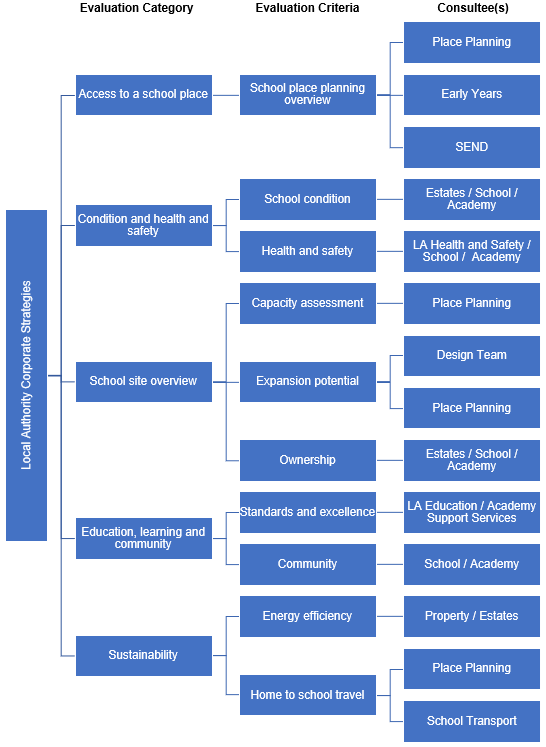
The project designed a School Relocation Assessment Tool (SRAT) which encourages officers to outline the financial impact of school relocation within the context of the council’s corporate strategies, and to consider short-term and long-term impacts of a variety of evaluation criteria in a holistic way, with weighting to support balanced decision-making. Critically, collaboration is a central factor of the tool.

Key points
• Where appropriately located land is available, some councils are starting to consider the option of relocating and expanding an existing school to a new site.
• Councils are currently only able to request developer contributions to fund the additional places required to mitigate the impact of the development, whereas re-provision of existing places must be met by council borrowing.
• The SRAT tool requires information to be gathered about multiple factors horizontally, across vertical silos within the Council to enable consideration of council priorities in a holistic way rather than being in competition with each other, thus mitigating the negative impacts of silo- thinking by making the assessment joined-up and strategic.
• The project identified several factors to evaluate when assessing school relocation opportunities, including home to school travel distances, community use, and school condition.

Background
Local Authorities in England have a statutory responsibility for education and have a duty to ensure there are sufficient school places to meet the needs of the population now and in the future. Traditionally, mitigating strategies adopted to provide additional pupil places generated by proposed new housing will involve either the provision of an entirely new school setting or an expansion to an existing provision. However, where appropriately located land is available, some councils are starting to consider a third option of relocating and expanding an existing school to a new site (school relocation).
The financial impact is particularly pertinent as councils are currently only able to request developer contributions to fund the additional places required to mitigate the impact of the development, whereas re-provision of existing places must be met by council borrowing.

What we knew already
Where strategic perspectives are not aligned within organisations there is a risk that obstacles to successful collaboration are created across administrative silos, where organisational parts of government [work] in isolation from each other. It’s been argued that reduced budgets have encouraged retreat into departmental silos, rather than collaboration.
Successful strategy relies on several overlapping strategic decisions being made in conjunction with one another, with financial constraints balanced against strategic priorities.
This research project involved both a systematic literature review and a group discussion with four senior council officers concerned with school standards, performance, and infrastructure.

What this research found
Financial and short/long term decision making
The current financial pressures faced by LAs encourages decision-makers to pursue the ‘least-cost’ option, without concern for externalities. The impact of school relocation should be considered within the context of wider council corporate strategies. A strategic perspective encourages LAs to take a longer-term approach to their decision-making.

The SRAT tool requires information to be gathered about multiple factors horizontally, across vertical silos within the Council to enable consideration of its priorities in a holistic way rather than being in competition with each other, thus mitigating the negative impacts of silo- thinking by making the assessment joined-up and strategic.

The project identified several factors to evaluate when assessing school relocation opportunities, including home to school travel distances, community use, and school condition.


School Relocation Assessment Tool (SRAT)

Conclusions
The aim of this research was to formulate an assessment criteria framework for school relocations. To achieve this, the project sought to understand how school relocation decision-making processes were impacted by financial constraints and silo-thinking, and to explore what criteria should be assessed when school relocations are considered.
The resultant SRAT has been successfully designed to encourage officers to outline the financial impact of school relocation within the context of a council’s corporate strategies, to consider short-term and long-term impacts of a variety of evaluation criteria in a holistic way with weighting to support balanced decision- making. Most significantly, it guides officers to collaborate with other teams across the council to ensure joined-up strategy is achieved.
During the research process, the researcher recognised that the literature around school relocation was lacking. The creation of a tool to assess both numerical and non-numerical evaluation factors of school relocations, drawing upon both practical and academic research, appears to have not previously been attempted until now. To build upon this research, different occupational viewpoints should be sought regarding the effectiveness of the tool to improve its validity, particularly from a financial perspective.


About the project
This research was a Master’s dissertation as part of the MSc in Public Management and Leadership, completed by Sarah Finn and supervised by Shailen Popat.

Equipping local governments to deliver national and local priorities

Jason Lowther

Today we launched our latest report, Equipping local government to deliver national and local priorities. Local government is critical to the delivery of the new government’s five key missions, and to improving life across the country. We argue that, once a series of critical reforms are in place, government should have confidence to equip local authorities with more power and (when public finances allow) prioritise additional resources there, enabling local and national priorities to be delivered. But critical reforms are needed in financial management, audit and performance management, and in community power and participation.

The new government inherited many challenges. Council budgets per person in England have been cut by 18% in real terms since 2010. Councils are hitting financial crises: twelve have issued section 114 notices in the last six years, compared with zero in the previous 17 years. Representative institutions at all levels of government are suffering from declining legitimacy and increasing polarisation. Local government plays a vital role in increasing democratic relationships and trust.

But councils’ wide remit, local knowledge, democratic accountability, public service ethos, and key roles in working with partners and shaping local places make them critical to the delivery of all five of the government’s key missions. Local governments are best placed to operationalise solutions to interconnected problems, for example, improving public transport and encouraging more cycling and walking helps meet net zero targets. It can also deliver health benefits, reducing the burden on the NHS, as well as increasing productivity by giving businesses access to a wider and healthier workforce.

Action is required to ensure that councils are fit for purpose to make the type of contribution that central government requires of them. Underlying this is a lack of confidence in local government on the part of ministers and civil servants.  We have identified three areas in which the government must be confident if it is to equip the local level with more power: financial sustainability, performance standards, and community power and participation. 

Policy recommendations

Financial arrangements

  1. Provide multi-year funding.
  2. End competitive bidding and deliver a “single funding pot” for each council/ local area that has been allocated fairly and sensitively to the needs and assets of the community.
  3. Abolish council tax capping.


Audit and performance management

  1. Strengthen the evaluation of councils’ performance management.
  2. Make OFLOG independent and extend its remit and approach.
  3. Reintroduce effective management and support of council external audit by independent bodies.


Community power and participation

  1. Strengthen the role of councillors as facilitators and catalysts of community-driven change.
  2. Embed participatory governance to ensure lived experience and marginalised voices drive policy and service delivery.
  3. Develop public-commons partnerships and community-wealth building to support community-driven sustainable economies.

As the Layfield Commission concluded 50 years ago, local government funding should promote responsible and accountable government. Beyond welcome recognition of acute financial challenges and commitment to multi-year funding settlements, there is a pressing need for additional immediate and longer-term action to improve Councils’ financial position and strengthen local accountability.

Local authorities have different needs for funding, depending for example on levels of population and its composition, deprivation, and spatial factors. Central and local government should develop updated funding formulae and funding models which are as simple as practicable whilst capturing the key elements of local need, and as transparent as practical in operation.  There are many reports researching available options for fairer funding, approaches to fiscal devolution, and local government funding options

Local audit, performance regimes and regulation each have a part to play. Both a parliamentary select committee and the Redmond Review into the Oversight of Local Government have sought to investigate the failings in local government audit.  The latter in 2020 critiqued market driven audits, stating that the new audit arrangements have undermined accountability and financial management. 

The adoption of the Redmond Review’s proposal for an Office for Local Audit Regulation would provide oversight on procurement, management, and regulation of external audits of local authorities. The government could extend the oversight of local government performance management processes while avoiding the creation of an overly powerful national regulator, by adopting key recommendations on the future arrangements of OFLOG (the Office for Local Government).

Proximity means that local government can play a crucial role in improving relationships between government and citizens. By creating conditions to mobilise the diverse expertise and resources of communities, local government can ensure that public policies and funding are informed by the assets, priorities and needs of local people and places.  There are already many examples where local government has made progress with innovations such as citizens’ panels and juries, the delegation of power to the hyper-local level and in building inclusive economies

We have over thirty years’ worth of research on deliberative democracy, social innovation, and co-production evidencing the value of collaboration with diverse communities and stakeholders. Participatory governance is less about finding perfect solutions and more about transforming organisations to engage with communities in processes of co-producing mutual understanding, shared solutions, and a sense of collective ownership.  

Our work on the 21st Century Councillor can help with enabling the role of councillors not just as democratic representatives but also as facilitators and boundary spanners between institutions, communities, civil society and local businesses.

Community-wealth building, pioneered in Preston and several London boroughs, can help strengthen the local economy with insourcing, linking public procurement to local cooperatives and social enterprises. These novel forms of governance can be formalised through Public-Commons Partnerships.

Equipping local government to deliver national and local priorities will leave a long-lasting legacy of a well-resourced, effective, accountable, and engaged local government.

The full report is available here

The report was edited by Jason Lowther and Philip Swann, with particular thanks to the following contributors (alphabetically by last name): Dr Koen Bartels, Dr Sonia Bussu, Prof Nicole Curato, Dr Timea Nochta and Dr Philip Whiteman. With thanks to other colleagues and associates in INLOGOV.