Councillors and their disappearing pensions

Chris Game

There’s no doubt about the domestic conversation topic of the past week: pension pots. Which for many councillors, following a budget with little good news for local government – unless you’re a pothole hoping for a makeover under the Chancellor’s ‘potholes challenge fund’ – must have felt like being kicked when already down. No tricky Lamborghini or Bugatti choice for them. Their ministerial April Fools’ Day gift is having their Local Government Pension Scheme policies terminated at the end of their current term of office, and barred to their successors.

To put it in context, only a minority will be affected, they’ve had fair warning, and it’s unlikely their constituents, should they hear of it, will be overly distressed. There is another perspective, though: the democratic one – which, by chance, is being debated in Strasbourg this week by the Congress of Regional and Local Authorities of the Council of Europe (CoE).

The Congress of the Council of Europe (not to be confused with the wholly different Council of the EU) is the representative voice of Europe’s 200,000 regions and municipalities in the 47 CoE member states. Its function is to promote local democracy, which it does in myriad ways, including writing expert monitoring and advisory reports – like that being presented in Strasbourg, on the state of local democracy in the UK.

Disappointing and worsening would fairly summarise the report’s verdict, which is particularly critical of our councils’ highly centralised grant funding, their very limited local tax base and financial discretion, and the severity of the budget cuts imposed on them through the Government’s debt reduction programme. The effect can be to leave elected councillors, “the backbone of the local government system”, unable to exercise properly their political choice of weighing the benefit of services provided against the cost to the local taxpayer or user.

Ministers, by contrast, would seemingly prefer a completely invertebrate system. As the CoE report politely put it, they prefer and promote a “part-time logic of engagement” for councillors, who should see themselves not as paid elected representatives, but as altruistic volunteers – like scout troop leaders, the comparison chosen by Conservative Chairman, Grant Shapps, in a BBC Today interview last year.

European observers’ basic difficulty with this ‘logic’ is a linguistic one. They’re used to the ‘local’ in local government meaning, well, local – as in local pub, or shops, or school, or bus stop; stuff in one’s locality or neighbourhood.

They accept the French are a bit extreme with their 36,000 communes, whose mayors and roughly half-million councillors they are currently electing, and all of which constitutionally have more powers and service responsibilities than our district councils.

But, even excluding France, their Europe is one in which the bigger countries’ most local tier of government comprises several thousand local councils, with an average population of 8,000. England has just 325 equivalent councils with an average population of 160,000, and consisting – in cases like Cornwall (population bigger than Luxembourg), and Northumberland (area the size of Trinidad and Tobago) – of what even we until recently called ‘county’, rather than ‘local’, government.

And that’s our councillor problem. Successive national governments have taken a Tescoesque approach to local authorities and their elected members.  Instead of “Pile’ em high, flog ‘em cheap”, it’s been “Make ‘em huge, and pay ‘em peanuts”.

It’s a logic that bewilders advocates of local democracy like the CoE, who would prefer local government on a recognisably local scale, but also accept that there is a choice. If you want councillors to be genuinely part-time volunteers, then the size of councils, of councillor workloads and their ward electorates has to be kept manageable by sufficient numbers of such volunteers.

But if, in the interests of what you consider to be efficiency, you want enormous councils, huge budgets, large wards and the smallest number of councillors you can get away with, then you should acknowledge the time commitment that’s inevitably involved and allow them to be paid accordingly.

Trying to have it both ways – humungous local authorities run by overstretched, parsimoniously paid part-timers – is a recipe for poor quality government and a betrayal of local democracy. For many councillors, the apparent choice is: get out and leave it to those who don’t need the money, or grab what financial compensation you legitimately can through other means, like pensions.

Ministers should recognise the phenomenon, because it’s essentially the same as they and their parliamentary colleagues do: making up what they consider their inadequate salaries by ‘stretching’ their expenses. The difference, of course, is that MPs do get salaries, of £66,400, while the average councillor’s basic annual allowance – before PAYE and National Insurance deductions – is around £7,000 and already incorporates a Public Service Discount of between 25 and 50%, in explicit recognition of the principle of council work as voluntary service.

Despite Labour’s pledge to vote against abolition in Parliament, the Blair Government’s intention, when it first proposed extending council employees’ Local Government Pension Scheme (LGPS) to councillors, was to restrict eligibility to those receiving Special Responsibility Allowances.

Not surprisingly, the Local Government Association (LGA) wanted the LGPS open to all councillors, arguing that any differentiation on the basis of work patterns would be both discriminatory and unhelpful to the cause of attracting and retaining councillors. But it was the Occupational Pensions Regulatory Authority who ruled that, for pension law purposes, all councillors should indeed be treated as employees, and therefore entitled to join the LGPS – which is what happened.

Ministers invariably label them ‘gold-plated’ or ‘taxpayer-funded’ pensions – as if councillors themselves made no contribution. They do, of course, but the package is undeniably attractive. It’s a tax-approved, career-average scheme with retirement and death benefits based on years in the scheme and average pay over those years in basic allowances and SRAs. Councillors contribute a flat-rate 6% of their current allowances, with the council paying the employer’s contribution, at a fluctuating rate averaging, according to the Government, around 22%.

The TaxPayers’ Alliance (TPA) found that in 2010/11 over 4,500 or one in five UK councillors were enrolled on the LGPS – at an estimated annual cost, now quoted authoritatively by Ministers, of £7 million.

Numbers, though, aren’t really the issue.  Nor, apparently, is making any coherent case for change – the best the Government has bothered with being that allowances look a bit like a salary (a mini-salary, presumably), which could blur the distinction with paid employees, compromise councillors’ independence to represent their communities, and so have a negative effect on local democracy.

Really?  A more negative effect than gratuitously insulting and financially punishing your local democratic representatives?  Intriguing argument.

The Political Colour of an English Parliament

Chris Game

One of the closing questions put to Professor Eastwood following his recent Distinguished Lecture on The British State: Past, Present and Future concerned the place, if any, of an English Parliament in the kind of future federal or quasi-federal Britain about which the lecture had speculated. Pressure of time permitted only a brief answer, but one reason proffered for what I took to be Professor Eastwood’s instinctive scepticism concerning such an institution was that it would be likely to have “a permanent Conservative majority”.

Even here in the Midlands, which could lay claim to be its most obvious location, a separate English Parliament has hardly captured the popular imagination as being the answer to Britain’s unfinished devolution project.  Much preferred, certainly within the present Government, would be ‘English votes for English laws’ – English MPs having the final say on purely English legislation – which has the considerable advantage that it wouldn’t itself require legislation, simply a change in the Standing Orders of the Commons.  Some suspect that an English Parliament would undermine the Union almost as seriously as Scottish independence. Still, that’s no reason not to consider what politically an English Parliament might look like, if there were one.

I’ll take the most improbable scenario first. If a devolved English Parliament were to comprise all the 533 English constituency MPs elected at the 2010 General Election, the Conservatives, even with their 39.5% of the English vote, would indeed have an overall majority – with 297 seats to Labour’s 191 (from 28% of the vote) and the Liberal Democrats’ 43 ( from 24%). It’s even further from proportional representation than was the actual Westminster result, thereby avoiding the need for any coalition negotiations. That, however, with great respect to the Vice Chancellor, is about as far as a permanent Conservative majority goes. In 1997, 2001 and 2005 Labour would have had very comfortable overall majorities of 127, 117 and 43 respectively.

It is, though, politically inconceivable that a new, devolved English Parliament would contain anything approaching the present number of English MPs – which would put it amongst the dozen largest national lower chambers in the world. For illustrative purposes, therefore, I will use a 180-seat chamber, loosely modelled on the Scottish Parliament and Welsh Assembly, as proposed in a 2011 policy paper by The Wilberforce Society. Obviously, if that two-thirds cut in membership were the only change posited, then the same results in recent General Elections would produce the same outcomes: overall, if numerically smaller, majorities for the Conservatives in 2010 and for Labour previously. But it wouldn’t be the only change.

Like the Scottish and Welsh devolved bodies, a devolved English Parliament would almost certainly be elected by some system of Proportional Representation (PR) – not least to reduce the prospect of any one party being able to obtain an overall majority on the basis of a minority vote. The Wilberforce Society’s model uses the Scottish and Welsh Additional Member System (AMS), in which each elector has two votes: a constituency vote and a party vote. 120 of the 180 MDEPs (Members of the Devolved English Parliament) would be elected from single-member constituencies, and the remaining 60 additional or ‘top-up’ members from regional party lists, in such a way as to make the Parliament’s final membership as proportionally reflective as possible of the party votes cast.

It needs to be remembered that PR isn’t itself an electoral system, but simply the broad aim of many different systems, some more perfectly arithmetically proportional than others. The German system, used to elect the Bundestag, is almost perfectly proportional, having exactly equal numbers of constituency and top-up members.  The Scottish Parliament and Welsh Assembly systems aren’t, with only 43% and 33% of top-up members respectively, which partly explains how the Scottish National Party, despite having only 44% of the party vote in 2011, achieved 69 of the 129 Parliamentary seats and an overall majority.

It would be possible, therefore, for a single party – say the Conservatives – to win an overall majority even in an English Parliament elected by a supposedly proportional electoral system like AMS. It would also be possible to prevent it: simply by adopting the German, rather than the Scottish, variant.

game

Chris Game is a Visiting Lecturer at INLOGOV interested in the politics of local government; local elections, electoral reform and other electoral behaviour; party politics; political leadership and management; member-officer relations; central-local relations; use of consumer and opinion research in local government; the modernisation agenda and the implementation of executive local government.

The Coalition’s mishandling of recall: worse than Baldrick’s war poem

Chris Game

Seeking an arresting phrase to convey the protracted abjectness of the events described in this blog, my first thought was Education Secretary Michael Gove’s  ‘misbegotten shambles’ – his accusatory summary of how certain historians and popular TV programmes like Blackadder have depicted the First World War.

Then I realised Captain Blackadder himself does the job even better in the final ‘Goodbyeee’ episode that probably riles Gove most. Appraising Private Baldrick’s second most famous war poem – not ‘Boom, boom’, but ‘Hear the words I sing, war’s a horrid thing’ – the Captain opines: “Well, it started badly, tailed off a little in the middle, and the less said about the end, the better. But, apart from that, excellent.”  A neat encapsulation, I’d suggest, of the sad story of the Coalition Government’s pledge to give electors the power through petition and election to recall/remove MPs and other public officials before the end of their term of office.

The less said about the pathetic end probably is for the better, but there has to be something. It looked to have arrived when it was widely reported last month that David Cameron and presumably his elections adviser, Lynton Crosbie, had decided that – with two incumbent Tory MPs already deselected and Culture Secretary, Maria Miller, apparently about to escape any significant punishment for claiming over £90,000 in allowances for a second home for her parents – it was time to kill the whole expenses-prompted recall issue by dropping the anyway ineffectual Bill from May’s Queen’s Speech.

This week the PM appeared to have completed a double U-turn, with the announcement that the recall Bill had not been recalled – well, not permanently anyway – and that it may well, or perhaps not, feature in the Queen’s Speech; but, either way, it owed nothing whatever to the Lib Dems.

It’s one more of the Coalition’s lengthening list of political reforms – an elected House of Lords, a smaller House of Commons and reformed electoral system, a House Business Committee, even the promised funding of 200 all-postal open primaries that I blogged about recently – whose actual or seriously contemplated abandonment must, if it were possible, have increased still further public cynicism towards the whole parliamentary system.

Whatever its immediate future, though, MPs’ recall is really only the secondary concern of this blog. My main moan here is the Coalition’s total neglect of the ‘other public officials’ strand – that should by now be in place and applying to at least directly elected mayors and Police and Crime Commissioners, both of which offices would, in my view, have proved more attractive to a suspicious electorate, had a recall provision been part of the package.

Recall, like referendums, citizens’ initiatives and petitions, is an instrument of direct democracy for holding directly elected politicians to account. Put simply, ‘fully participatory recall’ means that the voters who elect someone to public office have the right, between scheduled elections and for any reason, to initiate and vote for their removal. It sounds a laudable principle – possibly even meriting a Blackadder ‘excellent’ – but not just a principle, for that’s essentially how it operates in, for example, around 30 American states, some German Länder, Japan, Switzerland, and British Columbia.

Necessarily, it generates public interest. Take last November’s recall of Mayor Deedy Slaughter (female, if you were wondering) by voters in the smallish Louisiana town of Port Allen. The Mayor had upset residents by, among other allegations, hiring her brother-in-law as chief-of-staff and de facto policy boss, attempting to fire the Chief Finance Officer without City Council approval, and charging to taxpayers her Washington trip for President Obama’s Inauguration. A recall petition was launched, and signed by well over the required one-third of registered voters; 57% of the 63% turnout in the ensuing election voted for recall, and the Mayor was ousted from office by the same people who had voted her in.

It’s undeniably democracy, but clearly the very idea scares the pants off many of our MPs, who, even in the wreckage of their collective expenses scandal, were never going to vote for that much of it. Nor, more seriously, despite what some idealistic reformers imagined, was there ever any real chance of their being asked to. For, like Baldrick’s poem, our very approach to recall started badly, in two distinct ways: one unfortunate but understandable, the other just depressing.

The unfortunate one, assuming at least some of those involved wanted the thing to work, was not taking advantage of the fact that the politicians whose accountability the recall procedure is best suited to secure are those exercising personal executive powers – like the elected mayors and Police and Crime Commissioners (PCCs) being promoted in other sections of the Coalition Agreement, both, as it happens, also the subject of recent INLOGOV blogs.

Both these imported posts would always have been hard to sell to a disengaged and disenchanted electorate – even supposing the Government had bothered to mount serious information campaigns. But, judging from my own limited involvement with both issues, I feel some of people’s genuine worries about the accountability and removability of these new powerful office holders could have been mollified by the existence of credible and participatory recall mechanisms.

Given how the whole concern with recall had arisen out of the 2009 parliamentary expenses scandal, it was inevitable that recall of MPs would get legislative priority. But it would not have been difficult to publicise the Government’s intention that elected mayors and PCCs would be subject to similar recall accountability – as opposed to tucking it away on page 9 of a Localism Bill impact assessment.

Certainly it would not have been difficult, having opted to legislate for MPs’ recall first, to make a better fist of it. Indeed, as we’ll see below, the Commons Political and Constitutional Reform Committee’s view was that it would have been preferable to have produced nothing at all. That’s how depressing it was.

Much was made at the time of all three main parties’ 2010 manifestos supporting a right of recall; much less of the accompanying qualifications. For Labour it would apply only to MPs found responsible for financial misconduct (undefined); for the Conservatives and Liberal Democrats, it would be for proven “serious wrongdoing” (undefined).

From the outset, therefore, it was clear it would offer at most ‘mixed recall’, with voters’ involvement having to be triggered by someone else defining and proving the misconduct, wrongdoing, or whatever. And the ‘someone elses’, of course, would be the accused’s fellow MPs. The intended purpose of recall – empowering voters to hold MPs to account – would be turned virtually upside down. Yes, recall is a serious business and there should be safeguards, but not a parliamentary filter.

Apart from promising “early legislation”, the Coalition Agreement simply tidied up the manifesto pledges. Public confidence in our shamed parliamentarians was to be restored through what might be termed ‘late-in-the-day participatory recall’, “allowing voters to force a by-election where an MP is found to have engaged in serious wrongdoing and having had a petition calling for a by-election signed by 10% of his or her constituents.” (p.27).

The bad start was followed by the ‘tailing off a little in the middle’, or the draft Bill. Its many deficiencies included seeing recall as an instrument of discipline rather than democracy, and ‘serious wrongdoing’, without ever attempting to define it, as more concerned with prison sentences than abuse of position, breach of parliamentary privilege, nepotism, racism, cheating, lying and indolence. Its chief virtue was to offer a target for pre-legislative scrutiny, some of which was pleasingly robust, like that of the Commons P&CR Committee (p.3).

“Under the Government’s proposals, constituents themselves would not be able to initiate a recall petition. The circumstances that would trigger a petition – if an MP received a custodial sentence of 12 months or less, or if the Commons resolved that there [had been] ‘serious wrongdoing’ – are so narrow that petitions would seldom, if ever, take place.

“We are not convinced these proposals will increase public confidence in politics. Indeed, we fear that the restricted form of recall proposed could even reduce confidence by creating expectations that are not fulfilled.”

So misconceived and irredeemable was the Bill considered by some genuine reformers, like the Commons Committee, that they almost welcomed last month’s anticipated demise. As would I, were it not for my concern that any prospects of proper participatory recall for elected mayors, councillors, and Police and Crime Commissioners would have been even further postponed too.

game

Chris Game is a Visiting Lecturer at INLOGOV interested in the politics of local government; local elections, electoral reform and other electoral behaviour; party politics; political leadership and management; member-officer relations; central-local relations; use of consumer and opinion research in local government; the modernisation agenda and the implementation of executive local government.

Devolution’s biggest hurdle: Whitehall’s culture of contempt

Chris Game

Labour published its draft 2015 local government manifesto recently. Entitled Labour and localism: perspectives on a new English deal, the core of the deal is a radical new approach to the financing of local government:

“ … too much power is hoarded in Whitehall.  That’s why we need a fundamental shift from the centre to the local – communities, towns, cities and counties – which gives more power to people and to the elected politicians we already have.” (p.4)

Sounds good, doesn’t it, but also perhaps faintly familiar? Compare and contrast, as they say, with this:

“Over the last forty years, governments of all colours have been guilty of weakening local government. Bureaucratic control has replaced democratic accountability. Hoarding of power by distant politicians and unaccountable officials in Whitehall has damaged society by eroding trust.

“We believe if you decentralise power, you get better results and better value for money. So the plans in this manifesto represent an unprecedented redistribution of power and control from the central to the local, from politicians and the bureaucracy to individuals, families and neighbourhoods.”

The comparison, I think you’ll agree, shows that they’re pretty similar – lots of Whitehall hoarding being supplanted by earth-moving shifts of power to localities. The contrast is that the second quote comes from the Conservatives’ manifesto in 2010 – p.73, to be precise.

Which means, of course, that the ‘unprecedented redistribution’ must already be well underway. Evidence on the ground, however, suggests otherwise.  I doubt, for instance, if Somerset Levels residents, whose ground is currently flooded, reckon they’ve seen much redistribution – of power, that is, not water. They’ve discovered the hard way that, even if their elected local drainage boards manage to persuade the unelected Environment Agency that dredging and other flood defence work is necessary, what actually happens is determined by the Agency’s funding from the Department for Environment, and ultimately by benefit-to-cost rules imposed by the Treasury.

That’s how things work, in our most hypercentralised of governmental systems. As Yes, Minister taught us back in the 1980s and, as that Conservative manifesto acknowledged, Whitehall bureaucracy trumps local democracy every time.

Regarding local government, it’s hard to know whether the politicians who signed up to that 2010 decentralisation pledge, or the Ministers subsequently responsible for implementing it, ever really believed in it – other than as a vote-winning slogan. Communities and Local Government Secretary, Eric Pickles, self-admittedly didn’t. His brand of what he calls ‘muscular localism’ involves effectively setting councils’ tax and spending levels and telling them how often they should empty our refuse bins.

Cities Minister, Greg Clark, at least tries to walk the localisation walk, with his City Deals policy of stimulating city-driven economic growth through negotiated packages of powers and discretions. However, doubling until recently as Financial Secretary to the Treasury, few knew better than Clark where the serious power in Britain resides, irrespective of the party in government.  It’s in Whitehall departments and ultimately in the quaintly addressed Unit 1, Horse Guards Road, aka Her Majesty’s Treasury – between them a far more formidable obstacle to a genuine English devolution deal than any temporary bunch of Ministers.

Were any confirmation needed, it’s come in spades recently, in the Institute for Government’s fascinating study, Achieving Political Decentralisation, of how and why opposition parties so good at making commitments to devolve power have as governments found it so hard to implement them. Tom Gash and his IfG colleagues identify from their case studies a pleasingly neat, if depressing, ten obstacles to reform that anyone seeking to decentralise power must navigate.

At Number 1 – where else could it be? – is Resistance from national government, the essence of which is “the fact that ministers and civil servants simply do not trust sub-national government to competently exercise additional powers and … constantly worry that they will “do something barmy” (p.20). It almost beggars belief, doesn’t it? The civil service folks who brought us the NHS IT programme, the Child Support Agency, the West coast rail franchising fiasco, non-flying Chinook helicopters, and mothballed aircraft carriers sit around worrying about other people’s sanity and competence!

Unfortunately, there’s a serious point here, although – certainly on this platform – I’m inclined to put it less genteely than the IfG. Whitehall departments’ resistance to devolution doesn’t stem just from it being their powers and budgets that parties, when in opposition, want to devolve. Much worse, the beneficiaries would be a collection of local councils and politicians that senior civil servants generally regard in much the way that Mr Banks, prior to being saved by Mary Poppins, viewed his children: with an unconcealed mixture of disdain and distrust.

For the alliteratively inclined, it amounts to a culture of centralist contempt, and is naturally seen most obviously in the big things: local government’s huge dependence on central funding, the centre’s stranglehold on councils’ housebuilding, planning, and indeed their total budgets. If you actually work in local government, though, it’s possibly the smaller things – the almost daily drip, drip of petty insult, distrust, denigration and condescension – that really get you down. Let me illustrate with a couple of examples from last week’s drips – one trivial but irritating, one non-trivial and infuriating.

First, we have a typical illustration of how our Communities Secretary, when aggrieved, resorts to the role of Victorian paterfamilias and takes it out on his local authority children. Thwarted by Cabinet colleagues from reducing the council tax referendum trigger from an increase of 2% to 1.5 or even 1%, Pickles immediately put before Parliament alternative proposals he claimed would protect ‘hard-working families’ from their greedy councils: requiring them to publish, as a matter of record, each councillor’s individual vote on any council tax changes.

The Minister had discovered that most councils’ budget votes last year, whether to freeze or increase their council tax, were by a show of hands, with just the totals or results recorded in the Minutes. He disingenuously implies that this represents something underhand, although, as a onetime council leader, he knows full well that this is how most council votes are taken – a ‘named vote’ being taken only if called for by a specified number of councillors.

Taking Labour-controlled Birmingham as an example, there were in fact three named votes at last February’s Council budget meeting, on amendments proposed by the minority Conservative and Lib Dem parties. Named votes were called for, and the amendments were comfortably defeated by Labour’s 71 councillors voting en bloc – precisely as they would have done in support of the main motions to approve the Council’s Business Plan, Budget and Council Tax Requirement.

And that’s the point. In most council votes, as in Parliament, councillors vote with their party, and when one party has a clear overall majority, a named vote serves little purpose and wastes time. If Pickles wants to argue that the annual setting of the level of council tax is uniquely important, that’s fine. But to pretend that recorded votes will enhance local accountability and keep tax rates down is a deception of his hard-working families, as well as confirmation that he feels it entirely appropriate for a Cabinet Minister to dictate in detail how elected local governments conduct their business.

My second case is an archetypal central government gaffe – an example of what happens when you legislate from the centre without adequate consultation or scrutiny. This time it was the Bedroom Tax (or Spare Room Subsidy) – last April’s controversial change by the Department for Work and Pensions (DWP) that cut the housing benefit of those living in a council or housing association property deemed to have one or more spare bedrooms. The legislation should have exempted working-age tenants who had been living at the same address and entitled to claim housing benefit continuously since 1 January 1996. Basic as it seems, it didn’t – meaning that estimated tens of thousands of tenants are entitled to refunds of around £640 for 40 weeks of undue reductions.

To ordinary citizens, expecting perhaps at least a hint of humility, the DWP’s response to councils might seem extraordinary, and even for those of us only too familiar with the ways of central government, it was a minor classic. First, they disputed all local government and housing professionals’ estimates of the numbers. Their methodology calculated that “very few” households – maybe 5,000 – were affected.

Second, no, they wouldn’t disclose their methodology, even to the Local Government Association. Third, while the DWP would of course close the loophole, councils could pay for the department’s unfortunate slip-up by footing the bill for identifying, locating and refunding the relevant claimants. And you thought maybe I was exaggerating, talking of a centralist culture of contempt?

game

Chris Game is a Visiting Lecturer at INLOGOV interested in the politics of local government; local elections, electoral reform and other electoral behaviour; party politics; political leadership and management; member-officer relations; central-local relations; use of consumer and opinion research in local government; the modernisation agenda and the implementation of executive local government.

The theft of the open primary: can we pin it on Jeffrey Archer?

Chris Game

It’s rather late for a New Year’s confession, but I need to get it off my conscience: I confess I read Jeffrey Archer books. I’m advised it only ranks as a venial, rather than mortal, sin, and it’s not an addiction; I don’t buy hardbacks, or sneak them on to student reading lists.

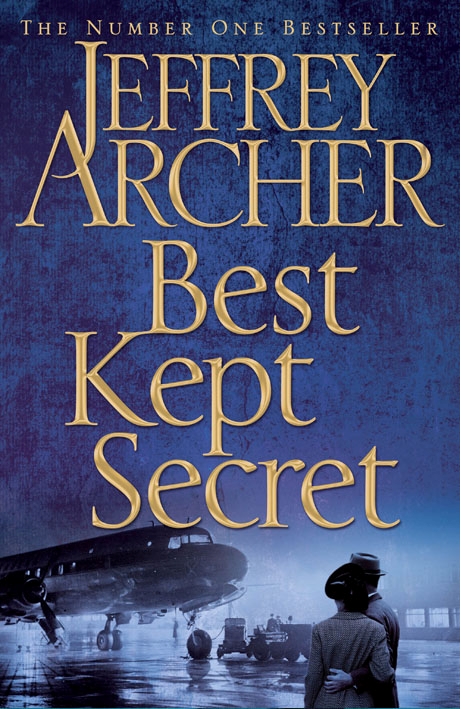
archerAnyway, over Christmas I read Best Kept Secret, the third in Archer’s multi-volume Clifton Chronicles, and came across something relating directly, and rather curiously, to a topic I was already planning to blog about: the Conservatives’ increasing use of open primaries to select their parliamentary candidates for the 2015 Election. So it’s me first, Archer later.

From literally his first day as leader, part of David Cameron’s project of ridding the Conservatives of their ‘nasty party’ image has involved, to quote his acceptance speech, changing “the scandalous under-representation of women in the Conservative Party” and generally diversifying the profile of its MPs and councillors. Stirring stuff, were such a change within his power. However, the “scandalous under-representation” – 17 women out of 198 Tory MPs in 2005 – was created not by his predecessors, but by autonomous local constituency associations who jealously guard their right to select their own candidates – with minimal interference from the national party, thanks very much.

Neither the party nor Cameron will accept anything seriously effective, like all-women shortlists or legally enforceable gender quotas. So they’re left with what they call “equality rhetoric and promotion measures” to increase the selection of minority groups – like the notorious Conservative Central Office ‘A-list’ of some 150 favoured women, black/minority ethnic (BAME) and disabled candidates, from which it was ‘expected’ that selectors in Conservative-held target seats would make their choice, at the expense, if necessary, of their own colleagues or preferred local candidates.

Perhaps surprisingly, some actually did, and in 2010 the party’s women MPs rose to 43, or one in seven of the parliamentary party, and its BAME MPs to 11. The A-list had served its immediate purpose, and the plan was for the diversification project to be driven in the new Parliament by another scheme favoured by both Cameron and the Lib Dems: open primaries – shorthand for the nominating primary elections in which US parties select their Presidential and legislative candidates.

Our recent candidate selections have been mostly through what could be termed membership or closed primary elections. Applicants are shortlisted by local party officials, but the final selection is open to all registered constituency party members – either at a meeting, or through a membership ballot – but closed to non-members. Then gradually during the last Parliament the Conservatives started opening up their selection process, eventually allowing non-party members to participate in the actual selection. We had the unrestricted open primary, in which all registered voters in a constituency, including members of other parties or no party, could participate.

Boris Johnson gave a massive kick start both to the idea and to his own successful 2008 London Mayoral campaign when he was chosen, overwhelmingly, as the Conservatives’ candidate in an open primary in which over 20,000 electors invested around £1.50 to call a premium rate phone line and register their votes.

Over a hundred open primary meetings were held between 2006 and 2010, but Cameron’s initial vision was to do the thing properly, Boris-scale, with postal ballots mailed to all registered voters in a constituency. The first in 2009 was in the Devon constituency of Totnes, and Sarah Wollaston, the winning candidate with nearly 8,000 votes, ticked just about all Cameron’s boxes. A Plymouth-based GP and mother of three, who’d only joined the party in 2006 to oppose the closure of the local community hospital, Wollaston would replace an embarrassing veteran MP, forced to stand down following the revelation of his abuse of parliamentary expenses for maintaining his country home and ‘rabbit protection’. A few months later a second postal primary in Gosport, Hampshire, was a virtual carbon copy. This time the expenses fiddler was the MP whose £30,000 gardening expenses included a £1,645 ‘floating duck island’, and his replacement was Caroline Dinenage, a local councillor, businesswoman, and mother of two.

To the incoming Coalition leaders, these postal primaries must have seemed like a magic potion: the key to cleaning up and transforming the membership of Parliament, opening up candidate selection in safe seats, and extending public participation all in one go. Certainly it went to their heads, for, at the height of an international financial crisis, they included in the Coalition Agreement the pledge to “fund 200 all-postal primaries over this Parliament, targeted at seats which have not changed hands for many years” – the funds to be allocated to all Parliamentary parties in proportion to their 2010 election vote.

With Totnes and Gosport having cost roughly £40,000 each, that would be £8 million-plus, and unsurprisingly it’s become one of the less contentious Coalition pledges to have fallen off the cart. What has continued, though, is that local Conservative Associations have been deciding for themselves to forgo the exclusive selection privileges to which their £25 membership fees entitle them, and to turn their final selection – from a shortlist of usually three or four – into an open primary meeting.

It’s a far less radical development than all-postal primaries. Even so, it has more than symbolically opened up a previously private process, has got Ed Miliband wondering if Labour should be doing something similar, and will surely strengthen the successful candidates’ mandate, if they’re eventually elected. As for the profile of those successful primary-selected candidates, my guess is that David Cameron is at least moderately encouraged. By my count, there have been fewer women than men, though a higher proportion than the overall one-third so far selected in the party’s target seats. Our interest, though, is in one in particular: Lucy Frazer QC, a commercial law barrister who, as re-confirmed candidate for South East Cambridgeshire, has already acquired a small, unwanted footnote in British electoral history.

Let me summarise. Safe Conservative seat; 100+ applicants, reduced by the local party executive to a shortlist of three women, one man – none, controversially, with serious local connections. In the first two rounds of voting, no candidate gets 50%, and the bottom candidate in each round is eliminated – leaving Frazer and Heidi Allen, a businesswoman and St Albans councillor. No voting numbers are revealed, even to candidates, who are not permitted scrutineers. Third round: Frazer is declared winner, by 84 votes to 48 – somewhat surprisingly, Allen having been ante-post favourite.

The presiding officer then, quite improperly, takes the ballot papers home, decides to recount them, and discovers a serious case of incompetence and/or malpractice. In the final vote, a pile of 25 ballot papers was marked as being for Frazer, although apparently only the top two actually were, the rest being for Allen.  The true result, therefore, should have been 84 less 23 = 61 for Frazer; 48 plus 23 = 71 and a majority of 10 for Allen.

Thus far, real life mirrors almost precisely a key plot device in Jeffrey Archer’s Best Kept Secret. In Archer’s version, Sir Giles Barrington narrowly retains his Bristol Docklands seat for Labour at the 1955 General Election, thanks to his sharp-eyed young nephew, Sebastian Clifton, having spotted that one of the piles of 100 ballot papers allocated to his Conservative opponent, Major Alexander Fisher, “has a Fisher ballot paper on top, and the 99 underneath are for Uncle Giles” (p.256).

At this point, however, fiction and fact diverge. Archer arranges for the mis-allocation to be discovered and confirmed during the recount already requested by Sir Giles [forget all the improbabilities – it’s a story, for goodness’ sake!]. The correct result can therefore be officially declared: a victory by 4 votes for Sir Giles, instead of the previous announced 184 for Major Fisher.

Heidi Allen was less fortunate. Not having been told her first and second round votes, she was unaware when the result was announced that she had apparently, and inexplicably, ‘lost’ more than a dozen of her supporters between the second and third counts. Others in the room, however, must have known, which seems to suggest an element of malpractice amidst all the incompetence – reinforced in my mind anyway by the fact that, as the world knows, the Archers’ home at The Old Vicarage, Grantchester is in – yes, South East Cambridgeshire.

Conservative Campaign HQ, confronted with this total car crash, reacted pleasingly predictably – first claiming that the ballot papers should have been shredded (which they shouldn’t – not for three months), then walking away from the whole thing. The South East Cambridgeshire Association then compounded their self-inflicted fiasco by refusing to contemplate a recount, calling instead an emergency closed meeting to which they invited Frazer but not Allen, and voted to reaffirm Frazer’s election in the interests of ‘party unity’ (some hope!).

As an outsider, I’m both amused and, because of the Archer coincidence, mildly intrigued. There is, though, a serious point. Open primaries are one of the more interesting electoral initiatives in recent years, and one hopes that other local parties aren’t deterred by the disaster of this single case.

Chris Game - pic

Chris is a Visiting Lecturer at INLOGOV interested in the politics of local government; local elections, electoral reform and other electoral behaviour; party politics; political  leadership and management; member-officer relations; central-local relations; use of consumer and opinion research in local government; the modernisation agenda and the implementation of executive local government.

Electoral reform: STV for local elections and first-time compulsory voting

Chris Game

Two research-based reports on electoral reform appeared almost simultaneously last week. Great for anoraks, but for a local government blog a dilemma.  Only one report directly concerns local government, and here, therefore, it properly leads off. But the second is – how to put this – at least methodologically the more interesting and will receive the greater attention.

Northern Blues: the Conservative case for local government reform is an Electoral Reform Society (ERS) report. The case starts from the Conservatives’ proportional under-representation – indeed, frequently complete non-representation – on northern metropolitan and unitary councils, due to the workings of the plurality or First-Past-The-Post (FPTP) electoral system. This weakens the party’s base for fighting parliamentary elections and undermines its claim to be a genuinely national party. The most obvious remedy, the report suggests, would be to follow the Scottish switch to the Single Transferable Vote (STV) form of proportional representation for local elections, which since 2007 has given Conservatives seats on councils and even in cabinets, where previously their presence was minimal.

None of this, of course – apart from the supporting statistics – is remotely new, even to Conservatives. Conservative Action for Electoral Reform (CAER), for example, is 40 next year, and jointly sponsored the oddly unmentioned 2005 forerunner of this report: Lewis Baston’s The Conservatives and the Electoral System.

The statistics do demonstrate the party’s under-representation on nine northern metropolitan councils in the three most recent sets of elections, but they are less “compelling” than the report’s foreword suggests, due to elections by thirds not being treated as individual events (p.8), and the omission throughout of total membership sizes of the councils on which the Conservatives are under-represented.

Simpler statistics and, I’d suggest, more compelling are that: (1) in the 2011 elections, in which the Conservatives overall did tolerably well, in the eight metropolitan boroughs of Gateshead, Knowsley, Liverpool, Manchester, Newcastle upon Tyne, Sheffield, South Tyneside and Wigan, the party’s candidates won an average of over 11% of the vote, but not one seat; and (2) today, of the total of 606 members on those same councils, just two are Conservatives (South Tyneside and Wigan, if you were wondering).

We know all about the Tories being the rich and nasty party, but sometimes overlooked is their stupidity quotient – as noted by John Stuart Mill to a Conservative MP in one of history’s great “I was misquoted” apologies: “I never meant to say the Conservatives are generally stupid. I meant to say that stupid people are generally Conservative”.  Sadly, even Peter Osborne, Telegraph and Spectator journalist and author of the ERS report’s above-mentioned foreword, is no exception to the rule. As blind as most of the party to the self-harm of its obsessional commitment to FPTP, Oborne claims “reading this report has persuaded me that proportional representation in local elections may be part of the answer” to the question of how to stem the wipe-out of Conservatism in northern England. It’s only one convert, but who knows?

Back in the world in which the rest of us live, we have Divided Democracy: Political inequality and why it matters – published by the ‘progressive’ thinktank, the Institute for Public Policy Research (IPPR). It’s a fascinating study of non-voting and its consequences that might almost have been devised to rebut the more objectionable views that the comedian, Russell Brand, has been inflicting on us recently.

Among Brand’s addictions are four-syllable words: he’s “utterly disenchanted”; politicians are all frauds and liars; the political system is merely “a bureaucratic means for furthering the augmentation and advantages of economic elites”. Until a “total revolution of consciousness” appears on a ballot paper, he will never vote – non-voting being “a far more potent political act to completely renounce the current paradigm”.

Pretty obviously, it’s not potent at all, but it’s his next pearl that really gets me: “I will never vote, and I don’t think you should, either … it seems like a tacit act of compliance”.  He wants us to join his misguided personal tantrum, and that is objectionable.

If self-interested economic elites are your enemies, it’s NOT VOTING that is the tacit act of compliance, consenting to their authority and perpetuating their rule. Not voting is a delusion: you either vote by voting, or you vote by abstaining and doubling the value of an opponent’s vote. Inaction has its own consequences. Multi-millionaire Brand can afford to be careless of the consequences of his inaction.  Potential non-voting disciples may not all be as fortunate.

The IPPR counter-thesis is simply summarised. Turnout in UK elections is not just falling, but is becoming more unequal. Governments aren’t stupid: they note these trends and act on them. They privilege voters, discriminate against non-voters, thereby ratcheting up societal inequality – at present, massively. One obvious way of making such behaviour at least more politically risky is through full or selective compulsory voting.

First, the figures. Recent General Election turnouts have fallen dramatically: from nearly four-fifths of the electorate in the 1960s to below 60% in 2001 and 65% in 2010. The fall has been anything but equal: much higher among the youngest and poorest. In 1970 the turnout gap between 18-24 year olds and over-65s was 18%; in 2010 it was nearly double: 76% of over-65s voting, but only 44% of 18-24 year olds. As for income, if you divide electors into five income groups, in the 1980s turnout among all five groups was over 80%. In 2010, while over three-quarters of the highest income quintile voted, turnout among the lowest quintile was barely half.

Any rational government, knowing these unequal turnout statistics, would in its own self-interest pay more attention to the likely voters than to the non-voters. The IPPR authors’ major contribution is to have developed measures of the extent to which the Coalition has acted in this way during its three years of cuts-driven austerity. In short, have low turnout groups suffered disproportionately from the funding reductions announced in the 2010 Spending Review and the national and local public service cuts to which they led?

game 2

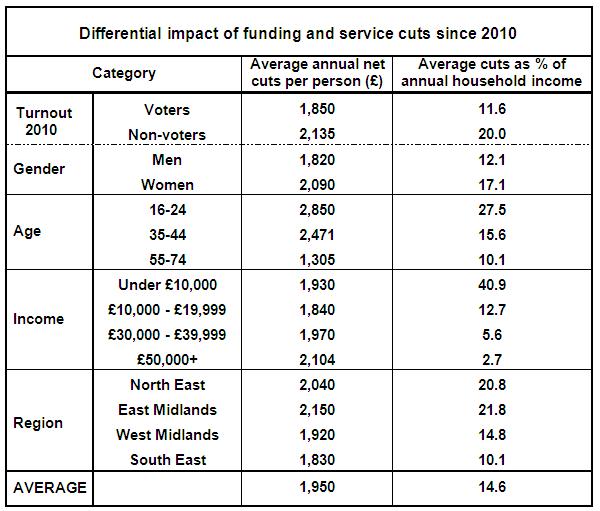
As the summary table shows, the answer is unmistakably Yes. The methodology, fully described in the IPPR paper, is complex, but uses the Treasury’s own accounting framework to collapse all public service expenditure into hundreds of small, everyday items, and then allocate them to households on the basis of known household consumption and spending patterns. Essentially the same is done for individuals, using information about voters and non-voters collected by the 2010 British Election Study.

The table confirms that all groups have been adversely affected to some degree, but that there are clear political inequality effects: women suffering a greater annual loss in services and benefits than men; the young more – much more – than the middle-aged and elderly; some regions more than others. Considered as a proportion of the average household income, the differences are even starker, especially in the case of income level itself. To quote the researchers: “Those with annual household incomes under £10,000 have lost an average of £1,926 annually from the spending measures, comprising a staggering 40.9 per cent of their average income”.

These are clearly important statistics in themselves, but the IPPR study’s primary concern is with the political inequality effect in respect of voters and non-voters: the cuts representing at household level 11.6 per cent of voters’ annual income and 20 per cent of that of non-voters.

Governments may not systematically aim to discriminate against non-voters, but that is the irrefutable effect of their policies – the inevitable consequence being “a vicious cycle of disaffection”. The less responsive politicians seem to be to their interests, the more disaffected people become, the less inclined they are to vote, and the less incentive politicians have to pay them attention.

The IPPR is already on record as a supporter of compulsory voting, as already practised in around a quarter of the world’s democracies. Even where not very robustly enforced, it produces significantly enhanced turnout rates – particularly among likely non-voters, thereby drastically reducing turnout inequality. Recognising, though, that a proportion of UK citizens tend to be fiercely protective of their right not to vote, the present authors settle for the more limited measure of making electoral participation compulsory for first-time voters only.

They would be obliged to go to the polls once, on the first occasion they were eligible – at their place of study for students living away from home.  A ‘None of the above’ option would be available, as in many compulsory systems, and it is suggested that a small fine be set as a gentle persuader.

There are several ancillary arguments for first-time compulsory voting. It should encourage voting in subsequent elections, boost citizenship awareness and political education, but above all it would force politicians to pay more attention to young people and their interests than they are inclined to do at present. Oh yes, and it’s infinitely more constructive than anything Russell Brand has to offer.

Chris Game - pic

Chris is a Visiting Lecturer at INLOGOV interested in the politics of local government; local elections, electoral reform and other electoral behaviour; party politics; political leadership and management; member-officer relations; central-local relations; use of consumer and opinion research in local government; the modernisation agenda and the implementation of executive local government.