An Arsène Wenger perspective on West Somerset

Chris Game

In her recent blog on financially distressed councils in general and West Somerset DC in particular, Catherine Staite suggested that we should be talking more about “streamlining the machinery of local government … merging smaller councils”, and in effect institutionalising some of the multiplying numbers of apparently cost-saving shared service and shared staffing arrangements

Hardly had Catherine’s blog hit the page, however, than things had moved on – certainly for hapless West Somerset. Despite its being a key recommended solution of both the LGA and the former Local Government Minister, Bob Neill, it seems West Somerset may not after all be one of the smaller councils destined for oblivion by merger. Instead, Neill’s successor, Brandon Lewis, has come up with a cunning plan to – as it’s put in the report going to the full council this Wednesday – “retain the ‘sovereignty’ of the Council as the local democratic accountable body in West Somerset” (p.34).

It’s good that ‘sovereignty’ word is encased securely in the kind of quotation marks used for unfamiliar or ironic usage – because it’s not one generally considered applicable to any UK local authority, and there certainly doesn’t seem a whole lot of it in the plan for West Somerset. Rather, it takes on almost the exact opposite of its usual meaning: namely, following to the letter the Minister’s lengthy list of demands and conditions, in exchange for which it has the unique ‘opportunity’ (my quotes, this time) to create a new model of operation by becoming a ‘Commissioning Authority’.

No, sorry, a solely Commissioning Authority, for in this case the Council would commission other service providers, mainly neighbouring councils, to provide all the services it decides West Somerset residents require, retaining only a skeleton staff to manage the arrangements and monitor performance. Yes – the minimalist council, once merely a gleam in the mind’s eye of Thatcherite Environment Secretary, Nicholas Ridley, has finally arrived. Remember the punchline to his vision of a council meeting just once a year, to hand out contracts for its various services: “I wouldn’t mind paying those councillors attendance allowances”.  How we laughed.  I wonder if West Somerset members will see the joke, as they learn the details of – to use a term that seems not to feature in Wednesday’s council report – their ‘virtual authority’: not physically existing as such, but made to appear to do so by software, or in this instance Ministerial soft-soap.

I want to return, though, to Catherine’s blog and her exhortation to talk about these things, and mergers in particular, before they reach the stage of Ministerial intervention. Here at the uni we’re all for more talk and critical inquiry – can’t get enough of them. So, in the interests of helping things along, I thought I’d perform an Arsène Wenger role and add a bit of perspective to the discussions.

The French-born Wenger, for those unfamiliar with Planet Football, is the longest serving and most successful manager of the English Premier League side, Arsenal. Despite his outstanding record, he is currently getting flak from both the media and club supporters after, by Arsenal’s recent standards, a poor start to the season. Wenger’s understandable response is to call for less emotion and more perspective, claiming that the club is in fact “in fantastic shape”.

No, I’m not about to claim that West Somerset, or indeed any other authority in these stressful times, is in fantastic shape. I do wonder, though, what it says about our system of LOCAL government that it apparently cannot accommodate a principal council of the size and with the potential resources of West Somerset, and when its own representative Association declares it “not viable as a unit of local democracy and governance over the longer term”. Why are we – a modest 80th among the territorially largest countries in the world – so desperately keen to have its largest-scale and least-local local government?

First, a few stats. The currently 28-member West Somerset DC was created in 1974 from a merger of two urban and two rural district councils (95 councillors in all), at least one of which – Minehead, a largely self-contained historic coastal town of just over 10,000 – would undoubtedly still be a principal council in its own right in many European countries.  West Somerset’s population is 35,000, with the oldest average age in the UK and spread across an area of 740 km² (290 mls²), including much of Exmoor, and the Quantock and Brendon hills. The result is a population density or sparsity of 48 people per km², compared to the UK average of nearly 400. Unfortunately, such extremes count for little when arguing grant settlement figures with London-based civil servants inclined to dismiss all such ‘special case’ bids as ‘that’s what they all say’.

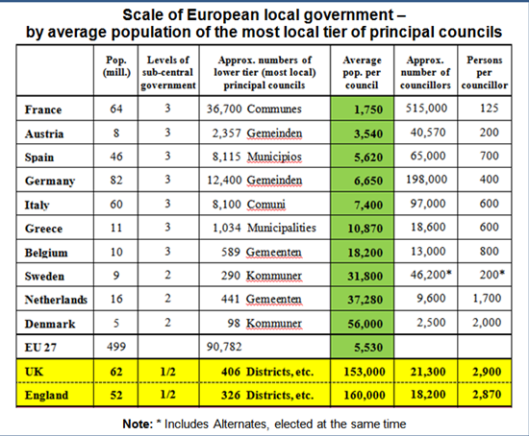
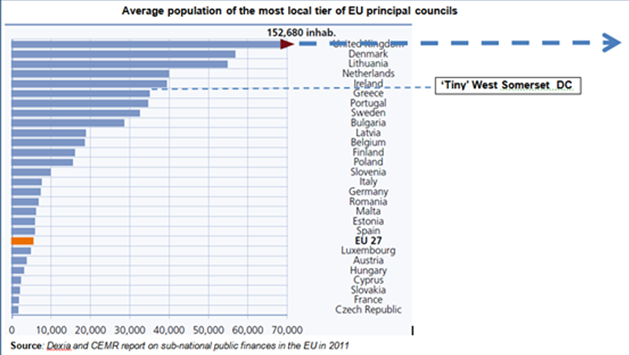
Media reports of West Somerset invariably attribute its alleged unviability to its – meaning presumably its 35,000 population – being so ‘small’ or even ‘tiny’.  Which it is – but only by the UK’s extraordinary, Brobdingnagian standards.  Among EU countries, as shown in the table below, it is more than six times the average size of the lower-tier authorities in what are mostly two- or three-tier systems (Wilson and Game 2011, p.275). If, notwithstanding this being a Wengerian perspective, we take out the distorting influence of the Lilliputian-scale French communes, it’s still well over four times the average size. Try putting the figures on a graph, and the UK not only goes off the end of the horizontal axis; it would require a whole second page for itself

Image 1 Wilson and Game, Local Government in the United Kingdom, 2011, p.275(Source: Wilson and Game 2011: 275).

Dexia CEMR Image 2

(Source: Dexia-CEMR, page 6)

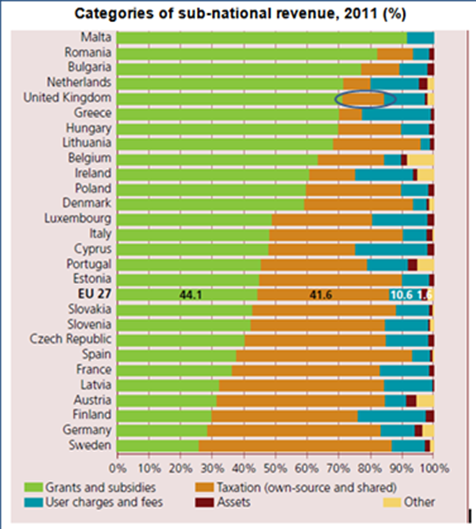
Most of these other EU countries’ municipalities, though generally much smaller than English districts, also have a constitutional power of general competence, and, even more relevantly in the present context, access to a number of different local taxes and tax bases – as can be seen in another graph from the same Dexia/CEMR publication (p.15). On average among the EU 27, the proportions of local revenue coming from central government grants/subsidies and from local/shared taxation are roughly equal; the UK ratio is 6 to 1. Across the EU, local taxes account for between 35 and 40% of local government revenue and between a fifth and a quarter of total tax revenues. Corresponding UK figures in 2011 were 12.7% and 6.2%  (Source: CCRE).

Dexia CEMR Image 3(Source: Dexia-CEMR, page 15)

West Somerset is simply an extreme example of UK local government’s general financial weakness and central dependency. It currently has, if I read the figures correctly, the lowest council tax base of any English district, minimal reserves on which to draw, and is facing a reduction in its revenue support grant both more savage and more immediate even than that for which it was already budgeting. Its alleged unviability is not, as the LGA described it, as a unit of local democracy and governance, but purely financial.  It is the victim of a rigidly centralist funding system being screwed down so tightly that the representative body of a sizable local area and population can no longer do the job for which it was elected.

One final point. Catherine Staite referred in her blog to Denmark’s recent municipality merger programme as one that might have lessons for this country: “councils joined together voluntarily with their neighbours until they achieved the best possible combination of size and geography to deliver economies of scale and locally accessible services”. As it happens, other Nordic countries and/or their citizens have resisted the Danish/British ‘bigger must always be better’ thesis – Norway and Sweden almost completely, Finland and Iceland considerably – but that is not my concern here.

The Danish structural reforms, if not the mergers themselves, were strongly centrally driven, incentivised, and extensive. The number of municipalities was cut by nearly two-thirds, from 271 to 98, the number of councillors by 45%, and the average population size increased from under 20,000 to 56,000 (see table above). However, there still remain 7 municipalities with populations of under 15,000 – the ‘special cases’ that our system seems unable, or unwilling, to accommodate.

It was actually suggested a couple of years ago that this should be the Government’s approach to West Somerset’s exceptional and increasingly dire situation: focus on the nature and needs of relatively small councils, rather than insisting on their adoption of a model designed for much larger councils. They could be allowed ‘flexibilities’, like lighter regulation, and not having to produce separate corporate, improvement and service plans. Above all, though, the Government might consider increasing, rather than cutting, their grant funding and allowing a council tax increase in excess of the then 3% cap.

And which hare-brained, ivory tower academic came up with that notion? None, actually – it was Bill Roots, ex-Westminster Chief Executive, and author of one of the first independent reports on West Somerset. A pity no one listened.

game

Chris is a Visiting Lecturer at INLOGOV interested in the politics of local government; local elections, electoral reform and other electoral behaviour; party politics; political  leadership and management; member-officer relations; central-local relations; use of consumer and opinion research in local government; the modernisation agenda and the implementation of executive local government.

Making Ends Meet: What Aren’t We Talking About?

Catherine Staite

Last month West Somerset District Council sent up a distress flare.  They can’t make ends meet and it is only going to get worse.  At the other end of the scale, the Leader of Birmingham City Council has announced £600m of cuts and declared that the changes which are coming will be ‘the end of local government as we know it’. LB Barnet’s ‘graph of doom’ demonstrates how rising social care costs will eat up their resources until there is no capacity to do anything else but social care and emptying the dustbins.

At INLOGOV we’ve been rather optimistic about the potential for some good to come out of the financial crisis.  We’ve been talking about how we need to build capacity, change relationships and challenge expectations – something we’re calling a ‘new model’ for public services. We are working with some very innovative councils who are embedding radical new thinking in the way that they prioritise resources and commission services. I really believe that it will be possible for them not only to survive but to thrive in this difficult climate.

Others will not be so fortunate. They may ‘salami slice’ and inadvertently lose all their innovative, creative people and therefore their capacity to change.  In some cases political and managerial leadership can’t imagine a different sort of world and so can’t act quickly enough to start building better relationships with communities, managing demand and harnessing capacity to help bridge the gap between what people need and what can be provided.  This requires a new style of local government and  very different, outward facing, political skills.

We are talking about many ways of mitigating the impact of reduced resources on the most vulnerable, but the one thing we don’t seem to talking about is streamlining the machinery of local government. Local government re-organisation – that is, merging smaller councils and moving to a world where shared services are the norm – could help to make the best use of limited capacity and save significant amounts of money but it is rarely discussed.  Many districts and some unitaries have successful shared arrangements, with chief executives and senior management teams managing up to three councils, with evident success.  Why don’t we talk about taking that further? Surely it isn’t because Mr P doesn’t like the idea.  That would recommend it to many. Perhaps it seems too difficult and painful a topic to discuss.  But if we don’t, then opportunities will be lost to make the changes in a positive way and not in a crisis, when distress flares have already gone up.

In Denmark, local government has re-organised itself successfully in recent years. Councils joined together voluntarily with their neighbours until they achieved the best possible combination of size and geography to deliver economies of scale and locally accessible services.  Perhaps we should think about doing the same thing?  If local government doesn’t take the initiative and provide its own leadership on this, no-one else will.  How can we justify the inefficiencies and unnecessary overheads of two tier areas and tiny unitaries in the current financial climate – when cuts are having a real impact on the most vulnerable?

English local government is demonstrably resilient and resourceful.  Can it also be clever, brave and altruistic?

Catherine Staite

Catherine Staite (Director of INLOGOV)
Catherine provides consultancy and facilitation to local authorities and their partners, on a wide range of issues including on improving outcomes, efficiency, partnership working, strategic planning and organisational development, including integration of services and functions.

Bristol: The Start of an Independents Revolution?

Martin Stott

As the only city to hold a mayoral referendum last May and vote in favour, Bristol confirmed its reputation as a city that marches to the beat of a different drum. The mayoral election in November reinforced this maverick status with electors decisively (albeit on a turnout of only 27.9%) electing Independent candidate George Ferguson as Mayor.

The idea of elected mayors has been around for over a decade, one imported uncritically from the US and grafted onto the existing system of local government here. Catherine Durose in her blog ‘Elected mayors: the wrong solution to the wrong problem’ argues that seeing elected mayors as the solution to the ‘democratic deficit’ is wrong. It certainly hasn’t fired up voters, with nine out of the ten cities conducting referenda in May rejecting them –  as they did when asked during earlier attempts by New Labour to introduce the concept outside London.

Durose is right in observing that almost all the elected mayors that do exist are already mainstream politicians (ex-MPs or council leaders) and this makes Bristol’s choice more interesting. George Ferguson is a colourful architect and entrepreneur with a track record in making things happen, including the Tobacco Factory in Southville, a multi-use regeneration project that includes café, bistro, apartments and a theatre. Despite his history  a Liberal Democrat – he only resigned from the party in May –  Ferguson stood as an Independent and won decisively, beating the favourite, Labour’s Marvin Rees, by 37,353 (54.4%) to 31,259 (46.6%)  on the second round. He also led by a substantial margin in the first round.

One of the interesting aspects of the result is just how badly the three main parties did, obtaining  between them, just 45% of the vote in the first round. The Bristol Post described Ferguson as making ‘mincemeat of the three major parties’.  While this appears to be true, it is also a reflection of the profound disconnect between party politics and the voter, expressed nationally in the very low turnout for Police and Crime Commissioners on the same day  – as does the election of 12 independent candidates as PCCs.

In Bristol, Labour claimed afterwards that Ferguson won because the Tory and Lib Dem vote collapsed. This is partly true – neither of them even managed 10%, but it begs questions about Labour’s ability to connect with and energise voters too. There was a distinct split across the city in terms of turn out, with relatively high percentages in middle class areas like Henlease (43%), Clifton, Redland, Bishopston, Windmill Hill and Westbury-on-Trym but really poor turn outs in Labour strongholds like Southmead, St George, Filwood and Hartcliffe (11%). The result of the mayoral election may have been important to the Labour Party, but its voters don’t seem to have agreed.

Four days before the vote, Ferguson held an ‘Independents gathering’ in the Tobacco Factory theatre. The audience, numbering well over 100, was surprisingly large for a Monday afternoon event.  With him on the stage were Independent veteran ex-MP Martin Bell, independent candidates from Liverpool and London and Independent PCC candidate for Avon and Somerset Sue Mountstevens. Bell, though very supportive, clearly thought that like the Liverpool and London independents, Ferguson and Mountstevens were going to be another pair of plucky losers. By the end of the week both had won, Mountstevens with the largest PCC mandate in the country, and Ferguson humiliating all the mainstream political parties. We may yet record that ‘the march of the independents’ started out in Bristol.

Martin Stott was Head of Environment and Resources at Warwickshire County Council until the autumn of 2011, when he concluded a 25 year career in local government.  He has recently become an INLOGOV Associate.

Elected Mayors: The Wrong Solution to the Wrong Problem

Catherine Durose

Only one eligible voter in every three participated in the local elections in May 2012, the lowest turnout since 2000 and despite a context of austerity and swingeing public spending cuts. The recent elections for Police and Crime Commissioners saw turnout slump to a record low for a national poll, averaging at 15%. To quote a Guardian editorial, ‘lack of engagement is the most eloquent of all the political messages…. and one that the parties need to take most seriously. Voters are fed up, not fired up’. Collapsing turnout is perceived as part of a wider decline in traditional forms of political participation, this trend has been labelled as a ‘democratic deficit’ and it is this ‘problem’ that elected mayors are seen as offering a fix to by as simplifying local democratic accountability and offering greater visibility for citizens.

In the referenda held in May 2012, the rejection of elected mayors was near unanimous. The average turnout was low at 32% with over 60% of those who participated, voting for the status quo. The turnout can be, in part, explained by the uncertainty and confusion amongst the electorate about what they were being asked to vote on (the powers which elected mayors would have was, and remains, unclear). But, the size of the ‘no’ vote suggests, at the least, a lack of enthusiasm about electing more politicians. Indeed, voters in Hartlepool have now decided to scrap the position of a directly elected mayor after three terms of office.

Bristol is an exception, by a narrow margin of 7%, it was the only one of the ten cities to vote in favour of an elected mayor. Yet, the Bristol mayoral election, held on 15 November 2012, only received a turnout of 27.92%. Of the fifteen candidates who contested the elections, only one was female and one was non-white. The newly elected mayor of Bristol, George Ferguson, whilst depicting himself as an independent, has previously sat as a Liberal councillor and contested a seat at two General Elections for the Liberal Democrats.

In thinking about why citizens are ‘fed up’ with local democracy and why the idea of elected mayors was a turn-off, perhaps we should take a look at those contesting and winning these elections. As in Bristol, mayors do not represent a radical departure from the professionalised political class or indeed the mainstream political parties which citizens are increasingly dis-engaged from: Boris Johnson in London, Ian Stewart in Salford and Peter Soulsby in Leicester, are all former MPs; Joe Anderson in Liverpool is a former Leader of the council.

I would argue that elected mayors are the wrong solution to the wrong problem. The currently proposed fixes in the constitutional reform agenda, including elected mayors, to deal with the ‘democratic deficit’, are clearly not producing changes which citizens are interested in engaging with. Perhaps this is because the assumption that underpins such fixes – that citizens are apathetic about politics – is incorrect. If we challenge this thinking, then many of the proposed fixes seem like the wrong solution to the wrong problem. If we instead recognise that many people feel that representative politics doesn’t represent them or indeed engage with the important issues that affect their everyday lives, then a different problem with a potentially different solution emerges.

One means of responding to a decline in traditional forms of political participation is to offer different opportunities to engage democratically. Broadening the range of democratic engagement fits with re-thinking what citizenship means: it’s less a ‘status’ which people possess and more a ‘practice’ that people participate in. Looking at data on levels of different forms of civic activity in the UK suggests there is a healthy base of existing participation and an appetite for more. The Hansard Audit of Political Engagement suggested that 14% of people are already active, but 51% felt that getting involved could make a difference; 14% of these were considered as ‘willing localists’, people who were not actively involved but were willing and likely to do so locally.

But how can we tap into this latent demand? First, local authorities and other public bodies need to stop ‘second-guessing’ citizens.  Recent research highlighted that whilst two thirds of local councils felt that the community would be unmotivated to participate more locally, less than 20% of them had formally assessed communities’ interest.  Second, we need to acknowledge that a lot of current opportunities for ‘participation’ replicate some of the problems of local representative democracy by acting as ‘mini town halls’ offering only tokenistic consultation of citizens, failing to recognise Sherry Arnstein’s seminal observation that “there is a critical difference between going through the empty ritual of participation and having the real power needed to affect the outcome of the process”. Third, to look for alternative ways to mobilise citizens and communities. I recently attended Locality’s annual convention – the organisation now recruiting and training 500 senior community organisers, along with a further 4,500 part-time voluntary organisers, over four years spent working with community host organisations. For Locality, this initiative is about ‘building a movement’. Speaking to organisers, they see their challenge as mobilising social action and generating a sense that change is possible. I have seen the impact of organising first-hand in Chicago, and it was inspiring to hear the impact the programme is already making there. If an elected mayor is to make a difference to local democracy, it won’t be as a visible manifestation of Politics, it will be about embracing and supporting these new social movements.

Catherine Durose is Senior Lecturer and Director of Research in the Institute of Local Government Studies at the University of Birmingham.  Catherine’s research focuses on the changing relationships between the state, communities and citizens.

Who Will Really Commission the Police?

Ian Briggs

By the end of this month, 41 newly elected Police and Crime Commissioners in England and Wales will be facing the challenge of filling their diaries with appointments to help them get to grips with a role that is both new and controversial. Whatever their mandate from the electorate, their role will open up some very interesting possibilities around public involvement in policing.

However, behind this significant change sits a number of questions for policing in England, and near the top of the list is how policing could operate within the possibilities created by taking a strategic commissioning approach to the way that policing operates. Strategic commissioning is of course nothing new, it is an established approach in many parts of the public sector and when it is done well and with care new operational opportunities arise, and in certain cases significant economies and quality improvements can be made.

Ensuring that we, as members of civil society, are adequately protected and that crime is efficiently detected will always be the core role for the police; but the emphasis is shifting in some very important areas. Crime prevention is a core task and there are clear benefits in attaining targets through early intervention with young people and those that are more vulnerable in society. Indeed, here the police have developed some interesting and innovative experience through partnership working and aligning intended outcomes with other public bodies and agencies; but the prevailing performance mindset in policing is one of targets and rational planning and not always one of the application of imagination. Where we can see some powerful examples of the benefits of strategic commissioning in other public services it is often around the imaginative approach to the way that joined up outcomes can be achieved. This often brings with it some uncomfortable choices.  At a simple level if we took away the gritting of the highway in winter and focused our attention onto making the pathways safer and free from snow and ice, then we potentially have fewer elderly members of society having their lives ruined through shattered bones and in so doing save us, the taxpayer a fortune in the expert care they require to enable them to recover. Can the PCC now do more than merely be held to account by the electorate in budget setting and the overemphasised issue of hiring and firing the Chief Constable?

Already advanced thinking is taking place.  In West Midlands Police work is underway to look at how strategic commissioning can open up opportunities to go beyond simple target attainment and seek to demonstrate how effective policing can have a wider impact. For example, a concentration of resources upon an often deprived locality could reduce house break-ins and burglary, which in turn could impact upon a reduction in insurance premiums – and which then could put some marginal but important extra spending power into that community to make other services more sustainable.

Whatever we think about the new PCCs, let’s hope that their diaries will have some reflective thinking time and allow imagination to flourish and break free of the terror of targets that policing and communities have suffered from in the past.

Ian Briggs is a Senior Fellow at the Institute of Local Government Studies.  He has research interests in the development and assessment of leadership, performance coaching, organisational development and change, and the establishment of shared service provision.

Equal Pay: Birmingham’s Seriously Disagreeable Christmas Sprout

Chris Game

You probably caught Monday’s headlines: “Country’s largest authority hit by £757 million equal pay bill”; “Birmingham taxpayers face massive service cuts to pay for growing compensation bill”; “Council bankrupt if Government withholds borrowing permission”.

If so, they may have prompted a feeling of déjà vu – both recent and distant. Recent, because these November 12th headlines reported only Birmingham City Council’s delayed official reaction to the genuinely headline-meriting event a fortnight earlier: the Supreme Court’s landmark ruling against the Council and in favour of 174 former employees seeking compensation under the Equal Pay Act 1970 (now the Equality Act 2010). Distant, because – to the shame of all those materially responsible – this lamentable case has been dragging on, chapter by chapter, for a good proportion of the 42 years since Barbara Castle’s historic legislation was passed in the final days of the 1960s’ Wilson Governments.

It’s inevitably a complex story, and the basis of the Supreme Court’s 3-2 majority judgement exceptionally so. But it also has potentially huge implications for other public and private sector employers. A bit of background, therefore, may be useful.

The Equal Pay Act outlawed unequal treatment of men and women, by permitting equal-pay claims to be made by women in the public and private sectors, who were engaged in the same or broadly similar work as men. Though passed in 1970, the Act’s implementation was put back until 1976, thus allowing employers what many felt was a generous period in which to make the necessary ‘adjustments’. Don’t laugh!

It took local government decades seriously to consider its adjustments, but in 1997 the National Joint Council for Local Government Services (NJC) – representing local government employers and the main trade unions: UNISON, UNITE and GMB – negotiated a Single Status Agreement, intended finally, or at least by 2007, to implement the Act without wholesale recourse to employment tribunals. The aim was to develop, through systematic job evaluation schemes, a common pay and grading scale for all manual, administrative and clerical jobs, based on the principle of equal pay for women employed in jobs of equal value to those typically done by men.

Whatever may have been fondly imagined, Single Status could never be cost-neutral. With (in Birmingham) men earning up to four times more than women doing identically pay-graded jobs, there would be losers as well as winners, with local authorities having to find very large sums of money on top of their required efficiency savings, and without jeopardising their primary task of improving local services. They had to devise and negotiate a more expensive unified structure, and compensate those discriminated against under the existing regime, while also ensuring that the now ‘downgraded’ bin men and road sweepers would not be penalised excessively – either through pay cuts or the withdrawal of the supposedly output-based bonus payments that tended to be the preserve of male-dominated jobs.

Righting a major long-term injustice is inevitably difficult, but 10 years was a fair time-frame.  Nevertheless, in 2010, three years after the deadline, one in five councils had still not implemented a Single Status Agreement. Few emerge from the saga with much credit. Ministers set no staged timetable, enabling them to refuse to provide extra funding for back-pay settlements. They also capped, initially at a hopelessly inadequate £200 million, the total ‘capitalisation’ sum councils could borrow against their own assets: a figure that, even in 2006, would barely have covered the then estimated costs of Birmingham City Council alone.

The generally male-run unions resisted any national campaign, giving the impression of putting men’s wages – and Labour councils’ interests – above those of their women members. ‘No win, no fee’ lawyers rushed in to fill the vacuum, taking action against recalcitrant councils, against unions who had settled for less than maximum compensation, and trousering up to 25% of any payout. In a particular irony, employment tribunals, which Single Status was designed to bypass, eventually took centre-stage. One decreed that up to six years’ compensation should be paid for past injustice, instead of the two years that had become the norm – thereby adding further huge sums to councils’ pay bills.

Then, in April 2010, 4,000 women won potentially the biggest pay-out of all in a tribunal judgement against Birmingham City Council. The tribunal found that thousands of women workers – cooks, cleaners, carers, clerks – were entitled to the same pay as men working as gardeners, refuse collectors and grave diggers, who had earned several times as much through large and discriminatory cash bonuses ‘awarded’ for tasks such as picking up refuse sacks and completing rounds on time. Adding insult to the financial injury of conceivably up to £3 billion, the tribunal criticised the Council for wasting public resources in misguidedly incurred legal fees, and its senior management for having continually pushed the problem to one side ‘like a disagreeable sprout on a Christmas dinner plate’.

Obviously, given where we are today, the advice was not heeded. Christmases came and went, the sprout increased in size and disagreeability, but the Council persisted in pushing it around. It took the above case to the Employment Appeal Tribunal, where it was dismissed. Meanwhile, it was facing other cases in the courts – brought by former-employee claimants, unable to go to employment tribunals because of the rules limiting their jurisdiction to cases brought within six months of the termination of the claimant’s employment.

This was how the present case started, and what it is essentially about. The Abdulla Group, as it became known after the first alphabetically listed claimant, comprised 170 women and 4 men who had missed out on the Council’s equal pay compensation payments paid to women still working for the Council in 2007/08 or who had recently left and taken their cases to an employment tribunal. The 174 had all left more than six months earlier, which the Council cynically decided meant that, since they would be time-barred from going to a tribunal, they could be safely excluded from the compensation scheme.

The Council’s case was that ordinary courts should refuse to consider such claims. In the words of the 1970 Act, the court should “direct that the claim be struck out”, on the grounds that it “could more conveniently be disposed of separately by an employment tribunal” – as indeed all previous equal pay claims had been, generally to the considerable benefit to the claimants, in costs, time and accessible expertise.

In the High Court, however, the deputy judge was less concerned with precedence than with Parliament’s intended meaning of ‘more conveniently’. Grossly oversimplifying the literally hours of judicial time since expended on this innocent little phrase, the judge’s interpretation was that a tribunal could hardly dispose of a case more conveniently, if it was time-barred from considering it at all, and that this surely cannot have been Parliament’s intention.

Nearly a year later, in November 2011, the Court of Appeal took the same view, and so two weeks ago did three out of five Supreme Court judges. Former employees have the right to bring claims in the civil courts, where the relevant time limit is not six months, but six years – which, with this case having started in 2010, includes anyone who was still working for the Council from 2004.

The District Auditor estimates that the Council will need to find £757 million to cover actual and potential equal pay settlements, which will mean going cap in hand to Communities and Local Government Secretary Eric Pickles for permission to borrow £325 million on top of the £430 million already secured to help fund the pay claims.

At the same time, struggling finally to digest their wretched Christmas sprout, the Council’s leaders have the nerve to moan at the long succession of referees who’ve ruled against them: “Employment tribunals and the courts have changed their opinion around the law over this period of time always in one direction, which has added significantly to the amount of claims we have had and the cost of them.” To which the thousands of exploited women employees will surely chorus: well, you could always have settled sooner, or even not discriminated in the first place.

Chris is a Visiting Lecturer at INLOGOV interested in the politics of local government; local elections, electoral reform and other electoral behaviour; party politics; political  leadership and management; member-officer relations; central-local relations; use of consumer and opinion research in local government; the modernisation agenda and the implementation of executive local government.