Tackling social problems: why don’t we do ‘what works’?

Jon Bright

One of the most significant problems in public policy has been the persistent failure to draw on evidence of “what works”—and, perhaps more crucially, what doesn’t.

Despite a growing interest in evidence-based policy, we still have a long way to go in identifying and scaling up successful practice. Take, for example, the findings from Nesta’s 2013 report, which revealed that only three out of seventy programmes implemented by the Department of Education were well evaluated (1). Sadly, this gap in evidence was not confined to education and still applies today (2).

Public sector managers need to know what works, what doesn’t and where they should experiment intelligently. However, until the late 1990s, there was little emphasis on evidence as a basis for policy and we haven’t moved as fast as we should have since then. As a result, we have been slow to innovate, evaluate, and scale up new ideas that add value.

What have been the consequences?

That’s not to say there haven’t been some stellar examples of innovation. But these have usually been down to exceptional people or circumstances. In most public organisations, knowledge of best practice is either lacking or hard to access. Public sector managers, particularly outside of professional disciplines, often lack the skills to assess evidence or adapt successful policies to different contexts. In some cases, even when they are aware of evidence, politicians may override advice in favour of projects shaped by political pressure, ideology, or personal interest.

As a result, we keep reinventing policies rather than refining and improving them over the longer term. This makes it much harder to tackle persistent social problems. What’s worse, some policies have been introduced despite evidence that they probably wouldn’t work (3). And even when successful programs are found, we struggle to replicate or scale them up in different contexts.

The Challenges of Policy Transfer and Scaling

This is the core of the problem. A good example is the attempt by English police forces in the early 2000s to replicate a successful gang violence reduction program from the US. Unfortunately, they ignored the detail underpinning the most important components of the US model and the results were largely unsuccessful (4).

In contrast, Strathclyde Police in Scotland carefully adapted the model and successfully reduced gang-related violence. Between 2004 and 2017, the murder rate in Strathclyde halved, and the rate of knife crime dropped by 65%. This example underscores the importance of understanding not only what works, but why it works and how it can be adapted to local contexts (5).

Scaling up successful interventions presents additional difficulties. Long-term success depends on increased funding which is rarely guaranteed. Family Nurse Partnerships (FNPs), for example, have been shown to be effective but have only benefited a small fraction of eligible children in the U.K., despite their positive impact on school readiness and early education outcomes (6). There must be a better way.

Why Is This Still a Problem?

There are several reasons why doing ‘what works’ is a difficult nut to crack. not least of which is the political environment in which decisions are made. Politicians may also reject evidence-based proposals for understandable reasons: cost, public opposition or concern about how they will land with colleagues and the media. Sometimes the timing’s just not right.

Moreover, public sector organisations are often risk-averse. Innovation requires a supportive culture, special funding, expertise, and incentives—elements that are frequently absent. On the plus side, the requirement to produce a business case for new policies does encourage the search for evidence.
The most common objection to evidence-based policy is that we often don’t have the evidence. I deal with this below.

Finally, until recently, there have been too few organisations charged with bringing evidence to decision-makers.

The What Works Centres

The good news is there has been some progress. Ten independent ‘what works’ centres have been set up in recent years to provide evidence-based guidance to policymakers. These centres, covering areas such as health, education, crime, homelessness, ageing and children’s social care, help to bridge the gap between research and practice (7). Their role is to provide unbiased, rigorous, and practical advice to help public services become more effective (8).

However, the work is far from complete. While the centres have made significant strides, there is no agreed, systematic way of incorporating ‘what works’ into the development of policy and delivery of services. Additionally, there has been no independent review of the centres’ overall impact on public policy in the 10 +years since they were founded.

What next for What Works?

The Centre for Public Impact (CPI) argues that a lot of evidence simply isn’t robust enough as the sole basis for social policy (9). It suggests we should use the term ‘evidence-informed’ alongside ‘evidence-based’ and proposes a combination of evidence, expertise, and experience as the best bet for designing policies that will work in most places.
Evidence-informed practice – Centre for Public Impact

To progress the evidence-based policy agenda, five points need to be addressed:

  1. Government Commitment: Government should invest more in research and development. While private companies like Volkswagen allocate a substantial portion of their budget to R&D, most government departments spend less than 1%. Senior civil servants must also be better equipped to understand and apply evidence-based policies (10).
  2. Local Government Involvement: Much of the ‘what works’ conversation takes place at the national level. Local government and civil society must be more involved to ensure better policy and bigger impact. The Welsh Centre for Public Policy is thought effective because of its close working with the devolved government.
  3. The Limits of Evidence: Often, evidence is incomplete or not easily applied to specific contexts. Furthermore, while the Centres are good at synthesising evidence, they don’t take account of the politics of policy making. Local policy makers often query the relevance of evidence when it doesn’t address their main policy questions (11). Evidence often needs to be combined with professional expertise and local experience to tailor policies to local needs.
  4. Scaling Up Good Practice: Public sector organisations need better systems for integrating successful new approaches into their mainstream services. This reduces the need for special funding. Similarly, successful programmes should be repackaged in a form that makes them easier to replicate at scale (12).
  5. Support for Local Managers and Practitioners: User-friendly, evidence-based information is crucial. For example, the Education Endowment Foundation assesses interventions based on evidence strength, cost and impact. This helps schools make good decisions. Other centres also provide ‘what works’ toolkits (13)

During 2024/25, there have been developments in the Network. For example, the Centre for Local Economic Growth has advised local authorities and emphasised tailored interventions that consider local contexts and needs. The Centre for Children’s Social Care has been recommending practices to improve outcomes for children in care. There has been greater collaboration among the Centres including a unified digital platform to disseminate findings. Looking ahead, new centres on climate resilience and digital inclusion are anticipated. The UK government has renewed its funding to the Network.

The ‘what works’ movement is a major step forward in improving public policy. To maximize its impact, its leadership needs to be refreshed, local government and civil society better engaged, and systems created to incorporate successful practice into mainstream services.

Jon Bright is a former civil servant who worked in the Cabinet Office and Department of Communities and Local Government between 1998 and 2014.

References

  1. Cited in The What Works Network (2018) The What Works Movement Five Years On. P15.
  2. Mulgan. G and Puddick. R, (2013) Making evidence useful- the case for new institutions, National Endowment for Science, Technology and the Arts (NESTA).
    See also Institute for Government event in October 2022 ‘What works’ in Government: 10 years of using evidence to make better policy. At this event, David Halpern commented that only 8% of sample of Government programmes had evaluation plans in place.
  3. Wolchover. N, (2012) Was DARE effective? Live Science 27.3.2012; and College of Policing (2015) Scared Straight Programmes, Crime Prevention Toolkit.

4. Knight. G, (2009) How to really hug a hoodie. Prospect. November 2009. See also, Tita. G, Riley. J,
Ridgeway. G, and Greenwood. P, (2005) Reducing Gun Violence Operation Ceasefire. National Institute of Justice (USA); and Braga. A. Kennedy. D, Waring. E, Morrison Piehl. A, (2001) Problem-oriented policing, deterrence, and youth violence: an evaluation of Boston’s Operation Ceasefire. National Institute of Justice.

5.Big Issue (2020) How Scotland’s’ Violence Reduction Unit breaks the cycle of crime, Big Issue 11.9.2020;
Craston. M, et al, (2020) Process evaluation of the Violence Reduction Units Home Office Research Report 116, August 2020; O’Hare. P, (2019) How Scotland stemmed the tide of knife crime, BBC Scotland news website, 4 March 2019; and Batchelor. S, Armstrong. S, and MacLellan. D, (2019) Taking Stock of Violence in Scotland, Scottish Centre for Crime and Justice Research August 2019.

  1. National Institute of Health Research (2021) Family Nurse Partnerships Building Blocks 5-6 study.
  2. Gov.UK (2013, updated 2022) What Works Network, Evaluation Task Force. https://www.whatworksnetwork. org.uk/
  3. The What Works Network (2018) The What Works Movement Five Years On.
    See also Breckon. J, and Mulgan. G, (2018) Celebrating Five Years of the UK What Works Centres, NESTA.
  4. Snow. T, and Brown. A, (2021) Why evidence should be the servant, not the master of good policy Centre for Public Impact.10.8.2021
  5. Halpern, D presentation at an Institute for Government (2022) event op cit.
  6. Private correspondence with Jason Lowther, Head of INLOGOV.
  7. Little. M, (2010) Improving children’s outcomes depends on systemising evidence-based practice… Demos
  8. Education and Endowment Foundation – Teaching and learning toolkit. An accessible summary of education evidence https://educationendowmentfoundation.org.uk/

The abolition of NHS England 

Councillor Dr Ketan Sheth,

We all recognise that the current government inherited a deeply entrenched crisis in our NHS. Years of austerity, coupled with the immense strain of the Covid pandemic, have left our health service at breaking point. Across the country, patients are facing unacceptable delays — whether in A&E, for a GP appointment, or for much-needed elective procedures. The Health Secretary, Wes Streeting, has not shied away from the truth, acknowledging that the NHS is ‘broken’. But with this recognition comes a clear responsibility to act. The commitment to investment and reform was at the very heart of the Labour government’s manifesto, and it is now our duty to ensure these promises become reality.

The three fundamental shifts outlined by Wes — focusing on prevention rather than cure, strengthening community-based care over hospital reliance, and embracing digital innovation — are undeniably the right priorities. 

These are not new challenges; they are the very issues that those of us in local government and health services have been highlighting for years. With Tom Kibasi now leading the development of the NHS’s Ten-Year Plan, there is a real opportunity to turn ambition into action. But make no mistake — this will require more than just vision. It demands political will, cross-sector collaboration, and real investment to drive lasting change.

As a councillor with deep experience in health and social care, and as Chair of a London joint health scrutiny committee, I firmly believe that elected representatives — both national and local — must have clear oversight of how the NHS delivers for our residents. The NHS is funded by the taxpayer, and accountability for its spending —amounting to hundreds of billions —must be transparent. Striking the right balance between strategic oversight and operational efficiency is key. Reducing duplication and inefficiencies between national bodies is a sensible goal, but only if it genuinely results in better care, not just headline-grabbing restructuring.

Earlier this month, the government announced that, in order to focus resources on the frontline, NHS England would be abolished and funding to Integrated Care Boards (ICBs) would be cut by half. There is a logical argument for streamlining management functions where the Department of Health and NHS England overlap. Equally, we cannot ignore the vast NHS deficits that must be tackled if we are to clear the backlog left by the previous government. Cutting costs without compromising frontline care is an extraordinarily difficult balancing act, and success will hinge on empowering local decision-making rather than imposing one-size-fits-all solutions from Whitehall.

But now we must address both the handling and the substance of these decisions.

First, the handling. The people working in NHS England and ICBs are dedicated professionals, many of whom have spent their careers serving our health service. These are individuals with expertise, commitment, and families to support — not faceless bureaucrats. It is entirely possible to debate the structure of public services without resorting to derogatory language, labelling roles as ‘flabby’ or dismissing people as ‘blockers and checkers’. That is why it was reassuring to see Wes take to the airwaves to make a crucial clarification: the target is excessive bureaucracy, not the people who keep our NHS running.

On substance, the proposal to merge the functions of NHS England with the Department of Health is a bold and potentially transformative step — but only if executed properly. Addressing duplication in management is a legitimate goal, yet we must not underestimate the sheer complexity of NHS operations. The government must ensure that what replaces NHS England’s oversight role does not become another layer of top-down control. If local government is to have greater freedoms to shape healthcare services, these must be real and meaningful, not simply a rebranding exercise where old centralised structures persist under new names.

We must also keep our focus on tackling the stark health inequalities that persist in our communities. This means:

• Reducing waiting times for GP appointments and elective procedures.

• Strengthening hospital discharge pathways to ensure patients receive the care they need at home.

• Investing in public health initiatives to drive prevention and early intervention.

• Engaging meaningfully with local communities, in line with the NHS’s statutory duty to involve them.

• Managing winter pressures effectively and ensuring higher vaccination uptake.

While we await the publication of the Ten-Year Plan, which we hope will provide clarity on these pressing issues, one thing is certain: this government must not just explain why these changes are necessary, but prove to the public how they will lead to tangible improvements in their daily lives. The NHS is more than an institution; it is a national treasure, built on the principle that healthcare should be available to all, free at the point of use.

This moment is an opportunity — a chance to build an NHS that is fit for the future. It will take determination, investment, and an unwavering commitment to those who rely on it every day. Let’s not waste it.

Cllr Ketan Sheth chairs the North West London Joint Health Scrutiny Committee

Transport issues are the most common concern raised in residents’ petitions in London local government

Richard Berry

The e-petitions system introduced by the UK Parliament has gained considerable attention in recent years. This is often when a noisy cause claims hundreds of thousands of signatures and forces its way onto the parliamentary agenda. At the time of writing, for instance, there are live petitions for suspending all immigration, rejoining the European Union, reducing the state pension age and changing the parliamentary electoral system.

One might question the feasibility of these suggestions. They may indicate high levels of popular support for an idea, however they call for major shifts in government policy, significant investment of public funds or far-reaching legislative change. Governments would ordinarily have determined their stance on such ideas without any further prompting from petitioners, even significant numbers of them.

In contrast, local government should be fertile ground for petitioners. The subjects of petitions submitted to councils are often hyper-local issues and, in theory at least, much more realistic in their ambitions.

Catherine Bochel and Hugh Bochel have studied the use of petitions in English local government and described the benefits to both local authorities and their residents. In summary, they have found petitions can provide access to politics for citizens without requiring a significant amount of resource. A well-run petitions system can come to decisions that are seen as fair by the petitioners, even if they do not get their desired outcomes, and can provide an educative function. For councils, a petitions system can be a means of receiving ideas and information, which may inform future policy development and service provision.

The London Assembly Research Unit has recently conducted research into how petitions are used in local government in London. We found that 28 of the 32 London boroughs (87.5%) offer an e-petitions platform on their websites. In a couple of boroughs these are only accessible to registered users of the site – that is, local residents with an online account with the council – but in most cases they were accessible to any visitor to the site.

Looking at the calendar year 2023, we were able to obtain data on the number of submitted petitions for 26 boroughs. There was significant variation, with Barnet Council receiving 45 petitions and some not receiving any. The average per borough across the year was 11 petitions.

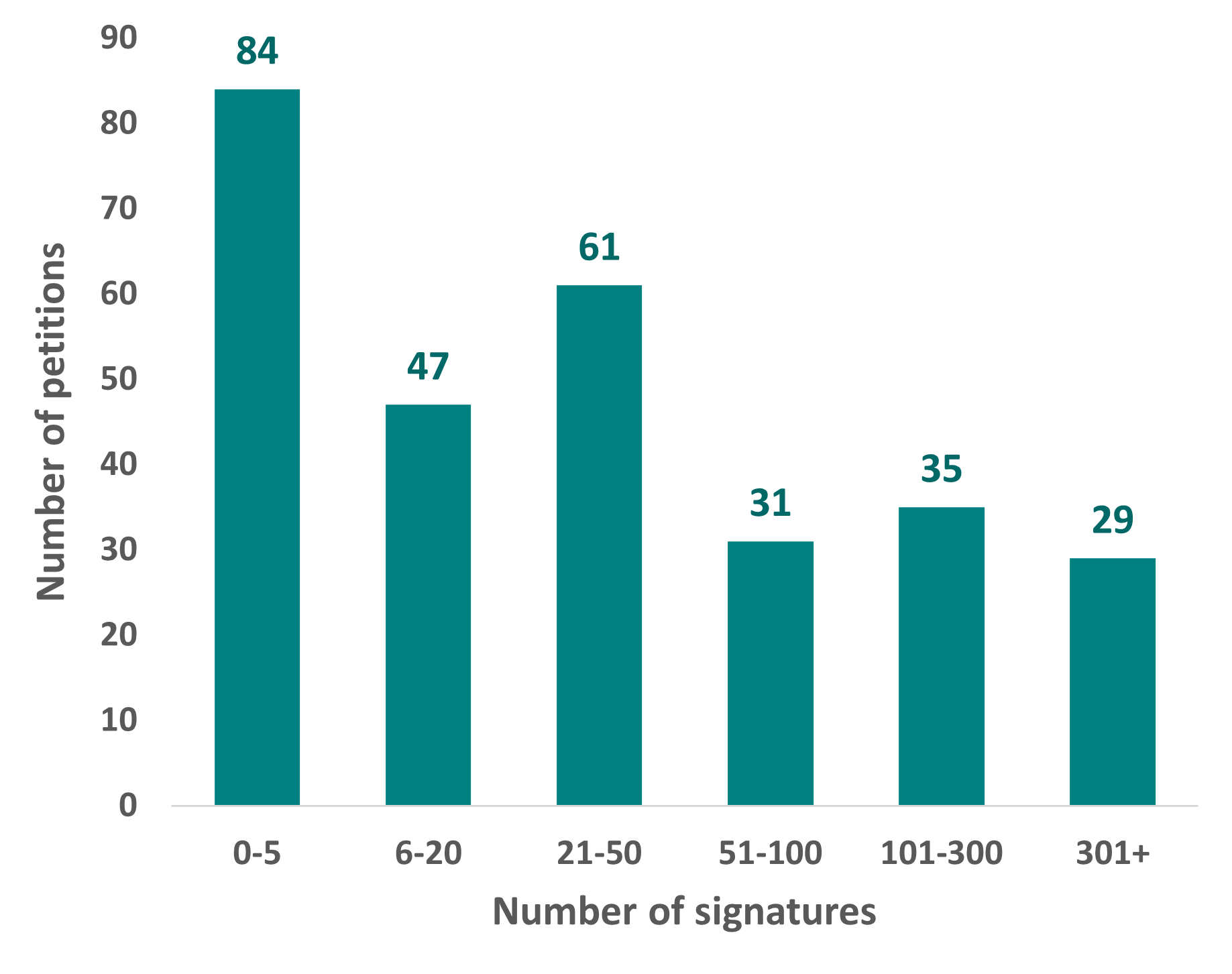
Chart 1 below presents information on the number of signatures received per petition. Most received relatively few signatures, with 26 being the median number of signatures. However, a few received very high numbers – 11 petitions across all boroughs received more than 1,000 signatures – bring the mean number of signatures per petition up to 187.

Chart 1: Number of signatures on e-petitions to London boroughs, 2023

Source: London Assembly Research Unit. Based on petitions data for 26 out of 32 boroughs

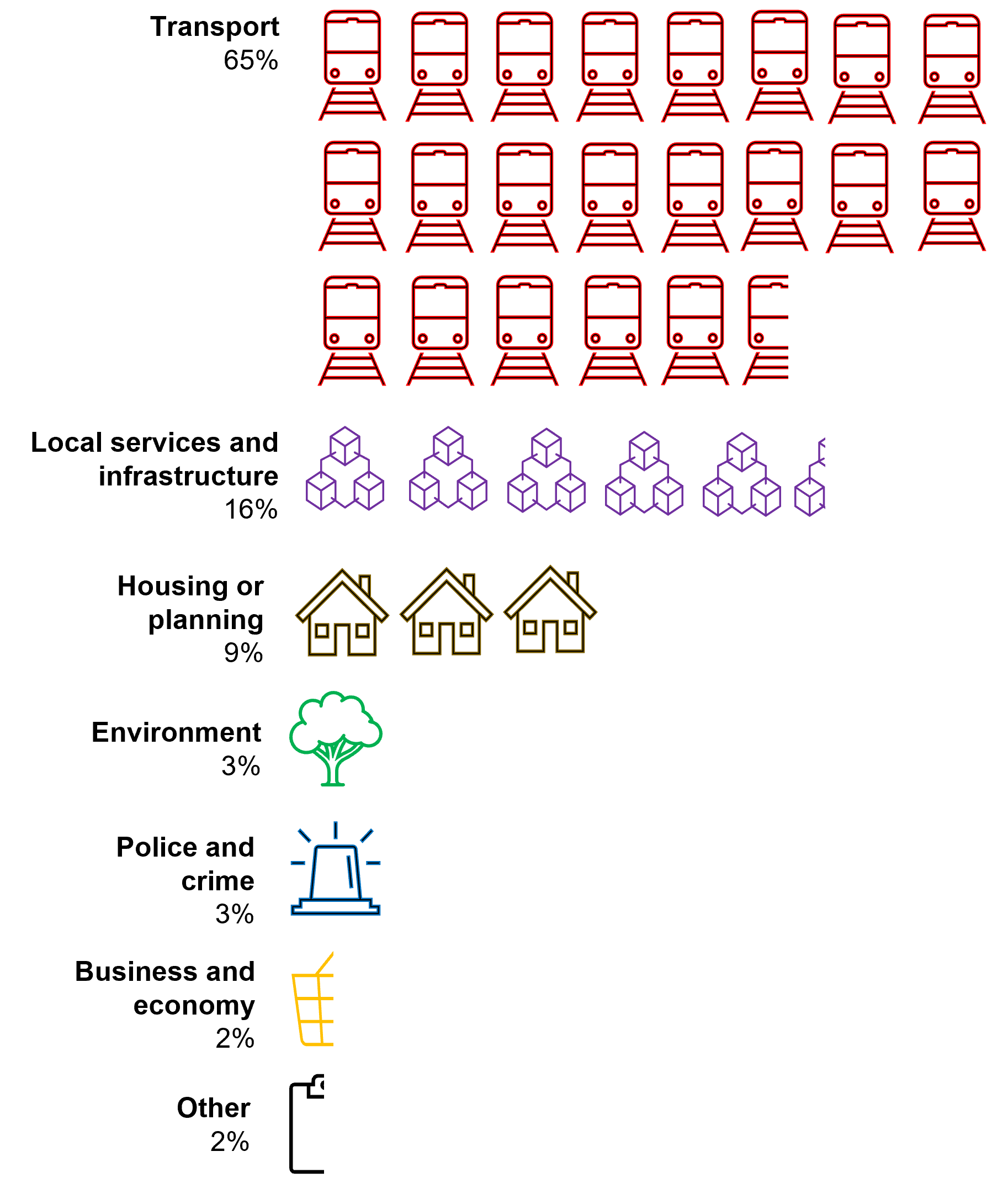
We also considered the topics of petitions submitted to boroughs. We found, somewhat surprisingly, that there was one dominant theme, transport, as shown in Chart 2.

In London, responsibility for most public transport and control of major roads is held by a city-wide strategic authority, Transport for London, overseen by the Mayor of London. Yet boroughs still control the majority of London’s roads, and we found this is where many petitions focused, as people sought changes to the streets where they live.

We see, for instance, that 71 residents of the London Borough of Ealing have called for the enforcement of the speed limit on one local road. 157 residents of the City of Westminster supported moving the location of an e-bike parking bay that had been blocking the pavement in one area. In the London Borough of Sutton, 52 residents signed a petition for the resurfacing one road in a state of disrepair.

Chart 2: Topic areas of e-petitions submitted to London boroughs, 2023

Source: London Assembly Research Unit. Based on petitions data for 26 out of 32 boroughs

The growth of online petitions systems has been the perhaps the most important development of recent times in this field. Another change that has coincided with the rise of e-petitions is that, from being the passive recipient of petitions generated externally, local authorities are now playing an active role in hosting the online platforms on which petitions are managed.

This was encouraged by the 2009 Local Democracy, Economic Development and Construction Act, which places a requirement on English local authorities to operate schemes for the handling of petitions from local residents. Although this requirement was repealed just two years later in the Localism Act 2011, systems had been introduced and in many cases have remained. In a very real sense, they are helping to facilitate campaigns focused on challenging councils’ own policies, which itself is a sign of a healthy democracy.

Richard Berry is the manager of the Research Unit at the London Assembly, which provides an impartial research and analysis service designed to inform Assembly scrutiny. The author would like to thank Kate First and William Weihermüller for conducting research cited in this article. All publications from the London Assembly Research Unit are available here.

Transforming Maternity Services in Brent

Councillor Dr Ketan Sheth

Each year here in Brent, we welcome almost 4,000 newborns into the world at Northwick Park Hospital’s maternity department. Each birth is the start of an exciting journey for new parents and families, who should all have confidence that they will receive safe, effective, compassionate maternity care that focuses on their individual needs.

Sadly, across the country, this has not always been the case. A quick online news search reveals that NHS maternity services have not always performed to an acceptable standard, with disparities in care especially for women from Black, Asian, and minority ethnic groups. The hard truth is that poor quality maternity care puts the safety and well-being of women and babies at risk.

An inspection by the Care Quality Commission in 2021 raised concerns about the quality and safety of maternity services at Northwick Park Hospital. I am delighted to say that in the years that have followed that inspection, Brent’s local government scrutiny committee has been working with the NHS leadership to ensure the service improves and staff have been working tirelessly with the National Maternity Safety Programme to turn things around for the 3,700 births there each year.

The maternity department recently celebrated opening its newly refurbished triage and birthing centres. Whilst this investment in new modern facilities is welcome, it is positive cultural change that is by far the biggest ingredient in the service transformation. There is a new senior management team and a commitment to listening to local women through the Northwick Park Maternity and Neonatal Voices Partnership, which is chaired by local mothers.

This has resulted in a raft of changes, including a special area for women who need to have an induced labour and a specialist midwife to support them. Obstetric nurses are on-hand to help women who have caesarean birth to recover quicker, and seven community midwifery teams have been set-up, three of which are in Brent. A new LifeStart trolley has also been introduced to look after newborn babies who need extra support, while keeping them close to their mothers. Antenatal care for women at risk of gestational diabetes has improved too.  

These substantial improvements, and many others besides, have led to the maternity team being taken off NHS England’s special measures. Indeed, the maternity service at Northwick Park Hospital was deemed the most improved of all trusts in a recent National Maternity Patient Survey

Transformation like this does not come about easily; it requires passion and the commitment from the local government and NHS working in partnership to continually deliver the best care possible for women, babies, and families. 

Tomorrow and every day, around ten babies will be born at Northwick Park, and each mother will have different needs. I wish them all the very best, safe in the knowledge they can expect personalised, safe, and compassionate care.  

Cllr Ketan Sheth chairs the North West London Joint Health Scrutiny Committee

REASONS TO BE HOPEFUL – HOW THE GAP IN LIFE EXPECTANCY BETWEEN ENGLISH REGIONS WAS NARROWED

Nicholas Hicks and Jon Bright

In this blog, we discuss a major success in health policy that’s been largely forgotten.

What happened?
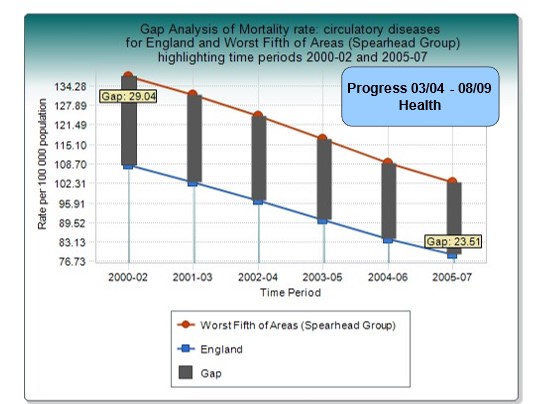
During the 2000s, a government strategy to tackle health inequalities in England led to a reduction in geographical differences in life expectancy. Furthermore, this success reversed a trend that had been increasing. It was achieved by reducing death rates caused by coronary heart disease.


The chart below shows an overall reduction in coronary heart disease mortality and a reduction of nearly 20% (19.07%) in the gap between the national average and the poorest areas. [Barr et al 2017]


This is the only period in the last 50 years when inequalities in death rates between rich and poor have narrowed. It was a considerable achievement and an historic result.

What was the impact in terms of lives extended?
This policy meant that many millions of people lived longer and healthier lives. Much of the benefit was probably due to reductions in smoking and managing risks such as high blood pressure and cholesterol. In 2000, 38% of the adult population smoked and smoking was twice as common amongst those on low incomes. Today, only about 13% of the adult population smoke, the lowest since records began.

But this achievement was not down to health policy alone. Importantly, it was also due to coordinated action across Government to tackle inequalities more generally. This is because many of the factors that affect health lie outside the health sector.

What were the policy drivers?
This work started in 2000 with the NHS Plan (that committed Government to publishing inequality targets), and the Department of Health’s National Service Framework for Coronary Heart Disease, and continued over several years.

These policies led to a national commitment to reduce inequalities. In the wake of the NHS Plan, the Government set Inequalities targets and incorporated them into national Public Service Agreements (PSAs). These Agreements required central government Departments to do better in those parts of the country where outcomes were poorest. This applied not only to health but also to low income, family functioning, education, employment, and crime. These wider issues are major influences on people’s health and targeted action on these made it more likely that health-specific interventions would succeed.

PSAs defined the goals of the 2002 and 2004 Comprehensive Spending Review. Departmental budgets were only agreed once each Department produced credible plans showing how they would contribute to the inequality targets.

What did all this mean in practice for people living in poorer regions?
Health-specific interventions included smoking cessation clinics; improving the distribution of GPs – many disadvantaged areas had no GP service; more resources for disadvantaged areas; national guidance on best practice; and improved access to mental health services. Action to tackle the wider causes of poor health included improving housing (the Decent Homes Standard); increasing household income (the Minimum Wage, Tax Credits); investment in education and skills; reducing the number of young people not in education, employment and training; teenage pregnancy prevention; and investment in early years (Sure Start and family support).

This approach is consistent with Prof Michael Marmot’s conclusions in his 2010 report, ‘Fair Society, Healthy Lives‘ .


What did evaluators find?
Evaluators found that regional inequalities decreased for all-cause mortality and that the strategy was broadly successful in meeting its ambitious targets. Writing in 2017, Barr et al they concluded that ‘future approaches should learn from this experience”. They noted that current policies were probably reversing this achievement of the previous decade. See also Holroyd et al’s systematic review.

In our main paper REASONS TO BE HOPEFUL we discuss the evaluations in more detail.


What lessons should we draw?
There are five main lessons to draw from this evidence:

  1. When Government takes a coordinated approach to a problem – and sticks with it over time – the results can be impressive, even with problems thought to be intractable.
  2. Health is a good proxy for Levelling Up. Narrowing the health gap between regions is a good proxy for ‘levelling up’ more widely. Health inequalities are in large part due to poverty, poor education, and poor housing. Regional inequalities in educational attainment and crime also narrowed.
  3. Leadership and persistence are essential. A ‘whole of government’ approach requires good cross departmental working, full engagement with local government, and leadership from the Prime Minister.
  4. Tackling the nation’s problems needs longer term policy making so successful approaches don’t fizzle out whenever there’s a change of Government. As we’ve seen, benefits achieved up to 2010 may have been lost by 2017. Maintaining progress requires cross-party, long-term collaboration.
  5. This approach worked by influencing mainstream budgets via better targeting and evidence-based interventions, rather than relying only special ring-fenced funding

Today, the big health challenges today are obesity, diabetes and related conditions. Again, poorer populations are much more affected. Will today’s politicians rise to the occasion?

Dr Nicholas Hicks BM BCh FRCP FRCGP FFPH is an Honorary Senior Research Fellow, Nuffield Department of Primary Health Care Sciences at the University of Oxford and a Senior Strategy Advisor, Department of Health and Social Care. He is also an Associate Fellow, Green Templeton College, University of Oxford. He was seconded to the Department of Health Strategy Unit and helped draft the inequalities chapter of the NHS Plan in July 2000 ([email protected]).

Jon Bright is a former civil servant who worked in the Cabinet Office and Department of Communities and Local Government between 1998 and 2014.

References

  1. Meadows D. Leverage points: places to intervene in a system.
  2. NHS Plan. A plan for investment; a plan for reform. Department of Health (2000): 106-7
  3. Health inequalities – national targets on infant mortality and life expectancy – technical briefing . Department of Health March 2002
  4. Spending Review 2002: Public Service Agreements, HM Treasury 2002 para 1.12
  5. Holdroyd I, Vodden A, Srinivasan A, Kuhn I, Bambra C, Ford JA. Systematic review of the effectiveness of the health inequalities strategy in England between 1999 and 2010. BMJ Open. 2022 Sep 9;12(9):e063137. doi: 10.1136/bmjopen-2022-063137. PMID: 36134765; PMCID: PMC9472114.

How digital policing may transform local relationships with the public: international perspectives from the Policing in the Digital Society Network Annual Conference 2025

Dr Elke Loeffler

The Policing in the Digital Society Network is a European network of academics and practitioners researching the changing nature of policing in the digital society. I was recently able to attend its annual conference, held at the University of Northumbria, for the first time and found this inspiring event brought together a vibrant community actively involved in exploring the impact of digital policing on local relationships with the public.

With the rapid increase in the availability of new digital technologies, including AI applications, together with ever-mounting staff and budget pressures, police forces in the UK, the Netherlands and Nordic countries are making increasing use of digital tools, e.g. automation of processes such as the transcription of interviews with victims and offenders and use of digital forensics to make investigations more effective. At the same time, the speed of technological innovation has given rise to new forms of cybercrime such as online forms of Violence against Women and Girls and has generated new policing tasks such as digital safeguarding.

Does this mean that the ‘bobby on the beat’ will be replaced by chatbots, so that relations between local people and the police will be dehumanised at neighbourhood level? The research presented at the conference in Northumbria University provided two different perspectives on this: Prof. Jan Terpstra’s research on the impact of digitalisation on the policing of public protests suggests both that policing has become more ‘abstract’, with increasing reliance on data-based systems, and has become more distant from and less personally knowledgeable about local community groups, while protesters have sought to become less traceable by disguising their physical appearance and avoiding the use of smart technology.

Interestingly, empirical research by Wendy Schreurs and Prof. Wouter Stol on intelligence-based neighbourhood policing in a selected district in the Netherlands has shown that officers get 54% of their information from citizens and 47% from digital police sources. This suggests that the police still need citizens as much as citizens need the police. At the same time, there is evidence, that neighbourhood police officers still spend a lot of unassigned time in their cars without any contact with local people. This has given rise to an experiment to provide police officers with intelligence-based notifications about priority issues at neighbourhood level such as fly-tipping and local ‘hot-spots’, so that they are able to target these issues in a more structured way and provide feedback, which is shared across police teams, and increase their visibility and dialogue with local people.

Moreover, a study by Prof. Kira Vrist Ronn from the University of Southern Denmark on digital police patrols in Norway suggests that the use of online platforms for genuine dialogue with local people on local issues (not necessarily related to policing), together with videos on social media platforms showing police officers in informal settings (such as the famous ‘dance videos’ by Norwegian police officers), may help to create ‘proximity at a distance’, as Kira termed it. In other words, the development of trust relationships does not necessarily have to start with ‘face-to-face’ meetings.

In the light of rapid technological advances and increasing (transborder) cybercrime there is now clearly an urgent need for police forces to collaborate in order to share risks and learning from digital experimentation – something which is still underdeveloped across Europe. As one police force representative stated at the conference “We have to speed up innovation processes”.

This applies in particular to the UK, where there is a risk that severe austerity pressures will drive the 43 police forces to become more inward looking and reactive, instead of breaking up silos and practicing collaborative innovation (Hartley et al. 2013) and collaborative governance (Loeffler 2024) in order to achieve much needed synergies. At European level, Europol has set up a secure infrastructure and innovation methodologies to enable the sharing of unlicensed tools and innovative projects between its members – but Brexit has excluded the UK from some of the key Europe-wide networks and partnerships. While a number of UK police forces such as Thames Valley Police have set up ‘Innovation Hubs’, which include behavioural scientists, leveraging this potential in policing faces particular ethical, legal and governance challenge. The responsible use of AI and other innovations in policing will require more public scrutiny and dialogue with the public at the local level, with a need for robust practices at local level. The independent Data Ethics Committee of West Midlands Police and Crime Commissioner (WMOPCC) and the West Midlands Police (WMP) has already taken steps toward more public engagement. At the same time, there is also a need for national frameworks which learn quickly from emerging successful practice across Europe in this rapidly changing environment.

Furthermore, Wouter Stol et al. (2025) make the point that a more integrated approach to online crime is needed in terms of prevention, detection and disruption. This integrated approach will not just be the responsibility of police forces but other public services as well, particularly in local government. From that point of view, the impact of austerity at local level, resulting in lower priority to community safety in UK local government, has been damaging and will need to be reversed – a topic which the Institute of Local Government Studies (INLOGOV) and the Centre for Crime, Justice and Policing at the University of Birmingham and, more widely, the Local Area Research and Intelligence Association (LARIA) and the Society for Evidence-Based Policing (SEBP) should urgently address.

The opportunities provided by this Policing in the Digital Society Network for learning from innovations and revealing practice across European police forces is likely to play an increasingly important role over the next few years. Its conference next year will be in Oslo – something to look out for!

Dr. Elke Loeffler is an Associate of INLOGOV and Director of Governance International. She undertakes applied research on local public services and has research interests in community engagement/co-production in a digital world. Elke is Vice-Chair for Doctoral Research in UKAPA and a Board Member of the European Group of Public Administration and the International Research Society for Public Management.