A ‘no’ vote for city mayors does not have to shut down discussion on how local political leadership can be strengthened

Dr. Karin Bottom

Last week, ten English cities voted on whether  to alter the dynamics of leadership in their authorities and replace the current leader and cabinet formula with that of elected mayor, deputy and cabinet.  The rejection was almost unanimous, only Bristol registered a yes vote – but with a majority of less than seven per cent – and more than 60% of voters in Coventry, Leeds, Newcastle, Sheffield and Wakefield   prioritised the status quo above change.   To some this outcome was a surprise, yet  polls prior to the referenda were inconclusive at best and taken in conjunction with the uncertainty surrounding elected mayors, it is hardly surprising that the majority of the electorate chose to stay at home or vote no, average turnout being recorded at a particularly  low 32 per cent.

With a focus on what the office of mayor could do to regenerate cities  and enhance local democracy,  ‘yes’ campaigns were beset with problems from the  start, not least for the reason that pre election, the role of the elected mayor was to be broadly similar to that of council leader: specifics were to be negotiated after taking office and worryingly for some, a substantial amount of the role’s leverage would be the product of personality and an ability to maximise what are often termed as ‘soft’  powers.  Compounding these factors, the office’s confinement to cities – as opposed to regions – suggested that capacity for real change was somewhat more limited than proponents suggested.

Analysis in the aftermath of the referenda suggests that a number of factors contributed to the ‘no’ votes but it  is clear that the overriding sentiments within the electorate were uncertainty and confusion.  Voters were unsure about what they were being asked to endorse or reject and some argue that this explains why the   ‘no’ campaigns were particularly successful at tapping into and harnessing public sentiment.  Taken in the context of austerity, ongoing public service cuts and a generalised dissatisfaction with the political class, it is easy to speculate and suggest that the electorate was unenthusiastic about electing more politicians, especially when the nature of the role was unclear and guidelines for removing poorly performing mayors were minimal to say the very least: to many the office seemed nothing other than a risky and unnecessary expense.

Yet, the results on May 3rd should not shut down discussion on local political leadership. The mayoral model may have been rejected but the issue has not gone away; arguments for stronger more visible city leadership persist and the government has made it clear that it now sees the move towards elected mayors as incremental, cumulative and progressive: in this sense the debate continues.  Yet, now it might be useful to shift the focus somewhat and think about how leadership can be nurtured and maximised in the 339 non mayoral authorities in England because there is nothing to suggest that the qualities which comprise strong leadership sit only within the purview of  an elected mayor.  While  Joe Anderson and Ian Stewart take up their new mayoral posts  in Liverpool and Salford, they do so alongside 124 other English authorities which also underwent some form of political reconfiguration last week: it will be interesting to see  whether  the issues which catalysed the mayoral referenda will impact on future leadership dynamics in those local  authorities.

Karin Bottom is Lecturer in British Politics and Research Methods at INLOGOV, University of Birmingham.  Her core research areas comprise parties (particularly small and the BNP), party systems and party theory.  She is particularly interested in concepts of relevance and how national level theories can be utilised at the sub-national level.

Go Back to Committees – and Use All the Talent of Elected Councillors

Andrew Coulson

A recent centre spread in the LGC has the headline “Committee System may be Outdated, Councils Warned”, even though the option to return to government by committees is one of the main planks of the Localism Act and a central plank of Conservative and especially LibDem policy.

The research reported on, by Ed Hammond of the Centre for Public Scrutiny, reports that four councils are expected to make the change in May 2012.  There will also be some “hybrid” arrangements, such as that likely to come into effect in Kent, where advisory committees are given greatly strengthened powers, even though technically decisions will remain in the hands of individual cabinet members, and the cabinet, though that is not expected to meet very often.

Up to 40 councils are believed to be giving serious consideration to making the change, including some of those where there will be mayoral referenda on 3 May.  If those referenda are lost, some of these councils may well revert to committee governance in May 2013.

Why?  Because, as they see it, committees are much more inclusive than any other form of governance. They give a voice to all the elected councillors, and potentially bring to the table all their talents. They make it harder to take decisions in secret. They give councillors a means of putting into effect the commitments they make when they stand for election, and they keep council officers on their toes because they can never be quite sure what will happen when they attend a committee – even if most of the major changes that might be made to a report will have been agreed in the group meeting of a majority party beforehand.  They also allow backbench councillors to specialise, and provide a means to induct them into how council services are run. They develop leadership – many strong leaders emerged over the years from the committee system.

This is not to say that committees were perfect or are inevitably the best solution. They can, and often were, criticised – for being slow to make decisions, leaving it unclear who was responsible for decisions, and for sustaining silos (such as Education authorities) which at times seemed to have little involvement with other parts of the council.  The criticisms can be answered. The committee system can be fast, and keep confidences, when it matters. With a cabinet, or indeed an elected mayor, leadership is still distributed – with chief executives or chief officers often the real leaders. Silos can be broken down if there is the political will to do so. But none of this is easy, and there were plenty of disillusioned and frustrated councillors and officers in the past. All we can say with confidence is that no system is perfect and that each council needs to work out what is best for its own purposes.

There are different forms of committee systems, ranging from a single committee with important decisions taken in full council (as in a number of the present Fourth Option councils, with populations less than 85,000, who have never given up their committees) to the massively complex structures in some counties and metropolitan districts before 2000 which had committees or sub-committees for almost everything that a councillor could become involved in – over 50 in total in one case. No-one is proposing to go back to that.

There have to be means of dealing with cross-cutting issues, urgent business between meetings, the size of committees and sub-committees, how often they meet, systems of councillors’ allowances, and policy review, to take but some of the issues of detail that must be addressed. Scrutiny will for most councils remain a function that needs to be done, and there are different ways of integrating it into a committee system. Maybe there is much to be said for not rushing into making the changes, and learning from what is happening now.

A day workshop at INLOGOV on 6 July will present a balanced picture and facilitate a discussion of the pros and cons of making the change and the detail issues that need to be taken into account in any new constitution.  Several of the councils making the change will be represented or make presentations. Ed Hammond, the researcher who wrote the Centre for Public Scrutiny report, will speak.  There will be comment from the Local Government Association, and support from FOSIG, the group that represents fourth option councils.

It will provide a unique opportunity to listen to the enthusiasts for making a change, and cross question them, and to understand the alternatives, and the possible downsides,  and the need to address the detail.  More about this workshop, including a booking form, can be found by clicking here.

Dr. Andrew Coulson is Lead Consultant on Overview and Scrutiny at INLOGOV,University of Birmingham, with wide experience of Overview and Scrutiny.  He has recently launched one of the first assessed qualifications on the subject.  His further research interests include partnerships and governance, economic and environmental strategies, and local government in Central and Eastern Europe.

Getting It Right for Victims of Crime

Professor John W. Raine

In January the Coalition Government announced its proposal to transfer funding of Victim Support, the national charity that provides support to victims of crime, to the soon-to-be-elected Police and Crime Commissioners (PCCs) for each force area of England and Wales.  The idea of ‘local commissioning’, of course, fits well with the wider ‘localism’ agenda but has raised fears of inconsistency in service provision (especially if PCCs choose to spend their money on more electorally attractive issues), of lower professional standards (through fragmentation of training) and increased administrative costs (with forty two local management structures rather than one national one).  Unsurprisingly, Victim Support is strongly opposed to the proposals.

However, there is a strong case to be made for a mix of both national and local commissioning.  National commissioning by the Ministry of Justice (of a universal support service for victims and witnesses) is vital to the maintenance of existing high standards.  In this respect, Victim Support is best placed to provide the service – having all the experience and the systems infrastructure in place for receiving referrals from the police of all reported crimes and making contact to offer support.  But there is much to be gained by also empowering local Police and Crime Commissioners to ‘top up’ this national base-line service by procuring services at the local level tailored to area-specific needs, for example, in crime hot-spots, and in localities beset by certain offences, such hate crime.

Most important, it is to be born in mind that a significant proportion of crime goes unreported to the police and therefore there are many victims of crime who se contact details are not known to Victim Support yet who would benefit from receiving support.  Domestic violence is particularly relevant here.  A recent ‘MumsNet’ poll of 1,600 users revealed that 83 per cent of women who had been victims of rape or serious sexual assault had not reported their victimisation to the police.

For this reason, ‘out-reach’ work in local communities needs to form a vital element of any comprehensive strategy for supporting victims, alongside national police referral systems to Victim Support.  Local commissioning by PCCs could help identify and meet particular local needs for support among victims who do not report to the police for whatever reason.

Recently, INLOGOV undertook evaluative research for Victim Support on a series of such ‘out-reach’ projects, some involving the establishment of community ‘drop-in centres’ (where no prior reporting or appointments are needed), and others deploying specialist workers in domestic violence and hate crime and operating in particularly disadvantaged neighbourhoods[1].  A key lesson from the research is that local commissioning of such community-based victim support services can usefully complement the national framework of provision from Victim Support in ‘getting it right for victims of crime’.

John Raine is Professor of Management in Criminal Justice at INLOGOV, University of Birmingham.  He has been involved in criminal justice research, consultancy and teaching at Birmingham for some twenty-five years and has a strong track record of commissions for the Home Office, Lord Chancellor’s Department/Department for Constitutional Affairs/Ministry of Justice on aspects of policy and practice within the criminal (and civil) justice sectors).


[1] The findings from this research are summarised in Raine JW, Merriam M, Beech A, and A Sanders (2012) ‘Reaching Out: Improving Access for Victims of Crime’, London: Victim Support.

Hilary Benn – not always so brilliant, or even believable

Chris Game

“Later, I heard that Hilary Benn had been appointed [as a Minister for International Development in a 2003 Blair reshuffle]. Lucky old Hilary. That’s the second time he’s stepped into my shoes, but I can’t complain. He’s brilliant.”

Deliverer of this unusually effusive politician’s compliment was the actor playing Chris Mullin, the former Sunderland Labour MP and junior minister, whose well-received diaries were recently adapted into one of the more surprising of recent London theatre hits, A Walk On Part: The Fall of New Labour.

Well, with due respect to Mr Mullin, his hero hasn’t been so brilliant – or even, apparently, honest – in his attempts to spin this year’s council tax figures to his party’s advantage.

On April 16, Mr Benn, Labour’s Communities and Local Government Spokesperson, posted a news items on Labour’s official website, headed ‘New figures reveal residents in Labour areas pay less council tax than in Tory or Lib Dem areas’.

Nothing remarkable there, I agree.  It could have been an early April headline from pretty well any year since Labour decided that tax-raising was an embarrassing activity for a social democratic party to be engaged in.  Still, I did wonder where the ‘new figures’ came from, as the only ones I knew of that analysed by political control were those helpfully produced by Matthew Keep in the House of Commons Library (Council Tax 2012/13 – Standard Note: SN/SG/6276).

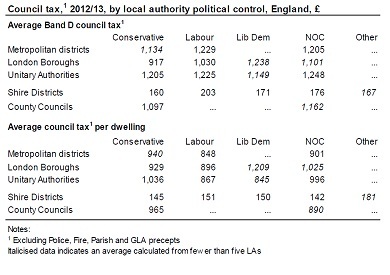
As a politician, Mr Benn sees no need to source his ‘new figures’ or the ‘research’ that produced them, but they are at such variance with those of the Commons Library – as in the table reproduced below – that they are worth comparing, or contrasting, more closely.  It may be, of course, that Mr Benn’s data are somehow more complete than those in the table, or maybe differently calculated – in which case it’s a particular shame that we weren’t informed.

Benn: ‘In Labour local authorities, the Band D council tax rate is £81 lower than in Tory areas and £42 lower than in Lib Dem areas’.
Commons Library: Wrong.  In ALL Labour authorities – all types and therefore all collectively – average Band D council tax is HIGHER than in Conservative authorities and, higher too than in Lib Dem authorities, with the exception of London borough, of which they control just two.

Benn: ‘Households in Labour-controlled authorities pay on average £220 less per year than those in Tory areas and £101 less than those in Lib Dem areas’.

Commons Library: Partly wrong. Households in Labour-controlled London and metropolitan boroughs and unitaries do pay less on average than those in Conservative areas, but the difference is much less than £220 p.a., and in shire areas those in Labour-controlled districts pay slightly more. Comparisons with Lib Dem authorities vary more by type of authority.

None of this, it should be emphasised, is surprising.  Indeed, the surprise would be if the picture painted by Mr Benn’s figures really were true. The truth, however, is that this is one of the more irritating ritual arguments in which the major parties engage every year in the period between council tax-setting and the local elections. It has become an inevitable by-product of the way in which our unreformed tax system works – as I sought to explain in this space last April.

The tax base for council tax is a ratio system centred around Band D: Band A paying 6/9 (2/3) of Band D; Band B 7/9, and so on up to Band H paying 18/9 (2x) of Band D. Councils calculate their tax base by weighting the number of dwellings in each band to Band D, and report their budget headlines in terms of ‘Council tax for council services (Band D)’.

Band D has thus become a benchmark for comparative purposes, and it is therefore perfectly reasonable that the Conservatives tend to use it – as they could with this year’s Commons Library figures – to claim that average Band D tax rates are normally lower in Conservative than in Labour or most Liberal Democrat areas.

Reasonable, but disingenuous. Not so much because only a small minority of properties (15% in England) are actually in Band D, but because, exacerbated by the absence of any revaluation since 1991, the mix of property bands across authorities and regions nowadays varies starkly. In my own authority of Birmingham 56% of properties are in Bands A and B, and just 14% in Bands E to H combined. Neighbouring Solihull has 19% A and Bs and 41% E to Hs. In the North East there are 56% Band As, in the South East 9%, in London 3%.

All of which obviously means that, to raise a certain tax income in an authority with mainly Band A to C properties requires a significantly higher Band D tax than in one comprising many E to H properties. The average bills paid by tax payers will vary similarly – being generally higher than the Band D figure in affluent and Conservative-inclined areas, and lower in poorer or Labour-inclined ones.

Hence Labour’s equally disingenuous preference for using average tax bill figures as their political comparators.  North East: Average Band D council tax £1,525; average tax bill per household £1,072. South East: Average Band D council tax £1,475; average bill per household £1,381. As the anthropomorphic Russian meercat, Alexsandr Orlov, would confirm: simples!

Mr Benn, though, wasn’t finished. His ‘research’ had also revealed that more Conservative than Labour councils had rejected the Government’s one-off grant in exchange for freezing or reducing their council tax in 2012/13. “16 Tory councils have increased council tax this year, as opposed to 15 Labour councils”.

This really is foolishness, on several different levels. First, is Benn really suggesting the 15 Labour councils were wrong: that they should have cravenly fallen in with the Government’s capping policy and accepted the one-off grant, even if they judged it detrimental to their residents’ longer-term interests? If so, it’s interesting that we didn’t hear more about it at the time, when Eric Pickles and his fellow Ministers were positively bullying Conservative councils into obedience.

Second, aren’t the numbers of councils controlled by the respective parties just a tiny bit relevant here?  The Conservatives have roughly two-and-a-half times as many as Labour, which makes the 16-15 comparison look a bit lame.

Third, if Benn really is following Pickles’ line – that it was councillors’ moral duty in these austere times to freeze council taxes – it’s presumably worth taking account of the percentage increases imposed by the respective groups of offending councils, and how close they came to exceeding the 3.5% that would have triggered a referendum.

The full list was published by the Local Government Chronicle on March 21, and, by my calculation, the average Conservative council increase was under 3%, while Labour’s average – with 8 of their 15 going for the full 3.5% – was 3.27%.

Mr Benn’s brilliance, it would seem, is more in the field of international relations than local government finance.

Chris is a Visiting Lecturer at INLOGOV interested in the politics of local government; local elections, electoral reform and other electoral behaviour; party politics; political  leadership and management; member-officer relations; central-local relations; use of consumer and opinion research in local government; the modernisation agenda and the implementation of executive local government.

Standards Codes: A Case of Motherhood and Apple Pie

Philip Whiteman

Whilst giving a lecture to a group of councillors at a summer school last year, I explained how the Localism Bill could result in some authorities abandoning their codes of conduct for reasons of despair with the standards regime.  The response from councillors was enthusiastic and comments included ‘expensive, time consuming and irrelevant’.  Some predictably expressed the view that the ultimate judgement of what constituted poor behaviour would be subject to the ballot box.

Walk on stage, Baron Bichard of Nailsworth who took a very different view when introducing an amendment to the Bill in order to save the code.

“At a time when the public’s trust in politicians is at a low ebb, it is important that all public bodies have explicit standards of conduct, which make transparent how they will carry out their business and provide benchmarks against which they can be held to account.”

Bichard’s intervention and proposal was timely albeit rather late during the Bill’s progress through Parliament.  Without his amendment, local government would have made a backward step of forty years.  Quite why the government objected to the code is unclear but they clearly had a very short memory span.   The code was introduced following the Poulson corruption scandal of the early 1970s and eventually became a statutory requirement. It is true that the code did not rule out further scandals whether they be Donnygate, Shirley Porter orWalsall, but it has given existing councillors a handle on what is acceptable or unacceptable behaviour – a situation further reinforced through the standards regime and most recently, the inclusion of the Nolan Principles into statute.

The Act is quite original in that it is probably the first piece of legislation that lists the Nolan principles, which must be adopted by each authority. However, the rest of the code has to be determined by each authority in the spirit of localism.  This is particularly problematic for authorities not willing to ever make a decision without receiving central government guidance, many of whom will have been waiting for some months by now.

So, from stage left and four months after the Act becoming statute, welcome the Local Government Association and Department for Communities and Local Government along with their new illustrative codes of conduct. Both of their anticipated documents arrived during April and within a week of each other.  This may be coincidental but it did rather resemble a rather unsightly race of one-upmanship or desperation between the two institutions.

Unfortunately, neither code is likely to generate much excitement and seem to be rather ‘motherhood and apple pie’ and lacking in substance – probably a result of disagreement and a rush to publish.

When comparing both documents, one could easily question whether the institutions are addressing the same legislation.  Just taking three examples:

  • CLG’s illustrative code fails to list the Nolan principles (remember that was a requirement under the Act).
  • The LGA acknowledges that others should be treated with respect but the CLG code does not.
  • CLG incorporates narrative on the new Disclosable Pecuniary Interest – but this totally ignored within by the LGA

And the list could go on.

Monitoring Officers and their councillors have gained a tremendous experience over the past few years from the work in developing standards codes.  They will know what works and what does not.  True, existing codes will need to change and reflect the legislative requirements but my recommendation is that they reconsider the own existing codes rather than unquestioningly adopt the vagaries of either the CLG or LGA models.

Returning to my discussion with the group of councillors and their opposition to codes of conduct.   When challenged on how they would determine a breach of standards and how they would tackle an errant councillor, there was quick realisation that a code of conduct provides an essential framework for assessing poor standards and breaches of acceptable behaviour.  Unfortunately, I think those councillors will be sorely disappointed with the LGA or CLG examples.

Philip Whiteman is a Lecturer at the Institute of Local Government Studies.  He has research interests in the impact of central government and regulators on the role, service delivery and performance of local government and other local bodies.  He is currently looking at developing a case for researching how guidance is an important instrument for steering local government over and above legislative instruments.  He is also Editor of the journal Local Government Studies.

If Ministers want us to vote for mayors, why make it so hard?

Chris Game

Even allowing for all the undecideds and the “ooh-I’ve-not-heard-anything-about-it”s, opinion polls suggest that several, perhaps even most, of the ten referendums on May 3rd could produce Yes majorities for elected mayors. None suggest, though, that there isn’t everything still to play for. Why, then, are Government Ministers, who claim to want this potentially momentous change, making life so difficult for the Yes campaigners?

Two issues come up at every mayoral meeting: What additional ‘hard’ powers would a mayor in my city have? and How do we kick out one who’s no good? With the Localism Act offering little help, and Ministers even less, this blog attempts to provide some at least partial answers.

Powers were intended to be easy. In the original Bill, undefined additional powers – transferred ‘local public service functions’ – would go to mayoral authorities only. They were the bribe to get us to vote for the mayors that only false consciousness had prevented us realising we really wanted all along.

But the Lords crucially amended this bit of the Bill, enabling functions to be transferred to any ‘permitted authority’, provided the transfer “would promote economic development … or increase local accountability”.  The mayoral bribe had gone – replaced only by a thinly disguised code.

December’s Cabinet Office prospectus, Unlocking Growth in Cities, stated that cities wanting significant new powers and funding would “need to demonstrate strong, visible and accountable leadership and effective decision-making structures” –universally interpreted as having an elected mayor.

This document launched the Government’s policy of ‘City Deals’ – bespoke packages of new powers, projects and funding sources, negotiated with the leaders of individual cities, in exchange for an agreement to work with the Government, the private sector and other agencies to unlock these cities’ “full growth potential”.

It sounds encouragingly localist – until you realise the Catch-22.  Ministers want to negotiate individual city deals with elected mayors; they can’t say what any specific deal will comprise without knowing who they’ll be negotiating with; but voters, unless they know the likely content of their deal, are much less likely to opt for mayors.

Though inconvenient, this logic might just be acceptable, had Ministers themselves not completely ignored it in publicising early deals with one city still to elect a mayor and another outspokenly opposed to the whole idea.

Ministers could yet decide, as was hinted at before the Budget, to reveal some meaningful detail about the discussions already held with the leaderships of other referendum cities, but it now seems unlikely.  Yes campaigners, therefore, must make the most of the Liverpool and Greater Manchester deals that we do know about – by no means, as it turns out, too discouraging a task.

Liverpool’s city deal was announced on February 7th – the same day as the Labour Council, bypassing its electorate, took the decision itself to have an elected mayor who, once elected on May 3rd, would lead its implementation.

All involved insisted, however, that the deal was not dependent on the city having a mayor – which means that any city whose electors have actually voted for a mayor will surely expect to negotiate a deal worth proportionately at least as much as Liverpool’s.

Liverpool Council’s website headlines the deal’s additional economic development money as initially £130 million – “including £75 million of new money from government” – with the potential to grow to between £500 million and £1 billion.

Other goodies include: an Environmental Technology Zone, with the resulting growth in business rate income going to the Local Enterprise Partnership (LEP) and five Mayoral Development Zones; a Mayoral Investment Board to oversee the city’s economic and housing strategy; and a Secondary School Investment Plan to build 12 new secondary schools.

Sceptics will, entirely reasonably, note the big questions here barely even addressed. How much of all of this is genuinely new money, as opposed to money that would have come to Liverpool anyway from existing or abolished funding sources?  How much of this city deal has to be shared with the city-region LEP? How much freedom of action will the Mayor have to do things that Ministers don’t like? And, of course, the perennial question of additional revenue-raising, as opposed to capital-raising, powers.

However, even to Kenny Dalglish and Liverpool FC, £500 million-plus is hardly loose change. Moreover, most of what relatively little criticism there has been of the package came, significantly, only after the announcement of Greater Manchester’s deal, whose ‘earn back’ tax provision – the first allowing local government to take directly a slice of national taxes – was rightly acknowledged as a genuinely ground-breaking policy innovation.

Importantly, Manchester’s is not a deal with the City Council, but with the Greater Manchester Combined Authority (GMCA) – the strategic authority for all ten Manchester boroughs, whose statutory city region status is clearly accepted by Ministers as having at least the strength and accountability of a city mayor.

Under the deal the GMCA will invest £1.2 billion in infrastructure to promote economic growth, and – the headline bit – will be able to earn back up to £30 million of the extra growth-generated tax revenues to reinvest in a revolving infrastructure fund, in which the money is returned on a payment-by-results basis.

The whole deal aims to create and protect a total of over 6,000 jobs, with other provisions – including devolution of the Northern Rail franchise, 6,000 more apprenticeships, a low carbon hub, and up to 7,000 new homes through a Housing Investment Board – detailed on the DCLG website.

Its total potential impact on the city and regional economy is huge, and, exceptional as the GMCA may be, this publicised deal has to be seen as a massive precedent, and, surely, a major addition to the Yes campaigners’ armoury.

Removal of mayors should also have been settled by now. In its Impact Assessment in January 2011, the Government asserted (p.9) that, if mayors were going to exercise additional powers and freedoms, the accountability regime should include a recall mechanism – to be introduced “at a later date … having considered the issue alongside proposals for recall for other public officials.”

It would have been useful had Ministers reminded voters of this pledge and given some vague hint of when the “later date” might arrive. Still, it remains Government policy, and the answer, therefore, to the question: “If we’re going to directly elect a mayor, how can we directly unelect a rubbish one?” is that, by the time the possibility arises, some recall mechanism should, as promised, be in place.

But what kind of mechanism?  The Warwick Commission Report on Elected Mayors seems to suggest that “an appropriate recall process”, enabling the removal of a mayor “in extremis”, might be one exercised through a no confidence vote by the full council (pp. 10,34). Which is not dissimilar to the Government’s current attempt to introduce a recall mechanism for MPs, controlled by other MPs, rather than by voters – and rapidly unravelling as a consequence, which probably explains why Ministers are keeping so stum about recall for mayors.

In what is supposed to be a major extension of direct democracy, “an appropriate recall process” would seem logically to be one in which voters are the key players. A set percentage of a disgruntled electorate sign a petition, and thereby trigger a recall vote in which those same electors are asked if they want their mayor to be recalled, with a Yes vote triggering in turn a by-election.

Finally, there is the in extremis issue. The Recall of Elected Representatives Bill – the one introduced, regrettably, not by the Government, but as a Private Member’s Bill by Conservative MP, Zac Goldsmith – proposes that recall should kick into action not in extremis, but in any circumstances in which representatives lose the confidence of their electorate: if, say, they’ve acted financially dishonestly or disreputably, intentionally misled the body to which they’ve been elected, broken promises made in an election address, or behaved in a way likely to bring their office into disrepute (Clause 1(2b).

It’s almost certainly not what Ministers have in mind, but I bet it wouldn’t half boost the Yes vote on May 3rd and maybe even the turnout.

Chris is a Visiting Lecturer at INLOGOV interested in the politics of local government; local elections, electoral reform and other electoral behaviour; party politics; political  leadership and management; member-officer relations; central-local relations; use of consumer and opinion research in local government; the modernisation agenda and the implementation of executive local government.