Keeping it simple

Claire Baxter

Sally Philips’s recent documentary about parenting a child with Down’s Syndrome explored the ethics of antenatal testing, but I couldn’t help being drawn to the back story; the families’ experiences of public services.

Earlier this year I managed a small charity, School for Parents, on an interim basis. It provides weekly classes for children with disabilities, teaching groups the skills others take for granted such as moving, communicating and eating.  During this time Dr Anne Emerson of the University of Nottingham conducted research to understand the experiences of the parents.  This provided a valuable opportunity to explore how families we worked with encountered public policy and services, and to appreciate the role university research can play.

What did I learn?

Continue reading

Local government re-organisation: the debate that goes round in circles

Catherine Staite

I do like the unitarisation debate. It has everything going for it. We’ve heard all the arguments countless times, so there are no surprises. It’s been running for so many years that it’s become a constant in a time of great uncertainty. Quite comforting really.

In 2008/9, I was part of the team that was asked to evaluate the effectiveness of the 2009 unitaries, in terms of their financial health, service performance and effective community engagement. The aim of the ‘Form and Function’ study, commissioned by DCLG was to answer the question ‘do unitaries perform better than two tier areas?’ We were asked to compare the performance of the new councils with the four, two-tier Pathfinders. Do you remember them? They argued that they could achieve all of the benefits of re-organisation without any unpleasant side effects, like change.

Continue reading

Can smart maps improve local government?

Walter T. de Vries

Local governments are increasingly making use of internet-based applications and social media to provide services and to interact with citizens. As these applications can operate on smart phones, it is possible for any citizen to upload their wishes and complaints directly. Some of these applications use digital maps, such as google maps, which makes it possible for citizens to upload a report on a specific location and to see if their contribution has been dealt with. In addition, the reports allow local governments to visualize and analyze spatial patterns of citizens’ contributions. This can be used by governments to verify where problems occur regularly, and by citizens to follow up on where a local government is actively addressing their problems.

Are these applications however really helping local governments? At first one would say: yes, they are. Ideally the uptake of mapping applications and the cheap acquisition of data would make local government more efficient in cost and time and more effective in acting on reported problems . Our recent article in Local Government studies, The Contradictory Effects in Efficiency and Citizens Participation when Employing Geo-ICT Apps within Local Government , evaluates to which extent this is true. Do citizens really voluntarily contribute to such systems, and is it really useful for local governments?

The study relies on the usage of the mobile application called the “verbeterdebuurt” (http://www.verbeterdebuurt.nl ) (a Dutch term and application which translates as “improve my neighborhood”), in Enschede (a city of nearly 160,000 inhabitants in the east of the Netherlands).   The application which relies on ‘voluntary’ contributions of citizens compliments a centralized internal system used at the municipality to handle reports on public space, such as complaints about maintenance of city roads, greenery, street and traffic lights, waste and sewerage, amongst others. By law, the Enschede local government has a responsibility to act on the reported problems within a defined deadline. In order to act appropriately, it is however crucial to obtain relevant information about the type and location of the problem.

Statistics of the past year reveal that in Enschede many people discovered the website and are increasingly uploading reports through the mobile app. One could conclude that this provides clear evidence that such mapping applications can help local governments in locating and addressing problems. However, the mapping facility is not decreasing the number of problems nor is it increasing the quality of the reports. On the contrary, numbers have increased rapidly and the quality varies considerably. The key question is why. When evaluating the reports more closely, there is a greater portion of trivial complaints, such as litter which could be easily picked up by the one who reported the problem. Furthermore, the facility also created opportunities for a kind of opportunistic behavior. A number of private construction companies started to frequently report problems that only they themselves could solve. The intentions of the technical design were thus overshadowed by unexpected consequences.

In sum, there is more work to do for developers of mapping applications, before local governments can increase their efficiency and effectiveness in the management of public space. Countering unintended behavior requires further attention before achieving more transparency and accountability of local governments.

de vriesWalter Timo de Vries ([email protected]) is Assistant Professor, land information governance and organization; and course coordinator, land administration, at the Faculty of Geo-Information Science  and Earth Observation of the University of Twente in Enschede, the Netherlands. Walter researches how, why and when agencies cooperate and coordinate to align (geo-)ICT and (geo-)information services within the public sector.

Local government – more appreciated than it often thinks

Chris Game

Someone asked me recently if, in those opinion polls that regularly monitor these things, net satisfaction with the government’s record was ever positive. In other words, are there ever nowadays more of us satisfied than dissatisfied with those who govern us, or have we become, on balance, a nation of malcontents, whoever we happen to have elected?

There are in fact two very easy Yes answers, although for one it probably helps to be pushing 40 or more – old enough, anyway, to remember 1997 and those halcyon, honeymoon days of New Labour and Tony Blair. Ipsos MORI, who have been doing these monitoring polls for decades, had for the preceding three years been logging net DISsatisfaction rates for the Major Government of between 50 and 70%. Then suddenly there were more of us pleased with the Blair Government’s early performance than had voted Labour – net satisfaction rates of over 30%, and for Blair personally over 50%.

Blair’s net positive ratings lasted a remarkable three years, although the Government went into the red, as it were, several months earlier. We’re inclined, though, to allow any new Government some honeymoon period, so at the end of the first fortnight of the Coalition in June 2010 it had a net satisfaction rating of 10%, Cameron one of 31%, and Nick Clegg a never-to-be-remotely-repeated 26%. This, though, was to be little more than a honeymonth, and by September Ipsos MORI were recording a Government net dissatisfaction figure of 4% and by November 20% – as it happens, almost exactly where it is now, and considerably better than it’s managed throughout the past two years.

It was easy to understand, then, what had prompted the question.  But personally it took me back to when I used in lectures to make an admittedly cheap debating point about the respective satisfaction ratings that survey respondents give to their local councils and to the national government, regardless of its political complexion. It’s patently obvious, of course, that when people are asked about their satisfaction “with the way your council runs things” and with “the way the Government is running the country”, they are not in their own minds comparing like with like.  However, it still comes as a surprise to many just how relatively well local government invariably comes out in such comparisons, however dubious they may be.

I wrote in these columns two years ago about how, filling the gap left by the Government’s scrapping of the Comprehensive Area Assessment’s Place Survey, we now have LG Inform, the LGA’s benchmarking data service for councils and fire and rescue authorities.  Local authorities, and eventually the public, would be able to have easy access to resident satisfaction data about councils and their areas, enabling them, if they wished, to make comparisons with other councils.

It’s taken some time, not least because the LGA stipulates that the public don’t get access to the survey findings until at least a year after the end of the financial year in which they’re collected.  This means that the first summary report of results, published in the September 2014 LGA Analysis and Research Bulletin (p.9) is of surveys of various types conducted between October 2012 and March 2013.

As described in my previous blog, Ipsos MORI are responsible for the methodology involved in the collection, presentation and usage of these benchmarking resident satisfaction data and they rightly emphasise how the mode of data collection can have a marked impact on results. They insist, therefore, that any findings should be presented alongside those from other authorities only when collected by the same method – postal/online, telephone, or face-to-face – and that only like-for-like data should be compared across councils.

My own summary in the accompanying table somewhat breaches this code, but for illustrative purposes only. In addition to exemplifying the benchmarking exercise by showing some of the key findings, I wanted to see, insofar as the arbitrary selection of authorities would allow, whether the different modes of data collection did seem to influence the results.
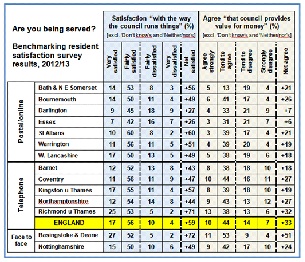
game table

First impressions suggest they do, the more personalised or interactive modes based mostly on quota samples producing slightly friendlier responses than the postal/online surveys based on random samples. Taking account, though, of the profiles of the respective sets of authorities, the difference is not perhaps as great as might have been imagined.

As with any set of results about anything nowadays, it’s obligatory to leap in with cautions about there being absolutely no room for complacency. Still, national ratings of 59% net satisfaction with councils and 33% net agreement that they provide VFM, following two of the most savage financial settlements inflicted on local government, suggests that large numbers of them, at least, must be doing something right – just as a national government’s consistently large negative ratings might also suggest that it’s getting the odd thing wrong.

Since the main purpose of this blog is to draw colleagues’ attention to the benchmarking exercise, I should conclude by saying a bit more about it. The best things in life are said to come in threes, and that’s certainly the case here. As well as the three modes of data gathering, there are three tiers of recommended benchmarking questions. The core or priority set comprises, yes, three: the two in my table, preceded by one on satisfaction “with your local area as a place to live”.

The second tier set of another three – a likely priority for most, but not all, councils – ask how well informed you think your council keeps residents about the services and benefits it provides, how strongly you feel you belong to your local area, and how safe you feel when outside in your local area (a) after dark, and (b) during the day.

The third tier questions, likely to be of interest to some councils only, are a bit of a mix. There’s a 7-tier anti-social behaviour question, and one on whether you trust your local council, but what particularly caught my eye was one asked by Bournemouth and Darlington, asking respondents whether they spoke positively or negatively about their council (a) if asked, and (b) without being asked.  Taking both responses together, the positives again outnumbered the negatives, and, if only about one in 20 confessed to running around the streets of their respective towns spontaneously cheerleading for the council, well – to adapt the Dr Johnson quote about women preaching and dogs walking on their hind legs – it’s pleasing to learn of it being done at all.

Chris Game - pic

Chris Game is a Visiting Lecturer at INLOGOV interested in the politics of local government; local elections, electoral reform and other electoral behaviour; party politics; political leadership and management; member-officer relations; central-local relations; use of consumer and opinion research in local government; the modernisation agenda and the implementation of executive local government.

What skills does a 21st Century fire service need?

Dave Cross

Over the past twenty years the fire service, like many other public sector agencies has undergone radical change. Whilst the public’s expectation of the fire service as a response based fire and rescue service remains the same, the organisational expectations of fire fighters has increased markedly. To quote a senior Greater Manchester fire officer “The job of a fire fighter nowadays has changed from not just putting out fires… to almost being a semi social worker”.

This change was precipitated by the Bain report of 2002 and the resultant repealing of the 1947 Fire services Act to be replaced by the 2004 Fire and Rescue Services Act. No longer was it response, but prevention that became the fire service’s primary consideration. In line with this prevention orientated approach fire fighters nationally are now undertaking Home Safety Checks. It is the carrying out of these checks and the increased access into people’s homes that has brought about an increase in fire fighters generic skills. A fire fighter now has to be aware of a range of issues, some way beyond the fire safety sphere. These would include health and wellbeing of the occupant, child and adult protection issues, possible need for a vulnerable person’s referral or other agency involvement.

The rationale behind this is that the most at risk groups fall into the catchments of many public sector bodies. This is borne out in the MECC programme (Making Every Contact Count) and the Marmot review of public health. MECC is a means by which other, agency appropriate involvement can be sought through previously established referral pathways.

Through their prevention schemes, the fire services run a universal programme of home fire safety checks: they are in touch with members of the public from all sections of the community and not only attempt to prevent fires, but are also involved in running prevention programmes from home safety to road safety. They link up with schools, engage and inspire young people, visit people’s homes and develop relationships with the community – they are in the perfect position to deliver interventions and partner with other agencies to reduce health inequalities. The fire services do what every stakeholder involved in reducing health inequalities should do: engage directly with the community, work to provide them with the opportunities they need to live a healthy life and focus on prevention.”

Professor Sir Michael Marmot.

Of more recent concern for the fire service is an awareness of signs of radicalisation and counter terrorism for which the fire service forms part of the first and last line of domestic defence.

In addition to home safety checks fire fighters are actively engaged in local schools delivering targeted, curriculum supporting sessions on fire safety and road safety. Fire stations are considered a community resource. They can be used by external agencies if they are a better avenue into at risk groups.

The perverse incentive that was envisaged by decreasing calls is being realised (fires having fallen by 64% in 10 years). The continuing effects of the government’s austerity measures which has seen fire service budgets slashed by 25% over the last 4 years has seen staffing numbers and appliances decrease. This has come with increasing pressure from central government to adopt more use of retained (part time) fire cover as this is considered to be more cost effective. In response some metropolitan brigades are resisting these pressures believing them to be unworkable in major conurbations. This has brought about an increased and management supported use of social media. It would not be unusual now to find a fire fighter ‘tweeting’ from the fire-ground. Whilst this carries some risk to the organisation and people have on occasion had their fingers burnt. The benefit of informing the public of our activities is seen as outweighing the risk from the odd ill advised ‘tweet’ but is yet another example of the broadening role of the fire fighter.

Commensurate with that reduction in calls is a reduction in fire fighters experience. This has created a double edged sword, for while the public are becoming increasingly safer fire fighters are becoming exposed to more risk. Not just from a lack of practical experience but also because advances in building construction (double glazing, furniture) is making fires hotter and requiring far more refined technical skills to be able to adequately deal with and therefore realistic training needs to increase.

Fire services are now faced with the dichotomy of putting more time and resources into the ‘softer’ skills that, increase public health and safety, complement interagency work but ultimately reduce service demand and funding with the need for increased staff training and awareness not only in the equipment and procedures for personnel safety in an increasingly threatened world but also in the necessity for public awareness and marketing. The role of a fire fighter is not what it was.

cross

Dave Cross is Watch Commander at West Midlands Fire Service.

This post was originally featured on the 21st Century Public Servant blog.

A view from Barnet’s Chris Naylor: how the class of 2014 are responding to perma-austerity

Chris Naylor

Two weeks ago I gave the lunchtime pep talk to a dozen young hopeful students each vying for a coveted place on Barnet’s graduate programme. Furiously clever, ambitious for Barnet and public services more generally – I didn’t envy those with the task of making a final selection. Like the alumni who have come through the Council’s programme before them, many of whom a decade on, as senior managers, continue to make a profound contribution to the success of the borough, the Class of ’14 will truly be the 21st Century Public Servants. Over the course of the next 40 years (probably 50….) they, with others, will come to define the scale, purpose and breadth of public services locally, nationally and perhaps beyond.

Along the way, the challenges that they will face are beginning to take shape. There are three striking features:

  •  deficit reduction and growing service demand, particularly in health and social care will mean public sector spending reduction and then restraint that has the potential to last deep into the second quarter of the century;
  •  meanwhile customer service expectations are rising exponentially and the public sector has so far proved too slow in response. From an inability to book appointments with the doctor, to the maddening requirement for the citizen to constantly re-provide to the state, information about themselves the state already knows and in some cases originated – serves to frustrate, erode trust and catalyse disengagement. And this coming at time when the scale of change facing the public sector requires greater proximity, not less; and
  • traditional interventionist measures to promote social mobility and other social outcomes will be challenged by a scarcity of public resources. Furthermore, rising health and social care demand, highlights the need to ensure that the public sector can properly demonstrate that services are provided fairly. Indeed there may well be a need to properly demonstrate that services are withdrawn fairly too. Fairness, of course being a concept that is ripe for debate and challenge!

Over the last 12 months Barnet Council has been working hard to develop ideas and options that address these trends, particularly as we expect them to manifest in the second half of this decade. The Council’s “Priorities and Spending Review” sets out a range of ideas to save money and achieve priority outcomes. They include many of themes identified by those interviewed by the 21st Century Public Servant Project: efficiency-particularly through the application of new technology; measures to promote economic growth; demand management; greater community enablement and facilitation and partnership working/integration. In Barnet, over the coming months these ideas and others will now be considered politically and with service users, residents and other stakeholders so that a conclusion can be reached. These decisions won’t be easy, by the end of the decade Barnet will be spending roughly half what it did in 2010 on the provision of public services.

In this context our workforce will quite understandably be concerned about job security. Not least because on the 1st April 2016 our workforce budget will be £68m per annum, while our savings target for the period 2016-2020 will be higher at £72m. All other things being equal – that will feel like a circle that can’t be squared. But the public sector will not disappear, realistically Barnet will still spend some hundreds of millions of pounds and employ many hundreds of staff, directly or indirectly, to provide services that require heavy personal involvement – Google has not replaced teachers, even if it has changed and enhanced the way they teach.

More importantly local government will continue to consist of good people doing good things for people – and it is this sense of moral purpose that attracts the Class of ’14, in much the same way it has attracted others before them. In this context, for public service leaders, at all levels and at all points in their career the truth is that the magnitude of change before them is not just a challenge to their skills and capability, but for some – many perhaps – it is a challenge to their philosophical outlook. To exemplify the point,consultation we undertook to inform the Priorities and Spending review revealed that many residents want Barnet to effectively market council services and the talents of staff – they are willing our organisation and workforce to be more entrepreneurial. It’s not, however, an attribute that universally characterises the culture of most local authorities. Indeed some folk will find the very notion alien to a public sector ethic. In Barnet the desire to be entrepreneurial has led us to establish ‘Re’, a joint venture with Capita to market our development and regulatory services. Several of the staff in the service/company have joint employment contracts, enabling them to provide a commercial service alongside their regulatory responsibilities. From its inception, it is a proposition that has had its supporters and opponents, notwithstanding the fact that the business model for Re sees a growth in employment and not a reduction. Winning the support and commitment of those staff transferring to the joint venture has been the leadership challenge both during the development of the proposal and for the post go live period. At the risk of sounding glib, the only way to win the hearts and minds of workforce in question has been to appeal to both their hearts and their minds. Reason, coupled with an on-going conversation and debate about their motivation and conviction to achieve good outcomes in Barnet.

One final observation: The 21st Century Public Servant research, rightly alerts to the tension between technology-led commoditisation of public services and the desire/requirement for a more ‘relational state’. But I would challenge a view that asserts too strongly that both responses are mutually exclusive. Insight derived from joined up data gives us the potential to engage more directly with individual residents based specifically on the services they use or the place where they live. For example we can already send details of a planning application in a resident’s street directly to the phone in their pocket. Ideally they could use that phone to work out their chances of getting their child into a particular school.  And if we know they’ve been looking at catchment areas, much as Amazon directs to similar products, we too should point “here are some children’s events in our libraries”. We hold that information, we just need to get it packaged and sent in a way that is useful to a resident.

The Class of ’14 were born between 1992 and 1994. They’ve been using social media and the internet before they became teenagers. The application of new technology to re-design services and better engage service users isn’t a novel idea – to them it’s both obvious and assumed. Over the coming years we should expect them to adopt the best levels of personal engagement from the most customer orientated parts of the private sector and develop new forms of civic engagement – using big data to make small but regular differences that change our residents lives for the better.

Chris Naylor is Chief Operating Officer at Barnet Council.