The Poplar Rates Rebellion

Chris Game

When you’re Leader of the Opposition, you welcome almost any headlines.  But “Make ‘fire-and-rehire’ tactics illegal”, following Sir Keir Starmer’s keynote address to last September’s TUC Conference, seemed risky even at the time.  Fire-and-rehire is the practice openly adopted by several companies – including British Airways and British Gas – of handing employees redundancy notices, then re-employing them on worse contracts. “Against British values”, pronounced Sir Keir, and should be outlawed.

As with most Starmer pronouncements, there was no orchestrated follow-up, which here was perhaps fortunate. For the local council most prominently pilloried for exactly the same practice was the overwhelmingly Labour controlled East London Borough of Tower Hamlets. The Council termed it a “workforce investment” exercise; to the workers themselves it was #TowerRobbery.

Embarrassing, you might think, for almost any self-respecting council, but uniquely so for Tower Hamlets. For this month the borough will embark, howsoever Covid permits, on a summer-long centennial commemoration of the famous Poplar Rates Rebellion mounted by the obviously rather different class of Labour councillors of one of its predecessor authorities, Poplar Metropolitan Borough. We’ll focus here, therefore, on the history.

The 1918 Representation of the People Act transformed British politics at a stroke probably more than any other single law since the Great Reform Act of 1832.  Extending the vote to all men and most over-30 women tripled the electorate, revamped elections, and potentially recast the elected memberships of local councils – though here in Birmingham and the West Midlands, as it happens, the stroke took rather longer than in most of the rest of the country. With the important exceptions of the Black Country and the Potteries, the well-organised and well-funded Unionist organisations controlled by the Chamberlains and Stanley Baldwin at least diluted and delayed the advance of Labour, if not the decline of the Liberals.

Poplar was the complete reverse, the Labour Party there being led by the radical socialist, Labour pioneer, and the party’s future national Leader, George Lansbury. By 1919 he had been a longstanding elected Poor Law Guardian and Poplar councillor, a Labour MP before resigning to fight, and lose, a by-election on the specific issue of women’s suffrage – and, particularly useful for attracting publicity during the Rates Rebellion, editor throughout the First World War of the anti-war Daily Herald.

In the 1919 local elections, Labour’s assortment of railway, dock and postal workers, labourers and housewives ousted almost entirely Poplar’s pre-war class of Conservative and Independent local businessmen-councillors.

The party took 39 of the 42 Council seats, including six women, and 19 of the 24-member Board of Poor Law Guardians, the body elected by local owners and occupiers of land liable to pay the ‘poor rate’ that funded the harsh ‘workhouse’ regime providing minimal accommodation and employment for those financially unable to support themselves. Much less surprisingly, Lansbury was elected a very non-ceremonial Mayor.

The reforms – particularly vividly recounted by Janine Booth and local historian Mick Lemmerman – began almost immediately, aimed at alleviating unemployment, hunger and grinding poverty. The big hurdle, though, was always going to be that outdated, almost intendedly inhumane, 1834 Poor Law, requiring that borough councils fund their own local poor relief – those councils with greatest need having almost by definition the least funding to do so and residents least able to afford any rate increase.

Lansbury himself, both as a Guardian and as a member of the 1905-09 Royal Commission on the Poor Laws, had long argued for complete replacement of the workhouse system by a combination of old age pensions, a minimum wage, and national and local public works projects. 112 years on, I doubt he’d be hugely impressed by our minimum wage, but certainly the workhouses have gone.

Back then, though, there was worse. In addition to collecting their own local rates, borough councils had to collect and hand over ‘precepts’ for the funding of four cross-London authorities: London County Council plus the Metropolitan Police, Asylums Board, and Water Board.  And when it came to the crunch – at the Council meeting on March 22nd 1921 – it was these precepts the Poplar Councillors collectively voted to refuse to pay, but to apply the revenues instead to the costs of local poor relief while campaigning for a fairer rate system.

Poplar Borough Council

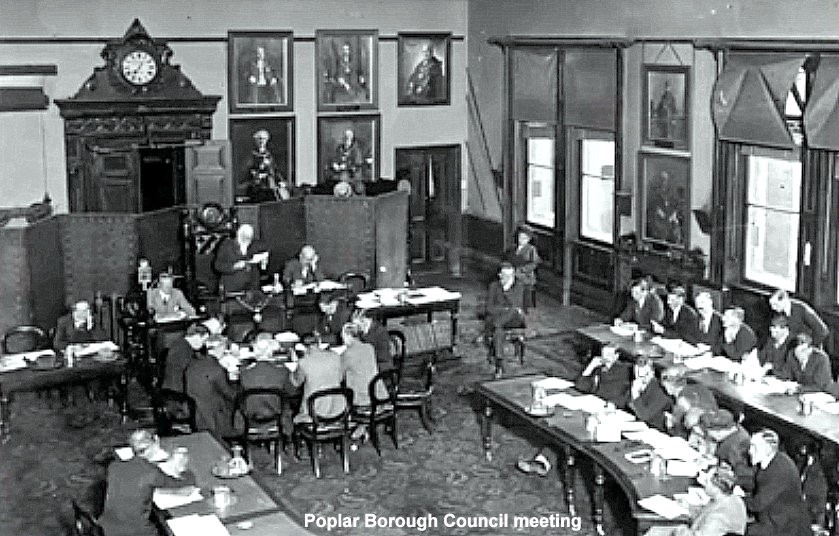
Which is an excuse to include one of my favourite local government photos – of a (admittedly, not the) 1921 Poplar Council meeting, showing the Mayoral chain of office draped around not the neck of the anti-ceremonial Mayor Lansbury, but a chair.

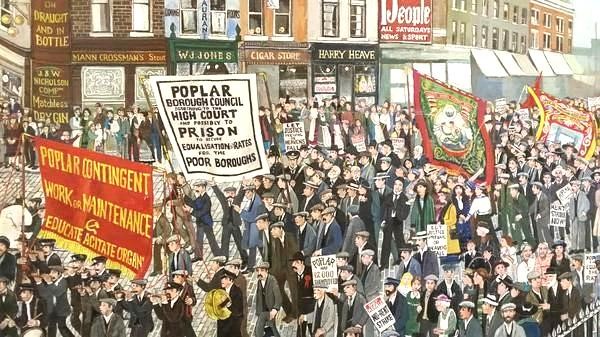
Hugely supported locally, this illegal action inevitably led to proceedings against the Council. So on July 29th, 30 councillors, including the six women, processed from Bow – accompanied by brass band and a banner proclaiming “Poplar Borough Council marching to the High Court and possibly to prison”.

Poplar protest

The banner was prescient. Persisting in their refusal to hand over the precepts, the 30 were found guilty of contempt of court and in September sentenced to imprisonment.  The men went to Brixton, the women, armed with flowers and surrounded by thousands of supporters, to Holloway – including the remarkable Nellie Cressall, pregnant then with her sixth child, and who was still serving on the Council in the 1960s.

The revolt received wide public and trade union support, neighbouring councils threatened similar action, and ‘Poplarism’ entered the political lexicon as a short-hand for both large-scale municipal poverty relief and local defiance of national government. Eventually, after six weeks’ imprisonment, the Court responded to public opinion and had the councillors released, while Parliament rushed through legislation roughly equalising tax burdens between rich and poor boroughs.

True, it took until 1929 for Poor Law Unions to be wholly abolished and the poor relief burden lifted from local councils. But try finding anyone, particularly this summer, who sees the ‘Poplar Rates Rebellion’ as anything but a stonkingly historic local government victory.

Photo

Chris Game is an INLOGOV Associate, and Visiting Professor at Kwansei Gakuin University, Osaka, Japan.  He is joint-author (with Professor David Wilson) of the successive editions of Local Government in the United Kingdom, and a regular columnist for The Birmingham Post.

The Leaseholder Cladding Scandal and When Ministers Direct

Chris Game

You probably caught at least something of the Commons ‘cladding’ debate last Monday (1st Feb), and almost certainly some of this week’s fallout.  Called by Labour on one of its designated ‘Opposition Days’, the debate sought “urgent” Government action to end the scandal of lease-holding flat owners, living in unsafe, unsaleable, uninsurable properties, being forced to pay unaffordable sums of money for the removal of flammable cladding.

And, if 43+ months after the Grenfell Tower tragedy qualifies as “urgent”, we finally got it this Wednesday, in the form of a statement from Robert Jenrick, Secretary of State for the whole thing – Housing, Communities and Local Government.

Important as that statement obviously is, neither its content nor even its questionable squareability with the PM’s most recent pledge that “no leaseholder should have to pay for the unaffordable costs of fixing safety defects that are no fault of their own” are the central concerns of this blog, which by comparison – Reader Alert! – are arcane verging on nerdy. For the record, however, Jenrick’s three key proposals are for:

  • a further £3.5bn of government grant to pay for the removal and replacement of dangerous cladding systems on buildings over 18 metres tall;
  • for buildings below 18 metres, a long-term “financing solution” of a government loan to the owner, repaid by leaseholders, with a payment cap of £50 per month;
  • a new levy for developers, to become applicable when planning permissions are submitted for high-rise developments.

Back, though, to last Monday. Labour’s motion, introduced by Shadow Housing Secretary, Thangam Debbonaire, called for the Government to establish a new, somewhat Starmer-sounding, cladding taskforce that would make buildings with dangerous materials safe and protect leaseholders from the costs. Initial respondent for the Government was, remarkably, the Minister of State for Europe and the Americas, Chris Pincher, not due formally to assume office as Minister of State for Housing for another 12 days. The so-called – and here so appropriately – wind-up was done by Eddie Hughes, Junior Minister for Rough Sleeping and Housing.   

As for the not generally publicity-shy Jenrick, he apparently “stayed away entirely”. Which inevitably reinforced the impression, conveyed by his being openly accused of “incompetence” in this matter by his own backbench ‘colleague’, that neither he nor the Government as a whole were any more bothered than they had appeared previously about even being seen to regard this scandal as a major priority.

For the record, Monday’s motion was passed by 263 votes to nil. The Ministers seemed unable to convince anyone that the Government was addressing the issues with anything like the requisite urgency. But Conservative backbenchers, increasing numbers of whom had already been seeking, without noticeable Labour support, to amend the Fire Safety Bill to avoid remediation costs being passed on to leaseholders, chose to abstain, rather than give HM Official Opposition unearned credit.  

At which point I must temporarily side-line cladding, while explaining how, almost by chance, I happened upon one of the latest updates in the Institute for Government (IfG)’s occasional series of ‘Explainers’ – on Ministerial Directions (MDs) – a topic about which previously, I confess, I’d bothered myself relatively little.  

Poor show perhaps, for someone actually endeavouring to teach students about British politics. My rationalisation would have been that, while broadly aware of what MDs were/are and their obvious importance, I sensed that their usage wasn’t that frequent, and that anyway, until “the rules” were changed and GOV.UK was launched in 2011/12, most such directions would indefinitely have remained state secrets.

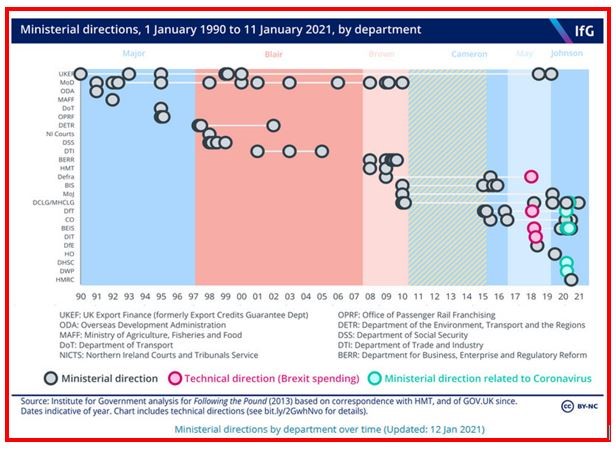
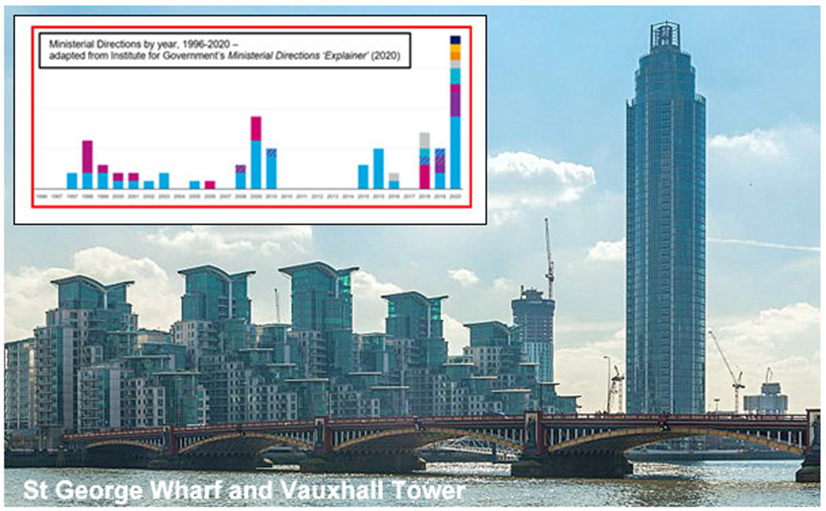
Unwittingly, I was actually right about the numbers – as shown in one of the IfG’s several excellent graphics: an average of under two a year while I was teaching, compared to 31 in the past three years and 19 in 2020 alone. The explosion, and indeed MDs generally, seemed worth further inquiries.

min-explainers

First, then, what exactly are ‘Ministerial Directions’?  In this case, just what it says on the tin: formal directions from Ministers instructing their department to proceed with a spending proposal – and in so doing overriding the principled objection of the most senior civil servant: the Permanent Secretary (PS), who is also the ‘Accounting Officer’, accountable to Parliament for how the department spends its money.

And it’s not just a clash of wills, or opinions. There are specified criteria any spending proposal must meet: that it’s within both the department’s legal powers and agreed spending budget, meets “high standards of conduct”, constitutes value for money, and stands a feasible prospect of being implemented as specified within the intended timetable. If a PS has doubts about a proposal meeting any of these criteria, they must seek explicit direction from the Minister, who thereupon writes a ‘directing’ letter and takes accountability for the decision.  Interestingly, that’s often how it seems to work: less a Minister’s wanting to spend overriding the horrified protests of a cautious civil servant than the civil servant seeing or at least agreeing the need to spend but constitutionally requiring the Minister’s say-so.

British politics being conducted in the ‘civilised’/secretive way it generally is, even the traditionally rare occasions on which such clashes come to a head are rarely much publicised, but there are exceptions. Remember Joanna Lumley’s ‘Garden Bridge’ over the Thames – proposed as a largely privately-funded project, but taken up with characteristic enthusiasm by the then Mayor of London and given significant pre-construction funding by the Department for Transport?  At which point the Transport Secretary, Patrick McLoughlin, came back wanting more – arguing to the ‘Accounting Officer’ (the PS)  and in his Ministerial Statement that there were more than mere transport benefits to be considered and that the Department’s pre-construction commitment should be increased by up to £15 million.  It duly was, and of course the Garden Bridge is today the “iconic tourist attraction right in the heart of our capital city” that the Mayor and Minister predicted. Sorry, is it not?

A more specifically local governmenty Ministerial Direction was that the MHCLG should not recover from councils £36 million that, through an error in civil servants’ methodology, they had been overpaid for participating in 100% business rate retention pilots (2017/18). Nice one, Sajid Javid!

What had particularly caught my interest, though, was that noticeable rise in MDs over the past 2-3 years and the positive explosion under the Johnson Premiership, certainly since the arrival of Covid.  In fact, the IfG’s graph reminded me almost immediately of the well-known view of one of the ugliest buildings in London – the Vauxhall Tower overlooking St George Wharf – and, as it happens, just two bridges down-river from the IfG.

tower

There have already been 14 Covid-related Ministerial Directions – worth possibly a blog in their own right – but I’d gone in looking for cladding business, and there it was, in May 2019 – two months pre-Johnson. James Brokenshire, Jenrick’s predecessor as Housing and Communities Secretary, had made clear both his and PM Theresa May’s view that leaseholders should not have to pay – even assisted by the kind of loan scheme announced this week.

It’s worth reading the full exchange of letters between Secretary of State Brokenshire and the Permanent Secretary, but the following extract from Brokenshire’s will convey at least the flavour:

“I  understand  that,  in  making  these  choices,  the  taxpayer  will  pick  up  the  vast  majority  of remedial costs.  However, I have considered that against the safety implications for residents and the need for pace.  I consider those two factors to be more important.”

The only thing, however, seemingly throughout this whole wretched business, to have happened at any pace was Brokenshire’s own departure, like that of Theresa May herself, to the backbenches. A pity – somehow I don’t feel he would have taken last Monday afternoon off, or that nearly 20 months later there would still have been no Government policy.

Photo

Chris Game is an INLOGOV Associate, and Visiting Professor at Kwansei Gakuin University, Osaka, Japan.  He is joint-author (with Professor David Wilson) of the successive editions of Local Government in the United Kingdom, and a regular columnist for The Birmingham Post.
Backroom or backlit? Council meetings post-Covid

Cllr. Bryony Rudkin

This week two councillor colleagues of mine told me of meetings they’d attended, one an unusual face to face gathering, the other online. For one friend it was the first time she had been to the Town Hall in almost a year. She and her colleagues sat, each at their own table, in an echoing chamber and raised their voices in order to be heard. It was an informal meeting of councillors, officers and other public servants, called to debate sensitive issues in person so that information could be shared freely and confidentially. The issues were serious and compounded by lockdown and stretched resources, an unwelcome distraction at any time. However, this turned out to be a meeting filled with laughter, jokes and gentle teasing. There were interjections and interruptions which helped the meeting flow freely. Delight in seeing each other was tempered only by the acknowledgment of how long it had been since they had last done so.

My other friend told me of an online meeting where an argument had taken place and where one person had cried after making a very personal speech. She observed that what she called “the protection of the screen” meant others were not afraid to show their reaction to the emotions on display but equally the meeting had been stripped bare of physical comfort, an arm around a shoulder or a squeeze of the hand.

These two accounts got me thinking about what we gain and what we lose when we meet online. There’s an interesting seam of academic literature on what meetings are, their role in policy making, the artefacts they produce and of particular interest to local government practitioners, what they tell us about what councillors actually do all day (Brown, Reed & Yarrow: 2017; Freeman: 2008, 2019; Freeman & Maybin: 2011; Llewelyn: 2005). What no one has yet had the chance to explore is the terrain of the online meeting. My own research has used webcast meetings as a rich source of data. Not all UK authorities broadcast public meetings prior to the pandemic but there is now a growing nationwide archive of the formal business of local authorities open to research. What might we want to learn from a closer look? Are individual councillors more or less influenced in their decision making by what they hear from fellow politicians or officers? What of the informal behaviours in meetings – the notes passed, the interruptions, the heckling, the laughter and the eye rolls? In real life these act as lubricants to the flow of discourse and breathing space for thought and reflection. How are they replicated in an online world? If you’re busy on the WhatsApp finding out what your friends are thinking, how much attention are you giving to what is being said?

Arguably, it might not be worth the effort of exploration. The legislation that enables online meetings in English and Welsh local authorities expires in May. The roll out of the vaccine means a roadmap back to the council chamber – alongside the doorstep for local election campaigning – might just be in reach. No doubt those first few ‘real’ meetings will be different. We will have to relearn what it means to speak and listen in person, without the protection and comfort of our screens and homes. We may have gained bigger audiences. Residents, having exhausted Netflix, may be turning to council meetings for entertainment. Maybe not. Anecdotally, councils aren’t directing too much effort into collating viewing figures right now, but having turned the cameras on, it may be difficult to turn them off. We can only wait and see.

I suppose for me it’s always been what happens ‘back stage’ in politics that’s piqued my interest. Privileged access to such space has shown me there’s always so much more to meetings than first meets the eye. It might be happening online, but I’ll wager not to the extent or with the nuance of the past. Back lighting is more of an imperative than backroom dealing right now.

And so I’m reminded of another story a fellow councillor told me years ago about meetings and what goes on in them. Sadly he’s no longer around, so it’s safe to relate. He’d been sent to observe a council meeting in another authority to check on behaviour and conduct. Everything he actually saw taking place was no better or worse than in any other council, he said. The real problem was behind the scenes. The leaders of all three parties represented in that chamber actually carried out negotiations by leaving notes for each other on the top of the old Victorian cisterns in the gents toilets. They were all men. The chief executive, with whom they had disagreements was a short woman who was never going to find them there.

Cllr. Bryony Rudkin is a PhD student at INLOGOV, Deputy Leader of Ipswich Borough Council and is a member of the UK delegation to the Congress of the Council of Europe. Bryony also works with councils around the country on behalf of the Local Government Association on sector-led improvement, carrying out peer reviews and delivering training and mentoring support.

References:
Brown, H., Reed, A. & Yarrow, T., (2017), “Introduction: towards an ethnography of meeting”, Journal of the
Royal Anthropological Institute, 23:S1, 10-26
Freeman, R., (2019), “The role of the councillor and the work of the meeting”, Local Government Studies,
46:4, 564-582
Freeman, R. & Maybin, J., (2011), “Documents, practices and policy”, Evidence & Policy, 7:2, 155-170
Llewellyn, N., (2005), “Audience Participation in Political Discourse: A Study of Public Meetings”, Sociology,
39:4, 697-716

The UK’s Covid-19 early response

Paul Joyce

There are many lessons to be drawn from the UK government experience of responding to COVID-19 in 2020 (see Joyce 2021). But some of the most important concern the problems created by a weak surveillance system and a passive response at the start of the year and by the centralised and command-and-control approach to decision making that denied the national government the full benefits of cooperation in a multi-level system of governance.

Weak Surveillance and Passive Response Early On

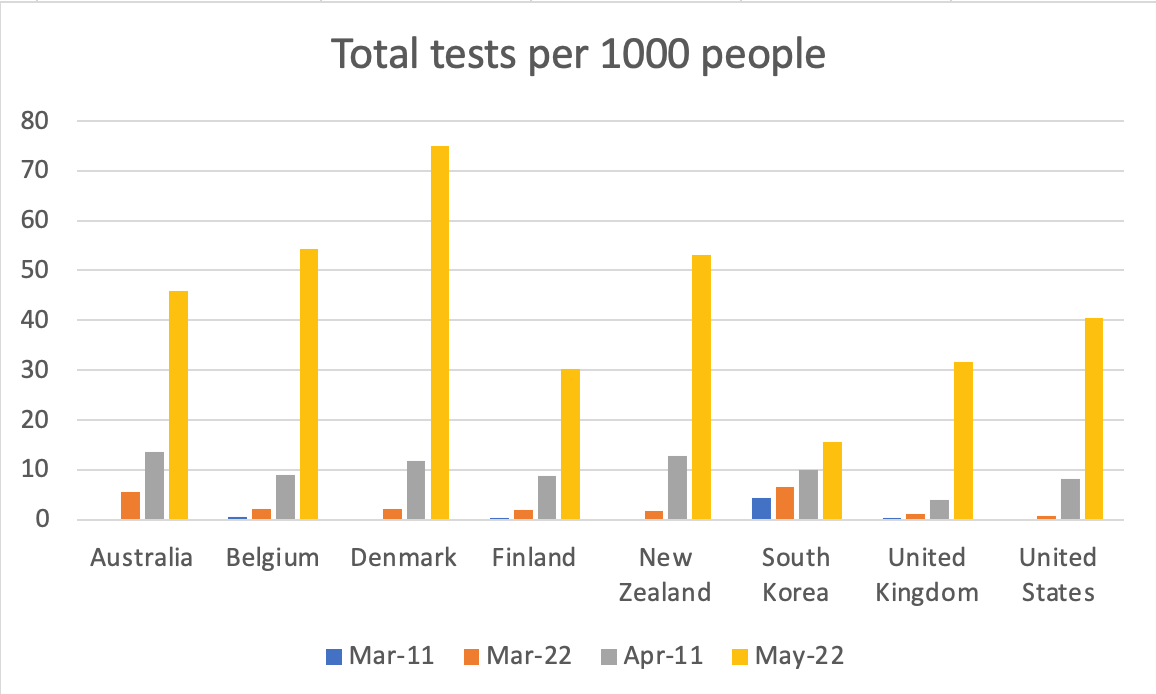
The UK Government was expecting a flu pandemic: in 2019 a National Security Risk Assessment document went to the UK Cabinet that stated that a flu pandemic was the top civil risk. Its experts seemed to be suggesting that the threat posed by COVID-19 might be thought about as a threat somewhat akin to a flu pandemic: in February 2020, with the COVID-19 virus spreading outside China, a committee that formed part of the UK Government’s structure of expert advice, produced a paper in which it judged that the reasonable worst case for pandemic influenza “would be an appropriate scenario at that point” (SPI-M-O 2020). This expert judgment was based on the evidence available at the time, but the evidence was limited: the UK Government was slow to increase its testing and tracing capability and even in April, after the lockdown had begun, its testing capacity was still quite modest (see Chart).

Chart: Extent of testing for Covid-19

Chart Note: The data was obtained from Our World in Data. Available at: http://www.OurWorldInData.org [3 June 2020]. There are important national differences in the production of the data (e.g., whether tests from all labs are counted, the inclusion of pending tests).

The UK government did eventually expand its capacity to carry out testing but in the early months, when its response emphasis was on surveillance, it was handicapped by a lack of data.

Generally speaking, the initial UK Government response was quite passive by comparison with many other countries, which had often responded quickly with measures to address the threat of the virus entering the country. The UK was different. By the end of May 2020, the UK government still had no measures in place to deal with the threat posed by international travel.

We might call the initial strategy of the UK Government a “spectator” strategy, because it mainly relied on treatment rather than prevention, counting on the NHS hospitals to treat those who became seriously ill; aggressive containment was definitely not part of the initial thinking. The advice coming from the World Health Organization (WHO) in early March 2020 was quite at odds with the UK’s spectator strategy. The WHO’s Director General strongly advocated an aggressive containment response: “So activate your emergency plans through that whole government approach, […] If countries act aggressively to find, isolate, and treat cases, and to trace every contact, they can change the trajectory of this epidemic. If we take the approach that there is nothing we can do, that will quickly become a self-fulfilling prophesy. It’s in our hands.”

Centralised and command-and-control decision making

One question that came up repeatedly concerned whether exactly the same measures should be applied to all four countries of the UK in identical ways and at the same time. It appears that on the whole there was a high degree of commonality in the design and application of measures – but with some differences in detail and timing. The Prime Minister’s briefings to the public on his aspirations and proposals for future measures had sometimes seemed to refer to the whole of the UK when, in fact, his remarks were just applicable to England. The Scottish First Minister, speaking at a televised daily briefing to the people of Scotland, said: “I will, as I have done before, ask the Prime Minister when he’s talking about lockdown and lifting restrictions to make clear that he is talking about England alone”.

In the early months of 2020 London was the place where infections and deaths rapidly increased and the hospitals were put under immense pressure by the pandemic. This is not surprising given London’s importance as a centre of commerce and tourism in the UK. The mayor of London was responsible for public transport in London, amongst other things, and clearly might have been expected to want to engage with the national decision-making process about responding to Covid-19. There was a newspaper report about the 2 March 2020 COBR meeting and the non-inclusion of the mayor of London in that meeting. The report said he had not been invited and quoted someone speaking on behalf of the Prime Minister: “The prime minister’s spokesman said Mr Khan was not invited because the meeting was meant to deliver a “a national response”, while London – and other areas – were involved through local level resilience forums.”

The UK Government decisions about how to end the first lockdown were also a focus of some friction in the UK’s governance system. In particular, some prominent council leaders in local government in the North of England were unhappy about the proposals to reopen schools on 1 June 2020. The concern for them was that they judged that the pandemic had not been adequately contained and controlled and the Prime Minister was bringing forward proposals that were too risky. For one local government leader, the Mayor of Greater Manchester, the source of the problem about too much risk in how the lockdown was to be ended was the advice being given to the Prime Minister by his special adviser, Dominic Cummings. He said: “Far from a planned, safety-led approach, this looked like another exercise in Cummings chaos theory.”

The problem in multi-level governance was not just one of friction. Sinclair and Read, writing in April 2020, pointed to the failure of the UK Government to take advantage of capacity existing at local government level:

“The government has been accused of missing an opportunity after it failed to deploy 5,000 contact tracing experts employed by councils to help limit the spread of coronavirus. … PHE’s [Public Health England] contact tracing response team was boosted to just under 300 staff, deemed adequate for the containment phase of handling the Covid-19 virus up to mid-March… tracing was scaled back when the UK moved to the delay phase of tackling coronavirus in mid-March… in Germany, thousands of contact tracers are still working – with more being recruited.”

The big challenge facing the UK Government is to evaluate its experiences of COVID-19 in 2020 and to learn lessons about how future pandemics may be prepared for and handled better than this time. 

Paul Joyce is an Associate at INLOGOV, University of Birmingham. He is also a Visiting Professor in Public Management at Leeds Beckett University. He has a PhD from London School of Economics and Political Science and is currently writing a book on the execution of strategy in the public sector. 

His recent books include Strategic Management for Public Governance in Europe (Palgrave Macmillan, 2018, with Anne Drumaux); Strategic Leadership in the Public Sector (Routledge, 2017, 2nd edition); and Strategic Management in the Public Sector (Routledge, 2015). 

In 2019 he became the Publications Director of the International Institute of Administrative Sciences, IIAS, headquartered in Brussels, Belgium.)

Research to Help Rebuild After Covid-19

Jason Lowther

Last month Sir Patrick Vallance, Chief Scientific Adviser to the UK Government, met (virtually) with over 100 researchers and policy officers to discuss the output of a six-month programme looking at some of the fundamental challenges to our society, economy and ways of living.  Commissioned by the Government Office for Science, the Rebuilding a Resilient Britain programme aims to help government with medium- and long-term challenges relating to the challenges of Covid-19, captured under nine themes including “vulnerable communities”, “supporting services”, and “local and national growth”.


The overall programme was led by Annette Boaz and Kathryn Oliver, two experienced social scientists whose work focusses on the use of evidence.  In their recent LSE article, they explain the background to the programme and how plans were upturned in March with the introduction of Lockdown in the UK.  

I was particularly involved in the “supporting services” theme, convening the work around local government.  It is an exciting initiative to be involved with, not just because of its scope and pace, but also because of the range of people engaged: researchers and academics, government policy and analysis officers, and funders.  What I found particularly interesting was how different Government departments and different academic disciplines were often looking at very similar issues but framing them from distinct perspectives and using diverse language to describe them.  This highlights the need to develop shared definitions of issues and ways to address these – considering “problem-based issues” in the round.

As well as summarising the existing research evidence around each of the identified themes, the work identified several “gaps” in the extant evidence base and opportunities for new research, policy/research dialogue, and knowledge exchange.

Within the Local Government theme, we recognised that LG’s role proved critical in the first stage of the pandemic, for example in supporting vulnerable and shielded people, enabling voluntary community groups, freeing up 30,000 hospital beds, housing over 5,000 homeless people, and sustaining essential services such as public health, waste collection, safeguarding and crematoria.  This role is likely to increase in future stages of the pandemic, with more responsibility for local surveillance testing and tracing, implementing local lockdowns, economic development, contributing to a sustainable social care system, and supporting further community mutual aid.

There is already a good evidence base showing how local government is playing vital roles in responding to and recovering from the pandemic.  We identified four main themes: empowering local communities, delivering and supporting services, devolution and localisation, and funding.
For each issue we considered the key policy and practice implications of existing evidence, the evidence gaps and the ways in which gaps might be filled.  

Around empowering local communities, for example, evidence showed that LAs responded quickly to the pandemic, and well-functioning local systems emerged to tackle the immediate crises in many parts of the UK.  Areas adopted a range of strategies in partnership with local communities. But informal community responses can lack coordination, resources, reach and accountability; and some groups face barriers to involvement.  Further evidence is required on what works in strengthening community support networks, empowering different types of communities, and co-producing public services.  Councils also need to understand better how staff, councillors and the institutions themselves can change to empower communities.

There has already been some important learning from this work, such as recognising the treasure trove of useful knowledge contained in existing evidence and expertise.   We need to get much better at using evidence from, for example, the evaluation of past policy initiatives.  The programme is helping to strengthen relationships across government, including some new and more diverse voices, and will be useful as government departments revisit their Areas of Research Interest post-Covid.  The thematic reports are due to be published in coming weeks.

I will be exploring the findings for other areas of interest to Local Government in future articles.

[This article also appeared in the Local Area Research and Intelligence Association December newsletter]

Jason Lowther is Director of the Institute for Local Government Studies at the University of Birmingham.

Vice-President-elect Kamala Harris and me

Chris Game

If only Birmingham weren’t in Tier 3 … I could prop up bars in city centre pubs, casually conversing with fascinated fellow-drinkers: “You know that Kamala Harris, the American Vice-President-elect – yeah, the one wearing the Elvis-style white trouser ‘power suit’ for her victory speech.

“Well, I was a professorial contemporary of her Dad, Donald, at California’s prestigious Stanford University, don’t you know?  Thanks, mine’s another Plum Porter.”

Sadly, with Plum Porter purveyors currently closed, I’m driven to search for alternative captive audiences.  However, in contrast to bits of the current series of The Crown, this boast, while it may not ‘ring true’, actually IS true.  Before coming to INLOGOV in 1979 my employers for the previous five years were indeed Stanford – the posh, private, but definitely prestigious university north-westish of Silicon Valley.  

At least, that was Kamala’s Dad’s main workplace – I said ‘contemporary’ not ‘colleague’!  Mine was Stanford’s British Studies Center – note the spelling – at the also posh but less sunshiny Cliveden House on a National Trust estate near Maidenhead, where some hundred or so American students would come to spend two or three semesters of their undergrad years.

And the ‘Professor’ bit?  Well, as everyone knows, almost all US university academics have that generic title. ‘Full’ Professors are the real deal, while my Cliveden colleagues and I were ‘academic personnel’ – but on envelopes from HQ ‘Assistant Professors’.

It’s been mildly disquieting to see some UK universities going down the ‘Assistant Professor’ route – Warwick, for instance – but I’m not in the least bitter. I just regret not saving at least a few of those envelopes, because in four subsequent Birmingham decades I never managed even that.

Jamaican-born former economics Professor Donald Harris is/was at the distant other end of the scale: an Emeritus Professor since retiring early from Stanford after an exceptionally distinguished career and numerous international academic awards.

Here’s the thing, though.  Harris joined Stanford in 1972, yet in my creepily retained 600-page 1974/5 Stanford University Bulletin we Clivedenites and our taught courses all get several individual mentions, yet Donald not one.  Which, for apparently “the first Black person to receive tenure in Stanford’s economics department”, seemed rather odd.

Still, it provides a link to his elder daughter’s string of ‘firsts’ that actually prompted this blog: the first major personal career choice made by the first woman, first African American, and first Asian-American US Vice-President-elect.  California-born – for those, like President Trump, still questioning her Presidential eligibility; and her name, incidentally, pronounced not at all like ‘Pamela’, but ‘Comma-lah’ – from the Sanscrit for lotus flower.

Which is also relevant, because Kamala’s parents divorced when she was just seven, meaning she and her sister, Maya, were brought up largely by their Indian-born mother, Shyamala Gopalan – a bio-medical scientist, whose career in breast cancer research was every bit as outstanding as her husband’s, but who in 2009 would die of cancer herself.

It was her mother’s acceptance of a research post at McGill University Hospital in French-speaking Montreal that chiefly determined that Kamala went first to a French-speaking elementary school.  Then her mother moved the family again, so Kamala could attend Westmount High School, Quebec’s only public school offering so-called Advanced Placement courses for potentially university/college credit.

That university/college choice in by now the early 1980s, though, was definitely Kamala’s. After several majority-white schools, and her parents working in eminent but predominantly white institutions, she sought a wholly different experience. Young, gifted and black, she would live, learn, socialise, and at times protest against South African apartheid, with black students in a black university in a black city.

She would therefore attend one of the hundred or so HBCUs – Historically Black Colleges and Universities – and arguably the most renowned: Howard University in Washington DC, the African American community’s ‘Chocolate City’. And a short subway ride to both her current Capitol Hill workplace in the Senate and her future one in the White House. Back then it was no part of any life plan, but it can serve as a useful putdown today to those who accuse her of being ‘not really black’ or ‘not black enough’.

In the early 1970s Stanford University – students and staff – was unmistakeably Californian and white.  But I remember quite early learning of and being fascinated by the whole HBCU concept – partly because of the then still relatively recent appointment of Thurgood Marshall as the first African American Supreme Court judge.

The HBCU initialism itself – not technically an acronym – is comparatively recent, a product of the historic 1964 Civil Rights and 1965 Higher Education Acts. But the Black Colleges themselves date back in some cases 170+ years to before the Civil War and abolition of slavery.

Even following abolition, certainly in the Southern states, there was a century of institutionalised racial segregation of housing, medical care, employment, transportation and, of course, education.  And even universities and colleges that didn’t completely bar African Americans usually applied tight quotas, with all the other manifestations of discrimination.

One of those barred was future Justice Thurgood Marshall. He had applied to the University of Maryland Law School and been rejected through its segregation policy effectively banning blacks studying with whites.  He therefore attended and graduated with distinction from, yes, Howard University Law School – and later successfully sued Maryland for its discriminatory admissions policy.

Quite a role model, had Kamala been looking for one at the time – just as she surely will be to this and future generations of aspiring university students, female and male.


A version of this article appeared in The Birmingham Post on 26th November 2020.

Photo

Chris Game is an INLOGOV Associate, and Visiting Professor at Kwansei Gakuin University, Osaka, Japan.  He is joint-author (with Professor David Wilson) of the successive editions of Local Government in the United Kingdom, and a regular columnist for The Birmingham Post.