Zilch for timing, but this Resolution Foundation report is important

Chris Game and Jason Lowther

If you wanted some serious reader attention for something West Midlands local governmenty, you really, really wouldn’t have chosen this past November. The war in Gaza was seriously hotting up, there were the COP 28 talks in Dubai, Christmas was coming, and Aston Villa were en route to becoming the Premier League’s “foremost home team”, whatever precisely that means.

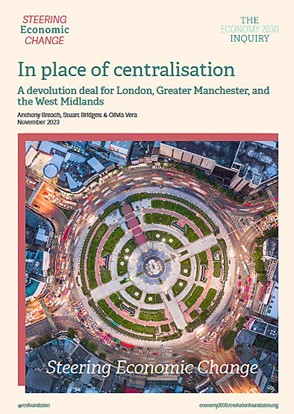
Serious distractions, but competition for headlines was only part of the challenge facing the Resolution Foundation’s early November release of its In Place of Centralisation report setting out a proposed and far-reaching Devolution Deal for London, Greater Manchester, and the West Midlands. There were other diversions and potential confusions too.

It was barely a month since Birmingham City Council – the principal West Midlands local authority involved in this proposed ‘Devo Deal’ – had issued not one but two Section 114 notices, reportedly declaring itself doubly “bankrupt”, unable to meet the Council’s financial liabilities relating to Equal Pay claims and an in-year financial gap within its budget, and handing over its governance to Communities Secretary Michael Gove’s appointed Commissioners.

And, if that wasn’t potentially complicating enough – for those directly affected as well as onlookers – in that same previous month representatives of the West Midlands Combined Authority (WMCA) had ratified the “Deeper Devolution” aka “Trailblazer” deal announced in the Chancellor’s March Budget.

That deal, comparable to that agreed by Greater Manchester back in March, but relatively little of which we’d heard in the meantime, would devolve more powers to ‘Metro-Mayor’ Andy Street (or, given the May Mayoral elections, potentially his successor), the 30 WM local authorities (7 met boroughs, 4 unitaries, 19 districts) and their 6 million population, and simplify funding arrangements, with £1.5 billion to spend on long-term infrastructure projects and services such as transport, skills, housing and regeneration.  A key element is a single block grant negotiated with the Government, like a central government department, as part of next year’s Spending Review.

Key ‘highlights’ include:

  • A ‘landmark’ housing deal worth up to £500 million, offering greater flexibility to drive brownfield regeneration and funding to deliver “affordable housing at pace”;
  • Greater control over local finance, including retention of an estimated annual £45 million of business rates for the next decade [hold on to that version of ‘local financial control’!];
  • Up to six ‘levelling up zones”, backed by £25-year business rate retention, with an estimate total value of at least £500 million, to target investment and encourage regeneration in areas agreed with the Government;
  • Measures to tackle digital exclusion, including greater influence over high-speed broadband investment across the region and a £4 million fund to get more people online.

In anywhere other than one of the most centralised governmental systems in the developed world, describing this package as ‘trailblazing’ would be wildly OTT. Here, though, it was rightly welcomed as constituting serious devolutionary progress, and Mayor Street, not surprisingly, was enthusiastic, seeing it as “marking the beginning of the end of … the ‘begging bowl culture’ where we must regularly submit bids for various pots of money on a piecemeal basis.”

Here’s the thing, though – well, two things, actually. First, the really rather big thing. The leading West Midlands council in this new ‘Trailblazer’ era is currently, following the issuing of those Section 114 notices, (a) in severe financial straits, and (b) being run until quite possibly 2028 not by elected councillors, but by Lead Commissioner Max Caller, his associate commissioners and political advisors – none of whom have ‘Trailblazing’ as a core part of their brief.

The second and, in Birmingham’s current circumstances, almost other-worldly thing, is the Resolution Foundation’s In Place of Centralisation report which is, incidentally, not the first RF report to be covered in these pages. It’s other-worldly too in the sense that it’s just one, albeit important, product of a bigger, wider-ranging academic project: The Economy 2030 Inquiry – a Nuffield Foundation-funded collaboration between the Resolution Foundation, an independent think-tank, and the LSE’s Centre for Economic Performance.

UK economic growth is their primary project – not boosting local democracy – one persistent obstacle to the attainment of which they identify as “the decades of underperformance of the big cities of Manchester, Birmingham, and more recently London” – the key cause being, they reckon, the centralisation of the British state. No startling news to INLOGOV blog readers, but a contrasting starting point to, say, that of the authors of Trailblazer deals, and their prescriptions go a good deal further.

They start (p.4), unsurprisingly, from a different array of statistics, demonstrating the extreme centralisation of the British state.

Only 5 per cent of the UK’s tax revenues in 2019 were collected by local    government, compared to 14 per cent in France, 23 per cent in Japan, and 35 per cent in Sweden. Accordingly, local government relies ongrant funding, with only 19 per cent of all local spending in the UK funded locally, compared to 37 per cent in the average OECD unitary state.

They concede that “recent advances in devolution have begun to unwind this”, but, following a decade of austerity, significantly further fiscal devolution is required to improve growth without increasing inequality – in the form of a ‘triple deal’ negotiated between the Government and the Mayors of Greater Manchester, the West Midlands, and London as a trio, going “beyond the recent ‘trailblazer’ deals” and into which other mayors would be able to opt in the future.

The core of the triple deal would be fiscal devolution, “which would help to end the centrally-imposed local government funding crisis for the three cities by widening the local tax base, and resourcing improvements in the local economy.” Everyone would be a winner – the mayors, borough and Exchequer all benefiting from a new revenue-neutral fiscal settlement, including (pp.4-5):

  • A local share of income tax receipts, with Greater Manchester and West Midlands keeping a larger share than London;
  • Complete retention of business rates, and control over the ‘multiplier’;
  • A single grant to the mayors distributed on a per person basis;
  • The ability for mayors to reform council tax.

It would then be up to the mayors, in negotiation with the boroughs, to distribute this revenue across local government’s various responsibilities across their city. And in the medium-term?

Well, big IF … but the higher growth in the three cities that would be “likely”, if this fiscal devolution were accompanied by other policy changes, would then translate into higher local tax revenues for the mayors – with, by 2038, Greater Manchester raising between £49 million and £230 million, and the West Midlands between £40 million and £187 million beyond their current level of funding.

That was from p.5 of what is a 64-page report, so there’s a very great deal more explanation and explication. But the key, and hopefully obvious, point of this blog is to enable you, if it crops up in conversation, to disabuse anyone of the notion that the Resolution Foundation’s contribution to this debate is just ‘Trailblazer deals’ writ large.

Our view is that the current local government finance system is bust. Business rates penalise high street shops, the council tax is regressive with hopelessly outdated valuations, and councils spend too much energy chasing central government largesse through competitive funding pots.  Democratically elected councils rely on a begging bowl and lack basic revenue raising powers that are commonplace internationally.  We will be saying more on this as the General Election approaches…

Chris Game is an INLOGOV Associate, and Visiting Professor at Kwansei Gakuin University, Osaka, Japan.  He is joint-author (with Professor David Wilson) of the successive editions of Local Government in the United Kingdom, and a regular columnist for The Birmingham Post.

Jason Lowther is Director of the Institute for Local Government Studies (INLOGOV) and Head of the Department of Public Administration and Policy at the University of Birmingham.

Beyond the Numbers: A Holistic Approach to Section 114 Notices in English Local Government

Dr Philip Whiteman

In English local government, the issuance of a section 114 notice is often perceived as a dire financial omen, signalling a council’s descent into insolvency. While financial stability is undoubtedly a cornerstone of effective governance, it is crucial to recognize that section 114 notices reveal more than just a precarious financial situation. They serve as a beacon, illuminating underlying issues that extend beyond the confines of spreadsheets and budget projections. Either way, the government’s Department of Levelling Up, Housing and Communities (DeLUHC) tends to respond with intervention and the imposition of commissioners to direct the authorities concerned.

The poor financial position of many authorities may be the direct result of years of underfunding by central government and we can expect many more councils to serve section 114 notices, but it would be improvident to assume there are no further underlying causes.

Nottingham City Council’s recent declaration of a section 114 is a clear indication that some authorities are simply folding due to a broken funding formula, but this is not the sole cause of failure in all cases. When looking at other authorities, alternative underlying causes are present. Further examples include:

  • The BBC Panorama programme highlighted how Thurrock Council was rendered bankrupt following a series failed investments in a solar farm, highlighting disastrous procurement practices, lack of accountability, poor governance, and inappropriate delegations to officers.
  • Birmingham City Council’s problems did not emerge overnight and were a culmination of challenges created by a historic equal pay-claim and botched procurement a new IT system, Oracle. Underpinning this was poor financial planning, governance, accountability, and a failing internal culture.
  • Woking Borough Council racked up a deficit of £1.2bn following the building and acquisition of major property portfolio. Against these investments, the authority had acquired loans from the Public Works Loan Board and other local authorities, accumulating debts that it could not service.
  • Liverpool City Council’s woes are not confined to finances. Government commissioners were appointed to Liverpool City Council in June 2021 following a damning Best Value inspection by Max Caller CBE on matters pertaining to poor leadership, unacceptable performance, poor resource management and a failure to engage with citizens.

Government appointed commissioners tasked with overseeing councils in financial distress must adopt a holistic approach, venturing beyond the immediate financial crisis to uncover the root causes of the council’s predicament. This requires a comprehensive examination of the council’s structural framework, external environment, performance management and internal governance practices.

Structural Challenges: A Precarious Foundation

English local governments face a unique set of structural challenges that can hinder financial stability. The relentless rise in service demands, coupled with a funding system that often fails to keep pace, places immense pressure on council budgets. This mismatch between resources and responsibilities can lead to a cycle of overspending and financial strain.

Commissioners must delve into the council’s structural framework, assessing whether the current allocation of resources aligns with the council’s responsibilities. They must also evaluate the effectiveness of the council’s revenue-generating strategies, ensuring they are maximizing their income potential without overburdening residents.

External Factors: Navigating Turbulent Waters

Local governments are not immune to the vicissitudes of the external environment. Economic downturns, shifts in government policies, and natural disasters can all have a profound impact on a council’s finances. Commissioners must assess the council’s vulnerability to these external factors, evaluating its risk management strategies and identifying potential contingencies.

Internal Governance: Cultivating a Culture of Accountability

While structural challenges and external factors can undoubtedly contribute to financial distress, internal governance failures often play a pivotal role. Poor financial planning, inadequate risk assessment, and a lack of transparency and accountability can erode a council’s financial stability.

Commissioners must scrutinize the council’s internal governance practices, ensuring that financial decision-making is sound, risks are appropriately assessed, and accountability is firmly established. They must also foster a culture of transparency, empowering residents to hold their council accountable for its financial stewardship.

A Holistic Approach: Beyond the Financial Storm

In the aftermath of a section 114 notice, commissioners must resist the temptation to focus solely on immediate financial stabilization measures. Instead, they must adopt a holistic approach, addressing the underlying structural, external, and governance issues that contributed to the council’s financial crisis.

By adopting a comprehensive view, commissioners can guide councils towards long-term financial stability, enabling them to deliver essential services to their communities without succumbing to the pressures of insolvency. Only by addressing the root causes of financial distress can we ensure that section 114 notices no longer serve as mere harbingers of financial doom, but rather as catalysts for positive transformation.

Speculating on further interventions

Speculation is precisely that. Estimates vary widely in terms of how many further councils are anticipated declare section 114 notices, but a clear signal of further failures exists:

  • In July 2023, ITV News cited a leaked DeLUHC document which estimated at least 26 bankruptcies over the next two years.
  • The Institute of Government has estimated that 10% of councils are at risk over the next two years.
  • The Special Interest Group of Municipal Authorities (SIGOMA), a representative body for 47 municipal authorities, published a survey in June 2023 which showed that five of their members were at risk.
  • A Local Government Association Survey conducted in November 2023 revealed that almost one in five local authority leaders and chief executives believe that their authority may have to declare a section 114 notice.

Whilst estimates vary, there is evidence that further authorities will become vulnerable to government intervention via the imposition of DELUHP appointed commissioners.  This raises a final question; can the predicted number of authorities realistically be serviced?

4-Day Weeks Improve Productivity: It’s time to roll them out

Andrew Coulson

Image: https://www.flickr.com/photos/carrienelson/

Until recently South Cambridgeshire Council was mainly known for being the only council in the UK which completely encircles another council, the City of Cambridge.

Now it has a place in history for a more lasting reason.  In January this year it began a trial which put much of its workforce onto a 4-day week, asking them to do in four days what previously they had done in five, for the same pay and without employing extra staff or reducing opening hours for the public.

Michael Gove took exception, and in October his Department issued non-statutory guidance which made it clear that he does not want councils to implement four-day weeks[1]. His junior minister, Lee Rowley, wrote to the Council in June and again in September asking it to abandon its trial.[2]  But the terms and conditions of council employment are not the business of central government, and to that extent the Council has the right to continue. Then, on 3 November, a senior civil servant wrote to the Council ordering them either to stop the trial, or to supply him with regular detailed information about their performance.[3]  To do this he invoked the concept of “Best Value”, also used in the Guidance note, claiming that the pilot means that the Council is not giving value-for-money to its taxpayers.

A bit more about South Cambridgeshire Council. 35 of its 45 councillors are LibDem, including its Leader, Councillor Bridget Smith. It provides services in the small towns and villages around Cambridge, working closely with the city council on matters that affect them both, such as sensitive planning proposals. 162,000 people lived there in 2021. House prices and average incomes are high, and it is one of the best places in the country to live. The council was and still is one of the best-performing in England.

The pilot is being evaluated by the Bennett Institute for Public Policy at the University of Cambridge. After nearly a year, the indications are extremely encouraging.[4]  In 27 October Bridget Smith reported that “sickness rates have fallen by a third, staff turnover has reduced by 36%, and complaints about services involved are down. 9 of 16 areas studied showed “substantial improvements in performance over the previous year”. The council has been better able to recruit staff, and now has 14 fewer “interim managers” recruited through an agency on a short-term basis and paid much more than normal local government rates, but seldom living in the area and with little long-term commitment to it. This has saved the Council considerable sums of money.[5]

These positive outcomes should not surprise civil servants, other researchers or Mr Gove. It is backed up by other research, for example a recent Fabian report about what the UK can learn about shorter working weeks from Germany.[6] Or research carried out in 2022 by a large team of experts in England and America led by the consultancy Autonomy.[7]  This studied 61 UK businesses which have implemented shorter working weeks in a variety of changes (such as having lower staffing on Mondays and Fridays with half the employees working on either the Monday or the Friday in any week). In almost all these companies the shorter working week improved productivity, staff recruitment and morale.

“Best Value” was invented in the 1980s when it was realised that the best outcomes would often not be achieved by paying the lowest prices. We do not get our cars serviced at the cheapest garages, or our roofs repaired by the cheapest contractors. We prefer someone we know, or who comes with good recommendations who will want to work with us in future, and so will not take short cuts, use poor quality parts, or put sufficient cement in its concrete. To make an informed decision, you also need information about the quality of other work done by the possible contractors. If you do not have that information, then you need to contract for a short period, and learn from the results. Many councils, with all types of political control, were able to demonstrate that Best Value was obtained by keeping a service in-house, not using external contracts.[8]

In this context, the invocation of Best Value reeks of despair: Gove’s civil servants cannot think of any other way to stop the trial. He may fear that other councils who adopt the same policies may not get the same benefits. But if South Cambridgeshire ever gets tested in a court of law, there is a strong probability that the Government will lose.

This is not the only recent populist announcement: Ricki Sunak announced at the Conservative Party Conference that he is trying to make it impossible for councils to introduce 20 mph zones in residential areas, even though this is a popular policy (not least among many car drivers) which saves lives and reduces pollution.[9]  He is also attempting to limit the number of low-traffic neighbourhoods[10] and has directed councils not to introduce multiple recycling bins, even though it is cost-effective for homeowners and businesses to sort as much of their waste as possible in advance.[11] He does not appear to recognise that councils are local authorities whose legitimacy comes from elections, and which can experiment and try out new ideas. They have a great deal more practical experience to draw upon than he does, or his civil servants.


[1] https://www.gov.uk/guidance/four-day-working-week-arrangements-in-local-authorities

[2] https://www.personneltoday.com/hr/four-day-week-trial-2/

[3] https://www.gov.uk/government/publications/south-cambridgeshire-district-council-best-value-notice

[4] https://scambs.moderngov.co.uk/documents/s131267/Appendix%202a%20Bennett%20Institute%20Evaluation%20of%20the%20KPIs%20final.pdf

[5] https://www.scambs.gov.uk/four-day-week-trial-extension-after-independent-analysis-shows-services-maintained-and-some-improved

[6] https://fabians.org.uk/wp-content/uploads/2023/11/231106_Nein-to-Five_EN_final_online-6-nov.pdf.  Or https://www.weforum.org/agenda/2023/10/surprising-benefits-four-day-week/ . Or from the World Economic Forum https://www.weforum.org/agenda/2023/10/surprising-benefits-four-day-week/

[7] https://autonomy.work/portfolio/uk4dwpilotresults/

[8] See, for example, statutory guidance issued in 2011 when Eric Pickles was Secretary of State for Communities and Local Government, at https://assets.publishing.service.gov.uk/media/5a7968ab40f0b63d72fc591f/1976926.pdf. Or articles in Andrew Coulson (ed.) Trust and Contracts: Relationships in Local Government, Health and Public Services, Policy Press, 1998.

[9] https://news.sky.com/story/rishi-sunak-to-block-councils-imposing-new-20mph-speed-limit-zones-12972106

[10] https://www.theguardian.com/uk-news/2023/jul/30/rishi-sunak-orders-review-of-low-traffic-neighbourhood-schemes

[11] https://resource.co/article/government-scraps-seven-bins-simpler-recycling

Andrew is a nationally-recognised expert on scrutiny in local government and is particularly interested in governance by committee. He is a columnist for the Birmingham Post and associate of INLOGOV. He writes in a personal capacity.


[1] https://www.gov.uk/guidance/four-day-working-week-arrangements-in-local-authorities

[2] https://www.personneltoday.com/hr/four-day-week-trial-2/

[3] https://www.gov.uk/government/publications/south-cambridgeshire-district-council-best-value-notice

[4] https://scambs.moderngov.co.uk/documents/s131267/Appendix%202a%20Bennett%20Institute%20Evaluation%20of%20the%20KPIs%20final.pdf

[5] https://www.scambs.gov.uk/four-day-week-trial-extension-after-independent-analysis-shows-services-maintained-and-some-improved

[6] https://fabians.org.uk/wp-content/uploads/2023/11/231106_Nein-to-Five_EN_final_online-6-nov.pdf.  Or https://www.weforum.org/agenda/2023/10/surprising-benefits-four-day-week/ . Or from the World Economic Forum https://www.weforum.org/agenda/2023/10/surprising-benefits-four-day-week/

[7] https://autonomy.work/portfolio/uk4dwpilotresults/

[8] See, for example, statutory guidance issued in 2011 when Eric Pickles was Secretary of State for Communities and Local Government, at https://assets.publishing.service.gov.uk/media/5a7968ab40f0b63d72fc591f/1976926.pdf. Or articles in Andrew Coulson (ed.) Trust and Contracts: Relationships in Local Government, Health and Public Services, Policy Press, 1998.

[9] https://news.sky.com/story/rishi-sunak-to-block-councils-imposing-new-20mph-speed-limit-zones-12972106

[10] https://www.theguardian.com/uk-news/2023/jul/30/rishi-sunak-orders-review-of-low-traffic-neighbourhood-schemes

[11] https://resource.co/article/government-scraps-seven-bins-simpler-recycling

Voter ID – A “Poisoned Cure” and Other Verdicts

Chris Game

It’s easy to claim, but there are times when I miss not having classes of students to endeavour to entertain – partly because, at least from a distance, it can seem rather easier now than back when I had that responsibility.

One gift I’d certainly have used during this year’s exam revision period was the YouTube rap video made by T-Dawg – aka Broadland and South Norfolk Councils’ Managing Director, Trevor Holden – ‘reminding’ intending voters in the May local elections to take photo ID with them to the polling station. Like the whole topic, the video received a mixed reception, but it certainly got my vote (sorry about that!) as an introduction to this split-blog’s attempted overview of the profusion of recently released Voter ID material. I’ve at least flick-read most of it, so you won’t have to worry about not doing so.

First, though, an additional declaration of personal interest, referring back to that  opening paragraph. My students weren’t, of course, learning directly about ‘political literacy’, but high on my short list of ‘research stats I’ve managed to remember for more than a few weeks’ was the depressing finding in the All-Party Parliamentary Group (APPG) on Political Literacy’s 2021 report that, of a 3,300 sample of secondary school teachers in England, only 1% [felt] “fully prepared” to teach courses aimed at developing young people’s political literacy.

The ”fully”, omitted in some reports, was in the question and doubtless partly explains the dispiriting response. But anyway the finding was highlighted by the APPG, led directly to the creation of the social enterprise Shout Out UK (SOUK), and these two bodies’ influence is clearly evident in some of the Electoral Commission’s recommendations for more focused information and awareness raising.

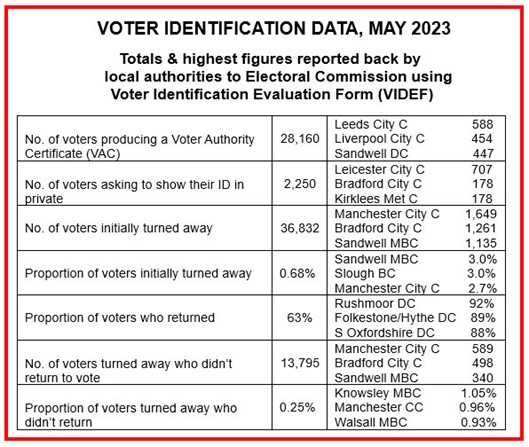
There had, of course, been earlier assessments of May’s elections – principally the Electoral Commission’s Interim Analysis in mid-June, reporting the anonymised returns from the Voter Identification Evaluation Forms (VIDEF) that Returning Officers were required to complete (see table below), plus results of three YouGov pre- and post-election public awareness surveys of between 1,700 and 3,700 adults each.

This first, stat-heavy part of the blog will present, in highly summarised form, some of the key data, with the second covering some of the more recent interpretative contributions – including that of the All-Party Parliamentary Group, from which I’ve appropriated the blog’s slightly giveaway title.

First, some scene-setting stats, taken from the final report. The total electorate was 27.3 million, ballot box turnout 32%. For the record, Labour took 33% of the vote and control of 70 councils; Conservatives 28.6% and 33; Lib Dems 37% and 20.  5.2 million postal ballots were initially issued to 19% of the electorate, 3.5 million (67%) of which were returned, of which 89,000 were rejected, mainly for missing or mismatched signatures or dates of birth. OK, it’s only 2.6%, but, after making the effort, it was higher than I might have guessed.

 Key findings from the analysis included that:

  • Immediately post-election, in areas with elections, 92% of people in England were aware they now needed to show photo ID to vote at a polling station. They weren’t asked, however, if that awareness extended to knowing that they couldn’t obtain ID – e.g. the Voter Authority Certificate (VAC) – on polling day itself.
  • Awareness was significantly lower (74%) among those who didn’t already have an accepted form of ID – and, unsurprisingly, among youngest age groups (82% for 18-24 year olds), Black and minority communities (82%), etc.   
  • Approximately 89,500 people applied for a VAC before the 25 April deadline, some 28,000 certificates being subsequently used – i.e. under one-third of the 250,000 to 350,000 estimated likely not to have any other acceptable ID.
  • At least 0.25% of people (c.14,000) who had tried to vote at a polling station were not issued with a ballot paper because of the ID requirement, but this excludes those who reacted to the ID reminder before they could be recorded in the data – thereby inevitably underestimating, as do the post-election analyses generally, the actual impact of the voter ID requirement.

This was essentially the ‘headline’ picture we had to content ourselves with over the summer, until quite suddenly, come September, there was a whole lot more – and it seems logical, if not strictly chronological, to start with the Electoral Commission’s full-scale Voter ID Demographic Analysis Research. The analysis aimed to identify patterns in areas where relatively higher or lower proportions of intending voters were turned away from polling stations due to the new ID requirement.

18 authorities with apparently relatively socioeconomically diverse wards were selected, including the West Midlands’ Coventry and Sandwell – the latter being the sampled borough with the nationally highest “initially turned away” percentage of 3%.  The Census-based ‘proxy’ variables measured were unemployment, ethnicity, household deprivation, and social renters.

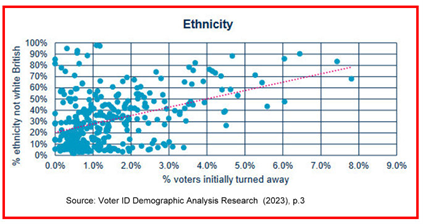
Hyper-summarising, the analysis suggested there was “a potential linear relationship” between each selected socio-economic variable and the proportion of voters initially turned away and those who didn’t return to vote. These results are obviously tabulated, but also graphed, as illustrated in what is described as the “moderate relationship” between ethnicity and the proportions initially turned away.

Overall, 13 of the 18 authorities showed at least a moderate relationship between the independent variables and the proportion of voters initially turned away, and 6 exhibited “strong relationships between one or more independent variables”. Strongest correlations were with areas having a high proportion of non-white British individuals, higher deprivation, and higher unemployment.   

Following this specifically Voter ID-focussed report, the Electoral Commission had published in June its overall Report on the May 2023 Local Elections in England, which it updated in early September. It made nine main recommendations, including increasing awareness of the support available for disabled voters, and improving data collection at polling stations.  

Four, however, related specifically to voter ID: review the list of accepted ID; improve access to the Voter Authority Certificate (see above); improve options for voters who don’t have or can’t access any accepted form of accepted ID – e.g. allowing ‘attestation’ by a named and verified elector; and polling station staff to continue to collect voter ID impact data at future elections.

Which brings us to about mid-September, already some way over this blog’s preferred length, and quite the wrong time, therefore, to address the “poisoned cure” and other reactions to these primarily statistical analyses – which will follow, with luck, fairly shortly.

Chris Game is an INLOGOV Associate, and Visiting Professor at Kwansei Gakuin University, Osaka, Japan.  He is joint-author (with Professor David Wilson) of the successive editions of Local Government in the United Kingdom, and a regular columnist for The Birmingham Post.

Splitting up the Second City is a third-rate idea

Andrew Coulson            

Relations between first and second cities are often strained, especially when those who live in the Second City elect leaders from a political party that is not running the national government – as has been the case with Birmingham for much of its life.

After the Second World War, Birmingham was prosperous. It had avoided most of the bombing that destroyed the centre of Coventry, and its factories had produced aircraft, lorries, and other vehicles and equipment for the military and were now available to meet the post-war demand for cars and lorries. Wages for semi-skilled labour were some of the highest in the country.  There were shortages of labour, and to meet them employers welcomed bus drivers, conductors and nurses. These were followed in the 1970s and 1980s by workers mainly from Pakistan and Kashmir.

From the perspective of the London government, Birmingham did not need more employment, so companies who wished to invest in the motor industry were directed to Liverpool and elsewhere. But academic commentators, and the more thoughtful employers, could see that all was not well.  Britain was becoming increasingly dependent on service industries, which were far from strong in the Midlands.  In that context, in the mid-1970s, Birmingham Council proposed to build a National Exhibition Centre, on land near the airport. It would be owned by a company which was a partnership with Birmingham Chamber of Commerce.  The government wanted it in London; the council carried on regardless, and eventually the London government allowed it to do so.

Its structure was innovative – the company had just two shares, one owned by the city council, the other by the chamber. Each could nominate four directors. The chair would always be one of the chamber nominees – for a long time the leading industrialist Sir Adrian Cadbury.  But if voting on the board was tied, the chair did not have a casting vote, and what was proposed would not go ahead. The company, underwritten by the council, borrowed money and built the NEC.

A few years later, in 1987, the NEC company started building the International Convention Centre and Symphony Hall, on land off Broad Street. This was to make Birmingham a centre for conferences and business meetings. The decline in manufacturing and rising unemployment was by then so evident that Birmingham was granted Assisted Area Status by the European Union, so a fraction of the cost was met from Europe. The London government was not involved.

The ICC became a preferred location for large gatherings of professional bodies, such as the British Small Animal Veterinary Association, which grew till it hosted more than 8,000 delegates. It met in Birmingham every year for more than 25 years.  A boom in the construction of hotels met the demand for accommodation for this kind of event. Also of offices, many taken by national or international companies. No longer is Birmingham lagging in its provision of services. On the contrary it is a leader – almost entirely because of these initiatives.  Symphony Hall was built to meet the specification of Simon Rattle, then a very young but highly promising conductor of the City of Birmingham Symphony Orchestra. It was part of a city-council strategy to support the arts, of which another strand was the attraction of what became the Birmingham Royal Ballet to the Hippodrome theatre – with its charismatic directors, Peter Wright, David Bintley and now the Cuban star Carlos Acosta. Another initiative required investors in large buildings to put a small extra amount aside for public art.

The arrival of a national Conservative government in 2010 meant that the council started losing the extra grant it had long enjoyed to meet its high levels of deprivation, and put it under huge financial pressure. Whole levels of staffing in departments of the council were removed. Many senior officers did not stay long. Some posts were not filled. Others are filled by ‘interim’ staff, who are supplied by agencies, do not expect to stay in the city and are very unlikely to live in it.  

The refuse collection service was traditionally headed by an assistant director who had worked in the service for many years. For a period before the 2017 strike, this post was not filled, and the service was for a time run by the director of leisure. The strike was about reducing the number of operatives on each vehicle when wheelie bins were introduced. It was resolved by giving the workers improved pay.

It appears that it was only later that the implications of this for ‘single status’ were recognised, meaning that other categories of workers – in particular in social care – could claim equal pay for work assessed as equivalent. To meet the huge resulting costs, the city sold the NEC company for £300m. It was resold for £800 million three years later – a warning to the current commissioners not to sell this kind of asset on the cheap. Since then, the bin workers have managed to complete their shifts in less time than expected – partly assisted by some residents not putting their bins out every week – and been permitted to sign off early when their round was completed. Again, it has only recently been realised that this opens the city to another round of ‘single status’ claims.  Hence the near bankruptcy, Section 114 Notice, and appointment, by Michael Gove in London, of commissioners.

To resolve challenges such as this, when Birmingham is facing extreme pressures on all its services, will not be easy for the commissioners.

The worst thing they could do would be to split Birmingham into perhaps three smaller councils. This would increase the overhead costs – three directors of each service instead of one, three separate offices – and lose major economies of scale. It would also threaten the leadership and finance which is part of being the Second City – in the arts, in the representative institutions of local government, and in creating and implementing an economic strategy which responds to the local opportunities and needs which are most clear to people living in the city.

Andrew Coulson is a retired lecturer from INLOGOV and a former Birmingham City Councillor.  A longer version of this article was published in The Birmingham Post.  Andrew writes in a personal capacity.

More Collaboration, Less Disruption? Shaping Tomorrow’s (Digital) Cities

Dr Timea Nochta

Promising Artificial Intelligence (AI) tools, most recently the likes of ChatGPT, have created an atmosphere of imminent disruptive change. News outlets bombard us with novel tools and applications that are poised to become the ‘new game in town’, revolutionising various sectors, jobs and ultimately the entire global economy. However, such sensationalist predictions often overlook the complexity of moving from where we are today to working effectively with novel, AI-powered tools in specific, concrete contexts and situations.

AI in the built environment: Digital twins

One such example of a recent hype are digital twins (DTs). Digital twins (virtual replicas) of physical objects or systems have been used for over two decades, most prominently in product engineering and manufacturing. Applications of the technology in the built environment are more recent, and in the UK in particular, the development of digital twins for built environment assets, systems and processes has been triggered by the National Infrastructure Commission’s Data for the Public Good (2017) report. Despite this relatively short history, technology promoters (often suppliers themselves) nowadays pitch the ‘digital twin’ as a ready-made, off-the-shelf data product to city authorities. Further contributing to the hype are various cities who market themselves on the global stage as leaders in digital innovation, and their digital twin projects, including the likes of Helsinki, Singapore, Barcelona, Xiong’an or Herrenberg. In the UK, cities such as Cambridge, Birmingham, Bristol and London have been experimenting with digital twins.

Are urban digital twins better characterised as ‘technology’ or ‘socio-technical innovation’ and why does it matter?

The urban digital twin (UDT) as a technology is often defined as a three-dimensional virtual replica of a city that makes use of a combination of technological innovation in sensors, big data and data science; building and city information modelling (BIM and CIM); and artificial intelligence (AI), machine learning (ML) and automation. At a more fundamental level, it is underpinned by a motivation to create an all-encompassing, single-source-of-truth digital simulation of the city’s built environment which is linked to the physical city via automated bi-dimensional data flows. Whilst the objective may be seen as admirable, there remain a myriad of unanswered questions when trying to unpack the UDT concept from a more practical view, including but not limited to:

  • Is the large-scale investment into the digital infrastructure (sensing, data storage and processing, analytics and modelling) justifiable given the expected benefits?
  • Is there enough good-quality evidence to suggest that the expected benefits can in fact be delivered in a particular context?
  • If so, what conditions might be necessary to enable benefit realisation?
  • How does the UDT project affect and/or incorporate urban citizens, communities and other stakeholders?
  • How does the proposed UDT fit into the existing landscape of data and digital tools in use?

To local authority practitioners these questions may sound common-sense or even routine. However, taking such issues into consideration essentially represents a move away from the purely technological towards a ‘socio-technical’ understanding of UDTs. From this perspective, UDTs are not off-the-shelf data products as they do not exist independently of the contexts in which they are applied. Ultimately, any digital twin will only ever be a partial representation of a city and its built environment, and therefore there are key decisions involved in designing UDTs for different cities (or regions). Such decisions can identify diverse technology design and/or implementation requirements based on specific, pertinent local policy questions or problems, existing data availability and digital twins (e.g., of energy systems) internally or accessed from other stakeholders, citizen and community preferences or needs, currently existing digital expertise, and so on. This process of developing requirements and solutions for digital twins has been termed ‘digital twinning’ in the literature, with scholars arguing that it represents an ‘act of governance’.

This is not to say that each and every UDT will, or need to be, bespoke. However, neither do UDTs need to be uniform, holistic and all-encompassing from the start – even if this were at all possible. Instead, federated systems of digital twins representing different aspects of cities can organically develop and evolve over time and as needs arise and change.

An alternative conceptualisation of UDTs: Transcending silos

Whilst it may not be possible or desirable to develop all-encompassing, ‘single-source-of-truth digital twins, UDTs nevertheless offer the possibility of linking certain currently siloed policy and governance processes which may benefit from some degree of integration to respond to contemporary challenges. One such example could be the intersection of energy, environment, transport and land-use in support of policy goals relating to net zero transition, affordable housing, mobility and employment – a use case we explored in the context of Cambridge.

Siloed working within and between local and regional authorities led to generic policy goals and targets being translated into conflicting sectoral implementation strategies across development planning (for housing, industry and services), electric charging infrastructure and incentives, and upgrades to the electric grid. Developing solution options to this issue necessitates understanding why different people travel, how and where they travel and therefore when and where they might charge their (future) electric cars.

Addressing it did not require extensive sensor deployment for data collection, or the development of ‘single-source-of-truth’ digital twin technology – instead, we could draw on existing available data (e.g., census and employment data) and models (e.g., land-use and transport models). The research team developed a small ‘module’ which served to integrate previously unconnected models and data sources. The exercise concluded that a potentially impactful policy option would be to offer incentives for charging at home and/or disincentives for charging (and/or parking) at workplace for electric car drivers, given travel patterns, the locations of housing, services and employment centres, and electric infrastructure upgrade needs and costs.

Conclusion: Working effectively with digital twins?

So what does such a socio-technical perspective imply in terms of working with UDTs in (local) government? Working effectively with digital twins may, in fact, require more collaborative working both across and between local and regional authorities, as well as with technology and data product designers – as opposed to joining the digital (twin) hype. Collaboration can also contribute to learning and skills development, beyond technology design. Re-establishing some specialist technical competencies through extensive collaboration (which may have been lost in local government in the last few decades) can in turn help developing confidence and competence in commissioning digital (and/or AI-powered) tools, and understanding the impact and implications of their adoption.

If you have any comments or would like to discuss any of the above, please feel free to get in touch via email ([email protected]). If you would like to read more on using a socio-technical perspective to design and implement digital twins for cities, or explore other use cases, you may wish to consult our recent book on Digital Twins for Smart Cities: Conceptualisation, Challenges and Practices.

Timea Nochta is a Lecturer at the Institute of Local Government Studies (INLOGOV) in the Department of Public Administration and Policy, at the University of Birmingham. Her research focuses on networks and governance in urban policy and implementation in the context of technological change, especially decarbonisation and digitalisation.