Voter ID – the warning lights are flashing

Picture credit: https://www.electoral-reform.org.uk/why-the-governments-mandatory-voter-id-plans-are-a-terrible-idea/

Jason Lowther

Previous columns have urged a cautious approach to the introduction of photographic voter ID in England.  The May 2023 elections provided the first nationwide test of the system, and early analyses are highlighting some significant issues. 

Elections took place in 230 areas in England and around 27 million people were eligible to vote.  This week, the Association of Electoral Administrators (the people in councils who actually deliver elections) issued their post-match analysis, highlighting ‘the fragility of the system’ and recommending a fundamental review of the country’s electoral arrangements.   

With less than four months between the enactment of the new legislation and polling day, which included new statutory duties on accessibility as well as voter ID, councils faced a huge and risky task to administer the new system effectively.  They also faced significantly more paperwork, with new forms to track electors unable to vote and new data capture requirements.  The AEA report significant impact on polling officials: ‘many of our members reported POs feeling overwhelmed by paperwork and the time it takes to complete throughout polling day and at the close of poll’.

The AEA report reveals that the government’s website to provide free photo ID to those needing Voter Authority Certificates (VACs) failed to work properly from its launch in January and many functions were still not available by the deadline to apply for a VAC for 4 May poll.  Updates were still being issued two weeks before polling day.  Almost 90,000 people applied for VACs by the deadline, well short of the Electoral Commission’s earlier estimate of 250,000 – 350,000 applications based on the proportion of local election voters who did not have suitable ID.  Many didn’t know they would need one – just over half (57%) of the overall population and those who said they did not already have photo ID were aware of VACs in May, according to the Electoral Commission.

The types of photo ID acceptable under the legislation proved rather esoteric.  Passports are accepted, but what about a passport from Zimbabwe or a British format immigration document?  London Oyster 60+ cards are accepted, but not the Merseytravel Over 60s pass which has similar application checks.  Photo IDs issued by councils themselves, such as taxi licences and gun licences, were presented but could not be accepted. Similarly police warrant cards, NHS and other emergency services photo ID were presented but unable to be accepted.

The Electoral Commission’s interim report on the election was issued on 23rd June.  They found that immediately before polling day, 87% of people in England (excluding London, where there were no elections) were aware that they needed to show photo ID to vote at a polling station – implying that around 3.5 m potential voters were not aware as the poll approached.  Awareness was lowest amongst young people, BME communities, those who haven’t previously voted in local elections, and people who didn’t have the necessary forms of photo ID.

To avoid voters queuing for a ballot paper and being turned away, in some areas ‘greeters’ were appointed to meet electors as they arrived and check whether they had an accepted form of photo ID with them.  Others provided posters and banners to explain the requirements outside polling stations.  Polling stations with greeters recorded a smaller proportion of people ‘turned away’ inside the polling station compared to those without greeters.  As a result of voters receiving advice outside the polling stations, and because of some other data issues, we should treat statistics on numbers of electors unable to vote with caution. Data collected inside polling stations shows that at least at least 0.7% of people (39,000 voters) who tried to vote at a polling station were initially turned away but around two-thirds of those people (63%) returned later in the day and were able to vote.  In some councils more than 1 in 100 electors were turned away.

More worryingly, the Electoral Commission found that 4% of people who said they did not vote in these elections gave an unprompted reason related to the ID rules, and the proportion of non-voters giving an ID-related reason rose from 4% to 7% when survey respondents were selecting from a list of reasons.

It was not possible to capture reliable demographic data on people who were not able to vote because of the ID requirement because electoral law did not allow polling station staff to collect demographic information about individuals who were turned away.  In the EC survey, disabled people and those who are unemployed were more likely than other groups to give a reason related to ID for not voting.

Voter confidence doesn’t seem to have been massively improved.  In fact, the EC found 68% of people were confident that the May elections were well run, compared to 73% in 2022.  For those who said they were not confident, the most common reason selected (by 46%) was that “some people were unable to vote due to the ID requirement”.

We await the Electoral Commission’s full report in the autumn.

Meanwhile, I close with an interesting comment made at the National Conservatism conference on the 15th May 2023 by former Secretary of State for Business, Energy and Industrial Strategy, Sir Jacob William Rees-Mogg:

Parties that try and gerrymander end up finding their clever scheme comes back to bite them – as dare I say we found by insisting on voter ID for elections.  We found the people who didn’t have ID were elderly and they by and large voted Conservative, so we made it hard for our own voters and we upset a system that worked perfectly well.

Jason Lowther is the Director of INLOGOV. His research focuses on public service reform and the use of “evidence” by public agencies.  Previously he worked with West Midlands Combined Authority, led Birmingham City Council’s corporate strategy function, worked for the Audit Commission as national value for money lead, for HSBC in credit and risk management, and for the Metropolitan Police as an internal management consultant. He tweets as @jasonlowther

Navigating between narratives of ‘vulnerability’ and ‘active citizenship’: how urban professionals facilitate citizen participation in marginalised neighbourhoods.

Simone van de Wetering

Residents of marginalised neighbourhoods have long been governed as a vulnerable group in need of help. Today, they are increasingly expected to be active citizens and (co-)creators in improving their neighbourhood. In the Netherlands, like in other European countries, local and participatory approaches are now central in urban policy for marginalised neighbourhoods. But what does this shift in governance approach look like in the work practice of urban professionals who give shape to citizen participation?

Urban professionals are known to play a key role in realising citizen participation: municipal and non-municipal professionals, ranging from civil servants to professionals working for welfare organisations and other social partners linked to the neighbourhood. What their role exactly entails is, however, not really clear. Especially in terms of the (dis)empowerment of urban residents and in marginalised neighbourhoods. 

On the one hand, urban professionals are seen to empower citizens. They can navigate between different roles and mediate between ‘the state’ and ‘the people’ due to their unique position in between. On the other hand, they can undermine residents’ power. This can happen when, despite emancipatory aims, decision-making authority remains in the hands of public officials or is shared only with a small group of already privileged residents.

I explored how urban professionals gave shape to citizen participation in my ethnographic study of a participatory governance approach in a Dutch marginalised neighbourhood. Here, I found that the work of these urban professionals cannot be classified simply as either empowerment or disempowerment.

While the participatory approach was discursively positioned as embodying active citizenship, in the work practice of urban professionals the idea of vulnerable places and people in need of help was not so easily replaced. Residents were viewed as having problems and simultaneously as having talents and capabilities; they were assumed to be in need of help from the government and from professionals, while also being able to come up with and execute initiatives to improve the neighbourhood.

As urban professionals translated the broader shift in the governance of urban marginality to their work practice, they navigated between narratives of ‘vulnerability’ and ‘active citizenship’ and employed, what I call ‘selective empowerment’. This is a differentiated approach towards citizen participation in which professionals ascribe a significant role to themselves as a continuous support system for citizens. In the words of one urban professional: “Participation needs to be supported. . . . We [professionals] need to create a canvas on which participation can go nuts. But you can’t expect a painting to arise without bringing the brushes.” Moreover, they facilitate participation within a normative framework of ‘appropriate’ or more traditional expressions of active citizenship. For instance, youths who violently protested in response to the COVID-19 evening-curfew were redirected to a youth council.

By employing selective empowerment, urban professionals reproduced existing categories of vulnerability while reworking the meaning of ‘active citizenship’ or ‘citizen participation’ with marginalised groups. Acknowledging vulnerability is then not (only) a reproduction of existing inequalities. It is also an embedded approach employed by urban professionals to facilitate context-specific citizen participation against the background of urban marginalisation. A discursive shift in governance approach is not automatically synchronised with the work practice of urban professionals. Based on my research, I propose a more nuanced understanding of the work of urban professionals beyond mere empowerment or disempowerment. These insights may provide a starting point for urban professionals’, and, more generally, local governments’, reflexivity: to challenge not only their perceptions of residents as ‘vulnerable’, but also the storyline of residents as ‘active citizens’. Such reflexivity could imply a move beyond discursive ideals of ‘active citizenship’ towards context-specific practices of participation in local neighbourhood policy.

Simone van de Wetering is a PhD candidate at the Department of Public Law and Governance of Tilburg University. Her research focuses on identity and inequality in the city. In her PhD project, she studies citizen participation in marginalised urban neighborhoods in the Netherlands and France. Taking an ethnographic approach, she zooms in on the strategies of citizens and the state to make urban change.

twitter.com/simvdw

linkedin.com/simonevdwetering

Photo credit: opensource.com

Local government should welcome Gordon Brown’s private bills proposal

Phil Swann

Streamlined access to local legislation must be available to help struggling councils to improve rather than rewarding those that have already done so, writes a PhD candidate in central-local government relations at INLOGOV and former director of Shared Intelligence.

In 1926 Winston Churchill, then chancellor of the exchequer, successfully opposed a private bill promoted by Bristol Corporation to establish a municipal bank in order to stop “all kinds of incompetent town councils”, particularly “socialistic” ones, from running banks. He did so despite the fact that the bill was supported by his Conservative colleague and former mayor of Birmingham Neville Chamberlain, who argued that Birmingham’s municipal bank had encouraged thrift and home ownership.

It is interesting to reflect on this dispute (not the last between these two political Titans!) in the context of the move by Gordon Brown’s Commission on the Future of the UK to promote the use of private bills by local councils. Raising the prospect of “the great cities of England” exerting similar powers to the Scottish and Welsh governments, the commission recommends a new, streamlined process enabling councils to initiate local legislation in parliament. This, the commission argues, would give councils an ability to secure the powers they need and to have a direct relationship with Parliament.

Evading centralising tendencies

It is undoubtedly the case, as the commission argues, that private legislation provided a vehicle for innovation in Victorian local government in the face of the social, economic and physical impacts of the industrial revolution. 

The genesis of public health lies in local legislation as does the creation of public utilities to provide gas, electricity and public transport. It was the ability of local corporations to promote private legislation that fuelled Joseph Chamberlain’s ambition to turn Birmingham Corporation into “a real local parliament”. Private acts were also used by enterprising councils to evade the centralising tendencies of successive governments in the second half of the 19th century.

It is also the case, however, that by the inter-war period private legislation had become a feature of the tensions in central-local government relations rather than necessarily being a solution to them. The resources and ambition required to draft and promote private legislation reinforced a growing divide between “advanced” or “progressive” councils on the one hand and “backward” or “penny-pinching” councils on the other hand. This reinforced differences between the major cities and smaller towns and rural areas. The widespread use of private legislation also contributed to the ad hoc and complex structures and powers of Victorian local government.

Significantly these trends were reflected in the justification for increasing central government intervention in local politics. In the 19th century there was a shift in ministerial focus from corruption to efficiency and action to bring “backward” councils up to the standard of the “progressive”. The first half of the 20th century saw a financially driven move to rein in the most innovative councils and drive improvement in the poorly performing ones. The dispute between Churchill and Chamberlain over the Bristol bank bill is an example of this.

Clause acts and adoptive acts

Despite these warning notes from history, the ambition of the Brown commission to enable local leaders to have access to a streamlined process to initiate local legislation should be welcomed. Many of the problems that emerged when private legislation was a common feature of local government could be overcome if it was explicitly seen as a way of testing new legislative powers prior to wider adoption – genuine pioneering.

Two other legislative devices deployed in the Victorian period could help to secure this approach if they were refreshed alongside a revival of local legislation. The first device is a clauses act, the prime example being the Town Improvement Clauses Act 1847. It brought together the provisions most commonly inserted in and effectively deployed through local legislation. Clauses acts, each of which would relate to a particular service area or initiative, would both streamline the legislative process and avoid unhelpful adhockery.

The second device, which takes this a step further, is the adoptive act. This is a piece of legislation which has been through the parliamentary process but which comes into effect only when it is adopted by individual local authorities. Acts of this type could make powers that have been successfully adopted by one authority available to be adopted by others without requiring local drafting or taking up parliamentary time.

Earned autonomy?

One other issue which requires attention is whether there should be a link between an ability to initiate local legislation and a council’s perceived performance. A sustained thread running through central-local government relations since the 1830s is the view that that councils should not benefit from new powers or responsibilities until they have met certain conditions or achieved a certain standard.

Joseph Chamberlain, who made extensive use of private legislation in Birmingham, took a different view. In 1877 he argued that “whatever the defects” of a council “I defy you to make a better one for the place except by gradually increasing its functions and responsibilities and so raising its tone.” No earned autonomy for Chamberlain!

If the increased use of local legislation is to help achieve the ambition set out by Brown and his commissioners, it is essential that streamlined access to local legislation is available to help struggling councils to improve rather than as a reward for having done so.

This article first appeared in the Local Government Chronicle on 13th December 2022.

Phil Swann is researching a PhD on central-local government relations at INLOGOV

Voter ID – in theory, practice and mirrors

Picture credit: https://www.electoral-reform.org.uk/why-the-governments-mandatory-voter-id-plans-are-a-terrible-idea/

Chris Game

“ID cards for polls are nothing more than suppression of voters” – D Butler. I’d forgotten precisely when and where I first read this pronouncement – May 2021 in The Times, as it turned out – shortly after the Government’s Elections Bill, now Act, was published. But I certainly remembered it.

Partly the phrasing, as personally I’d have gone for “nothing less than”, if I was hoping to galvanise readers into outraged protest. The seriously striking bit, though, was obviously the author.

Since first becoming fascinated by elections and electoral studies – thanks initially to Prof Richard Rose at the Univ of Manchester, then the late Prof Tony King at Essex – there has only ever been one D Butler in that file of my academic consciousness. Populariser of the Greekish word ‘psephology’ for the study of elections, and original authority figure in the BBC’s General Elections coverage: Nuffield College, Oxford’s Sir David Butler, who died earlier this month, aged 98.    

I knew him – distantly, but sufficiently to know he’d never have uttered anything resembling that strongly opinionated opening sentence – and, of course, ’twas not he. Rather, as I almost immediately realised, it was Dawn Butler: recent candidate for Deputy Labour Party Leader and, it so happens, MP for the London Brent constituency in which I first voted – shortly before she was born.

All of which might have excused a quickish blog return to the contentious Voter ID issue – within weeks of its last coverage – even if it hadn’t once more been prominently in the news this past fortnight, with Parliament finally getting its first full sight of the Government’s Voter Identification Regulations and the Electoral Reform Society leading the call for a parliamentary inquiry into its implementation.

The Elections Act requires voters, from next May, to produce photo ID at UK Parliamentary and most English local elections. And now, a mere six months or so later, we – and the local election officials required to implement them – finally have the Government’s list of acceptable forms of ID and proposed guidelines governing initially next May’s council elections: Coronation permitting, in most English councils – though not Birmingham, to save you checking.

The guidelines run to just the 344 pages, taking effect probably in January. Leaving already pressured election officials with minimal time (and as yet undetailed costs, beyond a ‘ballpark’ £180 million per decade) to process and issue electoral identity documents for those who gradually discover they don’t have acceptable forms of photo ID. Plus the near certainty that at least some would-be, and quite likely upset, voters will be turned away at their polling stations – which could add to the fun for the small army of volunteer poll workers.

At which point I should indicate my personal viewpoint. Instinctively – and certainly predating Birmingham’s own 2004 embarrassment of six Labour councillors getting elected through what was judicially described as a “massive, systematic and organised” postal voting fraud campaign – I’ve long broadly supported, in principle, stronger election integrity rules in general and photo voter ID specifically.

And I have recounted in these columns the reactions of some of my overseas students to the frankly casual ID confirmation procedures they’ve observed when accompanying me to the polling station. Their surprise at the staff’s indifference to whether I’ve brought my poll card identification; and almost shock as I ‘helpfully’ point on the register to what I claim is my name and address.

So why my support in principle for photographic ID – as well as nowadays that of a substantial majority of voters themselves and the conditional backing of the independent Electoral Commission?  Simples!  Elections are the engines of our democratic system. They should be seen by all as important, and that perceived importance is diminished by not having visibly more robust voter identification procedures – like virtually all other ‘democratic’ nations.

On the Crime Prevention Research Center’s database of Europe’s nearly 50 such countries, “only the United Kingdom” does not require government-issued photo voter ID to vote in national elections.

Correction!  Not the UK, just GB. Northern Ireland introduced voter ID nearly 20 years ago, and now has numerous forms of acceptable photographic ID – including, as well as passports and driving licences, a free Electoral Identity Card, plus senior, disabled and blind persons’ ‘SmartPasses’.

Since when, the Electoral Commission has found that, far from prompting polling day protest riots, voters’ confidence that elections are well-run has steadily increased to at least match the levels in other UK regions[1]. The demonstrable message has been not that we elsewhere in the UK are uniquely virtuous and trustworthy – though even Ministers concede that fraud levels are minimal, if not invariably seen as such. Rather, it’s that for us – and successive Governments – voting has been seen as less big a deal than, say, collecting a parcel at a post office.

Until now, that is, following a decade of quite dramatic change in the voting behaviour of particularly our 18 to 24-year-olds. Their turnouts are invariably lower than the average, but still high enough to hurt. In the 2010 General Election these mostly fledgling voters split equally across the Conservatives, Labour and Lib Dems, roughly 30% for each. By 2019, almost overlooked in the Conservatives’ overwhelming win, it was Labour 52%, Conservatives 28%, Lib Dems 11%.

That’s what evidently prompted the rush – not ‘personation’ or fraud, which for polling station voting are acknowledged as negligible. Rather, a possible early General Election campaign in which the Conservatives don’t start way ahead of the field. It also explains why the apparently generous range of 21 acceptable forms of ID is clearly weighted towards the better paid and over-60s. Older Person’s Bus Pass, Oyster 60+ card, Freedom Pass (66+), Scottish National Entitlement Card (60+), etc. – all welcome. Those particularly applicable to younger people, like Student ID cards or Railcards, remain “unacceptable”, as in the original legislation.

Yes, as in Northern Ireland, free ‘Voter Authority Certificates’ will be available – including online – and a public awareness campaign will remind you and your selfie to apply in time.  And no, none of this remotely approaches the legalised voter suppression we saw in some of this November’s American state elections. But – to coin a dreadful cliché – it’s from the same partisan playbook.

As are the £1.3 million-worth of 40,000 mirrors and privacy screens – one of each per polling station – that desperately cash-strapped councils must provide to check on would-be voters with religious face coverings. But they may well prove worth a blog of their own sometime before next May.

_______________________

A slightly publisher-edited version of this blog appeared in The Birmingham Post, 17th November – https://www.pressreader.com/uk/birmingham-post/20221117/textview


[1] Examples from the Electoral Commission’s ‘Winter Tracker’, Jan/Feb 2022:

   “Elections are affected by fraud/corruption?”  Total agree: 37%; W Midlands 37%; NI 30%.

Those “not confident that elections are well run: Some people have difficulties registering to vote”:                                          
Total agree: 20%; W Midlands 18%; NI 10%.

Chris Game is an INLOGOV Associate, and Visiting Professor at Kwansei Gakuin University, Osaka, Japan.  He is joint-author (with Professor David Wilson) of the successive editions of Local Government in the United Kingdom, and a regular columnist for The Birmingham Post.
Voter ID gets Code Red

Picture credit: https://www.electoral-reform.org.uk/why-the-governments-mandatory-voter-id-plans-are-a-terrible-idea/

Jason Lowther & Chris Game

‘Code Red’, for anyone even approaching the generation of this blog’s more senescent author, has to cue the memorable final Tom Cruise/Jack Nicholson courtroom scene in Aaron Sorkin’s film, A Few Good Men. Indeed, said author has actually adapted and used it previously in these very columns:

Lieut. Kaffee (Cruise): “Did you order the Code Red?”  Col. Jessup (Nicholson): “YOU’RE GODDAMNED RIGHT I DID!!!”

In the film, ‘Code Red’ is a term used for any extra-judicial punishment or action taken against US marines for the purposes of humiliation or worse. Its function is, essentially, to deal with issues that can’t be solved using the normal legal framework.

In substantial contrast, the UK Government’s Code Red, though hardly a regular feature of our media’s political reporting, is at the very core of our modern-day governmental system. It is a (arguably the) key instrument of the Infrastructure and Projects Authority (IPA), the Government’s centre of expertise for infrastructure and major projects, reporting to the Cabinet Office and HM Treasury.

Formed in 2016, the IPA’s intended function is to increase government efficiency and save public money by monitoring and ‘scoring’ the viability of its literally hundreds of infrastructure and major projects … and does so with an effectiveness that has some Ministers in the present Government viewing it as more of a PI(the)A.  

This already substantial introduction does have a local government-relevant point – promise!  And it is no blog’s function to deliver lecturettes, which in this instance are both available and well illustrated, from the Institute for Government and the IPA itself in its very recent 2022 Annual Report.

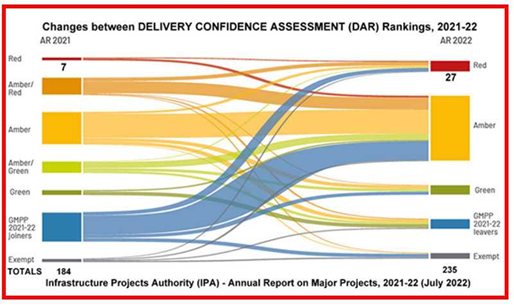
What follow, therefore, are a few shortish paragraphs outlining the IPA’s work, and two graphics from that 2022 Report worth, if not the proverbial thousand words, certainly a good many. We then focus on the issue of voter ID in England, reporting the government’s own assessment on the risks involved, and conclude that Government has still not yet shown how voter ID will operate in England without adversely affecting certain minority and disadvantaged groups.

The focus of the IPA’s work is the Government Major Projects Portfolio (GMPP), comprising this year 235 projects with a total Whole Life Cost of £678bn and estimated “monetised benefits” of £726bn, delivered by 18 departments and their arm’s-length bodies.

The projects are divided functionally into four categories, biggest-spending being Infrastructure & Construction (70 projects: £339 bill. whole life cost; £356 bill. “monetised benefits”) – high investment projects, including improving the UK’s energy, environment, transport, telecoms, sewage and water systems, and constructing new public buildings. Dominated financially, and in the IPA’s ‘unfeasible’ delivery confidence rankings, by the Dept for Transport’s HS2 (£72 – 98 billion) and Crossrail (£19 billion+) projects.

Transformation and service delivery covers projects changing ways of working to improve the relationship between government and the UK people, and harnessing new technology. Example: Vaccines Task Force.

Military Capability ispretty self-explanatory. Example: the Future Combat Air System – clever, mid-2030s stuff like uncrewed aircraft and advanced data systems.

ICT projects enable the “transition from old legacy systems to new digital solutions” to equip government departments for the future. Example: Emergency Services Mobile Communications.

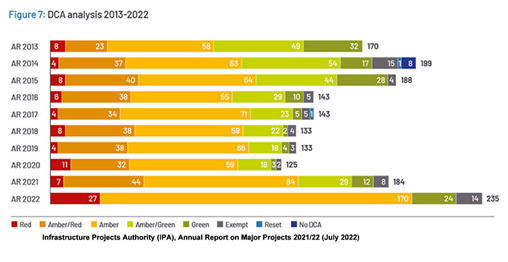
Now to the interesting bit: the actual ‘confidence rankings’, or in the above cases of HS2 and Crossrail ‘no confidence rankings’. The official term is Delivery Confidence Assessments (DCAs): judgements of the likelihood of a project delivering its objectives to time and cost.

In essence, it’s a basic traffic light system. Green represents high likelihood of successful delivery of the project on time, budget and quality; amber: successful delivery feasible, but significant issues already exist, requiring management attention; and ‘Code Red’: unachievable, not a cat in hell’s chance; major issues everywhere, with project definition, schedule, budget, benefits – all at this stage apparently irresolvable.

Given the variables involved, it sounds more than a touch crude, and two additional ratings were added: amber/green – successful delivery probable, if given constant attention; and amber/red – successful delivery doubtful, major risks apparent in numerous key areas, urgent action needed.

Usefully added, it seemed, as unqualified amber regularly took between 40% and 50% of ratings (see Fig.7 below). But no, looked at another way, the “average project rating worsened from Amber/Green in 2013 to Amber in 2020” (p.16). It obviously couldn’t possibly be the quality of the proposed projects, so it had to be the assessment system, which accordingly for the 2022 assessments was changed.

But oops! The number of red assessments nearly quadrupled, almost equalling the previous four years’ red totals between them – but that’s OK, because the average project rating, we are assured, “has improved over the past two years”, though it’s not entirely transparent in the second flow chart.

Which brings us back to Code Reds.  Unlock Democracy, the democratic reform campaign group – and also the Daily Mirror – reported last week that “the Government’s own rating system has given the Elections Bill implementation a code red, which is defined as successful delivery of the project appear[ing] to be unachievable.”  Followed by the Association of Electoral Administrators announcing that it “no longer believes it is possible to successfully introduce Voter ID in May 2023.”

The Government’s “Electoral Integrity Programme (EIP)” has been red rated in the IPA’s annual report (see page 58).  The report summarises the Programme as ‘implementing changes arising from the Elections Bill. The Elections Bill makes provision about the administration and conduct of elections, including provision to strengthen the integrity of the electoral process. Reforms will cover: overseas electors; voting and candidacy rights of EU citizens; the designation of a strategy and policy statement for the Electoral Commission; the membership of the Speaker’s Committee; the Electoral Commission’s functions in relation to criminal proceedings; financial information to be provided by a political party on applying for registration; preventing a person being registered as a political party and being a recognised non-party campaigner at the same time; regulation of expenditure for political purposes; disqualification of offenders for holding elective offices; information to be included in electronic campaigning material’.

DLUHC’s commentary on this result noted the deteriorating assessment and added: ‘The IPA Gate 0 Review of February 2022 concluded that the programme Delivery Confidence Assessment is rated Red and that the programme needs to address key risks related to the suitability of the structure, approach and governance given its complexity and delivery focus, suitability of its minimum viable and digital products, and its lack of contingency to deliver against immovable deadlines’.

Reassuringly, the department felt that ‘the programme is addressing these points’.   Meanwhile, the estimated ‘whole life costs’ of the programme jumped from just under £120m to over £145m.

Unlock Democracy’s Tom Brake has reportedly written to Levelling Up SoS Greg Clark saying ‘It would be highly risky to attempt the first roll out of photo voter ID for the largest election in the UK, without having tested it on lower turnout elections beforehand’.  This echoes Jason Lowther’s comment on this blog almost a year ago that ‘The Government has not yet shown how voter ID will operate in England without adversely affecting certain minority and disadvantaged groups.  Until issues such as costs and access are fully addressed, it needs to proceed with caution’.

Chris Game is an INLOGOV Associate, and Visiting Professor at Kwansei Gakuin University, Osaka, Japan.  He is joint-author (with Professor David Wilson) of the successive editions of Local Government in the United Kingdom, and a regular columnist for The Birmingham Post.

Jason Lowther is the Director of INLOGOV. His research focuses on public service reform and the use of “evidence” by public agencies.  Previously he worked with West Midlands Combined Authority, led Birmingham City Council’s corporate strategy function, worked for the Audit Commission as national value for money lead, for HSBC in credit and risk management, and for the Metropolitan Police as an internal management consultant. He tweets as @jasonlowther

Why and how do municipalities merge? A view from the cognitive perspective

[Photo: https://www.linkedin.com/pulse/mental-virus-flipside-covid-pandemic-dr-abha-bhartia/%5D

Dr. Veronika Vakulenko

Among all public sector reforms initiatives, those appearing on the municipal level are the most tangible. This is because in modern democracies citizens can observe and (if willing to) trace changes in, for example, city planning, local infrastructure, education and many other spheres. Let’s be honest, everyone likes to visit a clean park, modern library, drive perfect roads or celebrate an opening of a new school. Meaning that local governments need to use financial recourses on creating a comfortable place for all to live in. However, it becomes rather common that local governments are not able to balance their budgets, due to a higher per capita spending, lower public service provision, or limited infrastructural capacity, which is the case particularly for smaller rural areas.

Seeking to improve local financial condition, many countries worldwide launched local government reforms, which still remain on the top of agenda among academia and practitioners. Pursuing mainly the objective to enhance local financial efficiency and quality of local public services, the reforms can vary from contractual inter-municipal cooperation to mergers or amalgamations. Mergers are the most drastic reforms as they require alterations of territorial boundaries, changes in administrative responsibilities and routines, and adjustment of financial management practices, all of which affects significantly the lives of citizens.

Several European countries, e.g., Finland, Switzerland, Ukraine, selected to implement voluntary mergers, allowing local governments to celebrate the freedom in deciding whether to initiate the territorial reform. While some municipalities recognized merger’s benefits (i.e., improvement local governments’ economic condition and quality of local public service delivery), others resisted merger. In this situation, it becomes interesting to approach municipal amalgamations from a dynamic perspective to understand behaviour and interactions between different actors, which can result in diverging reform outcomes.

In our recent study published in open access at Local Government Studies, we use an interdisciplinary concept of cognitive style, to explore the psychological aspect of mergers. By mobilizing cognitive literature, we could take a closer look at local actors’ behaviour, to argue that a merger is not a simple ‘marriage of convenience’ of local actors to increase their economic efficiency. Rather, it is a complex cognitive process, which requires local actors’ mental work in taking decisions and creating (or not) a new merged municipality. Thus, a final decision “to merge or not to merge” depends not only on financial benefits, but also on the way local actors perceive and process information about financial incentives and how they operationalize their decisions.

In a story of two neighbouring local governments in Ukraine studied during 2015-2019, we approached two local political leaders, who were drivers of changes on the local level. By studying very carefully their behaviour and actions, we found that their initial perceptions of merging were completely the opposite. While the first one was viewing this as an opportunity and was able to convincingly explain the need and future benefits of this change, as well as introducing new practices to engage local citizens. Despite several other local actors were supporting this initiative, the second leader was acting in a discouraging way and always emphasized risks for their community, which in the end resulted in collective inaction.  To summarize, new interdisciplinary approaches can be used to better understand the success stories or failures of municipal mergers. Cognitive theory in public administration has a significant potential in this field as well as implications for practice. As our case showed, better mapping the sceptics and addressing perceptions of local leaders before initiating voluntary mergers could facilitate better results from territorial reforms.

Dr. Veronika Vakulenko is an Associate Professor at Nord University Business School, Norway. Their research interests include interdisciplinary public sector accounting research; budgeting and financial management in local governments; national and supra-national public sector audit; reforms particularly in the context of developing countries.