Why do we need a new model of public services?

Catherine Staite

Public services, including those commissioned and delivered by local government, have changed substantially in the past ten years. There have been changes in service delivery mechanisms, in relationships between users and services, in organisational structures and in partnership arrangements. It appears likely that the next ten years will bring at least as much change, if not more. One thing is clear: the old model of public services – people expect and services provide – is no longer tenable.  The growing gap between demand and resources has been described in terms of ‘the jaws of doom’.  That is one way of looking at the future.  Another way is to see the opportunities which we have to renegotiate ‘the deal’ between people and public services.

INLOGOV is working with a wide range of local authorities and other bodies to test a new model of public services. The model draws together many of the themes in current debates about the ways in which the public sector is likely  to have to change, in particular, how public services can manage demand, build capacity and achieve better mutual understanding, through the development of stronger relationships with communities as well as through co-production and behaviour change.  The purpose of this model is to support public service leaders – both political and managerial – to make better sense of a complex world.

INLOGOV’s model brings together the disparate cultural, structural, political and financial challenges facing local government and wider public services into an integrated framework, which takes account not only of individual drivers of change but also of the inter-relationship between changes in public services and the wider political and social context in which those changes are taking place. If we have a coherent model which reflects current and future realities it will be easier for us to explore possible solutions together.

We have concentrated on the challenges and opportunities for local government, in partnership with other local and national institutions.  That is not because we think local government is the most important player on the public service stage, it is because we think it plays a unique role as a convenor and mediator between conflicting interests within complex networks of players.  It is in this role that it can provide the creativity and connectivity to help shape solutions to the seemingly intractable problems of rising demand and falling resources.

The key drivers for a new model are: building stronger relationships with and between individuals and communities, increasing co-production of better outcomes by focusing on capacity, as well as need, and changing expectations and behaviours.  Before we can deliver these benefits we will need to change the way we think, plan and act.  There are many good, small scale examples of innovation which are delivering real change but now we need to scale up change to have a real impact – reducing dependency, building confidence and improving outcomes.  These are not quick fixes, so the sooner we start and the more energy we invest the sooner we’ll be able to achieve a sustainable relationship between public services and the communities they serve.


This blog post summarises some of the key messages in:

Why do we need a new model for public services? By Catherine Staite

Ch. 1 in Staite, C. (ed.)(2013). Making sense of the future: can we develop a new model for public services? (Birmingham: University of Birmingham/INLOGOV).

Catherine Staite

Catherine Staite is the Director of INLOGOV. She provides consultancy and facilitation to local authorities and their partners, on a wide range of issues including on improving outcomes, efficiency, partnership working, strategic planning and organisational development, including integration of services and functions.

In praise of … the Japan Local Government Centre

Chris Game

The Guardian newspaper has what it calls a daily editorial encomium: a short, benign tribute to a person or phenomenon featuring generally somewhere on the fringe of the day’s news. Entitled ‘In praise of’, its recent subjects have included Arunima Sinha – the first woman amputee to scale Everest – half-term holidays, male skirts, and Ringo Starr. This uncharacteristically uncritical blog is a lot longer than a Guardian encomium, but comes in a similar spirit.

The Japan Local Government Centre (JLGC) is the London (Whitehall) office of the Council of Local Authorities for International Relations (CLAIR) a joint organisation of Japanese local authorities, supported by the Ministry of Internal Affairs, and dedicated to ‘localised internationalism’: the fostering of international relations at the local level in Japan and the promotion of local Japanese culture and activities abroad.

It is the institutionalisation of a Japanese instinct that the British, not least in local government, tend not to share: a belief in the benefits, both intrinsic and instrumental, in seeking to understand how other countries do things. In addition, therefore, to its branches in each of Japan’s 47 prefectures (similar to our counties) and 20 designated cities (a case in point of a practice from which we could well learn), CLAIR also has seven overseas offices. The London office’s remit covers bits of northern Europe and Scandinavia, plus a responsibility for responding to research requests from the Japanese local authorities who provide most of its funding and a majority of the dozen or so staff.

That research function is one explanation of the extensive contacts we in INLOGOV have enjoyed over the years with JLGC, its rotating directors – mostly seconded from the Ministry of Internal Affairs – and both Japanese and UK staff. But far from the only one.

My personal association dates back to 1997, when I had the good fortune to be selected as a member of one of the Centre’s early annual study tours – in my case as one of a group of 10 mainly local government officers for a heavily subsidised and enormously enjoyable 10-day visit centred on Yokosuka City and Kanagawa Prefecture, just south-west of Tokyo. Unforgettable is almost as overused an adjective nowadays as incredible, but in this instance it is literally true and it paved the way for numerous succeeding contacts, relationships and revisits – from the latest of which, as it happens, I have recently returned.

I might well have blogged about it anyway, but that wouldn’t have justified the ‘In praise of’ peg, which by Guardian convention requires a relevant news item. That news item is (I shall resist typing ‘of course’) Japan400. In truth, the title refers to the yearlong programme of cultural events commemorating 400 years of diplomatic, trading and cultural relations between our two countries – as conducted through myriad organisations like CLAIR and the JLGC.

But the undoubted focal point of the year’s celebrations came on June 11th – exactly 400 years since the Clove, an aptly-named ship of the East India Company, finally made it across the East China Sea, up past Nagasaki to the south-west island of Hirado, and became the first British-commanded vessel to land in Japan.

The nautical detail is vital – especially for any like me, who, on first hearing of Japan400, were confused by thinking we’d already celebrated this quatercentenary more than a decade ago. I recalled clearly a fellow member of that 1997 study tour – Peter McLean, from the then Gillingham Borough Council’s Business Liaison Office (and the first UK local government officer I met who had a bilingual English/Japanese business card) – impressing upon us at every conceivable opportunity how the first Englishman to set foot in Japan, in 1600, had famously and indisputably been William Adams, a seaman from, yes, Gillingham in Kent.

Indeed, Peter, as was his wont, went further: presenting us all with a little book about the great man, The Blue-eyed Samurai, and his remarkable story of finding favour with the Shogun, becoming his trusted adviser, shipbuilder and the only officially recognised Western samurai, being granted a house and land, and spending the rest of his life in his adopted country.

All true and authenticated, and duly celebrated in 2000 in what by then, following Gillingham’s merger with Rochester, was the unitary Medway authority. William Adams was indeed Japan’s first English tourist, but – the big BUT – the ship on which he sailed was equally irrefutably Dutch: part of a Dutch fleet, owned by the Dutch East India Company, and commanded by a Dutch captain.

The Clove’s arrival 13 years later was very different. Though the voyage itself was hardly, as it were, plain sailing, it was heading from the outset to a known and at least minimally settled destination, and there was none of the drama occasioned by Adams’ landing. Quite the contrary, for the convoy commander, John Saris, brought official letters and gifts from King James I, and in turn was warmly welcomed by the local ruler – which I suppose makes it the more appropriate event from which to date the establishment of diplomatic and cultural relations.

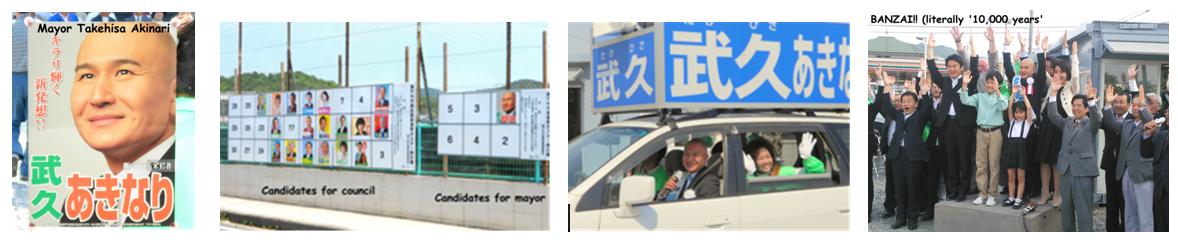
It also offers a really clunky segue back to my own recent visit, during which I too met and was welcomed by local rulers, although they tend nowadays to take the form of elected prefecture governors and municipal mayors, rather than daimyo and samurai. I’m hoping to write something loosely comparative on local government leadership in the UK and Japan, and thought I’d take advantage of the invitation of a friend and former colleague to observe his ‘campaign’ for re-election as mayor of Setouchi, a ‘new city’ of about 40,000 residents in Okayama prefecture, roughly midway between Osaka and Hiroshima.

There are two sets of inverted commas in that last sentence, both intended to signal distinctive usage. First, the city. Though in area roughly the size of Manchester, Setouchi isn’t in truth a city at all, but rather the product of a 2004 merger of three real towns that now, of course, have lost most of their governmental identity – rather like Gillingham and Rochester. And Setouchi too is an artificial name, derived from ‘Seto inland sea’, in which as few people actually live as in the River Medway.

In much the same way as we have been relentlessly merging real places into ever larger and artificial constructs like Medway, the Japanese have been engaged on a fiscally incentivised merger spree that has to date cut the number of municipalities from over 3,200 in 1999 to barely 1,700 – one striking difference, though, being that some of the meaningless names adopted by their new creations at least sound more attractive than ours – Sakura (cherry blossom) City, Asagiri (morning mist) Town, and the like.

That, however, is not my point here. Rather, it is to note that this governmental engrossment, and the substantial reduction in the number of local politicians, seems to have done little to stimulate either greater electoral competition or greater voter participation. Japanese mayoral elections can take place in almost any month, but in over a quarter of the 80 held in April of this year the mayors were elected or re-elected without a contest; and in over 60% of the cities in which elections did take place, voter turnout hit record low levels. Political parties in this country aren’t the most popular of institutions, but democratically a weak and ineffectual party system is surely worse.

My friend was also re-elected unopposed, and, while I’m sure that was a testament to the breadth of his personal appeal, the excellence of his mayoral record, and his undoubted political negotiating skills, even I would be that much more reassured, had he not also been unopposed when first and previously elected.

It did not, incidentally, mean that there was no ‘campaign’ at all for me to witness, following my 6,000 mile journey. There were the personal posters, on publicly provided display boards, that are an integral part of all Japanese elections; loudspeaker campaign cars, organised hospitality, and endless meeting, greeting and exchanging of business cards. But it’s the final picture – the triumphal and collective BANZAI! (in which the ‘distinguished foreign guest’ enthusiastically participated) – that most truly captures the spirit of this particular election: considerably more acclamation than confrontation.

game japan

None of which should be taken to suggest that Japanese mayors, particularly of larger cities, aren’t important political figures with substantial powers and influence, or that the country’s local politics is invariably low key. Last November’s mayoral election in Okinawa, for example, became effectively a referendum on the challenger’s platform of removing all US bases from the city and replacing the US-Japanese Security Treaty with a treaty of friendship – albeit one that he lost by quite a distance.

As for the politician currently receiving by far the greatest media coverage, both nationally and internationally, and performing the Farageiste role of scaring the hell out of the established political parties in the run-up to next month’s Upper House elections, Toru Hashimoto isn’t in Parliament at all, but the mayor of Osaka.

More of which possibly in the nearish future. For the present, though, simply a grateful reflection that, were it not for the JLGC, it’s quite likely that I’d never even have got interested in this stuff.

game

Chris is a Visiting Lecturer at INLOGOV interested in the politics of local government; local elections, electoral reform and other electoral behaviour; party politics; political leadership and management; member-officer relations; central-local relations; use of consumer and opinion research in local government; the modernisation agenda and the implementation of executive local government.

Hashtag politics: seven top tips for civil servants using social media

Stephen Jeffares

The Commons public administration select committee’s call for open policymaking, published on 3 June, envisages civil servants as the guardians of wiki-style policymaking, with public sector leaders embracing digital technologies and using platforms such as Twitter and Facebook.

But these social media platforms can be a double-edged sword for policymakers.

Never has it been easier, or cheaper, to launch or consult on new policy initiatives. The possibility of creating a hashtag and reaching both the influencers and the wider public is seductive. Yet it can also result in something close to a Dr Frankenstein scenario: you have created a hashtag, and it will destroy you!

Once unleashed, public, tag-able, searchable and unique policy ideas are vulnerable to all kinds of comment, including critique and derision. Keeping abreast of what is being said about your initiative, activity or organisation can be difficult when you are busy with everyday matters, as former BBC director general George Entwistle found to his cost.

The rise of social media has brought with it a goldrush, with numerous companies and social media consultants offering “social listening” technologies, related advice and services. These tools can be configured to alert organisations of both positive and negative discussion of their initiatives, opening up opportunities to capitalise or take action. Metrics are provided to show the most influential users discussing an initiative, and who should be approached to help spread the message.

New tags are created daily – #compassionatecare, #MyPCC, #Greendeal, and, a personal favourite, the probation-related tag #transformingrehabilitation, which takes up 20% of a tweet.

Succeeding at hashtag politics is challenging. Here are my top tips:

1. Acknowledge the craft

In the battle to disseminate a message in a competitive environment with multiple channels and information overload, the creation of effective labels – such as hashtags – for policy ideas is part of the craft of policymaking.

2. Expect and accept some loss of creative control

Since its inception, big society has been frequently criticised as nebulous and vague. However, vagueness is part of the appeal of a policy idea. Its very nebulousness is what draws people to it and allows them the important opportunity to attach their own meanings and demands. Organic labels, hashtags and alternative meanings will arise. Take, for example, the Home Office’s #MyPCC, which was usurped by #PCC.

3. Listen

Invest modest resources in social media monitoring software, but, more importantly, recruit and train policy researchers to integrate new forms of data into their work.

4. Diversify

Hashtag policymaking is more about creating memorable policy ideas than explicit hashtags. Following one hashtag or set of users is not enough. You have to adapt to changing language to be able to capture the conversation.

5. Peek under the hood now and again

Do not rely solely on automated analytics, such as sentiment monitors, when making decisions.

6. Engage more and broadcast less

Be prepared to engage in informal discussion with citizens, without the need for approval from above. Waiting three days for sign off to reply to a Facebook comment is not engagement.

7. Be prepared to let go

Every day your initiative is online, accept that attachment to policy ideas is gradual, cumulative and eventually disruptive. Learn to recognise when the policy idea is entering its final stages, be prepared to disinvest, and do not mislead your collaborators.

This post was originally published by the Guardian Public Leaders’ Network.

Image

Stephen Jeffares is a Roberts Fellow in the College of Social Sciences based in INLOGOV, Institute for Local Government Studies.  His fellowship focuses on the role of ideas in the policy process and implications for methods.  He is a specialist in Q methodology and other innovative methods to inform policy analysis.

Some seasonal thoughts on definitions of plagiarism and fraud

Chris Game

In the higher education world June means two things: the assessment season and the publication of university league tables. We had the Guardian University Guide rankings this week and here at the University of Birmingham we were very excited, having apparently shot up in a single year from 30th out of 119 institutions to 15th rankings. We seem to have cracked the system, so watch out, Oxbridge, here we come!

Rigorous assessment, as the Education Secretary regularly reminds us, is a vital part of any educational package, and certainly in HE it’s guaranteed to appeal to fee-conscious parents, if not necessarily to their prospective student offspring. Here in my little corner of the university, therefore, we like to feel we’ve done our bit towards our university’s startlingly improved ranking with our work on rooting out and publicising plagiarism.

Go too deeply into it and plagiarism – appropriating someone else’s work, language, thoughts, ideas, or whatever as your own – can quickly become over-complicated. What counts as a thought? Can you plagiarise yourself? Is wrongful appropriation a crime or an ethical lapse? So we try to keep it simple: it’s cheating, it’s bad, and the more of it you detect, the better.

In what we might call the dark ages, plagiarism rates were the numbers or percentages of all students’ marks that, on investigation, were found to be higher than they should have been, due to the students having cheated. Regrettably, because either our investigations were insufficiently diligent or students weren’t actually cheating that much, the rates were mostly pretty low and risked making us look careless about these matters.

How, then, could these disappointingly low rates be boosted without actually forcing students to cheat? Easy! What we’re really interested in is detecting marks wrongly assigned. But ‘wrongly assigned’ makes it seem as if we, not students, are responsible, so let’s keep the useful term ‘plagiarism’, but extend it to include ALL marks that were found to have been wrongly assigned.

So, if a student falsely claims to have handed work in on time, thereby avoiding a mark penalty for late submission, that’s plagiarism. If our external examiner finds we’ve over-marked an assignment, that’s plagiarism. If the Examinations Office incorrectly records or transcribes a mark, that’s plagiarism. The result: we’ve got stats that plagiarism detection software manufacturers would kill for.

At which point, I should emphasise, at John McEnroe-like volume, I AM NOT BEING SERIOUS!! Or rather, I am being serious, but not about plagiarism. Almost everything in the last few paragraphs – apart from the UoB’s Guardian ranking – derives from my warped imagination.

However, rewrite those paragraphs, replacing plagiarism or intellectual fraud with ‘benefit fraud’, and you’ve got a fair description of how in the real world Ministers and the media manipulate statistics to get them to tell a more convenient story. In brief, if you bundle various unrelated activities together and label them collectively as ‘fraud’, then feed the numbers to the media, you can have voters baying for all the benefit cuts you were going to introduce anyway.

Let’s take the most recent benefit fraud outrage panic, prompted by the release of some latest figures by the Department for Work and Pensions (DWP) hard upon the manslaughter trial revelations of benefit scrounger Mick Philpott. The Daily Telegraph went with “Fraudulent and wrong benefit claims hit £3.5 billion record”. The Daily Express launched a “Call for new blitz on benefits to cut £3.6 billion fraud bill”.

Don’t bother about the slight statistical discrepancy; we’ll come back to it shortly. Besides, what does the odd hundred million matter when most of your readers presumably subscribe broadly to the average view of respondents in a recent YouGov/TUC survey: that 41% of the entire welfare budget goes on benefits to unemployed people, and that 27% of the welfare budget is claimed fraudulently.

In fact, DWP statistics show that of the total 2012/13 welfare budget of £167 billion, nearly half (£80 billion) went on state pensions, 14% on housing benefit, 8% on disability living allowance, 5% on pension credits, and 3% each (just over £5 billion) on jobseeker’s allowance, income support, and council tax benefit. The TUC’s ‘correct’ answer to its ‘benefits to unemployed people’ question is the 3% for jobseeker’s allowance, and even if this does, perhaps misleadingly, ignore other benefits for which the unemployed may qualify, it’s still massively closer to the true picture than 41%.

As for the popular guesstimate of 27% of the welfare budget going in fraudulent claims, the DWP’s more evidence-based estimate is contained in the annual publication referred to above, the clue to which is in its title: Fraud and Error in the Benefit System. Yes, it covers fraud, but its purpose is to measure the total cost to the taxpayer of all incorrect benefit payments made, whatever the cause – and, most importantly, to distinguish between those causes.

The preliminary estimate for 2012/13 is that total over-payment due to fraud and error across all benefits was £3.5 billion, or 2.1% of the total welfare budget. That’s where the Daily Telegraph’s figure came from, except that the paper didn’t bother clarifying that only a third of it was actually the result of deliberate claimant fraud. The other two-thirds were caused by claimant error with no fraudulent intent, and error by DWP or local authority officials.

Moreover, non-fraudulent claimant and official errors were also responsible for under-payments of £1.4 billion, so the net cost to the taxpayer of all benefit fraud and payment error was £2.1 billion or a little under 1.3% of the total budget, with actual fraudulent claims being responsible not for £45 billion, which would be 27% of the budget, nor for £3.5 billion, but £1.2 billion or 0.7%.

Interestingly, the Daily Express recognised that £1.2 billion is the correct fraud figure, but, possibly not to be outdone by the Telegraph, they got their headline by trebling it to £3.6 billion to cover a three-year period.

It’s always tempting, when one knows roughly the respective figures, to compare benefit fraud and tax fraud – but not that easy. First, there’s the terminology. HMRC don’t investigate anything as crude as tax fraud. Rather, they measure tax gaps, between what should be and actually is collected, and talk only of people circumventing or evading paying their taxes. In 2010/11 they measured a tax gap of £32 billion, representing 6.7% of total tax liabilities, and 15 times the net benefit overpayment gap. As usual, by far the biggest gap was in VAT – £9.6 billion, or over 10% of the tax due.

When it comes to differentiating tax-circumventing behaviours, HMRC reckon that unambiguous tax evasion accounts for 46% of the gap, or £14.7 billion – although it seems unlikely that some of the other behaviours, like failure to take reasonable care, would be quite as sympathetically interpreted, were the perpetrators benefit claimants.

Time, I think, to make my own position clear. By trying to identify the most accurate recent measures in what is inevitably an immensely difficult and controversial policy field, I do not diminish in any way the financial, political or moral importance of either benefit or tax fraud. I welcome in particular The Local Government Fraud Strategy, both for the work that it is spearheading and for the increased knowledge and awareness to which it will lead.

My concern is with the deliberate distortion of public knowledge and awareness. Politicians, even Ministers, cannot be held entirely responsible for the public’s misconceptions of how the world works, but they can be criticised when they pander to those misconceptions by falsely presenting or encouraging the false presentation of their own figures. DWP Secretary Iain Duncan Smith – rebuked again only last month by the UK Statistics Authority for distorting his department’s figures on the impact of the benefits cap – and junior minister, Lord Freud, have both had publicly to apologise for exaggerating the extent of benefit fraud, so now they just rely on friendly media to do their dirty work for them. They, above all, should know that the subject’s importance deserves much better.

game

Chris is a Visiting Lecturer at INLOGOV interested in the politics of local government; local elections, electoral reform and other electoral behaviour; party politics; political leadership and management; member-officer relations; central-local relations; use of consumer and opinion research in local government; the modernisation agenda and the implementation of executive local government.

Something old, something new, something borrowed, something blue: is ‘Blue Labour’ part of the left response to the rise of UKIP?

Martin Stott

It is a commonplace for commentators to say that the recent success of UKIP in the shire elections poses a threat to Labour as well as the Tories. There is some truth in this, but a strand of thinking in the Labour Party has been grappling with some of the issues UKIP poses from a left perspective for several years. This is referred to as ‘Blue Labour’.

Essentially it is a critique of both Old and New Labour. It understands that the relentless progress of the last Labour Governments caused many Labour supporters to feel as if their communities had been left soulless. It recognises that Labour developed a top-down style of government and is critical of its neo-liberal view of the world – globalisation understood entirely on terms set by finance capital. Instead it focuses on a different approach to socialism, stressing communitarianism, self reliance and mutuality.

The debate has been driven by the credibility of many of those leading it, most notably the Labour MP and Milliband’s policy review chief, John Cruddas and cultural studies professor, Jonathan Rutherford. They set out the Blue Labour stall thus:

“…today Labour is viewed by many as the party of the market and the state, not of society. It has become disconnected from the ordinary everyday lives of the people. In England Labour no longer knows who it represents; its people are everyone and no one. It champions humanity in general but no one in particular. It favours multi-culturalism but suspects the popular symbols and iconography of Englishness. It claims to be the party of values, but nothing specific. Over the past decade it has failed to give form to a common life, to speak for it and defend it against the forces of unaccountable corporate power and state intrusion”.

A lot of people on the left can relate to that and the ‘Blue Labour’ argument is essentially that the loss by Labour of over five million votes between 1997 and 2010 is a reflection of this, encapsulated in Tony Blair’s famous 2004 comment “Leave the past to those who live in it”.

The problem with that mind-set is that this view of Labour supporters certainly does resonate with UKIP recruits from Labour. Recent focus groups of UKIP supporters when, after rehearsing a lengthy catalogue of things they didn’t like were asked what they did like about Britain, reportedly responded, ‘The past’. Cruddas’s summary of the trajectory of New Labour under Blair is:

“At its best New Labour encompassed both the progressive and the traditional, captured in Tony Blair’s, early recognition of the need for a ‘modern patriotism’. Over time however, it became all about the ‘progressive new’. By the end it embraced a dystopian destructive neo-liberalism cut loose from the traditions and history of Labour”.

What ‘Blue Labour’ is trying to articulate is a direction of travel that is different from a ‘progressive’ politics that uncritically embraces globalisation, neo-liberalism, consumerism and a market economy that leaves great swathes of the population behind and whose guiding principles were graphically exposed by the banking crisis of 2008.

By contrast, the current Government is a constant source of dismay to its supporters as it takes its admiration of all things ‘Blairite’ to new heights, with its attempts to flog off parts of English common life to the highest bidder, forests, waterways, parks, the Post Office, sport and culture, not to mention that national institution, the National Health Service. Hence the mass defections to UKIP from the Tories

By contrast ‘Blue Labour’ is attempting to create a polity through a set of values rooted in relationships – reciprocity, mutuality, solidarity and co-operation rather than the managerial, the bureaucratic and the corporate. It is not just a critique of New Labour though – Blue Labour is not that keen on Old Labour either.

As long ago as 1952, Richard Crossman in an article entitled “Towards a philosophy of Socialism” recognised that the post-war project, the creation of the Welfare State, the triumph of Fabianism, took for granted that politics was the business of maximising general happiness through social planning.

However a welfare state administered centrally in Whitehall sapped the life blood of the Labour Movement. “Before 1945, for hundreds of thousands of active trade unionists and party workers, socialism was a way of life and a vocation”. Now (and this was in 1952!), it seemed that it was exclusively the business of politicians at Westminster acting through an unreformed civil service. Those activists who had previously helped run municipal “gas and water socialism” were given “no vision of new socialist responsibilities”. ‘Blue Labour’ takes a similar view and indeed a deep scepticism of the Welfare State seems to be one of its defining features.

Navigating a credible path between a critique of the Welfare State, hostility to globalisation and neo-conservative economics, and a potentially reactionary nostalgia, is not easy. Labour’s traditions of solidarity, at their best, have been cross-class, cross-generational, cross-gender and cross-national. That is why the bust-ups over immigration prompted by the comments of the original exponent of ‘Blue Labour’ Maurice Glasman (enobled by Ed Miliband in 2011), hurt. It is also true that the ‘flag, faith and family’ tag has more than a hint of not just nationalism, but patriarchy. Some have denounced its perceived conservatism as a ‘Janet and John’ 1950’s style approach to family life. But the Labour Movement has a ‘tradition’ that embraces feminism, internationalism and more recently, multiculturalism. In this regard, ‘Blue Labour’ needs to be a lot more nuanced than current public perception of it.

It has also been criticised for having no coherent economic policy. Certainly talk of limiting the market, bemoaning the “commodification of human beings” and the promotion of regional banks and ‘city parliaments’, doesn’t constitute an economic policy. But unlike the “Big Society”, a shameless Tory ‘borrowing’ of the narratives of community and mutuality, ‘Blue Labour’ is not utterly silent on the market.

Whatever we think of the specific prescriptions that have emerged so far, what we are seeing with ‘Blue Labour’ is a return of something that was repressed under New Labour. Labour is once more talking about class and ideology and from that, some constructive new thinking and a credible response to the UKIP threat, should emerge.

stott

Martin Stott has been an INLOGOV Associate since 2012. He joined INLOGOV after a 25 year career in local government, both as an elected member and as a senior officer.

It’s not Labour or the LGA who are out of touch. It’s you, Minister!

Chris Game

Are you up to speed with your local finance jargon? If so, I wonder if you can explain the difference between a ‘widows tax’ and a ‘Bridget Jones tax’? No, it’s no use reaching for your £445 copy of the CIPFA Guide to Local Government Finance. The answer’s not in there. It’s the Conservative press you’re after, and specifically the Daily Mail and Daily Telegraph.

Monday’s edition of the Mail (that’s Monday, 6th May) thought it would be fun to scare its Bank Holiday readers with the news that “Labour plots ‘Bridget Jones tax’: Party accused of demanding an end to council tax discounts for singletons”.

Evidently the rest of what we once called Fleet Street was out to lunch, because it wasn’t until Thursday 9th that the Telegraph caught up with the story, by which time it obviously had to invent its own slant: “Town halls seek to levy ‘widows tax’”.

They are of course exactly the same thing – and neither, as we’ll see, remotely qualifies as news. But let’s stay with the papers for a bit. The Mail’s story opened as follows:

“Labour has been accused of plotting a ‘Bridget Jones tax’ on singletons as its local authorities demand an end to council tax discounts for those living alone.
In a formal submission to ministers, the Local Government Association [LGA] is calling for the power to end the 25 per cent discount offered in recognition of the fact single people place fewer demands on local services.
More than seven million are thought to benefit from the discount, at a cost of around £2.7 billion a year.”

It’s an interesting bit of reporting. The basic story is broadly accurate. One proposal in the LGA’s 24-page submission to the Government’s June Spending Review does indeed call for “the full and unconstrained ability to vary locally all council tax discounts including the single person discount”. In fact, it’s a kind of ‘belt and braces’ demand, because it could be seen as already implicit in the LGA’s more comprehensive proposal for “the removal of restrictions on council tax, so that councils can determine with their communities the appropriate level of tax and be accountable through local elections for doing so”.

The interesting bit is that the LGA is Conservative-led and Conservative-controlled – the party having been in control of over half of all English and Welsh councils following last year’s local elections. The Chairman of the LGA is therefore Conservative – Sir Merrick Cockell, from the Royal, and very Conservative, Borough of Kensington & Chelsea – and the Conservatives are also the largest group on the Association’s Executive. It would represent quite a coup for the minority representation of Labour authorities, if they had been able to hijack almost certainly the single most important document the LGA will produce this year – were it true.

Having already implied that the LGA was Labour-run, there wasn’t any real need for the Mail to offer further explanation, but there was a rather limp mention of that all-purpose stand-by for bewildered journalists – their anonymous ‘sources’. In this case, the “sources claim the campaign to end the discount is being driven by Labour authorities including Liverpool, Sheffield, Islington and Exeter”.

“and Exeter”. Brilliant. The sources certainly earned their pay-off there: three of the oldest recidivists around, and then, out of the blue, Exeter, to add real authenticity. A council that last year set one of the lowest district council tax rates in the country – so low that this year it was specifically allowed by Ministers to increase its bills by £5. A dangerous trouble maker, if ever there was one.

But it was more than enough for Communities Secretary, Eric Pickles, who not only ran with it, but suggested a name for what would have to be presented, of course, as a new tax: “There is clearly a well-orchestrated campaign being pushed forward by Labour councillors to target the most vulnerable. This is a Bridget Jones tax and shows how out of touch Labour are”.

Not, however, to quite the degree that his colleague, Brandon Lewis, appears to be. The Local Government Minister explained to the Daily Telegraph that it is in fact the LGA that “is completely out of touch by calling for stealthy council tax hikes – how strange they didn’t have the courage of their convictions to highlight this before election day.”

So let me get this straight. Our Conservative Minister would have liked it publicised, during the county council elections campaign, that the Conservative-led LGA was calling for stealthy council tax hikes? I find it a little surprising, but, if that was what he really, really wanted, he could have announced it himself – because the whole Spending Review submission – including, in bold type, the council tax discounts bid – had been produced back in March and had been in the public domain and available for every one of us to read throughout the campaign.

So which is it? Had he not read it, or forgotten it, or not realised its potential political exploitability? Whatever, I don’t think he’s in much of a position to make accusations about others being out of touch.

game

Chris is a Visiting Lecturer at INLOGOV interested in the politics of local government; local elections, electoral reform and other electoral behaviour; party politics; political leadership and management; member-officer relations; central-local relations; use of consumer and opinion research in local government; the modernisation agenda and the implementation of executive local government.