The role of the Ombudsman within the Japanese Local Government System: The Example of Kawasaki City

Professor Shunsuke Kimura

The ombudsman is an institution that serves as a voice for Parliament and the public, conducting administrative reviews through hearings and investigations of complaints and inquiries. Rooted in human rights protection, the ombudsman system monitors administrative agencies by directly addressing citizens’ claims.

This paper analyses the functions of the Japanese ombudsman system within the public policy framework, particularly considering Japan’s cultural characteristics. Despite its adoption by some local governments since 1990, the ombudsman institution has not gained widespread prominence across Japan. This raises questions regarding its effectiveness within the administrative dispute system and the reasons for its limited adoption. Research indicates that there are structural issues within Japan’s local administrative system that may hinder the mediation process.

The study employs original statistics sourced from interviews with ombudsmen from Kawasaki City, which was the first municipality to establish an ombudsman in 1990. The paper also highlights the presence of approximately 5,000 administrative advisors across Japan, which contrasts with the relatively small number of municipalities that have adopted the ombudsman system.

Municipal ombudsmen have contributed to addressing administrative grievances and improving local governance through reforms. The Japanese administrative dispute system comprises three subsystems: the administrative case litigation system, the administrative appeal system, and the grievance system, with the ombudsman system falling under the latter. (See Table1)

The ombudsman primarily addresses inadequate administrative actions, aiming to enhance administrative justice. Japan’s local government system consists of ordinary and special local governments, with prefectures and municipalities being the primary units.

The paper emphasizes that, unlike many countries, Japan does not have a national ombudsman system, only local government systems, which contributes to the unique characteristics of its public ombudsman framework. This framework includes legislative and executive types of ombudsmen, with the latter being more prominent in local governance.

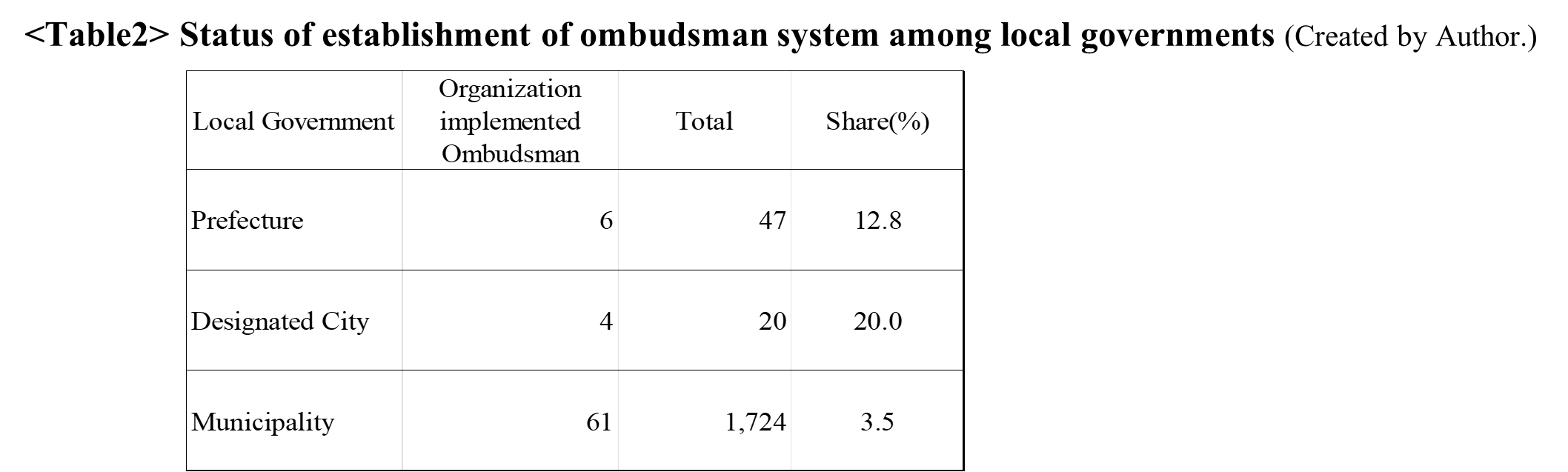
This paper discusses the varying implementation of ombudsmen across municipalities, pointing out that their presence is particularly notable in designated cities. However, the diffusion of ombudsmen remains limited, with only 71 municipalities adopting the system.(See Table2)

This limitation can be attributed to cultural factors that prioritize group cohesion over individual expression, as well as historical beliefs regarding government infallibility.

The role of the ombudsman in Japan is further complicated by the lack of national oversight and the challenges in securing competent personnel. Additionally, existing administrative bodies with similar functions pose competition for the establishment of ombudsmen.

The study concludes that while the ombudsman system has not spread significantly, it plays a crucial role in addressing administrative issues and enhancing citizen participation. The future of the ombudsman system in Japan hinges on recognizing its value in promoting administrative justice and ensuring the protection of citizens’ rights. In summary, the Japanese ombudsman system, despite its limitations, has the potential to evolve as a vital mechanism for administrative accountability and citizen engagement, particularly in an era marked by increasing complexity in governance and citizen demands.

Professor Shunsuke Kimura, PhD, is Professor and Dean of Graduate School of Global Governance, Meiji University, Tokyo, Japan. PhD(law) at Hitotsubashi Univ. After retiring from Ministry of Internal-Affairs, he has been working as a professor. He has been a Visiting Scholar at Lille Univ. in 2023 and at the University of Birmingham (INLOGOV) in 2025.

Cyclopean ‘local’ government and the end of local democracy?

Chris Game

As with another quite recent blog of mine, it’s important to start with the alert that most of its style, structure and content stem directly from its having been written in the first instance not for an academic readership, but as a column for probably this week’s Birmingham Post. There are a few additions and subtractions, plus, barring a dramatically uncharacteristic Lowtherian intervention, one guaranteeable difference: the title.

At the time of writing this intro I don’t know for certain what the Post editor’s choice of words and punctuation will be – except that it won’t comprise nine words, including three longish ones. Space and layout, you understand. It will, however – because regular authors do have at least some bargaining ‘say’ – open with that key word that many/most Post readers will barely recognise.

To summarise the whole thing: here in Britain we already have, and in England, following last December’s devolution White Paper, are about to develop still further, a scale of ‘local’ government that makes a complete mockery of the term ‘local’; and the present Government, with no noticeable public consultation, is embarked on increasing that non-local size still further – to truly Cyclopean dimensions.

And, as I sought to explain to the Post editor, by introducing this concept, rarely if ever used in modern political debate, both the Post and I will become – well, you never know – possibly a little bit famous. Here’s the reasoning.

First, ‘Cyclopean’, used in the context of local government.  Ancient Greek, pretty obviously, it originally described an architectural style in which the walls, towers and other fortifications of ancient cities like Mycenae (a 70-odd mile day trip SW of Athens) were constructed from massive limestone boulders – of the scale shown in the accompanying illustration – fitted extremely closely together without apparently having been substantially reshaped and without use of mortar or cement. 

So preternaturally impressive were these city constructions – the hilltop Mycenae was perhaps the most famous, but there were numerous others – that the myth developed that they must have been built by the Cyclopes, a race of superhuman giants in Greek mythology, and the only humans physically capable of creating such constructions. Hence ‘Cyclopean’ – to describe the assumed method and scale of a city’s governmental architecture, not the size of its residential population.

Somehow, though, towards the latter end of the 3,500 intervening years, the UK has developed, to an almost unique degree, its own interpretation of ‘Cyclopean local government’. Yes, there are loads of large buildings – Birmingham’s Council House and Central Library for starters, the Octagon, etc. – but there’s no Cyclopean mystery about what holds them together. Put crudely, it’s the concrete and steel, not some mystical manpower.

The UK’s, and particularly England’s, modern-day local government and its latest structural ‘reform’ have become almost entirely about scale. Instead of referring to the governance of, or provision of services for, a particular local community and its unique character, England’s ‘Cyclopean local government’ currently comprises just over 300 ‘local’ authorities, with populations averaging 180,000 – which is hardly our (or anyone’s) ‘everyday’ usage and understanding of that term ‘local’.

And yes, averaging. Which, of course, would make Birmingham’s 1.2 million population ‘super-Cyclopean’ – and the West Midlands Combined Authority’s 4 million ‘Mega-Cyclopean’. Or ‘hyper-Cyclopean’, which I personally slightly prefer, suggesting something beyond the bounds of reason, or control. We’ll return to that.

Some quick comparisons or contrasts: average size of German and Italian municipalities is around 7,500, Spain’s 5,700, and France, albeit as exceptional in its way as the UK, 1,900. Yes, slightly under one-hundredth the size of our average, and, by chance, roughly the same as our smallest, the Isles of Scilly, arguably our one ‘municipality’ that wouldn’t make a mockery of the term ‘autorité locale’.

The rest of the world, or first-time observers, find our scale figures as extraordinary as the Ancient Greeks found Mycenae. They are naturally curious as to how we do anything purporting to be genuinely ‘local’ government on such a manifestly non-local scale, and, above all, why.  Good questions, but not for a local newspaper column. Indeed, not for the likes of us mere citizens and voters either, because no one’s bothering to ask us.

The major redesign of England’s local government is currently in the hands of Angela Rayner – Deputy Prime Minister + (in any spare time) Secretary of State for Housing, Communities and Local Government.  An early action was to cancel – arguably “legally risky”, if not unconstitutionally (see Google– ‘Cancellation of 2025 English local elections’) – nine May 2025 county and unitary council elections, she/someone in the Government having decided that these bodies had had their day and there would be no room for them in her new, but still undefined, single-tier England.

Rightly describing the UK as the “most centralised” country in Europe (https://www.bbc.co.uk/news/articles/cn0xz4938z9o), Rayner’s apparent plan is to end central government’s micro-management by making ours, by a distance, the least localised – most Cyclopean – ‘local government’ certainly in Europe, if not the world (500,000 minimum), and, it would appear, without a great deal of consultation.

The ’plan’, in summary, represents the biggest and most transformative upheaval of English local government in my adult lifetime (sorry, you’ll have to work it out!), rushed/bullied through Parliament and local government itself with absolutely minimal consultation and consequential analysis. In short, modern-day Cyclopean local government.

Chris Game is an INLOGOV Associate, and Visiting Professor at Kwansei Gakuin University, Osaka, Japan.  He is joint-author (with Professor David Wilson) of the successive editions of Local Government in the United Kingdom, and a regular columnist for The Birmingham Post.

Picture credit: https://stock.adobe.com/uk/images/odysseus-und-seine-gefahrten-fluchten-vor-dem-zyklopen-polyphem/608942497

Rewiring Local Government for Citizen Engagement

Jason Lowther

The Institute of Local Government Studies (INLOGOV) has published a new report, Rewiring Local Government for Citizen Engagement, which sets out a compelling case for reimagining the relationship between local authorities and the communities they serve. At a time of structural reform, fiscal constraint and lower public trust, the report argues that citizen engagement must become fully embedded local governance, rather than a peripheral activity.

The report identifies three interrelated conditions that are essential for effective engagement. First, local authorities must convene inclusive democratic spaces that enable deliberation, dialogue and collective decision-making. These spaces, whether in the form of citizens’ assemblies, participatory budgeting or neighbourhood forums, can help to rebuild trust and foster more responsive policymaking.

Second, councils must invest in building community capacity. This involves supporting citizens, particularly those from groups whose views are often neglected, to participate meaningfully in public life. It also requires sustained investment in community infrastructure, such as local venues, networks and organisations, which provide the foundations for civic engagement.  The report recognises that 15 years of austerity since 2010 has significantly reduced the availability of community meeting places such as libraries, neighbourhood offices, youth and community centres, and cultural and leisure services.

Third, the report highlights the importance of co-producing public services. By involving service users in the design and delivery of services, councils can ensure that provision is more closely aligned with the lived experiences and priorities of local people. Co-production also fosters innovation and strengthens the legitimacy of public institutions.

The report draws on a wide body of academic research and practical experience, both in the UK and internationally. It shows that democratic innovations are already taking root in many councils, despite the challenges posed by austerity and institutional inertia. Examples include digital engagement platforms, youth-led initiatives, and the devolution of powers to neighbourhood and parish levels.

However, the report also acknowledges the barriers that councils need to address. Organisational cultures, limited resources, the need to develop new skills in officers and members, and legitimate concerns among elected members about the implications of participatory approaches can all inhibit progress. The report calls for leadership, reform and investment to embed engagement in the everyday practices of governance.

We pay particular attention on the vital role of councillors, who are well placed to act as facilitators and mediators between communities and institutions. Supporting councillors to develop these roles is essential if engagement is to be sustained and meaningful. The report also emphasises the need to engage young people and to make appropriate use of digital tools.

In conclusion, Rewiring Local Government for Citizen Engagement offers a clear and evidence-based framework for strengthening local democracy. It argues that by embedding citizen engagement in governance structures and practices, councils can foster trust, improve outcomes and build more inclusive and resilient communities.

We will be discussing our findings with councils, central government and related think tanks and sector organisations over coming months.

The full report is available here:

The Treasury’s Long Shadow: Why Local Government Needs Its Own Barber

Philip Swann

The extent to which the Blair government’s delivery unit became the focus of tension between No 10 and the Treasury is a key theme in Michelle Clement’s fascinating history[1] of the unit. It was a product of Tony Blair’s ambition to reform public services and was seen by Gordon Brown as a threat to his dominance of domestic policies generally and his planning mechanism, public service agreements, specifically.

There are striking similarities between the Treasury’s “not invented here” attempted dismissal of the Prime Minister’s Delivery Unit (PMDU) and the treatment of the government’s missions in the recent spending review.

Prime Minister Kier Starmer announced in February 2023 that five missions would form the “backbone” of Labour’s election manifesto. In October 2024 the Cabinet Office announced the establishment of a “mission board” for each mission chaired by the relevant secretary of state.  In December 2025 the government complicated things slightly when it published its Plan for Change: Milestones for Mission-led Government. It set out six targets which, “guided by our missions” would “set clear milestones[2]” to track the government’s progress.

The milestones were: raising living standards in every part of the UK; rebuilding Britain with 1.5m homes in England and fast-tracking planning decisions; ending hospital backlogs; putting police back on the beat; giving children the best start in life; and securing home-grown energy.

The missions were largely ignored in the spending review. Only one of the missions was referred to in Rachel Reeves’ speech and there were only 14 cursory references to missions in the core spending review document. This must mean that the missions were not central to the discussions about the government’s public expenditure priorities. This is so far removed from the way in which missions have been deployed elsewhere, such as by Camden Council. There missions were central to the council’s strategic planning and were used to engage partner organisations and the community in a concerted drive to address the challenges facing the borough.

It is clear from Clement’s book that the first head of the PMDU, Michael Barber, managed to keep the Treasury on board. His unpublished diaries are a key sources for the book, and Clement argues convincingly that, as one of the few senior figures who were respected by both Blair and Brown, he was instrumental in keeping the No 10-led show on the road.

In retrospect it is clear to me that local government suffered as a result of the differences of approach to delivery advanced by No 10 and Treasury. At the time the LGA, where I was director of strategy and communications, made a series of attempts to secure a more collaborative approach with government to the challenges then facing the country.

Local public service agreements (the name gives the game away) and their successors, local area agreements, became entangled in the Treasury’s target-laden bureaucracy and did not benefit from Barber’s more thoughtful “deliverology” which Clement refers to as an art rather than a science. Similarly the LGA’s “shared priorities, an earlier version of missions, got little traction beyond the Office of the Deputy Prime Minister and the then Audit Commission.

I do not recall any significant engagement with Barber, but I am not sure we would have made much progress. Clement refers to local delivery but not to local government and all the evidence suggests that Barber would have shared David Blunkett’s antipathy to the perceived lack of ambition of local education authorities (Barber worked with Blunkett in Blair’s first term).

It is not clear whether the absence of any significant reference to missions in the spending review was an oversight or a reflection of a bigger split between the Treasury and the Cabinet Office. If there is a serious divide we do not know where the Prime Minister stands. What we do know is that local government faces an urgent task in getting the Treasury to give more energy and political capital to the fundamental reform of local government finance. It is also fair to argue that, if taken seriously, the missions provide a good basis for a discussion why that should be a priority for central as well as local government.

One clear message from Clement’s book is that people matter. Local government needs to find its Barber.


[1] Clement, M. 2025 The Art of Delivery. Biteback Publishing


Phil Swann is studying for a PhD on central-local government relations at INLOGOV.

Win an election and implement your manifesto – that’s novel!

Image: Emily Sinclair/BBC https://www.bbc.co.uk/news/articles/c367lry5ypxo

Chris Game

First, a reader alert. What follows is in essence an only marginally revised column written for and hopefully published in this week’s Birmingham Post, to which for many years now I’ve been a regular contributor. Thanks, at least in part, to the “many years”, I’m permitted a wide scope of subject matter, but for obvious reasons local government in some form or other is what I tend to resort to most frequently – not least around local election season.

With the Post’s Thursday publication date, this is a mixed blessing, knowing that most readers interested in these matters would very likely have learned the results of the elections before they read one’s prognostications and predictions. What follows here, then, is my third column focused on this year’s local (County/Unitary Council) elections, which were, of course, limited to just 24 of England’s 317 local authorities (plus the Isles of Scilly) and precisely none in, never mind Birmingham, the whole metropolitan West Midlands.

Faced with the alternative option of ignoring the topic altogether, I decided to focus on the four West Midlands County Councils: three with biggish, if declining, Conservative majorities – Shropshire, Worcestershire and Warwickshire – plus STAFFORDSHIRE: Labour for decades, but Conservative since 2009, and, until the May council elections, with 55 Conservative councillors out of 62, almost as Tory as they come.

However … since last July, when the county’s parliamentary constituencies all went Labour, Nigel Farage’s Reform UK Party had been energetically hoping to build in Staffordshire on what statistically had been among its most promising performances. And indeed it did: Reform UK: 49 of the 62 County Council seats, leaving the previously controlling Conservatives with 10, and Labour, Greens and Independents 1 each. The Lib Dems, along with UKIP, the Workers Party of Britain and others, failed to score.

It typified results across the country. On what nationally was an exceptionally quiet election day, Reform UK increased its nation-wide base of just two councillors (both on Hampshire’s Havant Borough Council), to a relatively massive 677 (39% of the total seats contested) and gained majority control of no fewer than 10 of the 23 councils.

One can only speculate at some of the results that a fuller involvement of, say, the 130 unitary authorities, metropolitan districts and London boroughs might have produced. I concluded that Election Day column, though, not with any numerical predictions, but with Farage’s most publicised campaign observation/pledge: “We probably need a DOGE for every single county council in England”.

Which could have sounded a touch presumptuous from the Leader of a party who had approached that Election Day holding just two of the 1,700+ seats ‘up for grabs’ – but not from Farage.

I did wonder, though, what onlookers would make of that DOGE acronym (or, in some versions, D.O.G.E. – that’s how novel it is). Indeed, even Reform candidates, who probably knew at least that it stood for the love child of President Trump and the recently very departed Elon Musk’s Department Of Government Efficiency, trod carefully.

Created, they could possibly parrot, to “modernise information technology, maximise productivity and efficiency, and cut wasteful spending”, but did they have any real idea of how the function and office might work in a UK political context? Or did they possibly assume that, like so many campaign pledges, even if, rather incredibly, a DOGE majority did emerge, it would find itself, at least for the present, on the ‘too hard just now …. we’ve only just elected our Leader’ pile?

Certainly I, while having at least some idea of what county councils having an English DOGE might entail, would definitely NOT have predicted that, within just one month of those county elections, one of England’s biggest and traditionally most Conservative counties, KENT, would be preparing to face an ‘Elon Musk-style’ DOGE audit by a team of technical experts assembled specifically to analyse its £2.5 billion-plus budget spending and assess its financial efficiency.

Since the past weekend, the ‘Elon Musk-style’ bit will possibly have been played down, but not, seemingly, the ongoing implementation. With LANCASHIRE – £1.2 billion budget – already announced as next on the list, this just could prove insightful and potentially serious stuff.

Until May 1st, Kent County Council comprised 62 Conservatives, 12 Lib Dems, 4 Greens, 0 Reform UK.  Since then, it’s been 10 Conservatives, 6 Lib Dems, 5 Greens, and 49 Reform UK. If dramatic change is to be the agenda, Kent seemed an apt and attention-guaranteeing choice. 

By any measure, and almost whatever happens next, that – in my book, anyway – is an impressive achievement. There’s been, predictably enough, ‘Establishment’ outrage – “a superficial response to the deep problems of local government” … “initiating a review of local authority spending misunderstands the circumstances facing local authorities … All councils have been caught in an iron triangle of falling funding, rising demand, and legal obligations to deliver services. In that context every local authority has had to make difficult choices to cut services …” (Institute for Government).

On the other hand, win an election and implement your party manifesto! – a demonstration that turning out and voting in local elections, even in our exceedingly non-proportional electoral system – can produce policy action.

Or, rather, especially in our exceedingly non-proportional electoral system. Two of the new Combined Authority mayors (outside the West Midlands) were elected on under 30% of the votes cast, and obviously a much smaller percentage still of the registered electorate.

This follows the recent ditching of the Supplementary Vote in favour of ‘First-Past-The-Post’, where voters pick just one candidate, and the one with the most votes wins – even if, as this time in the West of England, that percentage was under a quarter of an already very modest turnout.

To me, anyway, it’s arguably even more important in these local/Mayoral elections than in parliamentary ones – for us, the elected Mayors, and democracy generally – that voters can indicate their first AND SECOND Mayoral preferences, thereby ensuring that, however low the turnout, the finally elected winner can claim the support of at least a genuine majority of voters.  Which means electoral reform – but that’s another column/blog.

Chris Game is an INLOGOV Associate, and Visiting Professor at Kwansei Gakuin University, Osaka, Japan.  He is joint-author (with Professor David Wilson) of the successive editions of Local Government in the United Kingdom, and a regular columnist for The Birmingham Post.

How Neighbourhoods Shape Perceptions: Local Organisations, Racial Inequality, and Financial Attitudes

We are delighted to announce the inaugural Autar Dhesi Lecture hosted by our sister school, the Birmingham School of Social Policy and Society at the University of Birmingham on Tuesday 17th June 2025 from 14.00-16.00 at G15, Muirhead Tower, University of Birmingham Edgbaston Campus.

To attend this event, please click on the Eventbrite link – https://www.eventbrite.co.uk/e/how-neighborhoods-shape-perceptions-local-organizations-racial-inequality-tickets-1326266953159?aff=oddtdtcreator

Professor Mario Small, Columbia University, USA

How do neighbourhood environments affect perceptions? This lecture examines how neighbourhood context contributes to racial differences in financial attitudes. Professor Small focuses on alternative financial institutions (AFIs) such as payday lenders, which in the U.S. are overrepresented in predominantly African American neighbourhoods. Based on survey, experimental, and qualitative interview data, it demonstrates that neighbourhood exposure to payday lenders significantly shapes perceptions, resulting in more positive attitudes toward the lenders. The effect operates through three mechanisms: convenience, concrete experience, and comparative assessment, as negative experiences with conventional banks play a role. It explores implications for our understanding of how neighbourhoods matter and how institutional conditions play a role in racial inequality.

Mario L Small, PhD is Quetelet Professor of Social Science in the Department of Sociology at Columbia University. He has made numerous contributions to research on urban neighbourhoods, personal networks, qualitative and mixed methods, and many other topics. He has shown that poor neighbourhoods in commonly-studied cities such as Chicago are not representative of ghettos everywhere, that how people conceive of their neighbourhood shapes how its conditions affect them, and that local organizations in poor neighbourhoods often broker connections to both people and organizations. Professor Small has demonstrated that people’s social capital—including how many people they know and how much they trust others—depends on the organizations in which they are embedded. His work on methods has shown that many practices used to make qualitative research more scientific are ineffective. Small’s most recent book examines why people are consistently willing to confide their deepest worries to people they are not close to.

WITH THANKS TO THE AUTAR DHESI ENDOWMENT FUND

We are delighted to present the first in our Annual Autar Dhesi Lecture Series. Professor Autar Singh Dhesi graduated from the University of Birmingham with a MSc in National Economic Planning in 1971 and later in 1974 with a PhD in Economics.  He then built a distinguished career at Guru Nanak Dev University before being appointed as a consultant to the World Bank, Washington DC, in 1982. He continued his career as Professor at Guru Nanak Dev University and later at the Punjab School of Economics. His major areas of specialisation include economic development and planning, public policy, sustainable development, human and social development, higher education and NGOs. Professor Dhesi has authored over 100 publications in community building, diaspora, social action, modernisation and economic development.

In 2023 Professor Dhesi reconnected with the University of Birmingham to share his philanthropic wish to create an endowed guest lecture in social capital and community building in the School of Social Policy and Society. This gift will enable exchange of knowledge and meaningful exploration; two themes that were exemplified by Professor Dhesi’s career and achievements.