
Can drama “Help” social care?

Jason Lowther

Photo credit: https://www.youtube.com/watch?v=5Z2ufAl2lko

Fresh from winning the Grand Jury Prize at the Banff Rockie Awards on Monday, Channel Four’s drama Help was yesterday nominated for Best Drama in the Edinburgh TV awards, with its lead actor Jodie Cromer also nominated for Best Actor.  The drama was one of the most watched on the channel, bringing to millions of viewers the plight of care homes and their residents during the pandemic.  Whilst the Help storyline is fictional, it is based on hard and devastating facts.

In my view, Help could be criticised for its farfetched ending and sometimes unsympathetic rendering of the care home manager, however its characterisation of care home staff and residents is both caring and revealing.  Clearly emotionally affected researching the programme, writer Jack Thorn said: “hearing the stories of those at the frontline, having people break down in tears on zoom in front of us has been incredibly moving and galling”.   

My two favourite parts of the programme (no spoilers) are the endless recorded message of a hopelessly over-run “NHS 111” call centre in the background for several minutes, and Jodie Cromer’s wrenching speech to camera (1:34 on the video) demanding “…underlying health conditions, eh?  When did all lives stop being worth the same?”  The programme ends highlighting some stunning research findings: 40% of Covid deaths in the early pandemic (from March to June 2020) were in care homes; the average wage of a care home worker is £8.50 per hour; whilst government provided 80% of PPE needs for the NHS, it only met 10% of adult social care’s needs. 

This last claim is based on the National Audit Office analysis published in November 2020, which found that the adult social care sector received approximately 331 million items of PPE from central government between March and July (10% of their estimated need) whereas NHS trusts received 1,900 million items sent to NHS trusts (80% of estimated need).  Whilst both fell significantly short of what was required, there is an apparent imbalance here.  Data collected by the Care Quality Commission (CQC) showed that, throughout April and May 2020, more than a fifth of domiciliary care providers had no more than a week’s supply of PPE. 

This situation was well known to the Secretary of State, not least because the LGA and the Association of Directors of Adult Social Services wrote stating “we continue to receive daily reports from colleagues that essential supplies are not getting through to the social care front-line. Furthermore, national reporting that equipment has been delivered to providers on the CQC-registered list does not tally with colleagues’ experience on the ground”.  Nevertheless, in a scene included in Help, during a Downing Street press conference on 15 May, 2020, Mr Hancock said: “right from the start, it’s been clear that this horrible virus affects older people most. So right from the start, we’ve tried to throw a protective ring around our care homes”, repeating in the House of Commons on 18 May that “we absolutely did throw a protective ring around social care”. 

Understanding the human costs of these central government failures is difficult, with the effects on staff, residents and their family impossible to measure objectively.  Help does a good job in illustrating some of the pressures on care staff and the pain of relatives unable to visit dying residents, made all the more poignant now that we know some of the behaviour during the pandemic of senior central government actors such as Hancock’s affair and Johnson’s multiple parties forensically examined in Sue Gray’s recent report

Perhaps the most basic measure is in human lives.  Last year researchers used the national death registry of all adult (aged ≥18 years) deaths in England and Wales between January 1, 2014, and June 30, 2020 to compare daily deaths during the COVID-19 pandemic against the expected daily deaths.  They estimated that during the early pandemic, about 26,000 excess deaths (almost half of the total excess deaths) occurred in care homes and hospices.  This is likely to be an underestimate since early in the pandemic, testing of suspected cases was available only in the hospital, whereas routine testing of staff and residents in care homes was not implemented until May 2020.

The latest ONS statistics, issued in February 2022, suggest that since the beginning of the coronavirus (COVID-19) pandemic, there have been over 274,000 deaths of care home residents (wherever the death occurred) registered in England and Wales; of these, 45,632 involved COVID-19 accounting for 17% of all deaths of care home residents. 

Intriguingly, The Lancet reported in March that “COVID-19 has had a disproportionate impact on the mortality of care home residents in England compared to older residents of private homes, but only in the first wave. This may be explained by a degree of acquired immunity, improved protective measures or changes in the underlying frailty of the populations.” Meanwhile, last month the Care Quality Commission finally published data on deaths in each care home during the first year of the pandemic (April 2020 to March 2021).

Whatever the precise figures, it’s clear that adult social care residents and staff were badly let down by central government, far from the Secretary of State’s “protective ring” narrative. This despite the best efforts of care managers, local commissioners and councils discussed in Luke Bradbury’s blog here last week.  Help does a fantastic job of showing the impact of these critical central failures – and recognising the incredible work care staff did in such difficult circumstances with so little financial reward.
Collaborative management in the face of government response to COVID-19? Evidence from care home staff and stakeholder experiences in West England.

Luke Bradbury

Picture credit: https://socialvalueportal.com/support-national-effort-covid-19/resources/news/social-value-in-action/support-national-effort-covid-19/

As a student on the MSc Public Management course at INLOGOV and having worked part-time in care for a number of years, I felt my final dissertation project was an opportunity to investigate the impact of COVID-19 on adult social care and the implications of government intervention. The works of organisations such as SCIE (Social Care Institute for Excellence) have already shown that inaccurate government guidance – combined with years of underfunding – resulted in the sector being ill-prepared for dealing with a pandemic and that care policy and practices had to rapidly adapt to unforeseen circumstances with limited support.

This case study aimed to explore this in the context of two care homes in West England during the early months of the pandemic. It was also interested in the role of collaborative management between care homes and their surrounding communities including local authorities, charities, businesses etc. ‘Collaboration’, in this context, took some influence from Helen Sullivan and Chris Skelcher’s conceptualisation of a collaborative agenda governing the (often mutually) beneficial cooperation between different public bodies and community agencies. One might consider how care homes may have banded together with their own local communities to ensure they still had the means to provide quality care in the face of COVID-19. Indeed, recent research by Fiona Marshall et al. has shown that, where government support was scarce, many care homes formed resource networks with external stakeholders such as local businesses, dentists, veterinaries, and domiciliary care agencies to source vital materials including personal protective equipment (PPE), electronics, toiletries, bedding and even food.

This study used semi-structured interviews and recruited five participants via a combination of snowball and non-probability purposive sampling. This included two deputy care home managers representing two different care homes in West England as well as a carer, a local parish councillor, and a co-owner of a local chemicals firm. The latter two participants were recruited as active members of the local community for one of the two participating care homes (or ‘external stakeholders’). Thematic analysis and grounded theory-based coding was then used to interpret the data.

The analysis firstly uncovered a strong dissatisfaction with the central government response to COVID-19 amongst all participants. Care staff spoke about how the implementation of the Coronavirus Act forced them to take on extra patients from hospital without an effective COVID-19 testing system in place and that inconsistencies between government guidance and company policy led to confusion amongst managers. Practices were forced to adapt; for example, adhering to stricter infection control measures and taking on extra care duties such as virtual GP consultations. External stakeholders also spoke about how these circumstances encouraged some level of collaboration within the community and a desire to assist local care organisations; for instance, a parish council was enabled to collaborate with the local chemicals firm and local school to source PPE such as goggles and hand sanitizer which could then be distributed to care providers.

Despite this opportunity to establish a resource network, collaboration between the two care homes and their surrounding communities was not evidenced as Marshall et al. had found previously. This was attributed to two main reasons. Firstly, resource dependency was less prevalent because effective internal management within both care homes meant they already had a sufficient supply of PPE. As one of the deputy managers recalled, the manager for her home made the decision to stock up on PPE and to lockdown early, therefore minimising the spread of the virus. The second reason was down to external circumstances that aided both care homes. Since both operate within rural areas of West England, they occupy less densely populated regions than care homes within inner city locations and therefore surrounding transmission rates remained relatively low. The implication is that locality largely eliminated the need to establish support networks with external stakeholders because they were not experiencing the same level of devastation seen in many other care homes. This was corroborated by staff who felt ‘fortunate’ compared to what they were seeing on the news.

These findings indicate the importance of effective management but also the extent to which contextual circumstances may or may not have necessitated collaborative networking between care homes and their surrounding communities during the early months of the pandemic. Whilst collaboration was less necessary here, the background coordination of parish council and local actors to produce a ‘safety net’ of resources did highlight the potential of localised collaboration and intervention in times of crisis. Perhaps, had such coordinated localised governance been enabled within the surrounding communities of less fortunate care homes, they may have been spared some of the devastations of the pandemic. Regardless, there is certainly a strong call for greater support towards the care sector for government and policymakers to consider – particularly in terms of clearer guidance, increased funding, and enabling localised governance to support care organisations.

Luke Bradbury graduated from the MSc Public Management in September 2021.

After austerity, comes the reckoning

Jason Lowther

The publication last month of the Institute for Government’s report on the impact of cuts in local services during the decade of austerity has revealed to the public what has been obvious in the sector for years – austerity was hugely unfair and hit the poorest hardest. 

Neighbourhood services under strain is written in IfG’s usual forensic style, and its conclusion is all the more brutal because of it: the most deprived areas received the biggest grant cuts, resulting in bigger reductions in local services such as libraries and recycling.  Central government grants were cut more in deprived areas because of the way cuts to grant funding were distributed ignoring councils’ different degree of dependency on this income source.  Because of the central cuts and pressures such as the increasing demand for social services, councils have been forced to cut preventative and universal services like children’s centres and housing programmes to help vulnerable people to live independently.

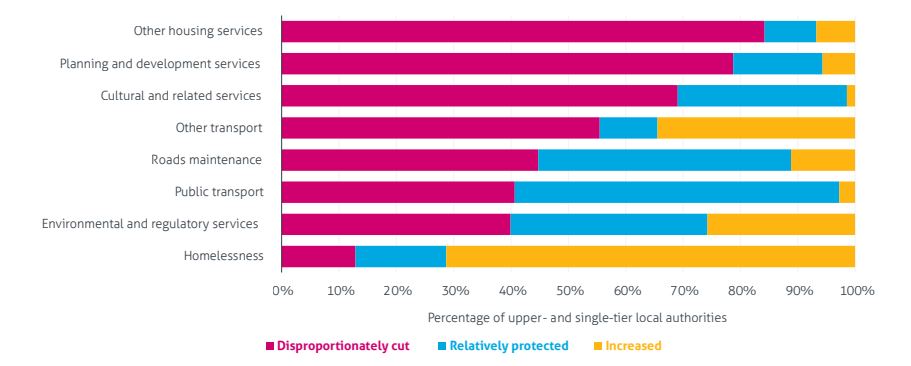
The report’s detailed analysis of changes in spending reported to DHCLG concludes that most councils chose to protect similar services.  ‘Relatively protected’ services included environment and regulatory services, homelessness and public transport.  At the other extreme, most councils applied higher than average spending cuts in housing, cultural, and planning services (figure 1 below).  This mirrors earlier analysis by the National Audit Office (which also highlighted the protection of social care services).

Figure 1: Local authorities that disproportionately cut, relatively protected, or increased neighbourhood services spending between 2009/10 and 2019/20, by category

Source: Institute for Government analysis of DLUHC, Local authority revenue expenditure and financing in England: individual local authority data – revenue outturn 2009/10 and 2019/20.

The IfG report hints at the innovative ways different councils responded to these pressures, from contract renegotiation and the use of new technology, to service redesign and rationalisation.  For a more detailed exploration of this, I recommend Alison Gardner’s excellent thesis on how local councils responded to austerity – including strategic asset management, shared services, commercialisation, co-production and demand management.  Whatever methods were used, however, it’s clear that by the second half of the decade of austerity the cuts were no longer into ‘fat’ but into ‘flesh’.

These new findings add to a growing library of research on the effects of the UK government choice to pursue austerity policies, including a BMJ study in October 2021 which suggested that the constraints on health and social care spend during this period of ‘austerity’ have been associated with 57,550 more deaths than would have been expected had the growth in spend followed trends before 2010.  Considering cuts to local government funding specifically, a July 2021 study in The Lancet estimated that cuts in funding were associated with an increase in the gap in life expectancy between the most and least deprived quintiles by 3% for men and 4% for women between 2013 and 2017. Overall reductions in local government funding during this period were associated with an additional 9,600 deaths in people younger than 75 years in England. Well before the pandemic, the UK was seeing a rapid slowdown in life expectancy gains in the 2010s and, although a number of other high income countries also saw such slowdowns, of large populations only the USA experienced a more severe slowdown/reversal and the magnitude of the slowdown in the UK was more severe than other large European populations.

Perhaps the most damning finding of the IfG report is that central government lacks the information to know what the impact of its spending cuts are on local services.  This echoes the assessment of the Nuffield Trust and Health Foundation back in 2014 which warned government was making decisions with ‘no comprehensive way to quantify the impact that social care cuts are having on their health and wellbeing’ and were therefore effectively ‘flying blind’.  Having abolished the Audit Commission in 2010, the government was left with no comparable performance statistics for two-thirds of local services.  Some may believe that this was quite convenient, given what we are now learning about the effects of that government’s spending policies.

NHS is a precious resource but this resource is finite

Cllr Ketan Sheth

As another week passes, Covid-19 infections in London have continued to fall. This is extremely encouraging news. After almost two years, I’m sure everyone is keen to start moving forward with their lives and moving back as close as we can to the life we knew before the pandemic.

But while the case numbers are moving in the right direction, it was actually some other figures published by the NHS in recent days that I would like to focus on in this blog. In December alone, England’s ambulance services answered more than 925,000 calls to 999. That’s 20% more than December 2020 and means a call came in every three seconds. These are truly incredible numbers, and represents the unwavering commitment and hard work of our emergency services.

London Ambulance Service has told me that as bad as the pressure was for them when Covid first appeared in 2020, 2021 was even more challenging. This might come as a surprise to many people. But as the capital began to open up and all remaining restrictions were removed last July, our health services saw a level of demand never seen before during summer months.

In fact, 2021 was London Ambulance Service’s busiest ever year, receiving a record two million 999 calls. That is simply astounding, and I would like to say a huge and heartfelt thank you to all of the staff and volunteers at London Ambulance Service.

The NHS is a precious resource. But this resource is finite, so we must use it wisely so the sickest and most seriously injured people get care quickly in their hour of need. We can all do our bit to help. It’s important people only call 999 in a life-threatening emergency. Otherwise, we should take a moment and just think about the many alternatives which are more appropriate. For example, please do visit NHS111 online or call 111 if you need urgent medical advice and are not sure what to do. Our GP surgeries and pharmacies are also open and able to help. Urgent treatment centres are there for those needing attention for something which is serious but not life-threatening. Finally, at this time of New Year’s resolutions, I’m sure we could all do more to look after ourselves from eating healthily to getting more exercise. Prevention, as they say, is better than a cure.

The past 22 months have undoubtedly been exhausting and stressful for all of us, but for those caring for the health of 9 million Londoners, perhaps even more so. We owe all those on the front line tremendous thanks for all they have done and continue to do as we emerge from the shadow of the pandemic and another extremely busy winter. But actions speak louder than words. Doing your bit in one of these ways is perhaps the best way to show thanks to the dedicated staff and volunteers working for our NHS.

Cllr Ketan Sheth is Chair of the NW London Joint Health Scrutiny Committee

Let’s Tackle Covid

Cllr Ketan Sheth

The ‘mass vaccination event’ at Twickenham Stadium on the Spring Bank Holiday was a proud day for the NHS and local government. The North West London NHS and Hounslow Council, supported by the Rugby Football Union, pulled off this remarkable day with less than a week to plan, following a surge in Covid cases in Hounslow.

The communications around the event included the obvious routes of national, local and social media, but also included targeted door knocking in Hounslow. During the day, as it became clear that there were likely to be some vaccines left over, the local NHS took the wise decision to open up the offer to anyone aged 18 and over and this was quickly picked up and reported by the BBC, Sky and other media outlets. The result was a huge spike in demand towards the end of the day. By the close, over 11,000 people had been vaccinated – a record for a single day at one venue in the UK. Those behind this effort are to be hugely congratulated.

There are three lessons I think we can learn from this remarkable event. First, it may be a myth that young people don’t want to get vaccinated. Most of those turning up when the offer was extended were under 30. Media reports talked of a ‘festival atmosphere’ and those who attended have confirmed to me that there was a real ‘buzz’ among the young people coming forward. A number of young people turned up with older family members, having persuaded them belatedly that they should be vaccinated. While time will tell, this does suggest that there may be more enthusiasm among younger people for getting vaccinated than had been previously suggested.

Second, and perhaps more contentiously, the quicker we open up to all age groups, the easier it will be to coordinate the vaccine effort. Had the whole day been open to anyone aged over 18, it is likely the demand would have been even higher throughout the day. While the initial targeting of older and more vulnerable people made sense, it becomes harder to justify as we move down through the age groups – and harder for the NHS to coordinate and promote vaccination. We might also want to think about vaccinating people at their convenience wherever they live – while the event was targeted at Hounslow residents and others in the NHS ‘North West London’ sector, I know people from Richmond were not turned away.

Finally, what we can learn is that if everyone pulls together and works as one team, remarkable things can be achieved, even in short space of time. This is a lesson that extends beyond Covid-19 and the vaccination programme – and bodes well for ‘integrated care systems’, in which the NHS and local authorities are expected to work in statutory partnerships in the years ahead.

Cllr Ketan Sheth is Chair of Brent Council‘s Community and Wellbeing Scrutiny Committee and Chair of NW London Joint Health Overview & Scrutiny Committee 

Big changes to the NHS

Cllr Ketan Sheth

Big changes come into effect this month in the way our local health services are managed. Eight clinical commissioning groups (CCGs), including Brent, have merged into a single North West London CCG. This CCG  will also be working with every hospital, mental health trust, community trust and local authority in North West London as part of an ‘integrated care system’ (ICS).

People often ask if such changes really matter. My sense is that they really do and that they can be both a risk and an opportunity.

NHS doctors and managers tell me that the benefit to patients is that a single organisation and system can drive a consistent approach to high quality services, using data on population health to target improvements and tackle health inequalities. There are huge inequalities across our patch, with outcomes and life expectancy varying widely between the poorest and more affluent areas. We saw this play out tragically during the Covid pandemic, where the least well off, including many people in Brent, were disproportionately affected.

The role of local authorities in the ICS – which is expected to become a statutory body in April 2022 – is also important, as it means we can better join up health and social care services, building them around the needs of our communities by working as a single system.

We also have to recognise the risks. A bigger system across eight London boroughs – North West London will be the biggest CCG and ICS in the country – could easily become far removed from local needs and concerns in each area. We know public input to both health and local council services improve those services. So ensuring a strong resident voice, at both borough and North West London level, is going to be critically important.

So too is local decision-making. I am pleased that the single CCG will have strong borough-based teams – and particularly, that the intention is to create a local ‘integrated care partnership’ (ICP) between all part of the NHS and the council in each borough. While this may sound like lots of new jargon and bureaucracy, it is important. The balance of power between the ICS and the local ICPs will be important: ICPs should be setting the local agenda with their residents while the ICS steers the overall direction of travel for the system.

On balance, the changes feel like the right thing to do – residents often complain that services don’t work together closely enough. But the success of this latest NHS reform will really depend on all of us. If we can ensure that the local systems work and play their part in driving down health inequalities across the whole area, there should  be huge benefits for North West London. If we lose local voice and influence in a sprawling, centralised bureaucracy, we will have failed.

Cllr Ketan Sheth is Chair of the Community and Wellbeing Scrutiny Committee of Brent Council