The abolition of NHS England 

Councillor Dr Ketan Sheth,

We all recognise that the current government inherited a deeply entrenched crisis in our NHS. Years of austerity, coupled with the immense strain of the Covid pandemic, have left our health service at breaking point. Across the country, patients are facing unacceptable delays — whether in A&E, for a GP appointment, or for much-needed elective procedures. The Health Secretary, Wes Streeting, has not shied away from the truth, acknowledging that the NHS is ‘broken’. But with this recognition comes a clear responsibility to act. The commitment to investment and reform was at the very heart of the Labour government’s manifesto, and it is now our duty to ensure these promises become reality.
The three fundamental shifts outlined by Wes — focusing on prevention rather than cure, strengthening community-based care over hospital reliance, and embracing digital innovation — are undeniably the right priorities. 

These are not new challenges; they are the very issues that those of us in local government and health services have been highlighting for years. With Tom Kibasi now leading the development of the NHS’s Ten-Year Plan, there is a real opportunity to turn ambition into action. But make no mistake — this will require more than just vision. It demands political will, cross-sector collaboration, and real investment to drive lasting change.

As a councillor with deep experience in health and social care, and as Chair of a London joint health scrutiny committee, I firmly believe that elected representatives — both national and local — must have clear oversight of how the NHS delivers for our residents. The NHS is funded by the taxpayer, and accountability for its spending —amounting to hundreds of billions —must be transparent. Striking the right balance between strategic oversight and operational efficiency is key. Reducing duplication and inefficiencies between national bodies is a sensible goal, but only if it genuinely results in better care, not just headline-grabbing restructuring.

Earlier this month, the government announced that, in order to focus resources on the frontline, NHS England would be abolished and funding to Integrated Care Boards (ICBs) would be cut by half. There is a logical argument for streamlining management functions where the Department of Health and NHS England overlap. Equally, we cannot ignore the vast NHS deficits that must be tackled if we are to clear the backlog left by the previous government. Cutting costs without compromising frontline care is an extraordinarily difficult balancing act, and success will hinge on empowering local decision-making rather than imposing one-size-fits-all solutions from Whitehall.

But now we must address both the handling and the substance of these decisions.

First, the handling. The people working in NHS England and ICBs are dedicated professionals, many of whom have spent their careers serving our health service. These are individuals with expertise, commitment, and families to support — not faceless bureaucrats. It is entirely possible to debate the structure of public services without resorting to derogatory language, labelling roles as ‘flabby’ or dismissing people as ‘blockers and checkers’. That is why it was reassuring to see Wes take to the airwaves to make a crucial clarification: the target is excessive bureaucracy, not the people who keep our NHS running.

On substance, the proposal to merge the functions of NHS England with the Department of Health is a bold and potentially transformative step — but only if executed properly. Addressing duplication in management is a legitimate goal, yet we must not underestimate the sheer complexity of NHS operations. The government must ensure that what replaces NHS England’s oversight role does not become another layer of top-down control. If local government is to have greater freedoms to shape healthcare services, these must be real and meaningful, not simply a rebranding exercise where old centralised structures persist under new names.

We must also keep our focus on tackling the stark health inequalities that persist in our communities. This means:

• Reducing waiting times for GP appointments and elective procedures.

• Strengthening hospital discharge pathways to ensure patients receive the care they need at home.

• Investing in public health initiatives to drive prevention and early intervention.

• Engaging meaningfully with local communities, in line with the NHS’s statutory duty to involve them.

• Managing winter pressures effectively and ensuring higher vaccination uptake.

While we await the publication of the Ten-Year Plan, which we hope will provide clarity on these pressing issues, one thing is certain: this government must not just explain why these changes are necessary, but prove to the public how they will lead to tangible improvements in their daily lives. The NHS is more than an institution; it is a national treasure, built on the principle that healthcare should be available to all, free at the point of use.

This moment is an opportunity — a chance to build an NHS that is fit for the future. It will take determination, investment, and an unwavering commitment to those who rely on it every day. Let’s not waste it.
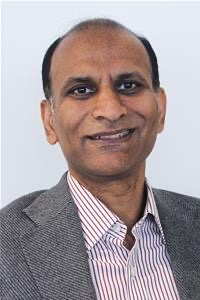
Cllr Ketan Sheth chairs the North West London Joint Health Scrutiny Committee

Transforming Maternity Services in Brent

Councillor Dr Ketan Sheth

Each year here in Brent, we welcome almost 4,000 newborns into the world at Northwick Park Hospital’s maternity department. Each birth is the start of an exciting journey for new parents and families, who should all have confidence that they will receive safe, effective, compassionate maternity care that focuses on their individual needs.

Sadly, across the country, this has not always been the case. A quick online news search reveals that NHS maternity services have not always performed to an acceptable standard, with disparities in care especially for women from Black, Asian, and minority ethnic groups. The hard truth is that poor quality maternity care puts the safety and well-being of women and babies at risk.

An inspection by the Care Quality Commission in 2021 raised concerns about the quality and safety of maternity services at Northwick Park Hospital. I am delighted to say that in the years that have followed that inspection, Brent’s local government scrutiny committee has been working with the NHS leadership to ensure the service improves and staff have been working tirelessly with the National Maternity Safety Programme to turn things around for the 3,700 births there each year.

The maternity department recently celebrated opening its newly refurbished triage and birthing centres. Whilst this investment in new modern facilities is welcome, it is positive cultural change that is by far the biggest ingredient in the service transformation. There is a new senior management team and a commitment to listening to local women through the Northwick Park Maternity and Neonatal Voices Partnership, which is chaired by local mothers.

This has resulted in a raft of changes, including a special area for women who need to have an induced labour and a specialist midwife to support them. Obstetric nurses are on-hand to help women who have caesarean birth to recover quicker, and seven community midwifery teams have been set-up, three of which are in Brent. A new LifeStart trolley has also been introduced to look after newborn babies who need extra support, while keeping them close to their mothers. Antenatal care for women at risk of gestational diabetes has improved too.  

These substantial improvements, and many others besides, have led to the maternity team being taken off NHS England’s special measures. Indeed, the maternity service at Northwick Park Hospital was deemed the most improved of all trusts in a recent National Maternity Patient Survey

Transformation like this does not come about easily; it requires passion and the commitment from the local government and NHS working in partnership to continually deliver the best care possible for women, babies, and families. 

Tomorrow and every day, around ten babies will be born at Northwick Park, and each mother will have different needs. I wish them all the very best, safe in the knowledge they can expect personalised, safe, and compassionate care.  

Cllr Ketan Sheth chairs the North West London Joint Health Scrutiny Committee

REASONS TO BE HOPEFUL – HOW THE GAP IN LIFE EXPECTANCY BETWEEN ENGLISH REGIONS WAS NARROWED

Nicholas Hicks and Jon Bright

In this blog, we discuss a major success in health policy that’s been largely forgotten.

What happened?
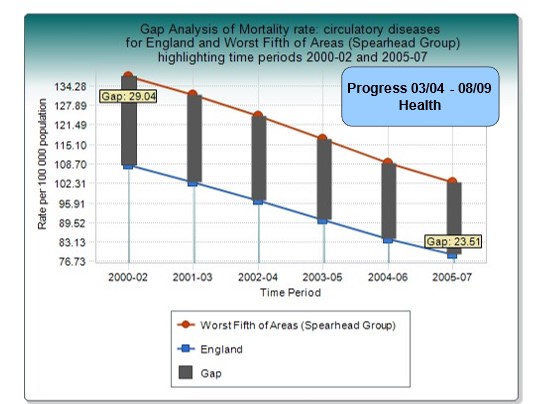
During the 2000s, a government strategy to tackle health inequalities in England led to a reduction in geographical differences in life expectancy. Furthermore, this success reversed a trend that had been increasing. It was achieved by reducing death rates caused by coronary heart disease.


The chart below shows an overall reduction in coronary heart disease mortality and a reduction of nearly 20% (19.07%) in the gap between the national average and the poorest areas. [Barr et al 2017]


This is the only period in the last 50 years when inequalities in death rates between rich and poor have narrowed. It was a considerable achievement and an historic result.

What was the impact in terms of lives extended?
This policy meant that many millions of people lived longer and healthier lives. Much of the benefit was probably due to reductions in smoking and managing risks such as high blood pressure and cholesterol. In 2000, 38% of the adult population smoked and smoking was twice as common amongst those on low incomes. Today, only about 13% of the adult population smoke, the lowest since records began.

But this achievement was not down to health policy alone. Importantly, it was also due to coordinated action across Government to tackle inequalities more generally. This is because many of the factors that affect health lie outside the health sector.

What were the policy drivers?
This work started in 2000 with the NHS Plan (that committed Government to publishing inequality targets), and the Department of Health’s National Service Framework for Coronary Heart Disease, and continued over several years.

These policies led to a national commitment to reduce inequalities. In the wake of the NHS Plan, the Government set Inequalities targets and incorporated them into national Public Service Agreements (PSAs). These Agreements required central government Departments to do better in those parts of the country where outcomes were poorest. This applied not only to health but also to low income, family functioning, education, employment, and crime. These wider issues are major influences on people’s health and targeted action on these made it more likely that health-specific interventions would succeed.

PSAs defined the goals of the 2002 and 2004 Comprehensive Spending Review. Departmental budgets were only agreed once each Department produced credible plans showing how they would contribute to the inequality targets.

What did all this mean in practice for people living in poorer regions?
Health-specific interventions included smoking cessation clinics; improving the distribution of GPs – many disadvantaged areas had no GP service; more resources for disadvantaged areas; national guidance on best practice; and improved access to mental health services. Action to tackle the wider causes of poor health included improving housing (the Decent Homes Standard); increasing household income (the Minimum Wage, Tax Credits); investment in education and skills; reducing the number of young people not in education, employment and training; teenage pregnancy prevention; and investment in early years (Sure Start and family support).

This approach is consistent with Prof Michael Marmot’s conclusions in his 2010 report, ‘Fair Society, Healthy Lives‘ .


What did evaluators find?
Evaluators found that regional inequalities decreased for all-cause mortality and that the strategy was broadly successful in meeting its ambitious targets. Writing in 2017, Barr et al they concluded that ‘future approaches should learn from this experience”. They noted that current policies were probably reversing this achievement of the previous decade. See also Holroyd et al’s systematic review.

In our main paper REASONS TO BE HOPEFUL we discuss the evaluations in more detail.


What lessons should we draw?
There are five main lessons to draw from this evidence:

  1. When Government takes a coordinated approach to a problem – and sticks with it over time – the results can be impressive, even with problems thought to be intractable.
  2. Health is a good proxy for Levelling Up. Narrowing the health gap between regions is a good proxy for ‘levelling up’ more widely. Health inequalities are in large part due to poverty, poor education, and poor housing. Regional inequalities in educational attainment and crime also narrowed.
  3. Leadership and persistence are essential. A ‘whole of government’ approach requires good cross departmental working, full engagement with local government, and leadership from the Prime Minister.
  4. Tackling the nation’s problems needs longer term policy making so successful approaches don’t fizzle out whenever there’s a change of Government. As we’ve seen, benefits achieved up to 2010 may have been lost by 2017. Maintaining progress requires cross-party, long-term collaboration.
  5. This approach worked by influencing mainstream budgets via better targeting and evidence-based interventions, rather than relying only special ring-fenced funding

Today, the big health challenges today are obesity, diabetes and related conditions. Again, poorer populations are much more affected. Will today’s politicians rise to the occasion?

Dr Nicholas Hicks BM BCh FRCP FRCGP FFPH is an Honorary Senior Research Fellow, Nuffield Department of Primary Health Care Sciences at the University of Oxford and a Senior Strategy Advisor, Department of Health and Social Care. He is also an Associate Fellow, Green Templeton College, University of Oxford. He was seconded to the Department of Health Strategy Unit and helped draft the inequalities chapter of the NHS Plan in July 2000 ([email protected]).

Jon Bright is a former civil servant who worked in the Cabinet Office and Department of Communities and Local Government between 1998 and 2014.

References

  1. Meadows D. Leverage points: places to intervene in a system.
  2. NHS Plan. A plan for investment; a plan for reform. Department of Health (2000): 106-7
  3. Health inequalities – national targets on infant mortality and life expectancy – technical briefing . Department of Health March 2002
  4. Spending Review 2002: Public Service Agreements, HM Treasury 2002 para 1.12
  5. Holdroyd I, Vodden A, Srinivasan A, Kuhn I, Bambra C, Ford JA. Systematic review of the effectiveness of the health inequalities strategy in England between 1999 and 2010. BMJ Open. 2022 Sep 9;12(9):e063137. doi: 10.1136/bmjopen-2022-063137. PMID: 36134765; PMCID: PMC9472114.

Keeping an Eye on our Health Providers

Cllr Ketan Sheth

The meetings of the North West London Joint Health Scrutiny Committee, which I Chair, don’t usually set the pulses racing but the recent one was an exception. 

My committee’s job is to keep a friendly but critical eye on how the NHS North West London Integrated Care Board (ICB) delivers its budget of over £4 billion to the 2.4 million population of the eight NW London boroughs.

What made my committee’s recent meeting special was that information had leaked revealing ICB plans for major changes in GP ‘same day’ services, replacing the system of individual practice reception staff passing calls on to GPs with a new system in which far fewer “hubs” would pass 93 percent of calls to other staff, with only 7 percent to be handled by GPs. The ICB had planned to introduce the hubs by April 1 as part of its ‘single offer’ local enhanced service, with practices obliged to sign up to access the funding — effectively mandating the hubs. They were forced to delay by a storm of protest from GPs and our residents.

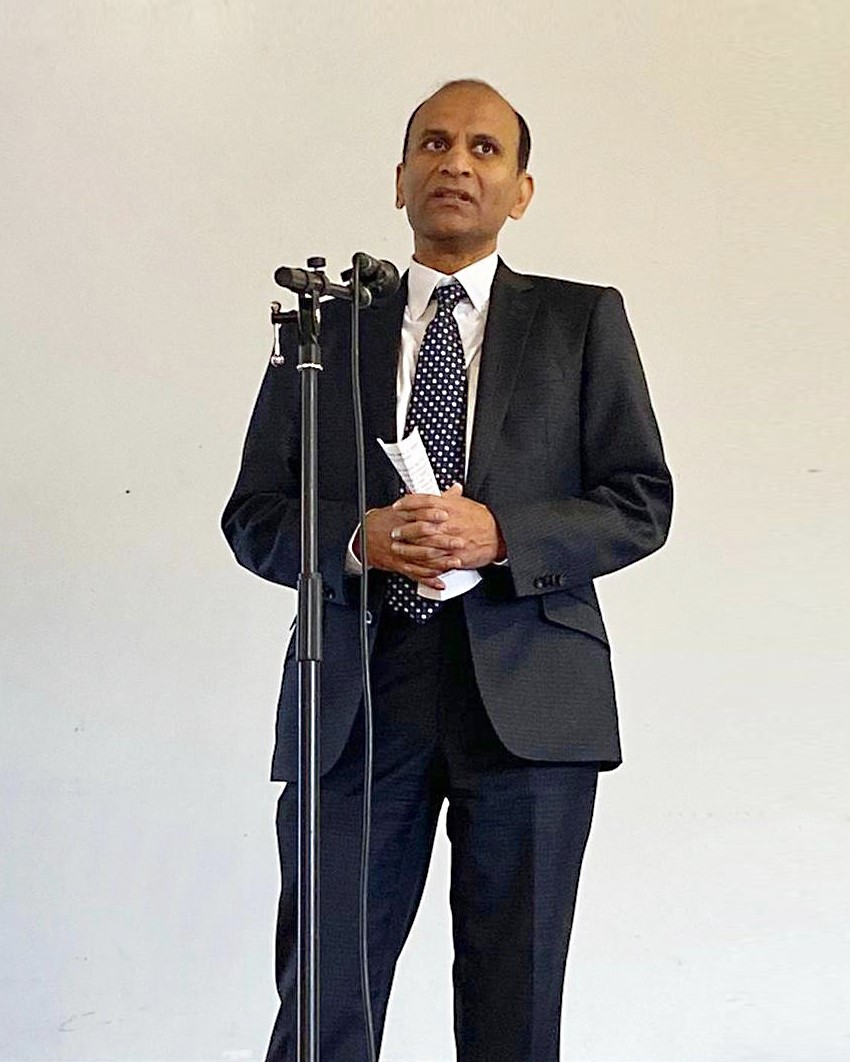
While my committee meetings are held in public, the members of the public aren’t usually allowed to speak at meetings, but on this occasion, I thought it right to ask Merril Hammer, a Hammersmith resident, Robin Sharp, a Brent resident, and Dr Vishal Vala, a local GP, to set the scene.

Merril spoke eloquently about the risks of triage or assessment in hubs by care co-ordinators or others who were not qualified or experienced GPs. The lack of any analysis of the impact on different groups and of proper risk assessment and of any reports from pilots was also of great concern.

Robin stated that Brent Patient Voice had urged patient involvement in any trials when the pilots were first mentioned, but the ICB had failed to listen. What had emerged to be implemented without any consultation with GPs had caused a great surprise and undermined the role of GPs as established since the NHS began.

When members of my committee gave voice to their questions and concerns, there was heavy criticism of the way in which the scheme had been developed by management consultants behind closed doors and without any prior engagement with the local government. There was concern that only long-term patients with complex needs would be referred to their GPs, when practices were made up of patients of all ages with needs that varied from time to time.

The ICB has now apologised for ‘poor communications’, arguing there had been ‘misunderstandings’ about triaging. They now talk of “co-production” with residents and local government at local level. So we look forward seeing the ICB’s plan for this and for wider engagement with the public as a revised scheme is developed.

Cllr Ketan Sheth chairs the North West London Join Health Scrutiny Committee

Photo credit: https://www.flickr.com/photos/popfossa/

The doctor will see you now… or will they?!

Cllr Ketan Sheth

We know our GPs are busy; and indeed, during my visits, I have seen how hard they work — my own doctor is amazing. But I also hear, too frequently, from our residents of their struggles to get an appointment, to use online systems or to see a GP in person.

As a Brent councillor, I chair two health committees — one in Brent, and the other covering the 8 NW London boroughs — and I am proud of our NHS, in this 75th anniversary year, particularly our primary care service.

So, a few days ago, I was pleased to welcome GPs from across NW London to Brent and to hear about some of the changes our local NHS is implementing to help us all get the very best from our GP surgeries.

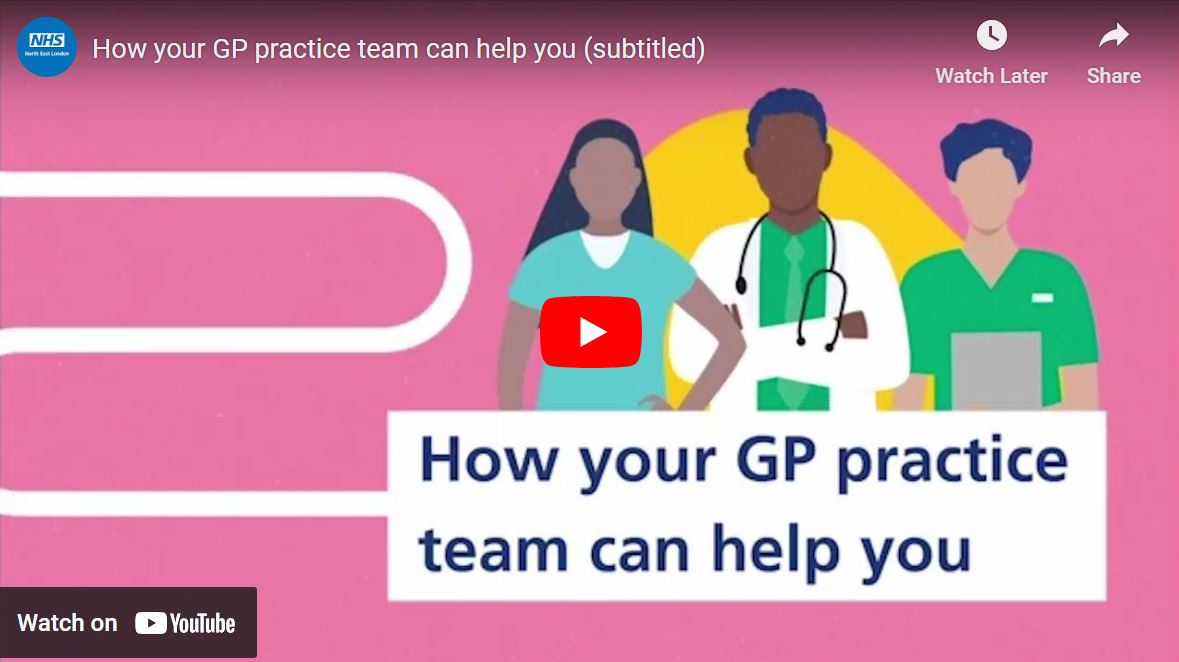
A new campaign from NHS NW London, We Are General Practice, explains the different people who are now working in our GP surgeries. I have met with GPs from across NW London, and they have spoken about how sometimes our residents do not actually need to see a GP — they can see a specialist like, say, a diabetes nurse, a pharmacist, or a physiotherapist. In many places, these people are now working side by side with the GP in the same building which, of course, is fantastic for patients.

Not only does this ease the pressure on our GPs but it means that, as a patient, you will be seen by the best possible person in a timely manner.

Also, what is special about this campaign is how it has used input from our residents. We often hear the phrase “co-produced”.  Well, this is, perhaps, the best possible example of that phrase. The teams in NW London, who are always out and about across the boroughs listening to residents, have taken on board what they have heard and used it to shape, not just the campaign, but the improvements we are beginning to see across our general practices. 

We, in local government, of course, have a part to play. Not only are we more formally in partnership with the NHS locally now but we are all here to support the same people.  The NHS call them patients, we call them residents. And we can all support people navigating their way through services and help with the sign posting and support.

So, my thanks to all those residents who shared their experiences and views on how our health services can improve.

Our GPs, and their teams, do such a lot to keep us all well and I am pleased to see this campaign shine a light on all the people that make up a general practice team.

Cllr Ketan Sheth chairs the North West London Join Health Scrutiny Committee

Thinking about the Earthquakes in Turkey: A Call for Local Democracy

Picture: FCDO/Russell Watkins

Professor Rabia Karakaya Polat

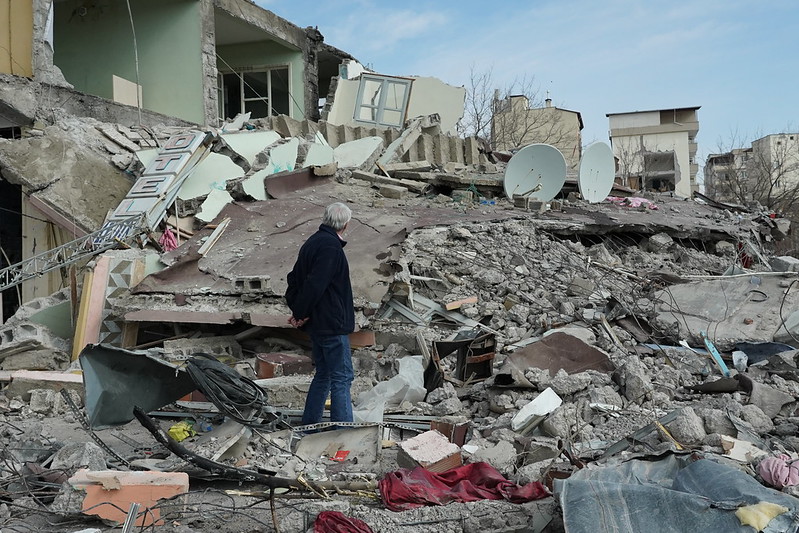
The earthquakes that took place in Maraş province of Turkey on February 6, together with the terrible destruction they caused, also led to the questioning of state institutions and capacity. An important dimension of the subject is the relationship between central and local governments in the country. These earthquakes and what happened afterwards have been instrumental in questioning the overcentralized structure of the state in Turkey[i]. Discussions centered on why the earthquakes were so devastating[ii] as well as the inadequacies in the post-earthquake response[iii].

In Turkey, the authority to issue city planning and zoning permits belongs to the central administration. The authority to carry out urban transformation processes in existing settlements also rests with the Ministry of Environment, Urbanization and Climate Change, which is the relevant ministry of the central government. Therefore, the possibilities of municipalities to make cities earthquake resistant are very limited. The authorities of municipalities, such as controlling and licensing the buildings against earthquakes, are not used effectively enough.

Turkish people have witnessed that the excessively centralized structure also hindered the post-earthquake rescue efforts. It was not possible for local actors to take the initiative and act. The lack of timely mobilization of local capacity increased the loss of life. It is very important that not only local governments, but also civil society mobilize in such crises. However, there was a process in which non-governmental organizations and volunteers carrying out aid campaigns were also targeted[iv]. In a televised speech to the nation, President Erdoğan complained about critical news and declared that he planned to hold critical voices to account. Later, access to Twitter was throttled while rescue operations were still underway. The government claimed that it did so to prevent “disinformation”. Some government actors and their supporters also raised concerns about the extent to which public support and fund-raising has been directed at civil society organizations like Ahbap, rather than the government’s own relief organization, AFAD.

In fact, we have witnessed such challenges to local actors in the face of complex and multiple crises by the central government before. For example, during the coronavirus pandemic, the efforts of the Istanbul Metropolitan Municipality to collect aid were stopped and the donations amounting to 6.2 million liras collected in the bank accounts were confiscated and transferred to the central government bodies[v]. The 3.5 million lira aid collected by the Ankara Metropolitan Municipality was blocked. The solidarity campaigns of municipalities were evaluated by President Erdogan as “the logic of being a state within a state”[vi]. Determining the policies and practices related to the pandemic from a single center instead of being shaped according to local conditions increased the negative effects of the pandemic on the society.

Municipalities were also left alone in the refugee issue, one of the deepest crises Turkey has experienced recently. Even municipalities with a refugee population of up to a quarter of their own population did not  receive a penny of additional support from the central budget[vii]. Moreover, municipalities do not know what to do about refugees, as there is no clear legislation and coherent policy in this area. While the discourse and policy towards refugees shifts from hospitality and religious solidarity to ‘voluntary’ return, municipalities are forced to cope with this uncertainty[viii]. Despite this, they develop and implement creative and entrepreneurial projects in cooperation with civil society to meet the needs of refugees and integrate them into society[ix].

The European Charter of Local Self-Government[x], signed by Turkey in 1992, obliges the parties to implement the basic rules that guarantee the political, administrative and financial independence of local governments. Despite this Charter, which provides for the recognition of the principle of local self-government in domestic legislation and, if possible, in the constitution, trustees appointed from the center serve instead of those elected[xi]. At the local elections on March 31, 2019, the HDP (Peoples Democratic Party) won 65 municipalities in the Kurdish-majority provinces. While six of the elected mayors were not given their certificates of election, trustees were appointed by the central government to 3 metropolitan, 5 provincial, 45 district and 12 town municipalities. While the municipalities are under such tutelage in regions where Kurdish voters are concentrated, a politically motivated judicial process hangs like the sword of Damocles over the head of Ekrem İmamoğlu, Istanbul Metropolitan Municipality’s elected mayor[xii].

Earthquake is one of the realities of Turkey. However, the strict centralist structure and the authoritarian regime, which further increases its negative impact, prevent local initiatives, resilience and solidarity not only in earthquakes but also in all kinds of crises that arise today. Complex crises such as pandemics, mass migration and climate change that we have faced in recent years and will face in the future are far from being problems that a single actor can deal with at a single level. It is not possible to deal with these crises without vertical cooperation between local, national and international levels of government and horizontal cooperation networks between state and non-state actors such as civil society organizations.

Although we can see the damages of over-centralized administration most clearly in times of crisis, the cost of not having resilient and participatory local government that meets local demands is much greater than we think. Local governments cannot be ‘local’ enough because they are financially dependent on the center and because of the arbitrary and partisan practices of the central government. If this earthquake is to be a start, taking big steps to strengthen local democracy should also be a part of it.

Rabia Karakaya Polat is a professor of political science at the Department of International Relations at Işık University (Istanbul). She recently completed a British Academy-funded joint research project, with Prof. Vivien Lowndes, analysing local refugee policies in Turkey. She published numerous articles in journals such as Security Dialogue, South European Society and Politics, Citizenship Studies, Parliamentary Affairs, Government Information Quarterly, Local Government Studies and Journal of Refugee Studies. Currently, she is working on refugee integration policies at the local level.


[i] Cemal Burak Tansel (2020) Reproducing Authoritarian Neoliberalism in Turkey: Urban Governance and State Restructuring in the Shadow of Executive Centralization, Authoritarian Neoliberalism, Routledge, 88-103

[ii] https://www.nytimes.com/2023/02/28/podcasts/the-daily/turkey-buildings-earthquake-construction.html

[iii] https://www.nytimes.com/2023/03/10/opinion/erdogan-turkey-earthquake.html

[iv] https://www.mei.edu/publications/turkeys-government-prioritizing-politics-over-policy-its-earthquake-response

[v] https://www.duvarenglish.com/turkish-govt-confiscated-millions-collected-for-covid-19-victims-by-istanbul-municipality-news-60396

[vi] https://www.al-monitor.com/originals/2020/04/turkey-erdogan-goodness-claims-may-backfire-amid-coronavirus.html

[vii] https://inlogov.com/2021/01/08/no-powers-no-funds-how-municipalities-are-working-creatively-to-address-the-needs-of-syrian-refugees-in-turkey/

[viii] Vivien Lowndes & Rabia Karakaya Polat (2020) How do local actors interpret, enact and contest policy? An analysis of local government responses to meeting the needs of Syrian refugees in Turkey, Local Government Studies, 48:3, 546-569

[ix] Rabia Karakaya Polat & Vivien Lowndes (2022). How does multi-level governance create capacity to address refugee needs, and with what limitations? an analysis of municipal responses to Syrian refugees in Istanbul. Journal of Refugee Studies, 35(1), 51-73

[x] https://rm.coe.int/european-charter-of-local-self-government-eng/1680a87cc3

[xi] https://bianet.org/english/world/259590-council-of-europe-finds-appointment-of-trustees-in-turkey-contrary-to-international-law

[xii] https://www.hrw.org/news/2022/12/14/turkey-court-convicts-istanbul-mayor-ekrem-imamoglu