Voter ID – the warning lights are flashing

Picture credit: https://www.electoral-reform.org.uk/why-the-governments-mandatory-voter-id-plans-are-a-terrible-idea/

Jason Lowther

Previous columns have urged a cautious approach to the introduction of photographic voter ID in England.  The May 2023 elections provided the first nationwide test of the system, and early analyses are highlighting some significant issues. 

Elections took place in 230 areas in England and around 27 million people were eligible to vote.  This week, the Association of Electoral Administrators (the people in councils who actually deliver elections) issued their post-match analysis, highlighting ‘the fragility of the system’ and recommending a fundamental review of the country’s electoral arrangements.   

With less than four months between the enactment of the new legislation and polling day, which included new statutory duties on accessibility as well as voter ID, councils faced a huge and risky task to administer the new system effectively.  They also faced significantly more paperwork, with new forms to track electors unable to vote and new data capture requirements.  The AEA report significant impact on polling officials: ‘many of our members reported POs feeling overwhelmed by paperwork and the time it takes to complete throughout polling day and at the close of poll’.

The AEA report reveals that the government’s website to provide free photo ID to those needing Voter Authority Certificates (VACs) failed to work properly from its launch in January and many functions were still not available by the deadline to apply for a VAC for 4 May poll.  Updates were still being issued two weeks before polling day.  Almost 90,000 people applied for VACs by the deadline, well short of the Electoral Commission’s earlier estimate of 250,000 – 350,000 applications based on the proportion of local election voters who did not have suitable ID.  Many didn’t know they would need one – just over half (57%) of the overall population and those who said they did not already have photo ID were aware of VACs in May, according to the Electoral Commission.

The types of photo ID acceptable under the legislation proved rather esoteric.  Passports are accepted, but what about a passport from Zimbabwe or a British format immigration document?  London Oyster 60+ cards are accepted, but not the Merseytravel Over 60s pass which has similar application checks.  Photo IDs issued by councils themselves, such as taxi licences and gun licences, were presented but could not be accepted. Similarly police warrant cards, NHS and other emergency services photo ID were presented but unable to be accepted.

The Electoral Commission’s interim report on the election was issued on 23rd June.  They found that immediately before polling day, 87% of people in England (excluding London, where there were no elections) were aware that they needed to show photo ID to vote at a polling station – implying that around 3.5 m potential voters were not aware as the poll approached.  Awareness was lowest amongst young people, BME communities, those who haven’t previously voted in local elections, and people who didn’t have the necessary forms of photo ID.

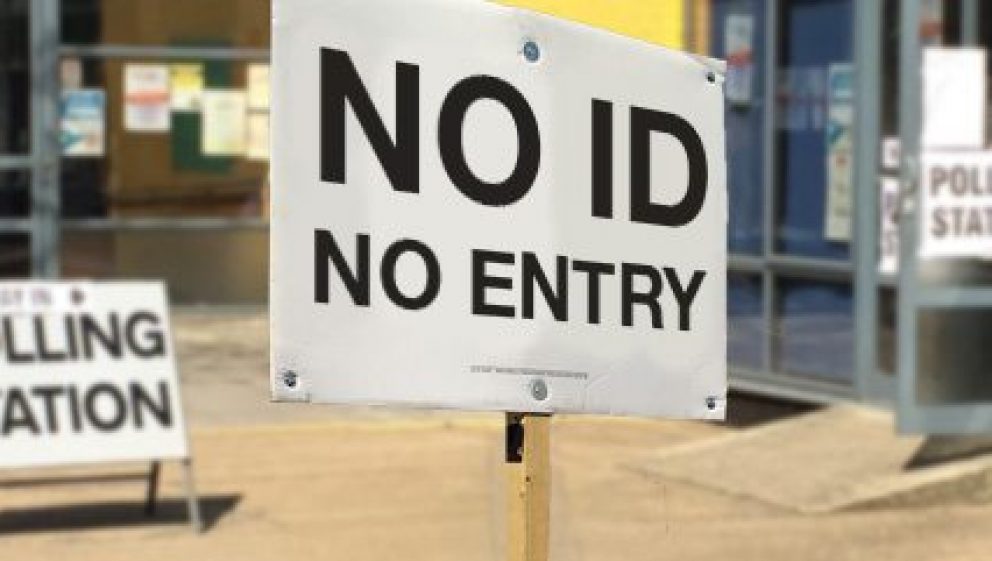
To avoid voters queuing for a ballot paper and being turned away, in some areas ‘greeters’ were appointed to meet electors as they arrived and check whether they had an accepted form of photo ID with them.  Others provided posters and banners to explain the requirements outside polling stations.  Polling stations with greeters recorded a smaller proportion of people ‘turned away’ inside the polling station compared to those without greeters.  As a result of voters receiving advice outside the polling stations, and because of some other data issues, we should treat statistics on numbers of electors unable to vote with caution. Data collected inside polling stations shows that at least at least 0.7% of people (39,000 voters) who tried to vote at a polling station were initially turned away but around two-thirds of those people (63%) returned later in the day and were able to vote.  In some councils more than 1 in 100 electors were turned away.

More worryingly, the Electoral Commission found that 4% of people who said they did not vote in these elections gave an unprompted reason related to the ID rules, and the proportion of non-voters giving an ID-related reason rose from 4% to 7% when survey respondents were selecting from a list of reasons.

It was not possible to capture reliable demographic data on people who were not able to vote because of the ID requirement because electoral law did not allow polling station staff to collect demographic information about individuals who were turned away.  In the EC survey, disabled people and those who are unemployed were more likely than other groups to give a reason related to ID for not voting.

Voter confidence doesn’t seem to have been massively improved.  In fact, the EC found 68% of people were confident that the May elections were well run, compared to 73% in 2022.  For those who said they were not confident, the most common reason selected (by 46%) was that “some people were unable to vote due to the ID requirement”.

We await the Electoral Commission’s full report in the autumn.

Meanwhile, I close with an interesting comment made at the National Conservatism conference on the 15th May 2023 by former Secretary of State for Business, Energy and Industrial Strategy, Sir Jacob William Rees-Mogg:

Parties that try and gerrymander end up finding their clever scheme comes back to bite them – as dare I say we found by insisting on voter ID for elections.  We found the people who didn’t have ID were elderly and they by and large voted Conservative, so we made it hard for our own voters and we upset a system that worked perfectly well.

Jason Lowther is the Director of INLOGOV. His research focuses on public service reform and the use of “evidence” by public agencies.  Previously he worked with West Midlands Combined Authority, led Birmingham City Council’s corporate strategy function, worked for the Audit Commission as national value for money lead, for HSBC in credit and risk management, and for the Metropolitan Police as an internal management consultant. He tweets as @jasonlowther

Oops!  We lost two Mayors – let’s overthrow a sensible system

Chris Game

I assume it was the 2021 mayoral election results that finally clinched it. With the Conservatives winning just two of that year’s 13 mayoralties to Labour’s 11, it was time to enact the party’s 2019 manifesto pledge – “to continue to support the First-Past-The-Post (FPTP) system of voting, as it allows voters to kick out politicians who don’t deliver, both locally and nationally”.  Specifically, the Supplementary Vote (SV) system – despite also, like electoral systems generally, featuring the kicking-out of politicians – had to be replaced for mayoral and Police and Crime Commissioner (PCC) elections asap.

True, the counting of electors’ supplementary – second preference – votes had just enabled West Midlands Conservative Mayor, Andy Street, to be re-elected with the useful perk of a narrow overall majority of votes cast, along with the party’s rising star, Tees Valley’s Ben Houchen, who’d swept in with nearly 73% of first preference votes.

No supplementary second round necessary there, but nor should there have been, reformers reckoned, in Cambridgeshire & Peterborough, where the established Conservative Mayor, James Palmer, had been a victim of the dastardly SV ‘system’. He’d comfortably led Labour’s Nik Johnson after the count of first preference votes – by nearly 18,000 votes or 8%. Yet, by some foul trickery, or possibly because he simply wasn’t as broadly appealing his opponent, after the counting of relevant second preference votes, he’d fallen behind: 48.7% to new Mayor Johnson’s 51.3%.  Despite Government Ministers repeatedly claiming that “the candidate with the most votes” lost, he hadn’t. He’d won – he just wasn’t Conservative.

Anyway, Palmer threw what looked like a wobbly, promptly retired from politics, and SV elections for Mayors and PCCs would be retired with him, though not in time for last May’s Mayorals, which very nearly produced a Croydon re-run of that Cambs & Peterborough result. First count: Jason Perry (Con) 34.8%, Val Shawcross (Lab) 32.7%. Second count: Perry 50.4%, Shawcross 49.6% – the candidate with the leadership-resonant first name just edged it.

By then, though, the FPTP legislation was well under way. The next Mayoral elections – this May – would use FPTP, as will next May’s PCC elections. It seemed a good time for a review of the whole SV lifespan, facilitated by the invaluable statistical records of my polling specialist friend, David Cowling.

Quickish review: the Supplementary Vote is obviously not a proportional system, which would be tricky when electing single Mayors, Police & Crime Commissioners, etc.  Rather, it’s a simplified majoritarian system, enabling voters to rank their two most favoured candidates on the ballot paper in order of preference.

If no candidate gets over 50% of first preference votes on the first count, just the top two candidates continue to a run-off, thereby encouraging candidates from the outset to seek support beyond their core supporter base. The winner may still get less than half the total vote, but will need significantly wider support than under FPTP, and especially under FPTP with a lowish turnout.

Both, however – ultra-topical insert – are more democratic than this past weekend’s Spanish ‘mayoral’ elections, in which Barcelona Mayor Ada Colau, almost certainly the nation’s best-known mayor both at home and abroad, is seeking a third term of office … but as Leader of a two-party socialist coalition – for Spanish mayors aren’t even elected by ‘the people’, but indirectly by fellow councillors.

The name – Supplementary Vote – may have been new when it was ‘invented’ by an early 1990s Labour Working Party, but essentially similar ‘preferential’ systems had been quite widely used internationally for ages. France’s Presidential ‘double-ballot run-off’ was one example, but most obviously there was the Alternative Vote – the actual subject of Winston Churchill’s senseless but oft-recycled quote, about it rewarding “the most worthless votes given for the most worthless candidates” – although today’s Conservative critics have no difficulty unearthing and redirecting it to SV.

I’m old enough to recall lecturing about the SV’s UK ‘invention’ by a Labour Party working party in the early 1990s and the even then revered ‘psephologist’, the late Sir David Butler, getting uncharacteristically incensed about it – calling it “silly”!  But his sphere of matchless expertise was parliamentary elections, with turnouts at the time of consistently over 70%. Even they, though, have slipped a bit since, and well over a third of today’s MPs won less than 50% of their constituency vote, and that’s an awful lot of voters left feeling unrepresented.

Local (including mayoral) election turnouts, however, are proverbially in another ballpark – and this is probably the blog’s key point. Except when they coincide with parliamentary elections, they average around 40%, and that’s on good days. PCC turnouts, unsurprisingly, are significantly lower still – not one of the 39 areas in England and Wales managing even 51% in May 2021, and Durham and Wiltshire not quite achieving 17%.  All of which, under FPTP, will mean large percentages of the votes of the most civically conscientious and politically committed citizens being ‘wasted’ and, arguably even more importantly, the mandates of the elected mayors and PCCs correspondingly diminished.

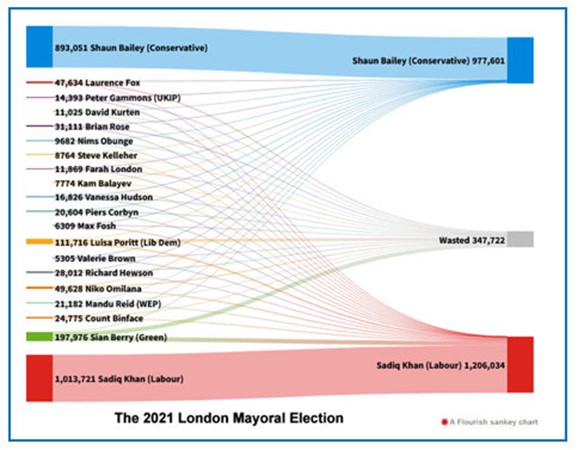
And then there’s the loss of the visual aids – for SV also produces what I only recently discovered are called ‘Sankey charts’, illustrating how the second-round count both produces a winner able to claim a statistical majority of positive votes and a dramatic reduction in the proportion of ‘wasted votes’ – on the part of voters choosing not to make use of their possible second choice. Good, isn’t it!

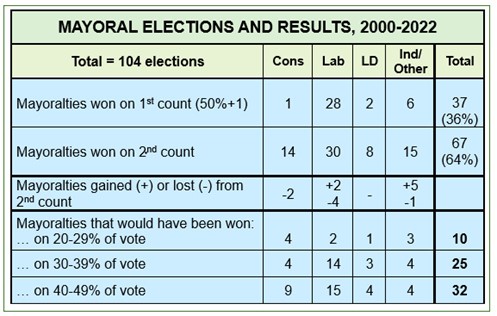
The Supplementary Vote, then, still favours the two main parties, but, returning to recent history and as shown in the following table, one in three of the 67 SV Mayoral elections going to second counts were won by Lib Dems, Independents and other parties. Labour won by far the most mayoral contests, but they also lost most in second counts. All of which contributes to SV hovering around mid-table in global democratic rankings of electoral systems – nothing to shout home about, except when compared with FPTP’s ranking as ‘least democratic’, apart from maybe Djibouti’s ‘Party Block Voting’.

SV’s statistical merits apply in principle to any elections, but particularly to a set in which two-thirds of turnouts were under 50% and nearly a third under 40% (see table). First, it hugely reduces the number and proportion of so-called ‘wasted votes’ – those cast for neither of the leading two candidates – and secondly it ensures that the winning candidate can claim the majority backing not necessarily of all voters, but at least of those the system counted.

My presumptuous guess would be that West Midlands PCC Simon Foster likes knowing, and possibly even mentioning now and then, that he was elected with 53.7% of the vote, rather than 45.5%. And, while I don’t know any of these people, that Surrey PCC Lisa Townsend (one of 12 women PCCs, if you were wondering) definitely prefers her 58% to 33.5%.

Time to start closing, by checking out the arguments Ministers sought to make to justify their replacement of SV with FPTP – or, rather, plundering the critique the Constitution Unit’s Alan Renwick and Alejandro Castillo-Powell made at the time.

  1. That SV increases the number of spoilt ballots – possibly, very fractionally; but, if so, why not work on improving ballot paper design?
  2. It allows ‘loser candidates’ to win – stupid argument (see above); they won the election they were required to contest.
  3. It reduces the accountability voters have in expressing a clear choice – but increases it by saving them from calculating how best to cast their single vote ‘tactically’ to elect or defeat a particular candidate.
  4. “FPTP is the world’s most widely used electoral system.”  Tricky – needs its own separate blog; also a bit silly. Depends a bit on whether you mean number of countries or number of voters. India, Pakistan, Bangladesh and the US give FPTP a head start. More to the point, a 650-Member legislature isn’t the same as a single elected mayor or PCC.
  5. SV is an “anomaly … out of step’ with other elections in England.” True, it was decisively rejected in the 2011 referendum for the election of MPs, but these are the country’s only public elections to executive offices. In short, they’re completely different.  

None of which, of course, stands the remotest chance of influencing, never mind changing, anything … but it was quite enjoyable to ‘research’ and write!

Chris Game is an INLOGOV Associate, and Visiting Professor at Kwansei Gakuin University, Osaka, Japan.  He is joint-author (with Professor David Wilson) of the successive editions of Local Government in the United Kingdom, and a regular columnist for The Birmingham Post.

Picture credit: Theresa Thompson at www.flickr.com/photos/theresasthompson/

Voter ID – in theory, practice and mirrors

Picture credit: https://www.electoral-reform.org.uk/why-the-governments-mandatory-voter-id-plans-are-a-terrible-idea/

Chris Game

“ID cards for polls are nothing more than suppression of voters” – D Butler. I’d forgotten precisely when and where I first read this pronouncement – May 2021 in The Times, as it turned out – shortly after the Government’s Elections Bill, now Act, was published. But I certainly remembered it.

Partly the phrasing, as personally I’d have gone for “nothing less than”, if I was hoping to galvanise readers into outraged protest. The seriously striking bit, though, was obviously the author.

Since first becoming fascinated by elections and electoral studies – thanks initially to Prof Richard Rose at the Univ of Manchester, then the late Prof Tony King at Essex – there has only ever been one D Butler in that file of my academic consciousness. Populariser of the Greekish word ‘psephology’ for the study of elections, and original authority figure in the BBC’s General Elections coverage: Nuffield College, Oxford’s Sir David Butler, who died earlier this month, aged 98.    

I knew him – distantly, but sufficiently to know he’d never have uttered anything resembling that strongly opinionated opening sentence – and, of course, ’twas not he. Rather, as I almost immediately realised, it was Dawn Butler: recent candidate for Deputy Labour Party Leader and, it so happens, MP for the London Brent constituency in which I first voted – shortly before she was born.

All of which might have excused a quickish blog return to the contentious Voter ID issue – within weeks of its last coverage – even if it hadn’t once more been prominently in the news this past fortnight, with Parliament finally getting its first full sight of the Government’s Voter Identification Regulations and the Electoral Reform Society leading the call for a parliamentary inquiry into its implementation.

The Elections Act requires voters, from next May, to produce photo ID at UK Parliamentary and most English local elections. And now, a mere six months or so later, we – and the local election officials required to implement them – finally have the Government’s list of acceptable forms of ID and proposed guidelines governing initially next May’s council elections: Coronation permitting, in most English councils – though not Birmingham, to save you checking.

The guidelines run to just the 344 pages, taking effect probably in January. Leaving already pressured election officials with minimal time (and as yet undetailed costs, beyond a ‘ballpark’ £180 million per decade) to process and issue electoral identity documents for those who gradually discover they don’t have acceptable forms of photo ID. Plus the near certainty that at least some would-be, and quite likely upset, voters will be turned away at their polling stations – which could add to the fun for the small army of volunteer poll workers.

At which point I should indicate my personal viewpoint. Instinctively – and certainly predating Birmingham’s own 2004 embarrassment of six Labour councillors getting elected through what was judicially described as a “massive, systematic and organised” postal voting fraud campaign – I’ve long broadly supported, in principle, stronger election integrity rules in general and photo voter ID specifically.

And I have recounted in these columns the reactions of some of my overseas students to the frankly casual ID confirmation procedures they’ve observed when accompanying me to the polling station. Their surprise at the staff’s indifference to whether I’ve brought my poll card identification; and almost shock as I ‘helpfully’ point on the register to what I claim is my name and address.

So why my support in principle for photographic ID – as well as nowadays that of a substantial majority of voters themselves and the conditional backing of the independent Electoral Commission?  Simples!  Elections are the engines of our democratic system. They should be seen by all as important, and that perceived importance is diminished by not having visibly more robust voter identification procedures – like virtually all other ‘democratic’ nations.

On the Crime Prevention Research Center’s database of Europe’s nearly 50 such countries, “only the United Kingdom” does not require government-issued photo voter ID to vote in national elections.

Correction!  Not the UK, just GB. Northern Ireland introduced voter ID nearly 20 years ago, and now has numerous forms of acceptable photographic ID – including, as well as passports and driving licences, a free Electoral Identity Card, plus senior, disabled and blind persons’ ‘SmartPasses’.

Since when, the Electoral Commission has found that, far from prompting polling day protest riots, voters’ confidence that elections are well-run has steadily increased to at least match the levels in other UK regions[1]. The demonstrable message has been not that we elsewhere in the UK are uniquely virtuous and trustworthy – though even Ministers concede that fraud levels are minimal, if not invariably seen as such. Rather, it’s that for us – and successive Governments – voting has been seen as less big a deal than, say, collecting a parcel at a post office.

Until now, that is, following a decade of quite dramatic change in the voting behaviour of particularly our 18 to 24-year-olds. Their turnouts are invariably lower than the average, but still high enough to hurt. In the 2010 General Election these mostly fledgling voters split equally across the Conservatives, Labour and Lib Dems, roughly 30% for each. By 2019, almost overlooked in the Conservatives’ overwhelming win, it was Labour 52%, Conservatives 28%, Lib Dems 11%.

That’s what evidently prompted the rush – not ‘personation’ or fraud, which for polling station voting are acknowledged as negligible. Rather, a possible early General Election campaign in which the Conservatives don’t start way ahead of the field. It also explains why the apparently generous range of 21 acceptable forms of ID is clearly weighted towards the better paid and over-60s. Older Person’s Bus Pass, Oyster 60+ card, Freedom Pass (66+), Scottish National Entitlement Card (60+), etc. – all welcome. Those particularly applicable to younger people, like Student ID cards or Railcards, remain “unacceptable”, as in the original legislation.

Yes, as in Northern Ireland, free ‘Voter Authority Certificates’ will be available – including online – and a public awareness campaign will remind you and your selfie to apply in time.  And no, none of this remotely approaches the legalised voter suppression we saw in some of this November’s American state elections. But – to coin a dreadful cliché – it’s from the same partisan playbook.

As are the £1.3 million-worth of 40,000 mirrors and privacy screens – one of each per polling station – that desperately cash-strapped councils must provide to check on would-be voters with religious face coverings. But they may well prove worth a blog of their own sometime before next May.

_______________________

A slightly publisher-edited version of this blog appeared in The Birmingham Post, 17th November – https://www.pressreader.com/uk/birmingham-post/20221117/textview


[1] Examples from the Electoral Commission’s ‘Winter Tracker’, Jan/Feb 2022:

   “Elections are affected by fraud/corruption?”  Total agree: 37%; W Midlands 37%; NI 30%.

Those “not confident that elections are well run: Some people have difficulties registering to vote”:                                          
Total agree: 20%; W Midlands 18%; NI 10%.

Chris Game is an INLOGOV Associate, and Visiting Professor at Kwansei Gakuin University, Osaka, Japan.  He is joint-author (with Professor David Wilson) of the successive editions of Local Government in the United Kingdom, and a regular columnist for The Birmingham Post.

Is Government Giving Value For Money?

Jason Lowther

When money is short, how we spend it becomes even more important. As central government reheats its arguments for austerity following the chaos of the last few weeks, I’ve been reflecting on the contents of the 2021 budget (just a year ago).  The 2021 budget set out not just spending plans, but also a souped up approach to measuring outcomes and cost-effectiveness of government spending. How are these playing out, and will they survive the No 10 merry-go-round?

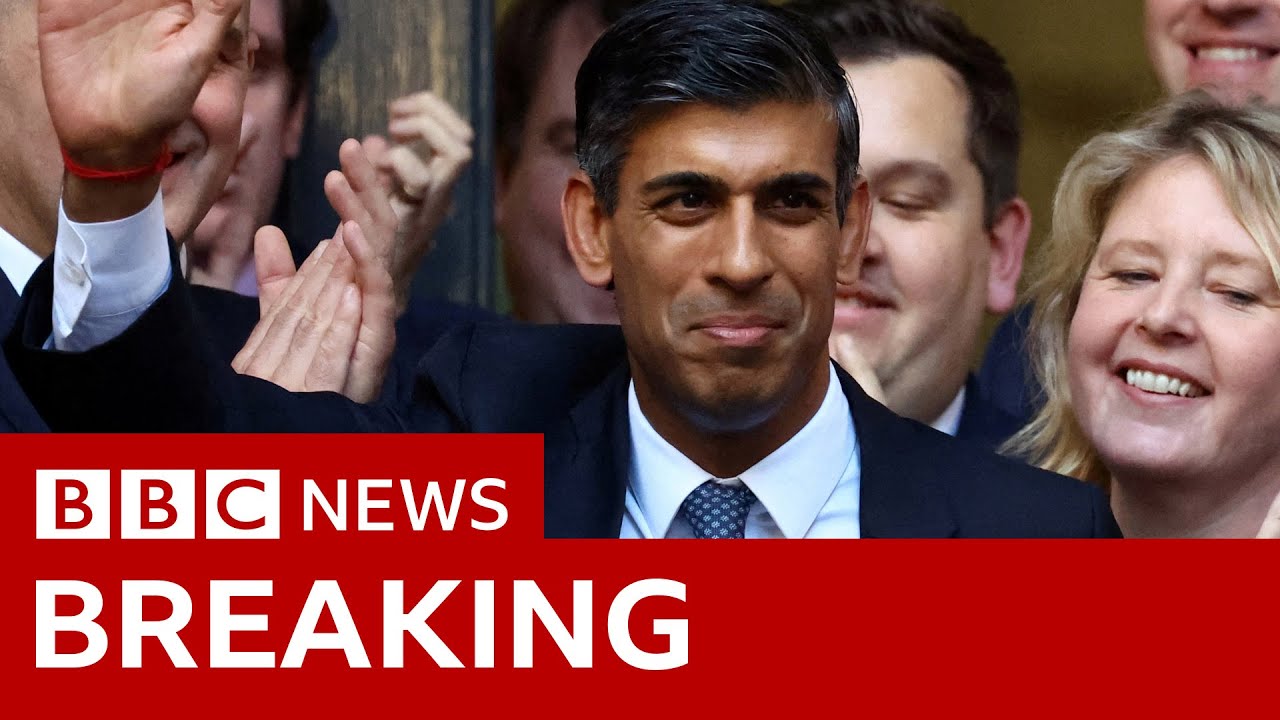
Rishi Sunak, then eight months into the job as Chancellor, noted that government borrowing was relatively high after the pandemic, warned of the public finances’ exposure to rises in interest rates, and outlined how spending was being linked to the delivery of outcomes alongside across the board ‘efficiency savings’:

The fiscal impact of a one percentage point rise in interest rates in the next year would be six times greater than it was just before the financial crisis, and almost twice what it was before the pandemic…

Decisions have been based on how spending will contribute to the delivery of each department’s priority outcomes, underpinned by high-quality evidence. The government has also taken further action to drive out inefficiency; SR21 confirms savings of 5% against day-to-day central departmental budgets in 2024-25. (page 2)

The “priority outcomes” are the latest in a long line of attempts to prod government spending into delivering effectively on political priorities, rather than blindly increasing/decreasing by x % compared to last year.  A 2019 report from the Institute for Government helpfully outlines many of these earlier initiatives (summary from the House of Commons Library) including:

  • “Scrutiny programmes” and the Financial Management Initiative (FMI), introduced under Thatcher.
  • The Cabinet Office and Treasury set up the Financial Management Unit (FMU) in 1982 to help with creating plans under the FMI.
  • The “Next Steps” report, published in 1988, which recommended the establishment of executive agencies to carry out the executive functions of government.
  • Tony Blair’s administration developed a greater focus on performance targets and Public Service Agreements (PSAs) which put these targets on a formal basis.
  • In 2001, Blair’s government also set up the Prime Minister’s Delivery Unit (PMDU), which was intended to coordinate PSAs and bring them under more central control.
  • Under the coalition government in 2010-15, PSAs were abolished and replaced with Departmental Business Plans (DBPs). These shifted the focus from targets to actions – in other words, they listed what each department would do and by when, rather than what they sought to achieve.
  • Under the Conservative government in 2016, DBPs were renamed to Single Departmental Plans (SDPs), which were themselves renamed to Outcome Delivery Plans (ODPs) in 2021. According to the NAO, SDPs (and by extension, ODPs) are supposed to be “comprehensive, costed business plans”.

As well as having to write down what outcomes they want to achieve, and how they will know whether that is happening, under the SDP system departments were also required “to assess progress in delivering their priority outcomes [and] … share regular performance reports with HM Treasury and the Cabinet Office”. 

In the 2021 spending review, the departmental outcomes were spruced up to reflect the (now last-but-one) PM’s five priorities of levelling up; net zero; education, jobs and skills; recovering the NHS; and reducing the volume and harm of crime.  

This blog’s audience may be interested in “Where does local government fit in this compendium of key priorities?”  The answer is a little depressing: on the last line of the last page (page 30 of 33), just before the devolved government departments. The relevant outcome is inspiring enough: “A sustainable and resilient local government sector that delivers priority services and helps build more empowered and integrated communities”, albeit with the reassuringly non-SMART measure that “the department will provide narrative reporting on progress for this outcome”.  Of course I exaggerate, because local government has critical inputs to very many of the earlier outcomes too, but it’s hard not to conclude that local services and communities were not yet at the top of the ministerial attention list.

Will the “priority outcomes” survive the whirlwind of ministerial movements and unforced economic missteps?  After the last seven weeks, I’m not going to make predictions – but we should know in the next month, and alongside the financial figures they could be our best hint yet on where a Sunak government is heading.

Picture credit: https://www.youtube.com/watch?v=Du_6mRV8Hm8

Jason Lowther is the Director of INLOGOV. His research focuses on public service reform and the use of “evidence” by public agencies.  Previously he worked with West Midlands Combined Authority, led Birmingham City Council’s corporate strategy function, worked for the Audit Commission as national value for money lead, for HSBC in credit and risk management, and for the Metropolitan Police as an internal management consultant. He tweets as @jasonlowther

Voter ID gets Code Red

Picture credit: https://www.electoral-reform.org.uk/why-the-governments-mandatory-voter-id-plans-are-a-terrible-idea/

Jason Lowther & Chris Game

‘Code Red’, for anyone even approaching the generation of this blog’s more senescent author, has to cue the memorable final Tom Cruise/Jack Nicholson courtroom scene in Aaron Sorkin’s film, A Few Good Men. Indeed, said author has actually adapted and used it previously in these very columns:

Lieut. Kaffee (Cruise): “Did you order the Code Red?”  Col. Jessup (Nicholson): “YOU’RE GODDAMNED RIGHT I DID!!!”

In the film, ‘Code Red’ is a term used for any extra-judicial punishment or action taken against US marines for the purposes of humiliation or worse. Its function is, essentially, to deal with issues that can’t be solved using the normal legal framework.

In substantial contrast, the UK Government’s Code Red, though hardly a regular feature of our media’s political reporting, is at the very core of our modern-day governmental system. It is a (arguably the) key instrument of the Infrastructure and Projects Authority (IPA), the Government’s centre of expertise for infrastructure and major projects, reporting to the Cabinet Office and HM Treasury.

Formed in 2016, the IPA’s intended function is to increase government efficiency and save public money by monitoring and ‘scoring’ the viability of its literally hundreds of infrastructure and major projects … and does so with an effectiveness that has some Ministers in the present Government viewing it as more of a PI(the)A.  

This already substantial introduction does have a local government-relevant point – promise!  And it is no blog’s function to deliver lecturettes, which in this instance are both available and well illustrated, from the Institute for Government and the IPA itself in its very recent 2022 Annual Report.

What follow, therefore, are a few shortish paragraphs outlining the IPA’s work, and two graphics from that 2022 Report worth, if not the proverbial thousand words, certainly a good many. We then focus on the issue of voter ID in England, reporting the government’s own assessment on the risks involved, and conclude that Government has still not yet shown how voter ID will operate in England without adversely affecting certain minority and disadvantaged groups.

The focus of the IPA’s work is the Government Major Projects Portfolio (GMPP), comprising this year 235 projects with a total Whole Life Cost of £678bn and estimated “monetised benefits” of £726bn, delivered by 18 departments and their arm’s-length bodies.

The projects are divided functionally into four categories, biggest-spending being Infrastructure & Construction (70 projects: £339 bill. whole life cost; £356 bill. “monetised benefits”) – high investment projects, including improving the UK’s energy, environment, transport, telecoms, sewage and water systems, and constructing new public buildings. Dominated financially, and in the IPA’s ‘unfeasible’ delivery confidence rankings, by the Dept for Transport’s HS2 (£72 – 98 billion) and Crossrail (£19 billion+) projects.

Transformation and service delivery covers projects changing ways of working to improve the relationship between government and the UK people, and harnessing new technology. Example: Vaccines Task Force.

Military Capability ispretty self-explanatory. Example: the Future Combat Air System – clever, mid-2030s stuff like uncrewed aircraft and advanced data systems.

ICT projects enable the “transition from old legacy systems to new digital solutions” to equip government departments for the future. Example: Emergency Services Mobile Communications.

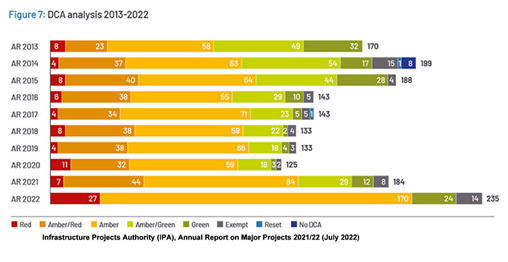
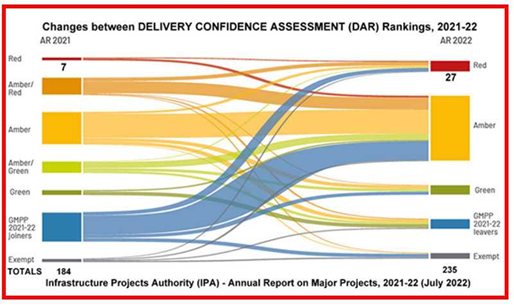
Now to the interesting bit: the actual ‘confidence rankings’, or in the above cases of HS2 and Crossrail ‘no confidence rankings’. The official term is Delivery Confidence Assessments (DCAs): judgements of the likelihood of a project delivering its objectives to time and cost.

In essence, it’s a basic traffic light system. Green represents high likelihood of successful delivery of the project on time, budget and quality; amber: successful delivery feasible, but significant issues already exist, requiring management attention; and ‘Code Red’: unachievable, not a cat in hell’s chance; major issues everywhere, with project definition, schedule, budget, benefits – all at this stage apparently irresolvable.

Given the variables involved, it sounds more than a touch crude, and two additional ratings were added: amber/green – successful delivery probable, if given constant attention; and amber/red – successful delivery doubtful, major risks apparent in numerous key areas, urgent action needed.

Usefully added, it seemed, as unqualified amber regularly took between 40% and 50% of ratings (see Fig.7 below). But no, looked at another way, the “average project rating worsened from Amber/Green in 2013 to Amber in 2020” (p.16). It obviously couldn’t possibly be the quality of the proposed projects, so it had to be the assessment system, which accordingly for the 2022 assessments was changed.

But oops! The number of red assessments nearly quadrupled, almost equalling the previous four years’ red totals between them – but that’s OK, because the average project rating, we are assured, “has improved over the past two years”, though it’s not entirely transparent in the second flow chart.

Which brings us back to Code Reds.  Unlock Democracy, the democratic reform campaign group – and also the Daily Mirror – reported last week that “the Government’s own rating system has given the Elections Bill implementation a code red, which is defined as successful delivery of the project appear[ing] to be unachievable.”  Followed by the Association of Electoral Administrators announcing that it “no longer believes it is possible to successfully introduce Voter ID in May 2023.”

The Government’s “Electoral Integrity Programme (EIP)” has been red rated in the IPA’s annual report (see page 58).  The report summarises the Programme as ‘implementing changes arising from the Elections Bill. The Elections Bill makes provision about the administration and conduct of elections, including provision to strengthen the integrity of the electoral process. Reforms will cover: overseas electors; voting and candidacy rights of EU citizens; the designation of a strategy and policy statement for the Electoral Commission; the membership of the Speaker’s Committee; the Electoral Commission’s functions in relation to criminal proceedings; financial information to be provided by a political party on applying for registration; preventing a person being registered as a political party and being a recognised non-party campaigner at the same time; regulation of expenditure for political purposes; disqualification of offenders for holding elective offices; information to be included in electronic campaigning material’.

DLUHC’s commentary on this result noted the deteriorating assessment and added: ‘The IPA Gate 0 Review of February 2022 concluded that the programme Delivery Confidence Assessment is rated Red and that the programme needs to address key risks related to the suitability of the structure, approach and governance given its complexity and delivery focus, suitability of its minimum viable and digital products, and its lack of contingency to deliver against immovable deadlines’.

Reassuringly, the department felt that ‘the programme is addressing these points’.   Meanwhile, the estimated ‘whole life costs’ of the programme jumped from just under £120m to over £145m.

Unlock Democracy’s Tom Brake has reportedly written to Levelling Up SoS Greg Clark saying ‘It would be highly risky to attempt the first roll out of photo voter ID for the largest election in the UK, without having tested it on lower turnout elections beforehand’.  This echoes Jason Lowther’s comment on this blog almost a year ago that ‘The Government has not yet shown how voter ID will operate in England without adversely affecting certain minority and disadvantaged groups.  Until issues such as costs and access are fully addressed, it needs to proceed with caution’.

Chris Game is an INLOGOV Associate, and Visiting Professor at Kwansei Gakuin University, Osaka, Japan.  He is joint-author (with Professor David Wilson) of the successive editions of Local Government in the United Kingdom, and a regular columnist for The Birmingham Post.

Jason Lowther is the Director of INLOGOV. His research focuses on public service reform and the use of “evidence” by public agencies.  Previously he worked with West Midlands Combined Authority, led Birmingham City Council’s corporate strategy function, worked for the Audit Commission as national value for money lead, for HSBC in credit and risk management, and for the Metropolitan Police as an internal management consultant. He tweets as @jasonlowther

‘The Great Parliamentary Resistance’ – some of the outcomes

Chris Game

Back in early February, I wrote a blog dissecting one of two big and controversial Government Bills involved in what I slightly hyperbolically termed the “historic Monday evening of the Great Parliamentary Resistance” – Monday, 17th January, when the Elections Bill received its Third Commons Reading, while across the way the Lords were savaging the ‘flagship’ Police, Crime, Sentencing and Courts Bill by defeating the Government a Parliamentary record 14 times in the same sitting[1].

Both Bills, in being big and controversial, were fiercely contested throughout their Parliamentary progress and significantly amended – to the extent that my initial idea of highlighting and summarising such amendments in two linked blogs in, say, February and March, proved ludicrously unrealisable. Not least because neither received their Royal Assent until 28th April.

On the ball, as ever, Jason Lowther blogged immediately about the particular aspects of the now Elections Act with which he had been particularly concerned – the Government’s ‘solution’ to the undemonstrated ‘problem’ of ‘personation’, of having in future to show counter-signed photo ID at UK Parliamentary and English local and PCC elections.

This single blog, therefore, will attempt two ludicrously daunting tasks: (a) to at least mention some of the additional, less publicised, measures in or out of the Elections Act, and (b) similarly, but even more summarily, for the considerably more complex Police, Crime etc. Act.

There were two key and particularly controversial Elections Act proposals, that went down to the proverbial wire at the so-called Ping pong stage of the Parliamentary process (pp.79ff. of the H/Commons Library briefing noted by Jason).

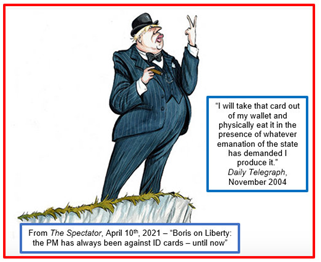
First, obviously, the several proposed age-discriminatory and non-photographic forms of ID that had been in and out of the Bill throughout – mentioned again here frankly as a pretext for reminding anyone who needs it of just how long and how implacably opposed the PM himself has been to ID cards of any description, and accordingly what we can presumably look out for come Election Day.

election1

The other long-running dispute concerned the Act’s provision for the Government to set a “strategy and policy statement” for the constitutionally independent Electoral Commission.  Some suspicious Parliamentarians suggested this might go beyond scrutiny and accountability, and “potentially into providing guidance about how [the Commission carries out its] functions on a day-to-day basis”.

They wanted it “not bound by” the Government’s “statement”, but apparently they were guilty of a “mischaracterisation” of the Government’s intentions, and the relevant amendments were defeated.

The Government’s listing of the Act’s additional benefits appears, of course, on the relevant Gov.UK page – summarised under the comfort blanket of the several “greater protections” it provides for voters, and also for candidates and campaigners.

Protection from fraud through photo ID, of course, but also from intimidation at the ballot box – the latter by fines, up to 5-year bans, and even imprisonment for offenders convicted of attempting an extended definition of ‘undue influence’.

Voters with disabilities must in future be provided with specialist equipment, and may be accompanied by an adult.  And the 15-year limit on the voting rights of British ex-pats, retired or working abroad, will be removed. An estimated 3 million potential voters are currently affected by the limit, and – read into this what you will – it fulfils a pledge in three recent Conservative manifestos.

Finally – although it was actually the first bit of the legislation I blogged about, back last April – the Act will change the voting system for both Mayoral and Police & Crime Commissioner elections from the ‘transferable’/choice-extending Supplementary Vote to First Past The Post – on the basis of “no other plausible argument” than it might fractionally reduce the numbers of rejected ballots”.

I have views – as doubtless do Mayors Tracy Brabin (Lab – West Yorkshire), Ben Houchen (Cons – Tees Valley) and Andy Burnham (Lab – Greater Manchester), all recently elected after transfers – but not here.

And so to the Police, Crime, Sentencing and Courts Act – a real pantechnicon of a Bill/Act, highly technical in places, with even the ‘short’ and definitely the ‘long’ (150-word) titles signalling how impossible it is seriously to summarise.

It makes major changes across the criminal justice system, significantly extending police powers and the treatment of suspected, arrested, charged and convicted offenders. Again, there is a substantial (100+ pages) Commons Library summary of the whole legislative process; also a detailed House of Lords account – presented, slightly disconcertingly, in reverse chronological order – covering the fate of at least some of the Lords’ 17th Jan. amendments.

I was never keen on listing Wiki on student reading lists, but in this case I might well make an exception.  For this blog, though, I have borrowed (sounds so much better than plagiarised!) the content of the next few paragraphs from the BBC’s summary –mainly because it focuses, as many of those Lords motions did, on the implications for and threats to the right to protest.

Until now, it has generally been the police’s responsibility, if they want to restrict a protest, to show it may result in “serious public disorder, property damage, or disruption to the life of the community” (emphasis added). They can also change/restrict the routes of marches. For major events, like the COP26 protests, details are typically agreed with the organisers weeks in advance.

The new Act enables particular measures to be designed for ‘static protests’, like those of Extinction Rebellion, whose modus operandi is to force governmental action on the “climate and ecological emergency” through non-violent civil disobedience, the occupation of roads and bridges, etc.  Start and finish times and noise limits will now be set, even for protests involving just one person, with fines up to £2,500.

Edward Colston, the C18th merchant/slave trader whose statue was pushed into Bristol docks gets his own clause, with damage to memorials earning up to 10 years’ imprisonment.

Shadow Home Secretary Yvette Cooper has described the “rushed” legislation as creating “incredibly widely drawn” powers …”, allowing the police to stop and search anyone in the vicinity of a protest, including passers-by, people on the way to work and peaceful protesters.”

The Government/Home Office/Police viewpoint is set out in a Home Office Policy Paper.

[1] It appeared on 4th February, at the start of what proved a particularly active blogging month, with the consequence that, to access it, you may need to key ‘Older Posts’ at the end of the February 2022 selection.

Photo

Chris Game is an INLOGOV Associate, and Visiting Professor at Kwansei Gakuin University, Osaka, Japan.  He is joint-author (with Professor David Wilson) of the successive editions of Local Government in the United Kingdom, and a regular columnist for The Birmingham Post.