Empowering Communities: How Councils Can Boost Wellbeing Amid Austerity

Alice Munson

This is the first of two blogs resulting from this year’s INLOGOV undergraduate summer intern project, which examined how councils can boost wellbeing amid austerity. This first article summarises some of the key literature, the second article (next week) will explore practice examples.

In a period characterised by fiscal austerity, local governments confront major hurdles in providing basic services while working with tight resources. Spending cuts have far-reaching consequences for communities, frequently having a negative impact on the public’s well-being and standard of living. In response to these issues, community initiatives have arisen as viable mechanisms for minimising the harmful effects of austerity policies whilst also promoting community belonging in neighbourhoods. This paper will begin with a literature review surrounding the topic, examining studies that have demonstrated the impact of community initiatives.

This article starts with a literature review examining the potential for community initiatives to achieve wellbeing outcomes, emphasising how councils may successfully collaborate with communities to reduce the negative effects of budget cuts in an age of permanent austerity. Since the 2008 global financial crisis, several nations have undertaken austerity measures that have considerably impacted local government finances and services (Lowndes and McCaughie, 2013). This ‘age of austerity’ has caused councils to reassess their approach to providing public services and ensuring community well-being (Hastings et al., 2015). In response to the spending, councils can and, on occasion, have turned to community initiatives as a possible way to preserve or improve wellness within the community.

Research consistently demonstrates that community-led initiatives can effectively address service gaps resulting from austerity measures while enhancing local decision-making practices and overall community well-being. Crisp et al. (2016) believe that community-led alternatives can assist in addressing service gaps caused by funding reduction. Their research of community-based organisations in the UK revealed that these projects might assist in areas such as employment, training and social care. Evans (2008) and Fletcher-Etherington (2010) also draw attention to the advantages of community-led initiatives, particularly highlighting enhanced decision-making procedures. Building on this concept, Fung and Wright (2003) provide further empirical support through their examination of participatory governance cases. Their research demonstrates that including the community in the decision-making process can result in more successful and fair policy results, which are more likely to improve the community’s general well-being.

Community initiatives are vital for improving public health outcomes, with research consistently showing their positive impact on physical and mental well-being. There is a strong link between community initiatives, social capital, and health outcomes, as revealed in various studies. For example, Kawachi and Berkman’s (2000) research provides compelling evidence that social connections, cultivated through community efforts, are associated with better physical and mental health. This link between community involvement and health is further explored in specific contexts, such as mental health initiatives. Knifton et al. (2010) investigated community-based mental health programs in Scotland and found that they have the potential to reduce stigma, increase social support, and improve access to mental health services. Moreover, South (2015) offers a comprehensive guide to community-centred approaches to health and well-being, emphasising the crucial role of local government and the NHS in supporting these initiatives. South’s research underscores the importance of integrating community-led approaches into broader health and social care strategies, highlighting how such integration can lead to more effective and sustainable health outcomes for the community. Strong partnerships between the council and the community, along with insights from studies like Kawachi and Berkman (2000) and Knifton et al. (2010), are crucial in this process. These studies underscore the value of community-centred approaches in improving public health and suggest that policymakers and health professionals should prioritise integrating community initiatives into mainstream health and social care strategies to promote positive well-being outcomes.

Community initiatives provide significant economic and environmental benefits, offering viable solutions for councils to improve well-being within financial constraints. Imbroscio (2013) has found in many cases that locally-driven community initiatives can create more sustainable and equitable economic outcomes compared to top-down approaches. Krasny and Tidball (2009) examined community-based environmental initiatives. They discovered that these programs not only benefited local ecosystems but also promoted social learning and community resilience. These findings are consistent with a growing global trend in communities engaging in environmental stewardship (Bennett, 2018). Examples include community-based conservation and locally managed marine areas, which have emerged in sectors such as fisheries, forestry, and water management (Berkes, 2004). This shift recognises that community initiatives can address environmental concerns while also building social connections and, therefore, well-being.

Asset-Based Community Development (ABCD) has emerged as a transformative approach to community well-being initiatives, emphasising the inherent strengths and resources within communities. McKnight and Kretzmann (2005), pioneers of the ABCD approach, argue that sustainable community development must start with recognising the capacities, skills, and assets of local residents and their associations. Their work emphasises the importance of mapping community assets as a starting point for development initiatives. The methodology is driven by community members and focuses on harnessing the inherent strengths and assets of individuals, associations, and communities to promote social change (Mathie, 2003). ABCD represents a shift from traditional deficit-based approaches to community development. Instead of focusing on needs and shortcomings, ABCD emphasises the existing strengths and resources within a community. This approach is based on the principle that every community, regardless of its challenges, possesses a wealth of assets that can be mobilised to address local issues and enhance overall well-being. The effectiveness of ABCD relies on several key mechanisms. Harrison (2019) highlights the importance of building strong, trusting relationships within the community as a fundamental aspect of this approach. These relationships form the foundation for cooperation and collective action, which are essential for the success of community initiatives. Additionally, Harrison emphasises the role of reciprocity and accountability among community members in sustaining engagement and ensuring that initiatives are both community-driven and beneficial. While ABCD is fundamentally community-driven, the role of local authorities in supporting and facilitating this approach is crucial for its success.

Local authorities play a pivotal role in nurturing and sustaining ABCD initiatives through strategic support and facilitation. Forrester et al. (2018) identify several key strategies local authorities can employ. These include participating in appreciative inquiry, which is asking positive, strength-based questions to identify and build on community successes. Local authorities can also build social capital by developing networks of connections, which are critical for community resilience and well-being. Furthermore, sponsoring local economic initiatives can assist in establishing long-term economic prospects while improving general community well-being. ABCD emphasises empowerment. According to García (2020), empowering people in the community to identify their own assets and skills can help local authorities to establish long-term community initiatives. This empowerment boosts self-efficacy and gives community members a stronger sense of ownership and duty. ABCD’s success depends greatly on a supportive and trustworthy atmosphere. Harrison et al. (2019) observe that when community members feel supported and trusted, they are more likely to actively participate and contribute to the success of community efforts. ABCD offers a promising approach to community development by focusing on the positive aspects of communities rather than their deficiencies. This strengths-based approach can lead to more sustainable and impactful outcomes. However, it is important to recognise that the success of the ABCD relies heavily on the presence of a supportive environment and the active involvement of local authorities. Local authorities must adopt a facilitative role, providing necessary support and resources and allowing community members to lead (Forrester et al., 2018). ABCD represents a paradigm shift in community development, offering a promising framework for sustainable well-being outcomes when effectively supported by local authorities and embraced by community members.

Alice has recently graduated from the University of Birmingham with a first class degree in Policy, Politics and Economics. She was awarded the Jane Slowey bursary in her final year for her research on the Homes for Ukraine scheme. Alice is currently seeking further opportunities and can be contacted at [email protected]

References

Berkes, F. (2004) Rethinking community-based conservation. Conservation Biology, 18(3), 621–630. doi:10.1111/j.1523-1739.2004.

Forrester, G., Kurth, J., Vincent, P., & Oliver, M. (2018) Schools as community assets: an exploration of the merits of an Asset-Based Community Development (ABCD) approach. Educational Review, 72(4), 443–458. doi:10.1080/00131911.2018.1529655.

Fung, A. and Wright, E.O. (2003) Deepening democracy: Institutional innovations in empowered participatory governance. Verso.

García, I. (2020) “Chapter 4 Asset-Based Community Development (ABCD): core principles”. In Research Handbook on Community Development. Cheltenham, UK: Edward Elgar Publishing. doi:10.4337/9781788118477.00010.

Harrison, R., Blickem, C., Lamb, J., Kirk, S., and Vassilev, I. (2019) ‘Asset-Based Community Development: Narratives, Practice, and Conditions of Possibility—A Qualitative Study With Community Practitioners’ Sage Open, 9(1). doi:10.1177/2158244018823081.

Hastings, A., Bailey, N., Gannon, M., Besemer, K., and Bramley, G. (2015) ‘Coping with the Cuts? The Management of the Worst Financial Settlement in Living Memory’. Local Government Studies, 41(4), 601–621. doi:10.1080/03003930.2015.1036987.

Henderson, C., Evans-Lacko, S. and Thornicroft, G. (2013) ‘Mental Illness Stigma, Help Seeking, and Public Health Programs’. American Journal of Public Health, 103(5), 777-780. doi:10.2105/AJPH.2012.301056.

Imbroscio, D. (2013) ‘From Redistribution to Ownership: Toward an Alternative Urban Policy for America’s Cities’. Urban Affairs Review, 49(6), 787-820. doi:10.1177/1078087413495362.

Kawachi, I. and Berkman, L. (2000) ‘Social cohesion, social capital, and health’. Social epidemiology, 174(7), 290-319.

Knifton, L., Gervais, M., Newbigging, K., Mirza, N., Quinn, N., Wilson, N., and Hunkins-Hutchison, E. (2010) ‘Community conversation: addressing mental health stigma with ethnic minority communities’. Social psychiatry and psychiatric epidemiology45, 497-504.

Kretzmann, J. P. and McKnight, J. (2005) Discovering community power: A guide to mobilising local assets and your organisation’s capacity. Evanston, IL: Asset-Based Community Development Institute, School of Education and Social Policy, Northwestern University.

Local Government Association (2023) Working with housing association ‘Bolton at Home’ to reduce unemployment and deprivation – Bolton Council. Available at: https://www.local.gov.uk/case-studies/working-housing-association-bolton-home-reduce-unemployment-and-deprivation-bolton (Accessed: 20 July 2024).

Lowndes, V. and McCaughie, K. (2013) ‘Weathering the perfect storm? Austerity and institutional resilience in local government’. Policy and Politics, 41(4), 533-549.

Mind (2024) 5 ways to wellbeing. Available at: https://www.mind.org.uk/workplace/mental-health-at-work/five-ways-to-wellbeing/ (Accessed: 21 July 2024).

New Local (2024) Re-occupying Union Street: How we built back our neighbourhood. Available at: https://www.newlocal.org.uk/case-studies/re-occupying-union-street/ (Accessed 13 June 2024).

NHS Providers (2024) Co-production and engagement with communities. Available at: https://nhsproviders.org/media/698572/co-production-health-ineq-1e.pdf (Accessed: 25 July 2024).

Nudge (2024) Local love, local jobs, local spend, local change. Available at: https://www.nudge.community (Accessed 12 June 2024).

South, J. (2015) A guide to community-centred approaches for health and wellbeing. Project Report. Public Health England / NHS England.

Stirchley Baths (2024) https://stirchleybaths.org (Accessed: 22 July 2024).

Trup, N., Carrington, D. and Wyler, S (2019) Community hubs Understanding survival and success, Available at: https://www.powertochange.org.uk/wp-content/uploads/2019/07/Hubs-Report-FINAL-120719.pdf (Accessed: 24 July 2024).

Zilch for timing, but this Resolution Foundation report is important

Chris Game and Jason Lowther

If you wanted some serious reader attention for something West Midlands local governmenty, you really, really wouldn’t have chosen this past November. The war in Gaza was seriously hotting up, there were the COP 28 talks in Dubai, Christmas was coming, and Aston Villa were en route to becoming the Premier League’s “foremost home team”, whatever precisely that means.

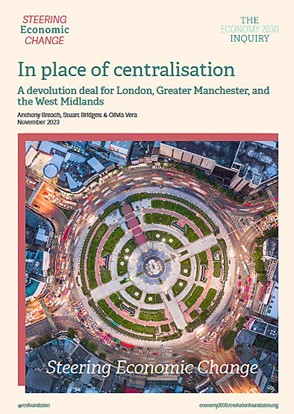
Serious distractions, but competition for headlines was only part of the challenge facing the Resolution Foundation’s early November release of its In Place of Centralisation report setting out a proposed and far-reaching Devolution Deal for London, Greater Manchester, and the West Midlands. There were other diversions and potential confusions too.

It was barely a month since Birmingham City Council – the principal West Midlands local authority involved in this proposed ‘Devo Deal’ – had issued not one but two Section 114 notices, reportedly declaring itself doubly “bankrupt”, unable to meet the Council’s financial liabilities relating to Equal Pay claims and an in-year financial gap within its budget, and handing over its governance to Communities Secretary Michael Gove’s appointed Commissioners.

And, if that wasn’t potentially complicating enough – for those directly affected as well as onlookers – in that same previous month representatives of the West Midlands Combined Authority (WMCA) had ratified the “Deeper Devolution” aka “Trailblazer” deal announced in the Chancellor’s March Budget.

That deal, comparable to that agreed by Greater Manchester back in March, but relatively little of which we’d heard in the meantime, would devolve more powers to ‘Metro-Mayor’ Andy Street (or, given the May Mayoral elections, potentially his successor), the 30 WM local authorities (7 met boroughs, 4 unitaries, 19 districts) and their 6 million population, and simplify funding arrangements, with £1.5 billion to spend on long-term infrastructure projects and services such as transport, skills, housing and regeneration.  A key element is a single block grant negotiated with the Government, like a central government department, as part of next year’s Spending Review.

Key ‘highlights’ include:

  • A ‘landmark’ housing deal worth up to £500 million, offering greater flexibility to drive brownfield regeneration and funding to deliver “affordable housing at pace”;
  • Greater control over local finance, including retention of an estimated annual £45 million of business rates for the next decade [hold on to that version of ‘local financial control’!];
  • Up to six ‘levelling up zones”, backed by £25-year business rate retention, with an estimate total value of at least £500 million, to target investment and encourage regeneration in areas agreed with the Government;
  • Measures to tackle digital exclusion, including greater influence over high-speed broadband investment across the region and a £4 million fund to get more people online.

In anywhere other than one of the most centralised governmental systems in the developed world, describing this package as ‘trailblazing’ would be wildly OTT. Here, though, it was rightly welcomed as constituting serious devolutionary progress, and Mayor Street, not surprisingly, was enthusiastic, seeing it as “marking the beginning of the end of … the ‘begging bowl culture’ where we must regularly submit bids for various pots of money on a piecemeal basis.”

Here’s the thing, though – well, two things, actually. First, the really rather big thing. The leading West Midlands council in this new ‘Trailblazer’ era is currently, following the issuing of those Section 114 notices, (a) in severe financial straits, and (b) being run until quite possibly 2028 not by elected councillors, but by Lead Commissioner Max Caller, his associate commissioners and political advisors – none of whom have ‘Trailblazing’ as a core part of their brief.

The second and, in Birmingham’s current circumstances, almost other-worldly thing, is the Resolution Foundation’s In Place of Centralisation report which is, incidentally, not the first RF report to be covered in these pages. It’s other-worldly too in the sense that it’s just one, albeit important, product of a bigger, wider-ranging academic project: The Economy 2030 Inquiry – a Nuffield Foundation-funded collaboration between the Resolution Foundation, an independent think-tank, and the LSE’s Centre for Economic Performance.

UK economic growth is their primary project – not boosting local democracy – one persistent obstacle to the attainment of which they identify as “the decades of underperformance of the big cities of Manchester, Birmingham, and more recently London” – the key cause being, they reckon, the centralisation of the British state. No startling news to INLOGOV blog readers, but a contrasting starting point to, say, that of the authors of Trailblazer deals, and their prescriptions go a good deal further.

They start (p.4), unsurprisingly, from a different array of statistics, demonstrating the extreme centralisation of the British state.

Only 5 per cent of the UK’s tax revenues in 2019 were collected by local    government, compared to 14 per cent in France, 23 per cent in Japan, and 35 per cent in Sweden. Accordingly, local government relies ongrant funding, with only 19 per cent of all local spending in the UK funded locally, compared to 37 per cent in the average OECD unitary state.

They concede that “recent advances in devolution have begun to unwind this”, but, following a decade of austerity, significantly further fiscal devolution is required to improve growth without increasing inequality – in the form of a ‘triple deal’ negotiated between the Government and the Mayors of Greater Manchester, the West Midlands, and London as a trio, going “beyond the recent ‘trailblazer’ deals” and into which other mayors would be able to opt in the future.

The core of the triple deal would be fiscal devolution, “which would help to end the centrally-imposed local government funding crisis for the three cities by widening the local tax base, and resourcing improvements in the local economy.” Everyone would be a winner – the mayors, borough and Exchequer all benefiting from a new revenue-neutral fiscal settlement, including (pp.4-5):

  • A local share of income tax receipts, with Greater Manchester and West Midlands keeping a larger share than London;
  • Complete retention of business rates, and control over the ‘multiplier’;
  • A single grant to the mayors distributed on a per person basis;
  • The ability for mayors to reform council tax.

It would then be up to the mayors, in negotiation with the boroughs, to distribute this revenue across local government’s various responsibilities across their city. And in the medium-term?

Well, big IF … but the higher growth in the three cities that would be “likely”, if this fiscal devolution were accompanied by other policy changes, would then translate into higher local tax revenues for the mayors – with, by 2038, Greater Manchester raising between £49 million and £230 million, and the West Midlands between £40 million and £187 million beyond their current level of funding.

That was from p.5 of what is a 64-page report, so there’s a very great deal more explanation and explication. But the key, and hopefully obvious, point of this blog is to enable you, if it crops up in conversation, to disabuse anyone of the notion that the Resolution Foundation’s contribution to this debate is just ‘Trailblazer deals’ writ large.

Our view is that the current local government finance system is bust. Business rates penalise high street shops, the council tax is regressive with hopelessly outdated valuations, and councils spend too much energy chasing central government largesse through competitive funding pots.  Democratically elected councils rely on a begging bowl and lack basic revenue raising powers that are commonplace internationally.  We will be saying more on this as the General Election approaches…

Chris Game is an INLOGOV Associate, and Visiting Professor at Kwansei Gakuin University, Osaka, Japan.  He is joint-author (with Professor David Wilson) of the successive editions of Local Government in the United Kingdom, and a regular columnist for The Birmingham Post.

Jason Lowther is Director of the Institute for Local Government Studies (INLOGOV) and Head of the Department of Public Administration and Policy at the University of Birmingham.

Beyond the Numbers: A Holistic Approach to Section 114 Notices in English Local Government

Dr Philip Whiteman

In English local government, the issuance of a section 114 notice is often perceived as a dire financial omen, signalling a council’s descent into insolvency. While financial stability is undoubtedly a cornerstone of effective governance, it is crucial to recognize that section 114 notices reveal more than just a precarious financial situation. They serve as a beacon, illuminating underlying issues that extend beyond the confines of spreadsheets and budget projections. Either way, the government’s Department of Levelling Up, Housing and Communities (DeLUHC) tends to respond with intervention and the imposition of commissioners to direct the authorities concerned.

The poor financial position of many authorities may be the direct result of years of underfunding by central government and we can expect many more councils to serve section 114 notices, but it would be improvident to assume there are no further underlying causes.

Nottingham City Council’s recent declaration of a section 114 is a clear indication that some authorities are simply folding due to a broken funding formula, but this is not the sole cause of failure in all cases. When looking at other authorities, alternative underlying causes are present. Further examples include:

  • The BBC Panorama programme highlighted how Thurrock Council was rendered bankrupt following a series failed investments in a solar farm, highlighting disastrous procurement practices, lack of accountability, poor governance, and inappropriate delegations to officers.
  • Birmingham City Council’s problems did not emerge overnight and were a culmination of challenges created by a historic equal pay-claim and botched procurement a new IT system, Oracle. Underpinning this was poor financial planning, governance, accountability, and a failing internal culture.
  • Woking Borough Council racked up a deficit of £1.2bn following the building and acquisition of major property portfolio. Against these investments, the authority had acquired loans from the Public Works Loan Board and other local authorities, accumulating debts that it could not service.
  • Liverpool City Council’s woes are not confined to finances. Government commissioners were appointed to Liverpool City Council in June 2021 following a damning Best Value inspection by Max Caller CBE on matters pertaining to poor leadership, unacceptable performance, poor resource management and a failure to engage with citizens.

Government appointed commissioners tasked with overseeing councils in financial distress must adopt a holistic approach, venturing beyond the immediate financial crisis to uncover the root causes of the council’s predicament. This requires a comprehensive examination of the council’s structural framework, external environment, performance management and internal governance practices.

Structural Challenges: A Precarious Foundation

English local governments face a unique set of structural challenges that can hinder financial stability. The relentless rise in service demands, coupled with a funding system that often fails to keep pace, places immense pressure on council budgets. This mismatch between resources and responsibilities can lead to a cycle of overspending and financial strain.

Commissioners must delve into the council’s structural framework, assessing whether the current allocation of resources aligns with the council’s responsibilities. They must also evaluate the effectiveness of the council’s revenue-generating strategies, ensuring they are maximizing their income potential without overburdening residents.

External Factors: Navigating Turbulent Waters

Local governments are not immune to the vicissitudes of the external environment. Economic downturns, shifts in government policies, and natural disasters can all have a profound impact on a council’s finances. Commissioners must assess the council’s vulnerability to these external factors, evaluating its risk management strategies and identifying potential contingencies.

Internal Governance: Cultivating a Culture of Accountability

While structural challenges and external factors can undoubtedly contribute to financial distress, internal governance failures often play a pivotal role. Poor financial planning, inadequate risk assessment, and a lack of transparency and accountability can erode a council’s financial stability.

Commissioners must scrutinize the council’s internal governance practices, ensuring that financial decision-making is sound, risks are appropriately assessed, and accountability is firmly established. They must also foster a culture of transparency, empowering residents to hold their council accountable for its financial stewardship.

A Holistic Approach: Beyond the Financial Storm

In the aftermath of a section 114 notice, commissioners must resist the temptation to focus solely on immediate financial stabilization measures. Instead, they must adopt a holistic approach, addressing the underlying structural, external, and governance issues that contributed to the council’s financial crisis.

By adopting a comprehensive view, commissioners can guide councils towards long-term financial stability, enabling them to deliver essential services to their communities without succumbing to the pressures of insolvency. Only by addressing the root causes of financial distress can we ensure that section 114 notices no longer serve as mere harbingers of financial doom, but rather as catalysts for positive transformation.

Speculating on further interventions

Speculation is precisely that. Estimates vary widely in terms of how many further councils are anticipated declare section 114 notices, but a clear signal of further failures exists:

  • In July 2023, ITV News cited a leaked DeLUHC document which estimated at least 26 bankruptcies over the next two years.
  • The Institute of Government has estimated that 10% of councils are at risk over the next two years.
  • The Special Interest Group of Municipal Authorities (SIGOMA), a representative body for 47 municipal authorities, published a survey in June 2023 which showed that five of their members were at risk.
  • A Local Government Association Survey conducted in November 2023 revealed that almost one in five local authority leaders and chief executives believe that their authority may have to declare a section 114 notice.

Whilst estimates vary, there is evidence that further authorities will become vulnerable to government intervention via the imposition of DELUHP appointed commissioners.  This raises a final question; can the predicted number of authorities realistically be serviced?

Birmingham’s contribution to local government numerology

Chris Game

Right – we, meaning I, must start with a dilemma declaration. How to deal with a major national news item – “Birmingham City Council declares itself bankrupt” – the consequences of which, as a long-term Birmingham resident and ratepayer, will affect you personally and about which in the distant past you might well have been invited to opine seriously and professionally. Yes, carry on being retired and/or pretend you’re still on your hols.

Obviously, I’ve chosen an alternative route, emphasising background and context and stuff that might just provide some clarification, or at least updating.  And, if it seems frivolous, tasteless or just indulgent, I apologise. Blame me, not the editor.

I’ll start, as it’s in the intendedly eye-catching title, with numerology – the study of the hidden, divine or mystical meaning of numbers. Even if you’re not into it, you’ll quite likely have come across ‘angel numbers’, aka ‘lucky primes’ – sequences of digits that supposedly bode well and make you feel good. Or, as the ologists put it, messages from the spiritual universe offering insight, wisdom, and directionality – three-digit ‘lucky primes’ usually including 127, 151, 163, 193, etc.

And which bunch of local government personnel, more than most, could benefit from having such character traits built into their job descriptions? Section 151 Officers, of course; aka Chief Finance Officers (CFOs) – those required by Section 151 of the 1972 Local Government Act to arrange and take responsibility for the proper administration of their local authorities’ financial affairs.

Just check out the numerologists. “The energies of number 1 combined with the vibrations of number 5 … a sign from the divine realm that you need to be strong, act as a leader, and be in control of your future life …” etc. etc.

The only problem being that, with a bit of searching, you can get similar hokum for almost any three- or four-digit number. So, somewhat to my disappointment I admit, no fiddling whatever would have been required of the Office of the Parliamentary Counsel – the people who actually draft our laws – to ensure that these matters would be dealt with by Section 151 of the 1972 Act.  Excepting possibly the Satanic 666, which would make the Act impossibly long anyway, almost any three-digit number would have served.  

I knew this back in 2017, but I’ve habitually kept a vague look-out for any published follow-up from my INLOGOV blogs and admit that I was quite chuffed when a few years ago one was picked up and passed on by Room 151 – the “online news, opinion and resource service for local authority Section 151 and other senior officers covering treasury, pensions, strategic finance, funding, resources and risk …”.

Chuffed too to that, albeit over a lengthier time period than I was envisaging, the broad thrust of my argument of more being on the way has proved to be accurate – a somewhat nerdy argument, admittedly, that can certainly be made even nerdier, but that, for current blogging purposes, can also be tolerably summarised in a few sentences.

So here goes!  If a council’s Chief Finance/Section 151 Officer (forever male, of course, in the 1988 LG Finance Act, although Birmingham’s current Interim Director of Finance happens to be Fiona Greenway) reckons his council’s expenditure is likely to exceed available resources, he issues a Section 114 Notice prohibiting any new spending apart from that funding statutory services and existing contractual obligations. OK, geeks, they’re technically ‘Reports’, not ‘Notices’, but that really, really isn’t the serious issue.

It’s a situation in which things are pretty obviously and publicly getting out of hand – current spending way over budget, reserves virtually exhausted, no imminent solution. The alternative, however, is worse: Section 24 of the Local Audit and Accountability Act 2014, or washing your dirty linen in public – the council’s EXTERNAL auditors appending a Section 24 ‘Recommendation’ to their Annual Audit letter, “copied to the Secretary of State”.

Which may sound chummy, but, I suggested, was “the bullet-shaped chumminess of a Mafia ‘message job’”: very nasty, and rarer even than 114 Notices – historically. Yet – and this is what prompted that 2017 blog – in the space of two months two Section 24s had been issued, to councils at the very extreme ends of the council scale spectrum: the Scilly Isles and Birmingham, the latter’s then Labour Leader, Cllr Sir Albert Bore, describing it as “the most concerning audit letter” he’d seen in his 36 years as a councillor. For the record, though, and without further explanation, that’s the last you’ll read of them in this particular blog.

The distinctions between the 114/24 courses of action were interesting and debatable, but you didn’t have to be a terribly nerdy follower of local government finances to see the probable beginnings of a trend, so it was pleasing to have been reckoned insightful by the serious pros in Room 151. Especially when the trend didn’t gather pace as quickly and widely as I speculated it might.

However, given the way local government finance ‘works’ in this country, particularly under Conservative administrations, it was only going to be a matter of time, and gradually the signals became unmissable – accelerating in quite a big way with (then Lab) Croydon LBC in late 2020, who issued not one but two s114 Notices in successive months, having again failed to balance its budget in the permitted 21 days of grace. Understandably, it prompted a Commons Inquiry by Clive Betts’ ever-watchful Local Government (sorry – Levelling-up, Housing & Communities) Committee.

Slough BC (Lab then, C/LD now) was next in July 2021, despite having been one of eight councils granted “exceptional support” the previous year, as Ministers became increasingly concerned at the adverse publicity generated by threats of councils ‘going broke’.

Come December and Cumbria’s Copeland BC (Lab then, since abolished and incorporated into Cumberland) was reported to be “in Section 114 territory”, but was soon overshadowed by (Lab) Nottingham City Council’s unlawfully diverting cash from what should have been a ring-fenced Housing Revenue Account to ‘General Funds’ – an ‘accounting error’ which personally I found extraordinary, since it’s one of the few bits of tekkie lg finance that even I know. And it dragged on.

2022 saw serious acceleration. In May Northumberland Council (Con)issued a s114 for unlawful expenditure, including allowances paid to the council’s Chief Executive. It was possibly the case generating least sympathy for the beleaguered council, whose elected members and officers went public with their mutual distrust – not the only such example, but probably the bitterest. 

Towards the end of 2022 it became clear how desperate the situation – or at least the search for commissioners available to ’intervene’ – was becoming, as returning Local Government Secretary Michael Gove sought to launch anticipatory “turnaround programmes” short of sending in commissioners – ‘risk-mitigation directions’, in Govester jargon.

Not in time, however, to prevent Croydon LBC (NOC) issuing its third s114 in three years, and Thurrock Council (Con) having the courage/desperation to report that it would require “exceptional support” from Gove’s Department “over a number of years … to stabilise our financial position and give us time to have balanced budgets.”

At which point – after an obviously uplifting Christmas and New Year – “Whitehall officials”, in the person of Jeremy Pocklington, Permanent Secretary of the Department for Levelling Up, Housing and Communities (DLUHC), had the confidence/nerve/effrontery to announce to a Select Committee that even at the time sounded, well, brave.

As reported in The MJ (Jan 10th), “Whitehall officials are not expecting councils to issue further Section 114 notices in the coming weeks … our assessment, looking at the sector as a whole, is that the financial position is sustainable … strengthened by the additional resources made available in the Autumn Statement.”

Apart, that is, from the nine councils within the Special Interest Group of Municipal Authorities (Sigoma) who warned last week that they could issue a Section 114 notice by 2025; Stoke-on-Trent City Council (Lab) that announced this week that it is on the verge of bankruptcy … oh yes, and Birmingham.

Chris Game is an INLOGOV Associate, and Visiting Professor at Kwansei Gakuin University, Osaka, Japan.  He is joint-author (with Professor David Wilson) of the successive editions of Local Government in the United Kingdom, and a regular columnist for The Birmingham Post.

The Jaws of Doom – still relevant a decade on

Chris Game

“Things from the past you’ll never see again”.  I came across a listing of these recently, and they were – well, moderately interesting. More so, anyway, than the accompanying “trends that have unfortunately returned” – pleated skirts, corsets, and structured vests, whatever they were.

The never-see-agains included smoking adverts, bubblegum cigarettes, and rotary push lawnmowers – to which I might easily have added “The Barnet Graph of Doom” as at least a never-expected-to-see-again.

It was a visual aid devised a dozen or so years ago primarily for the councillors of the London Borough of Barnet. It would come, however, to be associated with/appropriated by Birmingham City Council, and something with which some INLOGOV colleagues were so taken that it was discussed and illustrated in these pages not once but repeatedly – by, inter alia, me in May 2012 and January 2013 and the Institute’s then Director and this blog’s progenitor, Catherine Staite, in December 2012 and October 2013. Indeed, as Catherine notes in that second blog, it at least part-prompted an INLOGOV ‘book’ or, more accurately, Discussion Paper.

Impactful at the time, then, but at least not prominently, I presumed, over the ensuing decade. Certainly I, though at best semi-detached from these matters nowadays, was genuinely surprised to be confronted by its reappearance in a recent Financial Times (indeed, its double reappearance). Somewhat less so that it was credited entirely to Birmingham City Council, with Barnet getting, as my mother would have said, nary a mention. Which justifies at least a brief résumé, and for more senior readers a bit of reminiscence.

Some 15 years or so ago the very Conservative Barnet LBC acquired the not entirely flattering moniker of ‘easyCouncil’ – that precise orthography/spelling, though frequently ignored in the media, being arguably the policy’s most appealing attribute. With its stray upper-case C intendedly referencing the easyJet business model that inspired the council’s almost boundless outsourcing drive for no-frills efficiency, it embraced pretty well all services, from reduced-size waste bins and privatised street cleaning to limited ‘personalised’ adult social care budgets.    

Improved and cheaper services were obviously the aim, but senior officers foresaw that the sheer scale of demographic change – more children, more elderly – would in any foreseeable future take up an unmanageable proportion of the Council’s increasingly constricted budget. “No libraries, no parks, no leisure centres – not even bin collections”.  Hence the original Barnet Graph of Doom. The one on the left of the illustration, that is – the other, pleasing if more alarmist one, being a public ‘reminder’ tweeted a few years later, just as the social services budget was seriously taking off as forecast.

The Barnet graph, described at some length in my first blog and more summarily by the Guardian’s Public Services editor, David Brindle, started life as part of first a PowerPoint, later video, presentation used by the Council’s Chief Executive, Nick Walkley, to:

“focus the thoughts of colleagues and councillors …  In five to seven years we get to the point where it starts to restrict our ability to do anything very much else. Over a 20-year period, unless there was really radical corrective action, adult social care and children’s services would need to take up the totality of our existing budget.”

The tone, as Brindle noted, was deliberately alarmist, with the policy making no provision, inter alia, for Barnet’s anticipated rise in income through regeneration schemes. As an illustrative device, though, it was hugely effective. It featured regularly in local government media, and also in presentations by the late Sir Bob Kerslake – then Permanent Secretary at the DCLG, and whose outstanding career in both central and local government was fulsomely recounted following his recent death.

Alarming, yes, but “Where are the jaws?”, I hear you ask – and, of course, there weren’t any, yet. They were Birmingham Council’s contribution when it took the idea over and “simplified/dramatised” it by, as Patrick Butler put it, again in The Guardian, projecting “a ‘budget pressures’ line rising steeply to the top right of the grid, and a ‘grant reductions’ line crashing to the bottom right.”  It featured prominently as a ‘Jaws of Doom Graph’ in the council’s 2013 Budget Consultation document, and could indeed resemble, as Butler suggested, “a child’s depiction of a shark, or crocodile, about to bite its prey. Lunch, in this case, appears to be local government itself.”

In my January 2013 blog I sought to address the question of whether the ‘doom-mongering’ was entirely fair: Were “Birmingham and urban councils generally, or Labour councils, or the country’s most deprived areas, being particularly harshly treated by the government’s grant funding cuts?”

Which, you’ll be relieved to learn, I’ll not be bothering you with here – not least because, as already noted, for the vast bulk of the past decade I’ve personally given these particular ‘Jaws of Doom’ and their graph scarcely a passing thought. Now, though, I wonder whether that’s simply another consequence of a retiree’s detachment from the daily concerns and parlance of local government personnel. Could it be that this is what today’s finance officers jaw about, as it were, down the pub of an evening?

For suddenly there it was, weeks before the journalistic ‘silly season’, and in ‘The Pink Un’ – no, not Norwich City FC’s newsletter, but the albeit self-styled “worldʼs leading global business publication”: “The Jaws of Doom” graph in its original glory, and not once but twice. First, in a kind of editorial intro by Associate Editor, Stephen Bush, commending to readers William Wallis’ “excellent piece … featuring this alarming chart [shown on the right below] about the … ‘jaws of doom’ facing local authorities”.  And then Wallis’ article itself.

As you’d expect, it’s a good summary presentation – that I’d certainly be recommending to students, if I still had any – the thrust of which is that:

 “for more than a decade, local authorities in England have been sacrificing services and staff to what they call “the jaws of doom” – a reference to a graphic produced by Birmingham city council to show worsening budgetary pressures, that resembled a crocodile’s mouth.

Between rising demand for social care and other essential services, and the dwindling funds councils have received to provide these, discretionary spending on everything from libraries to youth clubs has already been eaten up.

Although local authorities won a better than usual financial settlement for 2023-24, 9.4% up on the year before, inflation running at 8.7% is eroding any benefits.”

And, having already well exceeded a thousand words, that’s where I’ll stop … though not before sharing the interesting and, more importantly, interactive graph of Sigoma’s English Indices of Multiple Deprivation also included in Wallis’ article – not new, so doubtless familiar to some readers, but to me unfamiliar, informative (see added results), surprising in places, and, I felt, worth sharing.  It made me (almost) sad not still to be lecturing and so able to play with it in public, as they say!

Chris Game is an INLOGOV Associate, and Visiting Professor at Kwansei Gakuin University, Osaka, Japan.  He is joint-author (with Professor David Wilson) of the successive editions of Local Government in the United Kingdom, and a regular columnist for The Birmingham Post.

Lessons from literature for local government

Professor Catherine Staite LLB, MBA, FRSA

No man is an island entire of itself: every man is a piece of the continent, a part of the main;

If a clod be washed away by the sea, Europe is the less, as well as if a promontory were,

As well as any manner of thy friends or of thine own were.

Any man’s death diminishes me because I am involved in mankind,

And therefore, never send to know for whom the bell tolls;

It tolls for thee.

John Donne

When every week seems to bring news of yet another major failure of governance in a local authority, some members and officers in other councils will be fearful that the same fate will befall their own council before too long, while others will be confident that all will be well for them.

When we look at the notable governance failures that have occurred in recent years, we see a very complex picture. Causes of failure are many and varied, ranging from the absence of the most basic controls to ambitious but risky money-making schemes. Some patterns are visible in all the complexity, including, failure to listen to officer advice, engaging in commercial activities without the requisite skills and knowledge, weak financial controls and opaque decision-making processes.

Councils need both strong rules, about finance and behaviour and strong public service values. Constant vigilance and honest collective self-reflection are vital to ensure that decision makers are independent, transparent, accountable, behave with integrity, have a sense of shared purpose and focus on outcomes. Ask yourself – are our informal and formal governance arrangements fit-for-purpose? If not, where might the weaknesses lie? Look at your structures. Are your Constitution, Codes of Conduct and Standing Orders up-to-date? Is your organizational structure robust? Are your s151 officer and Monitoring Officer on the senior management team and do they report directly to the Chief Executive? Then look at your systems. Are decision making processes clear? Can projects be started without the right sign-off? Can officers exceed their authority without consequences? Last, but by no means least, take a long hard look at organizational behaviour. How do leading politicians and officers respond to being challenged? Is bad behaviour rife but undiscussable?

It’s important to avoid complacency. Most of the members and officers leading and managing councils that have failed to uphold the best standards of good governance either thought what they were doing was fine, or that they could get away with it. Sometimes those who are part of an organization are the last to notice how the patterns of weak governance and bad behaviour, which have become so familiar that they cease to be noticed, will eventually lead to their downfall. Even when officers can see that their council is not going to able to balance its books or manage its risks, it can be difficult to speak up if members do not want to listen and it can be career limiting when a bullying culture prevails. Although statutory officers have statutory powers and duties, they are will not be protected from retaliation if they are perceived to be raining on the parade of colleagues and members who, because of ambition or political expediency, have lost sight of what good governance looks like. The statutory protections that attach to senior roles are not proof against bullying or actions amounting to constructive dismissal. The power imbalance between members and officers remains significant because while members may lose positions of power, or even their seats, officers risk losing their livelihoods and even their careers.

Those members and officers who consider themselves safe from failure may take some guilty pleasure from the failure of another council, especially if its run by another party. Councils have been encouraged to compete with each other for funding and kudos, so perhaps it’s natural to feel that the standing of better run councils goes up when the reputations of failing councils go right down. That’s a big mistake, for two very strong reasons; failure of one local authority reduces public confidence in local government as whole and it gives central government convincing reasons for not delegating resources and power to a local level. For all that we refer to ‘sovereign’ councils, no council is ‘an island, entire of itself’ and the failure of one diminishes all. When we open the LGC or MJ, to see for ‘whom the bell tolls’ we should hear the message that ‘it tolls for thee’.

Picture credit: Maggie Meng https://www.flickr.com/photos/snowfish2014/

Catherine is a researcher, consultant and coach who specialises in strengthening leadership, improving governance and supporting senior politicians and managers.  She is an independent consultant with Darlingburn, a small consultancy practice and is working with Grant Thornton on local government audit, specializing in governance. She was the Director of the Institute of Local Government Studies (INLOGOV) at the University of Birmingham from 2011 to 2017.