Politicians’ conceptions of fairness

Clive Stevens

“You won’t find many of them”, people quip when I tell them the title of my PhD; and my riposte, “that’s why I asked councillors”. And I was right; interviews with 17 councillors across four parties have revealed over 2,000 examples. Conceptions include: equality, proportionality, equity, fair opportunity, market fairness, fair administrative process and more. These conceptions were collected during the semi-structured interviews based on four carefully crafted vignettes (case studies). Thematic coding assisted their allocation into eight broad types (Realms) along with sub-categories like reciprocity, merit and efficiency. Sometimes the councillor denied they were talking about fairness, but they were; a simple reframing, usually changing a point of view, clarified the analysis, for example, council efficiency can be reframed as value for money and thus fairness to the taxpayer.

My PhD can be likened to an exploration. With me, the explorer, finding snippets of theory from various academic sources each describing a type of fairness and sometimes disagreeing with another. Thus equipped, I ventured into the jungle, Bristol City Council, and witnessed, watched and registered actual conceptions coming from actual politicians. I returned relatively unscathed and after analysis discovered much that agreed with theory but also much else. I now have a clear report to deliver about the eight, strange, fairness-beasts that rule their Realms and what happens when they mix.

Combinations

The findings map out the Realms more accurately and show that in certain circumstances a combination of Realms can elicit quite strong responses. For example, in one vignette, six councillors wanted to request a breach of council-house regulations to allow a tenant to sublet her flat. Reasons varied, but many were drawn to the description of her disadvantage, escaping an abusive relationship, and were impressed that despite all her problems she had not only sought work but actually landed a job. “Respect” and “this is the type of person we should be helping” were two of many responses. However, an equal number of councillors were totally unimpressed and thought she should be served notice as per the tenancy. 

Another vignette, about a large donation to the Children in Care Service, offered councillors three policy options. Eight wanted to make policy changes; and every one of those changes was based on making the choices fairer.

Fair Process or Outcome?

With this more reliable set of fairness definitions, the data can be analysed in many ways. For example, there is debate about whether fairness in Local Government should be about fair process or fair outcome, some arguing one way and some the other. I recall a council officer telling me that if a decision follows fair process from a fairly formulated policy, then it must be right whatever the outcome. But is that fair?

This data lets me measure the number of conceptions of fair process and the number of conceptions of fair outcome; there was little difference whether the councillors were male or female, new or experienced, and from different parties. But it did change and dramatically, if the councillor was or recently had been in a cabinet or committee chair position compared with backbench councillors. The latter group were much more interested in fairness of outcome. This is a finding from a qualitative study, so not definitive, but I’ve already had a number of conversations saying “that’s not surprising” each with suggested reasons. Perhaps a more rigorous study could be done.

Party Dogma?

Another question I’m asked is about the influence of parties. The interviews were conducted singly and confidentially; I hope I reached the councillors’ true views. One vignette asked them to come to a conclusion and vote based on their values, and then asked whether their vote might change if it were whipped. Many said they might change out of loyalty. Loyalty, like fairness, is a moral value and clearly quite powerful.

Wicked Problems

One of many potential uses is in understanding intractable “wicked” problems. These are made more wicked if there are value differences between the stakeholders. Fairness is a human value, so perhaps an understanding of fairness could assist in some small way to make headway with such problems that seem nowadays to be popping up everywhere.

What next?

I have just entered the final year; out of the jungle but not quite out of the woods, yet; there’s a lot of writing up to do, and then I’d like to use the findings and meet up with people interested in better understanding other councillors’ or parties’ values.

An ex-councillor in Bristol and author of the book on Local Government, After the Revolution, Clive followed up on politicians’ conceptions of fairness. He is now his final year of a PhD at the University of Bristol, interviews complete and writing it up. His personal blog site is: https://sageandonion.substack.com/

Do we need yet another body to help local government harness the potential of AI?

Dr Caroline Webb, Dr Stephen Jeffares, and Dr Tarsem Singh Cooner

Does local government need a devolved AI service to help the sector successfully harness the transformative power of AI? A new paper from the Tony Blair Institute (TBI) thinks so.

In their recent report “Governing in the Age of AI: Reimagining Local government” TBI make the case that local government faces several significant challenges – there’s a growing backlog of people seeking support coupled withdwindling resources and two thirds of funds must be spent on social care. Satisfaction is declining. Over £1.8bn is spent by the sector on technology, but innovation is stifled by a patchwork of legacy systems. The solution TBI suggest is the universal embracing of AI tools, but which is orchestrated, curated, supported and (one day perhaps) exploited via the establishment of a Devolved AI Service (DIAS).

The adoption of AI by councils continues to accelerate. Vendors of these tools extol the positive outcomes of AI, suggesting that “the day-to-day tasks of local government, whether related to the delivery of public services or planning for the local area, can all be performed faster, better and cheaper with the use of AI” (p3).  The UK, they argue, could save £200 billion over five-years though AI related productivity improvements (p7).

Whilst AI undoubtedly has the potential to increase the efficiency of some public services, we must pause to ask is it really the panacea that it is being marketed as, and are some public services being unfairly targeted by technology firms looking to promote their products and capitalise on an emerging market?

There is a clamour in the social care sector for example, which accounts for 64.8 per cent of the total budget for local government in England, to develop AI tools that can offer significant time savings, with the rationale that workers can spend more quality time with clients and less time on completing paperwork.  TBI cite Beam’s automated note-taking tool Magic Notes, that aims to transform social workers’ productivity by saving them s up to ‘a day per week on admin tasks’. Yet without external scrutiny and verifiable evaluation, such figures are little more than marketing claims.

As these technologies are capturing and summarising meetings to support some of the most vulnerable members of society, there is a need for local councils to interrogate these marketing claims critically before committing to such AI tools.  Despite safeguards such as ensuring a ‘human in the loop’, if these claims are not thoroughly examined there is a danger that these technologies may serve to reinforce and perpetuate existing biases, pose risks to clients’ data privacy and safety, strengthen process-driven systems which undermine person-centred decision making, and erode the relational foundations on which these services are built.

Of course, AI has numerous applications beyond reducing the cost of resource intensive casework. It has the potential to address some of the most despised and most intractable local policy problems (potholes, mould, chronic pain, mental health waiting lists). But the desirability of these innovations should not cause us to forget that these technologies themselves are not neutral, and just as they can lead to positive outcomes, if they are misused or implemented without proper ethical considerations, then adverse effects are just as likely to emerge.

The proposed introduction of a Devolved AI Service may go some way to ensuring a set of standardised safeguards, allowing for a coordinated approach to AI adoption within public services.  This collective approach could reduce duplication, provide practical support for the implementation and evaluation of sector-specific AI tools and facilitate a collaborative approach to working with technology providers to improve their products.  However, is it necessary to impose another central regulator on Local Government? There is already considerable piloting and evaluation of AI tools being conducted at the local level. These sector-specific evaluations are facilitating opportunities for shared horizontal learning across organisations. But it is vital that these results are shared, and that the evaluative measures and methods being employed are not imposed by the vendor of the tool, but rather determined by the needs of the organisation and the people they serve. Such evaluation should also consider more than value for money or accuracy, but also the experiences of frontline staff and citizens.

Ultimately, irrespective of how we chose to oversee the integration of AI tools, we must not lose sight of the fact that these tools should only be viewed as ‘part’ of the solution to providing effective public services, not the ‘whole’ answer as some technology companies may lead us to believe.

Dr Caroline Webb, Dr Stephen Jeffares, and Dr Tarsem Singh Cooner are academics at the University of Birmingham exploring how AI is reshaping frontline public service. Combining expertise in social work, public policy, and digital ethics, they develop training and research that support practitioners to engage critically and confidently with emerging technologies. Their work champions ethical, human-centred innovation in public services.

Politicians’ Conceptions of Fairness

Clive Stevens

Fairness is clearly very subjective and even categorising it will be a step forward.

The theory I am relying on comes mainly from the field of Social Psychology, which draws its evidence from experiment and Social Anthropological ethnography. Add in philosophical works on Social Justice, a sprinkling of Schön and Rein’s framing and spiced up with biases of empathy, risk and power.

I have chosen councillors as I was one myself, which has proved useful in gaining access as well as for writing engaging vignettes. The three I use are based on Local Government case studies. They took a year to write and are pumped full of triggers, suggestions, biases and frames to see what and how many conceptions of fairness come into view.

The vignette content has been carefully reviewed by four experts (the Expert Panel) including an INLOGOV academic; their modifications were incorporated. The vignettes are driving the conversation, so much so that I don’t actually have to ask many questions!

The first one tempts councillors to break the usual rules for housing allocation by pushing the sympathy button ever so strongly; it looks at breaches where policy and procedures exist (Planning and Housing). The second vignette is placed in a sector with no policy and no procedure – a rare occurrence I know – and the final one tests adherence to policy almost to destruction. I can’t reveal the results, not until next year – sorry.

Thematic analysis (inductive and deductive) is picking up between 80 and 100 conceptions per interview fitting into 11 broad categories. Eight of these are different categories of fairness, or realms as I call them, each having an approach appropriate for certain circumstances. The other three are moral foundations of care, loyalty and liberty.

My current struggle is not the thematic analysis itself, but wondering whether I should investigate if there is any qualitative link between conceptions offered up by councillors compared with the suggestion, trigger or framing at that part of the vignette. For example, if a section of a vignette is supposed to prompt feelings of equality, then how to analyse a reply which ignores equality and concentrates on merit? Surely such occurrences are as significant (not statistically) than a comment discussing equality? Answers on a postcard please.

So where does this fit into Public Policy you may ask? Indeed, my supervisors ask that too. Clearly democratic legitimacy (moral rather than legal) relies to an extent on fairness of inputs and throughputs, and output effectiveness. I have heard, “What’s the point of democracy, if it doesn’t deliver fairness?” Additionally, the resolution of Wicked Problems and getting issues onto Political Agendas require understanding of differing moral values including conceptions of fairness. So, I would suggest, quite a lot really.

Moving briefly away from English Local Government to US Foreign Policy, I recently came across a 2022 paper on International Relations. The authors appeared to be lambasting their colleagues for focussing on just one conception of fairness: equality. Powers et al. the authors, used Social Psychology’s Moral Foundation Theory to explain why the American public and politicians think aspects of foreign policy like burden sharing for defence, peacekeeping, environmental clean ups and emergency response are unfair.

Their paper proposes the field introduce a second conception, proportionality, which they called equity. In the UK Social Sciences, we reserve equity to mean fairness based on need. Fairness conceived as proportionality would suggest, for example, that it might be seen as fairer for NATO countries to pay their way by putting in a similar percentage of GDP rather each country putting in what it can. I hope they succeed for all our sakes but I’m dreading the thought of having to tell them that there might be up to eight conceptions of fairness!

Back to Local Government and I’ll leave the last word with one of my councillor interviewees. I paraphrase, “You know Clive, we don’t really talk much about it, it’s rules and regulations, there’s comfort in them. These vignettes are very interesting to actually spend time thinking about fairness.”

As an ex-councillor in Bristol and author of the book on Local Government, After The Revolution, Clive needed to follow up on politicians’ conceptions of fairness. He is now in Year 3 of a PhD at the University of Bristol interviewing current councillors. His personal blog site is: https://sageandonion.substack.com/

Keeping an Eye on our Health Providers

Cllr Ketan Sheth

The meetings of the North West London Joint Health Scrutiny Committee, which I Chair, don’t usually set the pulses racing but the recent one was an exception. 

My committee’s job is to keep a friendly but critical eye on how the NHS North West London Integrated Care Board (ICB) delivers its budget of over £4 billion to the 2.4 million population of the eight NW London boroughs.

What made my committee’s recent meeting special was that information had leaked revealing ICB plans for major changes in GP ‘same day’ services, replacing the system of individual practice reception staff passing calls on to GPs with a new system in which far fewer “hubs” would pass 93 percent of calls to other staff, with only 7 percent to be handled by GPs. The ICB had planned to introduce the hubs by April 1 as part of its ‘single offer’ local enhanced service, with practices obliged to sign up to access the funding — effectively mandating the hubs. They were forced to delay by a storm of protest from GPs and our residents.

While my committee meetings are held in public, the members of the public aren’t usually allowed to speak at meetings, but on this occasion, I thought it right to ask Merril Hammer, a Hammersmith resident, Robin Sharp, a Brent resident, and Dr Vishal Vala, a local GP, to set the scene.

Merril spoke eloquently about the risks of triage or assessment in hubs by care co-ordinators or others who were not qualified or experienced GPs. The lack of any analysis of the impact on different groups and of proper risk assessment and of any reports from pilots was also of great concern.

Robin stated that Brent Patient Voice had urged patient involvement in any trials when the pilots were first mentioned, but the ICB had failed to listen. What had emerged to be implemented without any consultation with GPs had caused a great surprise and undermined the role of GPs as established since the NHS began.

When members of my committee gave voice to their questions and concerns, there was heavy criticism of the way in which the scheme had been developed by management consultants behind closed doors and without any prior engagement with the local government. There was concern that only long-term patients with complex needs would be referred to their GPs, when practices were made up of patients of all ages with needs that varied from time to time.

The ICB has now apologised for ‘poor communications’, arguing there had been ‘misunderstandings’ about triaging. They now talk of “co-production” with residents and local government at local level. So we look forward seeing the ICB’s plan for this and for wider engagement with the public as a revised scheme is developed.

Cllr Ketan Sheth chairs the North West London Join Health Scrutiny Committee

Photo credit: https://www.flickr.com/photos/popfossa/

The UK’s Flipping Gender Gap

Chris Game

As I’ve aged, I’ve become ever keener to find mnemonic tricks that might help my increasingly faulty memory to recall potentially useful stuff – like, this week, key dates in the history of women’s suffrage. At some point somewhere during the extended celebrations of International Women’s Day (IWD) beyond March 8th, for example, there’s almost bound to be some reference to women gaining (or, in Afghanistan, losing/regaining?) the right to vote.

I used to lecture about this historic stuff and my women’s suffrage mnemonic was/is 1869, the year at least a few women – unmarried ratepayers in GB & Ireland – gained the right to vote in local elections.  Which, while obviously not globally record-breaking, sounds tolerably progressive – until you deploy the mnemonic, reverse the central digits, and recall that women in the Dutch province of Friesland had been at it for nearly two centuries – or since 1689, to be precise.

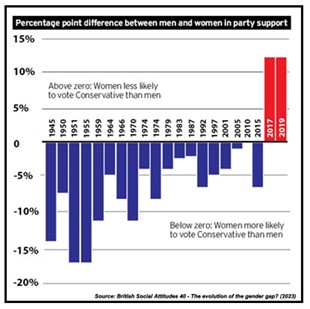
This IWD contribution, unsurprisingly, is not about women gaining the vote, but how, in post-war Britain they’ve collectively been exercising it in successive General Elections. And it’s aided by the following striking graph, whose ‘gender gap’ approach was developed by Inglehart and Norris back in 2000. They and their successors duly updated it in successive elections, drawing comparisons/contrasts with other countries, but only in the past few years has it really come into its own, and for the obvious reason: that it’s so visually, and politically, striking – as the version prepared for me by the Birmingham Posts editorial team demonstrates.

All but one of the first 19 bars/columns are blue, showing women as more likely to have voted Conservative by varying percentages up to a mighty 17% in the early 1950s. The sole exception was 2010, the first of the recent run of ‘hung Parliament’ elections, when men and women were equally likely to have voted Conservative, so no column at all.

It had become a truism: that, certainly in Britain, women were at least marginally more Conservative or right-wing than men in their voting behaviour. Until suddenly, in both the 2017 and 2019 General Elections, they weren’t – in each case being a sizeable 12% LESS likely to have voted Conservative than men.

Some unknowable proportion of what was swiftly tagged our Flipping Gender Gap was undoubtedly attributable to women’s consistently greater enthusiasm for remaining in the EU, but those striking 2019 gender gap figures are still worth detailing. Conservative: 47% of men, 42% of women; Labour: 29% of men, 37% of women – representing a massive 18% Conservative lead over Labour amongst men, and just a 5% lead amongst women.

Which begs the obvious question of whether we’ll see something comparable this time, and, if so, to what degree? Or was it, say, Brexit in those two elections that produced a kind of two-off aberration? Either way, these ‘gender gap’ statistics will be among the most anticipated and intensively studied, as commentators prepare their voting forecasts.

Indeed, they already have been, the commonest immediate reaction from those who study these things, particularly following the 2019 election, being that “at last” UK women voters were catching up.

For the stats have shown that for years now many/most other established democracies – the US outstandingly, but also the Scandinavians, Netherlands, Germany, Austria, Canada, even Italy – had seen the development of a modern-day gender gap, with women more likely to vote for left-leaning parties than men, while our gender gap showed the reverse.

No longer, then, did the UK seem to be bucking the global trend. As in these other democracies, as more women entered higher education and paid work, some at least became more socially and economically liberal and supportive of gender equality, pushing them to the left of men in their party choices.

Even just typing that ‘UK women voters’ label, though, I’m conscious of risking over-simplification. And indeed, it obscures significant and unsurprising differences across age cohorts. Younger women are considerably more likely to support Labour and less likely to support the Conservatives than younger men, but this modern gender gap lessens and eventually disappears among older voters.

So how will all this affect what happens in this year’s General Election? The estimable UK Women’s Budget Group commissioned a YouGov poll last autumn which reflected and updated some of the above findings – starting with almost a law of UK electoral politics: women take their time to decide.

Asked for their voting intentions, 18% of respondents hadn’t, with no election in the immediate offing, made up their minds: 11% of men and a full 25% of women. Those that had decided split very similarly between the major parties: Men – 20% Conservative, 31% Labour, 7% Lib Dem; Women – 17%, 31%, 8%.

The big difference came with the then Don’t Knows: just 11% of the men, but one in every four women. So, if they hadn’t then decided, perhaps they won’t vote?  By no means: 13% of males were ‘would not voters’, and just 3% of females.

Probably not surprisingly, their policy priorities differ somewhat too. NHS and healthcare is highest ranked by all, but that was 48% of men and 64% of women. The economy was “most important” for 44% of men, but only 28% of women, and the reverse was the case for ‘Environment and climate change’ and ‘Education and schools’ – the latter ranked “most important” by 18% of women but just 9% of men.

And, to quote the ever-flexible Forrest Gump: that’s all I have to say about that – for the time being.

Chris Game is an INLOGOV Associate, and Visiting Professor at Kwansei Gakuin University, Osaka, Japan.  He is joint-author (with Professor David Wilson) of the successive editions of Local Government in the United Kingdom, and a regular columnist for The Birmingham Post.

Voter ID – Part 2: How poisoned, how curative?

Chris Game

In the Electoral Reform Society’s recent review of the King’s Speech the first “conspicuous omission” identified, ahead of democratically reconstituting the Lords and electoral reform, was the repeal of Voter ID – “an unnecessary step backwards for our democracy and should be scrapped before it causes any more damage”.  Though I’m an ERS member, that’s not my personal view – as I’ve previously indicated, here and elsewhere – which is partly why I embarked on what has become a two-part blog, of which this is the second and – I promise! – final instalment.

Rationalising post hoc, the first part summarised the key data – published mainly by the Electoral Commission in its June Interim Analysis of the Voter Identification returns from Returning Officers, its September Demographic Analysis Research, plus its specifically Voter ID-related policy-and-practice recommendations. This second instalment covers, or at least references, some of the varying and more eye-catching reactions to all these data.

The first of which – partly for its comprehensiveness, but also because it provided the blog’s chosen title – is the early September review published on behalf of the All-Party Parliamentary Group (APPG) of senior MPs and Peers on Democracy and the Constitution and funded by the Joseph Rowntree Reform Trust. Undertaken by a cross-party panel chaired by Jon Nicolson (SNP), its four main conclusions were that:

  1. The voter-ID system, as it stands, is a “poisoned cure”, disenfranchising more electors than it protects. It quotes the well publicised statistic of there having been just eight convictions/cautions for personation in person since 2013, plus that detailed in the earlier blog of more than 14,000 possibly entitled voters having been turned away by ‘greeters’ in May before even entering the polling station – sufficient, arguably, to have swung the result of up to 16 constituencies in the 2019 General Election.
  2. The regime’s inherent ambiguity creates a real risk of injustice and potential discrimination.  Most obvious – “shamelessly obvious” to quote the Guardian’s Polly Toynbee in her coverage of the topic – was the selection of documents acceptable as ID, discriminating particularly, but not only, against young persons: Oyster 60+ passes [requiring proof of name and address] acceptable, but not student IDs, library cards, bank statements, etc.  The panel also noted that “independent observers” had recorded evidence of racial and disability discrimination at polling stations, with “non-white people being turned away even when they had qualifying ID, while some white people were permitted to vote without showing ID at all.”
  3. The regime lacks the flexibility necessary to avoid injustices – being over-reliant on decisions made by polling clerks and presiding officers, against which there is no formal right of appeal.
  4. The problems identified are systemic, but not fundamental – meaning that, with targeted reforms, the voter-ID regime can, as in many other states, be an asset to UK democracy. That was my emphasis, and, for what it’s worth, with all Europe and almost all developed countries requiring in-person voters to use photo ID, the panel give less emphasis to this point than I would have. A corollary of that point, however, is that these countries have polling station staff familiar with the demands of voter ID, and there is growing evidence of the need to address with some urgency the recruitment, training and retention of electoral staff.   

Overall, the panel’s conclusion is that the regime should remain in place, subject to three main structural reforms:

  1. Permit electors to ‘cure’ a failed ID check by utilising an existing mechanism in UK law and signing a declaration attesting to their identity and right to vote (as in Canada).
  2. Broaden the range of accepted identification documents and in doing so set clear criteria for deciding which forms of ID are accepted.
  3. Provide better training for polling station officers.

It’s a lengthy production (well over 100 pages, incl. research appendices) and a recommendable one for anyone new to the topic, not least in reminding us how the VID debate was actually kicked off – by a 2010 BBC Panorama investigation, leading eventually to a 2015 High Court case in which Tower Hamlets’ then Labour (and today Aspire Party) Mayor, Lutfur Rahman, was found guilty of involvement in a string of “corrupt and illegal electoral practices”, one of which was ‘personation’.  

Whereupon the Cameron Government instructed its ‘Anti-Corruption Champion’, Sir Eric Pickles, to prepare a report examining electoral fraud – one of whose 50 recommendations was that it should consider options for electors having to produce personal ID before voting at polling stations. Which led in turn to the 2018/9 trials, which reported a degree of increased public confidence in elections where VID was required – but not, as the All-Party review notes (p.9), that “electoral fraud ranked consistently last in public perception of problems around elections” [and administrators’ perception – see table below], or that they are “far more concerned about political funding and the redrawing of constituency boundaries than about personation”.

If the legislation did eliminate personation, the APPG’s view was that this came at the cost of “disenfranchising” electors: preventing or discouraging certain electors from voting – considerably more than the recorded 14,000 or so without ID who failed to return after being turned away by polling station staff. Excluding those turned away by party political ‘meeters and greeters’, this number was considered for several reasons to be “a significant underestimate”.

The democratic cost, in the name of preventing in person personation – occurring, on average 0.88 times p.a. – was to deny at least 14,000 people the opportunity to cast their ballot, which is “unacceptable and unjustifiable”.

Politically, however, the Panel reckoned that even these probably undercounted numbers of non-returnees could potentially impact on a General Election result – two West Midlands examples being Sandwell and Walsall, where 1,135 and 797 electors (respectively) were turned away.

There is, obviously, a great deal more, but almost simultaneously other contributions were appearing on the scene, perhaps most noteworthy being the Local Government Information Unit’s The Impact of Voter ID: The Views of Administrators. Based mainly on a survey of 171 electoral administrators who helped deliver the May 2023 elections, some of these ‘behind the scenes’ views are almost inevitably predictable: that VID is just the latest of the pressures added to the burden of electoral administrators already contending with resource constraints, complex legislation, tight timetables, temporary staff recruitment, etc.; and that a General Election offers an “opportunity for serious disruptions” (p.5).  

Perhaps most striking, though, appearing on the Introduction page (6), but without a word of direct reference, is the following bar chart. The words follow in the remainder of the report: yes, administratively elections in England have serious weaknesses: staffing pressures caused by “short timetables, convoluted legislation, inefficient processes and inadequate resourcing.” (p.11).  Administrators’ question for this research is how voter ID has impacted on these issues, as well as, of course, on “personation in the polling station”.

And my carefully considered conclusion, following this attempted overview of the welter of reports and evaluations that appeared several weeks ago now?  I should have done what I’ve habitually done for years in comparable situations: relied on the House of Commons Library, whose estimable staff – here Neil Johnston and Elise Uberoi – produced a characteristically thorough (and, unlike mine, unopinionated) 59-page Research Briefing covering pretty well everything I’ve attempted to. And, to quote Forrest Gump, that’s all I have to say about that!

Chris Game is an INLOGOV Associate, and Visiting Professor at Kwansei Gakuin University, Osaka, Japan.  He is joint-author (with Professor David Wilson) of the successive editions of Local Government in the United Kingdom, and a regular columnist for The Birmingham Post.