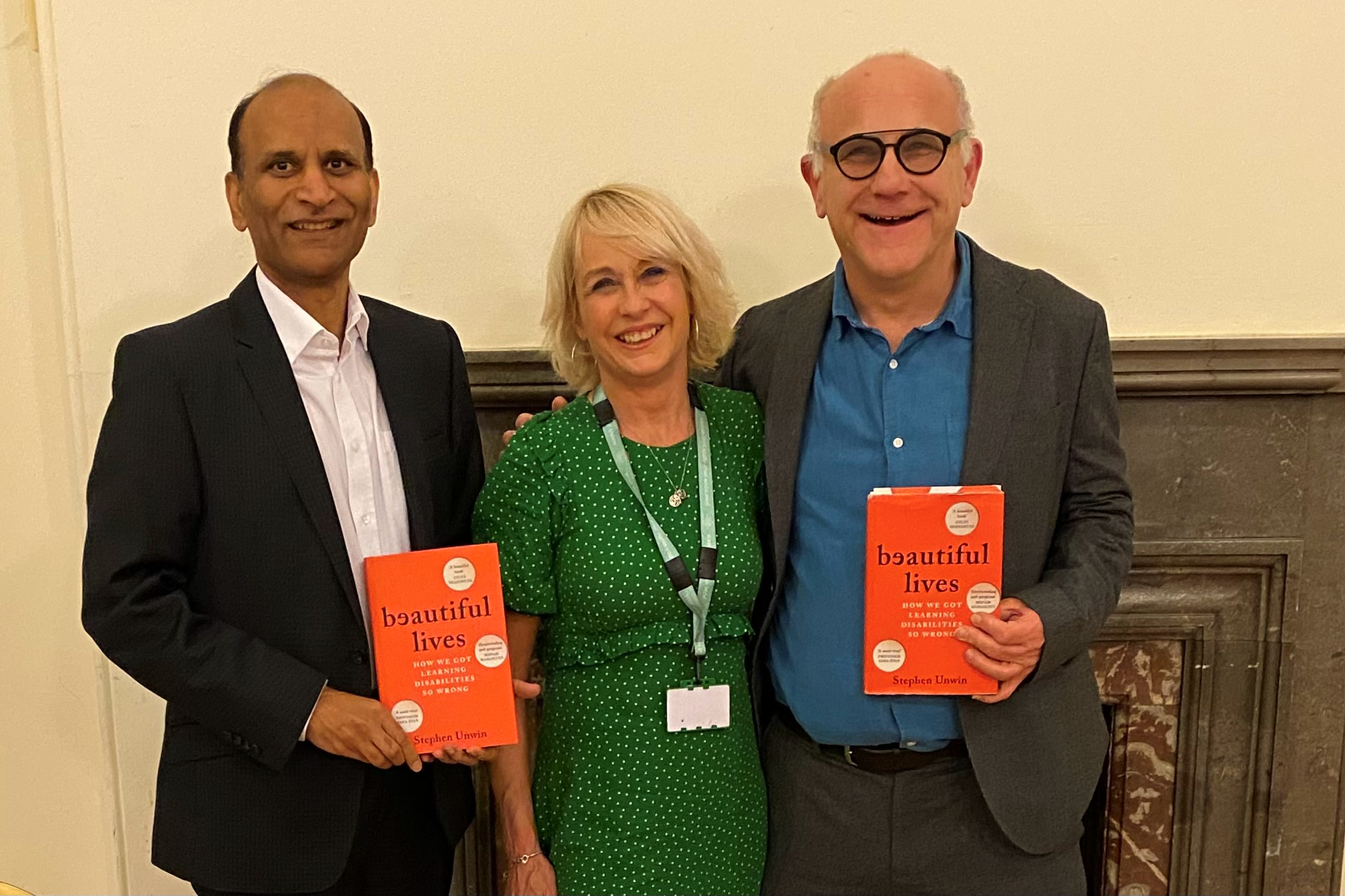
I recently chaired a landmark event hosted by The Advocacy Project, where community leaders, local government officers, NHS representatives, and voluntary sector partners converged at Hampstead Old Town Hall to confront a pressing issue: the systemic inequalities faced by people with learning disabilities. This event was more than a conversation – it was a catalyst for change.
Acclaimed playwright Stephen Unwin shared insights from his poignant book, ‘Beautiful Lives: How We Got Learning Disabilities So Wrong’, inspired by his son Joey’s experiences. Unwin’s words laid bare the dark history of societal attitudes towards people with learning disabilities, exposing the stark reality that despite progress, these individuals remain disproportionately disadvantaged in healthcare, social services, education, and beyond.
The discussion illuminated the critical role local government plays in shaping inclusive policies. By leveraging commissioning powers, local authorities can ensure services are co-designed with people with learning disabilities, prioritising their needs and preferences. This can address the stark health inequalities highlighted in the Learning Disabilities Mortality Review (LeDeR) programme, which revealed concerning disparities in healthcare outcomes.
Katherine Shaw, CEO of The Advocacy Project, underscored the imperative of confronting this history and committing to a future where dignity, equality, and human rights are non-negotiable. The Advocacy Project’s work with local government exemplifies this commitment, amplifying the voices of those with lived experience to inform responsive, respectful, and community-rooted services.
Through user involvement projects and partnerships, The Advocacy Project demonstrates the power of collaboration. For example, their work with local authorities has led to more accessible community services, improved mental health support, and increased participation in local decision-making. These tangible outcomes show that when people with learning disabilities are involved in shaping services, communities become more inclusive.
Local government’s role in education, housing, employment, public health, and adult social care is crucial. By promoting inclusive policies and supporting initiatives like person-centred planning and supported internships, local authorities can break down barriers and foster resilient communities. This can help tackle loneliness, improve mental health, and ensure economic participation for people with learning disabilities.
Moreover, local authorities can learn from The Advocacy Project’s approach to co-production, ensuring that services are designed and delivered with people with learning disabilities, rather than for them. This shift in approach can lead to more effective, person-centred support. By adopting this approach, local authorities can ensure that services are tailored to meet the unique needs of individuals, promoting greater independence and autonomy.
As local government leaders, policymakers, and community advocates, we are tasked with a profound responsibility – to listen, learn, and act. Let us strengthen partnerships, centre lived experience, and forge a more inclusive future for all. The Advocacy Project’s work is a beacon for this change, highlighting the importance of inclusive policies. Indeed, it’s essential to recognise the long-term benefits of such policies, including economic benefits, improved health outcomes, and increased social cohesion. By working together, we can create a more inclusive and equitable society, where people with learning disabilities are valued and supported to reach their full potential, contributing to a richer, more diverse community.
In conclusion, the event reinforced that inclusion is a collective responsibility. Local government’s leadership and partnerships are vital in driving this agenda forward. Let us heed the call to action, champion the rights of people with learning disabilities, and work tirelessly towards a more equitable society.
Councillor Dr Ketan Sheth is Chair of the Community and Wellbeing Scrutiny Committee at Brent Council
One of the most significant problems in public policy has been the persistent failure to draw on evidence of “what works”—and, perhaps more crucially, what doesn’t.
Despite a growing interest in evidence-based policy, we still have a long way to go in identifying and scaling up successful practice. Take, for example, the findings from Nesta’s 2013 report, which revealed that only three out of seventy programmes implemented by the Department of Education were well evaluated (1). Sadly, this gap in evidence was not confined to education and still applies today (2).
Public sector managers need to know what works, what doesn’t and where they should experiment intelligently. However, until the late 1990s, there was little emphasis on evidence as a basis for policy and we haven’t moved as fast as we should have since then. As a result, we have been slow to innovate, evaluate, and scale up new ideas that add value.
What have been the consequences?
That’s not to say there haven’t been some stellar examples of innovation. But these have usually been down to exceptional people or circumstances. In most public organisations, knowledge of best practice is either lacking or hard to access. Public sector managers, particularly outside of professional disciplines, often lack the skills to assess evidence or adapt successful policies to different contexts. In some cases, even when they are aware of evidence, politicians may override advice in favour of projects shaped by political pressure, ideology, or personal interest.
As a result, we keep reinventing policies rather than refining and improving them over the longer term. This makes it much harder to tackle persistent social problems. What’s worse, some policies have been introduced despite evidence that they probably wouldn’t work (3). And even when successful programs are found, we struggle to replicate or scale them up in different contexts.
The Challenges of Policy Transfer and Scaling
This is the core of the problem. A good example is the attempt by English police forces in the early 2000s to replicate a successful gang violence reduction program from the US. Unfortunately, they ignored the detail underpinning the most important components of the US model and the results were largely unsuccessful (4).
In contrast, Strathclyde Police in Scotland carefully adapted the model and successfully reduced gang-related violence. Between 2004 and 2017, the murder rate in Strathclyde halved, and the rate of knife crime dropped by 65%. This example underscores the importance of understanding not only what works, but why it works and how it can be adapted to local contexts (5).
Scaling up successful interventions presents additional difficulties. Long-term success depends on increased funding which is rarely guaranteed. Family Nurse Partnerships (FNPs), for example, have been shown to be effective but have only benefited a small fraction of eligible children in the U.K., despite their positive impact on school readiness and early education outcomes (6). There must be a better way.
Why Is This Still a Problem?
There are several reasons why doing ‘what works’ is a difficult nut to crack. not least of which is the political environment in which decisions are made. Politicians may also reject evidence-based proposals for understandable reasons: cost, public opposition or concern about how they will land with colleagues and the media. Sometimes the timing’s just not right.
Moreover, public sector organisations are often risk-averse. Innovation requires a supportive culture, special funding, expertise, and incentives—elements that are frequently absent. On the plus side, the requirement to produce a business case for new policies does encourage the search for evidence. The most common objection to evidence-based policy is that we often don’t have the evidence. I deal with this below.
Finally, until recently, there have been too few organisations charged with bringing evidence to decision-makers.
The What Works Centres
The good news is there has been some progress. Ten independent ‘what works’ centres have been set up in recent years to provide evidence-based guidance to policymakers. These centres, covering areas such as health, education, crime, homelessness, ageing and children’s social care, help to bridge the gap between research and practice (7). Their role is to provide unbiased, rigorous, and practical advice to help public services become more effective (8).
However, the work is far from complete. While the centres have made significant strides, there is no agreed, systematic way of incorporating ‘what works’ into the development of policy and delivery of services. Additionally, there has been no independent review of the centres’ overall impact on public policy in the 10 +years since they were founded.
What next for What Works?
The Centre for Public Impact (CPI) argues that a lot of evidence simply isn’t robust enough as the sole basis for social policy (9). It suggests we should use the term ‘evidence-informed’ alongside ‘evidence-based’ and proposes a combination of evidence, expertise, and experience as the best bet for designing policies that will work in most places. Evidence-informed practice – Centre for Public Impact
To progress the evidence-based policy agenda, five points need to be addressed:
Government Commitment: Government should invest more in research and development. While private companies like Volkswagen allocate a substantial portion of their budget to R&D, most government departments spend less than 1%. Senior civil servants must also be better equipped to understand and apply evidence-based policies (10).
Local Government Involvement: Much of the ‘what works’ conversation takes place at the national level. Local government and civil society must be more involved to ensure better policy and bigger impact. The Welsh Centre for Public Policy is thought effective because of its close working with the devolved government.
The Limits of Evidence: Often, evidence is incomplete or not easily applied to specific contexts. Furthermore, while the Centres are good at synthesising evidence, they don’t take account of the politics of policy making. Local policy makers often query the relevance of evidence when it doesn’t address their main policy questions (11). Evidence often needs to be combined with professional expertise and local experience to tailor policies to local needs.
Scaling Up Good Practice: Public sector organisations need better systems for integrating successful new approaches into their mainstream services. This reduces the need for special funding. Similarly, successful programmes should be repackaged in a form that makes them easier to replicate at scale (12).
Support for Local Managers and Practitioners: User-friendly, evidence-based information is crucial. For example, the Education Endowment Foundation assesses interventions based on evidence strength, cost and impact. This helps schools make good decisions. Other centres also provide ‘what works’ toolkits (13)
During 2024/25, there have been developments in the Network. For example, the Centre for Local Economic Growth has advised local authorities and emphasised tailored interventions that consider local contexts and needs. The Centre for Children’s Social Care has been recommending practices to improve outcomes for children in care. There has been greater collaboration among the Centres including a unified digital platform to disseminate findings. Looking ahead, new centres on climate resilience and digital inclusion are anticipated. The UK government has renewed its funding to the Network.
The ‘what works’ movement is a major step forward in improving public policy. To maximize its impact, its leadership needs to be refreshed, local government and civil society better engaged, and systems created to incorporate successful practice into mainstream services.
Jon Bright is a former civil servant who worked in the Cabinet Office and Department of Communities and Local Government between 1998 and 2014.
References
Cited in The What Works Network (2018) The What Works Movement Five Years On. P15.
Mulgan. G and Puddick. R, (2013) Making evidence useful- the case for new institutions, National Endowment for Science, Technology and the Arts (NESTA). See also Institute for Government event in October 2022 ‘What works’ in Government: 10 years of using evidence to make better policy. At this event, David Halpern commented that only 8% of sample of Government programmes had evaluation plans in place.
Wolchover. N, (2012) Was DARE effective? Live Science 27.3.2012; and College of Policing (2015) Scared Straight Programmes, Crime Prevention Toolkit.
4. Knight. G, (2009) How to really hug a hoodie. Prospect. November 2009. See also, Tita. G, Riley. J, Ridgeway. G, and Greenwood. P, (2005) Reducing Gun Violence Operation Ceasefire. National Institute of Justice (USA); and Braga. A. Kennedy. D, Waring. E, Morrison Piehl. A, (2001) Problem-oriented policing, deterrence, and youth violence: an evaluation of Boston’s Operation Ceasefire. National Institute of Justice.
5.Big Issue (2020) How Scotland’s’ Violence Reduction Unit breaks the cycle of crime, Big Issue 11.9.2020; Craston. M, et al, (2020) Process evaluation of the Violence Reduction Units Home Office Research Report 116, August 2020; O’Hare. P, (2019) How Scotland stemmed the tide of knife crime, BBC Scotland news website, 4 March 2019; and Batchelor. S, Armstrong. S, and MacLellan. D, (2019) Taking Stock of Violence in Scotland, Scottish Centre for Crime and Justice Research August 2019.
National Institute of Health Research (2021) Family Nurse Partnerships Building Blocks 5-6 study.
The What Works Network (2018) The What Works Movement Five Years On. See also Breckon. J, and Mulgan. G, (2018) Celebrating Five Years of the UK What Works Centres, NESTA.
Snow. T, and Brown. A, (2021) Why evidence should be the servant, not the master of good policy Centre for Public Impact.10.8.2021
Halpern, D presentation at an Institute for Government (2022) event op cit.
Private correspondence with Jason Lowther, Head of INLOGOV.
Little. M, (2010) Improving children’s outcomes depends on systemising evidence-based practice… Demos
In this blog, we discuss a major success in health policy that’s been largely forgotten.
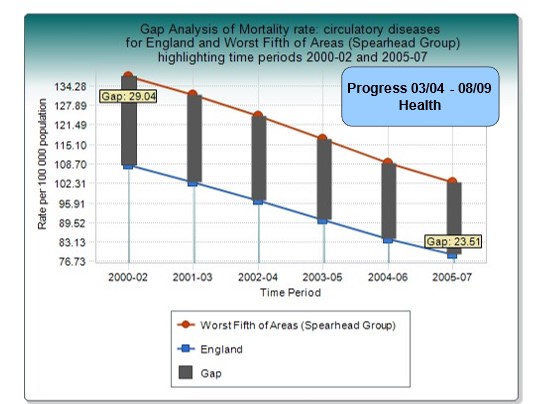
What happened? During the 2000s, a government strategy to tackle health inequalities in England led to a reduction in geographical differences in life expectancy. Furthermore, this success reversed a trend that had been increasing. It was achieved by reducing death rates caused by coronary heart disease.
The chart below shows an overall reduction in coronary heart disease mortality and a reduction of nearly 20% (19.07%) in the gap between the national average and the poorest areas. [Barr et al 2017]
This is the only period in the last 50 years when inequalities in death rates between rich and poor have narrowed. It was a considerable achievement and an historic result.
What was the impact in terms of lives extended? This policy meant that many millions of people lived longer and healthier lives. Much of the benefit was probably due to reductions in smoking and managing risks such as high blood pressure and cholesterol. In 2000, 38% of the adult population smoked and smoking was twice as common amongst those on low incomes. Today, only about 13% of the adult population smoke, the lowest since records began.
But this achievement was not down to health policy alone. Importantly, it was also due to coordinated action across Government to tackle inequalities more generally. This is because many of the factors that affect health lie outside the health sector.
These policies led to a national commitment to reduce inequalities. In the wake of the NHS Plan, the Government set Inequalities targets and incorporated them into national Public Service Agreements (PSAs). These Agreements required central government Departments to do better in those parts of the country where outcomes were poorest. This applied not only to health but also to low income, family functioning, education, employment, and crime. These wider issues are major influences on people’s health and targeted action on these made it more likely that health-specific interventions would succeed.
PSAs defined the goals of the 2002 and 2004 Comprehensive Spending Review. Departmental budgets were only agreed once each Department produced credible plans showing how they would contribute to the inequality targets.
What did all this mean in practice for people living in poorer regions? Health-specific interventions included smoking cessation clinics; improving the distribution of GPs – many disadvantaged areas had no GP service; more resources for disadvantaged areas; national guidance on best practice; and improved access to mental health services. Action to tackle the wider causes of poor health included improving housing (the Decent Homes Standard); increasing household income (the Minimum Wage, Tax Credits); investment in education and skills; reducing the number of young people not in education, employment and training; teenage pregnancy prevention; and investment in early years (Sure Start and family support).
This approach is consistent with Prof Michael Marmot’s conclusions in his 2010 report, ‘Fair Society, Healthy Lives‘ .
What did evaluators find? Evaluators found that regional inequalities decreased for all-cause mortality and that the strategy was broadly successful in meeting its ambitious targets. Writing in 2017, Barr et al they concluded that ‘future approaches should learn from this experience”. They noted that current policies were probably reversing this achievement of the previous decade. See also Holroyd et al’s systematic review.
In our main paper REASONS TO BE HOPEFUL we discuss the evaluations in more detail.
What lessons should we draw? There are five main lessons to draw from this evidence:
When Government takes a coordinated approach to a problem – and sticks with it over time – the results can be impressive, even with problems thought to be intractable.
Health is a good proxy for Levelling Up. Narrowing the health gap between regions is a good proxy for ‘levelling up’ more widely. Health inequalities are in large part due to poverty, poor education, and poor housing. Regional inequalities in educational attainment and crime also narrowed.
Leadership and persistence are essential. A ‘whole of government’ approach requires good cross departmental working, full engagement with local government, and leadership from the Prime Minister.
Tackling the nation’s problems needs longer term policy making so successful approaches don’t fizzle out whenever there’s a change of Government. As we’ve seen, benefits achieved up to 2010 may have been lost by 2017. Maintaining progress requires cross-party, long-term collaboration.
This approach worked by influencing mainstream budgets via better targeting and evidence-based interventions, rather than relying only special ring-fenced funding
Today, the big health challenges today are obesity, diabetes and related conditions. Again, poorer populations are much more affected. Will today’s politicians rise to the occasion?
Dr Nicholas Hicks BM BCh FRCP FRCGP FFPH is an Honorary Senior Research Fellow, Nuffield Department of Primary Health Care Sciences at the University of Oxford and a Senior Strategy Advisor, Department of Health and Social Care. He is also an Associate Fellow, Green Templeton College, University of Oxford. He was seconded to the Department of Health Strategy Unit and helped draft the inequalities chapter of the NHS Plan in July 2000 ([email protected]).
Jon Bright is a former civil servant who worked in the Cabinet Office and Department of Communities and Local Government between 1998 and 2014.
References
Meadows D. Leverage points: places to intervene in a system.
NHS Plan. A plan for investment; a plan for reform. Department of Health (2000): 106-7
Health inequalities – national targets on infant mortality and life expectancy – technical briefing . Department of Health March 2002
Holdroyd I, Vodden A, Srinivasan A, Kuhn I, Bambra C, Ford JA. Systematic review of the effectiveness of the health inequalities strategy in England between 1999 and 2010. BMJ Open. 2022 Sep 9;12(9):e063137. doi: 10.1136/bmjopen-2022-063137. PMID: 36134765; PMCID: PMC9472114.
Today we launched our latest report, Equipping local government to deliver national and local priorities. Local government is critical to the delivery of the new government’s five key missions, and to improving life across the country. We argue that, once a series of critical reforms are in place, government should have confidence to equip local authorities with more power and (when public finances allow) prioritise additional resources there, enabling local and national priorities to be delivered. But critical reforms are needed in financial management, audit and performance management, and in community power and participation.
The new government inherited many challenges. Council budgets per person in England have been cut by 18% in real terms since 2010. Councils are hitting financial crises: twelve have issued section 114 notices in the last six years, compared with zero in the previous 17 years. Representative institutions at all levels of government are suffering from declining legitimacy and increasing polarisation. Local government plays a vital role in increasing democratic relationships and trust.
But councils’ wide remit, local knowledge, democratic accountability, public service ethos, and key roles in working with partners and shaping local places make them critical to the delivery of all five of the government’s key missions. Local governments are best placed to operationalise solutions to interconnected problems, for example, improving public transport and encouraging more cycling and walking helps meet net zero targets. It can also deliver health benefits, reducing the burden on the NHS, as well as increasing productivity by giving businesses access to a wider and healthier workforce.
Action is required to ensure that councils are fit for purpose to make the type of contribution that central government requires of them. Underlying this is a lack of confidence in local government on the part of ministers and civil servants. We have identified three areas in which the government must be confident if it is to equip the local level with more power: financial sustainability, performance standards, and community power and participation.
Policy recommendations
Financial arrangements
Provide multi-year funding.
End competitive bidding and deliver a “single funding pot” for each council/ local area that has been allocated fairly and sensitively to the needs and assets of the community.
Abolish council tax capping.
Audit and performance management
Strengthen the evaluation of councils’ performance management.
Make OFLOG independent and extend its remit and approach.
Reintroduce effective management and support of council external audit by independent bodies.
Community power and participation
Strengthen the role of councillors as facilitators and catalysts of community-driven change.
Embed participatory governance to ensure lived experience and marginalised voices drive policy and service delivery.
Develop public-commons partnerships and community-wealth building to support community-driven sustainable economies.
As the Layfield Commission concluded 50 years ago, local government funding should promote responsible and accountable government. Beyond welcome recognition of acute financial challenges and commitment to multi-year funding settlements, there is a pressing need for additional immediate and longer-term action to improve Councils’ financial position and strengthen local accountability.
Local authorities have different needs for funding, depending for example on levels of population and its composition, deprivation, and spatial factors. Central and local government should develop updated funding formulae and funding models which are as simple as practicable whilst capturing the key elements of local need, and as transparent as practical in operation. There are many reports researching available options for fairer funding, approaches to fiscal devolution, and local government funding options.
Local audit, performance regimes and regulation each have a part to play. Both a parliamentary select committee and the Redmond Review into the Oversight of Local Government have sought to investigate the failings in local government audit. The latter in 2020 critiqued market driven audits, stating that the new audit arrangements have undermined accountability and financial management.
The adoption of the Redmond Review’s proposal for an Office for Local Audit Regulation would provide oversight on procurement, management, and regulation of external audits of local authorities. The government could extend the oversight of local government performance management processes while avoiding the creation of an overly powerful national regulator, by adopting key recommendations on the future arrangements of OFLOG (the Office for Local Government).
Proximity means that local government can play a crucial role in improving relationships between government and citizens. By creating conditions to mobilise the diverse expertise and resources of communities, local government can ensure that public policies and funding are informed by the assets, priorities and needs of local people and places. There are already many examples where local government has made progress with innovations such as citizens’ panels and juries, the delegation of power to the hyper-local level and in building inclusive economies.
We have over thirty years’ worth of research on deliberative democracy, social innovation, and co-production evidencing the value of collaboration with diverse communities and stakeholders. Participatory governance is less about finding perfect solutions and more about transforming organisations to engage with communities in processes of co-producing mutual understanding, shared solutions, and a sense of collective ownership.
Our work on the 21st Century Councillor can help with enabling the role of councillors not just as democratic representatives but also as facilitators and boundary spanners between institutions, communities, civil society and local businesses.
Community-wealth building, pioneered in Preston and several London boroughs, can help strengthen the local economy with insourcing, linking public procurement to local cooperatives and social enterprises. These novel forms of governance can be formalised through Public-Commons Partnerships.
Equipping local government to deliver national and local priorities will leave a long-lasting legacy of a well-resourced, effective, accountable, and engaged local government.
The report was edited by Jason Lowther and Philip Swann, with particular thanks to the following contributors (alphabetically by last name): Dr Koen Bartels, Dr Sonia Bussu, Prof Nicole Curato, Dr Timea Nochta and Dr Philip Whiteman. With thanks to other colleagues and associates in INLOGOV.
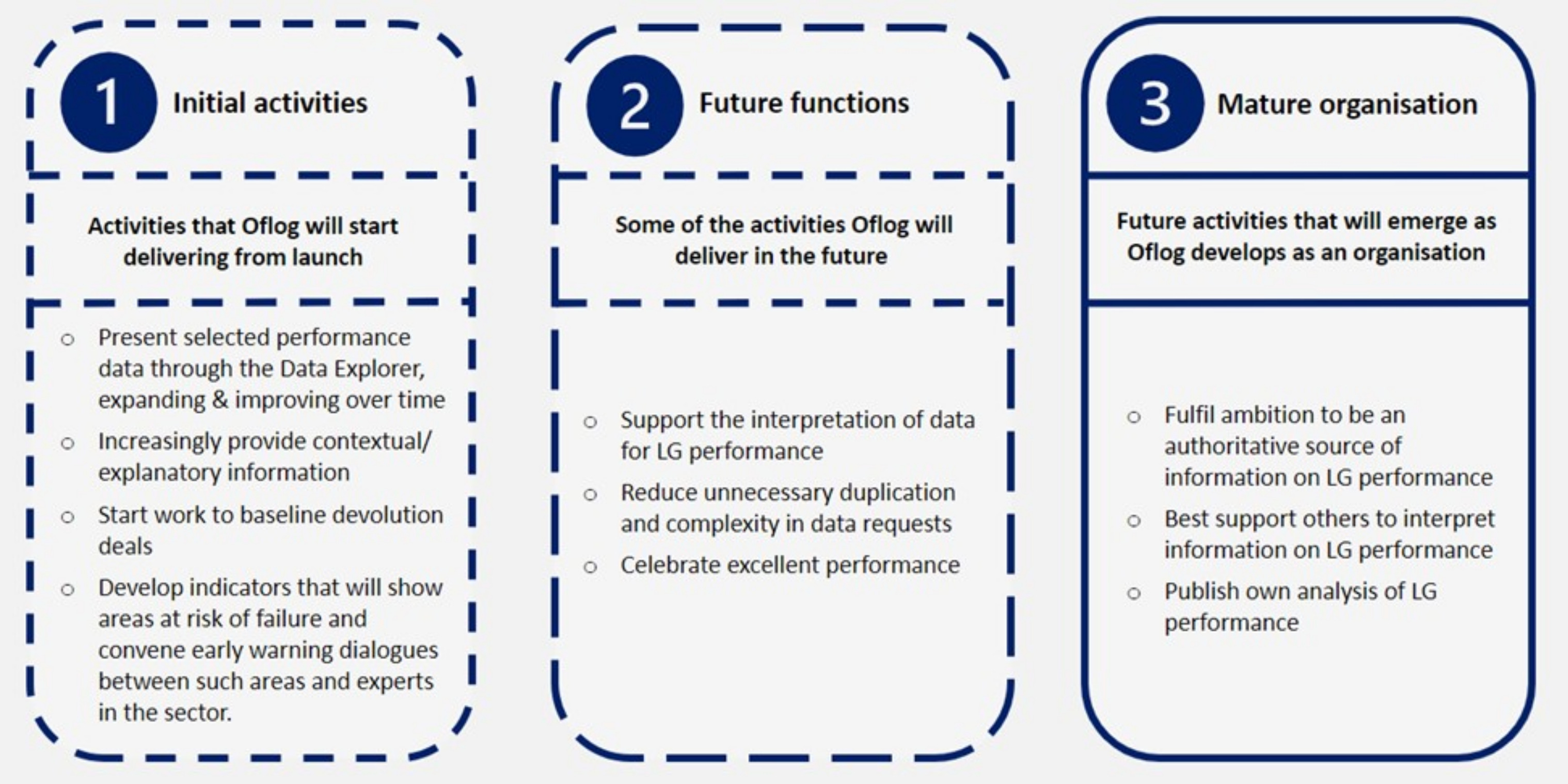
It’s been an exciting month in government, nationally and locally, since the General Election on 4th July. As the new Labour administration finds its feet, somewhere on Ministers’ “to do” list will be local government performance and (the department formerly known as) DLUHC’s attempts to improve this through the establishment of OFLOG, the Office for Local Government.
The election marked the exact anniversary of Michael Gove’s statement setting up OFLOG through the policy document, Understanding and supporting local government performance. Its remit was “to provide authoritative and accessible data and analysis about the performance of local government and support its improvement”.
Gove was at pains to stress “this is not about recreating the Audit Commission”. With that point at least, I agree. Whereas the Audit Commission was fiercely independent, often willing to criticise government policy where it was a factor in poor performance, OFLOG was established as an office of the department within the DLUHC department itself. Whereas the Audit Commission developed comprehensive performance measures which were rigorously audited to assure consistency, OFLOG picked 27 PIs and published these. Whereas the Audit Commission provided detailed national studies to inform best practice in local services, sometimes leading to wholesale systems change such as around youth justice services, with the local implementation of recommendations then supported by local specialist value for money auditors, the nascent OFLOG offered to “continue a programme of webinars to share best practice”.
An early product of OFLOG, in July 2023, was its “Local Authority Data Explorer”, which now brings together PIs on waste management, planning, adult social care, roads, and corporate and financial issues. For each service, users can select three comparison councils to produce scatter charts like Figure 1, which compares my local council’s waste management with that of three other big cities. This led to some rather uninformed press commentary and a response from the LGA. One may also say this is perhaps not the most compelling presentation of data in the world, arguably significantly less clear or flexible than the LGA’s excellent Inform tool which has been freely available for several years and includes thousands of published metrics.
Caution should be applied to OFLOG’s position within a ministerial setting and the potential for politicians to be selective in how they use data for judging local authorities that are not of their political persuasion. Whilst some may argue that the former Audit Commission may have been too powerful, it did provide a greater degree of transparency and objectivity at interpreting performance data.
Figure 1: Waste management
As my colleague in Inlogov, Dr Philip Whiteman, has recently argued, the new government should ensure that OFLOG is independent of government with a remit to focus on:
Working with the sector to identify councils at risk of failure to ensure that support can be provided from within the sector, minimising the need for government intervention.
Collecting, analysing, and reporting data to enable individual councils, groups of councils and the sector nationally to make progress with shared priorities agreed with government.
Developing intelligence from on-going engagement with councils.
Supporting improvement in local services and councils’ contribution to national outcomes through researching, synthesising, and disseminating good practice.
Working with academic institutions such as Inlogov to incorporate key lessons from existing and future research.
We can be confident that local government performance overall is strong, and sector-led improvement has demonstrated our collective commitment to continuous improvement. But with so much of the new government’s ambitious “Missions” depending on highly effective local government, we need to take a fresh look at how OFLOG can be further developed to identify and propagate good practice across the sector.
Jason is Director of the Institute of Local Government Studies (INLOGOV) at the University of Birmingham and was employed by the Audit Commission from 1994 to 2004. This article was first published in the August 2024 LARIA Newsletter. Email [email protected]
INLOGOV’s new report, Equipping Local Government to Deliver National and Local Priorities, is available here.
Until recently South Cambridgeshire Council was mainly known for being the only council in the UK which completely encircles another council, the City of Cambridge.
Now it has a place in history for a more lasting reason. In January this year it began a trial which put much of its workforce onto a 4-day week, asking them to do in four days what previously they had done in five, for the same pay and without employing extra staff or reducing opening hours for the public.
Michael Gove took exception, and in October his Department issued non-statutory guidance which made it clear that he does not want councils to implement four-day weeks[1]. His junior minister, Lee Rowley, wrote to the Council in June and again in September asking it to abandon its trial.[2] But the terms and conditions of council employment are not the business of central government, and to that extent the Council has the right to continue. Then, on 3 November, a senior civil servant wrote to the Council ordering them either to stop the trial, or to supply him with regular detailed information about their performance.[3] To do this he invoked the concept of “Best Value”, also used in the Guidance note, claiming that the pilot means that the Council is not giving value-for-money to its taxpayers.
A bit more about South Cambridgeshire Council. 35 of its 45 councillors are LibDem, including its Leader, Councillor Bridget Smith. It provides services in the small towns and villages around Cambridge, working closely with the city council on matters that affect them both, such as sensitive planning proposals. 162,000 people lived there in 2021. House prices and average incomes are high, and it is one of the best places in the country to live. The council was and still is one of the best-performing in England.
The pilot is being evaluated by the Bennett Institute for Public Policy at the University of Cambridge. After nearly a year, the indications are extremely encouraging.[4] In 27 October Bridget Smith reported that “sickness rates have fallen by a third, staff turnover has reduced by 36%, and complaints about services involved are down. 9 of 16 areas studied showed “substantial improvements in performance over the previous year”. The council has been better able to recruit staff, and now has 14 fewer “interim managers” recruited through an agency on a short-term basis and paid much more than normal local government rates, but seldom living in the area and with little long-term commitment to it. This has saved the Council considerable sums of money.[5]
These positive outcomes should not surprise civil servants, other researchers or Mr Gove. It is backed up by other research, for example a recent Fabian report about what the UK can learn about shorter working weeks from Germany.[6]Or research carried out in 2022 by a large team of experts in England and America led by the consultancy Autonomy.[7] This studied 61 UK businesses which have implemented shorter working weeks in a variety of changes (such as having lower staffing on Mondays and Fridays with half the employees working on either the Monday or the Friday in any week). In almost all these companies the shorter working week improved productivity, staff recruitment and morale.
“Best Value” was invented in the 1980s when it was realised that the best outcomes would often not be achieved by paying the lowest prices. We do not get our cars serviced at the cheapest garages, or our roofs repaired by the cheapest contractors. We prefer someone we know, or who comes with good recommendations who will want to work with us in future, and so will not take short cuts, use poor quality parts, or put sufficient cement in its concrete. To make an informed decision, you also need information about the quality of other work done by the possible contractors. If you do not have that information, then you need to contract for a short period, and learn from the results. Many councils, with all types of political control, were able to demonstrate that Best Value was obtained by keeping a service in-house, not using external contracts.[8]
In this context, the invocation of Best Value reeks of despair: Gove’s civil servants cannot think of any other way to stop the trial. He may fear that other councils who adopt the same policies may not get the same benefits. But if South Cambridgeshire ever gets tested in a court of law, there is a strong probability that the Government will lose.
This is not the only recent populist announcement: Ricki Sunak announced at the Conservative Party Conference that he is trying to make it impossible for councils to introduce 20 mph zones in residential areas, even though this is a popular policy (not least among many car drivers) which saves lives and reduces pollution.[9] He is also attempting to limit the number of low-traffic neighbourhoods[10] and has directed councils not to introduce multiple recycling bins, even though it is cost-effective for homeowners and businesses to sort as much of their waste as possible in advance.[11] He does not appear to recognise that councils are local authorities whose legitimacy comes from elections, and which can experiment and try out new ideas. They have a great deal more practical experience to draw upon than he does, or his civil servants.
[8] See, for example, statutory guidance issued in 2011 when Eric Pickles was Secretary of State for Communities and Local Government, at https://assets.publishing.service.gov.uk/media/5a7968ab40f0b63d72fc591f/1976926.pdf. Or articles in Andrew Coulson (ed.) Trust and Contracts: Relationships in Local Government, Health and Public Services, Policy Press, 1998.
Andrew is a nationally-recognised expert on scrutiny in local government and is particularly interested in governance by committee. He is a columnist for the Birmingham Post and associate of INLOGOV. He writes in a personal capacity.
[8] See, for example, statutory guidance issued in 2011 when Eric Pickles was Secretary of State for Communities and Local Government, at https://assets.publishing.service.gov.uk/media/5a7968ab40f0b63d72fc591f/1976926.pdf. Or articles in Andrew Coulson (ed.) Trust and Contracts: Relationships in Local Government, Health and Public Services, Policy Press, 1998.



 INLOGOV Blog