Local government should welcome Gordon Brown’s private bills proposal

Phil Swann

Streamlined access to local legislation must be available to help struggling councils to improve rather than rewarding those that have already done so, writes a PhD candidate in central-local government relations at INLOGOV and former director of Shared Intelligence.

In 1926 Winston Churchill, then chancellor of the exchequer, successfully opposed a private bill promoted by Bristol Corporation to establish a municipal bank in order to stop “all kinds of incompetent town councils”, particularly “socialistic” ones, from running banks. He did so despite the fact that the bill was supported by his Conservative colleague and former mayor of Birmingham Neville Chamberlain, who argued that Birmingham’s municipal bank had encouraged thrift and home ownership.

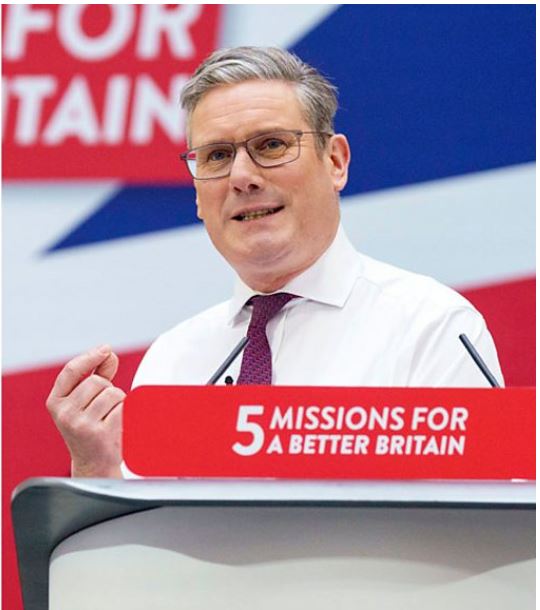
It is interesting to reflect on this dispute (not the last between these two political Titans!) in the context of the move by Gordon Brown’s Commission on the Future of the UK to promote the use of private bills by local councils. Raising the prospect of “the great cities of England” exerting similar powers to the Scottish and Welsh governments, the commission recommends a new, streamlined process enabling councils to initiate local legislation in parliament. This, the commission argues, would give councils an ability to secure the powers they need and to have a direct relationship with Parliament.

Evading centralising tendencies

It is undoubtedly the case, as the commission argues, that private legislation provided a vehicle for innovation in Victorian local government in the face of the social, economic and physical impacts of the industrial revolution. 

The genesis of public health lies in local legislation as does the creation of public utilities to provide gas, electricity and public transport. It was the ability of local corporations to promote private legislation that fuelled Joseph Chamberlain’s ambition to turn Birmingham Corporation into “a real local parliament”. Private acts were also used by enterprising councils to evade the centralising tendencies of successive governments in the second half of the 19th century.

It is also the case, however, that by the inter-war period private legislation had become a feature of the tensions in central-local government relations rather than necessarily being a solution to them. The resources and ambition required to draft and promote private legislation reinforced a growing divide between “advanced” or “progressive” councils on the one hand and “backward” or “penny-pinching” councils on the other hand. This reinforced differences between the major cities and smaller towns and rural areas. The widespread use of private legislation also contributed to the ad hoc and complex structures and powers of Victorian local government.

Significantly these trends were reflected in the justification for increasing central government intervention in local politics. In the 19th century there was a shift in ministerial focus from corruption to efficiency and action to bring “backward” councils up to the standard of the “progressive”. The first half of the 20th century saw a financially driven move to rein in the most innovative councils and drive improvement in the poorly performing ones. The dispute between Churchill and Chamberlain over the Bristol bank bill is an example of this.

Clause acts and adoptive acts

Despite these warning notes from history, the ambition of the Brown commission to enable local leaders to have access to a streamlined process to initiate local legislation should be welcomed. Many of the problems that emerged when private legislation was a common feature of local government could be overcome if it was explicitly seen as a way of testing new legislative powers prior to wider adoption – genuine pioneering.

Two other legislative devices deployed in the Victorian period could help to secure this approach if they were refreshed alongside a revival of local legislation. The first device is a clauses act, the prime example being the Town Improvement Clauses Act 1847. It brought together the provisions most commonly inserted in and effectively deployed through local legislation. Clauses acts, each of which would relate to a particular service area or initiative, would both streamline the legislative process and avoid unhelpful adhockery.

The second device, which takes this a step further, is the adoptive act. This is a piece of legislation which has been through the parliamentary process but which comes into effect only when it is adopted by individual local authorities. Acts of this type could make powers that have been successfully adopted by one authority available to be adopted by others without requiring local drafting or taking up parliamentary time.

Earned autonomy?

One other issue which requires attention is whether there should be a link between an ability to initiate local legislation and a council’s perceived performance. A sustained thread running through central-local government relations since the 1830s is the view that that councils should not benefit from new powers or responsibilities until they have met certain conditions or achieved a certain standard.

Joseph Chamberlain, who made extensive use of private legislation in Birmingham, took a different view. In 1877 he argued that “whatever the defects” of a council “I defy you to make a better one for the place except by gradually increasing its functions and responsibilities and so raising its tone.” No earned autonomy for Chamberlain!

If the increased use of local legislation is to help achieve the ambition set out by Brown and his commissioners, it is essential that streamlined access to local legislation is available to help struggling councils to improve rather than as a reward for having done so.

This article first appeared in the Local Government Chronicle on 13th December 2022.

Phil Swann is researching a PhD on central-local government relations at INLOGOV

Integrated Care Boards – a new frontline in localism?

Jason Lowther

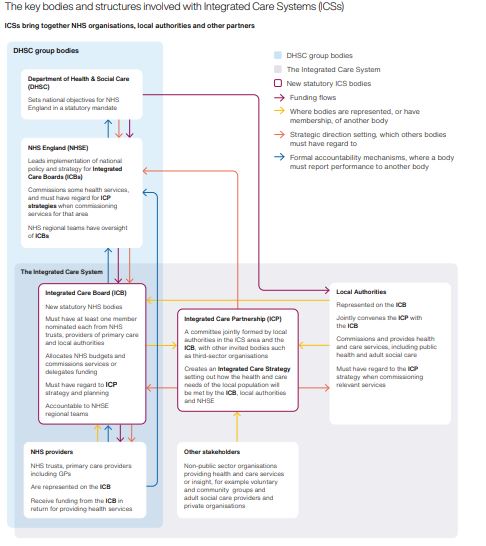
As the government once again kicks down the road decisions on vital reforms and funding for social care, local areas are establishing the Integrated Care Boards which will lead the new Integrated Care Systems (ICS), bringing together the NHS, local government and partners to plan and deliver integrated services to improve the health of the local population.  Building on the progress made since many public health responsibilities transferred back to local government in 2013, this is a great opportunity to address the determinants of health and issues around health inequality.  Might ICSs at last lead to an effective local voice in our over-centralised, top-down healthcare system?

Each ICS is supposed to plan at three levels: the neighbourhood (an area of around 40,000 people), the ‘place’ (often a LA area), and the (ICS) system (covering around 2 million people).  Working at the neighbourhood level is likely to be somewhat informal, often using a social prescribing approach and developing multi-disciplinary teams including third sector partners.  The approach to ‘place’ looks set to vary between areas, with some ICSs devolving significant responsibility (and funding) whilst others centralise these at ‘system’ level.  Meanwhile at ‘ICS system’ level, Integrated Care Partnerships (joint LA and health committees) will develop an Integrated Care Strategy to meet the assessed health and social care needs of their population identified in the Joint Strategic Needs Assessments and Wellbeing Strategies prepared by local Health and Wellbeing Boards.

Beyond the formal planning process, the success of local ICSs will partly depend on the quality of local collaborative (managerial and political) leadership – across statutory partners and with the third sector.  It will be a tough job to balance the priorities of the national health service and issues of local places, but many local authorities will be able to offer helpful experience , for example from moves to more networked governance approaches.

The National Audit Office recognises the potential but appears dubious on current prospects.  Last month it published a review, Introducing Integrated Care Systems: joining up local services to improve health outcomes, finding:

NHSE has a detailed regime to monitor performance against core NHS objectives but … it is less clear who will monitor the overall performance of local systems, and particularly how well partners are working together and what difference this new model makes…

The report notes that, whilst government is asking ICSs to set out local priorities and make progress against them, there is no protected funding and few mechanisms to ensure this happens.  This leads, as the NAO politely puts it, to “a risk that national priorities, and the rigorous oversight mechanisms in place to ensure they are delivered, crowd out attempts at progress on local issues”.  The report also identifies five “high risk” elements of effective integration: clarity of objectives, resourcing, governance and accountability (such as how ICSs will function alongside existing local government Health and Wellbeing Boards and how accountability differences between NHS and local authority bodies will be resolved), and the capacity to balance priorities other than national NHS targets. These urgently need to be addressed if ICSs are to begin to meet their potential.

At one of Inlogov’s “Brown Bag Lunch” discussions earlier this month we agreed on the importance of issues around how ICSs develop, particularly in terms of developing effective system leadership and planning, collaborating with community organisations, and links to wider devolution processes. I’d be interested to hear about experiences in local areas as these develop. 

Jason Lowther is the Director of INLOGOV. His research focuses on public service reform and the use of “evidence” by public agencies.  Previously he worked with West Midlands Combined Authority, led Birmingham City Council’s corporate strategy function, worked for the Audit Commission as national value for money lead, for HSBC in credit and risk management, and for the Metropolitan Police as an internal management consultant. He tweets as @jasonlowther

Picture credit: National Audit Office

Why and how do municipalities merge? A view from the cognitive perspective

[Photo: https://www.linkedin.com/pulse/mental-virus-flipside-covid-pandemic-dr-abha-bhartia/%5D

Dr. Veronika Vakulenko

Among all public sector reforms initiatives, those appearing on the municipal level are the most tangible. This is because in modern democracies citizens can observe and (if willing to) trace changes in, for example, city planning, local infrastructure, education and many other spheres. Let’s be honest, everyone likes to visit a clean park, modern library, drive perfect roads or celebrate an opening of a new school. Meaning that local governments need to use financial recourses on creating a comfortable place for all to live in. However, it becomes rather common that local governments are not able to balance their budgets, due to a higher per capita spending, lower public service provision, or limited infrastructural capacity, which is the case particularly for smaller rural areas.

Seeking to improve local financial condition, many countries worldwide launched local government reforms, which still remain on the top of agenda among academia and practitioners. Pursuing mainly the objective to enhance local financial efficiency and quality of local public services, the reforms can vary from contractual inter-municipal cooperation to mergers or amalgamations. Mergers are the most drastic reforms as they require alterations of territorial boundaries, changes in administrative responsibilities and routines, and adjustment of financial management practices, all of which affects significantly the lives of citizens.

Several European countries, e.g., Finland, Switzerland, Ukraine, selected to implement voluntary mergers, allowing local governments to celebrate the freedom in deciding whether to initiate the territorial reform. While some municipalities recognized merger’s benefits (i.e., improvement local governments’ economic condition and quality of local public service delivery), others resisted merger. In this situation, it becomes interesting to approach municipal amalgamations from a dynamic perspective to understand behaviour and interactions between different actors, which can result in diverging reform outcomes.

In our recent study published in open access at Local Government Studies, we use an interdisciplinary concept of cognitive style, to explore the psychological aspect of mergers. By mobilizing cognitive literature, we could take a closer look at local actors’ behaviour, to argue that a merger is not a simple ‘marriage of convenience’ of local actors to increase their economic efficiency. Rather, it is a complex cognitive process, which requires local actors’ mental work in taking decisions and creating (or not) a new merged municipality. Thus, a final decision “to merge or not to merge” depends not only on financial benefits, but also on the way local actors perceive and process information about financial incentives and how they operationalize their decisions.

In a story of two neighbouring local governments in Ukraine studied during 2015-2019, we approached two local political leaders, who were drivers of changes on the local level. By studying very carefully their behaviour and actions, we found that their initial perceptions of merging were completely the opposite. While the first one was viewing this as an opportunity and was able to convincingly explain the need and future benefits of this change, as well as introducing new practices to engage local citizens. Despite several other local actors were supporting this initiative, the second leader was acting in a discouraging way and always emphasized risks for their community, which in the end resulted in collective inaction.  To summarize, new interdisciplinary approaches can be used to better understand the success stories or failures of municipal mergers. Cognitive theory in public administration has a significant potential in this field as well as implications for practice. As our case showed, better mapping the sceptics and addressing perceptions of local leaders before initiating voluntary mergers could facilitate better results from territorial reforms.

Dr. Veronika Vakulenko is an Associate Professor at Nord University Business School, Norway. Their research interests include interdisciplinary public sector accounting research; budgeting and financial management in local governments; national and supra-national public sector audit; reforms particularly in the context of developing countries.

80% of councils directly involved (again) in delivering housing

Chris Game

If you’re an academic – either a genuine intellectual, theorising one, or a more lecturing, popularising one like what I was – there’s a good chance that the week before Easter is Conference Week.

It’s easy to mock, and knock, academic conferences. Too many delegates reading, rather than ‘presenting’, their papers; no time for proper interrogation, discussion and debate; mediocre university campus food. And for overseas conferences, add in climate threatening CO₂ emissions.

However, I like them – conferences, that is.  Indeed, this recent Easter week I racked up a full half-century of attending, at least intermittently, PSA (Political Studies Association) conferences.

Like most such events nowadays, this one was ‘hybrid’ – with panels attended partly in person, partly digitally via Zoom. Which makes genuine discussion additionally problematic, and emphasises the importance of the written papers addressing subjects that ideally are appealing, topical and even newsworthy.

Happily, in the Local Politics Specialist Group this is almost the norm. And this year one paper especially – in addition, obviously, to that of the INLOGOV’s Director, Jason Lowther (from ‘Birminham’, according to p.25 of the evidently un-proof-checked programme!) – struck me as both sufficiently important and timely to bring it to the attention of a couple of slightly wider audiences⃰.

Timely because we’re fast approaching the May 5th local council elections, and, if these councils’ controlling parties choose to draw voters’ attention to it, many could boast something they might well not have been able to even four years ago when these same seats were last collectively contested.

Specifically, over four in every five should be able to claim that they are genuinely and actively involved in the business of delivering social housing.  And if that doesn’t grab you, or you’re thinking: “well, isn’t that one of the main things councils are supposed to do?” – or maybe, as a Birmingham resident, you’ve heard of the 4,000+ homes built by the Birmingham Municipal Housing Trust, the City Council’s housebuilding arm, and assume that it’s fairly typical, rather than really exceptional – then I politely suggest you’ve rather lost the plot in recent years.

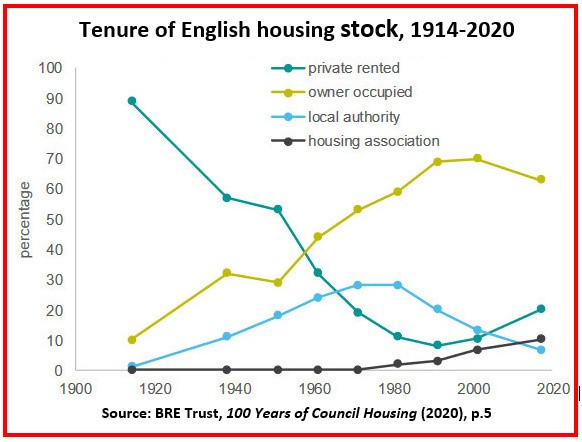
When I used to lecture to particularly overseas students about housing in England or the UK, I would use a couple of very basic graphs, similar to those illustrated here. The first showed the changing relative importance of our main housing tenures since 1919 – private rented, owner occupied, local authority, and housing association.

Tenure1

At the end of the First World War, the ‘big picture’ was straightforward: roughly 90% of housing stock was privately rented, 10% owner occupied. Councils were empowered to build ‘corporation housing’, but few did.  But the War changed everything. PM Lloyd George promised not just houses, but “Homes Fit for Heroes’, and the 1919 Addison (Housing, Town Planning, &c.) Act facilitated it. Council housing committees sprung up, generous subsidies were provided, and council estates mushroomed.

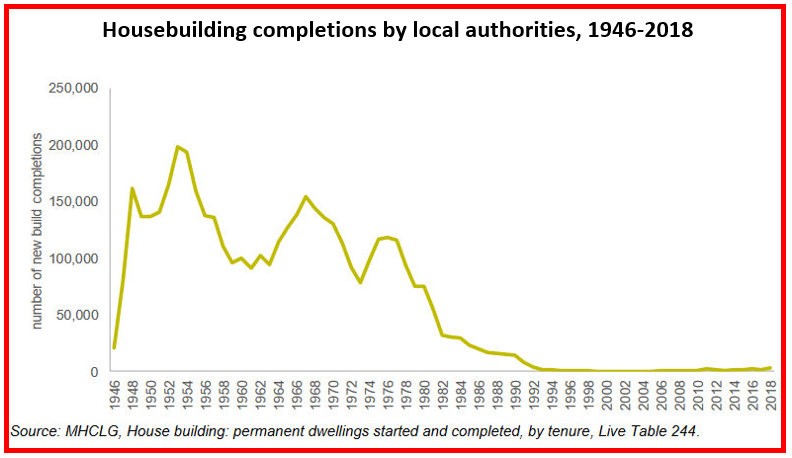
By 1939 over 10% of the population lived in council homes, and the numbers increased steadily post-war, with the Labour Government’s Town and Country Planning and New Towns Acts. At their 1950s peak, under Conservative Governments, councils were building nearly 200,000 houses a year – one completion every three minutes, if you were wondering.

By the 1970s over a third of England’s housing stock was ‘council’. Private renting had plummeted to below 20%, with owner occupation over 50% and rising, and housing associations just beginning to take off.

The 1980s Thatcher Governments’ priorities, though, were very different: a “property-owning democracy”, with successive ‘Right to Buy’ policies – requiring, rather than allowing, councils to sell off their housing stock, if tenants, particularly of larger, better-quality properties, wished to purchase.

Coupled with Treasury restrictions on councils borrowing money for capital expenditure, there began the long-term shift from council housing to housing associations or ALMOs (Arm’s-Length Management Organisations): from 7% of all social housing in 1980 to over 60% today, including virtually all new social housing.

On my second graph, of ‘Housebuilding Completions’ – albeit scaled for dramatic effect – the local authority line by the mid-1990s was barely distinguishable from the horizontal x-axis. Council house building on any significant scale virtually stopped, new homes countable in the hundreds, rather than hundreds of thousands – until, if you peer extremely closely, you can just see the space between line and axis opening up in 2018.

Housebuilding

Sales meanwhile averaged well over 100,000 a year, re-boosted by increased discounts from the Coalition Government following the 2007/8 financial crisis. That same Coalition – or its Treasury – also imposed tightly restrictive ‘caps’ on councils’ ability to borrow against their own Housing Revenue Accounts in order to build affordable homes.

True, the 2011 Localism Act and other changes gradually empowered councils to work both like and with private sector companies. But it was really only when, several years later, Theresa May announced to her October 2018 Party Conference that she would ‘ditch the cap’ that councils’ widespread re-engagement with housing provision seriously took off.

There were and still are significant hurdles: tenants’ right to buy, planning constraints, the need for more grant funding. But the climate has indisputably changed, and at least some of the circulating local election manifestos will surely contain the evidence.

The reason I’m confident of this is that one of the York conference sessions I attended was presented by Bartlett School of Planning’s Professor Janice Morphet, who, with her colleague Dr Ben Clifford, recently completed the third of their series of biennial surveys of councils’ engagement in the provision of affordable housing.

I was aware of this work, but frankly had no real idea of its scope, depth, rigour or even of the sheer quantity of data the surveys produced and made available, in both the respective main reports and the separate desk survey reports. Seriously impressive – and obviously impossible to do any kind of justice to here.

Hence the focus on what has been one of the surveys’ particularly key and consistent findings, summarised here in a couple of quotes: first from Morphet herself, then from the recent third survey’s Executive Summary:

“The third wave of research shows how local authorities are directly engaging in housing provision [and] that this has moved from a marginal to a mainstream issue.”

“From the desk survey, we found that in comparison with 2017 and 2019, the number of councils with [housing and/or property] companies … has increased from 58% in 2017, 78% in 2019 to 83% in 2021 … From the direct survey, we have found that 80% of local authorities now self-report that they are directly engaged in the provision of housing, a notable increase from the 69% … in our 2019 survey … and the 65% from the 2017 survey.”

Who said academic conferences are an indulgent waste of time?

________________________

⃰ A slightly abbreviated version of this blog – “Candidates will be homing in on a growing council priority” – appeared in the Birmingham Post on April 28th –  https://www.pressreader.com/uk/birmingham-post/20220428/281951726382871

Photo

Chris Game is an INLOGOV Associate, and Visiting Professor at Kwansei Gakuin University, Osaka, Japan.  He is joint-author (with Professor David Wilson) of the successive editions of Local Government in the United Kingdom, and a regular columnist for The Birmingham Post.

The Good Law Project – proud to be judged by its enemies

Chris Game

“I ask you to judge me by the enemies I have made”. No, not Ukraine’s remarkable President Zelenskyy, fitting though it would seem. It’s generally attributed to the rather longer-serving US President Franklin D Roosevelt, an at least equally appropriate author for this column’s political theme.

But who in the last fortnight’s UK politics might have prompted FDR’s “judge me by my enemies” thought?  Well, it wasn’t exactly a ‘who’.  Rather, a smallish, youngish, not-for-profit campaigning organisation doing its best to challenge abuses of power, inequality and injustice, mostly by Government departments and Ministers, in cases bigger, better-funded organisations hesitate to take on.

And they do have an appealing name – the Good Law Project (GLP).  Which is fortunate, since appealing is how they’re largely funded – through donations and periodic crowd-funded contributions to cover specific cases, as in this instance.

In a few short years, dominated by our EU exit and Covid, they’ve also racked up a pretty appealing court record, unless of course you view it as, say, a recent or current Government minister.

You’ll recall that Boris Johnson, within weeks of becoming PM in July 2019, ‘advised’ the Queen to prorogue/shut down Parliament for an unprecedented five weeks, thereby avoiding further parliamentary scrutiny of the already thrice-defeated Brexit withdrawal agreement, and enabling the UK potentially to leave the EU on October 31st without a deal.

The Queen had little constitutional option but to accede. Others, though, did. The GLP crowd-funded an appeal, sufficient to allow lawyers to petition first the Scottish Appeal Court, then the UK Supreme Court. You can maybe even re-picture the historic, televised, unanimous 11-judge ruling, delivered by the UoB Vice-Chancellor’s most recent Distinguished Lecturer, the Supreme Court’s spider-brooched President, Lady Hale.

Picture1

Johnson’s prorogation advice to the Queen “was outside the powers of the PM”, Parliament’s suspension unlawful and unconstitutional, and it should be immediately reconvened. Score: UK Government 0, GLP several.

Then came Covid, bringing with it what was quickly tagged ‘institutionalised cronyism’, with Health Secretary Matt Hancock and Cabinet Office Minister Michael Gove the biggest serial offenders.

The GLP could have chosen numerous cases, but selected three PPE (Personal Protective Equipment) contracts as illustrations: £252m to a finance company for face masks, £108m to a confectionery products agency, and £345m to a company trading as Pestfix – which, as we’ll see, is what the grudge-bearing Hancock would still dearly love to do to the GLP.

The otherwise defenceless Health Secretary – the man who broke his own social distancing guidelines in his own office – resorted to disputing GLP’s legal standing. The high court judge ruled, however, that he had acted unlawfully in respect of “vast quantities” of taxpayers’ money in failing to publish multibillion pound contracts within the legally required 30 days.

Cabinet Office Minister Michael Gove also had cronies. Ministers in those early Covid days needed to influence public opinion, and get focus group feedback on the effectiveness of their messaging.  Unfortunately, neither Gove nor anyone in the entire civil service could think of an experienced polling company.

Luckily, though, the PM’s Chief Adviser, Dominic Cummings, knew a ‘communications agency’, Public First, run by chance by some friends. Time, regrettably, was far too short for advertising or competitive tendering, so Public First got the eventual £840,000 ‘no-tender’ contract. Job done.

What was fast becoming almost standard ministerial practice was a gift for the GLP, and they set about proving Gove too had broken the law.

In June 2021 the High Court finally agreed. It rejected Gove’s bluster that no one else could possibly do the job, ruling that any “reasonable observer” – the legal test – would reckon it was Public First’s relationships with Cummings and Gove that secured the contract. The minister had indeed broken the law … and the GLP had acquired another ministerial enemy.  And no, Gove didn’t resign either.

Time for a statement of the obvious. The GLP don’t always win, as we’ll see. They deliberately select tough cases that big, established law firms decline. They raise funding case-by-case. Considering which, their record is impressive: in 2021, “four judgements, four wins”.

Then came Tuesday Feb.15th.  Notwithstanding Ukraine and the Duke of York, most media found room for reports variously headlined: “Ex-Health Secretary Matt Hancock broke/ignored/did not comply with equality laws/rules/duty over Covid appointments”.

Picture2

In a case brought jointly by the UK’s leading independent equality thinktank, the Runnymede Trust, and the GLP, two High Court judges ruled that “the UK government failed to comply with equality law” when appointing Baroness Dido Harding as Chair of the National Institute for Health Protection and Mr Mike Coupe as Director of Testing at Test and Trace.

Specifically, the “then Health Secretary Matt Hancock did not uphold a public sector duty to promote equality when hiring officials.”

It sounds clear and crushing enough, and it was.  However, that part of the judges’ verdict was in effect directed only at the Runnymede Trust, who had what is known as the standing and entitlement to bring the case. The judges deemed the GLF not to have such ‘standing’ – now or, by implication, were likely to have any time soon.

Still, does that verdict sound to you like an ex-Minister’s judicial triumph?  It apparently did to him!  Read to the end of the Guardian report, and you’ll see he went on instant attack, in a way that readers must have found, if not confusing, then surely bemusing, or simply desperate.

“We’re delighted the department has won yet another court case against the discredited Good Law Project. Claims of ‘apparent bias’ and ‘indirect discrimination’ have been quashed and thrown out by the high court.”  Which, of course, they weren’t.

“What the judgment does make clear is that ‘the claim brought by Good Law Project fails in its entirety’, therefore highlighting the fact this group continues to waste the court’s time.”

Back, then, to President Roosevelt. Last week was undoubtedly a setback for the GLP.  But the instant glee and hauteur with which the court’s ruling was received by Hancock and some of its other critics suggest that, given its record and support, it is unlikely to prove the “existential blow” they apparently crave.

And on the FDR scale – “Judge us by the enemies we’ve made” – they’re still doing pretty well.

Photo

Chris Game is an INLOGOV Associate, and Visiting Professor at Kwansei Gakuin University, Osaka, Japan.  He is joint-author (with Professor David Wilson) of the successive editions of Local Government in the United Kingdom, and a regular columnist for The Birmingham Post.

This blog was originally published in the Birmingham Post, March 3-9, entitled ‘Campaign group proud to be judged by its enemies’

Defining ‘Levelling Up’ – best effort yet?

Chris Game

PoliticsHome, the online Parliamentary news source, recently commissioned a Redfield & Wilton Strategies poll into the public’s awareness and understanding of the Government’s ‘flagship’ slogan – sorry, policy – of ‘Levelling Up’.

It wasn’t great – the awareness and understanding bit, I mean, not the poll. “Somewhat” and “moderately aware” responses formed the clear majority, with a further third of respondents shamelessly admitting “no understanding at all”.   

Which left 14% reckoning they were “well aware” – confident perhaps that they’d not be pressed for details. That’s one in seven potential voters claiming familiarity with the Government’s two-year-old core domestic policy.  Hardly impressive, but I’m sorry – I didn’t believe this particular sub-sample of the Great British Public, even when I first read it.

That is, before the week in which we learned that none of the HS2 eastern leg, the planned Northern Powerhouse Rail, and the Government’s cap on social care costs were, as widely supposed, integral to Levelling Up

Not the least of my reasons for doubting that 14% “well aware” figure was that I’d question whether that many Conservative MPs (50+) would seriously have claimed such familiarity. Even returning from October’s annual party conference, they were openly pleading for fewer “buzzwords” and some “meat on the bones” to offer their increasingly disaffected constituents.

Hardly surprisingly, considering all they’d got from the proverbial horse’s mouth – Levelling Up Minister Neil O’Brien at a Policy Exchange fringe event – was that it’s a “four-fold concept”, involving empowering local leaders and communities, growing the private sector in areas with lower living standards, improving public services, and heightening civic pride. Just what PoliticsHome’s 14% had in mind, no doubt!

But then O’Brien got carried away, almost parroting Douglas Adams’ Hitchhiker’s Guide to the Galaxy: “It’s big – You just won’t believe how vastly, hugely, mind-bogglingly big it is. You may think it’s a long way down the road to the chemist’s, but that’s just peanuts to …” 

Adams, of course, was describing space. Compare O’Brien on Levelling Up: It’s “a huge expensive thing … and will help all people who’ve long felt neglected”.  And there’ll be even more “in the Levelling Up white paper we’ll be publishing … (pause for drumroll) … shortly”.

Or not so shortly, as we learned this past weekend from the DLUHC’s otherwise largely silent ‘big hitter’, Michael Gove – but quite possibly featuring “swathes of rural England [electing] powerful American-style governors”. Odd that O’Brien didn’t mention them!

Either way, it’s frustrating for all concerned, particularly with Ministers having been handing out – and some of their constituencies receiving – tranches of supposedly Levelling Up-type funding for over two years now. So many tranches, indeed, that it’s genuinely hard to keep up.

And that’s not the purpose of this blog, but even a highlights list would include:

* £3.6 billion Towns Fundlaunched as effectively the new PM’s first policy initiative in July 2019, this one would “unleash the full economic potential of [eventually 101] English towns … as part of the Government’s plan to level up our regions”. 

An initial 1,082 towns were narrowed down to the “most needy” 50%, then grouped regionally by “officials” into high, medium and low priority.  All 40 ‘highs’ were selected for funding of up to £25m, with ministers choosing the remainder “based on the information provided and their own judgement”.

Which enabled Communities Secretary, Robert Jenrick, to judge his junior ministerial colleague Jake Berry’s 270th most deprived constituency as still pretty ‘needy’, in apparent exchange for Berry making a similar evaluation of Jenrick’s Newark.

* UK £220 million Community Renewal Fund awards to help 100 particularly needy places/communities across the UK prepare for next year’s launch of the (very much bigger – est. £1.5 billion) UK Shared Prosperity Fund that will replace EU structural and investment funding.                          

Bids were ranked on five ‘metrics’ – productivity, skills, unemployment rate, population density, and household income – with final funding decisions made by the Secretary of State for the (now) Levelling Up, Housing and Communities Department, “after considering any comments from ministerial colleagues”. No actual mention back then of Levelling Up, and disgruntled moans this time from MPs and councils across the spectrum – but, with over £15m to Moseley Road Baths, it wasn’t all bad.

* £4.8 billion Levelling Up Fund – this one is definitely about Levelling Up, bringing together that department, the Treasury, and Transport to invest in “high-value local infrastructure”. Focus is on “places where it can make the biggest difference to everyday life, including ex-industrial areas, deprived towns and coastal communities”. 

Come the results, though, we were back in Towns Fund territory – Sajid Javid’s Bromsgrove constituency and Culture Secretary Nadine Dorries’ Central Bedfordshire being levelled up still further from their positions among the least deprived fifth of authorities nationwide.

As with most of these exercises, the assessment process and criteria are explicit, but without providing the key information successful or, even more, unsuccessful bidders really want.  There are “pass/fail gateway criteria”, assessment criteria – here covering “strategic fit, deliverability, value for money, and characteristics of place” – giving GB bids a potential score of 100.  Following which, Ministers are increasingly involved, together with and guided by officials (of course), but in an essentially indeterminable way.

MPs, naturally, react at least in the first instance to whether ‘their’ patch has ‘won’ or ‘lost’ in these funding contests.  Not so the Commons Public Accounts Committee – Labour-chaired, but Conservative-dominated – who, pretty well from the outset with the Towns Fund, have criticised severely the blatant Ministerial involvement in the “not impartial” selection process.

Civil servants had ranked towns into three categories by local need and growth potential, then chosen all 40 ‘High Priority’ ones. Whereupon Ministers then selected a further 60, heavily represented by Conservative MPs, from the Medium and Low priority categories. Twelve Low Priority areas won out over Medium Priority towns, including Greater Manchester’s Cheadle, ranked 535th out of 541, but with a vulnerable 2,336 Conservative majority.

“Vague and based on sweeping assumptions” was the Committee’s verdict on Ministers’ selections, which risked jeopardising the civil service’s reputation for integrity and impartiality.

With something at least as sophisticated and certainly more objective evidently required, up stepped WPI (Westminster Policy Institute) with its Levelling Up Index. It attempts almost exactly what the Government claims it wants: a comprehensive socio-economic statistically based identification of those areas (though by parliamentary constituency, rather than local authority) most in need of levelling up.

WPI’s Index assigns all English and Welsh constituencies ‘Levelling Up’ rankings – from the most needy, Blackpool South (1), to the least, South Cambridgeshire (573) – then divides them into three categories: Priorities, Borderliners, Achievers.

Achievers, mainly in the South and upwardly mobile suburbs of major urban centres, perform better than Borderliners, who constitute the national average and are judged to require support in certain areas. Levelling Up Priorities, though, should be places, disproportionately in the North, Midlands, and Wales, that have historically suffered through industrial decline, and often additionally through Government spending policies.

Six indicators combine to determine a Levelling Up score: spending power; financial dependency, based on Job Seekers’ Allowance and Universal Credit claims; crime rates; deprivation scores; health measures; and empty commercial properties.

Better still, there’s an excellent interactive WPI Index Map, the enlarged West Midlands section of which shows clearly the prioritisation the six indicators suggest our region’s constituencies should be accorded in any objectively conducted Levelling Up exercise.

The map’s core message barely needs commentary, but some individual Levelling Up scores are useful. The whole metropolitan West Midlands is a Priority, with the exceptions of Borderliners Edgbaston (sounds familiar – 208) and Stourbridge (210), and Achievers Sutton Coldfield (452) and Solihull (524).

Other Birmingham scores range from Erdington, Ladywood, and Hodge Hill (9, 10 15), through Perry Barr, Hall Green, Yardley, and Northfield (43, 55, 60, 62), to Selly Oak (156).

Viewed pictorially, we look pretty determined to get our deserved recognition. To me, anyway, we resemble a rather ferocious, albeit three-legged, tail-docked Cockapoo – about to attack those South Staffs Achievers, before making mincemeat of Boris’s Peppa Pig.


Photo

Chris Game is an INLOGOV Associate, and Visiting Professor at Kwansei Gakuin University, Osaka, Japan.  He is joint-author (with Professor David Wilson) of the successive editions of Local Government in the United Kingdom, and a regular columnist for The Birmingham Post.