Renewing Democratic Leadership

Jason Lowther and Sonia Bussu

Legislative Theatre with West Midlands Combined Authority

As local government in England undergoes significant restructuring, with fewer councils serving larger and more diverse populations, the role of councillors is under pressure. At the same time, democratic innovations, such as citizens’ assemblies, or creative methods of participation, such as legislative theatre and digital engagement, are gaining traction. These innovations offer new ways to engage communities and strengthen democratic legitimacy.  But how do they fit with the role of elected councillors?

Recent research and practice suggest that councillors can play a crucial role in facilitating inclusive and impactful citizen participation.

Politicians’ Views on Participation

Across the UK and Europe, many elected representatives have expressed support for citizen participation in policymaking. They see it as a way to build trust, improve decision quality, acknowledge a wider range of perspectives and knowledge, engage citizens more deeply in political life, and potentially identify novel solutions to politically difficult issues. However, research by Kersting shows that this support is often conditional. Councillors tend to favour participatory instruments that reinforce their representative role, such as advisory boards or structured consultations. They are more sceptical of online platforms and randomly selected citizen assemblies (so-called minipublics), which they worry may not be genuinely representative of their electorate and may lack the capacity to understand complex issues.

Werner and Marien’s comparative experiments in Sweden and the Netherlands provide further insight. Their work shows that participatory processes consistently increase perceptions of fairness. This matters because fairness perceptions are closely linked to trust, policy compliance, and perceived legitimacy. Importantly, these effects are not limited to winners (who support the outcome of the exercise); even those who lose in participatory decisions tend to view the process more positively than in purely representative settings.

These findings highlight a tension. While democratic innovations can enhance legitimacy, councillors often feel uncertain about their role within them. Without open discussion, clear support, and integration, these processes risk bypassing councillors altogether.

Reimagining the Role of Councillors

Inlogov’s 21st Century Councillor research offers a compelling framework for renewing councillors’ roles. It describes councillors as hybrid connectors who build relationships both online and offline, multi-level diplomats who navigate partnerships across governance layers, and system stewards who shape democratic innovation and institutional change.

To fulfil these roles, councillors need support. This includes help to understand democratic innovations and any potential concerns.  They need understanding of key areas such as facilitation skills and digital engagement, confidence in narrative-building around democratic innovation, access to mentoring from peers with experience of these approaches, opportunity to explore difficult scenarios, and chance to reflect on their practice. Councils must also empower community members to scrutinise participatory outputs, and help councillors to navigate tensions between citizen input, officer advice, and party lines.

The Camden Model: Embedding Participation

Camden Council offers a practical example of how participatory processes can be embedded within representative governance. The council has institutionalised citizens’ assemblies as regular tools for major policy development, including planning, climate change, and health and social care. Assemblies are commissioned by council boards, which commit to formally responding to recommendations. In the case of the 2019 Climate Assembly, all 17 proposals were endorsed and integrated into Camden’s Climate Action Plan, with the citizen’s assembly referenced throughout the document.

This approach demonstrates how local government can lead participatory processes, ensuring they are not just consultative exercises but integral to policy development. However, several recommendations from the Camden climate assembly extended beyond the council’s jurisdiction, highlighting the structural limitations of local deliberative processes in addressing systemic issues like the climate. Councillors could have played a stronger bridging role, helping to clarify expectations and ensure that recommendations were grounded in the council’s remit. Stronger involvement from elected representatives might have thus enhanced democratic accountability.

Inclusive youth engagement in policymaking in the West Midlands

There is much more to learn and do to make democratic innovations more inclusive and effective, supporting participation from historically marginalised groups, which tend to ignore invitations to participate in citizen assemblies or formal consultation exercises.

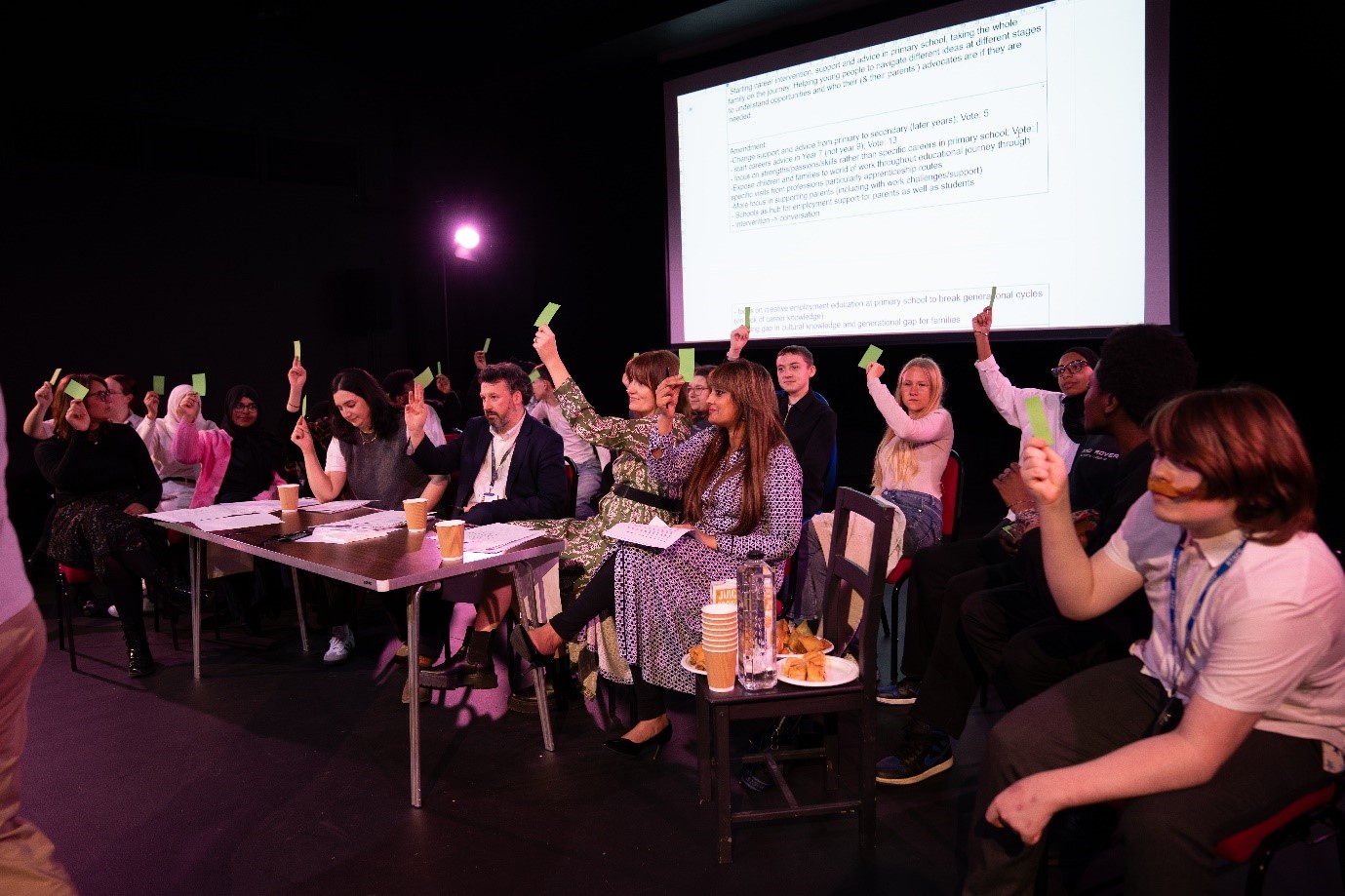
A recent example of inclusive approaches comes from the West Midlands, where the INSPIRE project, led by the University of Birmingham, used legislative theatre to engage young people in shaping youth employment policy. Legislative theatre is a method developed by Augusto Boal that uses performance to explore lived experience, test policy interventions, and co-create solutions. It involves watching a play co-created by the participants on real issues and based on their lived experience. During the event, an audience of community members and policymakers become spect-actors, acting out alternative scenarios, proposing policy changes, and voting on them in a public forum.

The University of Birmingham partnered with the Young Combined Authority and Youth Focus West Midlands to recruit a diverse group of 15 young people (14-17 years old) who, under the guidance of legislative theatre practitioners, developed a play about barriers to work experience and youth employment. Through performances and structured dialogue with policymakers, they co-created six policy proposals. These include reforms to careers advice, work experience, and employer accountability.

Crucially, policymakers were invited to participate not just as observers but as co-creators and champions. Their involvement can help bridge the gap between lived experience and institutional action, demonstrating how local government can play a central role in democratic innovation for social change.

Councillors as Democratic Innovators

Democratic innovations in Camden and the West Midlands are two examples of how local government can promote democratic renewal. Councillors can and should play more central roles in these processes, beyond party politics, to facilitate and nurture dialogue between citizens and institutions, ensuring follow-through on recommendations, and using committee structures to embed participatory outputs.

Rather than seeing participation as a threat, councillors can embrace it as a tool to strengthen their representative role and reconnect with communities. They are uniquely positioned to bridge the gap between citizen voice and institutional action. This requires a shift in mindset and practice.

Dr Jason Lowther is Director of Inlogov (the Institute of Local Government Studies) at the University of Birmingham, and was Assistant Director (Strategy) at Birmingham City Council from 2004 to 2018.  His research focuses on the use of evidence in public policy and central intervention in local government.

Dr Sonia Bussu is an Associate Professor at the University of Birmingham Department of Public Administration and Policy where she studies and teaches public policy. Her main research interests are participatory governance and democratic innovations, and creative and arts-based methods for research and public engagement. 

This article was first published in the Municipal Journal, 25th September 2025, available online here: https://www.themj.co.uk/renewing-democratic-leadership

Picture credit: Inspire Legislative Theatre, March 2025 – photo by Bucuria Maria Polodeanu – Insta: @reelmasterproduction

Cyclopean ‘local’ government and the end of local democracy?

Chris Game

As with another quite recent blog of mine, it’s important to start with the alert that most of its style, structure and content stem directly from its having been written in the first instance not for an academic readership, but as a column for probably this week’s Birmingham Post. There are a few additions and subtractions, plus, barring a dramatically uncharacteristic Lowtherian intervention, one guaranteeable difference: the title.

At the time of writing this intro I don’t know for certain what the Post editor’s choice of words and punctuation will be – except that it won’t comprise nine words, including three longish ones. Space and layout, you understand. It will, however – because regular authors do have at least some bargaining ‘say’ – open with that key word that many/most Post readers will barely recognise.

To summarise the whole thing: here in Britain we already have, and in England, following last December’s devolution White Paper, are about to develop still further, a scale of ‘local’ government that makes a complete mockery of the term ‘local’; and the present Government, with no noticeable public consultation, is embarked on increasing that non-local size still further – to truly Cyclopean dimensions.

And, as I sought to explain to the Post editor, by introducing this concept, rarely if ever used in modern political debate, both the Post and I will become – well, you never know – possibly a little bit famous. Here’s the reasoning.

First, ‘Cyclopean’, used in the context of local government.  Ancient Greek, pretty obviously, it originally described an architectural style in which the walls, towers and other fortifications of ancient cities like Mycenae (a 70-odd mile day trip SW of Athens) were constructed from massive limestone boulders – of the scale shown in the accompanying illustration – fitted extremely closely together without apparently having been substantially reshaped and without use of mortar or cement. 

So preternaturally impressive were these city constructions – the hilltop Mycenae was perhaps the most famous, but there were numerous others – that the myth developed that they must have been built by the Cyclopes, a race of superhuman giants in Greek mythology, and the only humans physically capable of creating such constructions. Hence ‘Cyclopean’ – to describe the assumed method and scale of a city’s governmental architecture, not the size of its residential population.

Somehow, though, towards the latter end of the 3,500 intervening years, the UK has developed, to an almost unique degree, its own interpretation of ‘Cyclopean local government’. Yes, there are loads of large buildings – Birmingham’s Council House and Central Library for starters, the Octagon, etc. – but there’s no Cyclopean mystery about what holds them together. Put crudely, it’s the concrete and steel, not some mystical manpower.

The UK’s, and particularly England’s, modern-day local government and its latest structural ‘reform’ have become almost entirely about scale. Instead of referring to the governance of, or provision of services for, a particular local community and its unique character, England’s ‘Cyclopean local government’ currently comprises just over 300 ‘local’ authorities, with populations averaging 180,000 – which is hardly our (or anyone’s) ‘everyday’ usage and understanding of that term ‘local’.

And yes, averaging. Which, of course, would make Birmingham’s 1.2 million population ‘super-Cyclopean’ – and the West Midlands Combined Authority’s 4 million ‘Mega-Cyclopean’. Or ‘hyper-Cyclopean’, which I personally slightly prefer, suggesting something beyond the bounds of reason, or control. We’ll return to that.

Some quick comparisons or contrasts: average size of German and Italian municipalities is around 7,500, Spain’s 5,700, and France, albeit as exceptional in its way as the UK, 1,900. Yes, slightly under one-hundredth the size of our average, and, by chance, roughly the same as our smallest, the Isles of Scilly, arguably our one ‘municipality’ that wouldn’t make a mockery of the term ‘autorité locale’.

The rest of the world, or first-time observers, find our scale figures as extraordinary as the Ancient Greeks found Mycenae. They are naturally curious as to how we do anything purporting to be genuinely ‘local’ government on such a manifestly non-local scale, and, above all, why.  Good questions, but not for a local newspaper column. Indeed, not for the likes of us mere citizens and voters either, because no one’s bothering to ask us.

The major redesign of England’s local government is currently in the hands of Angela Rayner – Deputy Prime Minister + (in any spare time) Secretary of State for Housing, Communities and Local Government.  An early action was to cancel – arguably “legally risky”, if not unconstitutionally (see Google– ‘Cancellation of 2025 English local elections’) – nine May 2025 county and unitary council elections, she/someone in the Government having decided that these bodies had had their day and there would be no room for them in her new, but still undefined, single-tier England.

Rightly describing the UK as the “most centralised” country in Europe (https://www.bbc.co.uk/news/articles/cn0xz4938z9o), Rayner’s apparent plan is to end central government’s micro-management by making ours, by a distance, the least localised – most Cyclopean – ‘local government’ certainly in Europe, if not the world (500,000 minimum), and, it would appear, without a great deal of consultation.

The ’plan’, in summary, represents the biggest and most transformative upheaval of English local government in my adult lifetime (sorry, you’ll have to work it out!), rushed/bullied through Parliament and local government itself with absolutely minimal consultation and consequential analysis. In short, modern-day Cyclopean local government.

Chris Game is an INLOGOV Associate, and Visiting Professor at Kwansei Gakuin University, Osaka, Japan.  He is joint-author (with Professor David Wilson) of the successive editions of Local Government in the United Kingdom, and a regular columnist for The Birmingham Post.

Picture credit: https://stock.adobe.com/uk/images/odysseus-und-seine-gefahrten-fluchten-vor-dem-zyklopen-polyphem/608942497

Do we need yet another body to help local government harness the potential of AI?

Dr Caroline Webb, Dr Stephen Jeffares, and Dr Tarsem Singh Cooner

Does local government need a devolved AI service to help the sector successfully harness the transformative power of AI? A new paper from the Tony Blair Institute (TBI) thinks so.

In their recent report “Governing in the Age of AI: Reimagining Local government” TBI make the case that local government faces several significant challenges – there’s a growing backlog of people seeking support coupled withdwindling resources and two thirds of funds must be spent on social care. Satisfaction is declining. Over £1.8bn is spent by the sector on technology, but innovation is stifled by a patchwork of legacy systems. The solution TBI suggest is the universal embracing of AI tools, but which is orchestrated, curated, supported and (one day perhaps) exploited via the establishment of a Devolved AI Service (DIAS).

The adoption of AI by councils continues to accelerate. Vendors of these tools extol the positive outcomes of AI, suggesting that “the day-to-day tasks of local government, whether related to the delivery of public services or planning for the local area, can all be performed faster, better and cheaper with the use of AI” (p3).  The UK, they argue, could save £200 billion over five-years though AI related productivity improvements (p7).

Whilst AI undoubtedly has the potential to increase the efficiency of some public services, we must pause to ask is it really the panacea that it is being marketed as, and are some public services being unfairly targeted by technology firms looking to promote their products and capitalise on an emerging market?

There is a clamour in the social care sector for example, which accounts for 64.8 per cent of the total budget for local government in England, to develop AI tools that can offer significant time savings, with the rationale that workers can spend more quality time with clients and less time on completing paperwork.  TBI cite Beam’s automated note-taking tool Magic Notes, that aims to transform social workers’ productivity by saving them s up to ‘a day per week on admin tasks’. Yet without external scrutiny and verifiable evaluation, such figures are little more than marketing claims.

As these technologies are capturing and summarising meetings to support some of the most vulnerable members of society, there is a need for local councils to interrogate these marketing claims critically before committing to such AI tools.  Despite safeguards such as ensuring a ‘human in the loop’, if these claims are not thoroughly examined there is a danger that these technologies may serve to reinforce and perpetuate existing biases, pose risks to clients’ data privacy and safety, strengthen process-driven systems which undermine person-centred decision making, and erode the relational foundations on which these services are built.

Of course, AI has numerous applications beyond reducing the cost of resource intensive casework. It has the potential to address some of the most despised and most intractable local policy problems (potholes, mould, chronic pain, mental health waiting lists). But the desirability of these innovations should not cause us to forget that these technologies themselves are not neutral, and just as they can lead to positive outcomes, if they are misused or implemented without proper ethical considerations, then adverse effects are just as likely to emerge.

The proposed introduction of a Devolved AI Service may go some way to ensuring a set of standardised safeguards, allowing for a coordinated approach to AI adoption within public services.  This collective approach could reduce duplication, provide practical support for the implementation and evaluation of sector-specific AI tools and facilitate a collaborative approach to working with technology providers to improve their products.  However, is it necessary to impose another central regulator on Local Government? There is already considerable piloting and evaluation of AI tools being conducted at the local level. These sector-specific evaluations are facilitating opportunities for shared horizontal learning across organisations. But it is vital that these results are shared, and that the evaluative measures and methods being employed are not imposed by the vendor of the tool, but rather determined by the needs of the organisation and the people they serve. Such evaluation should also consider more than value for money or accuracy, but also the experiences of frontline staff and citizens.

Ultimately, irrespective of how we chose to oversee the integration of AI tools, we must not lose sight of the fact that these tools should only be viewed as ‘part’ of the solution to providing effective public services, not the ‘whole’ answer as some technology companies may lead us to believe.

Dr Caroline Webb, Dr Stephen Jeffares, and Dr Tarsem Singh Cooner are academics at the University of Birmingham exploring how AI is reshaping frontline public service. Combining expertise in social work, public policy, and digital ethics, they develop training and research that support practitioners to engage critically and confidently with emerging technologies. Their work champions ethical, human-centred innovation in public services.

Cotswold District Council elections – more interesting than you imagined?

Chris Game

I’ve literally just finished watching the LGIU’s promotion of its new Future Local Lab – asking me personally, albeit rhetorically (“Chris, are you ready?”): “How are we going to survive climate?”, “Will there be enough houses?”, “What can we use Artificial Intelligence for?” and a dozen other similar teasers. If this is the kind of thing you’re into, please skip this blog entirely. It’s right at the other end of whatever scale the LGIU is operating on.

I was emailed over the weekend by an erstwhile colleague who, driving back to Birmingham through the Cotswolds, noticed that there is a local by-election this week for Cotswold District Council. Interesting, eh? No, if you’re still there, don’t go away just yet – there’s a bit more to it.

No, not control of the council. Historically Independent, then Conservative, Cotswold DC is nowadays comfortably Lib Dem: 20 Lib Dems, 9 Conservatives, 2 Greens, 2 Independents. So, even though it’s a Lib Dem member who’s resigning, the politics of the council won’t change. The real issue is: for how long will there be a Cotswold DC, or, for that matter, any of the other five Gloucestershire DCs – following Deputy PM Angela Rayner’s White Paper announcement that all England’s district councils will be abolished, with regional mayors and unitary councils to be introduced in all areas?

A council which in Gloucestershire’s case would currently be odds-on to be no longer, after two decades, Conservative, but, like Cotswold DC, Lib Dem. Or would it? The general assumption following the Government’s December White Paper seems to have been that in counties like Gloucestershire all six of the district councils would merge with the county council to produce, well, a pretty large and definitely non-local Gloucestershire Unitary Council.

To which prospect, as I assume is happening quite widely across England, there has been adverse reaction. Gloucestershire would be just in the top third largest counties (by population), and in its case five of the county’s MPs have recently written to the Minister of State for Local Government and English Devolution, Jim McMahon, proposing instead something on at least a slightly less ginormous scale. In this case, that two unitary councils be created – covering, in this instance, the Forest of Dean, Gloucester and Stroud in the West, and Cheltenham, Tewkesbury and the Cotswolds in the East. The area is simply too large to be covered by one council, they argue, although, probably unsurprisingly, the County Council would disagree.

Indeed, it has been looking at how Gloucestershire could enter into an even bigger Combined Authority with neighbouring counties: variously joining Herefordshire and Worcestershire to the north, becoming part of the West of England Authority around Bristol to the south, or joining with Oxfordshire, Berkshire, Reading and Swindon to the east. I’m guessing similar deliberations are happening across the country.

Whatever – it’s not exactly ‘local government’ as my emailing ex-colleague and I once knew it! Yes, back to him, and indeed the prompt for this blog. His main reason for emailing about this week’s Cotswold Council by-election was that he knew we would both recall what was almost certainly the last time one of those was in the news – the national news, that is.

It was in May 2023, when the Lib Dems strengthened their control of Cotswold DC, thanks in part to a Chris(topher) Twells taking the Tetbury with Upton ward from the Conservatives. Yes, the same Cllr Twells who was at the time and continued for a further year to be also a member of Salford City Council, 160 miles away, just west of Manchester.

As it came to be public knowledge, it was, of course, controversial – with initially, in some circles anyway, some uncertainty about its legality, not helped by the fact that apparently even the local leadership of his new party group had been unaware of the situation. All of which seemed barely credible, since even I could have told them about the legality bit, without even checking. Anyway, soon after his Cotswold election he was suspended by his own party, “to enable a complaint to be assessed”, which had prompted my weekend emailer to contact me. But I decided even I couldn’t pad it out into a blog – until now!
Double-Cllr Twells’ own self-justification was clear enough, but didn’t do him any great favours. Most obviously it was legal because “your qualifications to stand for election can be based on occupying property or work”. Correct. Working for himself gave him the “flexibility” to attend all necessary meetings of both councils. OK. The councillor sitting on two authorities 150 miles apart had no problem fulfilling all his duties because an elected member’s workload “is not enormously onerous”. Hmm – not guaranteed to make you many friends.

And the killer punch: “I don’t want to worry anyone, but I’m technically qualified to stand for up to five districts in England and Wales”. I don’t think he meant contemporaneously, but it’s a good way of remembering just what the law says.

Chris Game is an INLOGOV Associate, and Visiting Professor at Kwansei Gakuin University, Osaka, Japan.  He is joint-author (with Professor David Wilson) of the successive editions of Local Government in the United Kingdom, and a regular columnist for The Birmingham Post.

Dusting down the cautious welcome: Initial reflections on the devolution white paper

Phil Swann

When I was director of strategy and communications at the LGA I was frequently criticised, by the late professor John Stewart among others, for issuing press releases “cautiously welcoming” one Blairite initiative or another.

The criticism was probably justified, but I would definitely have deployed that phrase in response to the government’s recently published devolution white paper.

There is undoubtedly a lot to welcome, not least the stated commitment to devolution, the additional powers for metro mayors, the revival of strategic planning, its reference to struggling small unitary councils and the focus on audit and standards.

There are, however, at least four reasons to be cautious.

First, every serious reformer of local government since George Goschen in the 1860s has argued that local government finance and structures should be reformed together. No government has ever had the political will or energy to do so. This government has also ducked the opportunity. As a result, this white paper will not fulfil its potential.

Second, the current mess and confusion in the structure of English local government is the result of incremental change. Just think of Peter Shore’s “organic change” and Michael Heseltine’s ill-fated Banham Commission. There is a real danger that this government will run out of restructuring energy or time. The contrast with Scotland and Wales, where local government was reorganised in one go, could not be starker.

Third, the effectiveness of the structures being proposed will depend on the quality of the relationships between mayors and councils, between councils and parishes and between ministers and mayors, councils and parishes. In England we are not good at relationships like these and there is precious little in the white paper to signal the trust, effort and imagination that will be needed to make these relationships work better than the previous ones did.

Finally, key to the revival of local government and effective devolution is a revival of citizen engagement in local politics and local governance. Word has it this will be addressed in a forthcoming white paper, but it should be central to this one.

So, a very cautious welcome it is.

Phil Swann is studying for a PhD on central-local government relations at INLOGOV.

Local Democracy in Crisis?

Peter Hetherington

Battered by fourteen years of austerity, is local government losing its once-proud standing and status? Probably. For a start, It’s no longer as ‘local’ as it should be. And it certainly isn’t ‘government’ as we once knew it.


These days, we sometimes tend to lump ‘democracy’ and ‘crisis’ together in a global context, forgetting that close to our doorsteps – in countless civic centres, town and county halls – there’s another crisis: restoring faith in local democracy, while sustaining councils literally facing insolvency.

At a hybrid event, organised by the Centre for Urban and Regional Studies at Newcastle University, we asked a simple question at the start: Do we need a new, positive direction for once-powerful towns and communities where meaningful democracy has disappeared as local government has withdrawn?

We attracted a great range of speakers putting, broadly, two cases: first for a new local government structure in England based on economic geography embracing combined authorities for big city areas alongside large county-wide single purpose unitary authorities, underpinned by a more equitable funding formula; and, secondly, for varying degrees of town and parish governance, sustained by participatory democracy, including citizens assemblies, with powers – parks, libraries, leisure facilities for instance – devolved from existing larger authorities. Often, such an asset transfer is born out of necessity because larger councils can’t afford to keep them anyway and parishes/towns can raise money through a council tax precept while sometimes creating stand-alone community interest companies.

The case for a genuine new ‘localism’ appeared strong. That’s because, currently, a continuing process of abolishing councils to create larger units with few, if any, local roots has created a sense of powerlessness, a collective loss of identity with little or no attachment to people and places. Fifty years’ ago England had almost 1200 councils, from the smallest urban/rural district to the largest city. “We were run by our own,” recalled the writer, broadcaster and ultimate polymath Melvyn Bragg, in his 2022 memoir ‘Back in the Day’. Born in Wigton, Cumbria, his small town had a rural district council (which I knew well): “We could challenge the elected councillors who made the decisions” Bragg continued. “They were not a separate cadre…they were just people you had been to school with…(approach) on the street…to whom you could write a personal letter knowing it would be read, considered, answered.”

No longer. His council disappeared in 1974. Today, after several rounds of ‘reorganisation’ under the dubious label of efficiency – although there’s little concrete evidence of cost saving – that number has been reduced to 317, with little if any public debate. A forthcoming devolution White Paper is expected to advocate more reorganisation and even fewer councils in a country where local authorities already cover much larger areas than in mainland Europe.

Against this background, it’s probably no surprise that Carnegie UK, in its recent ‘Life in the UK’ index, reports that a lack of trust in politics and government is undermining collective well being. Three-quarters of people, says Carnegie, feel they can’t influence decisions. Surely reconnecting them begins locally. But how local?

If the government’s approach so far is a broad definition of ‘taking back control’, could an over-arching contradiction be emerging? Will the apparent obsession with more all-purpose councils, the prospect of an all-unitary England – similar to the structure in Scotland and Wales – make people feel even more distant from power, disaffected? Carnegie insists that restoring faith in democracy should be the Government’s ‘mission of missions’.

If that’s one challenge, there’s another, interlinked: the crisis of financing local government, with 7 councils theoretically insolvent and many more heading that way; legally, they can’t go bust and have been forced to borrow the equivalent of pay-day loans on a mega-scale to stay afloat, adding to a debt mountain. Now Conservative-run Hampshire has said issuing a section 114 notice – prelude to technical insolvency – is “almost inevitable”, with a sting of others close behind. And as Prof Andy Pike, and Jack Shaw have outlined in their recent excellent, but chilling paper (‘The geography of local authority financial distress in England’) 96% of English councils won’t balance their books by 2026-27.

Of course, alongside that unparalleled financial crisis in local government, we’re also facing an alarming democratic challenge nationally with the lowest turnout ever recorded in the recent general election; almost half the electorate didn’t vote! Surely, the place to renew trust in the democratic process begins at the grass roots, perhaps reviving some of the 10,000 town and parish councils, some of which want to take over functions from larger authorities (some are obliging out of necessity). Could this – call it double devolution – provide one small way forward?

I’m aware there’s a danger that events, like the latest one at CURDS addressing the crisis in local democracy, can produce a combination of hand-wringing and hot air. But, hopefully, we concluded with a practical, positive outcome. As Professor Jane Willis, geographer and champion of community empowerment – now in Cornwall- noted: “It’s not all gloom and doom – there is good news.” In her county, communities are taking back control, again out of necessity – a really positive story and a lesson for elsewhere? Willis advocates a new social contract under a layered system of local government to “re-franchise” people.


In the meantime, the chair of the event urged those present to make their views known to MPs, and the government, as the forthcoming devolution White Paper foreshadows a pre-legislative consultation process. As Professor Andy Pike, of CURDS, noted in summing up, one leading question needed answering above all: “What is local government for, and how to fund it?”


All we know so far is that the White Paper, according to the Treasury, will include …“working with councils to move to simpler structures that make sense of their local area with efficiency savings from council reorganisation helping to meet the needs of local people…”. Contradictory or otherwise – will more larger councils “make sense” of local areas? – we must surely intensify a campaign for a genuine new ‘localism’, embracing places, communities, towns and some cities now without any form of local government. That doesn’t necessarily mean sidelining the case for a new – and/or revised – local government structure in England tied to a ‘needs’-based funding formula. The current one favours the richer parts of the country and penalises the poorest with the lowest tax bases.


But the time for national government to act is during the first year or so of a new administration. It assuredly won’t go down well with the ‘middle England’ target readership of – say – the Daily Mail. There’ll be howls of protest. But it must be a priority to bring a sense of fairness to a deeply unequal country and, equally importantly, deliver some hope to voters in the so-called ‘red wall’ seats who either returned to Labour at the last election or voted for an ascendant Reform. We live in a fragile democracy. Restoring faith in government, local and national, begins in community, neighbourhood parish and town. We need the Labour government to think big and act local. We haven’t much time.

Peter Hetherington is a British journalist. He writes regularly for The Guardian on land, communities, and regeneration.  He is also a vice-president, and past chair of the Town and Country Planning Association, former regional affairs and northern editor of The Guardian and the author of the 2015 book, Whose Land is Our Land? The use and abuse of Britain’s forgotten acres, and the 2021 book, Land Renewed: Reworking the Countryside.