Two cheers for combined authorities and their mayors

Vivien Lowndes and Phil Swann

There are reasons to be cheerful about the fact that the newest component of English local government, the mayoral combined authorities, were in the headlines this spring. There were also reasons for caution, however, most notably the particular focus on two of the mayoral elections, in Teesside and the West Midlands, as a guide to the popularity (or not) nationally of Rishi Sunak and the Conservative Party.

This fact that combined authorities were in the news is a prompt to take stock of their development and impact with some thoughts stimulated by the discussion at a recent INLOGOV Brown Bag[1] session.

The media attention was attributable to the mayoral elections, with many of the incumbent candidates having established a national profile by, for example, challenging the government’s approach to Covid (Andy Burnham in Greater Manchester), defying political gravity and weak governance (Ben Houchen in Teesside) or crafting a new brand of active, compassionate Conservatism and challenging the government’s pruning of HS2 (Andy Street in the West Midlands).

The mayors have also disrupted the escalator assumption of British politics in which ambitious politicians use local government as a stepping stone to parliament and government. Burnham, Liverpool City Region’s Steve Rotherham and the new mayor of the East Midlands Claire Ward have each moved in the opposite direction.

The metro mayors undoubtedly have higher profiles than most council leaders. They have demonstrated impact beyond their statutory remit through soft power, particularly their ability to convene discussions and galvanise action on issues such as public health and homelessness.

Doubts remain about the sense of vesting so much power in a single individual. Only three of the twelve metro-mayors are women, showing the danger of equating ‘strong leader’ with ‘strong man’. More effort is needed on the part of political parties to diversify their mayoral candidate selection.

It is also valid to question whether, for example, an elected mayor in the West Midlands would have added more value as part of the city council’s governance rather than that of the wider city region. Some would argue that the city would benefit from the type of focussed political leadership that Mayor Jules Pipe provided in Hackney. Experience in both Liverpool and Bristol suggests that having a mayor at both city and city region level causes confusion.

There has been very little discussion about the role of council leaders as key players in the governance of combined authorities through their membership of the mayors’ cabinets. As one council leader in Greater Manchester is quoted[2] as saying: “We have to work with a mayor we did not want while he has to work with a cabinet he did not chose”.

The Greater London Authority model is very different, with a separately elected London assembly as well as a mayor. While this may seem more democratic, public awareness of the assembly is far lower than that of the mayor[3]. Perhaps it is time for a comparative review of these two very different sets of governance arrangements. In both cases, there is a strong argument for greater public involvement outside of the electoral cycle, both in setting up new combined authorities and to inform ongoing priorities.

The role of council leaders is inevitably linked with the wider question of the relationship between the combined authorities and their constituent councils. To date this has proved to be remarkably smooth, particularly given the often toxic precedent of county-district relations. The next period may be more testing. To date, councils and metro mayors have been united in coping with austerity, but difficult decisions about priorities will have to be taken should a new government make limited additional resources available. The increased interest of combined authorities and mayors in strategic spatial planning and housing will also raise challenging and potentially divisive issues.

The jury is out on the extent to which the establishment of combined authorities has led to substantive devolution of power from central government, although progress has been made in areas such as adult education, transport, health (in Greater Manchester) and mental health (in the West Midlands). While the new ‘trailblazer deals’ in Greater Manchester and the West Midlands promise a single funding settlement with central government, other combined authorities find themselves still bogged down in competitive bidding for relatively small pots of money.

One important feature of combined authorities is the way they are creating opportunities for innovation and testing new ways of working at a local level. To fully exploit the potential of this development it is important that arrangements are put in place to capture this learning and share it between combined authorities, and especially with newcomers like East Midlands, North East and York and North Yorkshire. There is also potential for metro-mayors to speak with a stronger collective voice in challenging and informing central government on issues affecting local and regional governance.

Finally, it is important to remember that combined authorities did not begin with a blank sheet of paper. The GLA and many of the combined authorities have similar boundaries as the GLC and metropolitan counties which were abolished by Margaret Thatcher in a fit of political pique in the 1980s.

Harold Macmillan pioneered regional arrangements for devolved delivery with regional boards to promote industrial productivity during the second world war and regional housing production boards to help meet his 300,000 a year housing target in the 1950s. Neither were well-received in Whitehall. John Prescott followed with his regional development agencies, abolished by Cameron’s coalition government, and his failed bid to create regional assemblies. What marks out combined authorities is the lack of a ‘one size fits all’ approach, with size, functions and governance arrangements varying around the country.[4] Indeed, only 50% of England’s population live in combined authority areas (so far).

Given this rocky terrain, it may be rash to vest too much hope in combined authorities and their mayors. But they clearly have the potential to disrupt our centralised politics and join-up aspects of regional governance after decades of damaging fragmentation.

Vivien Lowndes is Professor Emerita in the School of Government, University of Birmingham.

Phil Swann is studying for a PhD at INLOGOV in the Department of Public Administration and Policy, University of Birmingham, on the contribution of politicians to central-local government relations.

Picture credit: https://www.birminghammail.co.uk/black-country/sir-keir-starmer-walsall-pledges-29162669


[1] INLOGOV’s Brown Bag sessions are informal monthly discussions on events in and around local government bringing together academics, researchers, students, practitioners and alumni. For further details please Phil Swann ([email protected])

[2] Blakeley, G and Evans, B. 2023 How metro mayors are getting things done – even if they have limited money and power. The Conversation June 28 2023.

[3] According to London Elects (londonelects.org.uk) in January 2020 58% of people were aware that a mayoral election was taking place compared with 32% for the assembly election (down from 40% in 2016).

[4] Durose, C. and Lowndes, V. 2021. Why are designs for urban governance so often incomplete? A conceptual framework for explaining and harnessing institutional incompleteness, Environment & Planning C: Politics & Space, https://doi.org/10.1177/2399654421990;

Durose, C. and Lowndes, V. 2023. The pros and cons of messy devo (themj.co.uk) Municipal Journal 

Democratising public administration through public-common partnerships: the case of the Citizen Assets Programme in Barcelona

Marina Pera and Sonia Bussu

In a recent article titled Towards Democratisation of Public Administration:Public-Commons Partnerships in Barcelona, part of a Special issue on The International Journal of the Commons (edited by Dr Hendrik Wagenaar and Dr Koen Bartels), we explored public-commons partnerships in Barcelona through a relational lens, examining how they might be contributing to deeper democratisation of public administration.

The commons refer to those cultural and material resources collectively managed by the community and represent an alternative to both the state and the market. Recent literature emphasises the capacity of the commons’ prefigurative politics to develop alternative institutions to neoliberal regimes and/or deliberative and collective forms of resource management. The grassroots movements managing the commons often take an oppositional stance to the state, but they might also depend on its resources. By the same token, the state has an interest in supporting assets and services managed as commons, which offer flexibility and efficiency, while encouraging citizen participation in local politics.  

Within political contexts sympathetic to progressive socio-economic projects, such as  new municipalism in Barcelona, formalised alliances between the local state and the commons started to emerge, facilitating the development of novel policy instruments that respond better to the demands of the commons and open opportunities for more participatory policymaking. So-called public-common partnerships are long-term agreements based on cooperation between state actors and the commons members. In our paper, we wanted to understand better the relational work behind these partnerships and the role of boundary spanners that build bridges between two worlds, such as the state and the commons, which are often quite distant in terms of visions of local democracy and the language to articulate such visions.  We take the case of the Citizen Asset Programme (CAP) in Barcelona to explore the relationships between public officials and commons members, highlighting how these collaborations shape governance practices and can help foster a collaborative culture within public administration.

CAP was approved in 2016 and aims to create the institutional framework to recognise and support commons-managed municipal assets in the city. Based on qualitative analysis of interviews with public officials and commons members involved in the partnership, as well as official documents, we drew out insights on the relational dynamics that facilitated the creation of two policy instruments under CAP: The Community Balance Metrics and the Social Return on Investment of Can Batlló. The first one is a set of indicators to evaluate the performance of community-managed assets considering their transformative potential and including dimensions of internal democracy, care, inclusion, and environmental sustainability. The second helps to measure the value of activities and volunteer work carried out in the community centre of Can Batlló.

Through a series of vignettes depicting the different state and commons actors involved, we examined how they forged alliances and employed creative thinking to manage conflicts, resistance, and scepticism from both the local administration and the grassroots movements. Public officials from the Active Democracy Department were able to build trust among commons representatives by recognising their needs and potential. They explained the workings of public administration in a clear language. They created spaces of open-ended dialogue between grassroots movements and different departments to facilitate the development of policy instruments, measures and indicators that valued the commons’ innovative work, while still coherent with existing legal requirements. For instance, a working commission was set up involving members of Can Batlló, the Legal and the Heritage Department, as well as representatives of the District administration. This public-commons partnership developed a comprehensive agreement to regulate asset transfers, which fully recognises the social and economic value of the commons.

By the same token, the commons members played a crucial role in communicating to grassroots movements the work of the Active Democracy officials and build mutual trust. On the one hand, they helped the commons understand feasibility issues of their demands; on the other they pressed the public administration for greater transparency and creative interpretation of existing regulatory framework to strengthen democratic values underpinning asset transfer agreements.

Two cooperatives supported these partnerships as consultants. They contributed knowledge of innovative public policies from across the world. They also facilitated knowledge sharing to encourage cooperation between commons members and state institutions, for instance by inviting grassroots groups from other parts of the world to share their experience of working with the state.

The work of these public-commons partnerships is gradually reshaping the administrative culture and fostering more transparent and democratic working practices within the public administration. An example is the joint work to develop the Community Balance Metrics, which helps evaluate the performance of the commons using indicators agreed upon by both local public administration and the commons. However, these processes face a number of challenges, as they clash with established working routines and performance evaluations of public administrators that hardly ever value participatory work. Existing literature suggests that despite the introduction and encouragement of new practices, there is a tendency to revert to traditional policymaking methods when faced with unexpected problems. When boundary spanners that had supported the partnership exit the process, they can leave a vacuum that is hard to fill and that can jeopardise the partnership. In Barcelona, ongoing discussion between Can Batlló members and the City Council on who is responsible for funding the refurbishment of one of Can Batlló’s building is causing friction within the partnership and some of the work has stalled.

Inevitably this collaborative work is hard to sustain, but in the face of multiple and overlapping crises facing local government, these public-commons partnerships are also beginning to open safe space to experiment and do things differently.

Picture credit: Victoria Sánchez.

Sonia is an Associate Professor in INLOGOV. Her main research interests are participatory governance and democratic innovations, and creative and arts-based methods for research and public engagement. She led on projects on youth participation to influence mental health policy and services, coproduction of research on health and social care integration, models of local governance, and leadership styles within collaborative governance.

Marina is a researcher at Autonomous University of Barcelona (UAB). She holds a PhD in Public Policy from UAB and a M.A. in Sociology from Columbia University (New York). She has been a visiting scholar at CUNY Graduate Center (New York) and at INLOGOV, University of Birmingham. Her research interests
include community assets transfer, democratisation of public administration, community development and public-common partnerships.

Does Parliament discuss Local Government issues?

Steve Watson

So far in 2024 (as at 19th March), there have been 26 debates in Parliament to discuss Local Government issues. By way of comparison, there have been 12 debates on illegal immigration, and 16 on energy prices.

So, it seems reasonable to conclude that Parliament does discuss Local Government issues, but what issues have been discussed and who’s been doing the talking?

There are various sources of data on this topic, including Hansard and Parliament TV.  For this blog, I used the ScrutinyCounts app, which analyses MP’s contributions in Parliament (as recorded by Commons Hansard) and presents the data in an easy-to-use format on a mobile app so users can see who is saying what about which topics quickly and easily on their smartphone. 

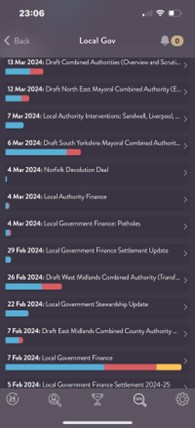
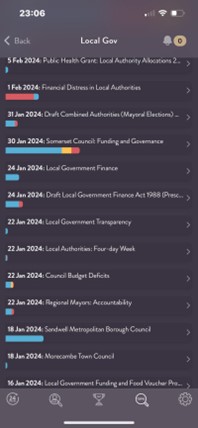
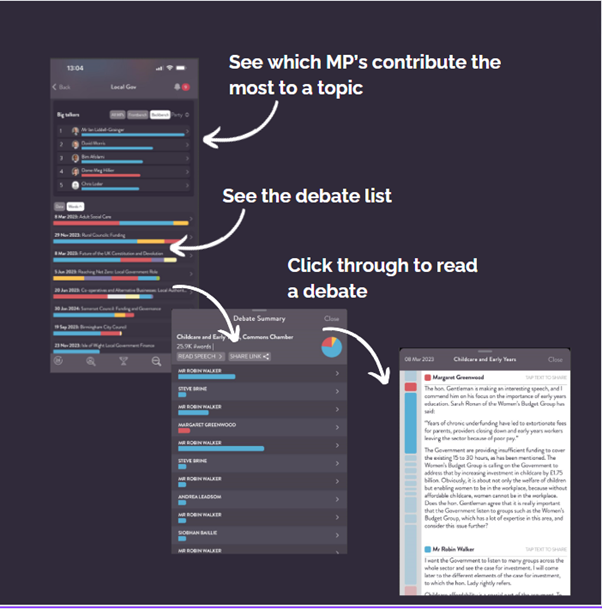
The charts below, taken from the Scrutiny Counts mobile app, show the Local Government debates that have taken place so far this year and the date they took place.

As can be seen from the screenshot charts, there’s a breadth of discussion on Local Government matters ranging from Financial Distress and Funding, Combined Authorities, Mayors, through to Four-day week working. Within the app, there is click-thru functionality which lets you see the full debate content, the MP’s who have participated, and the contributions they have made. There’s also “share” functionality to enable useful and interesting content to be quickly and easily shared with friends and colleagues.

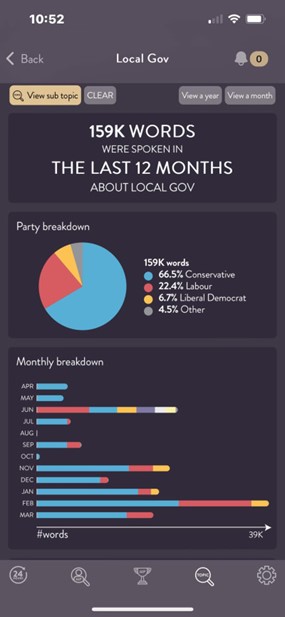
Looking across the past twelve months, there have been over 159,000 words spoken in Local Government debates (measured by words spoken as recorded in Commons Hansard).

Across the debates, Conservative MPs contributed into the debates 66.5%, Labour 22.4% and other parties 11.2% (this compares with the party split by number of sitting MPs of 53%, 30% and 17% respectively).

As can be seen in the “monthly breakdown” area of the chart below, after a relatively quiet few months over summer of 2023, the level of debate activity significantly increased during Autumn 23 and early 2024 with February 2024 being a particularly busy month.

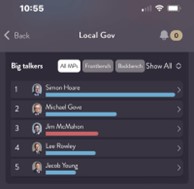
Perhaps not unsurprisingly the top contributing MPs in Local Government debates were government and shadow government ministers such as Simon Hoare (Parliamentary Under Secretary of State (Department for Levelling Up, Housing and Communities) and Jim McMahon (Shadow Minister (Levelling Up, Housing, Communities and Local Government) with contributions being made in their respective roles.

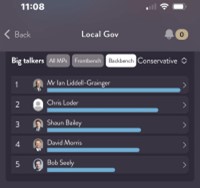
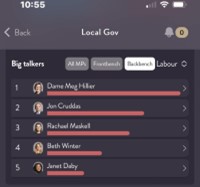
But aside from Frontbench MP’s, who have been the top contributing Backbench MPs in Local Government related debates during the last 12 months? (measured by words spoken as recorded by Commons Hansard).

The charts below show the top contributing Frontbench MPs, and the top contributing Backbench Conservative and Labour MP’s;

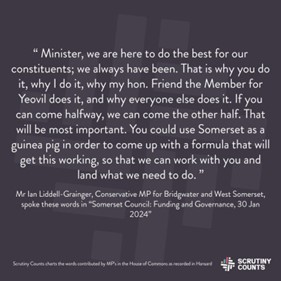
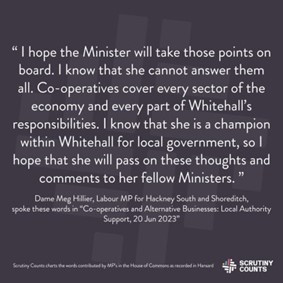
There are often detailed and constructive contributions into the debates from all the parties. The quotes shown below are taken from speeches given by the two top contributors in the above charts. They both give an insight into the work that MPs do in representing their communities and constituents in parliamentary debates.

So, in summary, yes Local Government issues are discussed in Parliament. The news in the mainstream media may focus on the weekly exchanges in PMQ’s, the political gossip of the day, or the topical late night divisions and votes, but in so doing many don’t see the work MP’s of all parties do in important debates across a range of subjects such as Local Government, Housing, Social Care, etc.

The contributions in debates are often constructive and well thought through, providing valuable insight for politicians, councillors, and council officers and all those with an interest in Local Government. The debates form an important function in bringing local issues to the national stage and play an important role in our democratic system.

The charts and images in the article are taken from the ScrutinyCounts mobile app which is available via subscription on Apple AppStore and Google Playstore. The app uses data as reported in Commons Hansard and presents it in an easy to digest format which enables users to quickly and easily read what MPs are discussing in Parliament.

Steve Watson is a Director of Hinc Ltd, the provider of the ScrutinyCounts mobile app. Steve started his career as an electronics engineer but quickly came to realise he was more suited to working with computers rather than designing them! After being a joint owner of a Local Authority data insight company which was successfully grew and subsequently sold, Steve started a new venture to develop a mobile app called ScrutinyCounts which enables users to quickly and easily see what is being said, and by who, in Parliament.   More information about ScrutinyCounts can be found here or at Twitter/X @ScrutinyCounts 

The UK’s Flipping Gender Gap

Chris Game

As I’ve aged, I’ve become ever keener to find mnemonic tricks that might help my increasingly faulty memory to recall potentially useful stuff – like, this week, key dates in the history of women’s suffrage. At some point somewhere during the extended celebrations of International Women’s Day (IWD) beyond March 8th, for example, there’s almost bound to be some reference to women gaining (or, in Afghanistan, losing/regaining?) the right to vote.

I used to lecture about this historic stuff and my women’s suffrage mnemonic was/is 1869, the year at least a few women – unmarried ratepayers in GB & Ireland – gained the right to vote in local elections.  Which, while obviously not globally record-breaking, sounds tolerably progressive – until you deploy the mnemonic, reverse the central digits, and recall that women in the Dutch province of Friesland had been at it for nearly two centuries – or since 1689, to be precise.

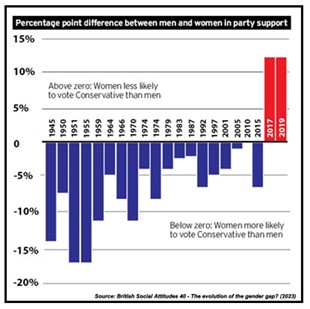
This IWD contribution, unsurprisingly, is not about women gaining the vote, but how, in post-war Britain they’ve collectively been exercising it in successive General Elections. And it’s aided by the following striking graph, whose ‘gender gap’ approach was developed by Inglehart and Norris back in 2000. They and their successors duly updated it in successive elections, drawing comparisons/contrasts with other countries, but only in the past few years has it really come into its own, and for the obvious reason: that it’s so visually, and politically, striking – as the version prepared for me by the Birmingham Posts editorial team demonstrates.

All but one of the first 19 bars/columns are blue, showing women as more likely to have voted Conservative by varying percentages up to a mighty 17% in the early 1950s. The sole exception was 2010, the first of the recent run of ‘hung Parliament’ elections, when men and women were equally likely to have voted Conservative, so no column at all.

It had become a truism: that, certainly in Britain, women were at least marginally more Conservative or right-wing than men in their voting behaviour. Until suddenly, in both the 2017 and 2019 General Elections, they weren’t – in each case being a sizeable 12% LESS likely to have voted Conservative than men.

Some unknowable proportion of what was swiftly tagged our Flipping Gender Gap was undoubtedly attributable to women’s consistently greater enthusiasm for remaining in the EU, but those striking 2019 gender gap figures are still worth detailing. Conservative: 47% of men, 42% of women; Labour: 29% of men, 37% of women – representing a massive 18% Conservative lead over Labour amongst men, and just a 5% lead amongst women.

Which begs the obvious question of whether we’ll see something comparable this time, and, if so, to what degree? Or was it, say, Brexit in those two elections that produced a kind of two-off aberration? Either way, these ‘gender gap’ statistics will be among the most anticipated and intensively studied, as commentators prepare their voting forecasts.

Indeed, they already have been, the commonest immediate reaction from those who study these things, particularly following the 2019 election, being that “at last” UK women voters were catching up.

For the stats have shown that for years now many/most other established democracies – the US outstandingly, but also the Scandinavians, Netherlands, Germany, Austria, Canada, even Italy – had seen the development of a modern-day gender gap, with women more likely to vote for left-leaning parties than men, while our gender gap showed the reverse.

No longer, then, did the UK seem to be bucking the global trend. As in these other democracies, as more women entered higher education and paid work, some at least became more socially and economically liberal and supportive of gender equality, pushing them to the left of men in their party choices.

Even just typing that ‘UK women voters’ label, though, I’m conscious of risking over-simplification. And indeed, it obscures significant and unsurprising differences across age cohorts. Younger women are considerably more likely to support Labour and less likely to support the Conservatives than younger men, but this modern gender gap lessens and eventually disappears among older voters.

So how will all this affect what happens in this year’s General Election? The estimable UK Women’s Budget Group commissioned a YouGov poll last autumn which reflected and updated some of the above findings – starting with almost a law of UK electoral politics: women take their time to decide.

Asked for their voting intentions, 18% of respondents hadn’t, with no election in the immediate offing, made up their minds: 11% of men and a full 25% of women. Those that had decided split very similarly between the major parties: Men – 20% Conservative, 31% Labour, 7% Lib Dem; Women – 17%, 31%, 8%.

The big difference came with the then Don’t Knows: just 11% of the men, but one in every four women. So, if they hadn’t then decided, perhaps they won’t vote?  By no means: 13% of males were ‘would not voters’, and just 3% of females.

Probably not surprisingly, their policy priorities differ somewhat too. NHS and healthcare is highest ranked by all, but that was 48% of men and 64% of women. The economy was “most important” for 44% of men, but only 28% of women, and the reverse was the case for ‘Environment and climate change’ and ‘Education and schools’ – the latter ranked “most important” by 18% of women but just 9% of men.

And, to quote the ever-flexible Forrest Gump: that’s all I have to say about that – for the time being.

Chris Game is an INLOGOV Associate, and Visiting Professor at Kwansei Gakuin University, Osaka, Japan.  He is joint-author (with Professor David Wilson) of the successive editions of Local Government in the United Kingdom, and a regular columnist for The Birmingham Post.

How does UK Local Government look from overseas?

Alice Watson

My sister lives in the Netherlands. I saw her at the weekend. She’s planning her return to the UK, and so our conversation inevitably turned to “the state of the UK”. To my surprise, the first thing she raised was the parlous state of Local Government. It’s not a topic that usually cuts through to the general public. Has it got that bad?

The slant that I take on this topic (and all others to be fair) is different from most people’s. I’m Alice Watson, part of the team that created the ScrutinyCounts app, which provides easy access to parliamentary debates. So every day I use the app to check what’s been said in the House, and I dip into any debates that look of particular interest.

And as luck would have it, recently (1st Feb 2024) there was a debate about Local Authorities in Financial Distress. And a few days before that there was one about Somerset Council’s difficulties, and the week before that there was one about Transparency in Local Government, and the week before that there was one about the potential merits of the Four Day Working Week….and the list goes on. There isn’t a shortage of topical content.

People groan when I say I read Parliamentary Debates. They assume they are like PMQ’s (a pet hate of mine), which they aren’t.

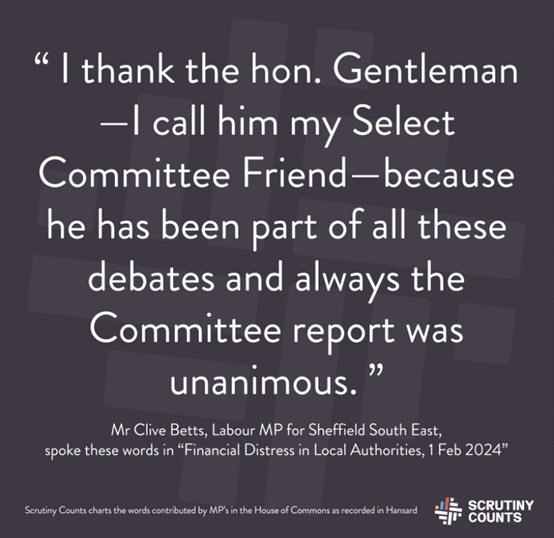
Here’s a quote from the recent debate about Local Authorities in Financial Distress. It’s a reply from a Labour MP (Clive Betts) to a Conservative MP (Bob Blackman):

It’s a cheering thought. Cross party select committees working collaboratively to explore problems and find solutions.

And what else did I learn from the debate? That the woes of some councils are self-inflicted, but not all. That the various mixed pots of funding available to councils makes for a patchy funding pattern geographically. That the three main spending challenges are Social Care, Special Educational Needs, and Homelessness.

There are two big benefits to reading a parliamentary debate on this (and any other) topic. Firstly, you get to read all sides of the political argument, which is good for the soul regardless of where you sit politically. And secondly, you get a sense of how different regions are affected. By way of example, Bradford’s problems stem from the high cost of Children’s Services in the Borough. The Trustees running Children’s Services have demanded a sum equivalent to about 50% of the council’s budget. Very different from the much-reported Equal Pay claims at Birmingham.

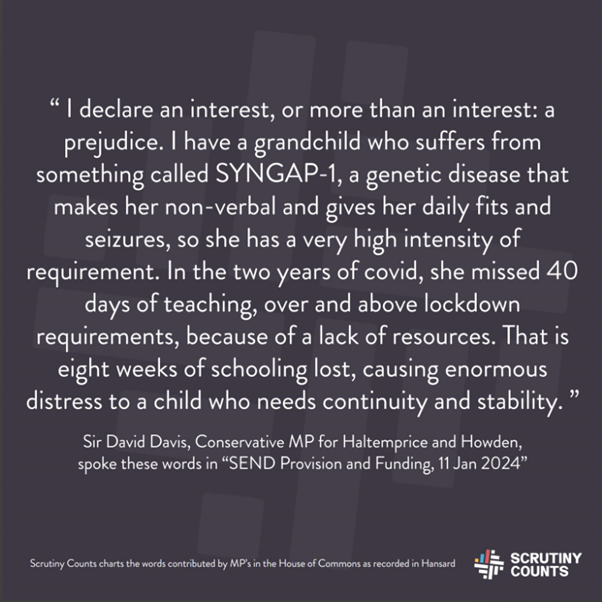
There are hundreds of other topics that are equally interesting and relevant to people who spin in the world of Local Government. On 11th January 2024 there was a debate about SEND Provision and Funding. As is often the case, MP’s volunteered personal stories which adds conviction and context to their contributions. Read this quote from David Davis (Conservative) about his granddaughter, Chloe:

I won’t try and precis this, or any other debates here. Because with every precis, comes editorial judgement, and the whole point of ScrutinyCounts is that we don’t edit, summarise, filter or distort. We have created summary charts that enable you to navigate quickly to items that are of interest. Then you click through to the original debate and text. Our screen designs are optimised for speed reading so you can jump to contributions that interest you, and scroll up and down fast.

So what did I say to my sister about the parlous state of Local Government? I told her not to believe everything she reads in the news, but to look on ScrutinyCounts, read about it for herself, and make her own judgement!

Alice Watson is a Director of Hinc Ltd, the provider of the ScrutinyCounts mobile app. Having trained as an Engineer (Bath Uni), she established Porge (a data insight company), which she successfully grew and subsequently sold. ScrutinyCounts is her latest chapter. It sprung from her belief that people need an easy way of following politics, undistorted by echo chambers or soundbites. More information about ScrutinyCounts can be found here – https://www.scrutinycounts.co.uk/ or follow us on Twitter/X @ScrutinyCounts 

Empowering Local Voices: Unveiling the Role of Councillors in European Governance

Dr Thom Oliver

In the intricate tapestry of European local governance, local councillors stand as pivotal figures, linking citizens to decision-making processes that shape their daily lives. Their interactions within communities, councils, and broader public administration are the bedrock of modern democracy. Last week, alongside colleagues from the University of Bristol, Cardiff University, and Ghent University, we embarked on an ambitious endeavour: an email survey reaching over 19,100 councillors across England, Scotland, Wales, and Northern Ireland.

The survey is part of a broader European effort, with a single shared survey being rolled out with spans twenty-eight European countries driven by a broad collaboration of academics emerges from extensive international research network dedicated to conducting surveys with local political actors to understand local and national political dynamics. Over two decades their comparative work has shed light on the councillor, council leader and mayor roles of local government, administrative intricacies, civic cultures, and political practices across Europe, enriching both academic and practical understanding.

Our latest research now refocuses on local councillors, probing fundamental questions about democracy, their perceptions of their roles, views on local government, challenges within the institutional environment, and policy priorities. The survey also aims to understand councillors’ experiences with aggression and abuse and the influence of such encounters on their council activities and public engagement.

But this survey is more than just academic curiosity; it’s about amplifying the voices of local representatives. Councillors are the conduits between citizens and power, entrusted with articulating community aspirations and championing collective interests. They face mounting external pressures—from austerity to centralisation—and grapple with balancing economic growth, development, and environmental concerns, alongside the existential threat of rising social care costs as more and more councils face financial distress.

Unlike previous paper-based iterations, this survey employs electronic questionnaires sent to individual councillors across England, Wales, Scotland, and Northern Ireland, with the survey lasting around 15 minutes, we are keen that councillors both start and finish the survey, so have enabled them to complete it over multiple sittings if required via simply clicking on the email invitation.

As the survey unfolds across 28 countries, we urge councillors to join the dialogue and lend their voices to the study. Personalised emails have been sent directly to councillors’ inboxes, and follow-ups will continue over the coming month. Any councillors unable to access the survey can reach out to the project team using the contact details provided below.

We are calling on all councillors to check their inbox for our survey! Your voices are crucial to use better understanding the challenges and priorities in your role. This is the first time we have delivered the survey across England, Scotland, Wales, and Northern Ireland so we are really keen to ensure that all voices are represented across political parties, different tiers of local government, and geographies. Let’s ensure all your voices are heard loud and clear.

Dr Thom Oliver is a Senior Lecturer in Politics at the University of the West of England, Bristol. Thom completed his PhD at INLOGOV in 2011. Along with Dr David Sweeting (Bristol), Prof Colin Copus (Gent), and Dr Bettina Petersohn (Cardiff), he is leading the Return of the Councillors study in England, Wales, Scotland, and Northern Ireland. Thom leads the Qualitative Election Study of Britain, and is a co-investigator on the Bristol Civic Leadership Project.