Stop playing party politics with Mayors and Police Commissioners

Chris Game

A couple of years ago I wrote a blog about choropleth maps and the accuracy, or otherwise, of the UK’s locally compiled electoral registers, in which I indulgently referred to the University of Essex, and particularly its Department of Government’s late Professor Anthony King, thanks chiefly to whom, as a 1960s postgrad student, I first became interested in such abstruse matters.

For me those UoE years were transformative, as no doubt they were for countless successors, including two prominent MPs – former Commons Speaker, John Bercow, and current Home Secretary, Priti Patel – whom The Times somehow mixed up in Professor King’s obituary. Recounting King’s tale of the now well-known ex-student whose thesis had been “so bad I virtually had to rewrite it” … the student was incorrectly identified as Bercow … rather than Patel. Grovelling apologies ensued, and not inconsiderable mirth.

It’s a pleasing story, but I’d have struggled to justify raising it, were we not currently witnessing a further example of Patel’s either inability or refusal to grasp the workings of surely King’s specialist Mastermind subject: electoral systems. The Home Secretary, in reviewing the role of our 41 Police and Crime Commissioners (PCCs), wants to replace from 2024 what she calls the “transferable system”, by which they – plus the Mayor of London and nine Combined Authority Mayors – are elected, with the ‘First-Past-The-Post’ (FPTP) system we use for MPs.

Patel offers several reasons. It is “in line with the government’s (2019) manifesto position in favour of FPTP”, creates “stronger and clearer local accountability”, and “reflects that transferable voting systems (her plural, my emphasis) were rejected by the British people in the 2011 nationwide referendum”.  Plus presumably, though unmentioned, she reckons on balance it would benefit the Conservative Party.

None of her assertions are straightforwardly true; only, strictly speaking, the bit about voters rejecting the 2011 referendum question – by a certainly decisive 68%. But that referendum was about one particular system, the Alternative Vote (AV) – supported ironically by neither party in the Conservative-Lib Dem Coalition and rejected understandably by voters as a contribution to producing the more fairly elected and representative House of Commons that at least many hoped the long awaited referendum would be about. Nothing to do with electing powerful, high profile and individually accountable public officials.

Moreover, if referendums are important, in the 1998 one creating the Greater London Authority, London electors voted by 72% for a Mayor elected by the then novel, but much debated, Supplementary Vote system she wants to abolish for us all with no voter consultation at all.

Her ‘transferable voting systems’ is anyway a potentially misleading term that I doubt Professor King would have used. ‘Preferential’ better describes the several systems allowing voters to express their ordered preferences for a list of candidates.

Best known is probably the highly ‘voter-friendly’ Single Transferable Vote (STV), used in multi-member constituencies, as in Scottish and Northern Irish local elections, where there are two objectives. First, to elect perhaps more representative ‘slates’ of local councillors than our FPTP system produces, and ultimately to elect more community-representative councils (or parliaments) by greatly reducing the numbers of ‘wasted’ votes cast for losing candidates.

Voters rank-order as many candidates as they like. A ’quota’ is set, based on the numbers of seats to be filled and votes cast. Then, once a candidate reaches that quota, proportions of their ‘surplus’ votes are transferred to voters’ second and subsequent choices until all vacancies are filled.

By contrast, PCCs and Mayors, as even the Home Secretary will have noticed, are elected individually. So the relevant ‘preferential system’ here is the Supplementary Vote (SV), using ballot papers with two columns of voting boxes, enabling voters to X both their favouritest candidate and their second favourite.

If no candidate gets over half the first-column vote – as in 36 of the 40 contests in the 2016 PCC elections, all five London and roughly two-thirds of all mayoral elections to date – just the top two candidates continue to a run-off, and will probably have campaigned with that eventuality in mind.

If either your first- or second-choice candidate gets through, they get your run-off vote. The important consequence is that the winner – here, every elected and accountable PCC – can claim the legitimacy and authority of having secured a majority electoral mandate.

Under Patel’s preferred FPTP system, 229 of our serving MPs could be accused of having slunk into office on minority vote mandates of regularly under 40%.  Personally, I’d feel slightly diffident, even as a Conservative MP, knowing both I and my party’s Government were elected on way short of majority votes. But for a PCC, daily exercising wide-ranging policing powers, it would be potentially undermining.

In our ‘local’ 2016 West Midlands election, the incumbent Labour PCC David Jamieson, seeking re-election, managed ‘only’ 49.88% of first-preference votes – fifth highest out of 40 English and Welsh contests, incidentally. But in the necessary second-round run-off against the Conservative, Les Jones, that was raised to a significantly weightier 63.4%.

The difference, and demonstrable majority electoral mandate, would be handy for an MP – but of genuine weight and almost daily importance for Police and Crime Commissioners, more than half of whom received under 40% of first-round votes.

Or, indeed, for elected mayors. I can’t but think West Midlands Conservative Mayor Andy Street feels considerably more comfortable being able to claim a 50.4% run-off victory over Labour’s Siôn Simon in 2017, as opposed to the 41.9% that would have given him a FPTP victory.

Time now, with a final paragraph already typed, for a very belated declaration of interest – personal and academic interest, that is – in an electoral system effectively invented, developed and, I’d argue, deployed effectively during my university teaching lifetime. I knew, at least distantly, both possible claimants to the SV’s invention, and, while I’m well aware of its limitations, I do believe it was and, after 20 years’ usage, is the best system realistically available for the election of mayors and PCCs.

If you’re interested in more, try the excellent evaluative paper written at about the halfway point in that history – and so before the invention of PCCs – by Colin Rallings and colleagues.  Pluses include a neat summary list of SV plus points (p.4), and some colourful and interesting bar charts.

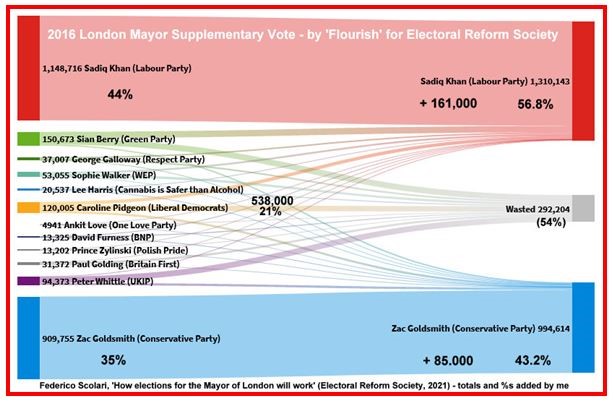
But nothing to rival the Electoral Reform Society’s recent effort: a creation of interactive beauty (the real thing, not my reproduction, obviously!), produced especially for this year’s elections, and showing for instance, as you’d possibly hypothesise, that first-choice Britain First and One Love Party voters split their second-choice votes proportionately really rather differently.
Election of London Mayor

To conclude: my hope is that at least Patel’s intervention will prompt a few interesting campaign questions – I was going to type ‘hustings’, but I’m not sure we’re allowed those this time – for Conservative PCC and mayoral candidates. The 20 successful Conservative PCC candidates in 2016 averaged 36% of turnouts averaging under 25%, or under 10% of the registered electorates.  Do they, I wonder, think election on their minority first-round votes alone – 11% of registered electors in Andy Street’s case – would give them the “stronger and clearer local accountability” Patel suggests it would?
Photo

Chris Game is an INLOGOV Associate, and Visiting Professor at Kwansei Gakuin University, Osaka, Japan.  He is joint-author (with Professor David Wilson) of the successive editions of Local Government in the United Kingdom, and a regular columnist for The Birmingham Post.
Handforth and the acoustics of local democracy

Kevin Harris

“Underlying the democratic ideal of government by consent of the governed is… the consent of the governed to behave themselves” (Jacobs, 2004, p. 211)

What might Jane Jacobs have had to say about recent challenges to democracy – like the prorogation of the UK parliament, the assault on the US capitol, Myanmar, and the fraught tragi-comedy of Handforth Parish Council’s infamous committee meeting? The expectation that the governed should behave themselves surely extends to those elected to govern. But our representatives sometimes disregard this, dismissing codes of conduct and protocols, as the Committee on Standards in Public Life has found. In my limited experience as a community council clerk I witnessed some of the consequences, having had to ensure on one occasion that police were on hand for a full council meeting, following a reported threat of disruption. It’s not so fanciful to see a connection between the villages of Washington DC and Handforth, Cheshire. Nonetheless, there may be a positive indirect consequence for local democracy, which I shall come to.

I do not propose to re-measure the hole that Handforth councillors dug themselves into. The episode was referred to by the Society of Local Council Clerks as “superficially amusing” while it exemplifies syndromic bullying behaviours. At the same time, if the celebrated Jackie Weaver has entertained many, there seems little doubt that she was out of order. The puzzle that remains unsolved (for me, at least) was posed parenthetically by David Allen Green in a heavily-commented post: “who can exclude a disruptive chair if the chair is disruptive?” I refer my right honourable friend to the quotation I gave earlier.

For those of us who have been keen to see a higher profile for parish and community councils, the Handforth incident is Fate’s Reminder to be careful what you wish for. And for all the comment generated – much of it showcasing a forensic fascination with regulatory niceties – what has struck me is how little of it acknowledges how local people have been forsaken by the institution designed to represent them.

There are two elephants in the zoom. One is the alpha male whose sense of power tramples his sense of responsibility (‘trump’ might be a better verb to use, but for the entangling of metaphors). The SLCC calls for “a dramatic strengthening of the standards regime”. Hmm, how dramatic would you like?

The other is democracy’s reliance on an impenetrable bureaucratic skin. It’s hard to see how the regulatory framework can be reduced, and Handforth may have given cause to extend it. But its effects can be countered, and there are all sorts of devices for that. As a clerk I wanted councillors to host, in turn, one each month, an informal reception (refreshments of course) immediately before each council meeting, inviting all residents from their zone (ward). And keep doing it. A few people we didn’t know, would have come. In time, the democratic return on investment would surely be visible in terms of the numbers who stayed on for at least part of the meeting, those who raised issues, and those who voted at the next election.

I failed to persuade my management group of any virtues in this idea, but had I stayed longer in post I think I could have got this and similar notions established. Democracy needs diligent ongoing maintenance, not frantic last-minute repairs.

To me, a key point about town and parish councils – now sometimes called ‘ultra-local councils’ – is that among their powers is a rather special informal convening power. They are able quickly, and usually a-politically, to bring together agencies (including principal authorities, police, health, schools etc), local businesses, community groups and residents to focus on specific local issues and get them sorted. This is oddly under-appreciated, not least by principal authorities. And it points to the need, when talking about democratic revitalisation, to ensure reference to the community sector, which can function as a democracy sandpit, default care provider, lightning-conductor for issues, and social responsibility conscience for councils.

Well, we now have a parish council in England that has become a huge embarrassment to its residents. The technology made a difference: Jackie Weaver’s performance would have been impossible in a face-to-face meeting. Meanwhile, councils in all tiers apparently have reported increased participation through online meetings. Bryony Rudkin offered insightful councillor’s reflections on the comparison with face-to-face meetings, on this channel recently. Now the government is under pressure to remove, permanently, the legal requirement for councils to meet in person.

I observe that public debate over the past year, in and out of lockdown, has acknowledged the reality that many families do not have anything like adequate technology to participate in a virtual society: so at least that argument doesn’t have to be made, does it? How then are hybrid meetings going to function against the risk of exclusion (the affluent signing in from home, with their intimidating bookshelf-backdrops; the rest huddling round a phone on threadbare broadband)? Do we expect those who would not have been likely to attend a formal council meeting before, and who cannot participate online, suddenly to be so excited at the prospect of a Weaveresque fracas that they’ll be queuing at the door?

There will have to be guidance for hybrid meetings, for all tiers. I’d like to see strong recommendation that councils fund community centres to host large-screen streaming. Community development workers will want to set these up anyway – refreshments, creche, homework corner, publicity; and someone on hand to give a little introduction and explain procedural necessities, to ‘sub-chair’ participation from the ‘annexe’, and provide feedback to officers. Councillors and officers should be encouraged to participate from these locations.

Forget the Handforth cacophony, maybe this is a chance to improve the acoustics of local democracy.

Kevin Harris is a PhD student at INLOGOV, researching into democratic voice and community action in local councils. He was previously a community development consultant and Chief Officer at Queen’s Park Community Council in London (2017-2019).

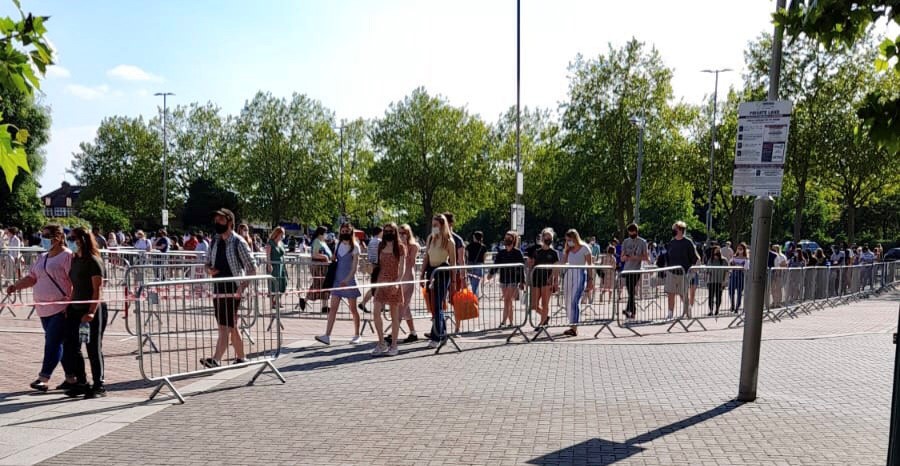
Photo source: https://www.swingdebates.com/news/handforth-parish-council/

References

Committee on Standards in Public Life, 2019. Local government ethical standards:  a review. Committee on Standards in Public Life, London.

Jacobs, J., 2004. Dark age ahead. Random House, New York.

Backroom or backlit? Council meetings post-Covid

Cllr. Bryony Rudkin

This week two councillor colleagues of mine told me of meetings they’d attended, one an unusual face to face gathering, the other online. For one friend it was the first time she had been to the Town Hall in almost a year. She and her colleagues sat, each at their own table, in an echoing chamber and raised their voices in order to be heard. It was an informal meeting of councillors, officers and other public servants, called to debate sensitive issues in person so that information could be shared freely and confidentially. The issues were serious and compounded by lockdown and stretched resources, an unwelcome distraction at any time. However, this turned out to be a meeting filled with laughter, jokes and gentle teasing. There were interjections and interruptions which helped the meeting flow freely. Delight in seeing each other was tempered only by the acknowledgment of how long it had been since they had last done so.

My other friend told me of an online meeting where an argument had taken place and where one person had cried after making a very personal speech. She observed that what she called “the protection of the screen” meant others were not afraid to show their reaction to the emotions on display but equally the meeting had been stripped bare of physical comfort, an arm around a shoulder or a squeeze of the hand.

These two accounts got me thinking about what we gain and what we lose when we meet online. There’s an interesting seam of academic literature on what meetings are, their role in policy making, the artefacts they produce and of particular interest to local government practitioners, what they tell us about what councillors actually do all day (Brown, Reed & Yarrow: 2017; Freeman: 2008, 2019; Freeman & Maybin: 2011; Llewelyn: 2005). What no one has yet had the chance to explore is the terrain of the online meeting. My own research has used webcast meetings as a rich source of data. Not all UK authorities broadcast public meetings prior to the pandemic but there is now a growing nationwide archive of the formal business of local authorities open to research. What might we want to learn from a closer look? Are individual councillors more or less influenced in their decision making by what they hear from fellow politicians or officers? What of the informal behaviours in meetings – the notes passed, the interruptions, the heckling, the laughter and the eye rolls? In real life these act as lubricants to the flow of discourse and breathing space for thought and reflection. How are they replicated in an online world? If you’re busy on the WhatsApp finding out what your friends are thinking, how much attention are you giving to what is being said?

Arguably, it might not be worth the effort of exploration. The legislation that enables online meetings in English and Welsh local authorities expires in May. The roll out of the vaccine means a roadmap back to the council chamber – alongside the doorstep for local election campaigning – might just be in reach. No doubt those first few ‘real’ meetings will be different. We will have to relearn what it means to speak and listen in person, without the protection and comfort of our screens and homes. We may have gained bigger audiences. Residents, having exhausted Netflix, may be turning to council meetings for entertainment. Maybe not. Anecdotally, councils aren’t directing too much effort into collating viewing figures right now, but having turned the cameras on, it may be difficult to turn them off. We can only wait and see.

I suppose for me it’s always been what happens ‘back stage’ in politics that’s piqued my interest. Privileged access to such space has shown me there’s always so much more to meetings than first meets the eye. It might be happening online, but I’ll wager not to the extent or with the nuance of the past. Back lighting is more of an imperative than backroom dealing right now.

And so I’m reminded of another story a fellow councillor told me years ago about meetings and what goes on in them. Sadly he’s no longer around, so it’s safe to relate. He’d been sent to observe a council meeting in another authority to check on behaviour and conduct. Everything he actually saw taking place was no better or worse than in any other council, he said. The real problem was behind the scenes. The leaders of all three parties represented in that chamber actually carried out negotiations by leaving notes for each other on the top of the old Victorian cisterns in the gents toilets. They were all men. The chief executive, with whom they had disagreements was a short woman who was never going to find them there.

Cllr. Bryony Rudkin is a PhD student at INLOGOV, Deputy Leader of Ipswich Borough Council and is a member of the UK delegation to the Congress of the Council of Europe. Bryony also works with councils around the country on behalf of the Local Government Association on sector-led improvement, carrying out peer reviews and delivering training and mentoring support.

References:
Brown, H., Reed, A. & Yarrow, T., (2017), “Introduction: towards an ethnography of meeting”, Journal of the
Royal Anthropological Institute, 23:S1, 10-26
Freeman, R., (2019), “The role of the councillor and the work of the meeting”, Local Government Studies,
46:4, 564-582
Freeman, R. & Maybin, J., (2011), “Documents, practices and policy”, Evidence & Policy, 7:2, 155-170
Llewellyn, N., (2005), “Audience Participation in Political Discourse: A Study of Public Meetings”, Sociology,
39:4, 697-716

Research to Help Rebuild After Covid-19

Jason Lowther

Last month Sir Patrick Vallance, Chief Scientific Adviser to the UK Government, met (virtually) with over 100 researchers and policy officers to discuss the output of a six-month programme looking at some of the fundamental challenges to our society, economy and ways of living.  Commissioned by the Government Office for Science, the Rebuilding a Resilient Britain programme aims to help government with medium- and long-term challenges relating to the challenges of Covid-19, captured under nine themes including “vulnerable communities”, “supporting services”, and “local and national growth”.


The overall programme was led by Annette Boaz and Kathryn Oliver, two experienced social scientists whose work focusses on the use of evidence.  In their recent LSE article, they explain the background to the programme and how plans were upturned in March with the introduction of Lockdown in the UK.  

I was particularly involved in the “supporting services” theme, convening the work around local government.  It is an exciting initiative to be involved with, not just because of its scope and pace, but also because of the range of people engaged: researchers and academics, government policy and analysis officers, and funders.  What I found particularly interesting was how different Government departments and different academic disciplines were often looking at very similar issues but framing them from distinct perspectives and using diverse language to describe them.  This highlights the need to develop shared definitions of issues and ways to address these – considering “problem-based issues” in the round.

As well as summarising the existing research evidence around each of the identified themes, the work identified several “gaps” in the extant evidence base and opportunities for new research, policy/research dialogue, and knowledge exchange.

Within the Local Government theme, we recognised that LG’s role proved critical in the first stage of the pandemic, for example in supporting vulnerable and shielded people, enabling voluntary community groups, freeing up 30,000 hospital beds, housing over 5,000 homeless people, and sustaining essential services such as public health, waste collection, safeguarding and crematoria.  This role is likely to increase in future stages of the pandemic, with more responsibility for local surveillance testing and tracing, implementing local lockdowns, economic development, contributing to a sustainable social care system, and supporting further community mutual aid.

There is already a good evidence base showing how local government is playing vital roles in responding to and recovering from the pandemic.  We identified four main themes: empowering local communities, delivering and supporting services, devolution and localisation, and funding.
For each issue we considered the key policy and practice implications of existing evidence, the evidence gaps and the ways in which gaps might be filled.  

Around empowering local communities, for example, evidence showed that LAs responded quickly to the pandemic, and well-functioning local systems emerged to tackle the immediate crises in many parts of the UK.  Areas adopted a range of strategies in partnership with local communities. But informal community responses can lack coordination, resources, reach and accountability; and some groups face barriers to involvement.  Further evidence is required on what works in strengthening community support networks, empowering different types of communities, and co-producing public services.  Councils also need to understand better how staff, councillors and the institutions themselves can change to empower communities.

There has already been some important learning from this work, such as recognising the treasure trove of useful knowledge contained in existing evidence and expertise.   We need to get much better at using evidence from, for example, the evaluation of past policy initiatives.  The programme is helping to strengthen relationships across government, including some new and more diverse voices, and will be useful as government departments revisit their Areas of Research Interest post-Covid.  The thematic reports are due to be published in coming weeks.

I will be exploring the findings for other areas of interest to Local Government in future articles.

[This article also appeared in the Local Area Research and Intelligence Association December newsletter]

Jason Lowther is Director of the Institute for Local Government Studies at the University of Birmingham.

Local authorities and climate change: responding to the green challenge

Jon Bloomfield

What lies ahead for local government in 2021? We know the pandemic will continue to loom large. But all the signs are that with the UK hosting the crucial, international climate change conference (COP26) in Glasgow next November, the issue of climate change will be high on the policy agenda.

Over the last 18 months many towns and cities have responded to the growing environmental emergency and declared their commitment to go carbon-neutral. In early December, 38 local authority leaders committed to cut their own carbon emissions to net zero by 2030. Among the leaders to sign the net zero pledge set out by the NGO UK 100 are the metro mayors of Greater Manchester and the West Midlands, plus council leaders in Birmingham, Bristol and Edinburgh. Together the signatories represent almost a third of the U.K. population. A  Zoom virtual conference saw more than 500 council leaders and officers participating.

The international political climate is favourable. Reversing four decades of Washington neo-liberal consensus, the International Monetary Fund has given its seal of approval to public investment strategies irrespective of the rising debt consequence. The national mood music is positive too. Boris Johnson’s 10 point plan for a Green Industrial Revolution recognised that we need a low carbon transition transforming all sectors in the economy. In the lingering shadow of Trumpist climate denialism, it was reassuring. The really tough question is how to make good on these national and local targets. The words are easy: the action is harder.

What is the best pathway to follow? The green recovery should focus on the exploitation of what we already know can fulfil a low carbon, ‘levelling up’ agenda. Here there are three key policy arenas, energy, mobility and buildings and in all three,  local authorities, their staff, community groups and local neighbourhoods have key roles to play.

Take buildings. The country needs a large-scale programme of state investment in the regions to both reduce emissions and create jobs. The quickest and simplest way to do that is to focus on decarbonising our building and housing stock. Renovation works are labour-intensive, create jobs and the investments are rooted in local supply chains.  Central to green recovery should be programmes where budgets are devolved to enable localities to design initiatives appropriate to their needs, in partnership with local stakeholders. That means looking to develop neighbourhood schemes so that entire streets are renovated together, rather than the government’s current green grants to individual householders. A community approach would bring economies of scale; permit accredited programmes with approved contractors; enable retrofit to be undertaken along with boiler replacements and renewable energy installations; introduce smart, digital appliances; and   on-street vehicle charging infrastructure. In other words, a comprehensive approach that takes citizens with you. Neighbourhood renovation and refurbishment offers lots of new jobs across the whole of the UK, with warmer homes, lower fuel bills and plenty of opportunities across the building supply chain. Plus a chance to engage local people in the revitalisation of their own streets and communities. What’s not to like?

But this all requires council officers to have the understanding and grasp of climate change transitions thinking and with the social and participatory skills to engage with neighbourhood and local groups. Climate change policies cannot be simply imposed from above. A huge social challenge won’t be addressed without some friction and tension. As we have seen with the Low Traffic Neighbourhoods policy over the last few months, if people aren’t engaged, then suddenly vocal resistance to these measures can arise.

Addressing climate change means we shall have to alter the ways that we live, move and work. The issues of climate transition are effectively an emerging policy arena. They require an understanding and marshalling of a new combination of skills amongst a wide cadre of local government officers, councillors and engaged citizens. Planners, traffic engineers, housing officers, finance and procurement staff: these and more all need additional skill-sets. Councils can set ambitious targets. But unless they have the staff within their ranks with the competence and skills to tackle them, then they will fall short.

Jon Bloomfield has been involved with the EU’s Climate KIC programme for over a decade, helping to develop educational and training programmes and experimental projects which help companies, cities and communities to make effective transitions to a low carbon economy.

Vice-President-elect Kamala Harris and me

Chris Game

If only Birmingham weren’t in Tier 3 … I could prop up bars in city centre pubs, casually conversing with fascinated fellow-drinkers: “You know that Kamala Harris, the American Vice-President-elect – yeah, the one wearing the Elvis-style white trouser ‘power suit’ for her victory speech.

“Well, I was a professorial contemporary of her Dad, Donald, at California’s prestigious Stanford University, don’t you know?  Thanks, mine’s another Plum Porter.”

Sadly, with Plum Porter purveyors currently closed, I’m driven to search for alternative captive audiences.  However, in contrast to bits of the current series of The Crown, this boast, while it may not ‘ring true’, actually IS true.  Before coming to INLOGOV in 1979 my employers for the previous five years were indeed Stanford – the posh, private, but definitely prestigious university north-westish of Silicon Valley.  

At least, that was Kamala’s Dad’s main workplace – I said ‘contemporary’ not ‘colleague’!  Mine was Stanford’s British Studies Center – note the spelling – at the also posh but less sunshiny Cliveden House on a National Trust estate near Maidenhead, where some hundred or so American students would come to spend two or three semesters of their undergrad years.

And the ‘Professor’ bit?  Well, as everyone knows, almost all US university academics have that generic title. ‘Full’ Professors are the real deal, while my Cliveden colleagues and I were ‘academic personnel’ – but on envelopes from HQ ‘Assistant Professors’.

It’s been mildly disquieting to see some UK universities going down the ‘Assistant Professor’ route – Warwick, for instance – but I’m not in the least bitter. I just regret not saving at least a few of those envelopes, because in four subsequent Birmingham decades I never managed even that.

Jamaican-born former economics Professor Donald Harris is/was at the distant other end of the scale: an Emeritus Professor since retiring early from Stanford after an exceptionally distinguished career and numerous international academic awards.

Here’s the thing, though.  Harris joined Stanford in 1972, yet in my creepily retained 600-page 1974/5 Stanford University Bulletin we Clivedenites and our taught courses all get several individual mentions, yet Donald not one.  Which, for apparently “the first Black person to receive tenure in Stanford’s economics department”, seemed rather odd.

Still, it provides a link to his elder daughter’s string of ‘firsts’ that actually prompted this blog: the first major personal career choice made by the first woman, first African American, and first Asian-American US Vice-President-elect.  California-born – for those, like President Trump, still questioning her Presidential eligibility; and her name, incidentally, pronounced not at all like ‘Pamela’, but ‘Comma-lah’ – from the Sanscrit for lotus flower.

Which is also relevant, because Kamala’s parents divorced when she was just seven, meaning she and her sister, Maya, were brought up largely by their Indian-born mother, Shyamala Gopalan – a bio-medical scientist, whose career in breast cancer research was every bit as outstanding as her husband’s, but who in 2009 would die of cancer herself.

It was her mother’s acceptance of a research post at McGill University Hospital in French-speaking Montreal that chiefly determined that Kamala went first to a French-speaking elementary school.  Then her mother moved the family again, so Kamala could attend Westmount High School, Quebec’s only public school offering so-called Advanced Placement courses for potentially university/college credit.

That university/college choice in by now the early 1980s, though, was definitely Kamala’s. After several majority-white schools, and her parents working in eminent but predominantly white institutions, she sought a wholly different experience. Young, gifted and black, she would live, learn, socialise, and at times protest against South African apartheid, with black students in a black university in a black city.

She would therefore attend one of the hundred or so HBCUs – Historically Black Colleges and Universities – and arguably the most renowned: Howard University in Washington DC, the African American community’s ‘Chocolate City’. And a short subway ride to both her current Capitol Hill workplace in the Senate and her future one in the White House. Back then it was no part of any life plan, but it can serve as a useful putdown today to those who accuse her of being ‘not really black’ or ‘not black enough’.

In the early 1970s Stanford University – students and staff – was unmistakeably Californian and white.  But I remember quite early learning of and being fascinated by the whole HBCU concept – partly because of the then still relatively recent appointment of Thurgood Marshall as the first African American Supreme Court judge.

The HBCU initialism itself – not technically an acronym – is comparatively recent, a product of the historic 1964 Civil Rights and 1965 Higher Education Acts. But the Black Colleges themselves date back in some cases 170+ years to before the Civil War and abolition of slavery.

Even following abolition, certainly in the Southern states, there was a century of institutionalised racial segregation of housing, medical care, employment, transportation and, of course, education.  And even universities and colleges that didn’t completely bar African Americans usually applied tight quotas, with all the other manifestations of discrimination.

One of those barred was future Justice Thurgood Marshall. He had applied to the University of Maryland Law School and been rejected through its segregation policy effectively banning blacks studying with whites.  He therefore attended and graduated with distinction from, yes, Howard University Law School – and later successfully sued Maryland for its discriminatory admissions policy.

Quite a role model, had Kamala been looking for one at the time – just as she surely will be to this and future generations of aspiring university students, female and male.


A version of this article appeared in The Birmingham Post on 26th November 2020.

Photo

Chris Game is an INLOGOV Associate, and Visiting Professor at Kwansei Gakuin University, Osaka, Japan.  He is joint-author (with Professor David Wilson) of the successive editions of Local Government in the United Kingdom, and a regular columnist for The Birmingham Post.