What ID for Voter ID? 

Jason Lowther

Photo credit: Liz West, https://www.flickr.com/photos/calliope/

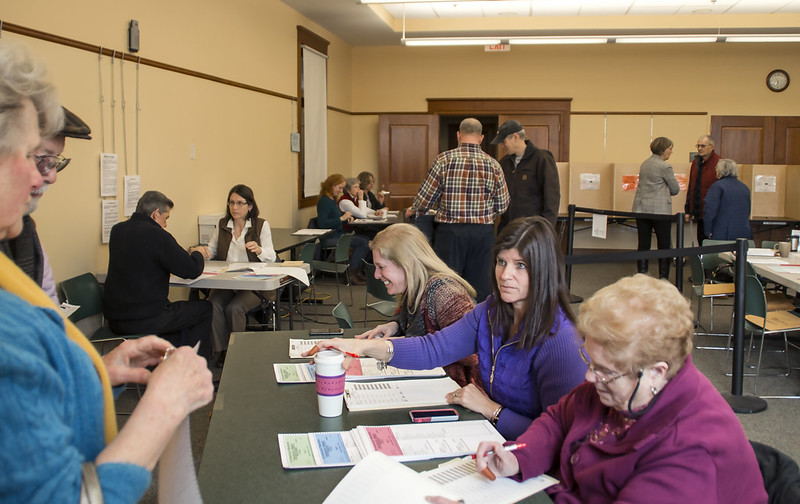
Last October, I wrote in this blog about the many positive aspects of the Elections Bill currently working its way through parliament.  It clarifies what “undue influence” on voters means, improves poll accessibility, reduces the risk of intimidation of candidates and requires all paid for digital political material to have an imprint.  The big problem, though, is the plan to require voters to present certain restricted types of identification in order to vote.  This month the House of Lords voted to mitigate this problem.

As part of the “Report Stage” of the bill, on 6th April the Lords agreed an amendment which radically expands the range of identification documentation which voters could use.  The new list is fairly extensive including an adoption certificate, bank or building society statement, P45 form, asylum seeker letter from the Home Office, and even a library card or National Railcard. 

In the debate, Cross-bencher Lord Woolley of Woodford claimed that the government had failed to make a convincing case on voter fraud – quoting one conviction from 47 million voters, which he likened to the chance of winning the national lottery jackpot.   He said that the cost of insisting on photographic ID could be to disenfranchise 2 million voters.

For the Greens, Baroness Jones of Moulsecoomb labelled the policy ‘a cynical ploy’. She went on to claim: “It is a clear attempt by the Government to make it harder for people to vote in elections. That is the only motive I can see when we have this sort of Bill in front of us. More cynically still, it will disproportionately stop BAME, working-class, Gypsy, Roma and Traveller people voting. These people find it hard enough to vote already. Anything you put in their way will stop them voting completely; that is preventing democracy’.

One of the amendment’s sponsors, Conservative former cabinet minister Lord Willetts, said that there was little concern with voter personation in the mainland and raised the concern that a future government elected with a small majority could face questions if significant numbers of voters had been unable to vote due to the new requirements.  He concluded that the amendment was ‘protecting our system from a major political and constitutional risk while remaining consistent with the manifesto on which the Conservative Party fought the last election’.

The vote on ‘Amendment 8’ in the Lords was 199 to 170, with three Conservative peers in favour and 155 against.  The House of Lords has its final sitting on the Report Stage on Monday (25th April), after which it will complete the Third Reading before the bill returns to the Commons for its consideration of the amendments.  The Government is known to be concerned at the inclusion of ID which does not have a photo, so the amendment is likely to be further challenged.

UPDATE (30/4/22): As anticipated, the Government rejected Amendment 8 in the Commons as the Government’s view was the types of ID listed were not sufficiently secure and might be prone to fraud. More detail is available in the excellent summary by Elise Uberoi and Neil Johnston for the House of Commons Library here.

Jason Lowther is Director of the Institute for Local Government Studies (writing in a personal capacity).

Women in (West Midlands) Governance: A patchy metamorphosis

Chris Game

Yes, I did blog really rather recently on the topic of ‘Women in local and national governance’; and yes, I did conclude it by pledging to “retire gracefully from this particular field of research”.

But that was before I found myself fruitlessly upending my flat for anything conceivably useful to the Ukrainian refugees for whom one of my ward councillors was commendably collecting. Finding virtually nothing I could honourably offer, it was cash to the Disasters Emergency Committee, who assured me the UK Government would double my donation.

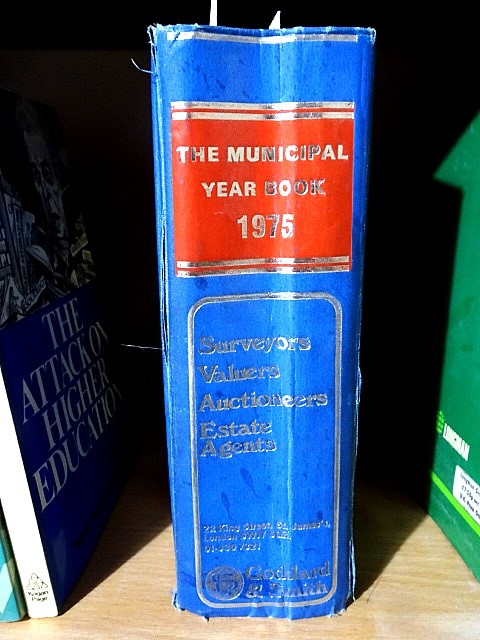
However, among the dust-covered treasures I’d totally forgotten, and spared the Ukrainians, was my 1975 Municipal Year Book (MYB) – a hefty, royal blue tome of 1,400-plus extremely closely printed pages, taking up over three inches of shelving.

myb

In pre-computer decades, when I joined INLOGOV, it was the proverbial local government bible – the 1975 MYB listing all 564 of the UK’s so-called principal local authorities plus, individually, their 26,467 councillors and further thousands of principal officers.

Several years later a thoughtful colleague, Ray Puffitt, bequeathed me his signed personal copy, possibly in exchange for my not pressing him to lecture to my undergraduate students.

Thoughtful because 1974/75 was, of course, the year of large-scale local government restructuring – or, in MYB-ese, ‘re-organization’. There were now far fewer councils and councillors, but these were the ‘new’ and therefore more relevant ones – which explains how I acquired my edition, though obviously not why it wasn’t binned decades ago.

Anyway, having discovered this 1975 stash of raw research data, I thought I’d share with you (and Birmingham Post readers) how much statistically women’s presence and visibility in our West Midlands local governments have changed in the past nearly half-century.

My earlier blog concluded by noting how Paulette Hamilton’s recent by-election victory for Labour in the Birmingham Erdington by-election had taken the proportion of women MPs over 35% for the first time. Moreover, that she and the six other women by-election winners since 2019 had – another first – made the Commons more gender-representative than our elected local governments, whose UK-wide proportion of women councillors has seemingly become stuck in the low 34%s.

Internationally, both percentages would get us, just, into the top quarter of the respective rankings. In educational lingo, though, it would be a “disappointing, could surely do better”.

If the Parliaments of Cuba, Mexico, New Zealand, Iceland and all Scandinavia can have more than 45% of elected women, why can’t we – or, more precisely, why doesn’t our huge Conservative Party majority comprise even a quarter? Similarly, if local government in countries as diverse as Bolivia, Tunisia, Iceland, Uganda, Namibia and Mexico can attract at least 45% of women elected members, why can we barely manage one in three?

At least, though, the picture has changed, or improved, hugely in the past half-century, which is what the rest of this blog is about – focusing on the metropolitan West Midlands.

I hadn’t moved to Birmingham in 1974/75, but I reckon that even without research I could probably have named the incumbent West Midlands’ women MPs – because, though few, they were all exceptional and established national reputations.

One, indeed, would have me as an Edgbaston constituent for the latter part of her elective parliamentary career: Jill (later Dame Jill) Knight, MP from 1966 to 1997.

The other three were all Labour: in West Bromwich another Dame-in-Waiting, Betty Boothroyd (1973-2000), latterly Speaker of the Commons. In Coventry West was Audrey Wise, and in Wolverhampton NE Renée Short. A formidable quartet.

Their successors are, necessarily, impressive too, and the reason I couldn’t immediately name them all is not just my ageing memory, but that there’s a full dozen of them. Eight Labour – including all three of Coventry’s – and four Conservatives out of West Midlands’ 28, or 43%.

Yardley’s Jess Phillips is, I’m guessing, probably best known, and she is one of just two of Labour’s eight who aren’t from minority ethnic backgrounds. Overall, another massive change from the mid-70s.

What about councillors?  Would the MYB’s council listings actually identify women members, and, if so, how?  Fortunately, they all risked the accusations of chauvinism and did – though in differing ways.

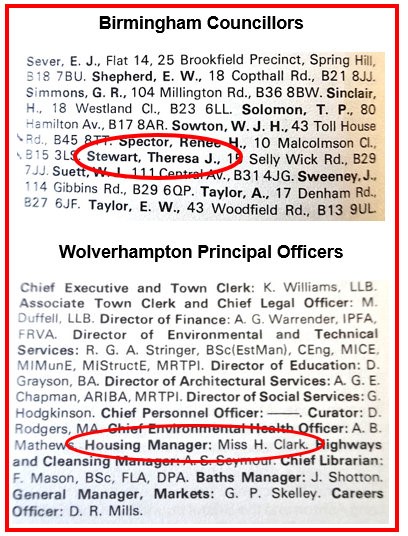
Birmingham, for example, gave first names – of all women members, while initialising the men. Then, as now, it was a Labour-dominated Council, 21 (17%) of whose 126 Members were women, including two Fredas, two Marys, and an exotic-sounding Carmen from Coleshill Road, B16. Oh yes, and a future Leader of the Council, Birmingham Lord Mayor, and wife of a Professor John Stewart.

bcccllrs

The other councils preferred marital status: almost always Mrs, with the very occasional Miss. Across the seven West Midlands councils Labour members outnumbered Conservatives by two to one, which was broadly reflected in women’s representation, with comfortably Tory Solihull managing just one woman out of 51 members.

However, the gender blend on Labour-run Coventry and Walsall Councils wasn’t that much better – four women on councils of well over 50, and one can only imagine how, on occasion, they must have been treated.

And no point whatever seeking empathy from senior women officers – because quite simply there weren’t any. Sorry, not strictly true. Of the 101 listed Principal Officers in the seven WM Councils, Miss H Clark, Wolverhampton’s Housing Manager, was the sole woman.

It’s here that the culture has changed most dramatically. Today, try counting the number of women in the senior managements of the seven West Midlands metropolitan councils, and the very first name you’d encounter would be Birmingham City Council Chief Executive: Deborah Cadman OBE – heading a 13-strong team of service Directors, including four more women.

Remarkably, though, that 38% female senior management puts Birmingham at the foot of this particular league table, which is headed by Dudley and Solihull with 75% and 67% women senior managers respectively, followed by Walsall with 57%, headed by CE Dr Helen Paterson. In this sphere of local government at least, there has indeed been a metamorphosis.

Photo

Chris Game is an INLOGOV Associate, and Visiting Professor at Kwansei Gakuin University, Osaka, Japan.  He is joint-author (with Professor David Wilson) of the successive editions of Local Government in the United Kingdom, and a regular columnist for The Birmingham Post.

_________

A version of this blog – ‘Equality progress – but room for improvement’ – was published by the Birmingham Post, March 24th, 2022 https://www.pressreader.com/uk/birmingham-post/20220324/textview

Getting under the skin of council budgets: what does good scrutiny look like?

Cllr Ketan Sheth

It’s a testing but all-too-familiar mix: funding cuts from central government, skyrocketing demand for local services, a growing population, tough choices and communities vulnerable as they recover from the social and economic shocks of the pandemic. As we approach budget setting, our situation in Brent – a NW London borough – mirrors the position of local authorities around the country.

​Against this challenging backdrop, I believe the role of effective Scrutiny is more important than ever, and so too is learning from one another.

This year, I co-chaired Brent Council’s Budget Scrutiny Task Group. It was our job to get under the skin of budget proposals, to grasp their real-world effects, to understand any mitigations, and to make recommendations where we felt the decisions of our Cabinet, and Full Council, could be strengthened.

To bring forward a balanced budget, this year we were called to scrutinise a package of savings totalling £2.7million, alongside Council Tax increases.

A deeper approach to scrutiny

Given the stark financial picture across the country, from the outset, we wanted to make sure that scrutiny was grounded in the complex reality of the difficult decisions that the Cabinet needed to take. We were determined that the scrutiny process must add value.

As a group, we worked with officers to develop a much broader approach than simply reviewing proposed savings. Instead of solely relying on the community consultation undertaken by the Cabinet, we went into detail on the impacts and sought out testimony from people on the ground. We felt we needed to get a deeper understanding of the experience of those who use Brent’s services and the complexity of their situations.

The idea was to test underlying assumptions made in the proposals, in order to give Cabinet and Full Council information and evidence to base their decisions on. We identified a number of areas to probe:

1. Impacts of Covid-19 on income from business rates, Council Tax and rents;

2. The impacts on health inequalities work when grant funding ends;

3. Implications of Covid-19 on the adult social care budget, especially mental health;

4. Pressures within the Dedicated School Grant; and

5. How the council’s £17m Covid-19 recovery package is being spent

The task group agreed a mix of less conventional scrutiny methods to build this holistic view, including focus groups and detailed evidence sessions with people on the ground. From local head teachers to voluntary and community sector partners, teams from our well-being  services, and Brent Hubs staff (Brent Hubs are spaces in the community bringing lots of services together under one roof to improve access for residents with more complex needs).

By taking this approach, we were able to assess the wider financial and service context, identify possible future budget pressures and the likely emerging needs of our communities.

It allowed us to make a number of nuanced, practical recommendations when reporting back. Most focused not on the savings themselves, but on how the Cabinet  might work differently to overcome and address some of those pressures. Helpfully, the group also identified areas where we felt the Council could effectively lobby for more support nationally and regionally. We’ve also put in place mechanisms for pulling insights from these testimonies as well as learnings from this deeper process through to future budget scrutiny cycles. Ultimately, we are all trying to deliver a better outcome for local people, and so I’m a big believer in the power of scrutiny to support good decision-making. I think that this is best realised by being a “critical friend”. The deeper, more contextual approach we took in Brent this year achieved just that, and I look forward to seeing these efforts bear fruit when the budget is taken to Full Council later this month.

Cllr Ketan Sheth is Brent Council’s Chair of Community and Wellbeing Scrutiny Committee and co-chaired its Budget Scrutiny Task Group
Monday Jan 17th 2022 – The Great Parliamentary Resistance (Part 1)

Chris Game

About the first sizable 2022-dated research-based publication I at least scanned was the alliteratively subtitled The Great Reset: Public Opinion, Populism, and the Pandemic by Cambridge University’s Centre for the Future of Democracy.  Based on massive international data sets, it finds that (summarising outrageously), while the pandemic has generally reversed the rise of populist leaders, parties and attitudes, the cost has been “a disturbing erosion of support for core democratic beliefs and principles, including less liberal attitudes with respect to basic civil rights and liberties, and weaker preference for democratic government.”

The UK Government can obviously provide numerous illustrations – from its treatment of refugees and asylum seekers to a Justice Secretary who wants to rewrite the Human Rights Act minus its “wokery”.

But then, literally following the weekend of my coming across The Great Reset, we had the extraordinary, in parts even historic, Monday evening of the Great Parliamentary Resistance.

Both Houses were involved, and two separate Government Bills, both as controversial as they are important, both the subject of consequential, even history-making action simultaneously throughout the evening – and virtually all of at least interest, where not of direct relevance, to an Institute of Local Government Studies.

This Government, even in its legislative behaviour, is greedy, disorganised and unscrupulous, and on that Monday 17th it was all on display – the problem being that, with the more complicated (House of Lords) action being summarily and potentially misleadingly reported, doing justice to the historic legislative events seemed a bit too much for a single blog.  What’s more, I didn’t come across a single stealable visual aid.

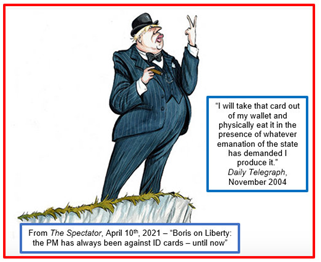
So, I took a decision: two separate but linked blogs. The second – because it makes better chronological sense – will cover the hugely controversial Elections Bill, that seeks to ‘Reset’ some of those core democratic beliefs and principles referred to above: among other things, introducing mandatory voter ID at polling stations, undermining the independence of the Electoral Commission, and changing the electoral system for Mayors and Police & Crime Commissioners.

Its intentions to restrict voting are blatantly partisan; it has been rammed through Parliament, added to and amended, minimising legislative scrutiny; and on that Monday evening it received its Third Commons Reading on more or less straightforward partisan lines (https://www.bbc.co.uk/news/uk-politics-60037651), and thereby progresses to the Lords.

Both Jason Lowther and I have blogged previously about aspects of the Bill, and Part 2 of ‘The Great Parliamentary Resistance’ will shortly update them.

For the remainder of this Part 1, though, it’s across to the Lords and their truly historic Monday evening, when they savaged the Government’s ‘flagship’ Police, Crime, Sentencing and Courts Bill – and not once or twice but an apparently Parliamentary record 14 times! 

Even the Bill’s title suggests a huge legislative gallimaufry, and it is – a classic Priti Patel production, taking the whole of the second part of last year to progress through the Lords to last Monday’s Report stage. That time lapse proving, pleasingly piquantly, the key to some of the Government’s difficulties.

For Patel evidently thought it would be a clever wheeze to use the Lords’ extended deliberations as an opportunity to add all sorts of additional clauses to the Bill, covering some of the myriad things that had enraged her since March – like Insulate Britain’s M25 traffic obstructions last September and Extinction Rebellion protests around November’s UN Cop26 climate summit.

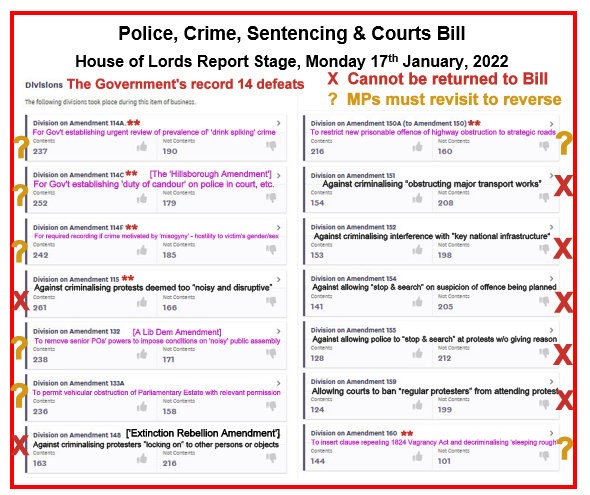
All of which meant that there were three distinct types of Government defeats – sorry, votes – taking place at this Lords Report Stage.  First, the ‘normal procedural’ ones, on parts of the Bill as received from the Commons last July, that the opposition parties in the Lords would like to see reconsidered by MPs and ideally amended or removed. This will kick off the process so whimsically known as ‘parliamentary ping pong’ between the two Houses.

Patel’s ‘late additions’, though, are another matter entirely: criminalising protests deemed too noisy and disruptive … and protesters ‘locking on’, either to each other or immovable objects … and interference with key national infrastructure … and obstructing major transport works … and allowing police to stop and search without giving reasons … and allowing courts to ban regular protesters from even attending protests …   The Lords defeated all of these and MPs can’t reinstate them, as they never voted them into the Bill in the first place, so they’re removed altogether – or at least until Patel repackages them into another Bill for the new parliamentary year starting in April.

Then there are the Lords’ own ‘late additions’ – reviewing the prevalence of ‘drink-spiking’ crime … and crime motivated by ‘misogyny’ … and removing police powers to determine what constitutes a ‘noisy’ assembly … and belatedly repealing the 1824 Vagrancy Act, thereby establishing that begging or sleeping rough should no longer, in this post-Napoleonic/Waterloo era, constitute criminal offences.

None of these were in the Bill when it left the Commons, but they are now – and if MPs don’t like them, they’ll have to vote them down.

What concerned me about the initial reports I read of the Great Lords Monday Night Rebellion was that most seemed, albeit understandably, excited by the record 14 Government defeats, to the point of failing to note the really rather significant differences in the categories and potential significance of the defeats – even some of those with a stake in some of that detail, like Police Professional or Green World.  

So, having recently received my copy of the Inlogov Associates Handbook and being slightly apprehensive that the Director might try to inveigle me into some actual lecturing, I thought I’d prepare the first new overhead I’ve attempted for, well, a few years now – summarising at least my understanding of the current state of play. Hope it helps!


Photo

Chris Game is an INLOGOV Associate, and Visiting Professor at Kwansei Gakuin University, Osaka, Japan.  He is joint-author (with Professor David Wilson) of the successive editions of Local Government in the United Kingdom, and a regular columnist for The Birmingham Post.

Notwestminster: Writing the future of local democracy

Dave McKenna

Next month, Notwestminster takes place again after a year off.  

It’s an event that we love here at INLOGOV and have been delighted to support
previous events as well as go along and share some of our work such as the 21st
Century Councillor research

If you haven’t heard of it before, it’s perhaps best described as a mini
festival of all things local democracy – an informal mix of workshops and
speakers that takes place in Huddersfield. This year it’s taking place in
the hallowed halls of Huddersfield University on Saturday 26th February.

What makes it really rock is the mix of people – volunteers, citizens, council
officers, councillors and yes, even academics, all mix together to discuss a
shared (and sometimes nerdy) appreciation of all things local democracy.

Here’s a section of the workshops to give a flavour:

• Pirates, Citizens and the future of local government

• Zines for democracy

• Creating 100 ideas for the North

• Dramatic Communication Strategies

• How can measuring political literacy help to improve local democracy?

• Fair and equal voting rights for young people across the UK

So, if you’re up for the challenge of renewing our democracy, please join in
for a day of workshops, quick-fire talks, conversations and inspiration in
Huddersfield. Notwestminster is a free event and everyone is welcome to
take part.

You can find out more and sign up here:

https://notinwestminster.wordpress.com/notwestminster-2022/

Hope to see you there.


Dave McKenna is a Research Fellow in INLOGOV.

How the climate crisis is changing Europe’s economic landscape. After four decades, the pandemic and especially the climate crisis have silenced the exponents of fiscal orthodoxy. Keynes is back.

Jon Bloomfield

Image: https://www.flickr.com/photos/jmenj/

Despite the disappointments of COP26, it’s important to acknowledge the momentum the climate movement has gained. Denialists are in retreat, while all governments are under pressure to strengthen their climate targets and actions. The climate crisis, the pandemic and the outcome of the German elections are all profoundly changing the prospects for European politics. The neoliberal right doesn’t like it but, after four decades in absentia, Keynesian economics is back.

Orthodoxy shattered

The first big sign came in the summer of last year, when after several months of sharp debate the European Union agreed a €1.8 trillion budgetary and stimulus package focused strongly on ecological and digital transformation.

What is the political significance of this shift? As the economist Jeffrey Sachs crisply expressed it in the Financial Times, ‘I would say the European Commission is carrying out a social democratic programme, not in name … but in spirit.’

Growing recognition of the climate crisis, reinforced at COP26, has combined with the outcome of the German elections in late September. Leaders of the putative ‘traffic-light’ coalition parties—the social-democratic SPD, the Greens and the liberal Free Democrats—have agreed to make major investments in Germany’s creaking infrastructure and to boost public spending for green and digital transition. They are coming under increasing pressure from German business too. In a major report published late last month, BDI, the German industry association, said the next government had to act quickly—triggering large-scale, low-carbon investments and setting the right framework to ensure the country would transform its economy to reach climate neutrality by 2045.

Joint borrowing

How can the coalition partners finance such ambitious plans, when they have already promised not to raise taxes or change Germany’s constitutionally-embedded ‘debt brake’ (Schuldenbremse), which severely limits new public debt? One proposal is to use the state bank, KfW, to finance investments. But more novel is a proposal for joint EU borrowing—via a European Commission bond programme, similar to that which the EU has launched for the recovery fund.

Keynesian road

The BDI director general, Joachim Lang, indicated the association was open to the idea of EU borrowing, to help fund the massive public and private investment necessary to meet German and European climate goals. ‘To meet its climate targets, Germany needs additional investment of €860 billion until 2030,’ Lang said.

The precise outcome of the negotiations on the German coalition programme remains uncertain. Recognition of the depth of the climate emergency is however driving industrialists and centrist politicians down a Keynesian road. The new government is likely to sidestep the debt brake by giving additional leeway to the KfW. But the more dramatic step would be to call for a new, EU-wide bond programme.

The size and shape of such a programme would of course be crucial issues for EU institutions to determine. But agreement on such a move would confirm that the European Green Deal was no one-off transaction—rather a first step towards Europe adopting Keynesian macroeconomic policies.

The return of social democracy

The tectonic plates are moving. The four decades hegemony of neoliberalism and the ‘Washington consensus’ are drawing to a close. As Sachs says, these moves herald a return to social democracy.

Three huge questions arise. First, will this shift be driven by social-democratic parties or, more likely, broader coalitions as in Germany?

Secondly, will the orthodox European right embrace the climate-change agenda

or will it lapse into the climate denialism of the nationalist right, as in the USA?

Thirdly, can the citizens’ and youth movements which have been so effective in foregrounding the environmental crisis find ways to intervene effectively in this battle? They will have to shed reflex, anti-politics populism and recognise the importance of maximising the potential of the European Green Deal.  COP26, for all its shortcomings, highlighted that politics is on the move. For progressives, there is all to play for.

Jon Bloomfield runs a regular blog series on the Green Deal with Professor Fred Steward

The full text of this article is available at Social Europe.

 How the climate crisis is changing Europe’s economic landscape – Jon Bloomfield (socialeurope.eu)

Dr. Jon Bloomfield. Honorary Research Fellow, Institute of Local Government Studies, University of Birmingham.

Policy Advisor on EU Climate Knowledge Innovation Community (KIC) programme; writes on cities, governance and migration as well as climate