Crisis management in cities: how politicians and public servants worked together during the Ukrainian refugee reception

Dr. Nicolai De Wulf, Prof. Dr. Joris Voets

When Russia invaded Ukraine in February 2022, millions of people fled their homes seeking safety across Europe. In Belgium, cities such as Antwerp, Ghent, and Mechelen were suddenly faced with the urgent task of housing and supporting thousands of Ukrainian refugees. Local leaders had to act fast, building emergency villages almost overnight. But how do politics and administration work together when everything is urgent?

In my recent article in Local Government Studies (co-authored with Joris Voets), we examined how local governments managed this unprecedented crisis and how politicians and civil servants collaborated under pressure. Our study provides new insights into how city administrations function when crises disrupt “business as usual”.

The local dimension of crisis management

Local governments are the first to respond when crises hit. They are close to citizens, know their communities, and must act fast. But crises like the arrival of Ukrainian refugees test even the most prepared administrations. They demand not only logistical problem-solving, like building emergency housing, but also leadership, trust, and coordination across political and administrative levels.

The study draws on 25 interviews with mayors, aldermen, and senior civil servants in Antwerp, Ghent, and Mechelen. These cities hosted the highest numbers of Ukrainian refugees in Flanders and each built an “emergency village” to provide collective housing.

Politics and administration: not separate worlds

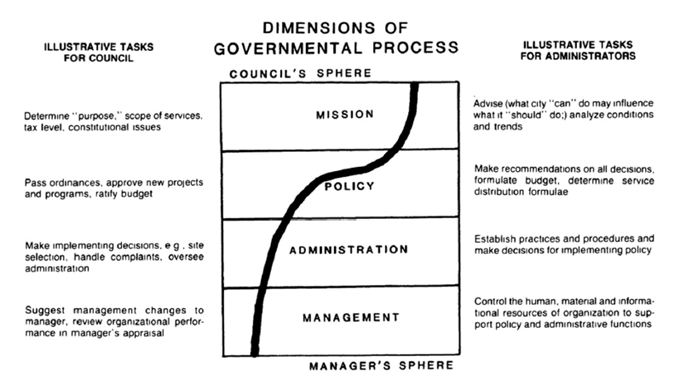
Traditionally, politics and administration are seen as separate spheres: politicians make decisions, and civil servants carry them out. However, decades of research, including the complementarity model developed by Svara, show that successful governance depends on cooperation between the two. The shared responsibility is aptly visualised:

The study addresses the following research question: ‘How complementary are the interactions between politics and administration in cities during the management of the Ukrainian refugee crisis?’

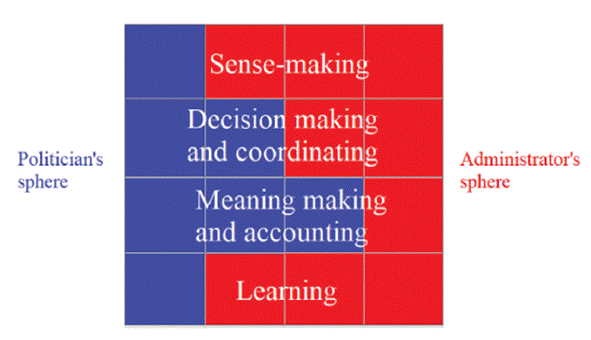
Our study shows that this politico-administrative complementarity is clearly observed during the Ukrainian refugee crisis. Crises blur boundaries: decisions must be made quickly, communication is intense, and trust becomes vital. We replaced the 4 building blocks of ‘regular’ policy making (missions, policy, administration, and management) by 4 crisis management tasks (sense-making, decisions making and coordinating, meaning making and accounting, and learning). We visualised the politico-administrative role division, as for example for the case in Antwerp:

Overall, the tasks of sense-making and learning are predominantly performed by the administration. It has to be noted that the ‘lessons learned’ primarily relate to adaptations along the way, rather than formal evaluations. The decision and coordination task shows a very mixed image: in each of the 3 cases under study, the responsibility of the decision lies, of course, with the politicians. However, the deliberation preceding the decision always showed a shared effort. The meaning-making and account-giving task is predominantly taken on by the politicians involved, most notably the mayors.

Three cities, three approaches

Antwerp had a clearly structured crisis response, with distinct political and administrative levels. The Emergency Planning Coordinator (EPC) played a key role as liaison between the mayor’s team and the city administration.

Ghent adopted a more collaborative approach, with large crisis meetings that included both the College of Mayor and Aldermen and the Management Team. This inclusivity built broad consensus but also slowed decision-making.

In Mechelen, the acting mayor and Emergency Planning Coordinator shared leadership, while the city’s political “DNA” of human rights and diversity shaped its narrative and public communication.

In all cases, civil servants were observed operating in a political world. Primarily the Emergency Planning Coordinators, but also civil servants such as project managers, can play a very determining role in the structuring of the crisis management approach, decision-making, and coordination.

Lessons for local crisis management

Complementarity works: Trust and mutual respect between political and administrative leaders were crucial. In all three cities, politicians and administrators worked as a team, but with notable differences in style. City identity shapes response, each city’s political culture influenced how it managed the crisis.

The study highlights that crises are not only technical challenges but governance challenges. They reveal the real dynamics of how cities work.

For practitioners, the message is clear: invest in relationships between political and administrative leaders before the next crisis hits. For scholars, this case offers evidence that Svara’s complementarity model holds up even under crisis conditions, but needs adaptation to capture the intensity and speed of crisis decision-making.

As crises become more frequent, cities need to build governance systems based on trust, expertise, and teamwork. Complementarity between politics and administration is not a luxury, it is what keeps local government resilient when it matters most.

Dr. Nicolai De Wulf (ORCID 0000-0002-1748-6604) finalised his PhD focusing on politico-administrative relations within local government. In the PhD three topics are studied through a politico-administrative lens: policy integration and coordination, partisan political staff, and crisis management. The PhD was supervised by prof. dr. Joris Voets.

Prof. Dr. Joris Voets (ORCID 0000-0002-8266-8607) is an associate professor in the Department of Public Governance and Management at Ghent University, Belgium. His main research interests are inter-organisational networks and local government.

From Consultation to Co-Creation: How Birmingham Can Lead the Way in Participatory Governance

Susana Higueras and Sonia Bussu

In a time of growing inequality, political disillusionment, and institutional strain, Birmingham is at a crossroads. The city’s bold initiative, Shaping Birmingham’s Future Together (SBFT), offers a timely and transformative opportunity: to reimagine how local government works with its communities.

A new report by Susana Higueras and Sonia Bussu lays out a compelling roadmap for how Birmingham City Council (BCC) can become a participatory council. Drawing on UK and international examples, as well as interviews with local stakeholders, the report argues that participatory governance must be more than a buzzword. It must be embedded into the everyday workings of the council, grounded in inclusive practices, and driven by a genuine commitment to share power.

Why Participation, Why Now?

Birmingham is one of the UK’s most diverse and youngest cities. This diversity is a strength, but also a challenge when it comes to ensuring that all voices are heard in policymaking. At the same time, the city faces deep structural inequalities, including the highest child poverty rates in the UK. Traditional top-down governance models are no longer fit for purpose. What’s needed is a shift from consultation to co-creation.

The SBFT partnership, launched in 2024, aims to tackle these challenges by fostering collaboration across public, private, and community sectors. But as the report makes clear, this vision will only succeed if participation is embedded, not treated as an add-on or a one-off event.

What Does Embedded Participation Look Like?

Embedded participation means making citizen engagement a routine part of how decisions are made, from setting priorities to evaluating outcomes. It requires:

  • Facilitative leadership that enables collaboration and power-sharing;
  • Boundary spanners, or individuals who bridge the gap between institutions and communities;
  • Strong partnerships with civil society, grassroots, and voluntary organisations;
  • Intersectional inclusion that centres the voices of those facing multiple, overlapping barriers to participation.

The report highlights that successful participatory governance is not about flashy new tools or one-off events. It’s about culture change, within the council, across sectors, and in how communities are engaged.

Lessons from Elsewhere

The report draws on global examples to show what’s possible, and what pitfalls to avoid.

  • Porto Alegre, in Brazil, was a trailblazer in participatory budgeting, enabling residents to directly allocate public funds, at one point transferring over $300 per person annually to community control. However, as political leadership shifted, the commitment to the process waned, and budget allocations steadily declined, leading to a loss of momentum.
  • Barcelona, Spain, embedded citizen participation through digital platforms like Decidim and cultivated strong ties with social movements. At its peak, over 40,000 citizens engaged in budgetary decisions. Yet, the experience underscores the vulnerability of transformative initiatives when overly reliant on charismatic leadership, making them susceptible to political cycles.
  • Camden, London, institutionalised citizens’ assemblies, integrating them into formal decision-making structures. Notably, all 17 citizen recommendations on climate policy were adopted. Still, challenges persist around ensuring inclusivity and maintaining consistent follow-through.
  • Reykjavik, Iceland, leveraged digital platforms to crowdsource citizen ideas and implement participatory budgeting. Initially successful in mobilising thousands of residents, the initiative faltered as political support diminished and the platforms remained peripheral to formal governance, highlighting the limitations of digital participation without institutional anchoring.
  • Ostbelgien, Belgium, established the world’s first permanent deliberative system linked to a legislative body. Its legally enshrined Citizens’ Council and Assemblies offer a promising model of democratic stability and accountability. However, the top-down design and limited community ownership reveal the critical need for co-creation and inclusive recruitment to prevent the reinforcement of existing inequalities.

These examples show that embedding participation requires sustained commitment, institutional support, and mechanisms for accountability.

Opportunities in Birmingham

Despite the challenges, Birmingham has a strong foundation to build on:

But There Are Challenges Too

The report doesn’t shy away from the barriers:

  • Broken trust: Communities are tired of being consulted without seeing change.
  • Hierarchical leadership: A top-down culture limits innovation and responsiveness.
  • Structural silos: Departments often work in isolation, duplicating efforts and missing opportunities for collaboration and nurturing citizen participation.
  • Unfair funding mechanisms: Smaller community organisations feel sidelined and overburdened by bureaucracy.

These challenges are not unique to Birmingham, but they must be addressed head-on if SBFT is to succeed.

What Needs to Happen Next?

The report offers a clear set of policy recommendations.

Rebuild trust through transparent communication and visible follow-through.

Trust has been eroded by repeated consultations without tangible outcomes. BCC must commit to clear feedback loops, visibly acting on community input and explaining decisions transparently to rebuild credibility and legitimacy.

Embed participation in budgeting, service design, and scrutiny processes.

Participation should not be limited to one-off events; it must be embedded across governance functions. This can include participatory budgeting, citizen panels, and co-designed scrutiny mechanisms that give residents real influence over public decisions.

Foster facilitative leadership and cross-sector collaboration.

Leadership must shift from command-and-control to facilitation, enabling shared power and collaborative problem-solving. Cross-departmental working groups and partnerships with civil society can help break down silos and foster innovation.

Work better with communities, recognising them as co-creators, not just consultees.

Community organisations should be treated as equal partners, with fair funding, early involvement in policy development, and recognition of their expertise. This means moving from consultation to co-creation, where communities help shape solutions from the outset.

Design for intersectional inclusion, addressing overlapping barriers to participation.

Inclusive participation requires acknowledging and addressing systemic inequalities. Councils must create safe, accessible spaces and use diverse engagement methods, including arts-based approaches and multilingual formats, to ensure marginalised voices are centred and valued.

The SBFT partnership can be a catalyst of this change and become the space for shared governance and accountability.

A Call to Action

The SBFT initiative is more than a policy programme, it’s a democratic innovation. It’s a chance to reshape how power is shared in the city, how decisions are made, and how communities are valued. As one community leader put it: “We’re not asking to be asked. We’re asking to lead.”

If Birmingham can rise to this challenge, it won’t just be shaping its own future. It will be setting a national, and even global, example of what inclusive, embedded participatory governance can look like in the 21st century.


DOI: https://doi.org/10.48352/inlogov.bhamx.0001

Dr Sonia Bussu is an Associate Professor at the University of Birmingham Department of Public Administration and Policy where she studies and teaches public policy. Her main research interests are participatory governance and democratic innovations, and creative and arts-based methods for research and public engagement. 

Susana Higueras Carrillo is a Peruvian anthropologist. She is PhD candidate at Goldsmiths, University of London and holds a master’s degree in Environmental Governance from the University of Oxford. She has worked at the University of Birmingham in the INSPIRE (Intersectional Space of Participation: Inclusive, Resilient, Embedded) project researching how to strengthen intersectional inclusion through arts-based methods such as legislative theatre. Her research interests lie in environmental and social justice and communicating research in creative and impactful ways.

Renewing Democratic Leadership

Jason Lowther and Sonia Bussu

Legislative Theatre with West Midlands Combined Authority

As local government in England undergoes significant restructuring, with fewer councils serving larger and more diverse populations, the role of councillors is under pressure. At the same time, democratic innovations, such as citizens’ assemblies, or creative methods of participation, such as legislative theatre and digital engagement, are gaining traction. These innovations offer new ways to engage communities and strengthen democratic legitimacy.  But how do they fit with the role of elected councillors?

Recent research and practice suggest that councillors can play a crucial role in facilitating inclusive and impactful citizen participation.

Politicians’ Views on Participation

Across the UK and Europe, many elected representatives have expressed support for citizen participation in policymaking. They see it as a way to build trust, improve decision quality, acknowledge a wider range of perspectives and knowledge, engage citizens more deeply in political life, and potentially identify novel solutions to politically difficult issues. However, research by Kersting shows that this support is often conditional. Councillors tend to favour participatory instruments that reinforce their representative role, such as advisory boards or structured consultations. They are more sceptical of online platforms and randomly selected citizen assemblies (so-called minipublics), which they worry may not be genuinely representative of their electorate and may lack the capacity to understand complex issues.

Werner and Marien’s comparative experiments in Sweden and the Netherlands provide further insight. Their work shows that participatory processes consistently increase perceptions of fairness. This matters because fairness perceptions are closely linked to trust, policy compliance, and perceived legitimacy. Importantly, these effects are not limited to winners (who support the outcome of the exercise); even those who lose in participatory decisions tend to view the process more positively than in purely representative settings.

These findings highlight a tension. While democratic innovations can enhance legitimacy, councillors often feel uncertain about their role within them. Without open discussion, clear support, and integration, these processes risk bypassing councillors altogether.

Reimagining the Role of Councillors

Inlogov’s 21st Century Councillor research offers a compelling framework for renewing councillors’ roles. It describes councillors as hybrid connectors who build relationships both online and offline, multi-level diplomats who navigate partnerships across governance layers, and system stewards who shape democratic innovation and institutional change.

To fulfil these roles, councillors need support. This includes help to understand democratic innovations and any potential concerns.  They need understanding of key areas such as facilitation skills and digital engagement, confidence in narrative-building around democratic innovation, access to mentoring from peers with experience of these approaches, opportunity to explore difficult scenarios, and chance to reflect on their practice. Councils must also empower community members to scrutinise participatory outputs, and help councillors to navigate tensions between citizen input, officer advice, and party lines.

The Camden Model: Embedding Participation

Camden Council offers a practical example of how participatory processes can be embedded within representative governance. The council has institutionalised citizens’ assemblies as regular tools for major policy development, including planning, climate change, and health and social care. Assemblies are commissioned by council boards, which commit to formally responding to recommendations. In the case of the 2019 Climate Assembly, all 17 proposals were endorsed and integrated into Camden’s Climate Action Plan, with the citizen’s assembly referenced throughout the document.

This approach demonstrates how local government can lead participatory processes, ensuring they are not just consultative exercises but integral to policy development. However, several recommendations from the Camden climate assembly extended beyond the council’s jurisdiction, highlighting the structural limitations of local deliberative processes in addressing systemic issues like the climate. Councillors could have played a stronger bridging role, helping to clarify expectations and ensure that recommendations were grounded in the council’s remit. Stronger involvement from elected representatives might have thus enhanced democratic accountability.

Inclusive youth engagement in policymaking in the West Midlands

There is much more to learn and do to make democratic innovations more inclusive and effective, supporting participation from historically marginalised groups, which tend to ignore invitations to participate in citizen assemblies or formal consultation exercises.

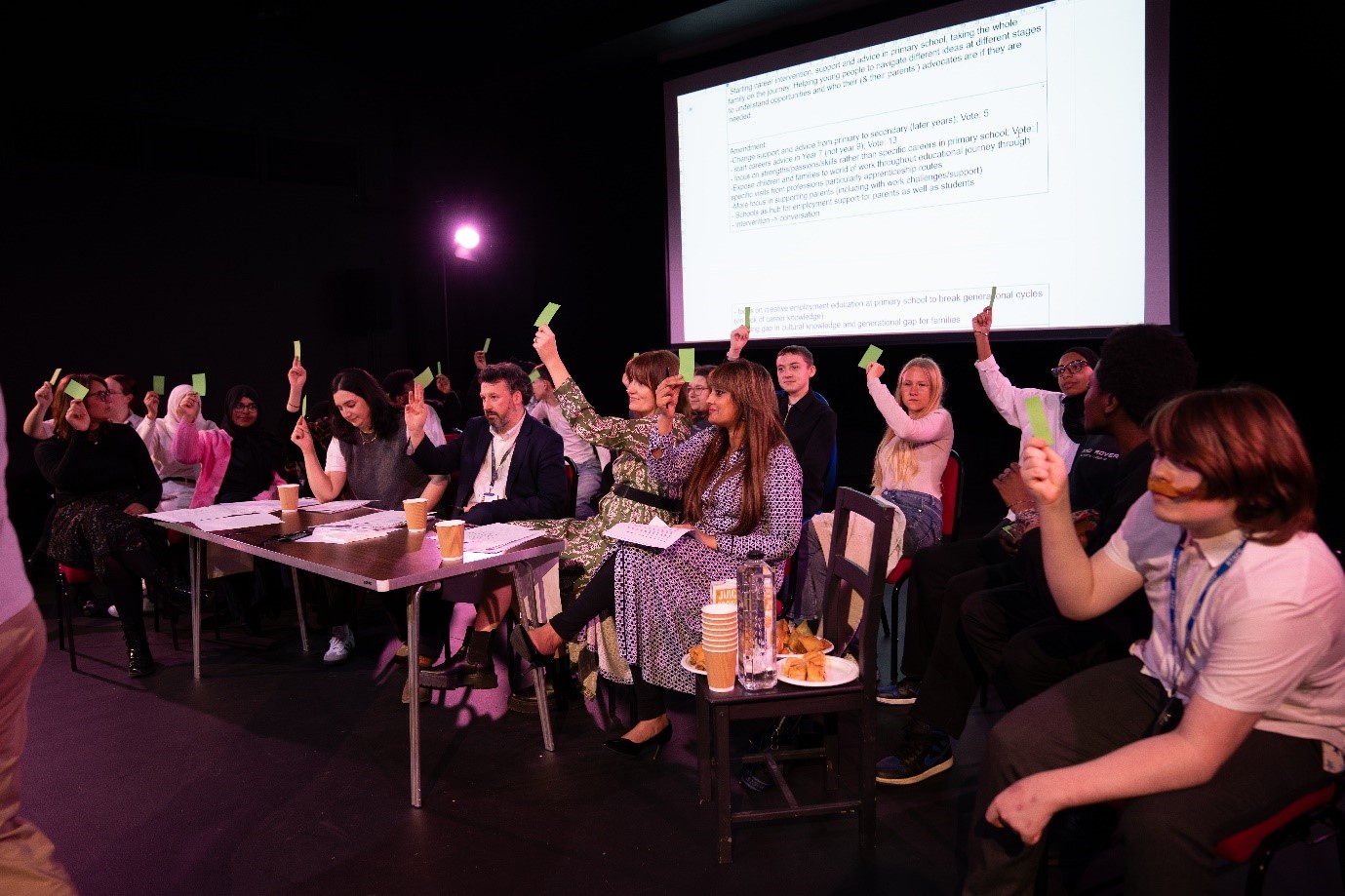
A recent example of inclusive approaches comes from the West Midlands, where the INSPIRE project, led by the University of Birmingham, used legislative theatre to engage young people in shaping youth employment policy. Legislative theatre is a method developed by Augusto Boal that uses performance to explore lived experience, test policy interventions, and co-create solutions. It involves watching a play co-created by the participants on real issues and based on their lived experience. During the event, an audience of community members and policymakers become spect-actors, acting out alternative scenarios, proposing policy changes, and voting on them in a public forum.

The University of Birmingham partnered with the Young Combined Authority and Youth Focus West Midlands to recruit a diverse group of 15 young people (14-17 years old) who, under the guidance of legislative theatre practitioners, developed a play about barriers to work experience and youth employment. Through performances and structured dialogue with policymakers, they co-created six policy proposals. These include reforms to careers advice, work experience, and employer accountability.

Crucially, policymakers were invited to participate not just as observers but as co-creators and champions. Their involvement can help bridge the gap between lived experience and institutional action, demonstrating how local government can play a central role in democratic innovation for social change.

Councillors as Democratic Innovators

Democratic innovations in Camden and the West Midlands are two examples of how local government can promote democratic renewal. Councillors can and should play more central roles in these processes, beyond party politics, to facilitate and nurture dialogue between citizens and institutions, ensuring follow-through on recommendations, and using committee structures to embed participatory outputs.

Rather than seeing participation as a threat, councillors can embrace it as a tool to strengthen their representative role and reconnect with communities. They are uniquely positioned to bridge the gap between citizen voice and institutional action. This requires a shift in mindset and practice.

Dr Jason Lowther is Director of Inlogov (the Institute of Local Government Studies) at the University of Birmingham, and was Assistant Director (Strategy) at Birmingham City Council from 2004 to 2018.  His research focuses on the use of evidence in public policy and central intervention in local government.

Dr Sonia Bussu is an Associate Professor at the University of Birmingham Department of Public Administration and Policy where she studies and teaches public policy. Her main research interests are participatory governance and democratic innovations, and creative and arts-based methods for research and public engagement. 

This article was first published in the Municipal Journal, 25th September 2025, available online here: https://www.themj.co.uk/renewing-democratic-leadership

Picture credit: Inspire Legislative Theatre, March 2025 – photo by Bucuria Maria Polodeanu – Insta: @reelmasterproduction

Dusting down the cautious welcome: Initial reflections on the devolution white paper

Phil Swann

When I was director of strategy and communications at the LGA I was frequently criticised, by the late professor John Stewart among others, for issuing press releases “cautiously welcoming” one Blairite initiative or another.

The criticism was probably justified, but I would definitely have deployed that phrase in response to the government’s recently published devolution white paper.

There is undoubtedly a lot to welcome, not least the stated commitment to devolution, the additional powers for metro mayors, the revival of strategic planning, its reference to struggling small unitary councils and the focus on audit and standards.

There are, however, at least four reasons to be cautious.

First, every serious reformer of local government since George Goschen in the 1860s has argued that local government finance and structures should be reformed together. No government has ever had the political will or energy to do so. This government has also ducked the opportunity. As a result, this white paper will not fulfil its potential.

Second, the current mess and confusion in the structure of English local government is the result of incremental change. Just think of Peter Shore’s “organic change” and Michael Heseltine’s ill-fated Banham Commission. There is a real danger that this government will run out of restructuring energy or time. The contrast with Scotland and Wales, where local government was reorganised in one go, could not be starker.

Third, the effectiveness of the structures being proposed will depend on the quality of the relationships between mayors and councils, between councils and parishes and between ministers and mayors, councils and parishes. In England we are not good at relationships like these and there is precious little in the white paper to signal the trust, effort and imagination that will be needed to make these relationships work better than the previous ones did.

Finally, key to the revival of local government and effective devolution is a revival of citizen engagement in local politics and local governance. Word has it this will be addressed in a forthcoming white paper, but it should be central to this one.

So, a very cautious welcome it is.

Phil Swann is studying for a PhD on central-local government relations at INLOGOV.

Local Democracy in Crisis?

Peter Hetherington

Battered by fourteen years of austerity, is local government losing its once-proud standing and status? Probably. For a start, It’s no longer as ‘local’ as it should be. And it certainly isn’t ‘government’ as we once knew it.


These days, we sometimes tend to lump ‘democracy’ and ‘crisis’ together in a global context, forgetting that close to our doorsteps – in countless civic centres, town and county halls – there’s another crisis: restoring faith in local democracy, while sustaining councils literally facing insolvency.

At a hybrid event, organised by the Centre for Urban and Regional Studies at Newcastle University, we asked a simple question at the start: Do we need a new, positive direction for once-powerful towns and communities where meaningful democracy has disappeared as local government has withdrawn?

We attracted a great range of speakers putting, broadly, two cases: first for a new local government structure in England based on economic geography embracing combined authorities for big city areas alongside large county-wide single purpose unitary authorities, underpinned by a more equitable funding formula; and, secondly, for varying degrees of town and parish governance, sustained by participatory democracy, including citizens assemblies, with powers – parks, libraries, leisure facilities for instance – devolved from existing larger authorities. Often, such an asset transfer is born out of necessity because larger councils can’t afford to keep them anyway and parishes/towns can raise money through a council tax precept while sometimes creating stand-alone community interest companies.

The case for a genuine new ‘localism’ appeared strong. That’s because, currently, a continuing process of abolishing councils to create larger units with few, if any, local roots has created a sense of powerlessness, a collective loss of identity with little or no attachment to people and places. Fifty years’ ago England had almost 1200 councils, from the smallest urban/rural district to the largest city. “We were run by our own,” recalled the writer, broadcaster and ultimate polymath Melvyn Bragg, in his 2022 memoir ‘Back in the Day’. Born in Wigton, Cumbria, his small town had a rural district council (which I knew well): “We could challenge the elected councillors who made the decisions” Bragg continued. “They were not a separate cadre…they were just people you had been to school with…(approach) on the street…to whom you could write a personal letter knowing it would be read, considered, answered.”

No longer. His council disappeared in 1974. Today, after several rounds of ‘reorganisation’ under the dubious label of efficiency – although there’s little concrete evidence of cost saving – that number has been reduced to 317, with little if any public debate. A forthcoming devolution White Paper is expected to advocate more reorganisation and even fewer councils in a country where local authorities already cover much larger areas than in mainland Europe.

Against this background, it’s probably no surprise that Carnegie UK, in its recent ‘Life in the UK’ index, reports that a lack of trust in politics and government is undermining collective well being. Three-quarters of people, says Carnegie, feel they can’t influence decisions. Surely reconnecting them begins locally. But how local?

If the government’s approach so far is a broad definition of ‘taking back control’, could an over-arching contradiction be emerging? Will the apparent obsession with more all-purpose councils, the prospect of an all-unitary England – similar to the structure in Scotland and Wales – make people feel even more distant from power, disaffected? Carnegie insists that restoring faith in democracy should be the Government’s ‘mission of missions’.

If that’s one challenge, there’s another, interlinked: the crisis of financing local government, with 7 councils theoretically insolvent and many more heading that way; legally, they can’t go bust and have been forced to borrow the equivalent of pay-day loans on a mega-scale to stay afloat, adding to a debt mountain. Now Conservative-run Hampshire has said issuing a section 114 notice – prelude to technical insolvency – is “almost inevitable”, with a sting of others close behind. And as Prof Andy Pike, and Jack Shaw have outlined in their recent excellent, but chilling paper (‘The geography of local authority financial distress in England’) 96% of English councils won’t balance their books by 2026-27.

Of course, alongside that unparalleled financial crisis in local government, we’re also facing an alarming democratic challenge nationally with the lowest turnout ever recorded in the recent general election; almost half the electorate didn’t vote! Surely, the place to renew trust in the democratic process begins at the grass roots, perhaps reviving some of the 10,000 town and parish councils, some of which want to take over functions from larger authorities (some are obliging out of necessity). Could this – call it double devolution – provide one small way forward?

I’m aware there’s a danger that events, like the latest one at CURDS addressing the crisis in local democracy, can produce a combination of hand-wringing and hot air. But, hopefully, we concluded with a practical, positive outcome. As Professor Jane Willis, geographer and champion of community empowerment – now in Cornwall- noted: “It’s not all gloom and doom – there is good news.” In her county, communities are taking back control, again out of necessity – a really positive story and a lesson for elsewhere? Willis advocates a new social contract under a layered system of local government to “re-franchise” people.


In the meantime, the chair of the event urged those present to make their views known to MPs, and the government, as the forthcoming devolution White Paper foreshadows a pre-legislative consultation process. As Professor Andy Pike, of CURDS, noted in summing up, one leading question needed answering above all: “What is local government for, and how to fund it?”


All we know so far is that the White Paper, according to the Treasury, will include …“working with councils to move to simpler structures that make sense of their local area with efficiency savings from council reorganisation helping to meet the needs of local people…”. Contradictory or otherwise – will more larger councils “make sense” of local areas? – we must surely intensify a campaign for a genuine new ‘localism’, embracing places, communities, towns and some cities now without any form of local government. That doesn’t necessarily mean sidelining the case for a new – and/or revised – local government structure in England tied to a ‘needs’-based funding formula. The current one favours the richer parts of the country and penalises the poorest with the lowest tax bases.


But the time for national government to act is during the first year or so of a new administration. It assuredly won’t go down well with the ‘middle England’ target readership of – say – the Daily Mail. There’ll be howls of protest. But it must be a priority to bring a sense of fairness to a deeply unequal country and, equally importantly, deliver some hope to voters in the so-called ‘red wall’ seats who either returned to Labour at the last election or voted for an ascendant Reform. We live in a fragile democracy. Restoring faith in government, local and national, begins in community, neighbourhood parish and town. We need the Labour government to think big and act local. We haven’t much time.

Peter Hetherington is a British journalist. He writes regularly for The Guardian on land, communities, and regeneration.  He is also a vice-president, and past chair of the Town and Country Planning Association, former regional affairs and northern editor of The Guardian and the author of the 2015 book, Whose Land is Our Land? The use and abuse of Britain’s forgotten acres, and the 2021 book, Land Renewed: Reworking the Countryside.

Equipping local governments to deliver national and local priorities

Jason Lowther

Today we launched our latest report, Equipping local government to deliver national and local priorities. Local government is critical to the delivery of the new government’s five key missions, and to improving life across the country. We argue that, once a series of critical reforms are in place, government should have confidence to equip local authorities with more power and (when public finances allow) prioritise additional resources there, enabling local and national priorities to be delivered. But critical reforms are needed in financial management, audit and performance management, and in community power and participation.

The new government inherited many challenges. Council budgets per person in England have been cut by 18% in real terms since 2010. Councils are hitting financial crises: twelve have issued section 114 notices in the last six years, compared with zero in the previous 17 years. Representative institutions at all levels of government are suffering from declining legitimacy and increasing polarisation. Local government plays a vital role in increasing democratic relationships and trust.

But councils’ wide remit, local knowledge, democratic accountability, public service ethos, and key roles in working with partners and shaping local places make them critical to the delivery of all five of the government’s key missions. Local governments are best placed to operationalise solutions to interconnected problems, for example, improving public transport and encouraging more cycling and walking helps meet net zero targets. It can also deliver health benefits, reducing the burden on the NHS, as well as increasing productivity by giving businesses access to a wider and healthier workforce.

Action is required to ensure that councils are fit for purpose to make the type of contribution that central government requires of them. Underlying this is a lack of confidence in local government on the part of ministers and civil servants.  We have identified three areas in which the government must be confident if it is to equip the local level with more power: financial sustainability, performance standards, and community power and participation. 

Policy recommendations

Financial arrangements

  1. Provide multi-year funding.
  2. End competitive bidding and deliver a “single funding pot” for each council/ local area that has been allocated fairly and sensitively to the needs and assets of the community.
  3. Abolish council tax capping.


Audit and performance management

  1. Strengthen the evaluation of councils’ performance management.
  2. Make OFLOG independent and extend its remit and approach.
  3. Reintroduce effective management and support of council external audit by independent bodies.


Community power and participation

  1. Strengthen the role of councillors as facilitators and catalysts of community-driven change.
  2. Embed participatory governance to ensure lived experience and marginalised voices drive policy and service delivery.
  3. Develop public-commons partnerships and community-wealth building to support community-driven sustainable economies.

As the Layfield Commission concluded 50 years ago, local government funding should promote responsible and accountable government. Beyond welcome recognition of acute financial challenges and commitment to multi-year funding settlements, there is a pressing need for additional immediate and longer-term action to improve Councils’ financial position and strengthen local accountability.

Local authorities have different needs for funding, depending for example on levels of population and its composition, deprivation, and spatial factors. Central and local government should develop updated funding formulae and funding models which are as simple as practicable whilst capturing the key elements of local need, and as transparent as practical in operation.  There are many reports researching available options for fairer funding, approaches to fiscal devolution, and local government funding options

Local audit, performance regimes and regulation each have a part to play. Both a parliamentary select committee and the Redmond Review into the Oversight of Local Government have sought to investigate the failings in local government audit.  The latter in 2020 critiqued market driven audits, stating that the new audit arrangements have undermined accountability and financial management. 

The adoption of the Redmond Review’s proposal for an Office for Local Audit Regulation would provide oversight on procurement, management, and regulation of external audits of local authorities. The government could extend the oversight of local government performance management processes while avoiding the creation of an overly powerful national regulator, by adopting key recommendations on the future arrangements of OFLOG (the Office for Local Government).

Proximity means that local government can play a crucial role in improving relationships between government and citizens. By creating conditions to mobilise the diverse expertise and resources of communities, local government can ensure that public policies and funding are informed by the assets, priorities and needs of local people and places.  There are already many examples where local government has made progress with innovations such as citizens’ panels and juries, the delegation of power to the hyper-local level and in building inclusive economies

We have over thirty years’ worth of research on deliberative democracy, social innovation, and co-production evidencing the value of collaboration with diverse communities and stakeholders. Participatory governance is less about finding perfect solutions and more about transforming organisations to engage with communities in processes of co-producing mutual understanding, shared solutions, and a sense of collective ownership.  

Our work on the 21st Century Councillor can help with enabling the role of councillors not just as democratic representatives but also as facilitators and boundary spanners between institutions, communities, civil society and local businesses.

Community-wealth building, pioneered in Preston and several London boroughs, can help strengthen the local economy with insourcing, linking public procurement to local cooperatives and social enterprises. These novel forms of governance can be formalised through Public-Commons Partnerships.

Equipping local government to deliver national and local priorities will leave a long-lasting legacy of a well-resourced, effective, accountable, and engaged local government.

The full report is available here

The report was edited by Jason Lowther and Philip Swann, with particular thanks to the following contributors (alphabetically by last name): Dr Koen Bartels, Dr Sonia Bussu, Prof Nicole Curato, Dr Timea Nochta and Dr Philip Whiteman. With thanks to other colleagues and associates in INLOGOV.