Our elections should be about voter inclusion, not exclusion

Chris Game

When I used to teach undergraduate Politics courses, I would try to invite along at least one overseas student when I went to vote – partly for their cultural education, partly to share their impressions.

Their customary first question was: will there be queueing?  It would be asked in relation to almost any unfamiliar British activity, but particularly after I happened to have recounted the time a Romanian Presidential Election clashed with Birmingham’s Frankfurt Christmas Craft Market, and police were required to shepherd literally hundreds of remarkably patient Balkan voters round the fringes of the market to the Town Hall, doubling for the occasion as a regional Romanian polling station.

My queueing answer, even for a General Election, was a confident ‘No’. Likewise, to usually the next question: taking photos.

The students would already know about voting in the UK not being compulsory. So the polling station trip’s key ‘learning point’ was identity verification, as they were fully aware that, unlike many of their countries, we don’t have national ID or citizen cards, with or without a photo.

Whereupon I would produce my so-called poll card from the City Council Returning Officer, detailing the election date, my polling station and register number, voting hours, plus “You do not have to take this card with you in order to vote”. They would be underwhelmed by the flimsy, featureless B&W card that almost begs to be junked immediately upon, if not before, being read. So I would tease them by telling them initially that it’s another ‘British tradition’.

Poll cards were first produced for the 1950 General Election, and tradition requires them still to look as if printed by a pre-Xerox mimeograph machine. Compared to our queueing obsession, separate hot and cold water taps, and constant apologising, it usually struck students as among our lesser cultural eccentricities.

But how would I prove my identity?  Whereupon I would explain that, although Northern Ireland voters have since 2002 had to produce one of seven possible forms of photographic ID – including, if necessary, a free Electoral Identity Card – as a GB voter, I wouldn’t have to. Indeed, even if I proffered my poll card, the Poll Clerk would still ask my name and address – which I could easily read upside down on the electoral register as it was being marked off.

Meaning, if I wanted to cheat small-time – commit ‘personation’ by having someone illegally cast an extra vote for my preferred candidate – I could easily memorise the names of neighbours who had not yet voted, and select one least likely to in, say, the next hour or so, who could thus be safely impersonated.

Almost invariably, that voting practice summary proved among the most impactful information I imparted to my students. “How British!” was their first reaction, though generally followed by mild but real shock: at our treating so apparently casually this core act of political participation that many of them and their parents’ generation had literally fought – and then queued – for.

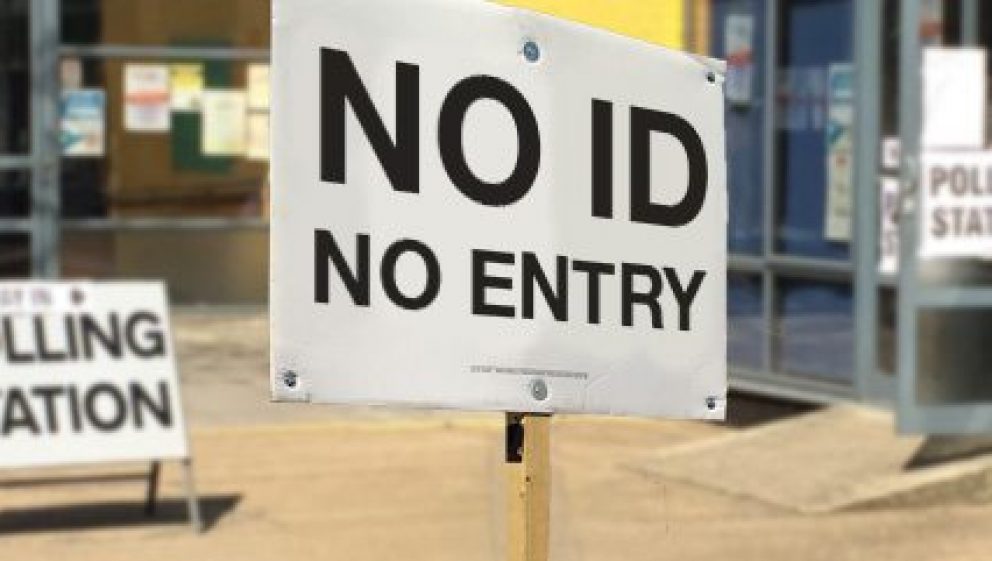
All of which is an anecdotal way of introducing my own ambivalence towards the Government’s commitment to extend from 2023 the Northern Ireland practice and require all UK citizens to show photo ID in all the categories of Parliamentary and local elections taking place on May 6th.

So what’s my problem? The Electoral Commission has supported it for years.  The policy has been in two winning Conservative manifestos. It will be an Electoral Integrity Bill, which sounds worthy enough. It has been pilot tested – kind of. It worked in Northern Ireland, where ‘personation’ has been largely eliminated.

Besides, since we nowadays show ID for ever more everyday services, it’s irrational not requiring it for something as important as voting. I can almost hear my students agreeing – as indeed do I. My problems are with the Government’s priorities – and the false Northern Ireland analogy.

20 years ago NI had a big, pumpkin-sized electoral problem – public perception of widespread electoral malpractice, including vote-stealing, impersonation, voter intimidation, multiple register entries. GB, thankfully, doesn’t.

The Electoral Commission’s own analysis shows that of 58 million votes cast across the whole UK in 2019, 595 alleged electoral fraud cases were police-investigated – most concerning local elections and campaigning offences. Just four led to convictions, one being for impersonation.

Partly, and sadly, because of widespread political apathy and alienation, GB’s voting malpractice problem is, pinching the Electoral Reform Society’s metaphor, nut-sized – yet to which the Government proposes bringing a clumsy, costly, partisan legislative sledgehammer.

Second, the effectiveness of the NI photo ID reform is almost always judged first by pre-reform turnout rates not having significantly fallen. What significantly rose, though, to today’s seriously disturbing levels, is the incompleteness of the electoral registers on which those turnout percentages are based.

According to the Electoral Commission, just 51% of NI 18-34 year olds were correctly registered in 2019, compared to 94% of over-65s; 88% of ‘outright’ homeowners, but 38% of private renters. Obviously, if you’re not registered, you’re not part of the turnout base. In short, NI today is not an exemplary electoral model for the rest of the UK.

GB’s genuinely big electoral problem, again based on those most recent Electoral Commission data, is that over 9 million, or 17%, of eligible GB voters were either not or incorrectly registered at their current address – particularly, if unsurprisingly, the young, persons of colour, renters, low-income, disabled, and simply those with no fixed address.  Many/most of whom – how to put this – would on balance probably not be natural Conservative supporters.

There is an obvious solution: Automatic Voter Registration (AVR) – the direct enrolment of citizens on to the electoral register by public officials; no citizen initiative required. But that’s for another blog.

Meanwhile, if anything should be made compulsory, let’s make it not photo ID, but poll cards: “You SHOULD take this card with you when you go to vote”.


Chris Game is an INLOGOV Associate, and Visiting Professor at Kwansei Gakuin University, Osaka, Japan.  He is joint-author (with Professor David Wilson) of the successive editions of Local Government in the United Kingdom, and a regular columnist for The Birmingham Post.
Source: Electoral Reform Society

Local Government’s Big Night

Jason Lowther

On Thursday, over 17,000 candidates will be asking their fellow citizens to elect them to around 5,000 roles as their representatives.  Although there have been serious concerns about the wisdom of running elections in the middle of a pandemic, as we explored in this blog in January, it looks like local government has again risen to the challenge and will deliver elections as required.  It looks like a big night for local government, with some important trends that might affect politics nationally in coming years.  Will Northern voters return to Labour?  Will England’s Combined Authorities see a shift in power?  How will voters react to alternative voting systems?  What will be the impact of greater postal voting?  And will we see more influence from smaller parties?

Will the Red Wall start to repair or crumble further?  Labour is defending seven councils where the 2019 general election suggests a swing of over 6% to the Conservatives, according to analysis by the GuardianResearch by Lord Robert Hayward (Con) suggests that the Conservatives are fielding many more candidates in Northern areas than in the last local elections in 2017: at least doubling their candidates in Doncaster and Rotherham and fielding more than 40% extra candidates in Durham. 

Combined Authorities could see some significant shifts in power.  Whilst Labour has a strong majority in Greater Manchester and Liverpool City Region, other CA contests look much closer.  Tees Valley CA has a straight two-way fight between red and blue, with Conservatives defending a 2.3% majority. But the closest fight is probably in the West Midlands, where Conservative Andy Street had less than a 1% majority last time. 

A range of voting systems are operating.  In England, Combined Authority (Metro) Mayors and Police and Crime Commissioners are being elected on the ‘supplementary vote’ system rather than the traditional First Past The Post (FPTP) system used for MPs.  With the ‘single transferable vote’ system in Scottish Councils and NI, and the ‘additional member system’ in London and (all adults aged over 16) in the Scottish and Welsh Parliaments, there must be a question mark on how long MPs can hold out against a more democratic electoral system for Westminster.

As required by the Combined Authority (Mayoral Elections) Order 2017, in CA areas each registered voter has received a package of information on the election process and each of the candidates.  I was interested to read the West Midlands CA booklet, which provided a clear explanation of the ‘supplementary vote’ system used in these elections.  It also included two-page statements from each of the candidates which I felt was a huge improvement on the usual random arrival of leaflets through the letterbox.  In a very Covid-Era vignette, the order in which the candidates appeared in the booklet was decided after the close of nominations by the Council’s Monitoring Officer drawing lots, witnessed by the Electoral Commission on a Teams Call, with the video of the call then provided to the candidates. 

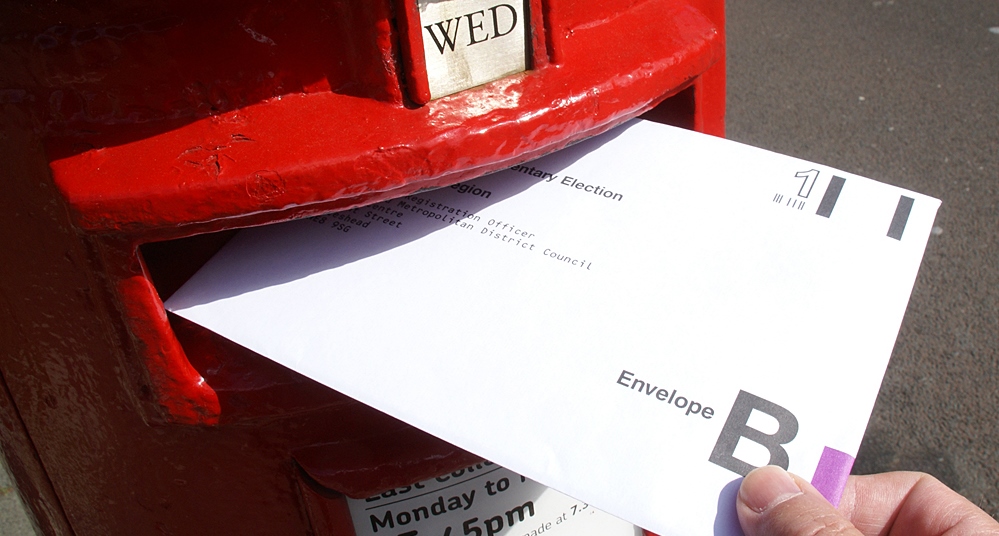
Postal votes may be particularly important in these elections, with around 90,000 people requesting their postal vote on the deadline day itself.  In some areas most votes might be cast in this way before election day, fortunately for the Conservatives ahead of the current ‘cash for curtains‘ controversy.  It will be interesting to see whether this new method becomes the ‘new normal’ for many voters, replacing their usual stroll to the ballot box in the Great British weather.

We are seeing a rise in smaller parties.  Beyond the big four parties, six smaller parties are fielding 60 or more candidates at these elections: Reform UK, the Trade Unionist and Socialist Coalition, the UK Independence Party, the Freedom Alliance, the Social Democratic Party and The For Britain Movement.  Research by Democracy Club, based on Statements of Persons Nominated published by English councils on 8-9 April 2021, shows these six parties contesting at least 1% of available seats.  As Colin Copus demonstrated, smaller parties not only provide voters with electoral choice, they can also influence the agenda of larger parties and can shift boundaries in political thinking.  Although Westminster MPs continue to hoard power in the big two parties through the FPTP system, across the UK we are seeing a much wider range of political options for voters.

We might not know the results of the May elections for a couple of days given the difficulties in managing counts in the context of the pandemic, but when they come they could be significant not just for local people but also for our future politics nationwide.

Jason Lowther is the Director of INLOGOV. His research focuses on public service reform and the use of “evidence” by public agencies.  Previously he worked for the West Midlands Combined Authority, led Birmingham City Council’s corporate strategy function, worked for the Audit Commission as national value for money lead, for HSBC in credit and risk management, and for the Metropolitan Police as an internal management consultant. He tweets as @jasonlowther

[edited 9.5.21 to delete quoted voting odds post election results]

Big changes to the NHS

Cllr Ketan Sheth

Big changes come into effect this month in the way our local health services are managed. Eight clinical commissioning groups (CCGs), including Brent, have merged into a single North West London CCG. This CCG  will also be working with every hospital, mental health trust, community trust and local authority in North West London as part of an ‘integrated care system’ (ICS).

People often ask if such changes really matter. My sense is that they really do and that they can be both a risk and an opportunity.

NHS doctors and managers tell me that the benefit to patients is that a single organisation and system can drive a consistent approach to high quality services, using data on population health to target improvements and tackle health inequalities. There are huge inequalities across our patch, with outcomes and life expectancy varying widely between the poorest and more affluent areas. We saw this play out tragically during the Covid pandemic, where the least well off, including many people in Brent, were disproportionately affected.

The role of local authorities in the ICS – which is expected to become a statutory body in April 2022 – is also important, as it means we can better join up health and social care services, building them around the needs of our communities by working as a single system.

We also have to recognise the risks. A bigger system across eight London boroughs – North West London will be the biggest CCG and ICS in the country – could easily become far removed from local needs and concerns in each area. We know public input to both health and local council services improve those services. So ensuring a strong resident voice, at both borough and North West London level, is going to be critically important.

So too is local decision-making. I am pleased that the single CCG will have strong borough-based teams – and particularly, that the intention is to create a local ‘integrated care partnership’ (ICP) between all part of the NHS and the council in each borough. While this may sound like lots of new jargon and bureaucracy, it is important. The balance of power between the ICS and the local ICPs will be important: ICPs should be setting the local agenda with their residents while the ICS steers the overall direction of travel for the system.

On balance, the changes feel like the right thing to do – residents often complain that services don’t work together closely enough. But the success of this latest NHS reform will really depend on all of us. If we can ensure that the local systems work and play their part in driving down health inequalities across the whole area, there should  be huge benefits for North West London. If we lose local voice and influence in a sprawling, centralised bureaucracy, we will have failed.

Cllr Ketan Sheth is Chair of the Community and Wellbeing Scrutiny Committee of Brent Council

Stop playing party politics with Mayors and Police Commissioners

Chris Game

A couple of years ago I wrote a blog about choropleth maps and the accuracy, or otherwise, of the UK’s locally compiled electoral registers, in which I indulgently referred to the University of Essex, and particularly its Department of Government’s late Professor Anthony King, thanks chiefly to whom, as a 1960s postgrad student, I first became interested in such abstruse matters.

For me those UoE years were transformative, as no doubt they were for countless successors, including two prominent MPs – former Commons Speaker, John Bercow, and current Home Secretary, Priti Patel – whom The Times somehow mixed up in Professor King’s obituary. Recounting King’s tale of the now well-known ex-student whose thesis had been “so bad I virtually had to rewrite it” … the student was incorrectly identified as Bercow … rather than Patel. Grovelling apologies ensued, and not inconsiderable mirth.

It’s a pleasing story, but I’d have struggled to justify raising it, were we not currently witnessing a further example of Patel’s either inability or refusal to grasp the workings of surely King’s specialist Mastermind subject: electoral systems. The Home Secretary, in reviewing the role of our 41 Police and Crime Commissioners (PCCs), wants to replace from 2024 what she calls the “transferable system”, by which they – plus the Mayor of London and nine Combined Authority Mayors – are elected, with the ‘First-Past-The-Post’ (FPTP) system we use for MPs.

Patel offers several reasons. It is “in line with the government’s (2019) manifesto position in favour of FPTP”, creates “stronger and clearer local accountability”, and “reflects that transferable voting systems (her plural, my emphasis) were rejected by the British people in the 2011 nationwide referendum”.  Plus presumably, though unmentioned, she reckons on balance it would benefit the Conservative Party.

None of her assertions are straightforwardly true; only, strictly speaking, the bit about voters rejecting the 2011 referendum question – by a certainly decisive 68%. But that referendum was about one particular system, the Alternative Vote (AV) – supported ironically by neither party in the Conservative-Lib Dem Coalition and rejected understandably by voters as a contribution to producing the more fairly elected and representative House of Commons that at least many hoped the long awaited referendum would be about. Nothing to do with electing powerful, high profile and individually accountable public officials.

Moreover, if referendums are important, in the 1998 one creating the Greater London Authority, London electors voted by 72% for a Mayor elected by the then novel, but much debated, Supplementary Vote system she wants to abolish for us all with no voter consultation at all.

Her ‘transferable voting systems’ is anyway a potentially misleading term that I doubt Professor King would have used. ‘Preferential’ better describes the several systems allowing voters to express their ordered preferences for a list of candidates.

Best known is probably the highly ‘voter-friendly’ Single Transferable Vote (STV), used in multi-member constituencies, as in Scottish and Northern Irish local elections, where there are two objectives. First, to elect perhaps more representative ‘slates’ of local councillors than our FPTP system produces, and ultimately to elect more community-representative councils (or parliaments) by greatly reducing the numbers of ‘wasted’ votes cast for losing candidates.

Voters rank-order as many candidates as they like. A ’quota’ is set, based on the numbers of seats to be filled and votes cast. Then, once a candidate reaches that quota, proportions of their ‘surplus’ votes are transferred to voters’ second and subsequent choices until all vacancies are filled.

By contrast, PCCs and Mayors, as even the Home Secretary will have noticed, are elected individually. So the relevant ‘preferential system’ here is the Supplementary Vote (SV), using ballot papers with two columns of voting boxes, enabling voters to X both their favouritest candidate and their second favourite.

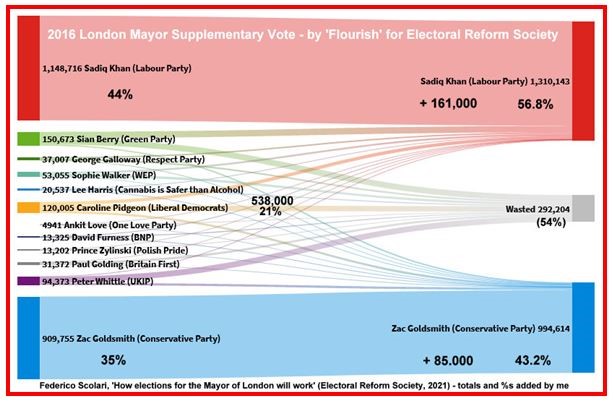
If no candidate gets over half the first-column vote – as in 36 of the 40 contests in the 2016 PCC elections, all five London and roughly two-thirds of all mayoral elections to date – just the top two candidates continue to a run-off, and will probably have campaigned with that eventuality in mind.

If either your first- or second-choice candidate gets through, they get your run-off vote. The important consequence is that the winner – here, every elected and accountable PCC – can claim the legitimacy and authority of having secured a majority electoral mandate.

Under Patel’s preferred FPTP system, 229 of our serving MPs could be accused of having slunk into office on minority vote mandates of regularly under 40%.  Personally, I’d feel slightly diffident, even as a Conservative MP, knowing both I and my party’s Government were elected on way short of majority votes. But for a PCC, daily exercising wide-ranging policing powers, it would be potentially undermining.

In our ‘local’ 2016 West Midlands election, the incumbent Labour PCC David Jamieson, seeking re-election, managed ‘only’ 49.88% of first-preference votes – fifth highest out of 40 English and Welsh contests, incidentally. But in the necessary second-round run-off against the Conservative, Les Jones, that was raised to a significantly weightier 63.4%.

The difference, and demonstrable majority electoral mandate, would be handy for an MP – but of genuine weight and almost daily importance for Police and Crime Commissioners, more than half of whom received under 40% of first-round votes.

Or, indeed, for elected mayors. I can’t but think West Midlands Conservative Mayor Andy Street feels considerably more comfortable being able to claim a 50.4% run-off victory over Labour’s Siôn Simon in 2017, as opposed to the 41.9% that would have given him a FPTP victory.

Time now, with a final paragraph already typed, for a very belated declaration of interest – personal and academic interest, that is – in an electoral system effectively invented, developed and, I’d argue, deployed effectively during my university teaching lifetime. I knew, at least distantly, both possible claimants to the SV’s invention, and, while I’m well aware of its limitations, I do believe it was and, after 20 years’ usage, is the best system realistically available for the election of mayors and PCCs.

If you’re interested in more, try the excellent evaluative paper written at about the halfway point in that history – and so before the invention of PCCs – by Colin Rallings and colleagues.  Pluses include a neat summary list of SV plus points (p.4), and some colourful and interesting bar charts.

But nothing to rival the Electoral Reform Society’s recent effort: a creation of interactive beauty (the real thing, not my reproduction, obviously!), produced especially for this year’s elections, and showing for instance, as you’d possibly hypothesise, that first-choice Britain First and One Love Party voters split their second-choice votes proportionately really rather differently.

Election of London Mayor

To conclude: my hope is that at least Patel’s intervention will prompt a few interesting campaign questions – I was going to type ‘hustings’, but I’m not sure we’re allowed those this time – for Conservative PCC and mayoral candidates. The 20 successful Conservative PCC candidates in 2016 averaged 36% of turnouts averaging under 25%, or under 10% of the registered electorates.  Do they, I wonder, think election on their minority first-round votes alone – 11% of registered electors in Andy Street’s case – would give them the “stronger and clearer local accountability” Patel suggests it would?

Photo

Chris Game is an INLOGOV Associate, and Visiting Professor at Kwansei Gakuin University, Osaka, Japan.  He is joint-author (with Professor David Wilson) of the successive editions of Local Government in the United Kingdom, and a regular columnist for The Birmingham Post.
Airedale Terrier or Lapdog?

John Cade

The recent publication of Grant Thornton’s report on “Lessons from recent Public Interest Reports” highlighting the lack of sound scrutiny in certain Councils reminded me of the question that was circulating at the time of the 2007-2008 financial crisis.

“What’s the difference between a non-executive director and a supermarket trolley?”

Answer: “It’s the supermarket trolley that has a mind of its own.”

The Grant Thornton report makes the point that arguments can be made for and against different governance models, but their effectiveness, as demonstrated by recent Public Interest Report cases, is less about the system of governance and more about how it operates, who operates it and how willing it is to accept scrutiny and challenge. 

Unfortunately, this is not a new revelation and the report does not make any specific recommendations about scrutiny.

Having worked for some of my career in Edinburgh and conscious of how the forthcoming Scottish Parliament elections might affect the UK, I have been taking an interest in the recent cross-party Scottish Parliamentary Committee investigation into the issues raised by the previous SNP Leader, Alex Salmond.  As I write, it has just been leaked that the committee has voted by 5 to 4 that Nicola Sturgeon misled the committee on one particular matter.

What struck me in looking at the Committee sessions was the contrast between the often imposing evidence given by both Alex Salmond and Nicola Sturgeon (the latter having a marathon 8-hour session) and the invariably partisan questioning by the Committee.  The SNP members frequently feeding friendly points to Nicola Sturgeon to build her response and the Opposition Members invariably revealing their own pre-conceived opinions.

“Isn’t this inevitable?”, I hear you say. 

Perhaps, but there are also many examples, cited by the Centre for Governance and Scrutiny, of where scrutiny has and does effectively challenge the Executive, but this is less newsworthy. In writing this short blog, I just hope that Council Leaders will recognise the correlation between good scrutiny and good governance and at their Annual General Meetings, following the May elections, appoint/enable not a lapdog to chair the function, but an Airedale terrier (“an alert and energetic breed, not aggressive but fearless” – according to Wikipedia)

Photo by Zuni1520 – Own work, CC BY-SA 3.0, https://commons.wikimedia.org/w/index.php?curid=16360374

John Cade is an INLOGOV associate and former senior local government officer. His interests relate to governance arrangements with a particular focus on relationships and developing trust between Executives, Chairs and Scrutiny Members.

Sunday’s Census: A billion pound historic curiosity?

Chris Game

In a recent blog entitled ‘Elections in a pandemic’ Jason Lowther concluded, along with the great bulk of surveyed council Returning Officers and Chief Executives, that ‘Super Thursday’ on May 6th may not be a great idea.  Over 5,000 representatives in 4,300-plus separate ballots, including councillors in 150 English councils and the London Assembly, 13 mayors, 40 Police and Crime Commissioners, plus the Scottish Parliament and Welsh Senedd, town and parish councils, and the odd local referendum – to complete what might well be our “most complex elections ever”.

On balance, and notwithstanding that well over 100 countries have managed to hold significant public votes over the past 13 months, Jason’s conclusion was that, while:

      “as always, local government will rise to the challenge if the decision is to go ahead in May, … the Westminster government … might be wise to start contemplating a Plan B.”

I happen to agree, although I can’t pretend to share the “incredulity” of those council chief executives Jason had consulted “that the Government seems unwilling to seriously consider delaying until October”. Indeed, it serves as the starting point for this blog.

Postponement of ‘Super Thursday’ – including now probably the Hartlepool parliamentary by-election – would still be perfectly feasible.  It would reassure at least some potential voters, and almost certainly increase turnout – as evidenced in a recent online survey by Hope Not Hate, the anti-racism charity, and the National Education Union, as part of their #MAKEVOTINGEASIER drive. Over a quarter of respondents felt the Covid-19 situation would make them less likely to go to the polling station to vote, rising to around 40% of ethnic minorities and the largely unvaccinated under-25s.

Ah, but, Government Ministers and the Electoral Commission probably responded, you didn’t describe polling stations’ additional safety measures, and how easily – if you remember and have a working printer handy – you can apply for a postal or proxy vote by April 20th or 27th respectively.

But detailed dates aren’t the real issue.  Last year’s postponement came on March 13th, this year’s current deadline is March 29th, and even could be stretched. But it won’t be, because those Ministers have nil incentive to jeopardise any political ‘vaccine bounce’, or #MAKEVOTINGEASIER for more young and ethnic minority voters to turn out and support mainly other parties.

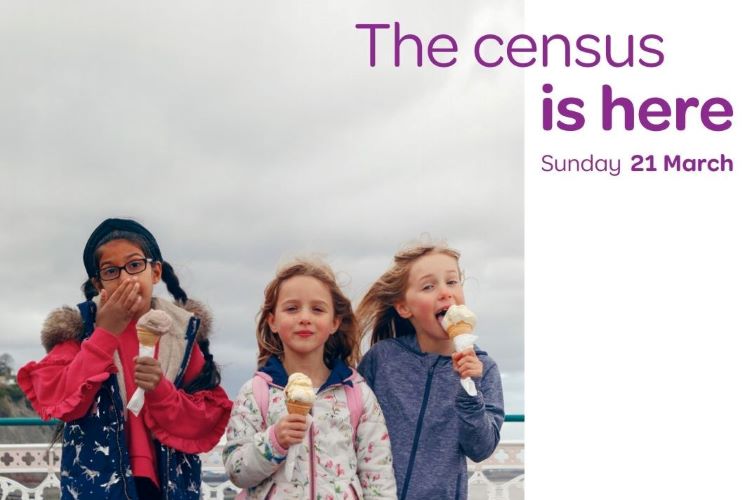
Even that vanishingly small chance, though, is a big difference from Sunday’s Census, which passed its optimal postponement date sometime last summer – when Covid’s potential impacts were already apparent, leading the canny Scots and Irish  to postpone their scheduled Censuses until March and April 2022 respectively.

The Chief Executive of the Scottish Public Record Office, National Records of Scotland, described it as “the right decision”, as it has surely proved.  Scottish academics, or at least some, disagreed – one labelling it “an act of scientific vandalism”, while “the country’s leading historian” (name in URL), almost incredibly, could “not understand how the incidence of coronavirus in a year’s time would affect the collection of census data in Scotland” – which even then made you wonder what he thought the purpose of the Census actually is.

Speaking as a definitely non-leading academic, and nowadays merely tax-paying UK citizen, I can honestly claim to have applauded the Scots’ July decision at the time, and, as circumstantial witnesses, would call on the undergrad students to whom I once taught ‘Research and Measurement in Public Policy’.  I offered to bet the class of 2000/01 that that April’s Census would be the last traditional count-everybody-on-a-random-Sunday Census of its type, and that by 2011 we would have followed the increasing number of at least European countries who even then were switching to alternative, more efficient, flexible, and significantly cheaper methodologies.

I would have lost hands-down, of course, but I’m not completely stoopid, and knew that by then they would have long left Birmingham, forgotten the bet, or both.  Rather more importantly, though, the Scots’ decision and the questionable value of significant chunks of Sunday’s data should finally end the mythology of our 200-year old decennial event being uniquely capable of providing policymakers with the comprehensive statistical data they will require over the next decade.

Yes, mythology, in several ways.  First, there is no ‘UK Census’ and never has been. Nothing to do with devolution. Right back to the first official census in 1801 – of England and Wales – it has always been censusES, with Scotland then Ireland in 1821 doing their own thing. Usually that has meant the four countries using the same arbitrary Sunday, asking similar but not identical questions, and separately processing and publishing their results.

Genuine UK-wide statistical comparability – “harmonisation of outputs” is the favoured euphemism – is a real struggle. Even the Office for National Statistics rated only half the last Census’s roughly 50 questions as ‘highly comparable’ across the whole UK. A quarter were ‘broadly comparable’, the rest ‘country specific’.

Sunday’s exercise, therefore, will be a sophisticated snapshot of Scotland-less pandemic Britain at the most exceptional, unrepresentative point in most of our lives. And costing close to £1 billion – much of it going to the Zurich-based Adecco company, for expensively recruiting and training 30,000 inexperienced ‘field staff’ for door-to-door ‘completion-checking’  – a further Covid-model scandal in itself.

The Scots’ foresightful postponement obviously scuppers any genuine UK-wide comparability. It should, however, enable them to reconsider and potentially rephrase key questions and reduce obvious pitfalls: over-counting those working from home; under-counting street homelessness, the unemployed – by excluding the ‘furloughed’ –  and the vulnerably housed; miscounting travel-to-work patterns, migrant workers, early availability for work, and our own university students.

Then there are potentially hugely important new questions – on vaccination perhaps, place of work, mode of travel-to-work, travel days per week. Plus the opportunity to get some existing ones aired and re-clarified – why Britain’s Jews and Sikhs aren’t treated as separate ethnic groups, for example, and the really rather basic difference between a person’s sex and their gender identity.

We know this Government doesn’t like gender self-identification, but that hardly justifies muddying its Census guidance. It was only finally sorted last week, thanks to the crowd-funded campaign group, Fair Play for Women, and a High Court judge – after an estimated 3 million of us had, albeit prematurely, completed our forms.

To clarify: ‘sex’ is one’s legal sex, as registered on birth or gender recognition certificate – but not necessarily one’s passport, which, like a driving licence, is alterable without a formal legal process, and so, contrary to the original Census guidance, NOT technically a legal document. Gender identity is an entirely separate, voluntary question for over-16 respondents.  You’d think someone official over the preparatory decade might have clocked that – wouldn’t you?

All of which shambles surely means we may finally join – possibly as early as 2026 with an emergency, catch-up census – at least most other European countries in using census methodologies more appropriate to the 21st Century than the early 19th – more frequent perhaps, thus more continuously reflective of change, and significantly cheaper. 

It is 50 years now since Denmark held its last ‘traditional’ census and started modelling the switch towards register-based – and in some countries five-yearly –  censuses, with information on population, households and dwellings being continuously compiled in various registers, files and databases.

The UN Economic Commission for Europe, in announcing that some 15 countries have so far postponed planned censuses to some degree – just contemplate all that “scientific vandalism”! – suggests that approaching 60% of the 2020-22 round of European censuses will be at least partly register-based, leaving the UK, Ireland and mainly small and/or Eastern European countries with their ‘traditional, direct collection’ methods – plus France, forever proud in its exceptionalism, with its ‘rolling census’.

However, some Stop Press news from the Office for National Statistics: “We are investigating the feasibility of moving to a census based on administrative data after 2021.”  Fingers crossed that they don’t rush things.


Photo

Chris Game is an INLOGOV Associate, and Visiting Professor at Kwansei Gakuin University, Osaka, Japan.  He is joint-author (with Professor David Wilson) of the successive editions of Local Government in the United Kingdom, and a regular columnist for The Birmingham Post.