Europe’s Largest Local Authority – It’s NUTS!

Chris Game

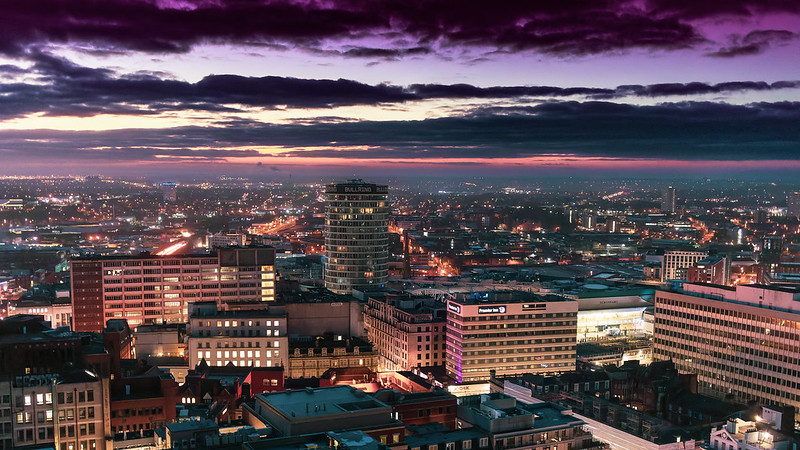
It’s little consolation to the ‘powers that were’ in Birmingham Council House, but the past several months’ headlines about “Europe’s Largest Local Authority” going bankrupt have done wonders for my personal online social networking. From the BBC and Financial Times to the World Socialist International Trotskyists, that headline has made us Brummies suddenly globally famous as citizens of ELLA.

I’ve been emailed by erstwhile colleagues and ex-students I’ve not seen or heard from for years, now back home in Australia and South Africa, Japan and Kazakhstan, wanting to know whether Birmingham really is Europe’s Largest Local Authority – like it boasts on its Website Awards page – and, if so, why didn’t I make more of it while they were students here.

Yes, they’re curious about the bankruptcy bit, which I also have to try to explain, but it’s the ELLA boast that really fascinates them – because they recall their travels around Britain and Europe, and clearly blame me for their not having been able to boast about temporarily residing in the continent’s LLA.  The clever-dick ones even add, “What about Kent?” Or “Didn’t you say it was East Lindsey in Lincolnshire?”.

And they’re not wrong, of course. Take the real ‘biggies’.  In population, Kent is nowadays just one of the ‘Big 3’ of the 36 non-metropolitan or shire counties – its 1,858,000 fractionally behind Essex and Hampshire, and all roughly half as large again as Birmingham City Council’s 1.15 million. However, those counties’ local governments are, of course, two-tiered – counties and districts, each responsible for different functions and services. And – spoiler alert – it’s single-tier or unitary authorities, responsible for providing all principal local government services in an area, that count here. 

County councils provide services covering the whole county – education, adult social care, waste disposal, etc.  More local services, like refuse collection, environmental health, and leisure facilities, are provided – as I’d certainly have pointed out – by, in Kent’s case, 12 smaller district councils.

Sounds straightforward, doesn’t it?  In fact, it’s anything but, and, if you were a class of students, I’d have had to at least mention the bizarre distinctions between ceremonial and historic counties, Lord-lieutenants (Lords-Lieutenant?) and High Sheriffs. Suffice it here to stress that it’s the two-tier structure and the ‘county’ bit that bar these bodies from challenging Birmingham’s status as ‘Largest’.

We do, of course, have a West Midlands Combined Authority, headed currently by Mayor Andy Street, but that’s entirely different and its 18 local authorities cover a far larger regional area than the old West Midlands County Council that Margaret Thatcher abolished in 1986. It’s an increasingly important, and influential, regional and national voice, but definitely not a local authority.

And East Lindsey? I honestly can’t remember ever mentioning this.  If I did, I’d guess it was to encourage some overseas students to visit Skegness, as somewhere ‘different’ but inherently English and off the proverbial tourist track. It’s a pleasant seaside resort with a rather splendid clock tower – which tells the time, unlike, for apparently a further several weeks, the UoB’s Old Joe – that probably happened then to be the largest town in England’s geographically largest local government district – East Lindsey – and five or six times the area of Birmingham.

We’ve fully established, then, that Birmingham’s ‘Europe’s Largest Local Authority’ claim has nothing to do with either population or geographical size, but everything to do with the UK’s uniquely large-scale, or ‘non-local’, local government structure and the gradual disappearance of devolution to more local units of government.

Put another way, it’s a question of NUTS. Yes, there’s plenty about our local government system that doesn’t make much sense – not least its sheer non-localness – but here we’re actually talking about the Nomenclature of Territorial Units for Statistics, which both sounds better in the original French and produces an easily memorable acronym.  

It’s statistical shorthand for the EU’s hierarchical way of standardising the different ways in which the hugely varying EU states administratively structure their sub-central governments – regardless, if necessary, of the institutional reality. A statistical harmonisation exercise, therefore, rather than an aid to serious cross-national local government comparison.

The NUTS classification subdivides every member country into three principal levels, NUTS 1 to 3, to which large countries can add further levels by subdividing NUTS 3 into LAU (Local Administrative Units). Very roughly, then, the currently 92 NUTS 1s are major socio-economic regions or groups of regions of relatively larger states – Germany’s 16 Länder, France’s 14 Régions, Poland’s 7 Makroregiony. And the UK, were we still EU members, would have 12: West Midlands and the eight other English regions, plus Scotland, Wales and Northern Ireland.

The 240 NUTS 2s are basic regions or regional groupings for the application of regional policies – Austrian Bundesländer, Belgian, Dutch and France’s former Provinces – and in the UK 40 conveniently grouped counties, London ‘districts’, and in the West Midlands its seven boroughs.

The 1,164 NUTS 3s tend to be sub-divisions of regions, provinces, counties, or groupings of municipalities for specific purposes, rather than individual local authorities. But such is the UK’s exceptional non-local scale that it takes nearly one-sixth of that total (174), with many councils qualifying for their own, including all seven West Midlands boroughs.

Even forgetting the UK’s large slice, that 1,164 doesn’t sound that many for a whole continent, does it?  Hence those Local Administrative Units – over 92,000 of them which constitute the overwhelmingly biggest columns in the main NUTS table. In our case LAU 4s would be the upper tiers of our traditionally two-tier system of county and district councils, and LAU 5s the lower tiers – or, rather, would have been, the two levels having since been merged.

I hate that LAU term. It’s misleading bureaucratese: a seriously disparaging label for what most European countries’ residents would first think of when asked to identify their elected local governments. To pick some examples: France’s LAU 4s were/are its nearly 35,000 Communes, Germany’s its 10,775 Gemeinden, Italy and Spain their 8,000 Comuni and Municipios – with, obviously, what we would consider mostly modest-sized populations to match.

At which point I admit my age and recall Mr Spock’s immortal response to Star Trek’s Captain Kirk: “It’s life, Jim, but not as we know it”. And yes, I know it was from a later song, rather than the TV series, but it fits. Because for a Brit those sizeable NUTS/LAU numbers could easily be described as representing “Real Local Government, Jim, but not as we know it.”

Chris Game is an INLOGOV Associate, and Visiting Professor at Kwansei Gakuin University, Osaka, Japan.  He is joint-author (with Professor David Wilson) of the successive editions of Local Government in the United Kingdom, and a regular columnist for The Birmingham Post.

Photo credit: Mac McCreery https://www.flickr.com/photos/simac/
Does Parliament discuss Local Government issues?

Steve Watson

So far in 2024 (as at 19th March), there have been 26 debates in Parliament to discuss Local Government issues. By way of comparison, there have been 12 debates on illegal immigration, and 16 on energy prices.

So, it seems reasonable to conclude that Parliament does discuss Local Government issues, but what issues have been discussed and who’s been doing the talking?

There are various sources of data on this topic, including Hansard and Parliament TV.  For this blog, I used the ScrutinyCounts app, which analyses MP’s contributions in Parliament (as recorded by Commons Hansard) and presents the data in an easy-to-use format on a mobile app so users can see who is saying what about which topics quickly and easily on their smartphone. 

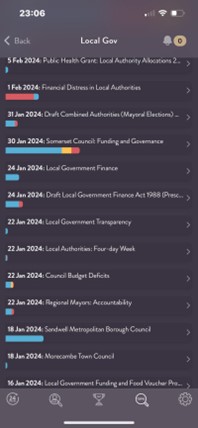
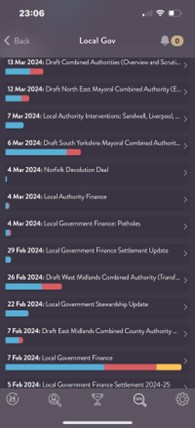
The charts below, taken from the Scrutiny Counts mobile app, show the Local Government debates that have taken place so far this year and the date they took place.

As can be seen from the screenshot charts, there’s a breadth of discussion on Local Government matters ranging from Financial Distress and Funding, Combined Authorities, Mayors, through to Four-day week working. Within the app, there is click-thru functionality which lets you see the full debate content, the MP’s who have participated, and the contributions they have made. There’s also “share” functionality to enable useful and interesting content to be quickly and easily shared with friends and colleagues.

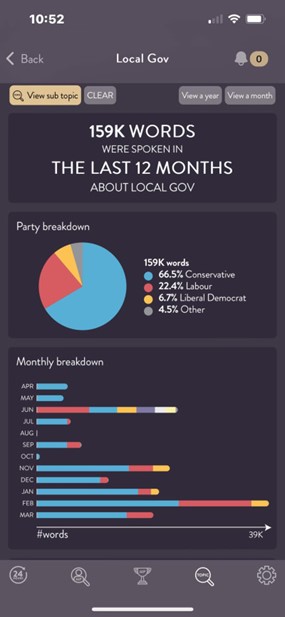
Looking across the past twelve months, there have been over 159,000 words spoken in Local Government debates (measured by words spoken as recorded in Commons Hansard).

Across the debates, Conservative MPs contributed into the debates 66.5%, Labour 22.4% and other parties 11.2% (this compares with the party split by number of sitting MPs of 53%, 30% and 17% respectively).

As can be seen in the “monthly breakdown” area of the chart below, after a relatively quiet few months over summer of 2023, the level of debate activity significantly increased during Autumn 23 and early 2024 with February 2024 being a particularly busy month.

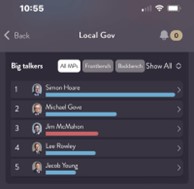
Perhaps not unsurprisingly the top contributing MPs in Local Government debates were government and shadow government ministers such as Simon Hoare (Parliamentary Under Secretary of State (Department for Levelling Up, Housing and Communities) and Jim McMahon (Shadow Minister (Levelling Up, Housing, Communities and Local Government) with contributions being made in their respective roles.

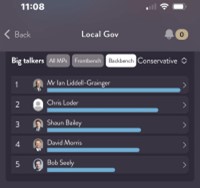
But aside from Frontbench MP’s, who have been the top contributing Backbench MPs in Local Government related debates during the last 12 months? (measured by words spoken as recorded by Commons Hansard).

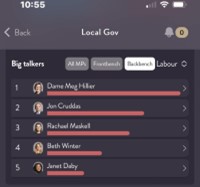
The charts below show the top contributing Frontbench MPs, and the top contributing Backbench Conservative and Labour MP’s;

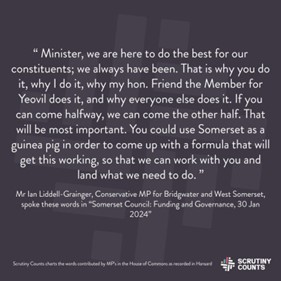
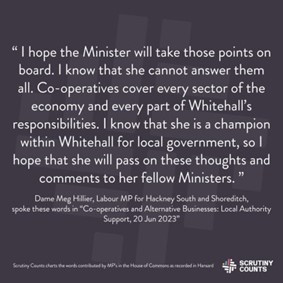
There are often detailed and constructive contributions into the debates from all the parties. The quotes shown below are taken from speeches given by the two top contributors in the above charts. They both give an insight into the work that MPs do in representing their communities and constituents in parliamentary debates.

So, in summary, yes Local Government issues are discussed in Parliament. The news in the mainstream media may focus on the weekly exchanges in PMQ’s, the political gossip of the day, or the topical late night divisions and votes, but in so doing many don’t see the work MP’s of all parties do in important debates across a range of subjects such as Local Government, Housing, Social Care, etc.

The contributions in debates are often constructive and well thought through, providing valuable insight for politicians, councillors, and council officers and all those with an interest in Local Government. The debates form an important function in bringing local issues to the national stage and play an important role in our democratic system.

The charts and images in the article are taken from the ScrutinyCounts mobile app which is available via subscription on Apple AppStore and Google Playstore. The app uses data as reported in Commons Hansard and presents it in an easy to digest format which enables users to quickly and easily read what MPs are discussing in Parliament.

Steve Watson is a Director of Hinc Ltd, the provider of the ScrutinyCounts mobile app. Steve started his career as an electronics engineer but quickly came to realise he was more suited to working with computers rather than designing them! After being a joint owner of a Local Authority data insight company which was successfully grew and subsequently sold, Steve started a new venture to develop a mobile app called ScrutinyCounts which enables users to quickly and easily see what is being said, and by who, in Parliament.   More information about ScrutinyCounts can be found here or at Twitter/X @ScrutinyCounts 

The UK’s Flipping Gender Gap

Chris Game

As I’ve aged, I’ve become ever keener to find mnemonic tricks that might help my increasingly faulty memory to recall potentially useful stuff – like, this week, key dates in the history of women’s suffrage. At some point somewhere during the extended celebrations of International Women’s Day (IWD) beyond March 8th, for example, there’s almost bound to be some reference to women gaining (or, in Afghanistan, losing/regaining?) the right to vote.

I used to lecture about this historic stuff and my women’s suffrage mnemonic was/is 1869, the year at least a few women – unmarried ratepayers in GB & Ireland – gained the right to vote in local elections.  Which, while obviously not globally record-breaking, sounds tolerably progressive – until you deploy the mnemonic, reverse the central digits, and recall that women in the Dutch province of Friesland had been at it for nearly two centuries – or since 1689, to be precise.

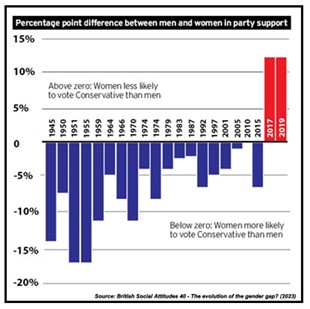
This IWD contribution, unsurprisingly, is not about women gaining the vote, but how, in post-war Britain they’ve collectively been exercising it in successive General Elections. And it’s aided by the following striking graph, whose ‘gender gap’ approach was developed by Inglehart and Norris back in 2000. They and their successors duly updated it in successive elections, drawing comparisons/contrasts with other countries, but only in the past few years has it really come into its own, and for the obvious reason: that it’s so visually, and politically, striking – as the version prepared for me by the Birmingham Posts editorial team demonstrates.

All but one of the first 19 bars/columns are blue, showing women as more likely to have voted Conservative by varying percentages up to a mighty 17% in the early 1950s. The sole exception was 2010, the first of the recent run of ‘hung Parliament’ elections, when men and women were equally likely to have voted Conservative, so no column at all.

It had become a truism: that, certainly in Britain, women were at least marginally more Conservative or right-wing than men in their voting behaviour. Until suddenly, in both the 2017 and 2019 General Elections, they weren’t – in each case being a sizeable 12% LESS likely to have voted Conservative than men.

Some unknowable proportion of what was swiftly tagged our Flipping Gender Gap was undoubtedly attributable to women’s consistently greater enthusiasm for remaining in the EU, but those striking 2019 gender gap figures are still worth detailing. Conservative: 47% of men, 42% of women; Labour: 29% of men, 37% of women – representing a massive 18% Conservative lead over Labour amongst men, and just a 5% lead amongst women.

Which begs the obvious question of whether we’ll see something comparable this time, and, if so, to what degree? Or was it, say, Brexit in those two elections that produced a kind of two-off aberration? Either way, these ‘gender gap’ statistics will be among the most anticipated and intensively studied, as commentators prepare their voting forecasts.

Indeed, they already have been, the commonest immediate reaction from those who study these things, particularly following the 2019 election, being that “at last” UK women voters were catching up.

For the stats have shown that for years now many/most other established democracies – the US outstandingly, but also the Scandinavians, Netherlands, Germany, Austria, Canada, even Italy – had seen the development of a modern-day gender gap, with women more likely to vote for left-leaning parties than men, while our gender gap showed the reverse.

No longer, then, did the UK seem to be bucking the global trend. As in these other democracies, as more women entered higher education and paid work, some at least became more socially and economically liberal and supportive of gender equality, pushing them to the left of men in their party choices.

Even just typing that ‘UK women voters’ label, though, I’m conscious of risking over-simplification. And indeed, it obscures significant and unsurprising differences across age cohorts. Younger women are considerably more likely to support Labour and less likely to support the Conservatives than younger men, but this modern gender gap lessens and eventually disappears among older voters.

So how will all this affect what happens in this year’s General Election? The estimable UK Women’s Budget Group commissioned a YouGov poll last autumn which reflected and updated some of the above findings – starting with almost a law of UK electoral politics: women take their time to decide.

Asked for their voting intentions, 18% of respondents hadn’t, with no election in the immediate offing, made up their minds: 11% of men and a full 25% of women. Those that had decided split very similarly between the major parties: Men – 20% Conservative, 31% Labour, 7% Lib Dem; Women – 17%, 31%, 8%.

The big difference came with the then Don’t Knows: just 11% of the men, but one in every four women. So, if they hadn’t then decided, perhaps they won’t vote?  By no means: 13% of males were ‘would not voters’, and just 3% of females.

Probably not surprisingly, their policy priorities differ somewhat too. NHS and healthcare is highest ranked by all, but that was 48% of men and 64% of women. The economy was “most important” for 44% of men, but only 28% of women, and the reverse was the case for ‘Environment and climate change’ and ‘Education and schools’ – the latter ranked “most important” by 18% of women but just 9% of men.

And, to quote the ever-flexible Forrest Gump: that’s all I have to say about that – for the time being.

Chris Game is an INLOGOV Associate, and Visiting Professor at Kwansei Gakuin University, Osaka, Japan.  He is joint-author (with Professor David Wilson) of the successive editions of Local Government in the United Kingdom, and a regular columnist for The Birmingham Post.